The Haunting of Drumroe

The Haunting of Drumroe
Claudette Nicolle | Fawcett Gold Medal | 141 pages | 1971

Eileen Donegan returns to Ireland and her ancestral family home after receiving a cryptic letter of help from her aunt Agnes, Lady Donegon of Drumroe. Driving to the remote estate, Eileen is nearly killed by a tree falling across the road, sending her rental car plunging into a lake. Finally arriving at the great house, she is alarmed to discover that her aunt has gone missing, and that none of the household staff can explain her absence. 

A familiar gothic thriller template is further established with the introduction of two competing love interests for Eileen, the dark-haired solicitor Rory Muldoon and the gray-eyed local historian Colin Riorden. A bit of unnecessary backstory relating to Eileen’s philandering ex-husband lays the groundwork for her shifting affections between the two men, which is expressed mostly through some feverish hand holding and a few chaste kisses.

Claudette Nicolle is a pseudonym for John Messman, who wrote a number of these genre staples, almost universally featuring covers depicting women in nightgowns running away from castles. Hints of this underlying male authorship abound by the fascination with Eileen’s sleeping in the nude, and the repeated references to her firm and ample breasts.

Although there are no actual hauntings in The Haunting of Drumroe, supernatural elements emerge through Eileen’s psychic abilities. Reportedly descended from an infamous local witch, Eileen has received psychic impressions of family tragedies at various periods throughout her life, some at great distance. Now, her psychic impressions tell her that aunt Agnes is dead, although the details are maddeningly scarce. 

Beyond simply “knowing” that her aunt is dead, Eileen’s psychic talents are mostly underutilized and not particularly relevant in solving the mystery. Eileen is even less gifted as a traditional detective, since she seems bluntly oblivious to the fairly overt clues leading to the person responsible for her aunt’s disappearance, the attempts on her own life, and a laundry list of other mysterious deaths in the family.

The Irish setting is modestly rendered, but appealing: the small villages, the rolling hills, the chilly lough, the lonely cemetery, and—of course—the weird pagan rituals in the woods at night. The political violence in Northern Ireland is introduced as a possible explanation for an attack on Eileen, but it does feel slightly out of place in an otherwise standard genre work that could have easily been set in the nineteenth century.

A perfectly serviceable, if altogether unmemorable, gothic thriller.
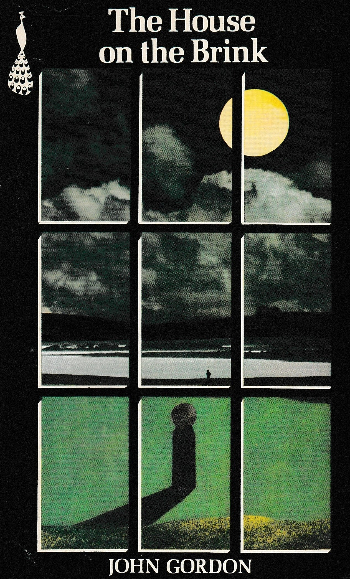
The House on the Brink

The House on the Brink
John Gordon | Puffin Books | 1972 | 192 pages

Two teenagers investigate a supernatural mystery after something malevolent seemingly pulls itself free of the mud of the marshy Fenlands in East Anglia. Written primarily for a teen audience, the book does suggest a hypothetical Hardy Boys/Nancy Drew mashup–in which Frank and Nancy also develop a budding romance–-that could easily have been titled The Case of the Evil Log.

Leaving a night class held in the isolated home of a lonely widow, Mrs. Knowles, teen Dick Dodds stumbles across a strange trail in the mud of the marsh. However, Dick discovers he is somehow able to continue following the trail over dry land. He experiences a bizarre, psychic-like sensation in the air around him, pointing him forward towards the destination of the strange entity that he assumes originated from the muck.

While searching the countryside, Dick meets Helen Johnson, a young neighbor who also is able to sense the psychic trail. Although Dick becomes fixated on a blackened stump that casts an inexplicably malevolent pall, Helen claims to have actually seen a frightening figure–without arms and legs–wriggling in the mud in the marsh beyond her house. 

An old woman who has the power of water divination informs the pair of their latent talents in a scene marginally prefiguring Dick Hallorann’s “Not things that anyone can notice, but things that only people with shine can see” speech to Danny Torrance in The Shining (only about dowsing). As the pair investigate the mysteries of the marsh, their encounters with the supernatural sometimes seem silly, but are frequently spooky and take advantage of the isolated wilderness of the surrounding landscape.

Their investigations prove as impulsive as Dick himself, bouncing around between the old water dowser, Mrs. Knowles, and her lawyer friend, Tom Miller, whose interest in the local legend of King John’s lost treasure further informs the story. Dick frequently acts like a heel, unfortunately subject to uncontrolled impulses of rash bravado, intermittently interrupted with chaste kisses with Helen. He is also annoyingly prone to blunt, rhetorical ejaculations that instill much eye-rolling; “I am the key in the lock of the world!”

Still, the appeal of a pair of teen amateur detectives cycling around the Fenlands in an adventure that involves lost treasure is undeniable, even if the Big Bad of the story initially appears to be “a black, smooth, round, bald-headed old post.

Night Has a Thousand Eyes

Night Has a Thousand Eyes
Cornell Woolrich | Ballantine | 1983 (first published 1945) | 304 pages

A dark prophecy of death sends a man and his daughter into a downward spiral of despair in this supernaturally-tinged noir from the famed author of Rear Window.

While strolling along the riverside late one night, off-duty detective Tom Shawn comes across a distraught young woman standing upon the raised embankment, seemingly in contemplation of jumping to her death. Talking her down from the ledge, Shawn escorts her to a nearby diner, where she confides her fatalistic story of a foretold death.

The book is split roughly into thematic halves, with the first recounting the series of successful prognostications leading Jean Reid and her father, Harlan, to become convinced of the veracity of a psychic’s visions of the future. The predictions culminate in a very precise foretelling of Harlan’s death three days hence at midnight.

Even the means of death, simply described by the psychic as death by lion, becomes somehow less absurd when a pair of lions escapes from a local traveling sideshow. 

The second half of the book is less satisfying, describing Shawn’s attempts at stopping the prophecy and saving Harlan’s life. Even considering that Shawn is calling in a personal favor from his superior on the police force, the sheer number of officers pulled into an extensive investigation and protection operation—based on a nominal threat described in a psychic vision—is almost as comical as the purported means of death.

Harlan’s rapid descent from self-confident businessman to sniveling coward in the light of the fatal prediction also deflates much of the interest in seeing Shawn triumph in saving his life. By the time a wasted Harlan begs not to be left alone while watching the clock tick down to midnight, many readers will probably wish that Shawn would drag the defeated wretch down to the zoo and toss him headfirst in the lion’s den himself.

The final dinner party, characterized by Shawn and Jean’s forced cheerfulness in order to distract Harlan’s broodings, goes on much too long, with several instances of conversational near-blunders referencing time or tomorrow. Even playing records isn’t safe, with unexpected lyrics mentioning destiny threatened to send Harlan deeper into a fully self-absorbed despair. Intended as a suspenseful, against-the-clock countdown, the scene just drags along, not helped by the latent romantic undercurrent of Shawn and Jean’s banter.

However, the overall mood is effectively dark, with a fatalistic, downbeat atmosphere for characters to squirm around inside while fighting against their destinies. Although the conclusion casts the nature of the predictions themselves in an ambiguous light, the inevitable outcome clearly suggests the futility of struggling against one’s own fate.

***

SPOILER ALERT: Fraud or not, the psychic was—strictly speaking—not wrong about the lion!

Voices in an Empty Room

Voices in an Empty Room
Philip Loraine | Fontana | 1975 | 192 pages

If a voice speaks in an empty room and no one is around to hear it, does it make a sound?

John Lamb’s romantic San Francisco reunion with Ellie Spenser, a young woman with whom he had a passionate affair in Paris, takes an unexpected turn after Ellie experiences a lengthy and disturbingly ecstatic, post-coital seizure. Engaging help from her brother Richie and the family doctor, John manages to pull Ellie from her trance, but soon discovers that the incident is not an isolated one. As Ellie suffers from more strange blackouts, she becomes convinced that she is doomed to inherit her family’s legacy of insanity.

The Spenser siblings are the last heirs of a venerated social lineage, having received ownership of the family mansion in Pacific Heights after the death of their uncle. While Ellie lives in the carriage house, the main estate is rented to a curious pair of women. Amelia Guardi is obsessed with the supernatural, staging nightly séances with her secretary/companion, Lulu Jenkins, a mentally challenged but exceptionally gifted psychic. The unsettled spirits that Lulu channels derive directly from a dark chapter in the house’s history, and the voices and visions that arise mirror themselves in Ellie’s strange mental episodes.

As Ellie withdraws into a vacant depression, John and Richie attempt to save her by delving into the Spenser family history. Unpacking a family feud that sent brothers moving across the country from each other, they discover a secret history of infidelity, mental illness, suicide, and even a monstrous birth. Tragic, certainly, but ultimately far from revelatory, or even very suspenseful. The doctor’s independent search for missing family case files only results in a confirmation of insanity, which is handled more like a bogeyman than a legitimate medical issue.

Even the occasional séances are more mundane than menacing, with spirit voices recorded on tape while inexplicable winds flicker out the attendant candles. The social is arguably more frightening than the supernatural, however, expressed in the dated attitudes towards Richie’s sexuality, derogatory comments surrounding Lulu’s weight and mental acuity, and John’s violent slap to return Ellie to her senses after a blackout.

Although a final twist puts a character’s motivation in a new context, not much interesting really ever happens. The secret family history purports to repeat itself in some way through Ellie and John, but the parallels never align enough to be convincing. The action-based conclusion following another attempted séance leaves a curiously confused feeling, although it’s amusing to follow John and Richie sneaking into the main house through a connecting closet similar to the secret passage between the Woodhouse and Castevet apartments in Rosemary’s Baby.

One thing we definitely learn is that a Fabergé egg makes an unlikely and unreliable object for the purposes of psychomancy.

In the closing paragraphs, the big house on Pacific Heights is briefly described as standing empty, in what could be a tenuous reference to the opening paragraph of The Haunting of Hill House. Only the Spenser mansion is no Hill House, and the “whatever” that walks there is more than welcome to walk alone.

Water Baby

Water Baby
Patricia Wallace | Zebra Books | 1987 | 301 pages

After a boating accident claims the lives of her parents and younger sister, seven-year-old Kelly Lucas goes to live under the care of her aunt Brooke. However, something in the sea lays a claim on Kelly, slowly growing in strength and reaching out to destroy the lives of those around her.

Kelly displays little fear of the water following the accident and begins to hear the call of her dead sister, but she quickly fades in importance as the story develops. Aunt Brooke, nominally the protagonist, is also reduced to a mere player in a dueling, who-will-she-choose romantic subplot between a concerned doctor and the earnest Coast Guard officer who rescued Kelly.

An expanding cast of secondary characters spiral out and around Kelly’s wealthy southern California beach community, providing a laundry list of potential victims. Between some general social critiques of the gated community’s lifestyle, many of these privileged sons or philandering fathers meet questionably waterlogged deaths. 

Probably the biggest failing in the book is the lack of a coherently developed lore surrounding the growing link between Kelly and her dead sister, and how it manifests into the supernatural happenings plaguing The Cove. Throw in a building storm that somehow increases the power of darkness at the ocean’s floor, along with the telepathic warnings received by a psychic who specializes in finding lost children, and any mythology the book attempts to build is muddied beyond understanding.

A boring medical malpractice subplot surrounding Kelly’s purported misdiagnosis plods along, resolving itself in a death with no connection at all to the Lucas family tragedy. Among the hospital characters, Dr. Decker is the most directly sympathetic, but ultimately his impact on the outcome of events is negligible beyond vague “feelings” of something not being right about the young girl’s case.

Brooke’s mother is institutionalized with melancholia, a condition that eventually leads to a mother-daughter scene that offers some half-baked ruminations on a vaguely implied hereditary issue. Within the text, “Water Baby” refers to either Brooke or her sister (Kelly’s mother) and their uncanny affinity for the water, although it also later could apply to Kelly and her sister. These generational pairings share some commonalities, but fail to tie together any relevance to the building power under the ocean that desires to pull Kelly under the churning waves.

Like so many other Zebra horror books of the 1980s, Water Baby completely fails to deliver on the promise of its cover. Disappointingly, don’t expect any skeleton mermaids nursing human infants on the bottom of the sea.

The Footprints on the Ceiling

The Footprints on the Ceiling | The Great Merlini #2
Clayton Rawson | International Polygonics | 1987 (first published 1939) | 256 pages

The Great Merlini, stage magician and amateur detective, returns to assist the New York police in the puzzling murder of an agoraphobic woman on her estate located on a private island in the East River. Sharing a few of the locked-door genre foundations of his first case, Death from a Top Hat, this second installment instead ramps up the nested mysteries enfolding its extended cast of eccentric characters, diffusing the traditional challenge to the reader to solve the crime and enhancing a breathless pursuit of a series of improbable twists and turns.

Merlini is invited to remote Skelton Island to gauge the legitimacy of a psychic medium who is staging a series of seances. Immediately upon arrival, however, he discovers the body of wealthy family matriarch, Linda Skelton, dead by apparent poisoning. The body is found sitting in a chair in an otherwise empty room of an abandoned house on the grounds of the estate. Suicide is quickly ruled out, since Linda had long suffered from agoraphobia, rarely leaving her room in the occupied main house. The murder scene is virtually devoid of any items or clues, except a perplexing sequence of footprints on the ceiling, leading out through an open window over a long drop to the river below.

In a departure from the pacing established in Death from a Top Hat, Merlini has little time to luxuriate in advancing theories or pondering the established variations of locked-room mysteries. Events soon steamroll beyond this initial crime, incorporating arson, pirates, sunken treasure, circus acrobats, a man with blue skin, Chicago gangsters, a second (and eventually third murder), all culminating in a brief gun battle characterized by pistol shots displaying impossible trajectories. The second murder serves almost as a fully nested auxiliary mystery, with its naked, unidentified victim found in a locked hotel room.

Along the way, many red herrings and smaller puzzles are rapidly thrown out for Merlini’s consideration. A suitcase is briefly switched with another full of counterfeit doubloons, only to be switched back. An alibi-providing letter is mailed from a city a suspect never visited. The means of delivery for the poison comes into question, along with the identity of the truly intended victim. The titular footprints are perhaps among the least interesting clues, and arguably least important, of the steady flow of clues in the case.

The misdirection of all these clues baffles Inspector Gavigan, returning in his role as lead homicide detective. Although exhibiting a gruff exterior and short to anger, his sparring matches with Merlini belie an underlying affection, and often feature a lighter touch than typically found in crime fiction. 

***Spoiler alert***

The multiple crimes, suspects, and motivations leads to an amusingly high number of arrests prior to the eventual denouement. So many possible murderers are led away in handcuffs in the penultimate chapter—for crimes other than murder—that only two suspects remain standing for Merlini’s traditional gathering-of-the-suspects reveal (the potential lack of available handcuffs possessed by the police is noted). Even so, he still has one final twist to offer in naming the culprit.

***End spoilers***

Although providing some light comic relief, the extended dialogue between Merlini, Gavigan, and Ross Harte (freelance writer and “Dr. Watson” to Merlini’s “Holmes”) does tend to be somewhat prosaic. Merlini himself also repeatedly withholds information, stubbornly refusing to make timely explanations. His sleight-of-hand card tricks and insistent coyness frequently risks reducing any flippant charm into exasperation and irritation.

The Footprints on the Ceiling is best enjoyed not as a Golden Age puzzle to be unpacked by the attentive reader, but as an eccentric romp with a colorful cast of characters and over-the-top plotting.

Death from a Top Hat

Death from a Top Hat
Clayton Rawson | International Polygonics | 1997 (first published 1938) | 286 pages

There is death in that room!

Stage magician, the Great Merlini, is called upon by the police to assist in solving not one, but eventually two, locked-door murders, in the first book of Clayton Rawson’s whodunnit crime series from the thirties.

Dr. Cesare Sabbatt, a dabbler in the occult and black magic, is found murdered, his body lying inside a chalked pentagram on the floor of his completely locked and bolted apartment. Complicating the police investigation is the nature of the suspects, a laundry list of members of the Society of American Magicians, each possessing special qualifications potentially enabling them to execute the seemingly impossible crime.

The group breaking down Sabatt’s door and discovering the body includes Madame Rappourt, a psychic, Eugene Tarot, a master card-trick and sleight-of-hand illusionist,  Alfred and Zelma LaClaire, a pair of mentalists, and later, David Duvallo, an escape artist. Due to the specific qualities of the crime and suspects, Inspector Gavigan employs Merlini to advise on the case. 

The story is told from the perspective of Ross Harte, ex-newspaper reporter and Sabbatt’s neighbor, who functions in the role of Dr. Watson to Merlini’s Sherlock Holmes. Rawson actually name-checks Holmes and Watson, and in so doing, almost flirts with some level of meta-fiction. The novel actually opens with a longish meditation from Ross on the nature of detective fiction itself, and various tropes of the genre are occasionally discussed. Merlini also references John Dickson Carr’s fictional detective, Dr. Gideon Fell, in an exposition on the problems and solutions of locked-door mysteries.

The proceedings are very chatty, with Merlini and others expounding on various matters while standing around the crime scene. After a second locked-door murder scene is uncovered, the process begins anew, with rumination among the investigators and suspects alike. The unique skills of the suspects again comes into focus, when it’s revealed that a witness accompanying a police officer overhearing a conversation through the locked door leading to the murder scene is a notable ventriloquist.

The banter between Merlini, Harte, and Gavigan often displays a light touch, amusement mixing with the affected gruffness of the investigator. Harte’s recount of his notes, listing various suspects and their alibis for both crimes, provides a useful summary recap for the benefit of the reader, but tends to bog down the narrative. A literal listing of all the possible resolutions of locked-door puzzles also crashes the storytelling to a grinding stop.

A few smaller puzzles are unpacked in the interim between solving the greater mysteries. A suspect slips the pursuit of his detective tail, disappearing from a moving taxi while under constant surveillance. A typewriter bangs out an enigmatic message, the keys depressed under the influence of phantom fingers. Math nerds will revel in the chance to solve a geometry puzzle.

The action reaches a climax during a stage performance, with many of the suspects performing their illusionist routines, including one magician attempting to catch a bullet between his teeth. Merlini himself only pulls a rabbit out of a hat, along with a few other magic staples. Although the culprit is apprehended after the show, Merlini, in great Golden Age fashion, gathers everyone at his magic shop to reveal the details of the crime. This epilogue, although working out the details of the crime, feels overly extended, the suspense deflated due to the reveal of the murderer’s identity in the previous chapter.

Although individual pieces of the solution are satisfying, the overall murder plot is overly complicated, and not probably something armchair detectives will be able to unknot themselves.

Eltonsbrody

Eltonsbrody
Edgar Mittelholzer | Secker & Warburg | 1960 | 191 pages

Initially establishing itself as a Caribbean-flavored variation on the “Old Dark House” mystery popularized during the twenties and thirties, Eltonsbrody upends the established genre conventions with a shocking, unexpectedly gory finale.

Or, perhaps, not so unexpectedly, as indicated by the warning in the first chapter:

It’s a shocking story—a story of real horror—and anyone that feels that he can’t stomach real horror had better go no further than here.

Mr. Woodsley, an English commercial artist on holiday in Barbados, takes up residence in Eltonsbrody, a hilltop mansion on the island’s sparsely populated, windswept Atlantic coast. Since the death of Dr. Scaife eight years previously, the estate has been run by his widow, Dahlia Scaife, a self-proclaimed eccentric who claims a form of psychic ability that allows her to see the mark of death written upon people’s faces. Eltonsbrody also serves as home to a small staff of servants, all of whom—according to Mrs. Scaife—share the same deadly, tell-tale mark upon them.

Soon after Woodsley’s arrival, Mrs. Scaife learns of the tragic death of her young nephew. Exhibiting a morbid fascination for death, Mrs. Scaife confides to Woodsley her puzzling emotional reaction—equal parts horror and inexplicable joy. While weighing the evidence of his proprietor’s sanity, Woodsley encounters a series of strange occurrences around the mansion.

For most of its page count, Eltonsbrody succeeds as an atmospherically rich, Gothic potboiler. The constant, swirling winds of the desolate landscape are almost a character themselves, sending stray leaves tapping against  windowpanes, circling drafts around Woodsley’s feet and up his trouser legs, and violently shaking the foundations of the house itself. Two locked rooms upstairs are off-limits, even to the servants, although Woodsley frequently hears the sound of a wardrobe creaking inside. The small bedroom established for Mrs. Scaife’s late nephew periodically is locked, and a rich odor of earth and–later–formaldehyde–permeates the hallways.

Although the Barbados setting, with its canefields and rugged coastline, is evocative, the West Indies vernacular dialogue of the household staff can be occasionally off-putting. “Sir, Oi ain’ loike how matters happening, sir. Oi ‘fraid. Dis house froighten me bad.” Malverne, the housemaid, also suffers from a distracting bit of exhibitionism. She repeatedly opens her bodice and reveals herself to Woodsley.

Events eventually take a deadly turn when Malverne, after claiming to witness the appearance of an evil visage peering over the landing (and after another episode of “peek-a-boo” with Woodsley), falls down the stairs and sustains a life-threatening injury. Joined by Ms. Linton, the nurse assigned to the stricken maid, Woodsley vows to determine whether Mrs. Scaife is indeed insane, or some other nebulous forces are at work in Eltonsbrody. Matters are purposely muddied by Mrs. Scaife’s insistence upon engaging in “practical jokes”, some involving coffins, finger bones, and pails of blood.

Amateur sleuthing aside, the small details are what define the mood, providing the spooky appeal of the mystery: the somehow sinister play of light over a glass centerpiece, the striped afternoon shadows falling upon the sideboard in the dining room, and the chipping sound of mortar being removed from a tomb in the graveyard. Below it all, however, stirs the restless tendrils of the wind, alternatively sneaky or blunt in its never-ending incursion into all corners of the mansion, sometimes carrying the scent of death.

A final reveal inserts a sharp sting into the proceedings, vividly etching all the previously unseen horrors into stark reality and transforming a potentially creaky haunted house tale into something entirely else, all accomplished through the simple act of opening a locked door and looking inside.

Carnacki, the Ghost-Finder

Carnacki the Ghost-Finder | William Hope Hodgson | Sphere Books | 1981 (First published 1913) | 239 pages

I am not given to either believing or disbelieving things ‘on principle,’ as I have found many idiots prone to be, and what is more, some of them not ashamed to boast of the insane fact.

The telling of the ghostly tales is always the same. Carnacki gathers his long-suffering group of companions—Dodgson, Jessop, Arkwright, and Taylor—for a dinner, revealing nothing until the time is right. After settling into a comfortable chair with an after-dinner smoke from his pipe, Carnacki finally gives his captive audience what they want: a detailed account of his latest case of occult detective work.

Carnacki seems relentlessly cheerful in his retelling, imploring his friends to keep up by frequently peppering his monologue with repetitive calls of “Do you follow?” However, his breathless delivery seems to occasionally undercut any potential horror derived from the scene.

The cases vary from instances of hauntings to strange manifestations, but are not always supernatural in origin. A good fifty years before Scooby Doo ushered in its gang of meddling kids unmasking evildoers perpetrating ghostly deeds, Carnacki uncovers (The House Among the Laurels) the hidden wire used to mysteriously slam shut a door, and the secret ceiling recess where an otherwise inexplicable rain of blood drops originates.

Although drawing on some mystical properties, such as the defensive force provided by a pentagram drawn on the floor, Carnacki also utilizes a system of scientific methods to battle the forces of the occult. In The Gateway Monster and The Hog, he implements a battery-powered series of vacuum tubes that channel electric current to boost the effectiveness of the pentacle. Carnacki also elaborates, in some detail, the inherent powers of the spectrum, with a system of colored vacuum tubes providing an additional line of psychic defense.

Although some cases are revealed as frauds, most are ultimately supernatural in their origins. Psychic forces manifest in the material world, and Carnacki references an entire arcane body of work in his methodology. Drawing material from these fantastic texts, he battles instances of “induced hauntings” (The Horse of the Invisible) and psychical imprint of past evil deeds (The Gateway of the Monster), before facing his ultimate deadly test in The Hog.

Whereas most of the earlier accounts are retold with a breezy good humor, the tale of The Hog presents an epic struggle against a malevolent intrusion from an “Outer Level” of existence. Carnaki’s success, although foregone by the structure of the telling, seems tenuous. Saddled with his stricken client—who is incapacitated, and reduced to making grunting  noises—in a fragile series of electric-powered vacuum tubes installed to defend against a powerful psychical intrustion, Carnacki nearly succumbs to the black pit of an interdimensional void, through which comes the snout of a gigantic hog.

In addition to the previously cited metaphysical text references, this tale unpacks an entire cosmology on the nature of “psychic gases” in the solar system, the creatures spawned by it, and their intrusion into our world. But following all the long-winded pontificating comes relief, as Carnacki eventually finishes his tale and (once again) curtly dismisses his audience:

‘Out you go!’ he said using the recognised formula in friendly fashion. ‘Out you go! I want a sleep.’

The Dream Detective

The Dream Detective
Sax Rohmer | Pyramid Books | 1966 (First published in 1920) | 191 pages

Adorned with his trademark brown bowler and gold-rimmed pince-nez, Moris Klaw spends his working days as proprietor of a small, out-of-the-way Wapping curio ship, offering for sale a selection of “seatless chairs, dilapidated chests, and a litter of books, stuffed birds, cameos, inkstands, swords, lamps, and other unclassifiable rubbish.” But when Inspector Grimsby of Scotland Yard encounters a case of uncanny dimensions, Klaw proffers his exceptional psychic abilities in service of its resolution.

Klaw is able to take the “odic impressions” that linger at a crime scene, producing something akin to a mental photograph of the thoughts and emotions experienced by the criminal. Assisted by his strikingly beautiful (and inexplicably French-accented) daughter, Isis, Klaw typically sleeps in the location the crime has occurred, allowing the psychic impressions to register on his hyper-sensitive brain. 

Along with Mr. Searles, who functions as a biographer of Klaw’s adventures (in the vein of Dr. Watson to Sherlock Holmes), Moris Klaw and Isis encounter a host of mysterious thefts, decapitated mummies, locked-door mysteries, country-house hauntings, and one seemingly outright case of possession over the course of this collection of ten short stories, first published as a magazine series in the 1910s. That era’s fascination with Orientalism is evident throughout, with references to the god Anubis, the cult of Isis, and many artefacts plundered from ancient Egypt.

The short nature and construction of the stories, however, preclude much interest beyond their general occult flavor. One after another, the stories follow a simple four-step beat: establish the odd details of the crime, introduce Klaw, take the equivalent of a psychic snapshot, then proceed to resolution.

A few stories amount to locked-door puzzles. A giant diamond is stolen among a group of men in a locked room in “The Blue Rajah” [no, it was not swallowed]. In “The Ivory Statue”, a life-sized statue disappears under the watch of its sculptor. Later stories take a more supernatural bent. A specter forces an heir out of his inherited estate in “The Haunting of Grange”, and nocturnal voices plague a reputedly haunted house in “The Whispering Poplars.” It seems merely window dressing, however, before the smug occult detective peels away the mystery with his “odic” powers.

Ultimately the failure of Klaw as a compelling detective is due to the nature of his psychic abilities, which essentially border on the magical. The lack of real process prevents any opportunity at play-along detective work on the part of the reader. No mechanics exist in Rohmer’s occult detective akin to the working of Poirot’s “little gray cells”, or even the singular focus of Holmes when “the game is afoot,” and the stories suffer for that lack.

What’s left beyond the superficial interest provided by the vaguely supernatural trappings of the individual cases? A recumbent detective with a silk pillow.