Design Patterns, the Ruby Way (Part 2): Modern Creational and Structural Patterns June 28, 2026 In the first article of this series, we explored why Ruby changes the way developers think about design patterns. Features like duck typing, modules, blocks, and delegation often replace the ceremony required in more rigid object-oriented languages. Now it's time … Continue reading Design Patterns, the Ruby Way (Part 2): Modern Creational and Structural Patterns
Category: Software Development
Design Patterns, the Ruby Way (Part 1): Why Ruby Changes the Conversation
Design Patterns, the Ruby Way (Part 1): Why Ruby Changes the Conversation June 25, 2026 Software developers have been talking about design patterns for more than thirty years. Since the publication of Design Patterns: Elements of Reusable Object-Oriented Software in 1994, the Gang of Four (GoF) patterns have become a shared vocabulary for solving recurring … Continue reading Design Patterns, the Ruby Way (Part 1): Why Ruby Changes the Conversation
How Ruby Implements Closures: What Really Happens When You Call lambda
How Ruby Implements Closures: What Really Happens When You Call lambda June 24, 2026 Why does a local variable survive after a method returns? Built for Ruby on Rails Build Maps WithoutGoogle APIs Generate beautiful production-ready maps directly from your Rails backend. Fast rendering, zero external dependencies, full control. View Live Demo → Read Docs … Continue reading How Ruby Implements Closures: What Really Happens When You Call lambda
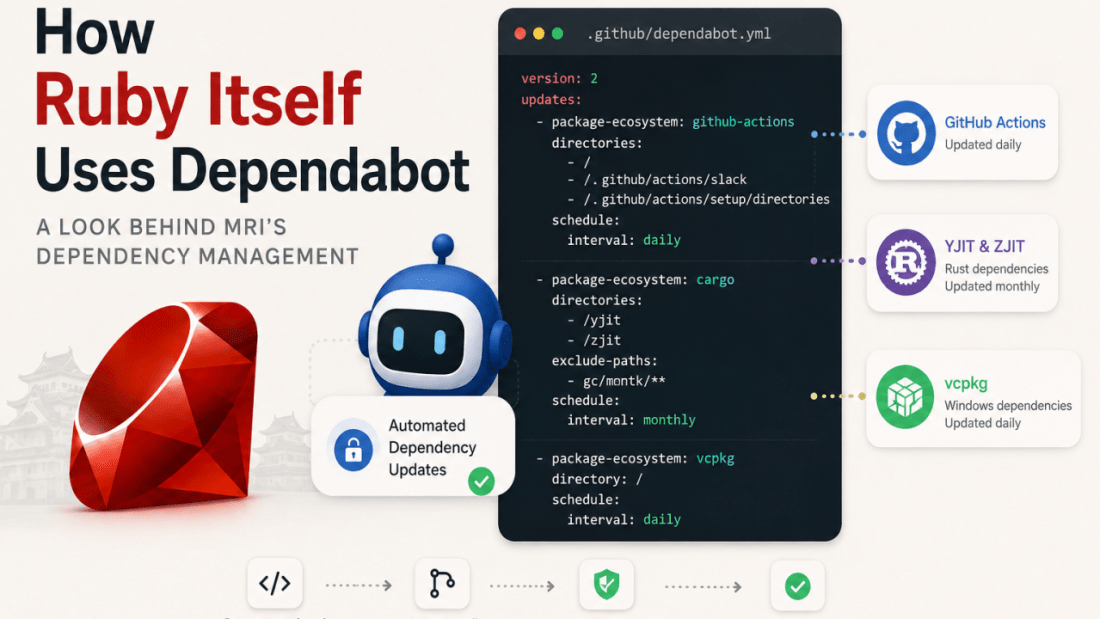
How Ruby Itself Uses Dependabot: A Look Behind MRI’s Dependency Management
How Ruby Itself Uses Dependabot: A Look Behind MRI's Dependency Management June 23, 2026 When people think about Dependabot, they usually picture a Rails application keeping its gems up to date. But Ruby itself—the MRI interpreter—also relies on Dependabot to automate dependency updates. Its configuration offers an interesting glimpse into how the Ruby core team … Continue reading How Ruby Itself Uses Dependabot: A Look Behind MRI’s Dependency Management
Can Ruby Next Help You Upgrade an Application Gradually?
Can Ruby Next Help You Upgrade an Application Gradually? June 21, 2026 Upgrading a Ruby application is rarely as simple as changing the version number. Dependencies, deployment pipelines, CI environments, and legacy code often mean that a runtime upgrade becomes a project of its own. As a result, many teams postpone adopting newer Ruby language … Continue reading Can Ruby Next Help You Upgrade an Application Gradually?
Herb and ReActionView: A Glimpse Into the Future of Rails Views
Herb and ReActionView: A Glimpse Into the Future of Rails Views June 18, 2026 For years, Rails developers have enjoyed one of the simplest and most productive ways to build web applications: write HTML with ERB, let Action View render the templates, and move on. While the Ruby language, the parser, and the tooling ecosystem … Continue reading Herb and ReActionView: A Glimpse Into the Future of Rails Views
Ruby 4.0 Is Here. Why Is AI Still Writing Ruby 3.0?
Ruby 4.0 Is Here. Why Is AI Still Writing Ruby 3.0? June 17, 2026 Artificial intelligence has become an indispensable tool for Ruby developers. We ask AI assistants to write methods, refactor services, generate RSpec tests, explain stack traces, and even architect new features. For many developers, AI is no longer an experiment—it's part of … Continue reading Ruby 4.0 Is Here. Why Is AI Still Writing Ruby 3.0?
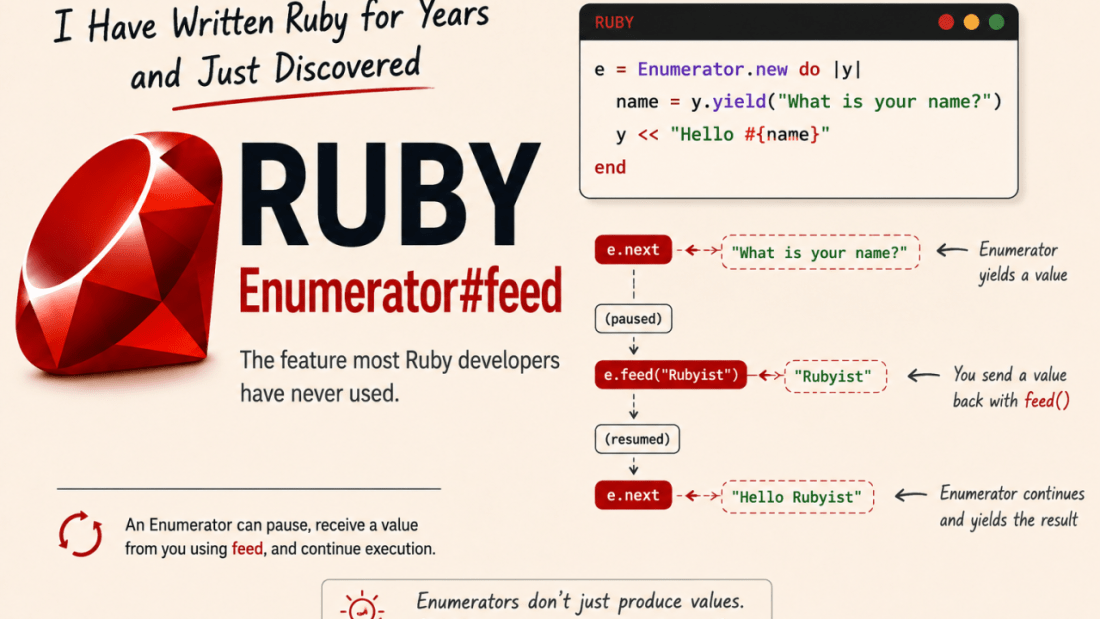
I Have Written Ruby for Years and Just Discovered Enumerator#feed
I Have Written Ruby for Years and Just Discovered Enumerator#feed June 15, 2026 Ruby is full of delightful surprises. Even after years of writing Ruby professionally, I still occasionally stumble upon a feature that makes me stop and think: "Wait... Ruby can do that?" Recently, that feature was Enumerator#feed. Most Ruby developers are familiar with … Continue reading I Have Written Ruby for Years and Just Discovered Enumerator#feed
This Week in Rails: Better Guides, Better Framework
This Week in Rails: Better Guides, Better Framework June 10, 2026 The Rails team had another busy week, shipping documentation improvements, infrastructure updates, and a collection of bug fixes across the framework. Here are some of the highlights. 📚 The Active Job Guide Gets a Major Refresh The revamped Active Job Basics guide is now … Continue reading This Week in Rails: Better Guides, Better Framework
The Shared Echo: Understanding Ruby on Rails’ Request–Response Cycle
The Shared Echo: Understanding Ruby on Rails' Request–Response Cycle June 8, 2026 As developers, we often chase the big topics. Distributed systems. Microservices. Event-driven architectures. AI. Scalability. Performance. The industry constantly presents us with bigger mountains to climb. In that pursuit, we sometimes walk past the things we use every single day. The familiar. The … Continue reading The Shared Echo: Understanding Ruby on Rails’ Request–Response Cycle