Posts Tagged ‘map making’

Ordurak and Switzerland

December 26, 2023

When the Wilderness of Ordurak adventure and gazetteer were in development, I was looking for a real world cognate that would be a comparison that would help with understanding the size and scale of the area. Today, somewhat randomly, I took a map of Switzerland and dropped it under a 5-mile hex grid, and it fits pretty well into the 12×18 size map (one-quarter Alusia, if you will).

Wilderness of Ordurak and Switzerland at the same scale in the image below. The hex mapped area is about 190 miles by 125 miles in each.

This is, I suppose, all in conjunction with thinking about new DragonQuest adventures and material. I’m using the break over the next few days to work on some ideas for the Water Works sequel adventure I’ve been calling GasWorks (but that won’t be the final title for it, I promise). And some things are starting to come together with that. So stay tuned for more about that in 2024.

Wrapup for #dungeon23 Pamphlet Zines

December 17, 2023

Things got bogged down over the last couple months. Real Life intrudes in many ways. But, this past week, I finished out the series of all 12 zines for the #dungeon23 pamphlet series.

These are available from DriveThru and on itch.io. And, for a limited time, the complete set of all 12 zines is available in a discounted bundle from DriveThru:

https://www.drivethrurpg.com/product/464125/dungeon23-Pamphlet-Zines-BUNDLE

https://rthorm.itch.io/dungeon23-pamphlet-zines-q4

If you want hardcopies, these are available from Exalted Funeral (for zines #1 through #5, for now; their site looks like #6 is sold out, and they don’t yet have the second half of the series).

Hardcopies of all 12 are also available directly from us, in bundles of three (for each quarter of the year) via the itch links.

The twelve issues are:
#1 Intersections
#2 Halls & tunnels
#3 Stone masonry
#4 Doors
#5 Water
#6 Stairs & shafts
#7 Air & gasses
#8 Network
#9 Mechanisms
#10 Geology
#11 Secrets
#12 Plants & vegetation

In addition to the maps, there are some further dungeon-inspired illustrations from artists including Jake Mix, Jan Krycinski, and HodagRPG

DragonQuest Adventure and other updates

October 15, 2023

Expanding from my dice.camp post :

I’ve been trying to pull together the pieces of a DragonQuest adventure idea for a while. I’ve had ideas for a couple interesting things earlier this spring – and in particular, a sequel to my first published DQadventure, The Water Works – but it wasn’t coming together completely. This weekend’s breakthrough was coming up with a framework for what is going on. I’m not sure if it’s going to work out yet, but I have something that I can start to work around. As a seasonal metaphor, I have a skeleton, and now I can see if I can put flesh onto those bones.

I often start with the architecture, and build up the narrative to inhabit that place. I have a couple locations I wanted to use, but had to figure out who was in them and why they were there. Now that I have some of the why, the next pieces will start to come together, hopefully.

I’m always leery of predicting that the path forward is now clear, because prior experience has taught that that is never the case. But, if you are a DQ GM who might be interested in this, I’d like to line up a couple of alpha reviewers for feedback about parts of this once it starts getting to that point.

The premise for this, in the broadest terms, is going to be another elemental magics laboratory to be explored; this time it’s a facility for the College of Air Magics. The final title will be something different, but for now, I’m referring to this as the Gasworks.

Other updates

There are now three sets of #dungeon23 Pamphlet Zines available. I’m still looking for one last piece of art for the last three issues; if you have a lead on someone who has a small piece of dungeon-related art that they would be interested in licensing for use in a small zine project.

If you want to pick up a copy of one or several of the PDFs for these, they are available at both DriveThruRPG and rthorm.itch.io. Each zine is a single-sheet, legal-size, double-sided, black-and-white zine with random tables, map fragments, and a thematic article. Hardcopies are available from Exalted Funeral or directly from us through the itch.io site. You can pick up single issues from Exalted Funeral; if you purchase through itch.io, they are available only as a set of 3 zines (sets divided in each quarter of the year).

On a more personal note, things have been a little more sparse around here the past few weeks because we had a house fire earlier this year, and all the complications from that are taking a lot of attention. But hopefully we can start to do a bit more on some other RPG things.

Tables for #dungeon23

January 18, 2023

This is a compilation of the random tables I’ve posted to my Mastodon account for prompts or elements to use for rooms for Dungeon23. These are meant as individual tables, not a sequential set. Some are d10, others are different.

Water

1 Dripping somewhere, coming from above
2 A small flow in a channel, crossing the floor
3 Puddle, or a deeper bowl, an armspan wide
4 Fast moving stream, more than a stride in width, dividing the room in two
5 Shower/waterfall from ceiling
6 Floor and walls are slick with water
7 Stack of water barrels in the corner
8 Umm.. that’s not actually /water/
9 Fountain spraying in the middle
0 There is no floor; this room is a pool

Ceiling:

1 Several heavy iron chains
2 A small flue or chimney
3 Crystalline minerals all over the surface
4 A glowing orb casting dull orange light throughout the room
5 Most of an old, but still legible fresco mural
6 Heavy timbers and broken rock
7 Narrow crevasse extending upwards
8 Something that looks like scales

One wall is:

1 fissured, with several cracks large & deep enough to reach into
2 stacked, rough-sawed logs with rope caulk and tar in the joints
3 actually a pair of large wooden doors
4 a very, very smooth, white stone
5 carved with a set of relief portraits
6 glassy and translucent, like amber
7 bricked up with properly finished masonry
8 a coarsely hewn rock surface with rubble at the foot
9 shot through with veins of gold
0 hidden behind curtains of stitched animal hides

Room is filled with:

1 Brilliant green leaves and vines
2 Decades’ worth of accumulated cobwebs
3 Swirling snow and ice covered surfaces
4 Some form of mist or fog
5 Incredibly foul odors
6 A glow, evenly illuminating everything, coming from an unknown source
7 Swarms of small flying insects
8 Stacks and stacks of bones

Details:

1 Wall covered with strips of old copper
2 Decorative gold inlay on wall near floor
3 Each corner of room is actually a full-height hinge
4 Floor is a bed of smooth, loose, fist-size stones
5 Crystalline projection about the size of a head
6 Floor to ceiling clear glass pipes in one corner
7 Perforated metal plate on wall away from the door
8 Hole shooting hot, moist air into room
9 Stalactites, but projecting from wall
0 Embedded, polished silver plates

This was originally inspired by insipidutopian on Mastodon, and they are compiling these from a number of contributors.

Planetary Display for #Dungeon23 and #space23

December 10, 2022

There is a dungeon-drawing project currently taking off on Twitter and on Mastodon. The original suggestion was made by Sean McCoy, and is spreading with the hashtag #dungeon23 (or, for space-themed variants, with hashtag #space23). The idea here in the dungeon iteration is to create a megadungeon. Beginning on January 1, participants will create one room each day, and move to the next level each new month, using a journal or daily planner for this to collect the notes for this. At this rate, by the end of the year, you will have accumulated 365 rooms and descriptions over 12 levels – a megadungeon!

There are different approaches one could take for extending this idea from a classic megadungeon and doing something more science fiction. A tower complex or a space station are ready options I’ve seen some people discussing. I’ve also seen suggestions of doing a Traveller sub-sector. And, if you want to do a dozen planets for this, I have some resources for you.

A few years ago, I made some resources for planet mapping that are based on a truncated icosahedron (which you may also know as a buckyball or a soccer ball). Since it has 32 faces, this makes it nearly ideal if you are doing one section a day. (And since there are north- and south-poles, if you let those go, then the remaining 30 sections are even easier to fit into monthly formatting.

Assuming that a few people might be interested in working with this, I’ve made discounts for these from DriveThru RPG:

https://www.drivethrurpg.com/browse.php?discount=95b542e778 (PDF)

A set of Planetary Display Log Book pages, with one section per page designed for printing an 8-1/2″ x 11″ notebook for mapping a planet.

This Logbook is designed for mapping the surface of a single planet (or other spherical body). The surface is divided into 32 faces; 20 hexagons and 12 pentagons, all with equal edge length.

https://www.drivethrurpg.com/browse.php?discount=95bf35c96c (softcover print)

A POD print version of the Planetary Display Log Book The print version has a blank globe on the cover (image right), but unfortunately, the glossy cover isn’t very easy to draw on.

https://www.drivethrurpg.com/browse.php?discount=95cf9d2af3 (PDF)

Single page PDF poster with the latitude and longitude lines and the 32 sections.

I hadn’t done anything with the Planetary Display logbook for a few years. But I just re-opened it to check it out again. I found it works very well as a digest (zine) size 5-1/2″ x 8-1/2″ booklet. I also did a re-ordering of pages and printed it in the order “1, 3-40, 2” which might also appeal to you as a better layout.

The discounts on these at DriveThru is good through the end of January.

Updated Portfolio

July 9, 2017

In response to a recent request for my portfolio, I realized that what I currently had available was not very up-to-date.  In a way, the whole Antherwyck House blog is a portfolio.  But for a more curated and limited presentation, my new portfolio page is here:

Rodger Thorm Portfolio

The kinds of things I’m most interested in are the kinds of things that you’ve seen me posting already – odd geometries, section dungeons, isometrics, and other things dealing with somewhat unusual display of information.

As I say on the page, “I am aware of small budgets and I’m willing to work with you to try to make things work out.  I’m not going to give it away (and “for the exposure” doesn’t fly), but we can see if there’s a way to work with you, even if it’s a modest budget for a small project.  I’m a gamer, too, so don’t be afraid to reach out to discuss a project or an idea.”

Map with two backgrounds

May 21, 2017

This is another map with one of the two new fountain pens I recently added.  This is still something of a pen test, but a larger area, and enough to be considered as a small dungeon map in its own right.

It’s the first fountain pen I’ve had that has a bladder converter, rather than a piston.  Maybe I’ll change my mind over time (and there is something to be said for the quickness of the bladder over the piston), but I overall, I like the piston style better.  I also have some blue cartridges I’m trying out in another fountain pen.  They are certainly convenient, but I also like to use some bottle ink colors, and those tend to be nicer than the basic colors in cartridges.

In retrospect, for this map, it might’ve been better to have the steps continuing downward in the darker background hatching, and kept the lighter fill pattern for the higher parts.  Sometimes I include the doors and sometimes I don’t indicate anything; this map is one of the latter.

I assume someone who wants to use one of these will add in doors where they think they are needed.  There hasn’t been any strong feedback about it one way of the other, so I’ll continue with the mix.


Call for Participants: Exquisite Corpse Dungeon 4

August 19, 2016

[Edit: added link to signup list on G+  https://plus.google.com/u/0/112759340492106094051/posts/3yRPXPZXXox ]

I haven’t been disabused of the idea yet, so let’s do another dungeon!

If you’re unfamiliar with the previous Exquisite Corpses, I suggest looking at the previous projects for an idea of what this involves; I’m not going to explain the whole thing in detail.

Some things are going to be different this time.  The map is going to be a single column this time (rather than the double-wide version in ECD2). The starting section will be in the middle, and then it will extend both up and down from that, so there will be two chains going at the same time.

The spaces will be larger than in the past.  Each contributor’s field will be 40 x 16 squares (10 x 4 inches). That should allow for print maps that are 12″ wide, with margins.  Finished pieces should be 300 dpi (3000 x 1200 px). If grid is not included in the final art, clearly identify where openings are so next person can make reasonable connections. If the final scan is oversized, provide clear crop marks.

There are going to be a maximum of 20 slots (which would make the map about 80 inches/2 meters/6′-8″ tall, if we get that many entries).  Each participant will sign up for a particular slot in the field in advance, so you’ll have some sense of where and when you fit in to the sequence.  We’re going to have 3 day turnaround (and a day for me to get things received and handed off to the next person), so hopefully 2 sections a week in each chain.  If you can’t meet that schedule, please sit this one out.

If a schedule conflict arises, you can swap spots with another person. There will also be an ‘on-deck’ line for late arrivals and those willing to step in whenever.

Signups for spaces will be on a priority basis.  Participants in previous ECD projects have first choice in choosing spaces.

Along the left edge of the map, another 1/2″ space will be allowed for artist signature/identification/website link.

It is the intent that print copies of the final version of this will be produced and sold.  The map and each of its sections will also be released under a Creative Commons license to allow others to expand further on this megadungeon.  Given logistics and technical limitations, the distributed version may not be the full 300 dpi version.

Participants from previous Exquisite Corpse Dungeon projects can now choose their sections. Others interested in taking part in this can begin choosing from the remaining open spots beginning Monday (8/22).  Once we have at least the first 10 slots set, we’ll get the mapping underway.

Questions and discussion will largely take place on the G+ community for Exquisite Corpse Dungeon Project, but important additions will be cross posted back to the original item on the RThorm blog.


Spherical Grid – Experiment #1

June 21, 2016

After a wonderful partial map posted by Kevin Campbell a couple weeks ago [here on Google+], I did some looking and found a couple blank map forms*.  They aren’t wonderful quality (too dark and heavy), but they’ll still do for doodling.

Spheric-X1

So this is a quick and dirty try at using the spherical box blank.  It’s little more than a five-minute map, but it’s one experiment at finding an interesting way to use the form.  It’s enough to justify messing around some more later on. (more…)

Planetary Display

April 26, 2016

Here is a planetary display form I’ve made for mapping worlds in science fiction games.

PD Capture

This map uses a “buckyball” geometry, a truncated icosahedron with hexagonal and pentagonal sections, but instead of filling it with hexes, it has been laid out with lines of latitude and longitude. The major latitude lines are in 10 degree steps, with further subdivision into 2.5 degree sub-steps, and the major longitude lines are in 18 degree steps (which neatly works with the pentagonal division of the ball). Longitude lines are shown at 4.5 degrees at the equator, extending to 50 degrees latitude, and then 9 degrees between 50 and 70 degrees latitude.

PD1

These quadrants created with this mapping are not all equal, but it does provide a ready way to identify a location anywhere on the surface, and they provide a sufficiently fine-grained division of the planet to allow for distinctions of the different areas.

Part of the inspiration for this was another wonderful “buckyball” planetary display done by Ronald Stepp which he posted on G+ recently. But in his map, each face is covered with a hex grid (which he warps to fit the pentagonal sections in a most interesting way). One of the comments asked about a way to identify the small hexes for mapping and note making purposes, and that got me thinking about latitude and longitude.

This is being made available as a pay what you want PDF through RPG Now and DriveThru RPG.  Once it’s approved, this should be [Update: it’s available now!] the link to get the Planetary Display PDF.

It’s pretty apparent to me that this could be cut out and turned into a 3D object quite easily.  But what seems easy to me isn’t necessarily easy for everyone, so if I need to put together a tutorial for that, that’s something else that could be done.

There will be revisions to this, and if you have suggestions, we’ll be glad to look at them and see about incorporating them into an update.  There could also be a spin off variant that is more oriented for fantasy rather than SF games.

We’re also probably going to have a very large version (maybe 24″ x 36″ or so) that we’ll have to sell direct, rather than being able to distribute through DriveThru.  There will be an announcement about that when that is further underway.

Grids & Guides Notebook Review

February 26, 2016

Grids&GuidesA few weeks ago, I got the new Princeton Press Grids & Guides notebook (the red cover was being promoted for Valentine’s Day).  And, though I didn’t initially get it with map-making specifically in mind, I think this might be of interest among my friends and fellow gaming map makers.  We probably are not the target market for this notebook, but it’s well suited for all kinds of creative inspiration.

The Grids & Guides notebook is a nicely made clothbound notebook with an assortment of different grid styles, as well as a few pages of information on various topics (the ‘Guides’ portion).  The notebook has 144 pages of nice quality off-white stock, and the size is 5-1/2″ x 8-1/2″.

For those interested in alternative map styles, the Grids & Guides notebook offers a number of different grids, to add some variety and interest to your map making.  It’s not a stock notebook with all the pages gridded the same way. There are 8 patterns that are repeated throughout the notebook.  The Guides portion is several pages which serve as section breaks, each printed with information on topics such as knot-tying, musical scales, logic expressions, and geometry.

There are two versions of the Grids & Guides notebook.  The original one was the black cover, and the red cover is the new one.  There are differences in the guide topics and in the grids contained in each, although some are repeated in both versions.

grids

The red notebook’s 8 different grids include regular squares in 3 different sizes.  Of these, the finest size has 1/16″ squares (and slightly darker 1/4″ and a heavier 1/2″ lines), the medium size is simple 1/8″ grid with a centered X/Y axis, and the largest uses 1/2″ squares which are keyed A-O across the top (long edge, at the gutter) and 1-10 down the side.  Other pages have a dot grid (with dots at 1/4″ spacing), as well as log-log, diamond (with 1/4″ squares as well as diagonals), an isometric grid with 4 lines per inch at 120 degree rotations, and a circle pattern grid made with overlapping 1″ circles at 1/2″ spacing plus 1″ grid lines.

The black notebook (which I’ve only seen online) has Cartesian grid, isometric grid, log-log plot, same as the red notebook.  The others found only in the black notebook are a ledger table, reticle grid (little crosses, rather than the dot grid), architectural plan grid (with double lines to alow for wall thicknesses), storyboard grid, and polar graph & unit circle.

616xOlqUhDL

Overall, the red notebook has a better set of grid choices, though the architectural grid would be nice, perhaps in place of the smallest of the three regular grids.  Maybe there will be other, future notebooks with other colors of covers and an even better mix of grids.  The only one I found to be really useless for my purposes is the log-log (though I decided it would be suitable for a pen test to see how drawing and writing are on the paper.

test

The paper is nice quality, with only a slight indication of show-through from the heavier pens.  It’s not really bleeding through, but it can be seen from the other size if you have a dark area filled in, or if you have heavier lines it may be noticable, but probably only if you look for it.  The printed grid lines are fairly fine in this notebook, and they should not be too much of a distraction.

I’m not sure if this will become a maps-only notebook for me, or if I will end up using it as an anything and everything kind of notebook.  I tend to be more of a single-page map maker, rather than using bound notebooks (though I do love bound notebooks for other things).  It’s generally easier to scan things from a single page.  But with the fun and creativity this notebook, don’t be surprised to see some maps from me in the future that are drawn from this notebook.


If you’re an Amazon customer and you’d like to support me by buying it from them, you can use these links for:
Grids & Guides (Red): A Notebook for Visual Thinkers (Grids and Guides)

or the black cover version, which is a couple bucks cheaper (at least at the time of posting):
Grids & Guides: A Notebook for Visual Thinkers

Table of Patterns for Rock

December 15, 2015

Here’s one of the kinds of things I loved coming across in books when I was a kid.  This is probably a part of why I love drawing dungeons like I do, and that’s why I’m sharing it here.

plate_iii_lrg

I think this is a great resource.  The full size plate is a thing of beauty.  This came from the Gutenberg project, so it is a work in the public domain, and I’m happy to see it shared widely.

Already, this has figured into a couple of the maps I’ve posted (whether to good effect or not is a separate question), and I hope to do more from this chart (maybe eventually at least one of each, but there are no promises about that).

For reference, the kind of hatch that I do most often (and that Dyson Logos popularized) is #58, “Massive igneous rock,” but there are clearly other choices available, if you’re open to mixing it up a bit.

Exquisite Corpse 3 – CITY

November 13, 2015

Here are the directions for Exquisite Corpse 3 – CITY  SIgn up to participate, and follow the progress as it evolves in the Exquisite Corpse 3 CITY Community on Google+

PROCESS


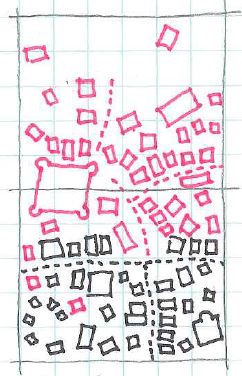
CapturecityYou will only fill about 3/4ths of the section you draw. The person who draws the next section further out will fill in the rest as part of completing their section. If you are the first to claim a spot adjacent to an unfinished section, you will get that section (not just a strip) that is mostly completed, and will fill that in, along with drawing the section you’ve selected, but leaving about the outermost 1/4 which the next person will fill in, if the city expands that far, or which will be the outskirts if it doesn’t go any farther.  [See diagram for how this might work. In the example, black was the first section drawn (note how it does not extend to the top edge of the section), and then red was drawn afterwards (again, leaving space at the outer edge for the next participant).]

Leaving roads and other connecting elements for other players to build off of is an essential part of the Exquisite Corpse process, but all buildings and other singular features should be complete.  Please don’t draw a building that goes off the edge of a section for the next person to finish.  However, the second participant in any pair of sections may certainly draw a large structure over the dividing line between two sections (again, see example at right).  There is nothing magical about the section lines that means they can’t be crossed; this is only to keep from making things unnecessarily difficult for the follow-up artists.

MAP REQUIREMENTS


Map scale is roughly 10 yards/10 meters/30 feet/5 fathoms/2 rods/one-half chain per square.

All maps to be *exactly* 1500 x 1500 px (20 x 20 squares) Getting everyone to provide properly and equally sized sections will make management of this project a lot easier.  Any graphics format (JPG, PNG, TIFF) is acceptable.  Hand-drawn, computer-drawn, and hybrid styles are all allowed.  Because of the way this is structured, you will actually be returning 2 drawings when you return your finished works.  Please send those as two separate image files.

When you turn in your section, you must also provide a name for it.  Keys and legends may be included.  Brief narratives and descriptions are also permissible.  These will be incorporated as an appendix in the final piece.

Unlike the previous Exquisite Corpse projects, this one is open to color as well as black and white imagery.  It will be a more varied and patchwork project than the earlier Dungeons.

SCHEDULE


The Exquisiste Corpse 3 – CITY project runs from today, 13 November 2015 through the end of the year.

Once a spot is claimed, you have 1 week to complete your section and turn it in, or the spot is forfeit.

Participants can claim multiple spaces, but only 1 at a time, and only 1 per quadrant of the map. (Turn in your first piece before you claim another spot.)  A section is open for claim once all the lower numbered adjacent spaces are completed.  You can either put your name in for a random selection (you’ll get assigned a section when your turn comes up), or you can request a particular section.  I may go random for order of the first ones, but I’ll have a list so you’ll know when it’s getting close to your turn. If you’re going to be unavailable for a while, you can go on hold.

Unlike the Exquisite Corpse Dungeons, there will probably be some midway reveals, so you’ll get to see the center of the City before the whole thing is completed.

OVERVIEW


This will start from the center, then there will be 4 extensions from the 4 sides of that, and then extend on and out.  The starting diagram map shows the sections, and updated versions of this diagram will be used to identify which section is assigned to each participant.  If this project grows beyond the identified sections, we’ll add more spaces.

The river must be continued through any spaces it connects to. If there’s a river coming into your space, you have to extend it to another adjacent space. Small ponds are okay, but this won’t be a coastal city, so no ocean/seaside/waterfront.

PARTICIPATION


By participating in this project, you agree that your contribution is Creative Commons licensed CC-BY-NC 4.0.  Additionally, you agree to allow Antherwyck House Games permission to include your map in commercially distributed print versions.  (In short, I’d like to make this map available in print through OBS (DriveThruRPG and RPGNow) to further spread these works.  They are going to be priced close to cost, but print products have to be sold, so specific permission for this needs to be provided.)  This is meant to be an opportunity to promote your work, so be sure to include contact info and a blurb for the final version.

To participate, you have to have a G+ account and check it regularly; all the communication during the map-building will be through there (and afterwards, an email address for contact and followup).  This will be cross-posted to the G+ Exquisite Corpse 3 CITY Community, and turn assignments will be posted there.

Some Notes on Medieval Cities

November 11, 2015

If the grid for the Exquisite Corpse City is going to be 30 foot/10 meter squares, I wanted to see if that really made sense.

So (perhaps prompted by Stephan Beal’s suggestion in a geomorph discussion), I got a Google map of Carcassonne and did a quick and dirty grid overlay with roughly 30’/10m squares.  It looks pretty good to me.

CarcassonneGrid

This isn’t the full 20 x 20 section, but it is 20 squares wide (counting just the full squares), so it’s a reasonable guideline for medieval building density and what an Exquisite Corpse City section might look like.  It’s tight enough in that it’s worth drawing from an artistic perspective, but, at the same time, it’s far enough out that lets each section be a substantial enough size to become a city map.  People are pretty small at this scale, but are still individually distinguishable; it seems like a really good scale for something like this.

There are only a few roads in this at this scale, but roads, lanes and alleys can be distinguished.  A one-square building is reasonably good sized, but there will be many features that are smaller, so drawing at a larger scale and then downsizing for the final drawing may be called for.

For a more visual reference, here’s what that same area looks like as an aerial view:

CaptureCarcassonneAerial

For another reference point, here’s a bit of Paris at about the same scale.  If you want the aerial view, you should be able to find that on your own.

CaptureParis

A Voronoi Map (part 1)

August 26, 2015

voronoiCapture After the pentagonal tiling map was posted last week, there were a couple comments that discussed Voronoi diagrams as an alternative.  This illustration is an example.

It’s another kind of grid-making, although it doesn’t produce regular sized regions, like a tiling pattern does. Nonetheless, it could be used as another way of generating walls with irregular edges, good for caverns and caves, though my own preference would be to have something regular for an interior space such as a dungeon.

But a Voronoi diagram might be a good way of making a regional map, with different kinds of terrain.  So this is a documentation of the experiment.  I’m not sure where it’s headed, but I’ll post updates to it as it progresses.

IMAG1097 The first steps were making villages (where two points were close to one another) and towns (where there was a cluster with a center).  Town/cities are not just the center of the cluster, but also extend to all other immediately adjacent cells in the diagram.  Some coastline was also added at the top, as well.  This is all somewhat arbitrary, and I’m fairly sure I’m not following the rules with rigor.  But it does provide a way to make decisions, and it suggests differences in the landscape, unlike a blank page or any sort of regular grid would.

Next are some rivers, and a bit of shading to show the coastline more clearly.  Rivers always follow the edges, since they define a separation between two areas (except for the delta wetland of the left river at the coast, which becomes the whole area.  Areas around the towns were also shaded to highlight them a little more.

IMAG1098Roads sometimes follow edges, and serve as the boundary between two regions, but at other times, they go through the middle of a region.  Again, it’s arbitrary choices (and the beginnings of stories about places, potentially). A road going between two areas serves to define the division between them.  But a road that goes through the center of a region serves the region and is part of its character.

This is all rough diagramming at this point.  The final version, even if it is drawn on a copy of the Voronoi diagram, will start with a clean copy of the diagram.  But the rough version is fine for working things out.

IMAG1101

The most recent version has added some more roads, as well as adding some features.  Areas with a small region are likely a point of interest of one sort or another, so a couple of those have been marked with diamonds.  Some forested areas of woodland and some mountainous areas have been identified, as well.


Design a site like this with WordPress.com
Get started