Showing posts with label defense. Show all posts

Thursday, 23 March 2017

Cold Iron: Forgery and Reality

European folklore often paints fey creatures as allergic to iron. This supports the idea that people with Bronze or Stone age technology, defeated by iron-using peoples, passed into the victors' mythology as faeries and other weird beings. The first and finest expression of this belief in gaming comes from Runequest, where technology is Bronze Age, meteorite iron is rare and near-magical, and elves and trolls can't stand it.

As with so many other issues, Runequest had the elegant solution and D&D ham-fisted it. In a medieval, iron-using society, there's nothing special about the metal itself. Thus the peculiarity, in the AD&D Monster Manual, of seeing iron as the bane of demons and other evil creatures. And the backpedaling, in a couple of entries, to insist that only "cold iron" bans a ghast or harms a quasit.

Adding injury to St. Dunstan's insult.
As I understood this back in the day, "iron" must mean something different from steel. Most likely, the carbon involved in forging weapons in the medieval-Renaissance world somehow disrupted the mojo of iron, so you would have to special-order a mace head of the same stuff as your cauldron or door handle. And, it would be reasonably balancing to say that non-carbon iron couldn't make up a useful blade, because it would be too soft or brittle.

"Cold iron" is near-meaningless, more a poetic epithet than a technical term. Iron can't be extracted from ore without heat, and "cold forging" is a modern industrial term which assumes you can die-stamp a sheet of rolled iron (which passed through heat in the smelting and rolling processes). One obvious way to get iron "cold" is to chip it off a meteorite, but with what tools exactly?

Over the years, the D&D rules got cleaned up to the point where only this "cold iron" can harm some immune monsters, and the 3rd edition SRD lists it as a special material: "This iron, mined deep underground, known for its effectiveness against fey creatures, is forged at a lower temperature to preserve its delicate properties ."

Well, but there's something too game-y balance-y about this solution, full of vague and passive rules-speak. "Stuff that harms the Weird is super expensive because it comes from a Place of Rareness." It makes sense but lacks resonance. The same goes for meteorite iron. I suppose if only dwarves or lost human races had the technology to whittle blades from meteorites that would sound a bit cooler. But ...

Why not have iron (as opposed to steel) just show up the ability of non-carbon-forged tools and household implements to resist the supernatural? After all, the silver that devils and werewolves fear is dirt-common in the D&D world. Silver pieces are crappy coins that make slightly more expensive sling bullets than lead. A party in my campaign once bought a silver teapot, filled it with sand, and swung it as a flail against the equivalent of wights. So why not have desperate halfling housewives fending off a quasit with a skillet? Or adventurers chucking their iron door spikes at ghasts? 

As a bonus, if elves can't stand iron spikes, it throws a little game balance into elven PC's who (at least in AD&D) are far superior to poor old humans.

Sunday, 3 March 2013

The Devil's Acre: Defense

This afternoon I finished up a three-session adventure that did a lot of things my players and I were not used to. I think it was a success, but it may be useful to review some of the oddities about this set-up.

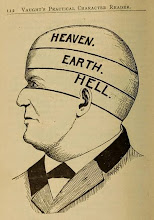
They had just rescued the bard Diarmuid from his evil faerie lover, in line with the prophecy that he would sing at the religious Synod and strengthen the cause of peace in the brewing war between humanity and the Otherworld. But in order to be accepted at the Synod, Diarmuid would have to undergo a swift and efficacious, if dangerous, penance. Three nights of vigil at the Devil's Acre were prescribed.

This huge hoofprint-shaped field is the site of pacts and contracts between Heaven and Hell, under which a soul claimed by Hell can be redeemed if the person endures three nights praying in the Acre. Unfortunately, devils and other damned beings proportional to the person's importance will climb out of the caves and fissures in the Acre and try to devour the penitent's body and corrupt his or her soul. Fortunately, the rules allow you to take some bodyguards along.


Perhaps for a more jaded party I would have served up the more grotesque of Bosch's devils. But because the Band's players are largely unfamiliar with the Monster Manual, the adventure was stocked with the standard Gygaxian "products of the imagination": lemures and nupperabos herded by a pair of spined devils, hell hounds, a sarcastic barbed devil, erinyes and so forth.

For a group used to going forth and exploring, the point defense scenario was a novel challenge.  Assailed from all sides by waves of foes, and needing to stay between them and a vulnerable bard playing the rebec and singing hymns, the mood was tense even when they ended up winning with some margin of ease. On the first night, a beloved henchman was slain, and on the last night, movement-point-draining wraiths of sloth managed to sleep one PC and nearly kill another henchman. Things would have been even more hairy if the keepers of a nearby holy citadel, charged with watching over the Acre, hadn't been convinced to sell two barrels of holy water to our heroes and loan them a two-handed sword, +3 against devils.

The defense scenario, in short, was an excellent change of tone and had me thinking about the ways it could get even crazier. The terrain they were defending was minimalist - a hill, a stone cross, a bonfire, a magic circle that only let so many devils in at a time.

But what if there was more pick and choose about where to defend?  A ruined town, a mound with megaliths that could be reinforced with stakes and traps, a besieged castle with crypts to explore and rumors of tunnels leading out - safety measure or security breach? A temple where you have to decide what's scarier - breaking the sealed crypt in hope of some advantage, or getting overwhelmed by the hordes drawn to your presence there? I'll have to think about that.


At any rate, I have made up my mind. A version of the Devil's Acre will be my entry in the One Page Dungeon contest this year. Which means I'll also have to grapple with the far knottier problem I faced in designing the adventure: how to represent temptation as a challenge to the players and their characters. More on that, next post.