language

Cold Iron in folklore, fiction, and RPGs

‘Gold is for the mistress—silver for the maid!
Copper for the craftsman cunning at his trade.’
‘Good!’ said the Baron, sitting in his hall,
‘But Iron—Cold Iron—is master of them all!’
       — Rudyard Kipling, “Cold Iron

Folklore

image
Drudenmesser, or “witch-knife”, an apotropaic folding knife from Germany

The notion that iron (or steel) can ward against evil spirits, witches, fairies, etc is very widespread in folklore. You hang a horseshoe over your threshold to deny entry to evil spirits, you carry an iron tool with you to make sure devils won’t assault you, you place a small knife under the baby’s crib to ward it from witches, and so on. Iron is apotropaic in many many cultures.

In English, we often come across passages that refer to apotropaic cold iron (or cold steel). “All uncouth, unknown Wights are terrifyed by nothing earthly so much as by cold Iron”, says Robert Kirk in 1691, which I believe is the earliest example. “Evil spirits cannot bear the touch of cold steel. Iron, or preferably steel, in any form is a protection”, says John Gregorson Campbell in 1901.

Words

So what is cold iron? In this context, it’s just iron. The “cold” part is poetic, especially – but not only – if we’re talking about either blades (or swords, weapons, the force of arms) or manacles and the like. It just sounds more ominous. There are “cold yron chaines” in The Fairie Queene (1596), and a 1638 book of travels tells us that a Georgian general (in the Caucasus) vowed “to make the Turk to eat cold iron”.

Green’s Dictionary of Slang defines “cold iron” as a sword, and dates the term to 1698. From 1725 it appears in Cant dictionaries (could this sense be thieves’ cant, originally? why not, plenty of words and expressions started as underworld slang and then entered the mainstream), and from ~1750 its use becomes much more common.

NGram Viewer diagram for 1600-2019.

In other contexts, cold iron is (surprise!) iron that’s not hot. So let’s talk a bit about metallurgy.

Metals

In nature, we can find only one kind of iron that’s pure enough to work with: meteoritic iron. It has to literally fall from the sky. Barring that very rare occurrence, people have to mine the earth for iron ore, which is not workable as is. To separate the iron from the ore we have to smelt it, and for that we need heat, in the form of hot charcoals. Throwing the ore on the coals won’t do much of anything, it’s not hot enough. But if we enclose the coals in a little tower built of clay, leaving holes for air flow, the temperature rises enough to smelt the ore. That’s called a bloomery.
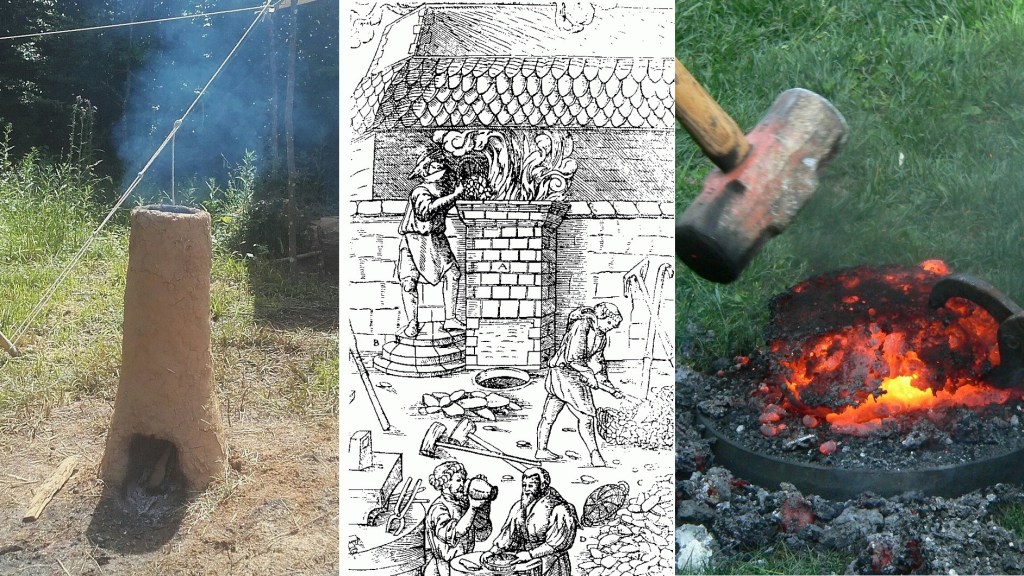
clay bloomery / medieval bloomery / beating the bloom to get rid of the slag

What comes out of the bloomery is a bloom: a porous, malleable mass of iron (that we need) and slag (byproducts that we don’t need). By hammering the hot bloom over and over, we can get rid of the slag and at the same time turn the porous mass to something solid. And once the slag is off, by the same process we can give it a desired shape in the forge, reheating it as needed. This is called “working” the iron, hence “wrought iron” objects, i.e. forged.

a blacksmith in his forge, with bellows, fire, and anvil (English woodcut, 1603)

This is the lowest-tech version, possibly going back to ~2000 BCE in Nigeria. If we add bellows, the improved air flow will raise the temperature. So smelting happens faster and more efficiently in the bloomery, and so does heating the iron in the forge, making it easier to work with. And that’s the standard process from the Iron Age all through the middle ages and beyond (although in China they may have skipped this stage and gone straight to the next one).

If we make the bloomery bigger and bigger, with stronger and stronger bellows, we end up with a blast furnace, a construction so efficient that the temperature outright melts the iron, and it’s liquified enough to be poured into a mould and acquire the desired shape when it cools off. This is “cast iron”.

a blast furnace

So in all of this, what’s cold iron? Well, it’s iron that went though the heat and cooled off. (No heat = no iron, all you got is ore.) If it came out of a bloomery, or if it wasn’t cast, it’s by definition worked, hammered, beaten, wrought, and that happened while it was still hot.

Is there such a thing as “cold-wrought” iron? No. In fact, “working cold iron” was a simile for something foolish or pointless. A smith who beats cold iron instead of putting it in the fire shows folly, says a 1694 book on religion, so you too should choose your best tools, piety and good decorum, to educate your children and servants, instead of beating them. When Don Quixote (1605) declares he’ll go knight-erranting again, Sancho Panza tries to dissuade him, but it’s like “preaching in the desert and hammering on cold iron” (a direct translation of martillar en hierro frío).

Minor work can be done on cold iron. A 1710 dictionary of technical terms tells us that a rivetting-hammer is “chiefly used for rivetting or setting straight cold iron, or for crooking of small work; but ’tis seldom used at the forge”. Fully fashioning an object out of cold iron is not a real process – though a 1659 History of the World would claim that in Arabia it’s so hot that “smiths work nails and horseshoes out of cold iron, softened only by the vigorous heat of the sun, and the hard hammering of hands on the anvil”. [I declare myself unqualified to judge the veracity of this statement, let’s just say I have doubts.] And there is of course such a thing as “cold wrought-iron”, as in wrought iron after it’s cooled off.

Either way, in the context of pre-20th century English texts which refer to apotropaic “cold iron”, it’s definitely not “cold-wrought”, or meteoritic, or a special alloy of any kind. It’s just iron.

Fiction

The old superstition kept coming up in fantasy fiction. In 1910 Rudyard Kipling wrote the very influential short story “Cold Iron” (in the collection Rewards and Fairies), where he explains invents the details of the fairies’ aversion to iron. They can’t bewitch a child wearing boots, because the boots have nails in the soles. They can’t pass under a doorway guarded by a horseshoe, but they can slip through the backdoor that people neglected to guard. Mortals live “on the near side of Cold Iron”, because there’s iron in every house, while fairies live “on the far side of Cold Iron”, and want nothing to do with it. And changelings brought up by fairies will go back to the world of mortals as soon they touch cold iron for the first time.

In Poul Anderson’s The Broken Sword (1954), we read:

“Let me tell you, boy, that you humans, weak and short-lived and unwitting, are nonetheless more strong than elves and trolls, aye, than giants and gods. And that you can touch cold iron is only one reason.”

In Peter S. Beagle’s The Last Unicorn (1968) the unicorn is imprisoned in an iron cage:

“She turned and turned in her prison, her body shrinking from the touch of the iron bars all around her. No creature of man’s night loves cold iron, and while the unicorn could endure its presence, the murderous smell of it seemed to turn her bones to sand and her blood to rain.”

Poul Anderson would come back to that idea in Operation Chaos (1971), where the worldbuilding’s premise is that magic and magical creatures have been reintroduced into the modern world, because a scientist “discovered he could degauss the effects of cold iron and release the goetic forces”. And that until then, they had been steadily declining, ever since the Iron Age came along.

There are a million examples, I’m just focusing on those that would have had a more direct influence on roleplaying games. However, I should note that all these say “cold iron” but mean “iron”. Yes, the fey call it cold, but they are a poetic bunch. You can’t expect Robin Goodfellow’s words to be pedestrian, now can you?

RPGs

And from there, fantasy roleplaying systems got the idea that Cold Iron is a special material that fey are vulnerable to. The term had been floating around since the early D&D days, but inconsistently, scattered in random sourcebooks, and not necessarily meaning anything else than iron. In 1st Edition’s Monster Manual (1977) it’s ghasts and quasits who are vulnerable to it, not any fey creature. Devils and/or fiends might dislike iron, powdered cold iron is a component in Magic Circle Against Evil, and “cold-wrought iron” makes a couple of appearances. For example, in AD&D it can strike Fool’s Gold and turn it back to its natural state, revealing the illusion.

Then Changeling: The Dreaming came along and made it a big deal, a fundamental rule, and an anathema to all fae:

Cold iron is the ultimate sign of Banality to changelings. … Its presence makes changelings ill at ease, and cold iron weapons cause horrible, smoking wounds that rob changelings of Glamour and threaten their very existence…. The best way to think about cold iron is not as a thing, but as a process, a very low-tech process. It must be produced from iron ore over a charcoal fire. The resulting lump of black-gray material can then be forged (hammered) into useful shapes.

Changeling: The Dreaming (2nd Edition, 1997)

So now that we know how iron works, does that description make sense? Well, if we assume that the iron ore is unceremoniously dumped on coals, it does not. You can’t smelt iron like that. If we assume that a bloomery is involved even though it’s not mentioned, then yes, this is broadly speaking how iron’s been made since the Iron Age, and until blast furnaces came into the picture. But the World of Darkness isn’t a pseudo-medieval setting, it’s modern urban fantasy. So the implication here is that “cold iron” is iron made the old way: you can’t buy it in the store, someone has to replicate ye olde process and do the whole thing by hand. Now, this is NOT how the term “cold iron” has been used in real life or fiction thus far, but hey, fantasy games are allowed to invent things.

Regardless, 3.5 borrowed the idea, and for the first time D&D made this a core rule. Now most fey creatures had damage reduction and took less damage from weapons and natural attacks, unless the weapon was made of Cold Iron:

“This iron, mined deep underground, known for its effectiveness against fey creatures, is forged at a lower temperature to preserve its delicate properties.”

Player’s Handbook (3.5 Edition, 2003)

Pathfinder kept the rule, though 5e did not. And unlike Changeling, this definition left it somewhat ambiguous if we’re talking about a material with special composition (i.e. not iron) or made with a special process (i.e. iron but). The community was divided, threads were locked over this!

So until someone points me to new evidence, I’ll assume that the invention of cold iron as a special material, distinct from plain iron, should be attributed to TTRPGs.

[original post]

Back slang and a Barbie pun

So, “lui c’est juste Ken” (he is just Ken) sounds exactly like “lui sait juste ken” (he just knows fucking).

“Ken” is a slang / argot word, and specifically verlan, a type of back slang.

Back slang is a type of cant where words are pronounced backwards. In English, a back slang of street sellers (costermongers) emerged in early Victorian London, so they could talk among themselves behind the customers’ / constables’ back. Possibly prisoners also used it (or something similar) to talk behind the wardens’ back. The words are pronounced backwards phonetically, more or less. So “boy” becomes yob, “pot of beer” becomes top o’ reeb, “no good” becomes on doog. But it’s not always straight forward, rules are always hazy in cant, so for example “police” becomes esclop. Cool the namesclop = look at the policeman.

The French equivalent is verlan. Its origins are hazy, elements of it appear from the Middle Ages, the criminal underworld probably used it (in some regions, at least) in the 19th century, it shows up in literature in the 20th, later the youths of the banlieues picked it up, rap and hip hop ran with it, and by now it’s pretty much mainstream, if informal.

Verlan reverses the syllables, transposing the last syllable to the start of the word. So “métro” become tromé, “bizzare” become zarbi, and “mec” becomes keum (with signle-syllable words it can go backwards phonetically). Sometimes it further truncates them, so zarbi becomes zarb. And “niquer” (“to fuck”, an argot word in the first place) becomes first keni, and from there ken.

[Speaking of niquer: during one of the many rebellions of the Parisian banlieues, a local tv station had sent a crew all the way to Paris to cover the riots, and the reporter found herself in front of a wall with large graffiti that said “SARKOZY NIQUE TA MÈRE”, and awkwardly said to the camera “and here we see a phrase that means, uh, ‘down with Sarkozy'”.]

Another famous back slang is Argentinian Lunfardo, which also reverses the syllables, so tango becomes gotán. (Hence, the Gotán Project.) Lunfardo was supposedly the slang of the criminal underworld and Italian immigrants in Buenos Aires, circa late 19th-early 20th century. It features in songs and in literature (see Borges’s “Streetcorner man”), though I should note its seedy origins are disputed. Roberto Arlt, an Argentinian author who didn’t just write about the underworld, he was of the underworld, commented that he doesn’t use Lunfardo in his writings because he doesn’t know it, he’d never heard it in real life in the shady dens he frequented. So it may have been a literary invention to some degree.

Other back slangs which reverse syllables are Xhosa Ilwimi, used mostly by teenagers, Japanese tougo, Serbo-Croatian-Bosnian šatrovački, used originally by criminals and later by youths in general, and Greek podana, which means exactly the same as the French verlan, it’s the word “backwards” (anapoda / l’envers) backwards, and is a somewhat dated criminal / subculture slang (mostly stoner-related tbh), only minimally taken up by hip hop.

Rule of thumb: hip hop is now the ultimate indicator of cant/slang. If a slang word or type of slang doesn’t take off there, it’s dead. If it’s widely used there, it’ll become mainstream informal in no time. (I believe the AAVE->tumblr speech pipeline is a subset of that, though that’s probably a bit more complicated.) And there’s a sweet spot in between where it’s alive but still marginal.

[originally posted on tumblr]

How Tolkien invented dwarves (it used to be “dwarfs”)

“In English, the only correct plural of ‘dwarf’ is ‘dwarfs’ and the adjective is ‘dwarfish.’ In this story ‘dwarves’ and ‘dwarvish’ are used, but only when speaking of the ancient people to whom Thorin Oakenshield and his companions belonged.”

— J. R. R. Tolkien, foreword to The Hobbit

frequency of “dwarves” vs. “dwarfs” 1930-2019, with Tolkien-related dates [Ngram Viewer graph generated by tuulikki]

“And why dwarves? Grammar prescribes dwarfs; philology suggests that dwarrows would be the historical form. The real answer is that I knew no better. But dwarves goes well with elves; and, in any case, elf, gnome, goblin, dwarf are only approximate translations of the Old Elvish names for beings of not quite the same kinds and functions.”

— J. R. R. Tolkien, to the editor of the ’Observer’, 1938

“[T]he printing is very good, as it ought to be from an almost faultless copy; except that the impertinent compositors have taken it upon themselves to correct, as they suppose, my spelling and grammar: altering throughout dwarves to dwarfs; elvish to elfish; further to farther; and worst of all, elven – to elfin. I let off my irritation in a snorter to A. and U. [George Allen and Unwin, Tolkien’s publishers in London] which produced a grovel.”

— J. R. R. Tolkien, from a letter to Christopher Tolkien, 1953

Oof.

D&D used the spelling “dwarves” from the start (along with other Tolkien ideas, such as hobbits, only later renamed to halflings for obvious reasons). Before the start, even. In 1972 Gygax published Chainmail, which was a wargame and not an RPG, but it included a fantasy supplement and it had stats for dwarves and hobbits. From 1974 on, all D&D publications (AFAIK) spell it “dwarves”.

It is debatable how much impact that had, and it’s tempting to guess “none at all”, given the HUGE overlap of “D&D players” and “people who’ve read Tolkien anyway”, and how recently D&D became mainstream enough to make a dent anywhere. But I think that would be ignoring D&D’s indirect impact via other media (official or otherwise), from Forgotten Realms novels to video games to webcomics to Critical Role, which reached a reasonably large audience NOT exclusively comprised of Tolkien readers. Anecdotally (but I think not weirdly for non-anglophone countries), I played D&D before I read Tolkien, and in fact that’s why I read Tolkien, thanks to D&D osmosis – and for a long time I totally thought that “dwarves” was the only spelling lol.

The graph is from google’s Ngram Viewer, it only takes printed sources into account, so no internet-only material. Here’s an updated version with 2 corpora, English fiction (there are more dwarves than dwarfs here, hah!) and English in general, plus a few extra dates.

frequency of “dwarves” vs. “dwarfs” 1930-2019, with Tolkien- and D&D-related dates [Ngram Viewer graph]

[originally posted on tumblr]

Historical Thieves’ Cant: A Selection

From 18th Century and Regency Thieves’ Cant, though some of these terms are centuries older.

1. Hanging

Up the ladder I did grope
and the hangman pulled the rope
and ne’er a word I spoke
tumbling down

Tyburn was a village in the county of Middlesex. For many centuries, the name Tyburn was synonymous with capital punishment, it having been the principal place for execution of London criminals and convicted traitors, including many religious martyrs. Known also as ‘God’s Tribunal’, in the 18th century, it was the image of a society which was more concerned with property crimes than the value of human life. [x]

ACORN You will ride a horse foaled by an acorn, i.e. the gallows, called also the Wooden and Three-legged Mare. You will be hanged. 1811

BEILBY’S BALL He will dance at Beilbys’ ball, where the sheriff pays the music; he will be hanged. Who Mr. Beilby was, or why that ceremony was so called, remains with the quadrature of the circle, the discovery of the philosopher’s stone, and divers other desiderata yet undiscovered. 1811

CRAP the gallows. 1819

DANCE UPON NOTHING To be hanged. 1811

DANGLE to be hanged: I shall see you dangle in the sheriff’s picture frame; I shall see you hanging on the gallows. 1811

DEADLY NEVERGREEN, that bears fruit all the year The gallows, or three-legged mare. 1811

HEMPEN FEVER A man who was hanged is said to have died of a hempen fever; and, in Dorsetshire, to have been stabbed with a Bridport dagger; Bridport being a place famous for manufacturing hemp into cords. 1811

Oh I went up Holborn Hill
in a cart, in a cart
at St Giles* I had my fill
and at Tyburn wrote my will

HOLBORN HILL To ride backwards up Holborn hill; to go to the gallows: the way to Tyburn, the place of execution for criminals condemned in London, was up that hill. Criminals going to suffer, always ride backwards, as some conceive to increase the ignominy. The last execution at Tyburn, and consequently of this procession, was in the year 1783. 1811

*The village of St Giles stood on the main road from Holborn to Tyburn. Convicted criminals were often allowed, in tradition, to stop at St Giles en route to Tyburn for a final drink – a “St Giles Bowl” – before hanging. [x]

JAMMED Hanged. CANT. 1811

LADDER To go up the ladder to rest; to be hanged. 1811

LEAF To go off with the fall of the leaf; to be hanged: criminals in Dublin being turned off from the outside of the prison by the falling of a board, propped up, and moving on a hinge, like the leaf of a table. IRISH TERM. 1811

MORNING DROP The gallows. He napped the king’s pardon and escaped the morning drop; he was pardoned, and was not hanged. 1811

MORRIS to hang. dangling in the Air, to be executed. 1737

New Drop gallows, Newgate Prison

NEW DROP The scaffold used at Newgate for hanging of criminals; which dropping down, leaves them suspended. By this improvement, the use of that vulgar vehicle, a cart, is entirely left off. This is also called the last drop.  1811

NUBBING Hanging. Nubbing cheat: the gallows. Nubbing cove; the hangman. Nubbing ken; the sessions house. 1811

PADDINGTON FAIR DAY An execution day, Tyburn being in the parish or neighbourhood of Paddington. To dance the Paddington frisk; to be hanged. 1811

PISS He will piss when he can’t whistle; he will be hanged. 1811

QUINSEY Choked by a hempen quinsey; hanged. 1811

SCRAGGED Hanged. Scraggem fair; a public execution. Scragging-post; the gallows. 1819

SHERIFF’S BALL An execution. To dance at the sheriff’s ball, and loll out one’s tongue at the company; to be hanged, or go to rest in a horse’s night-cap, i.e. a halter. 1811

SHERIFF’S PICTURE FRAME The gallows. 1811

STRETCHING hanging. He will stretch for it; He will be hangd. 1737

SUSPENCE One in a deadly suspence; a man just turned off at the gallows. 1811

THREE-LEGGED MARE, or STOOL The gallows, formerly consisting of three posts, over which were laid three transverse beams. This clumsy machine has lately given place to an elegant contrivance, called the NEW DROP, by which the use of that vulgar vehicle a cart, or mechanical instrument a ladder, is also avoided; the patients being left suspended by the dropping down of that part of the floor on which they stand. This invention was first made use of for a peer. 1811

TO SWING To be hanged. He will swing for it; he will be hanged for it. 1811

TOP’D hanged. 1819

TOPPING-CHEAT the Gallows. 1737

TRINE to hang; also Tyburn. 1737

TWISTED executed, hanged. 1737

TYBURN TIPPET A halter; see Latimer’s sermon before. Edward VI. A. D. 1549. 1811

WRY MOUTH AND A PISSEN PAIR OF BREECHES Hanging. 1811

WRY NECK DAY Hanging day. 1811

Oh me name it is Sam Hall,
and I’ve robbed both great and small
and me neck will pay for all, when I die
and I hate youse one and all, damn your eyes

~ “Sam Hall”, traditional

(more…)

Regional Thieves’ Cants in D&D

Thieves’ Cant signs collection by aliveria

There’s an idea floating around that “thieves cant is essentially coded messages, probably based on references and stuff, so it’d be SUPER regional”. The logical conclusion is that a traveling rogue would have to learn the local culture before understanding the references, and that’s indeed pretty funny.

And you could do that! One modest option is to assume that only a few terms are different, so you can mostly communicate but misunderstandings can still happen.

But historically, cants weren’t really regional, because they were mostly used by people on the road, vagrants and vagabonds and itinerant workers and such. Think hobo signs and hobo slang: the whole point is to communicate with people who came from elsewhere, and don’t have the same references as you. Some cants were geographically MORE widespread than local languages. For example, Rotwelsch was spoken by various marginal groups in Germany, Austria, Switzerland, and Bohemia.

Without looking it up right now, I believe the English cant had very few regional, local references, and those mostly involved prisons or execution sites. Like, “Tyburn tippet” meant noose: a tippet is a scarf-like garment worn by anglican priests, and Tyburn was a gallows. A bunch of terms refernce it, both directly and indirectly (“to go to Holborn Hill” = to hang, because this hill was on the way there from London, “Paddington Fair day” = execution day, because it was in the parish of Paddington, etc). But everyone knew Tyburn, and especially everyone who spoke cant. There were also terms that referenced the Newgate prison, the executioner Jack Ketch, and so on, but again, all these were famous all over Britain, and not obscure local knowledge.

On the other hand, a French argot-speaking rogue would find English cant mostly unintelligible, though some words come from Romance languages or Romani, so they’d have a headstart learning it, at least. But of course, here we get to the larger issue of languages in D&D settings, and to the absurdity of Universal Common — a worldbuilding atrocity that I’m happy to handwave because it facilitates gameplay and makes the story go. (Seriously, Common makes no sense at all if you think about it, but whatchagonna do? Never travel to or meet anyone from a different country? Preposterous! We’re hopping to other planes here, surely we can make it to the equivalent of France!)

So anyway, if you want to introduce some regional differences in thieves’ cant in your game because you dig it, that’s great! But if you’re only doing it for the verisimilitude, you don’t really have to, and I think you shouldn’t go overboard either way. Don’t screw the Rogue!

As I’ve said before, thieves’ cant in D&D works better when you think of it like its historical counterpart: it’s not the language of thieves, it’s the language of people in the margins. Including but not limited to thieves.

[originally posted on tumblr]

The Sfondagiaco dagger


“The sfondagiaco (plural: sfondagiachi) is a rare type of dagger, with a robust blade and a very sharp tip, capable of perforating chainmail and sliding between metal armour plates.”
~ The Ambrosiana’s Collection

“Also known as smagliatore, this new type of weapon first appeared around the thirteenth century, dictated by the needs of war: it was the sfondagiaco, a double-edged knife-dagger with a very strong blade and reinforced tip, often triangular (long and pointed). It was used to penetrate the giaco, that is the coat of mail worn under the surcoat and under the armour, with a deadly strike. It was often used by the “sweepers” of the battlefields, who used it to finish off the dying soldiers and promptly strip them of everything of value, in which case it would perhaps be more accurate to speak of misericordia, mercy.”
~ it.wikipedia.org

Terminology

Both daga and pugnale are translated as “dagger” in English, but daga refers to longer blades (though still not big enough to be called a sword). The pugnale usually has a short blade, and the sfondagiaco is apparently somewhere in between.

Judging from the labels, sometimes sfondagiaco refers to a specific type of blade (the extra pointy, slightly triangular type) which can be combined with different kinds of hilt, like eared, rondel or bollock dagger. Other times it appears to be just a matter of blade length. If it’s too long for a pugnale and too short for a daga, they might call it a sfondagiaco, even though it’s not particularly triangular or pointy. If it’s very short, then even if the shape is patently like the sfondagiaco‘s, they still call it a pugnale. Or it may be a matter of function, what the weapon was made to do: sfondagiaco means precisely “mailpiercer”.

This is very complicated and fluid, it resists accurate translations and well-defined and ordered categorizations and typologies, and I love it. 😀

All the photos from Florence are by Andrea Carloni. The Bargello, incidentally, was built as a castle in the 13th century, the Medici tuned it into a prison and police barracks in the 16th c., and in the 19th c. it was converted to an art museum. That’s typical Florence, around the same time they built a theatre (now called Teatro Verdi) where Le Stinche once stood, the largest prison of the city and one of the oldest in Europe.

[original post]

The ‘coup de Jarnac’ and the insidious dagger

h.jpg

“The dagger, which is a shortened sword, or a lengthened poignard, was called in the 14th century Misericord, because, thrust at the throat of an overthrown adversary, it forced him to ejaculate its name. In the 16th century, the dagger no longer goes to war; it becomes a duelling arm—terrible and traitorous; now parrying the rapier-thrust, anon insidiously insinuating itself into the openings of fence, to deal the adversary a ‘coup de Jarnac’: sometimes the dagger, naked and smooth to the eye, hid within itself a trident: two little lateral blades, incorporated with the central one, bifurcated under pressure of a spring hidden in the shoulder.  ‘Twas a viper protruding its triple tongue of venom.”

~ Paul de Saint-Victor, Anciens et Modernes (1886)

A “coup de Jarnac” is basically a sneak attack. At first it meant “a devastating, skillful and unexpected strike”, emphasis on skill. It originated from a trial by combat in 1547, where Guy Chabot, baron de Jarnac, defeated his opponent by striking him behind the knee — he basically hamstrung him. The move was new and unexpected as far as the audience (and his opponent) were concerned, though Jarnac didn’t invent it, he learnt it from an Italian swordsman that he’d hired before the duel. It wasn’t considered dishonourable at the time, only especially adroit and effective. No one disputed the duel’s result, and the king declared Jarnac the victor.

But a few centuries later, the meaning of the expression coup de Jarnac shifted from “skillful blow” to “traitorous”, precisely because it was unexpected. It didn’t have to be about combat, it was also used metaphorically for an act that ruins someone or destroys his fortune, sort of like the English backstab.

From there, jarnac came to mean “dagger”, and that’s where Paul de Saint-Victor picked it up, and went on to describe daggers as terrible, traitorous, insidious, venomous, etc. This Rogue, for one, takes it as a compliment. :p

[original post]

P.S. The English translation of Paul Saint-Victor is from the prologue of Worke for Cutlers: A Merry Dialogue betweene Sword, Rapier and Dagger (a 1615 play, edited by Albert Forbes Sieveking, Cambridge University Press, 1901). I changed “glaive” to “sword” for clarity. (The translator would expect his 1901 audience to recognise “glaive” as a French and therefore poetic word for sword, but for modern audiences the glaive is a polearm, and it would be terribly confusing.)

A Rogue by any other name…

“and rogue was a word with a twinkle in its eye”
  ~ Terry Pratchett

Translating D&D books from English can be complicated, especially when it comes to terms that have few counterparts in other languages, such as Dungeon, or Ranger…

…or Rogue. Now that’s a hard one. You might think it’s an international concept, but branding (sometimes literally…) as criminals an entire class of people that were left to roam without a job while feudalism collapsed around them, that’s very characteristically English. And then, as time passed, turning that word into what we recongise as a rogue today – half dangerous and half playful, all exciting – that’s also very English. 🙂 [If  less unique: tricky shady bastards are universally popular, heh.]

One other language that boasts a word almost identical to rogue is Spanish, with the word pícaro. Not coincidentally, this word comes with its own literature too – the picaresque novel – which preceded English rogue literature by a century. That said, it’s only the exact meaning and… timbre of the word rogue that is rare. Words that are similar, but not quite, abound in other languages, though they may be too informal or slang to use as an official term in a roleplaying game.

Be that as it may, in the absence of an exact counterpart, D&D translators sometimes resorted to the word thief or a variation thereof, and other times they improvised.

So this is a non-exhaustive list of the D&D term “Rogue” in other languages – preferably, and when available, according to the official translation of the Player’s Handbook, from 3rd Edition onwards. In earlier editions, we were all Thieves. If you have a language to add (it doesn’t need to have an official D&D translation, common usage is also very interesting) or if you spot a mistake, please let me know.

  • Czech: Tulák (vagabond, vagrant, tramp)
  • Chinese: 盜賊 (bandit, robber)
  • Dutch: Schavuit (rascal, rogue, crook)
  • Finnish: Rosvo (robber, bandit, brigand)
  • French: Roublard (wily person)
  • German: Schurke (villain)
  • Greek: Κλέφτης (thief) – unofficial
  • Hebrew: נוכל (con man)
  • Hungarian: Kalandor (adventurer)
  • Italian: Ladro (thief, burglar)
  • Japanese:  シーフ (thief)
  • Norwegian: Snik (cheat, con artist, trickster)
  • Polish: Łotrzyk (diminutive of łotr: villain, scoundrel)
  • Portuguese: Ladino (wily, sly, cunning)
  • Russian: Плут (swindler, cheat, knave)
  • Spanish: Pícaro (rogue)
  • Swedish: Tjuv (thief)
  • Turkish: Düzenbaz (cheat, trickster)
  • Ukranian: Злодій (thief, burglar)

P.S. Almost the entirety of this research was possible thanks to wikipedia’s wonderful sidebar, with links to the same article in other languages. That was an invaluable starting point.

Image credits: FencingMasterComp by ianllanas

[originally posted by Rogue on tumblr]