Sometimes it’s called Rogue, sometimes it’s called Thief. It can be a class, or a template, or a sample build for a classless system. It can be pigeonholed to a couple of roles and specialties, or wide open to interpretations and extensive customisation.
But any self-respecting fantasy game, chock-full as it may be with mighty warriors and powerful wizards, needs a disreputable little shit: the rogue, the thief, the scoundrel, the one who strays. And it’s a truly universal archetype. The people in the margins are the salt of the earth, and a setting without them is just… unseasoned.
“The thief gives us a chance to play someone closer to heart, someone who’s not strong or possessed of magical talents, someone who has to rely on wit and stealth to survive. Someone, we can imagine, who might very well be just like us. And in being more like us, it’s clear that the thief is not just a column of percentile chances to pick locks and disarm traps; she is blessed with as many different skills and appearances as there are crimes to be committed. And that’s quite a lot.” [x]
So here’s a sneak peek at the Thief/Rogue in:
Shadowdark (2023) – gridmark and rules-light dungeoncrawl
Tales of the Valiant (2024) – a D&D 5e variant
Rolemaster Unified (2022) – famously crunchy and customisable
GURPS 4e Dungeon Fantasy (2007) – classic classless system
Ars Magica 5th Edition (2004) – the historically grounded one (in Europe 1200 AD), very customisable
Four Against Darkness (2017) – solo dungeoncrawl
Blades in the Dark (2017) – where everyone’s a rogue!
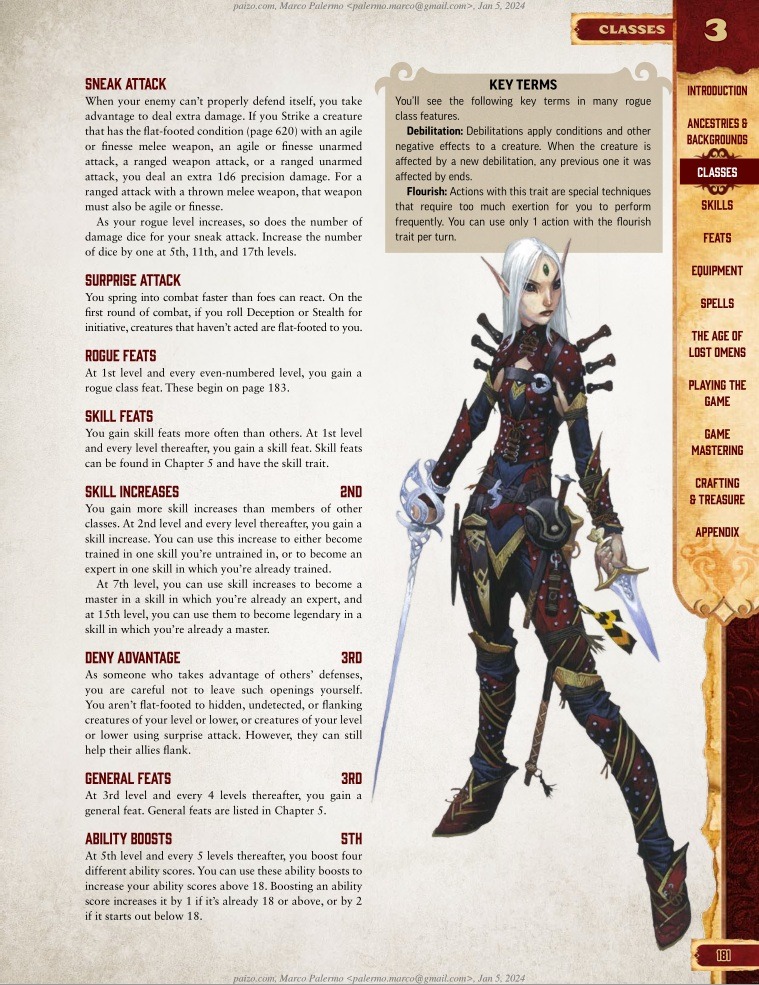
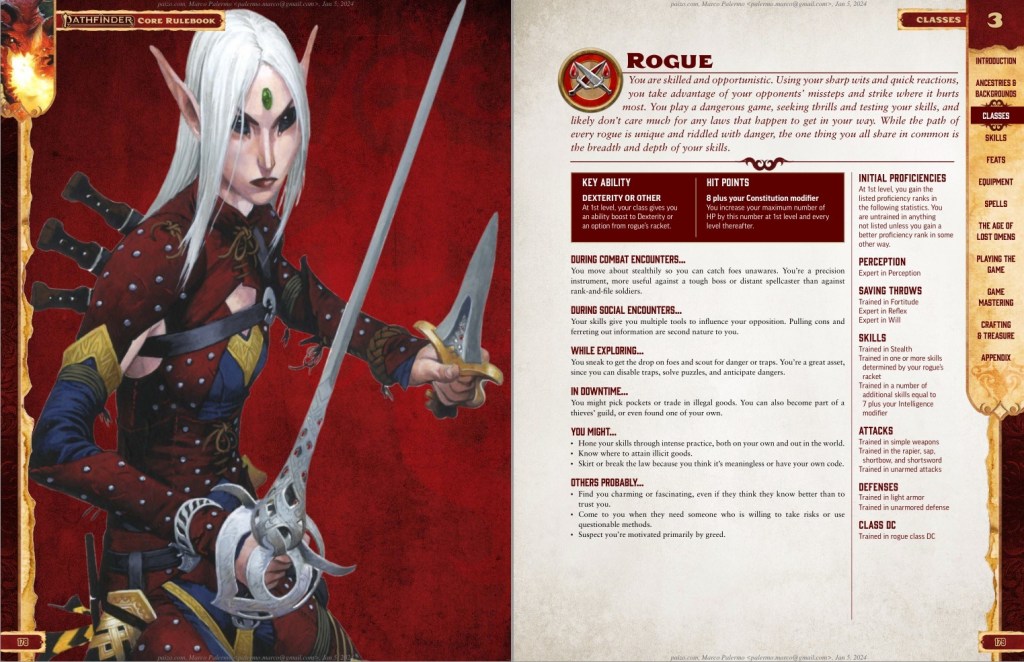
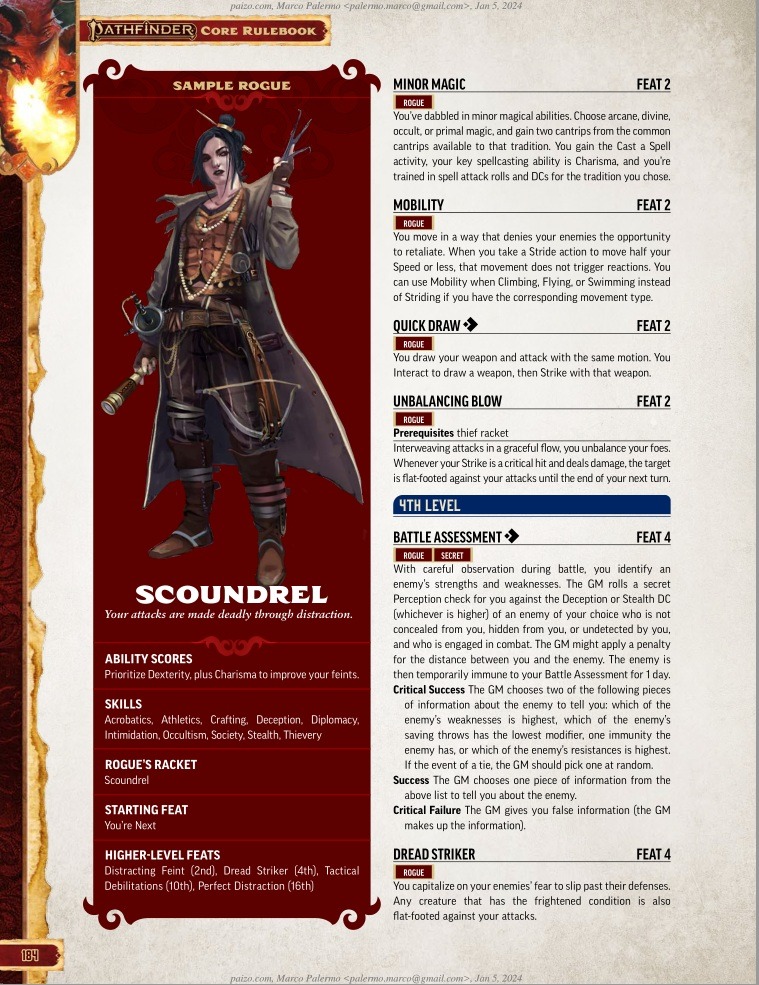
Pathfinder 2e (2024) – a million rules and it’s all 3.5’s fault
Lankhmar: City of Thieves (2015) – the Fafhrd and Gray Mouser setting, with the Savage Worlds system
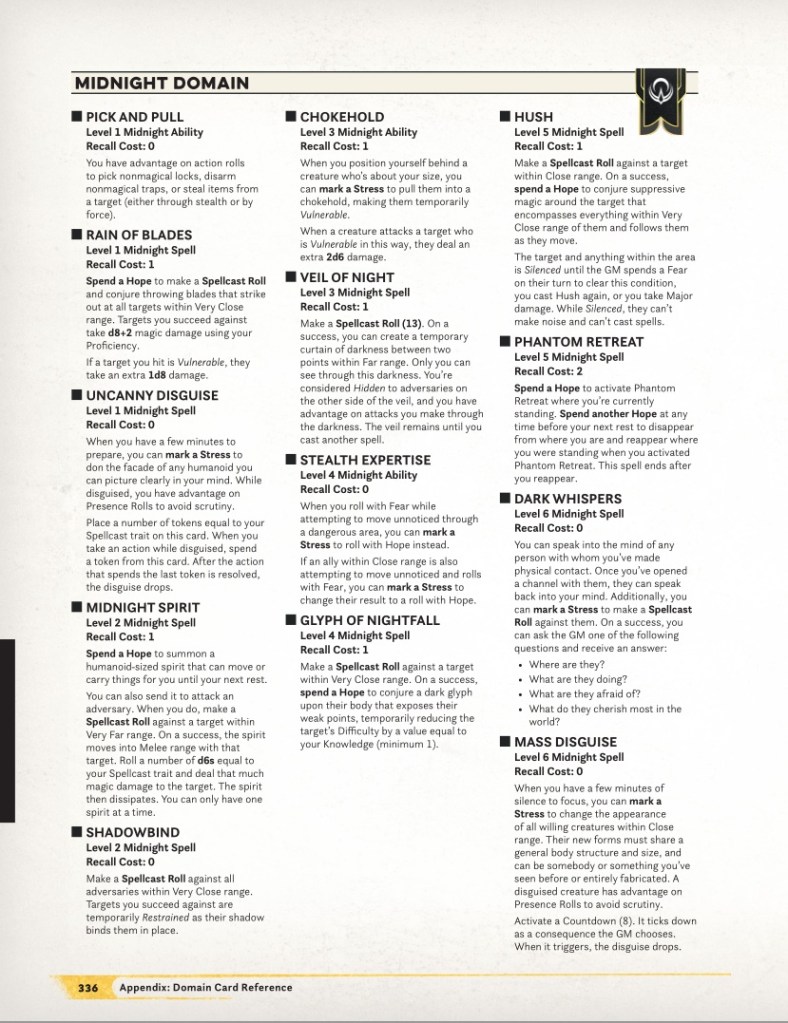
Daggerheart (2025) – a more narrative, D12-based system
This list is drawn from the 2024 PHB and DMG. I’m listing first general rules that apply, and then specific methods arranged by the level when they become available.
The list can serve as reference for any Rogue handbook. But it’s also, rather accidentally, a list of how to impose all the relevant conditions (blinded, stunned, etc), so I think it’s useful for the whole party, and especially debuffers. Check this out if you enjoy using spells and abilities to debilitate opponents, so that your sword-swinging buddies can then swoop in and finish them. Teamwork!
The Basics: you roll with advantage when you
attack while Invisible [see below]
attack a Blinded target [see below]
attack a Prone target within 5 ft (negated if you use a Ranged weapon, de-negated with Crossbow Expert (lvl 4))
attack a Stunned target
attack a Restrained target
attack a Paralyzed target
attack a Petrified target
attack an Unconscious target
[but NOT when you attack an Incapacitated target: this condition now means you can’t take actions, but you can still move]
The Invisible condition
can be gained both by magical means and by taking the Hide action: whether you cast a spell which alters the very fabric of reality or you just lunge behind some crates, by the rules you’re Invisible
please note that stealth rules make no sense and nobody knows how they work, just assume that IF it works, you get advantage
the advantage is negated if “the creature can somehow see you” (whatever that means)
the advantage is negated if you’re in range of the target’s Blindsight
the advantage is negated if you’re in range of the target’s Truesight (including from the True Seeing spell) or See Invisibility spell, even if you gained the Invisible condition by taking the Hide action [this is RAW, not a suggestion; my suggestion is fuck this stupid rule]
Tremorsense doesn’t matter
The Blinded condition
the advantage is negated if you’re in range of the target’s Blindsight
if the condition comes from trying to see in Darkness, the advantage is negated if you’re in range of the target’s Darkvision (unless you’re a Gloom Stalker)
Tremorsense doesn’t matter
Methods to get Advantage
LEVEL 1
attack while Invisible from the Hide action, 1 attack normally but you can retain the Invisible condition with Cunning Strike: Supreme Sneak (Thief Rogue 9), or the Skulker feat (4) if you miss
attack after you’ve damaged the target with a Vex weapon
attack after an ally took the Help Action to Assist an Attack Roll
attack spending a Luck point from the Lucky feat (1) proficiency bonus times / long rest
target is affected by Faerie Fire (Bard/Druid 1st, Drow Elf 3, Magic Initiate feat 1) negated if you can’t see the target, though the spell does negate the benefits of Invisible, 1 minute / concentration, 20-ft cube, DEX save
target is affected by Guiding Bolt (Cleric 1st, Magic Initiate feat 1), 1 attack
target is Blinded because you are located in Darkness assuming you can see, so generally you need Darkvision or Blindsight, unless somehow you’re in Darkness but the target is not
target is Blinded because you and/or it are located in Heavily Obscured space assuming you can see, so generally you need Blindsight
target is Blinded from Colour Spray (Bard/Sorcerer/Wizard 1st, Magic Initiate feat 1, Shadow Touched feat 4), ~1 round, 15-ft cone, CON save
target is Prone from Unarmed Strike: Shove
target is Prone from a Topple weapon
target is Prone from Ball Bearings (Utilize action, 10-ft square, DEX DC 10)
target is Prone from a Goliath’s Hill’s Tumble, Hill Giant lineage, 1/day
target is Prone from Command: Grovel (Bard/Cleric/Paladin 1st, Magic Initiate feat 1, Fey Touched feat 4)
target is Prone from Grease (Sorcerer/Wizard 1st, Magic Initiate feat 1), 1 minute, 10-ft square, DEX save at casting/entering/ending turn
target is Prone from Tasha’s Hideous Laughter (Bard/Warlock/Wizard 1st, Magic Initiate feat 1, Fey Touched feat 4) 1 minute / concentration, WIS save
target is Prone from Thunderous Smite (Paladin 1st) STR save
target is Restrained from Ensnaring Strike (Ranger 1st) 1 minute / concentration, STR save, Athletics check every round
target is Restrained from Entangle (Druid/Ranger 1st, Magic Initiate feat 1) 1 minute / concentration, 20-ft square, STR save, Athletics checks every round
target is Restrained with Manacles that are fixed in place (Utilize action DC 13 DEX (sleight of hand), target must be grappled etc to begin with)
target is Restrained with Rope and their legs are bound (Utilize action DC 10 DEX (sleight of hand), target must be grappled etc to begin with)
target is Restrained with a Net (replaces attack, DC 8 + DEX + proficiency bonus)
target is Unconscious from Sleep (Bard/Sorcerer/Wizard 1st, Magic Initiate feat 1, Fey Touched feat 4), 1 attack/target, 2 successive saves for unconsciousness, 1 minute / concentration
LEVEL 2
attack with Reckless Attack (Barbarian 2) applies to Str-based attacks
target is Prone from being hit by an Elk / Mastiff (Druid 2 wild shape)
LEVEL 3
attack while Invisible from Invisibility (Bard/Sorcerer/Wizard/Warlock 2nd, Shadow Touched feat 4), 1 attack only
attack a target that relies on Darkvision to see while in Darkness and Invisible from your Umbral Sight (Gloom Stalker Ranger 3)
attack with Steady Aim (Rogue 3) bonus action, and cannot move in this turn at all, unless you’re an Assassin 9 in which case you can move after the attack
attack with Assassinate: Surprising Strikes a target that hasn’t taken a turn yet during the first round of combat (Assassin Rogue 3)
attack with Feinting Strike (Battle Master Fighter 3) bonus action
attack while both you and your duplicate from Invoke Duplicity are within 5 ft of the target (Trickery Cleric 3) bonus action to cast / move the duplicate 30 ft
target is Restrained from Web (Sorcerer/Wizard 2nd), up to 1 hour with Concentration, 20-ft cube conjuration, DEX save at entering/starting turn, Athletics check every round
target is Restrained from Nature’s Wrath (Oath of the Ancients Paladin 3) 1 minute, targets you can see within 15 ft, they save every round
target is Paralyzed from Hold Person (Bard/Cleric/Druid/Sorcerer/Warlock/Wizard 2nd, Abyssal Tiefling 5), up to 1 minute with Concentration, target saves every round
target is Blinded from Blindness/Deafness (Bard/Cleric/Sorcerer/Wizard 2nd), lasts up to 1 minute, target saves every round
target is Prone from a Trip Attack (Battle Master Fighter 3)
target is Prone from Open Hand Technique: Topple (Warrior of the Open Hand Monk 3)
target is Prone from being hit by Primal Companion: Beast of the Land (Beast Master Ranger 3)
target was hit by an ally’s Distracting Strike (Battle Master Fighter 3)
target is within 5 ft of an ally using Rage of the Wilds: Wolf (Path of the Wild Heart Barbarian 3)
[2014 Legacy] attack after you’ve used a bonus action for Insightful Fighting (Inquisitive Rogue 3) requires an Insight vs Deception check, lasts for 1 minute
LEVEL 4
attack with Mounted Strike from the Mounted Combatant feat (4) while mounted, a target smaller than your mount and within 5ft of your mount
target is Grappled by you and you have the Grappler feat (4)
target is Prone from being bashed by someone with the Shield Master feat (4)
target is Prone from being hit by a Giant Goat / Warhorse (Druid 4 wild shape)
target is Restrained from being hit by a Crocodile (Druid 4 wild shape)
target was critically hit with a bludgeoning weapon by someone with the Crusher feat (4), 1 round
LEVEL 5
target is Stunned from Stunning Strike (Monk 5)
target is Blinded from Hunger of Hadar (Warlock 3rd), only if you can see in magical darkness, up to 1 minute with Concentration
target is Prone from Eldritch Smite (Warlock 5)
target is Prone from Cunning Strike: Trip (Rogue 5)
target is Prone from Sleet Storm (Druid/Sorcerer/Wizard 3rd) area effect
target was hit by Shining Smite (Paladin 2nd) up to 1 minute with Concentration
LEVEL 6
attack while Invisible from your Steps of the Fey: Disappearing Step (Archfey Patron Warlock 6) 1 attack only
attack a target you’ve connected to via Awakened Mind: Clairvoyant Combatant (Great Old One Warlock 6) Wis save, 6+ minutes, 1/short rest normally
LEVEL 7
attack while Invisible from Greater Invisibility (Bard/Sorcerer/Wizard 4th), up to 1 minute with Concentration
target is Blinded from Fount of Moonlight (Bard/Druid 4th) until the end of the next turn
target is Restrained from Evard’s Black Tentacles (Wizard 4th)
target is Prone from Telekinetic Thrust (Psi Warrior Fighter 7)
LEVEL 8
target is Prone from being hit by a Brown Bear / Dire Wolf / Tiger (Druid 8 wild shape)
LEVEL 9
attack while Invisible from your Mislead (Bard/Warlock/Wizard 5th), 1 attack
target is Blinded by Blinding Smite (Paladin 3rd) up to 1 minute with Concentration, target saves every round
target is Blinded by Jallarzi’s Storm of Radiance (Warlock/Wizard 5th), up to 1 minute with Concentration, no save, area effect
target is Paralyzed from Hold Monster (Bard/Sorcerer/Warlock/Wizard 5th), up to 1 minute with Concentration, target saves every round
target is Prone from Yolande’s Regal Presence (Bard, Wizard 5th)
target is Restrained from Telekinesis (Sorcerer/Wizard 5th), 1 round
target is Restrained from Conjure Elemental (Druid/Wizard 5th), up to 10 minutes with Concentration, target saves every round
LEVEL 10
attack after an you or an ally used Zealous Presence (Path of the Zealot Barbarian 10), bonus action, 1 round
LEVEL 11
target is affected by Otto’s Irresistible Dance (Bard/Wizard 6th) up to 1 minute with Concentration
target is Unconscious from Eyebite (Bard/Sorcerer/Warlock/Wizard 6th), 1 attack only
target is Restrained or Petrified from Flesh to Stone (Druid/Sorcerer/Wizard 6th)
target is Restrained from Otiluke’s Freezing Sphere (Sorcerer/Wizard 6th), 1 minute, Str (Athletics) to break free, targets swimming on the surface only!
target is Blinded from Sunbeam (Cleric/Druid/Sorcerer/Wizard 6th), 1 minute
LEVEL 12
target is Prone from being hit by an Elephant (Circle of the Moon Druid 12 wild shape)
LEVEL 13
attack while Invisible from your Psychic Veil (Soulknife Rogue 13), 1 attack that deals damage only
attack with Studied Attacks (Fighter 13) 1st attack after you’ve attacked target and missed
target is Blinded or Stunned from Divine Word (Cleric 7th)
target is Restrained, Petrified or Blinded from Prismatic Spray (Bard/Sorcerer/Wizard 7th)
target is Stunned from Staggering Smite (Paladin 4th), until the end of the caster’s next turn
target is Unconscious (1 attack) or Stunned (1 minute) from Symbol (Bard/Cleric/Druid/Wizard 7th)
[2014 Legacy] attack a target previously hit in the first round of combat with Ambush Master (Rogue Scout 13) lasts until the start of the Scout’s next turn
LEVEL 14
attack while Invisible from your Nature’s Veil (Ranger 14), bonus action, lasts until the end of your next turn
target is Prone from Power of the Wilds: Ram (Path of the Wild Heart Barbarian 14)
target is Unconscious from Cunning Strike: Knock Out (Rogue 14), 1 attack
target is Blinded from Cunning Strike: Obscure (Rogue 14), lasts until the end of target’s next turn
target is Blinded from Searing Vengeance (Celestial Patron Warlock 14), lasts until the end of the current turn
LEVEL 15
target is Prone from Earthquake (Cleric/Druid/Sorcerer 8th)
target is Blinded from Holy Aura (Cleric 8th)
target is Stunned from Power Word Stun (Bard/Sorcerer/Warlock/Wizard 8th)
target is Blinded from Sunburst (Cleric/Druid/Sorcerer/Wizard 8th), 1 round
LEVEL 17
attack while affected by Foresight, lasts for 8 hours (Bard/Druid/Warlock/Wizard 9th)
attack while a duplicate from Improved Duplicity is within 5 ft of the target (Trickery Cleric 17)
attack while Invisible from your Cloak of Shadows (Warrior of Shadow Monk 17), lasts up to 1 minute under conditions
target is affected by your Hunter’s Mark (Ranger 17) up to 1 hour with Concentration
target is Prone from Destructive Wave (Paladin 5th) 30-ft emanation (sphere), CON save
target is Blinded, Restrained, or Petrified from Prismatic Wall (Bard/Wizard 9th), 1 minute
target is Restrained or Unconscious from Imprisonment (Warlock/Wizard 9th), until dispelled
target is Stunned from Rend Mind (Soulknife Rogue 17), 1 minute, saves every round
[2014 Legacy] use Master Duelist (Swashbuckler Rogue 17) to reroll with advantage an attack that missed
LEVEL 19
attack while Invisible from the Boon of the Night Spirit epic boon feat, 1 action’s (or bonus action, or reaction) worth of attacks only
MAGIC ITEMS
attack within the 30-foot radius Dim Light shed by a Candle of Invocation (very rare)
attack within 72 hours after drawing a Jester on the Deck of Many Things (legendary)
attack your sworn enemy with an Oathbow (very rare)
attack elementals while wearing a Ring of Elemental Command (legendary)
attack a creature that dealt damage to you, as a Reaction, with a Sword of Answering (legendary)
FOR COMPLETION’S SAKE
Optional Rule: at the DM’s discretion, you may roll with advantage when you attack a Frightened creature. (Flanking is not an optional rule any more.)
Note: the number next to classes is class level where the relevant ability is gained, the number next to feats is class level required to take it, and the number next to spells is spell level, e.g. “Paladin 2nd” is a 2nd lvl spell, filed under Level 5 when Paladins get it.
That’s right, the new PHB isn’t even fully released yet, and we’re already fiddling with it, making up houserules. Quintessential D&D right there: RAW is a suggestion.
The tweaks are tentative, given that the DMG and the MM aren’t out yet. Several things are still in the air (skills, tools, stealth) because they’re vague or wonky in the PHB, and we don’t know what the monsters look like. Does the power creep of player classes mean they’ll be tougher? Are all traps and all locks really a flat DC 15? How do skills work? Time will tell. But for now, here are a few houserules that will hopefully make the 2024 Rogue experience more rewarding, and bring the class back to the middle of the curve damage-wise, because it was behind to begin with and now it dropped to the nether regions in comparison with other martials.
Rogue
In the base class, honestly everything’s GREAT except stealth rules and damage output. So all I got to add is:
See Invisibility, Truesight and similar don’t let you see creatures that used the Hide action successfully
Pending a more comprehensive stealth fix, because dear god these rules suck, and also I won’t be sure how they even work until the DMG comes out or a designer chimes in with Sage Advice.
Sneak Attack 1/turn/target
Extra Attack at lvl 5
My old 5e houserule. This may seem too much (with the Nick Weapon Mastery you can have 3 melee attacks/attack action at lvl 5) but remember that it’s a much bigger hassle to set up sneak attack for multiple targets (stealth and Steady Aim will only cover one attack), Cunning Strike sacrifices sneak attack dice lowering dmg, and often you’ll simply run out of targets. So you won’t actually be dealing 3 x sneak attack dmg every round. Also remember that other martials got boosted even more and deal quite a lot of damage. Needs playtesting, but I’m confident it’s gonna be fine, and if it’s not, I’ll just roll back the extra attack.
Cunning Strike includes Disarm, like in the playtest
Come to think of it, shouldn’t that be a Weapon Mastery? Do you think books down the line will introduce alternate weapon masteries, like, rapiers normally get Vex, but alternatively you can pick Disarm or whatever? Cause we can beat them to the punch and homebrew that right now!
Arcane Trickster
you can cast Mage Hand without verbal components
you can cast without verbal components [Proficiency Bonus] times / long rest
Self-explanatory. Sorcerers are the masters of metamagic, but conceptually this subclass needs Subtle Spell.
Mage Hand can be used to pick locks and disarm traps
No idea why they removed this ability, and limited Mage Hand to Sleight of Hand, but that’s just silly and we’re bringing it back.
you can use scrolls of the spells you know
Just clarifying a little thing here – an unfortunate wording appears to prevent Arcane Tricksters and Eldritch Knights from doing that by RAW, because they choose “Wizard” spells, and you can only use scrolls of your “class’s spell list”.
Assassin
the extra damage from Surprising Strikes is now twice your Rogue level, and applies only on the first sneak attack that hits in the first round
Assassinate, famously, used to let you crit surprised targets. Surprise rules changed, and now we get instead advantage on initiative (new and cool), advantage vs creatures that haven’t acted yet on the first round of combat (as before), and Surprising Strikes: if you sneak attack on the first round, add +rogue lvl to damage. (so like, +3 at lvl 3 and +20 at lvl 20). Although much more reliable, this flat bonus is really underwhelming, and doubling it gets it on par with a crit. I feel that’s appropriate. What’s the point of being an Assassin if you don’t wreck someone once per combat? It’s your job!
As for the crit, I will miss it because it was HEAPS of fun, but I’ll admit that for multiclass martials the “Assassin 3” dip was simply too good, and anything that’s too good is bad design.
And I added the “only on the first sneak attack” clause due to my 1st houserule: now rogues can potentially sneak attack more times per round, and we only want to go nova once.
Soulknife
Psychic Blades can now be used outside your turn
Opportunity Attacks are finally feasible with psychic blades in 5.5, but for example a Commander’s Strike from your Fighter buddy gives you an attack as a reaction, not called an Opportunity Attack, so it wouldn’t apply. And it’s a pointless restriction.
‘Gold is for the mistress—silver for the maid! Copper for the craftsman cunning at his trade.’ ‘Good!’ said the Baron, sitting in his hall, ‘But Iron—Cold Iron—is master of them all!’ — Rudyard Kipling, “Cold Iron”
Folklore
Drudenmesser, or “witch-knife”, an apotropaic folding knife from Germany
The notion that iron (or steel) can ward against evil spirits, witches, fairies, etc is very widespread in folklore. You hang a horseshoe over your threshold to deny entry to evil spirits, you carry an iron tool with you to make sure devils won’t assault you, you place a small knife under the baby’s crib to ward it from witches, and so on. Iron is apotropaic in many many cultures.
In English, we often come across passages that refer to apotropaic cold iron (or cold steel). “All uncouth, unknown Wights are terrifyed by nothing earthly so much as by cold Iron”, says Robert Kirk in 1691, which I believe is the earliest example. “Evil spirits cannot bear the touch of cold steel. Iron, or preferably steel, in any form is a protection”, says John Gregorson Campbell in 1901.
Words
So what is cold iron? In this context, it’s just iron. The “cold” part is poetic, especially – but not only – if we’re talking about either blades (or swords, weapons, the force of arms) or manacles and the like. It just sounds more ominous. There are “cold yron chaines” in The Fairie Queene (1596), and a 1638 book of travels tells us that a Georgian general (in the Caucasus) vowed “to make the Turk to eat cold iron”.
Green’s Dictionary of Slangdefines “cold iron” as a sword, and dates the term to 1698. From 1725 it appears in Cant dictionaries (could this sense be thieves’ cant, originally? why not, plenty of words and expressions started as underworld slang and then entered the mainstream), and from ~1750 its use becomes much more common.
NGram Viewer diagram for 1600-2019.
In other contexts, cold iron is (surprise!) iron that’s not hot. So let’s talk a bit about metallurgy.
Metals
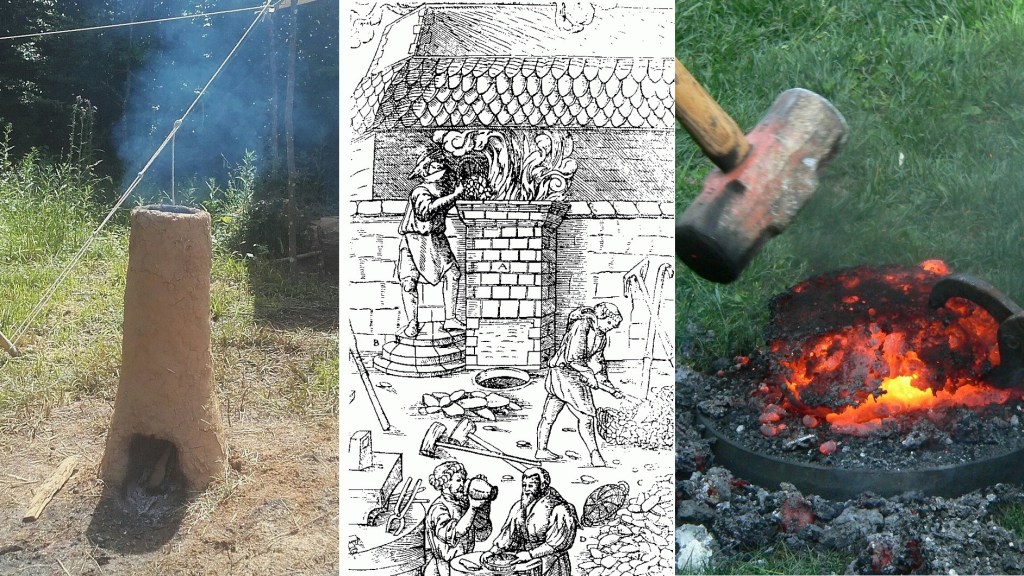
In nature, we can find only one kind of iron that’s pure enough to work with: meteoritic iron. It has to literally fall from the sky. Barring that very rare occurrence, people have to mine the earth for iron ore, which is not workable as is. To separate the iron from the ore we have to smelt it, and for that we need heat, in the form of hot charcoals. Throwing the ore on the coals won’t do much of anything, it’s not hot enough. But if we enclose the coals in a little tower built of clay, leaving holes for air flow, the temperature rises enough to smelt the ore. That’s called a bloomery.
clay bloomery / medieval bloomery / beating the bloom to get rid of the slag
What comes out of the bloomery is a bloom: a porous, malleable mass of iron (that we need) and slag (byproducts that we don’t need). By hammering the hot bloom over and over, we can get rid of the slag and at the same time turn the porous mass to something solid. And once the slag is off, by the same process we can give it a desired shape in the forge, reheating it as needed. This is called “working” the iron, hence “wrought iron” objects, i.e. forged.
a blacksmith in his forge, with bellows, fire, and anvil (English woodcut, 1603)
This is the lowest-tech version, possibly going back to ~2000 BCE in Nigeria. If we add bellows, the improved air flow will raise the temperature. So smelting happens faster and more efficiently in the bloomery, and so does heating the iron in the forge, making it easier to work with. And that’s the standard process from the Iron Age all through the middle ages and beyond (although in China they may have skipped this stage and gone straight to the next one).
If we make the bloomery bigger and bigger, with stronger and stronger bellows, we end up with a blast furnace, a construction so efficient that the temperature outright melts the iron, and it’s liquified enough to be poured into a mould and acquire the desired shape when it cools off. This is “cast iron”.
a blast furnace
So in all of this, what’s cold iron? Well, it’s iron that went though the heat and cooled off. (No heat = no iron, all you got is ore.) If it came out of a bloomery, or if it wasn’t cast, it’s by definition worked, hammered, beaten, wrought, and that happened while it was still hot.
Is there such a thing as “cold-wrought” iron? No. In fact, “working cold iron” was a simile for something foolish or pointless. A smith who beats cold iron instead of putting it in the fire shows folly, says a 1694 book on religion, so you too should choose your best tools, piety and good decorum, to educate your children and servants, instead of beating them. When Don Quixote (1605) declares he’ll go knight-erranting again, Sancho Panza tries to dissuade him, but it’s like “preaching in the desert and hammering on cold iron” (a direct translation of martillar en hierro frío).
Minor work can be done on cold iron. A 1710 dictionary of technical terms tells us that a rivetting-hammer is “chiefly used for rivetting or setting straight cold iron, or for crooking of small work; but ’tis seldom used at the forge”. Fully fashioning an object out of cold iron is not a real process – though a 1659 History of the World would claim that in Arabia it’s so hot that “smiths work nails and horseshoes out of cold iron, softened only by the vigorous heat of the sun, and the hard hammering of hands on the anvil”. [I declare myself unqualified to judge the veracity of this statement, let’s just say I have doubts.] And there is of course such a thing as “cold wrought-iron”, as in wrought iron after it’s cooled off.
Either way, in the context of pre-20th century English texts which refer to apotropaic “cold iron”, it’s definitely not “cold-wrought”, or meteoritic, or a special alloy of any kind. It’s just iron.
Fiction
The old superstition kept coming up in fantasy fiction. In 1910 Rudyard Kipling wrote the very influential short story “Cold Iron” (in the collection Rewards and Fairies), where he explains invents the details of the fairies’ aversion to iron. They can’t bewitch a child wearing boots, because the boots have nails in the soles. They can’t pass under a doorway guarded by a horseshoe, but they can slip through the backdoor that people neglected to guard. Mortals live “on the near side of Cold Iron”, because there’s iron in every house, while fairies live “on the far side of Cold Iron”, and want nothing to do with it. And changelings brought up by fairies will go back to the world of mortals as soon they touch cold iron for the first time.
In Poul Anderson’s The Broken Sword (1954), we read:
“Let me tell you, boy, that you humans, weak and short-lived and unwitting, are nonetheless more strong than elves and trolls, aye, than giants and gods. And that you can touch cold iron is only one reason.”
In Peter S. Beagle’s The Last Unicorn (1968) the unicorn is imprisoned in an iron cage:
“She turned and turned in her prison, her body shrinking from the touch of the iron bars all around her. No creature of man’s night loves cold iron, and while the unicorn could endure its presence, the murderous smell of it seemed to turn her bones to sand and her blood to rain.”
Poul Anderson would come back to that idea in Operation Chaos (1971), where the worldbuilding’s premise is that magic and magical creatures have been reintroduced into the modern world, because a scientist “discovered he could degauss the effects of cold iron and release the goetic forces”. And that until then, they had been steadily declining, ever since the Iron Age came along.
There are a million examples, I’m just focusing on those that would have had a more direct influence on roleplaying games. However, I should note that all these say “cold iron” but mean “iron”. Yes, the fey call it cold, but they are a poetic bunch. You can’t expect Robin Goodfellow’s words to be pedestrian, now can you?
RPGs
And from there, fantasy roleplaying systems got the idea that Cold Iron is a special material that fey are vulnerable to. The term had been floating around since the early D&D days, but inconsistently, scattered in random sourcebooks, and not necessarily meaning anything else than iron. In 1st Edition’s Monster Manual (1977) it’s ghasts and quasits who are vulnerable to it, not any fey creature. Devils and/or fiends might dislike iron, powdered cold iron is a component in Magic Circle Against Evil, and “cold-wrought iron” makes a couple of appearances. For example, in AD&D it can strike Fool’s Gold and turn it back to its natural state, revealing the illusion.
Then Changeling: The Dreaming came along and made it a big deal, a fundamental rule, and an anathema to all fae:
Cold iron is the ultimate sign of Banality to changelings. … Its presence makes changelings ill at ease, and cold iron weapons cause horrible, smoking wounds that rob changelings of Glamour and threaten their very existence…. The best way to think about cold iron is not as a thing, but as a process, a very low-tech process. It must be produced from iron ore over a charcoal fire. The resulting lump of black-gray material can then be forged (hammered) into useful shapes.
— Changeling: The Dreaming (2nd Edition, 1997)
So now that we know how iron works, does that description make sense? Well, if we assume that the iron ore is unceremoniously dumped on coals, it does not. You can’t smelt iron like that. If we assume that a bloomery is involved even though it’s not mentioned, then yes, this is broadly speaking how iron’s been made since the Iron Age, and until blast furnaces came into the picture. But the World of Darkness isn’t a pseudo-medieval setting, it’s modern urban fantasy. So the implication here is that “cold iron” is iron made the old way: you can’t buy it in the store, someone has to replicate ye olde process and do the whole thing by hand. Now, this is NOT how the term “cold iron” has been used in real life or fiction thus far, but hey, fantasy games are allowed to invent things.
Regardless, 3.5 borrowed the idea, and for the first time D&D made this a core rule. Now most fey creatures had damage reduction and took less damage from weapons and natural attacks, unless the weapon was made of Cold Iron:
“This iron, mined deep underground, known for its effectiveness against fey creatures, is forged at a lower temperature to preserve its delicate properties.”
— Player’s Handbook (3.5 Edition, 2003)
Pathfinder kept the rule, though 5e did not. And unlike Changeling, this definition left it somewhat ambiguous if we’re talking about a material with special composition (i.e. not iron) or made with a special process (i.e. iron but). The community was divided, threads were locked over this!
So until someone points me to new evidence, I’ll assume that the invention of cold iron as a special material, distinct from plain iron, should be attributed to TTRPGs.
Rich Burlew’s The Order of the Stick is approaching the finish line, and it’s crazy to think that it launched in 2003 as a light-hearted parody of D&D rules – starting with the transition from 3rd Edition to 3.5. It’s crazy that we’re now on strip #1262 #1295, 1295 comic strips with stick figures, 1295 punchlines, together making an amazing story which goes so beyond escapism.
OotS features one of my favourite antagonists of all time. Redcloak is a villain with an Actual Point and a hell of a backstory, and his arc, to my joy, is now coming forward. Plot-wise, I think the whole comic is Redcloak’s story – the Order reacts to his plans and machinations, and Xykon is the Big Bad only in terms of raw power, which he seeks for power’s sake. But Redcloak is a motherfucker with a cause, and a large chunk of OotS’s themes revolve around that cause.
In the most recent strip, “Two Villages”, we see the Extremely Wise bugbear (and goblinkin) Oona giving her insight on how much, and how exactly, Redcloak cares about actual living goblins.
“Intentions are sparkly, like fresh snow on mangled corpse. But little bald man is dong in his life what we bugbears are calling “living in two villages.” First village is named Doing-Very-Best-For-Goblins, where we are skipping and playing and not worrying about getting smushed by dwarf or elf. Second village is named Right-All-Along, and all the rocks and trees there are telling little bald man he is being very smart and justified.”
“Anyway, little bald man is liking both villages and is owning fancy cottage with indoor fireplace in each. Okie dokie! Villages are across river from each other. No big whoop to be living in both. Lunch in one, dinner in the other! Everyone is happy!
But problem with living in two villages is: what if one day, bridge over river is being eaten by angry dolphin? Which village will little man be living in then? Which choice will he be choosing when choosing time is here?”
Oona is not worried that Redcloak will choose his ego over his cause. Oona KNOWS he will do that, and that’s why she’s helping him and “fighting off dolphins”, so that the bridge stays intact and he never has to make that choice in the first place.
Like. Dude. The SHIT you can SAY with STICK FIGURES while being HILARIOUS at the same time, I love comics so much, I love D&D, I love fantasy, it’s amazing.
“In English, the only correct plural of ‘dwarf’ is ‘dwarfs’ and the adjective is ‘dwarfish.’ In this story ‘dwarves’ and ‘dwarvish’ are used, but only when speaking of the ancient people to whom Thorin Oakenshield and his companions belonged.”
— J. R. R. Tolkien, foreword to The Hobbit
frequency of “dwarves” vs. “dwarfs” 1930-2019, with Tolkien-related dates [Ngram Viewer graph generated by tuulikki]
“And why dwarves? Grammar prescribes dwarfs; philology suggests that dwarrows would be the historical form. The real answer is that I knew no better. But dwarves goes well with elves; and, in any case, elf, gnome, goblin, dwarf are only approximate translations of the Old Elvish names for beings of not quite the same kinds and functions.”
— J. R. R. Tolkien, to the editor of the ’Observer’, 1938
“[T]he printing is very good, as it ought to be from an almost faultless copy; except that the impertinent compositors have taken it upon themselves to correct, as they suppose, my spelling and grammar: altering throughout dwarves to dwarfs; elvish to elfish; further to farther; and worst of all, elven – to elfin. I let off my irritation in a snorter to A. and U. [George Allen and Unwin, Tolkien’s publishers in London] which produced a grovel.”
— J. R. R. Tolkien, from a letter to Christopher Tolkien, 1953
Oof.
D&D used the spelling “dwarves” from the start (along with other Tolkien ideas, such as hobbits, only later renamed to halflings for obvious reasons). Before the start, even. In 1972 Gygax published Chainmail, which was a wargame and not an RPG, but it included a fantasy supplement and it had stats for dwarves and hobbits. From 1974 on, all D&D publications (AFAIK) spell it “dwarves”.
It is debatable how much impact that had, and it’s tempting to guess “none at all”, given the HUGE overlap of “D&D players” and “people who’ve read Tolkien anyway”, and how recently D&D became mainstream enough to make a dent anywhere. But I think that would be ignoring D&D’s indirect impact via other media (official or otherwise), from Forgotten Realms novels to video games to webcomics to Critical Role, which reached a reasonably large audience NOT exclusively comprised of Tolkien readers. Anecdotally (but I think not weirdly for non-anglophone countries), I played D&D before I read Tolkien, and in fact that’s why I read Tolkien, thanks to D&D osmosis – and for a long time I totally thought that “dwarves” was the only spelling lol.
The graph is from google’s Ngram Viewer, it only takes printed sources into account, so no internet-only material. Here’s an updated version with 2 corpora, English fiction (there are more dwarves than dwarfs here, hah!) and English in general, plus a few extra dates.
frequency of “dwarves” vs. “dwarfs” 1930-2019, with Tolkien- and D&D-related dates [Ngram Viewer graph]
Brawler rogues, thuggish rogues, rogues who fight with improvised weapons and/or unarmed strikes, and rogue/monk combos are common and popular character concepts. Well, class concepts really. For the purposes of making it work with sneak attack rules, which arguably include needless restrictions, people have been unearthing and/or homebrewing variants for ages. In D&D 5e, all it takes it a teeny houserule: sneak attack damage applies to unarmed strikes (or whatever weapon your thug uses; in one game I had extreme success and heaps of fun bludgeoning people with a crowbar). And that’s it. You tweak the rules just a little bit, and now you can go forth and be a sneak-attacking brawler, thug, whatever you want.
Of course, you need DM approval, but technically you need DM approval for everything. Rule Zero rules all, and this is about how to use Rule Zero to make the game better for all your players.
That said, weapon proficiencies are a part of the class system, and the whole thing is a tradeoff anyway: ALL class features restrict the player’s choices (you choose from these weapons, these skills, these abilities, these spells; if you could pick whatever you want, you’d play a classless system), and in return you get an archetype: a pack of flavour with pre-calculated balance in its mechanics (at least theoretically; I am well aware this doesn’t always work out in practice).
I like class systems. Given how much I adore character customisation, and fiddling with options and tweaking the rules, perhaps I shouldn’t, but I really do. It gives me a cool starting point, and from there I can fuck things up and adjust them to my preferences. Classless systems are cool too, but at the end of the day… this is a blog for Rogues. Not for sneak attack plus evasion or whatever. So for me at least, the archetype is the pull, and the rest is bookkeeping.
An archetype often means different things to different people, and each player (and DM) might have different tolerance on how much deviation from the rules is acceptable for a given game and setting. You may be okay with a mace-wielding rogue, but what about a greataxe-wielding rogue? Isn’t that too much? (Too much for what?) Does it maybe depend on circumstances, the setting, the character concept? I think it 100% should. If you play with a class system, you can be flexible with it, but on a case by case basis. (Unless you go revise the whole system and effectively replace the PHB with your own creation, which, good luck! I’m not being ironic, honestly, good luck! It sure needs an overhaul, and that 5.5 which WotC is currently concocting is 20% hit and 80% miss.)
For example: the most unconventional sneak attacker I’ve played was a girl with a glaive. However, the flavour was very specifically a former gladiatrix, which, at least in our eyes, perfectly justified the image of fighting dirty (i.e. sneak attacking) with a non-finesse two-handed reach weapon. BUT, at no point did I say “well if it’s allowed for THAT character concept, it should always be allowed for all rogues!”. It was suggested (and accepted) only as part of that specific character, and not as a general houserule to be adopted from now on. The general rule exists already and it’s called Rogue. And happy as I am to fuck with it, I like that it exists, restrictions, warts, and all. 🙂
tl,dr; restrictions are annoying, but they’re an integral part of the class system; feel free to ignore a restriction which ruins your fun or character concept for no reason; but if ALL restrictions annoy you, consider switching to a classless system
There’s an idea floating around that “thieves cant is essentially coded messages, probably based on references and stuff, so it’d be SUPER regional”. The logical conclusion is that a traveling rogue would have to learn the local culture before understanding the references, and that’s indeed pretty funny.
And you could do that! One modest option is to assume that only a few terms are different, so you can mostly communicate but misunderstandings can still happen.
But historically, cants weren’t really regional, because they were mostly used by people on the road, vagrants and vagabonds and itinerant workers and such. Think hobo signs and hobo slang: the whole point is to communicate with people who came from elsewhere, and don’t have the same references as you. Some cants were geographically MORE widespread than local languages. For example, Rotwelsch was spoken by various marginal groups in Germany, Austria, Switzerland, and Bohemia.
Without looking it up right now, I believe the English cant had very few regional, local references, and those mostly involved prisons or execution sites. Like, “Tyburn tippet” meant noose: a tippet is a scarf-like garment worn by anglican priests, and Tyburn was a gallows. A bunch of terms refernce it, both directly and indirectly (“to go to Holborn Hill” = to hang, because this hill was on the way there from London, “Paddington Fair day” = execution day, because it was in the parish of Paddington, etc). But everyone knew Tyburn, and especially everyone who spoke cant. There were also terms that referenced the Newgate prison, the executioner Jack Ketch, and so on, but again, all these were famous all over Britain, and not obscure local knowledge.
On the other hand, a French argot-speaking rogue would find English cant mostly unintelligible, though some words come from Romance languages or Romani, so they’d have a headstart learning it, at least. But of course, here we get to the larger issue of languages in D&D settings, and to the absurdity of Universal Common — a worldbuilding atrocity that I’m happy to handwave because it facilitates gameplay and makes the story go. (Seriously, Common makes no sense at all if you think about it, but whatchagonna do? Never travel to or meet anyone from a different country? Preposterous! We’re hopping to other planes here, surely we can make it to the equivalent of France!)
So anyway, if you want to introduce some regional differences in thieves’ cant in your game because you dig it, that’s great! But if you’re only doing it for the verisimilitude, you don’t really have to, and I think you shouldn’t go overboard either way. Don’t screw the Rogue!
As I’ve said before, thieves’ cant in D&D works better when you think of it like its historical counterpart: it’s not the language of thieves, it’s the language of people in the margins. Including but not limited to thieves.
The Dumb Fighter is a D&D cliché, a trope, we can even say it’s an unofficial term, like “meatshield”. So is it a justified cliché? Not in recent editions, but earlier yes, I think it was.
cartoon by Will McLean, probably mid ’70s to early ’80s
For starters, in early editions you didn’t choose your stats, you rolled them, in order, 3d6 for each. If you wanted to play a Fighter (or Fighting-Man, in OD&D) and rolled STR 4, you just didn’t play a fighter. If you rolled STR 15 and INT 4, you proceeded.
Second and VERY important, in OD&D and Basic you could fiddle with some of your rolled stats, and reduce one to increase another, but not on a 1:1 basis. Fighters could lose 2 points of INT to gain 1 point of STR, and having a higher STR affected almost everything for fighters including XP, so they had a strong incentive to do it.
It’s not just about the math though: Thieves could also lower their INT to raise their DEX, and yet “dumb Thief” has never been a trope or term in D&D. I think the reasons for that are obvious. People choose to play Fighters to be badass and hit things. People choose to play Thieves (or Rogues) to be smartass and steal things. It ain’t rocket science. 🙂
D&D tropes have a lot of inertia, they remain strong in the collective imagination long after the reason they came to be is gone. AD&D didn’t keep all these rules, people could also assign rolled scores to their stats, choosing which are high and which are low. With this arrangement, Fighters only dumped INT if they chose to. (And you know what? They often did.) AD&D also had minimum scores, and the Paladin (originally a Fighter subclass) had the strictest prerequisites: STR 12, INT 9, WIS 13, CHA 17. I theorise that Intelligence was included because otherwise Paladins would end up dumber than their horse. In any case, that left vanilla Fighters NOT required to be smarter than their Intelligent magic sword, and you know what? They often weren’t. Partly for optimisation reasons (you got more benefits from keeping your other stats high, CHA affected NPC reactions and henchmen, WIS affected saving throws, and all INT gave a non-caster was languages), and partly for roleplaying reasons (real-life fighting may be about tactics, but strategic players weren’t necessarily attracted to Fighters, not with these rules, which gave them ONE option and that option was to hit it again).
Then came 3rd Edition, which was complicated. There were 173 splatbooks and a million rules. There were tons of feats, and all the Fighter got was feats. There were hundreds of classes and prestige classes, many of them combat-oriented, and multiclassing was easy. Point-buy became a popular method of generating ability scores, which meant that once again people could reduce their INT to boost their STR if they do pleased. And optimisation became a science, peer-previewed in dedicated forums.
At that point, if all you wanted to do was hit it again, you played a Fighter, dumped Intelligence to boost your physical stats, and took Power Attack and similar feats. If you wanted tactical combat, you could do it, but then Fighter was a dip class. You’d take 2 or 4 levels tops for the extra feats, and then you had much better options, some of which were INT-based. You COULD build a strategic Fighter by choosing the right feats, a charger, or a tripper, or someone who focuses on attacks of opportunity, but there were few good combos, and some didn’t need INT at all, while others had Combat Expertise and required INT 13. That was basically the smartest “normal” Fighter.
So the dumb Fighter trope remained. Mind you, it wasn’t dumb warrior in general. People who wanted to fight smart had plenty of options, but playing a single-class Fighter was not the best or the most common, and even then a high INT was not required.
…At least in some circles. One very famous fighter is Roy Greenhilt, from The Order of The Stick, and he has “a very good Int” (number not stated, but fans have calculated it’s 14 to 17). This is noted to be unusual, considered suboptimal for Fighters, and whatchagonnado with it anyway?
Well I’ll tell you. I’ll figure out which columns are load-bearing, entice you to hit them using myself as bait, and bring the whole building down on your head, you oaf!
Basically, Roy was Rich Burlew’s vehicle to push back against the dumb Fighter trope, to remind us that they don’t have to be stupid and/or useless, and that copying an optimisation handbook is not the only way to build a character and play the game. 🙂
5th Edition is another animal altogether. If we only look at base classes, Fighters have no incentive at all to boost their intelligence, but neither does anyone else (except INT-based casters). All INT gets you now is a rarely rolled saving throw and some skills. It doesn’t affect how many skills or languages you get any more, so not even skillmonkeys are beholden to it, unless they focus on INT-based skills. Uncharitable but not entirely undeserved wording: in 5e, “dumb Fighter” isn’t much of a trope because everyone is dumb.
Once we look at subclasses though, the picture changes. There are actually more martial archetypes that have something to do with Intelligence than there are roguish archetypes! (For me this is an affront.) Eldtritch Knights are INT-based half-casters, Arcane Archers get INT-based trick shots, Psi Warriors get a bunch of stuff. For comparison, the roguish archetype named “Mastermind” gets zero mechanical benefits from a high INT, the Inquisitive is good with the Investigation skill, and the Arcane Trickster is the INT-based half caster.
As for tactical combat, Fighters are in the lead here. Battle Masters get manoeuvres, and (perversely, if you ask me) no one else does, not even Swashbucklers. Tasha’s Cauldron of Everything has an optional rule where all Fighters, regardless of archetype, also get a single manoeuvre, as a treat. Various martial archetypes come with various combat options.
Of course, it’s very easy, and not uncommon, to play a Fighter who does nothing but hit it again. Fighters excel in that, what with Action Surge and a million Extra Attacks. However, if that’s all you do and/or if you dumped Intelligence, then it’s clear you chose to be a dumb Fighter. The system didn’t push you. You had other options, and you didn’t take them.
So by now the “dumb Fighter” trope is a bit of a relic. It’s a lot more undeserved now than it was in the 1970s. It hasn’t died out, though. One reason is inertia, people hear an old cliché and repeat it and perpetuate it. But another reason, which I think is important, is that at the end of the day, despite all the available options, most people who play D&D just want to be badass and hit things: the most popular choice of species/class has always been and still remains “Human Fighter”.
Personally I prefer to be smartass and steal things, but to each their own.
“Rule 0” is an unofficial term for a fundamental aspect of tabletop role-playing games: the DM’s word is Law. Some games have no referee at all, but if there is such a thing as a Dungeon Master, Game Master, Storyteller, etc, then what they say goes.
This can mean two things. The first is “what they say goes, as opposed to what the players say”. Someone has to be the final arbiter on how rules are interpreted and what happens in game. And if the DM says Rocks Fall Everyone Dies, well, rocks do fall and everyone does die. (And whatever led to that should be addressed out of game.)
The second is “what they say goes, as opposed to what the rulebooks say”. As far as I know, no RPG designer has ever had the gall to claim that the rules are final and you shouldn’t change anything. Sometimes it’s left unsaid (and probably considered obvious), but most of the time rulebooks explicitly state that the DM (Game Master, Storyteller, etc) can change the rules. The attitude varies, ranging from “rules are a suggestion! do what you want!” to “you can make changes BUT take into account this and that”.
I find it interesting that D&D 3rd Edition is the most stringent in this regard. It doesn’t say “change the rules as you see fit”, it rather says “well if you must change the rules, do it right”. It makes sense, I guess: that edition was BIG on simulation, and having rules for every little thing. Like, you can calculate how many hit points the wall has, depending on size and material. That means the DM can tell how many punches it takes to break each specific wall, since unarmed attacks deal damage to objects (half dmg, but still). It also suggests that the DM shouldn’t say “you punched the wall? okay, your knuckles bleed, it hurts like hell, and the wall is fine”, which for some styles of play is in fact unfortunate, because that’s exactly what the DM should say.
(There’s no right or wrong here, different strokes for different folks, and every system caters to different needs.)
I also find it interesting that the very similar Pathfinder is conversely generous, and singles out Rule Zero as “The Most Important Rule”. This also makes sense, given that Pathfinder is essentially a house-rules project that got out of hand.
In any case, here’s a selection of different ways to say “the rules are a suggestion”.
Original D&D (1974)
“These rules […] remain flexible. As with any other set of miniatures rules they are guidelines to follow in designing your own fantastic-medieval campaign. They provide the framework around which you will build a game of simplicity or tremendous complexity — your time and imagination are about the only limiting factors.”
— Dungeons & Dragons Book I: Men & Magic
Basic D&D (aka Eric Holmes’s revision, 1977)
“Instructions for the game referee, the “Dungeon Master,” are kept to the minimum necessary to allow him to conduct basic games. This is absolutely necessary because the game is completely open-ended, is subject to modification, expansion, and interpretation according to the desires of the group participating, and is in general not bounded by the conventional limitations of other types of games.”
— Dungeons & Dragons Basic Set
AD&D (1979)
“The final word, then, is the game. Read how and why the system is as it is, follow the parameters, and then cut portions as needed to maintain excitement. […] The game is the thing, and certain rules can be distorted or disregarded altogether in favor of play.”
— Dungeon Masters Guide
Basic D&D: B/X (aka Tom Modvay’s revision, 1981)
“In a sense, the D&D game has no rules, only rule suggestions. No rule is inviolate, particularly if a new or altered rule will encourage creativity and imagination. The important thing is to enjoy the adventure.”
— Dungeons & Dragons Basic Rulebook
Basic D&D: BECMI (aka Frank Mentzer’s revision, 1983)
“You may use all or part of these rules. They often include several ways of playing and running the game. You may create new rules, monsters, and magic, using these rules as guidelines.”
— Dungeons & Dragons Fantasy Roleplaying Game Set 1: Basic Rules
AD&D (2nd Edition, 1989)
“Take the time to have fun with the AD&D rules. Add, create, expand, and extrapolate. Don’t just let the game sit there, and don’t become a rules lawyer worrying about each piddly little detail. If you can’t figure out the answer, MAKE IT UP! And whatever you do, don’t fall into the trap of believing these rules are complete. They are not. You cannot sit back and let the rule book do everything for you. Take the time and effort to become not just a good DM, but a brilliant one.”
— Dungeon Master Guide
D&D (3rd Edition, aka 3.0, 2000)
“Changing The Rules: Beyond simply adjudicating, sometimes you are going to want to change things. That’s okay. However, changing the rules is a challenge for a DM with only a little experience.”
— Dungeon Master’s Guide
Note: I won’t quote the whole thing, but it goes into some length on what to consider before changing a rule. I’m gonna bet that when they suggested you ask yourself “How will the change impact other rules or situations” they hadn’t predicted that 3rd Edition would end up with 215 books full of interconnected rules, NOT including adventures and periodicals.
D&D (Version 3.5, 2003)
“The power of creating worlds, controlling deities and dragons, and leading entire nations is in your hands. You are the master of the game—the rules, the setting, the action, and ultimately, the fun. This is a great deal of power, and you must use it wisely.”
— Dungeon Master’s Guide
Note: I won’t quote the whole thing, but it says there are different styles of play, and if you like combat-oriented games you should be “very careful about adjudicating rules and think long and hard about additions or changes to the rules before making them”, whereas if you’re into deep-immersion storytelling, rules become less important: “feel free to change rules to fit the player’s roleplaying needs. You may even want to streamline the combat system so that it takes less time away from the story.” Or you can go for something in between.
Deadlands (Revised Edition, 2004)
“The rules in the Weird West Player’s Book are fairly detailed. […] Characters need all that detail because they can’t cheat. But you’re the Marshal. You can do whatever the Hell you want to, and that’s official partner.”
— The Marshal’s Handbook
GURPS ( Revised Third Edition, 2004)
“The GM is the final authority. Rules are guidelines … the designer’s opinion about how things ought to go. But (as long as he is fair and consistent) the GM can change any number, any cost, any rules.”
— GURPS Basic Set
D&D (4th Edition, 2008)
“If you disagree with how the rules handle something, changing them is within your rights.”
— Dungeon Master’s Guide
Pathfinder (1st Edition, 2009)
“The Most Important Rule: The rules in this book are here to help you breathe life into your characters and the world they explore. While they are designed to make your game easy and exciting, you might find that some of them do not suit the style of play that your gaming group enjoys. Remember that these rules are yours. You can change them to fit your needs.”
— Pathfinder Roleplaying Game Core Rulebook
D&D (5th Edition, 2014)
“The D&D rules help you and the other players have a good time, but the rules aren’t in charge. You’re the DM, and you are in charge of the game.”
— Dungeon Master’s Guide
Vampire: The Masquerade (5th Edition, 2018)
“If the rules in this book interfere with your enjoyment of the game, change them.”
— Vampire: The Masquerade (5V corebook)
Legend of the Five Rings (5th edition, 2018)
“Your Game, Your Rokugan: This game is designed to support numerous styles of play and, as GM, you are empowered to jettison, rework, or simplify rules as you desire.”
— Legend of the Five Rings Core Rulebook
Pathfinder (2nd Edition, 2019)
“As Game Master, you have the final say on how the world and rules function.”















 Roguish