
A mixtape of execution ballads and assorted tales of guilt, wrath, terror, and defiance on the gallows, where all men are brothers. [on spotify]
21 tracks / 1h 15min in full (spotify lacks one song)
1. Hans Zimmer – Hoist The Colours

Heave ho
thieves and beggars
never shall we die
What a heartbreaking thing to say on the scaffold. But we have to start with theatrics and a drum roll, and our introduction needs no introduction.
2007, from Pirates of the Caribbean: At World’s End OST
lyrics: Ted Elliott & Terry Rossio
music: Hans Zimmer & Gore Verbinski

2. Shirley Collins – Tyburn Tree (Since Laws Were Made)
Next stop, Tyburn: England’s most notorious gallows. In The Beggar’s Opera, the highwayman Macheath (later also known as Mack the Knife) observes that if they hanged rich criminals like they hang the poor ones, “‘twould thin the land”. Shirley Jackson subtly changed this to the better.
Since laws were made for ev’ry degree
to curb vice in others as well as me,
I wonder there’s no better company
on Tyburn Tree.
But since gold from laws can take out the sting,
and if rich men like us were to swing,
it would rid the land their numbers to see
upon Tyburn Tree.
recorded 1966, released 2002 in Within Sound
lyrics: John Gay, from The Beggar’s Opera, 1728
music: traditional (“Greensleeves”), 16th century

3. Joan Baez – Long Black Veil
A country ballad about a man falsely accused of murder, who lets himself get dragged to the gallows because he won’t reveal his alibi: an affair with his best friend’s wife. It’s been covered by a million people, here’s Baez live.
The scaffold is high, eternity near,
She stands in the crowd, she sheds not a tear,
But sometimes at night, when the cold winds moan,
In a long black veil she cries o’er my bones.
1963, from In Concert Part 2
lyrics & music: Lefty Frizzell, 1959

4. Oscar Isaac with Punch Brothers & Secret Sisters – Hang Me, Oh Hang Me
A poor boy who got “so damn hungry he could hide behind a straw”, made his last stand with a rifle and a dagger, and has been all around this world, and is positively done with it.
They put the rope around my neck, they hung me up so high
Last words I heard ’em say, won’t be long now ‘fore you die
Hand me, oh hang me, and I’ll be dead and gone
Wouldn’t mind the hanging, but the laying in the grave so long
2015, from Another Day, Another Time: Celebrating the Music of “Inside Llewyn Davis”, after Oscar Isaac’s rendition in Inside Llewyn Davis, 2013, in turn after Dave Van Ronk’s rendition in Folksinger, 1962
lyrics & music: traditional American/unclear origin, folk song with various titles (I’ve Been All Around This World, The Gambler, My Father Was a Gambler, The New Railroad), first recorded by Justis Begley, 1937

5. Chapel Hill – Seven Curses
Cover of a Bob Dylan song, telling us the dark tale of a judge who’s about to send a man to the gallows for stealing a horse, promises his daughter he’ll show clemency if she agrees to sleep with him, and then reneges on his promise.
The next morning she had awoken
to know that the judge had never spoken
she saw that hanging branch a-bending
she saw her father’s body broken
These be seven curses for a judge so cruel
2013, from One For The Birds
lyrics inspired by Judy Collins’s “Anathea” (1963), in turn inspired by the traditional Hungarian ballad “Feher Anna”, who curses the judge “thirteen years may be lie bleeding”
lyrics & music: Bob Dylan, recorded 1963, released 1991 in The Bootleg Series

6. Ewan MacColl – Go Down Ye Murderers
A song about Timothy Evans, a man accused of murdering his wife and child, which he denied until his last breath. They convicted him and hanged him in 1950. He was 25 years old. Three years later the real murderer, his neighbour John Christie, confessed, and the case played a major role in abolishing capital punishment in the UK.
The rope was fixed around his neck, and the washer behind his ear
And the prison bell was tolling but Tim Evans did not hear
Sayin’ go down, you murderer, go down
They sent Tim Evans to the drop for a crime he didn’t do
It was Christy was the murderer, and the judge and jury too
Sayin’ go down, you murderers, go down
1956, from Bad Lads and Hard Cases: British Ballads Of Crime And Criminals
lyrics & music: Ewan MacColl

7. Jennifer Lawrence – The Hanging Tree
One of the stranger things that can happen at the hanging tree is camaraderie. “On the gallows tree, all men are brothers”, to quote A Feast for Crows, and when the state murders, then in defiance, an execution ballad can become a protest song. Many have in real life, this one is fiction, from The Hunger Games. Wisely, the director asked the composer for a simple tune, nothing elaborate, something that could be “sung by one person or by a thousand people”.
Are you, are you coming to the tree?
Wear a necklace of rope side by side with me
Strange things have happened here, no stranger would it be
If we met at midnight in the hanging tree
2014, from The Hunger Games: Mockingjay – Part 1 OST
lyrics: Suzanne Collins
music: James Newton Howard
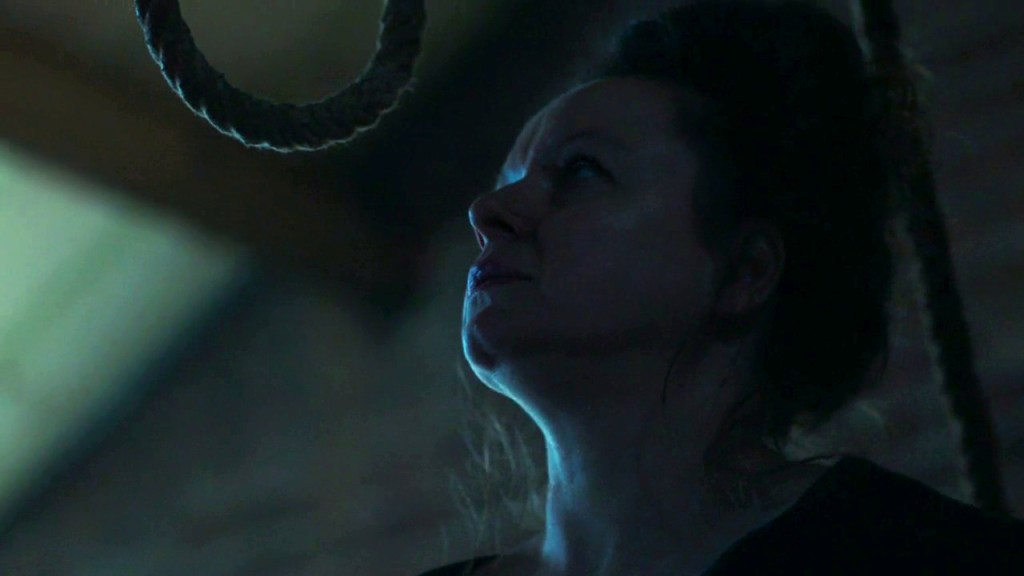
8. Let’s Play Dead – Heaven and Hell
A fairly traditional execution ballad written recently for the series Harlots. Margaret Wells sings it to herself for consolation and courage, as she sits alone in a cell, waiting to get dragged to the gallows.
I’m no more a sinner than any man here
I’m no less a saint than the priest at god’s ear
But now I am snared, they will punish me well
With a ladder to heaven and a rope down to hell
2018, from the single Heaven and Hell, for Harlots Season 2 Episode 7
lyrics & music: Let’s Play Dead

9. Odetta – Gallows Pole
Probably the most well-known execution ballad of the 20th century, thanks to several iconic renditions. This one remains my favourite.
Hangman, hangman, slack your rope, slack it for a while
I think I see my father coming, riding many a mile
Papa did you bring me silver, did you bring me gold?
Or did you come to see me hanging by the gallows pole?
1960, from At Carnegie Hall
lyrics & music: traditional (Child 95 / Roud 144), known under many other titles (“Hangman”, “The Maid freed From the Gallows”, “The Prickle-Holly Bush”); this version is directly influenced by Lead Belly’s “Gallis Pole” (1930s), and they both informed Led Zeppelin’s 1970 version

10. Johnny Cash – 25 Minutes to Go
Peak gallows humour, uproariously funny and defiant, and somehow still conveying the terror of a man who’s about to die and emphatically doesn’t want to. Performed live at Folsom Prison.
Then the sheriff said boy I’m gonna watch you die, 19 minutes to go
So I laughed in his face and I spit in his eye, 18 minutes to go
Now here comes the preacher for to save my soul, 13 minutes to go
And he’s talking about burning but I’m so cold, 12 more minutes to go
1968, from At Folsom Prison
lyrics & music: Shel Silverstein, from his 1962 album Inside Folk Songs

11. Johnny Cash – Sam Hall
A classic execution ballad with many versions (see here for its complicated history), some of which are stoic and dignified, and others humorous. But this one brims with rage. Sam Hall will not be repenting on the gallows, and he’ll see you all in hell.
My name it is Sam Hall and I hate you one and all
And I hate you one and all, damn your eyes
2002, from American IV: The Man Comes Around
lyrics & music: : traditional, 18th century broadside ballad, Roud 369

12. Nick Cave & The Bad Seeds – Up Jumped the Devil
A song about a man doomed from the start to play the villain’s part, and the origin of this blog’s #swinging from the gallows tree tag.
Who’s that hanging from the gallow tree?
His eyes are hollow but he looks like me
Who’s that swinging from the gallow tree?
Up jumped the Devil and he took my soul from me
1999, from Tender Prey
lyrics: Nick Cave
music: Nick Cave & The Bad Seeds

13. Dead Rat Orchestra – The Black Procession
[Not on Spotify, here’s a Bandcamp link] This ballad imagines a sinister procession of 20 criminals (black tradesmen brought up in hell!), each with their own specialty (it’s mostly thieves of some sort), on the way to the gallows. The last and worst of them is the thief-catcher, and if one of them is innocent, they’ll all go free. But of course none of them are. It’s written in thieves’ cant (lyrics and more context here), and the chorus means: “Look well, listen well, see where they are dragged, up to the gallows where they are hanged.”
Toure you well; hark you well, see where they are rubb’d,
Up to the nubbing cheat where they are nubb’d.
2015, from Tyburnia: A Radical History Of 600 Years Of Public Execution
lyrics: from The Triumph of Wit by J. Shirley, 1688
music: Robin Alderton, Daniel Merrill & Nathaniel Robin Mann

14. John Harle & Marc Almond – The Tyburn Tree
And where does the Black Procession lead? To Tyburn, of course. The dark gothic side of Marc Almond.
The Tyburn Tree, I weep for thee, blood in the roots
‘Tis not a tree with bark and leaves of spring awakening
‘Tis not a tree with blossom and fruit, ’tis not a tree
No boughs to bend beneath the unruly breath of winter
No memories of woods warmed by spring’s sweet touch
‘Tis not a tree — take a ride to Tyburn and dance the last jig
2014, from The Tyburn Tree (Dark London)
lyrics: Marc Almond
music: John Harle

15. CocoRosie – Gallows
Speaking of dark and gothic.
They took him to the gallows, he fought them all the way though
And when they asked us how we knew his name
We died just before him, our eyes are in the flowers
Our hands are in the branches, our voices in the breezes
And our screaming is in his screaming
2010, from Grey Oceans
lyrics & music: Sierra Rose Casady & Bianca Leilani Casady

16. The Tiger Lillies – Hang Tomorrow
In their Two Penny Opera, the pioneers of dark cabaret reimagine Brecht’s Threepenny Opera, and take all the suaveness out of Mack the Knife. Here they also take all the fight out of him. What’s even left? A pathetic empty husk, a bastard (let’s not forget that Brecht’s MacHeath is no rogue with a heart of gold, he’s a horrible man) who can’t even be intriguing. How disturbingly pedestrian.
So here I am in jail again, oh god it stinks of piss
I’ve been in here since I was young, so I can reminisce
It’s looking rather grim this time, it’s looking rather bad
But if I swing tomorrow in some ways I’ll be glad
2001, from Two Penny Opera
lyrics & music: Martyn Jacques

17. Tom Hollander – Ballad In Which MacHeath Begs All Mens’ Forgiveness
In The Threepenny Opera, Mack the Knife stands on the scaffold and asks for pity. No point being judgmental now, that he’s about to die. He morbidly describes how his dead body will end up, and then he lashes out at everyone, cops and criminals (same difference), while still begging them all for forgiveness. Very VERY sarcastically. The ballad’s concept is borrowed from François Villon (see below), and this translation is unusually bold (honorific, see here and here for other translations and context).
You crooked cops with your Mercedes,
your mobile phones, your trendy jackets,
your cuts from drugs and dice and ladies,
your Scotland Yard protection rackets.
Let heaven smash your fucking faces,
slash you and let the blood run free
and break you in a thousand places.
I’ve pardoned you. You pardon me.
1994, from The Threepenny Opera – Donmar Warehouse Original Cast
lyrics: Bertolt Brecht 1928, loosely inspired by François Villon’s “Ballad of the Hanged” c. 1489, translated by Jeremy Sams 1994
music: Kurt Weill 1928

18. Saga de Ragnar Lodbrock – Ballade des pendus
And here’s the OG Ballad of the Hanged, written in the 15th century by the OG poète maudit, François Villon (translation here). It paints an indelible picture of strung up corpses swaying in the wind, decaying, pecked by birds, ravaged by the elements and time. And crucially, it’s in the first person. The hanged speak, begging their fellow-humans for pity, and god for forgiveness.
Frères humains, qui après nous vivez,
N’ayez les cœurs contre nous endurcis,
Car, si pitié de nous pauvres avez,
Dieu en aura plus tôt de vous mercis.
Vous nous voyez ci attachés, cinq, six:
Quant à la chair, que trop avons nourrie,
Elle est piéça dévorée et pourrie,
Et nous, les os, devenons cendre et poudre.
De notre mal personne ne s’en rie;
Mais priez Dieu que tous nous veuille absoudre!
recorded 1979, released 1999 in the Saga de Ragnar Lodbrock reissue
lyrics: François Villon, c. 1489
music: Saga de Ragnar Lodbrock

19. Nick Cave & The Bad Seeds – The Mercy Seat
Honorary inclusion, a song not about hanging: the mercy seat is the electric chair. But the lyrics are a punch and this is a torrent of a song, a whirlwind, a masterpiece, a 7-minute cynic snarl. So it couldn’t possibly get left out of this compilation.
And the mercy seat is awaiting, and I think my head is burning
And in a way I’m yearning to be done with all this measuring of proof
An eye for an eye and a tooth for a tooth
(a life for a life and a truth for a truth)
And anyway I told the truth, and I’m not afraid to die
(and I’m afraid I told a lie)
1999, from Tender Prey
lyrics: Nick Cave
music: Nick Cave & Mick Harvey

20. Graveyard Train – Ballad For Beelzebub
And after? Welcome to Hell, ladies and gents, and bards. (Bards are rogues, too.) The Graveyard Train play a kind of Southern Gothic (but very southern, they’re Australian), and here they entertain the thought of a band that ends up in hell and has to keep playing, without end, for an audience that can’t hear. What a bleak prospect.
Well the air on the stage is burning our lungs
And we’re all going deaf from the beating drums
And you can’t see a thing for all the blood and the sweat in our eyes
Well we played till we died, and now we’re all dead
But the Man says we got to get up there again
And you can’t come down till the brimstone turns to ice
2008, from The Serpent And The Crow
lyrics & music: Graveyard Train

21. Samuel Kim feat. Colm R. McGuinness – Hoist the Colours
Yo ho, all together
Hoist the colours high
Heave ho, thieves and beggars
But we won’t end in hell. The only acceptable ending to this compilation is the triumphant version (wait for it) of its beginning: a pirate’s end. Traditionally the gibbet, yes, but also the ghost ship that still sails, the ripple that still travels, and the story that still gets told.
Did I stutter the first time?

 Roguish