Time for another article where I give quick breakdowns of supplements I’ve looked at lately. This time, it’s mostly Basic Roleplaying-based, with supplements for RuneQuest, Pendragon, BRUGE, and Age of Vikings, but I also dip into the grim darkness of the far future to see what’s going on with Imperium Maledictum.
The Gods of Fire and Sky (RuneQuest)
This is the latest volume in the Cults of RuneQuest supplement series; this one covers the pantheon ruled over by the sun-emperor Yelm, whose members take in everything from abstract illumination through to humble cooking fires. Some of these deities have been alluded to in other volumes in the series; The Lightbringers, for instance, is defined in part by the constituent gods’ involvement in the Lightbringer’s Quest to bring Yelm back from the underworld after Orlanth, the lead Lightbringer, killed him in the mythic before-time and came to badly regret the consequences.
However, there is a very clear logic to why these deities have been put into this book: the pantheon as a whole represents a particular cultural outlook, rooted in Dara Happa and with outposts elsewhere, which offers a direct contrast to the outlook presented in books like The Lightbringers. Indeed, the Yelmian version of the narrative has a rather different emphasis, in which the divine justice doled out by Yelm is so potent that it reached out beyond the grave and caused his killers to die, recasting the Lightbringer’s Quest less as an epic journey and more as a penitential pilgrimage of Orlanth and his co-conspirators to apologise to Yelm for being bad, and for Orlanth to sacrifice himself to bring Yelm back.
The Sutra of Pale Leaves is a Call of Cthulhu campaign set in 1980s Japan and sold in two volumes – Twin Suns Rising and Carcosa Manifest. Rather than being developed in-house by Chaosium, the project was spearheaded by the Sons of the Singularity, an indie RPG design house which has put out several products under its own name. The founder Sons of the Singularity are Jason Sheets and Jesse Covner, two Americans who met whilst working in China, but they have ample connections to Japan (Covner in particular following up his 15 years in China with a 7 year stint working in Japan); their design team for this project also includes people from a range of backgrounds, from local Japanese designers to expatriate Anglophone gamers.
This puts The Sutra of Pale Leaves in a particularly advantageous position when it comes to presenting an English-language RPG supplement for gaming in Japan. Having a mixture of people born and raised there and more recent immigrants means that the team is not only steeped in the culture, but can also get a handle on what aspects particularly need to be explained to outsiders without prior exposure (or whose encounters with Japanese culture are limited to some anime and manga).
On top of that, all of the participants are well-placed to take a look at Japan’s thriving Call of Cthulhu play community and draw on innovations originating there, whilst at the same time being steeped enough in English-language materials for the game that they know how Chaosium typically presents their products and how Anglophone readers expect scenarios to be presented – so they can act as intermediaries not just on the level of national culture, but also in terms of the different roleplaying subcultures they hail from.
Handsomely presented with gorgeous cover art and hardcover presentations in trade dress which allows them to sit seamlessly next to your 6th edition Pendragon collection, the new “Pendragon lore” releases from Chaosium consists of two extremely useful reference works used by Greg Stafford in devising the game in the first place, and useful to referees and anyone researching Arthurian myth in general.
Le Morte d’Arthur is Thomas Malory’s epic summation of the body of Arthurian myth as it existed in the 15th Century, a work which both encapsulates how diverse the preceding Arthurian sources really are and ended up becoming the touchstone for numerous major works thereafter, from Pendragon itself to John Boorman’s Excalibur to T.H. White’s The Once and Future King and so on and so forth. This version adds marginal notes from Arthurian scholar John Matthews and from Greg Stafford himself (Greg having fortunately finished these prior to his untimely passing in 2018), as well as a short foreword from Michael Moorcock. The Arthurian Companion is Phyllis Ann Karr’s encyclopaedia of Arthurian concepts, delivered along with a set of excellent essays on the subject, which has been put out in various editions, having been originally commissioned by Greg Stafford as part of the research process for an Arthurian boardgame before it then got used extensively in preparing Pendragon.
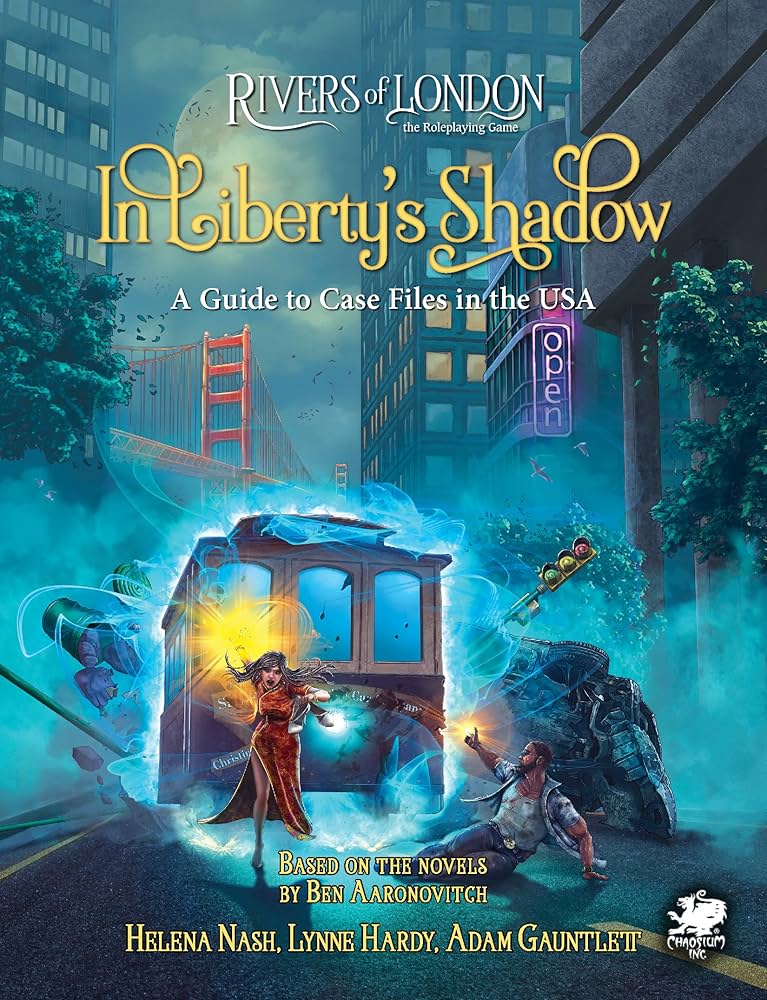
In Liberty’s Shadow is really the first truly chunky supplement for Rivers of London, Chaosium’s RPG based on the urban fantasy series created by Ben Aaronovitch; the game’s had a few scenarios come out for it as well, but other than that players and referees have had to make do with the core book, their imaginations, and the admittedly fairly thick stack of Rivers novels when it comes to material for the game prior to this supplement coming out.
The default assumption of the core Rivers of London rulebook book is that PCs will be members of the Folly – a group that’s one half secret society, one half obscure Metropolitan Police department, which focuses its efforts on providing community policing to London’s “demi-monde”, the local occult subculture whose nature is subtly shaped by the esoteric geography of the city. That’s a very specific focus, both in terms of what player characters are likely to be getting up to and the geographic scope of their exploits, but that also tracks with the focus of the series. The full-length Rivers of London novels which form the backbone of the series are very much focused on Peter Grant and his work, which almost entirely takes place in the UK and only occasionally strays outside London. Things get more diffuse in the penumbra of expanded media around the series, which includes short stories, novellas, an upcoming TV show (assuming it doesn’t die somewhere in development hell as TV shows often do), and a graphic novel series co-written with Aaronovitch’s old Doctor Who buddy Andrew Cartmel; some of the expanded media stories have touched on other parts of the world, focused on characters other than Grant, or explored periods prior to the present day. Even then, these are very much occasional exceptions.
Given the core book’s strong focus on the Folly and London, one might think the natural first significant supplement to do would be a “rest of Britain” book. Although the Met doesn’t have UK-wide jurisdiction, it’s still well-placed to lend help to other forces, and Folly PCs aren’t necessarily Met officers in the RPG since the Folly does have civilian consultants. As a result, you’d expect to be able to set Rivers of London scenarios elsewhere in Britain with reasonable ease – the consultant PCs aren’t really disadvantaged by being outside London, and any police officer PCs can be “on secondment” to a local force (the Folly perhaps pulling a few esoteric strings to help this along) for the duration of a scenario. Aaronovitch has done entire novels in the series set in other areas of the UK – I believe the latest one takes place in Aberdeen – so he’s probably got a deep bench of notes on the wider occult geography of Britain, and the rest can be cooked up from urban legend, weird bits of true history, and a sprinkling of folk horror.
As such, In Liberty’s Shadow is a bit more of a departure than I expected, focused as it is on fleshing out the demi-monde of the USA and the various groups that interact with it. This isn’t entirely untouched territory for the series; Aaronovitch has done an entire novella set in 1920s New York, and in the present day of the series there’s an FBI agent who helps out Peter Grant sometimes. Even then, it still feels like a supplement which falls mostly outside the scope of both the default assumptions of the core rulebook and the usual scope of the novel series.
Time for a bit of a Chaosium special. Chaosium’s books have tended to get thicker and heavier over the years, particularly recently. That’s thanks in part to the glossier production values Chaosium have deployed ever since the Moon Design team took over as part of Greg Stafford and Sandy Petersen’s emergency rescue operation, and in part to Chaosium’s long-standing drive for ever-deeper research and erudition on the part of their game designers (commercially necessary to justify putting out work based on not-exactly-copyrightable material like Arthurian myth or well-into-the-public-domain horror tales of yesteryear). Those factors will tend to drive up page count a tad, and whilst recent Chaosium material is certainly pleasant to read and navigate and tends to offer really excellent value for money in terms of the amount of material they pack into their books, sometimes concepts which previously were delivered in one volume can be deployed in two.
For instance, in some cases products which would have been sold in a single standalone package have been divided into a player-facing volume and a referee-facing one, both because packaging them as a single volume would be burdensome and because splitting them out like this is both commercially savvy (you tend to have more players than referees, so a player-facing book can sell several times as many copies as a referee-facing one) and in some respects quite useful. (Having several copies of the essential player-facing rules at one table can speed things up in actual play appreciably). A while back I reviewed the player-facing halves of Pendragon and Cthulhu By Gaslight‘s latest editions; now it’s time to look at what referees get in their books.
Gamemaster’s Handbook (Pendragon)
The 6th Edition Pendragon core rulebook may be the nicest-looking the core rules for the game have ever looked, but they did come in for a bit of flak when they first emerged due to a perception that they were incomplete. This, I suspect, comes from a misperception of how much you absolutely need to get a Pendragon campaign going and a mild lack of perspective. (That’s what I think on a kind day, at any rate; if I’m in a grumpy mood I’d say that too many people in the RPG sphere have become too accustomed to certain walled garden design approaches to the point where they feel lost if a product doesn’t provide the guardrails they have become used to.) Sure, the core book doesn’t offer a whole lot beyond generating knights and the basic procedures of having them go off, adventure, gain Glory, and use Passions and Traits, but that’s kind of all you need for a very basic Pendragon game.
Of course, all the complaints were in part based on an incomplete overview of the line anyway. Now Chaosium have brought out the next major entry in the line, the Gamemaster’s Handbook – and I defy anyone looking over this to suggest the core game is incomplete now. Along with the full procedures for running large-scale battles, this includes an extensive toolkit covering everything from guidelines for depicting magic (it basically comes down to “NPCs can do magic as and how the narrative requires it”, but you get a lot of pointers on how to make sure this actually pans out in an Arthurian-feeling manner), stats for major NPCs, a bestiary, setting details for Salisbury (the assumed start point of The Great Pendragon Campaign), some sample adventures, a good look at the major religions of the setting and how they are structured and interact, a couple of scenarios, and so on and so forth.
Two things stand out to me in particular; the first is the Running the Game chapter, which provides an important breakdown on different modes of running Pendragon and how you should shift gear depending on whether you want to do the full Great Pendragon Campaign or a more short-term campaign or anything in between, and the second is the chapter on Arthurian Acts, which covers all manner of common situations to being taken captive in battle (or taking others captive) to the cut and thrust of courtly love to tournaments to feasts, all of which have robust systems in place to support.
It is here that Stafford’s intentions for this edition – to draw on the absolute best of the 5th Edition support line and fold the strongest and most useful aspects of it into the core book – start to really come to fruition. There’s more to come yet – namely a supplement on playing the higher nobility, where I suspect a lot of the estate management stuff from prior editions has ended up, and of course an update to The Great Pendragon Campaign itself – but any referee that has this book to hand who doesn’t feel supported in homebrewing their own Pendragon sessions is in need, perhaps, of more assistance honing their skills than any published book can reasonably offer.
Time for another entry in my regular series of articles on game supplements which have caught my eye and inspired some brief thoughts. This time around, it’s a Basic Roleplaying special; with spooky season closing in, the emphasis is going to be on the more eldritch end of that particular family of games, with two Call of Cthulhu releases as well as a visit to Delta Green (not technically under the BRP brand umbrella, but unquestionably a fork from the wider family tree – and come to think of it, it may be advantageous for them to consider shifting over to the ORC licence under which BRP has been made widely available for use, to provide the legal coverage the used to get under the OGL before Wizards shatthebed), but there’s also something more genre-neutral to look at.
No Time To Scream (Call of Cthulhu)
In terms of its format, this is another release in the same general vein as Gateways To Terror. Like that book, No Time To Scream is a collection of three mini-scenarios which are designed to be playable in an hour or two if you’re brisk about it but can be elaborated upon or expanded as desired, and are equally suited to being one-off pick-up games or slotting into appropriate points on an ongoing campaign.
A Lonely Thread offers a classic horror setting – a cabin in the woods! – and packs in a bit of roleplayed conversation, a bit of exploration, and a bit of peril, with a reasonable amount of flexibility in how the scenario might unfold. Bits & Pieces confesses to having a pulpier tone – and the concept, whilst fun, may risk descending into farce unless groups do a really bang-up job of maintaining a horror atmosphere; there’s just something a tad slapstick about the spectacle of investigators running after a bunch of dismembered body parts.
Age of Vikings is a brand-new RPG from Chaosium… or rather, it is and it isn’t. Age of Vikings is certainly a new brand for them – but its author, Pedro Ziviani, had previously written the Mythic Iceland supplement for use with the Big Yellow Book version of Basic Roleplaying, which has recently been revised and rereleased as the Basic Roleplaying Universal Game Engine. Both Age of Vikings and Mythic Iceland have essentially the same concept: your characters live in the unique society of 10th Century Iceland, whose inhabitants spurn the rulership of a King like their European peers in favour of the sovereignty of the Althing, their assembly which is arguably the oldest surviving Parliament in the world, with the “mythic” side of the equation coming in because the game depicts a world in which the myths and legends believed in by the Icelanders are essentially real, but enough historical detail that if you wanted to use the material to run a more purely history-based game (with some departures for playability) that’s absolutely something you can do.
Given the circumstances, you might be forgiven for thinking that Age of Vikings is just Mythic Iceland given a new title and with all the required system bits from Basic Roleplaying folded into it. You might even be sold on that idea; Mythic Iceland was one of the more acclaimed supplements that came out for the Big Yellow Book under Charlie Krank’s stewardship of Chaosium, and an update of that tweaked to stand alone to avoid flipping about between two books feels like a worthwhile endeaovur in its own right. However, Age of Vikings is a significant development of and embellishment of the concept, drawing on a deeper bench of material than just Mythic Iceland.
Arguably, both Mythic Iceland and Age of Vikings are in their own right descendants of RuneQuest Vikings – a supplement for the game’s third edition that is, alongside Land of Ninja, regarded as the high water mark of the “Mythic Earth” concept that edition explored before pivoting back to focusing on Glorantha (giving rise to the short-lived “RuneQuest Renaissance“). As a result, it makes sense that Age of Vikings has looked to how the latest edition of RuneQuest has folded in concepts from Pendragon to update its presentation, and proceed accordingly.
In particular, Age of Vikings adds in rules for Passions and a method of exploring your character’s family history during character generation, both of which are Pendragon innovations which have become more widely embraced across the Basic Roleplaying line. As with the original RuneQuest-style hit locations and skill categories are used, both of which seem suited to the material, whilst bespoke systems for reputation and status better-targeted towards Icelandic society, along with magic systems tailored towards the folklore, allow the material to work better than attempts to crowbar the standard RuneQuest magic systems into the setting. Whereas Mythic Iceland used the “Allegiance” concept from the Big Yellow Book – derived from Stormbringer – to model characters’ dedication to their patron gods, this utilises the idea of Devotions, which is similar in concept except better-integrated with the Passions rules and with somewhat different game mechanical effects.
As a result of the work necessary to incorporate these ideas, there’s major differences between this and Mythic Iceland, though a good amount of text from the original survives (with revisions for readability and the like). The “History of Mythic Iceland” chapters from the original all get largely reproduced here, for instance, though not necessarily in the same order (and history post-977, the assumed start date for Age of Vikings campaigns, is glossed over). The main excision is the rather terse notes on using Iceland in Cthulhu Dark Ages – in fact, Mythic Iceland rather bizarrely included a Cthulhu Dark Ages sample scenario instead of a Mythic Iceland one!
That mistake isn’t repeated here; as well as a fully worked-out scenario depicting a visit to the Althing – which nicely means that it’s repeatable, since the Althing is a regular, structured event that can be visited again and again to do different business and get different results each time – there’s also a rather neat system for throwing together a Viking raid on the fly. All this, plus seiðr magic too in parallel with the rune magic? It’s a great deal; on the whole, Age of Vikings is a substantial improvement on Mythic Iceland by any metric, more than justifying its rather long gestation period. Norse myth and the Dark Ages are subjects which RPGs have drawn on extensively over the years, but Age of Vikings raises the bar appreciably, making it a highly useful release for anyone running a game touching on this era or its myths.
In the early days of RuneQuest, the old guard at Chaosium made the game a major success, a serious challenger to Dungeons & Dragons, and arguably the most groundbreaking and sophisticated RPG of the 1970s. More recently, the new regime at Chaosium – primarily made up of members of Moon Design Publications, brought in by Glorantha creator and Chaosium founder Greg Stafford to right the ship after a series of major blunders nearly destroyed the company – have proved to be reliable custodians of the game, producing a new edition which enjoys the most lavish production values and extensive support that RuneQuest has ever enjoyed.
In between. however, RuneQuest‘s history has been somewhat patchier. I’ve gone on the record here as not liking Mongoose’s custodianship of the line in the mid-2000s; their first edition seemed a little slapdash, suffering from the lax production values that has been Mongoose’s trademark for most of their existence (though I was recently pleased to note that their latest versions of Paranoia and Traveller have found them cleaning up their game on that front), and their second edition was legendarily botched, with the two lead designers leaving to found the Design Mechanism and given the blessing of Greg Stafford to produce a 6th Edition of the game – a variant later retitled Mythras – which was essentially a “director’s cut” of the second Mongoose edition without the hatchet job it suffered in the edit.
Before the Mongoose era, however, RuneQuest endured another misstep – Chaosium’s decision to get into a business arrangement with Avalon Hill. Let’s rewind to the early-to-mid-1980s: RuneQuest, Call of Cthulhu, and Stormbringer are all big hits, but Chaosium isn’t a huge business (and never really has been) and doesn’t really have the means to do all the production and distribution logistics on all three game lines. Lead figures like Greg Stafford and Steve Perrin want to spend more time doing game design and less time doing business management. As a result, the business decides to indulge an experiment to see if they could pivot to being a design house, so they could do all the fun part of designing game materials and other companies could handle the nitty-gritty of actually printing, distributing, and marketing the stuff.
Although Chaosium have provided at least some support for the popular 1890s-based Cthulhu By Gaslight setting for Call of Cthulhu during the game’s 7th Edition era thanks to the Cthulhu Through the Ages supplement, which provides 7th Edition guidance for creating Investigators in a number of eras (and thus provides all you need to use existing Gaslight products with 7th Edition), until recently they hadn’t gotten around to fully updating the old Cthulhu By Gaslight supplement for the new version of the game. Originally put out in a couple of editions in the 1980s (a 1986 boxed set, and then a 1988 revision of the box contents into a softcover book), its most recent tune-up was back in 2012, a mere couple of years before the release of 7th Edition, and so perhaps it was deemed prudent not to render that redundant immediately lest it seem like a cash grab.
However, it’s been over a decade since that came out, so it’s hardly exploitative of Chaosium to put out a new version of the supplement – but rather than just take the old text, multiply all the core attributes by five, and move on (which is really all you need to do to convert a supplement from the 1st to 6th Editions of the game to 7th Edition), Chaosium have gone in for a root and branch revision and expansion that’s even more extensive than the job Kevin Ross did back in 2012 of expanding on William Barton’s original supplement.
This is sensible. The downside of writing an RPG supplement that’s about a real historical period is that on the one hand, you have the advantage of a mass of real-world material to base your research off, but you also have the downside that here in the Internet age a fairly sizable proportion of your audience has access to the same material. If you’re going to sell someone a supplement detailing a historical period, you’re going to need to something a bit more substantial than what they could get by skim-reading a few of the meatier Wikipedia articles on the subject; in effect, your audience is paying you to do the research legwork for them and present the material in a way which is of particular use for the purpose of playing in and running games set in the era.
This is particularly the case with the Cthulhu By Gaslight Investigators’ Guide – because the 7th Edition expansion of Gaslight is so major that it’s been split into two books. We’re promised that in due course a Cthulhu By Gaslight Keepers’ Guide will emerge giving NPC stats, Mythos threats, and other Keeper-facing rules and information; for obvious reasons, this is going to be where most of the outright fictional material is going to land. In contrast, the Investigators’ Guide is a player-facing book, providing a deep dive on the Victorian setting without spoilering any of the Keeper’s secrets – which in effect means that most of the real-world history researched for the supplement is going to end up here, because that history provides the pool of common general knowledge available to the characters in the setting, describes the zeitgeist they exist in, and gives details on the class and cultural context they hail from.
In fact, the Investigators’ Guide is rather cunningly developed so that it can serve as either a supplement or as a core rulebook depending on your preferences and what makes sense for your gaming table – rather than requiring Gaslight players who want a rulebook but don’t want any of the referee-facing stuff to get the 7th Edition Investigator Handbook, as you might for a game set in the 1920s (which the Handbook has a fairly extensive chapter on) or the modern day (which, since you reside there, you don’t need an introduction to), such a player can just get this book and have everything they need, because not only does this include the Gaslight-specific rules for creating an investigator, but it also has an appendix reproducing the basic Call of Cthulhu rules.
This, perhaps, might be a by-product of the development of the Call of Cthulhu Starter Set, since the condensed rules here are much like the brief version of the rules there – doing the exercise of seeing just how much you can strip down the rules and still give someone the details they need to fully participate in a game session seems to have helped Chaosium realise that they could put this out with a significant shift in the balance of setting material to rules stuff; whereas the Investigator Handbook has the full-fat rules explanations for players (and so may still be of some help to participants in Gaslight campaigns – if you already own it you didn’t waste your money) and about 40-odd pages of 1920s setting discussion, this book goes all-out on providing deep dives into the era.
This may be necessary. For one thing, the 1920s are increasingly in the rear view mirror, but they still feel more modern than the 1890s, and some players – especially those who haven’t studied 19th Century history previously all that much – may have less of a sense of what the era was like in general. For another, the assumed centre of gravity for Gaslight campaigns is London, due to the literary inspirations of the setting, and assuming everyone knows what Victorian-era British culture was like is a stretch. Thus the book provides an overview of British cultural values at the time and a deep dive on London, a close look at the rest of the UK, and sufficient details on the rest of the world to be getting on with. It also notes that the Down Darker Trails supplement can cross over with Gaslight, since after all the Old West is just an ocean liner voyage and a railway trip away.
When I reviewed the previous edition of the supplement, I noted that it didn’t go too deeply into some of the social inequities of the era, and tended to assume PC groups would be primarily middle-to-upper class. This version of the supplement realises that audiences these days won’t go for that, and so both provides guidance on how working class characters could contribute to investigations and provides a deeper look at the inequalities of the period – some groups will simply gloss over that, of course, but it’s better to have the information and not want it but to want it and not have it.
That isn’t to say it’s all dry sociological stuff. The section on Victorian occultism, in particular, gives a sense of the interpersonal drama and larger than life characters that existed at the time, and makes allusions to a system for astral projection detailed in the Keepers’ Guide – making me wonder whether they’re going to dip into the system for exploration of the astral plane (as imagined by occultists of the age) detailed in Pagan Publishing’s old, long out of print The Golden Dawn supplement or whether they’ve cooked up an all-new take on the concept.
On the whole, the sheer quantity and quality of the material in the Cthulhu By Gaslight Investigators’ Guide more than justifies the split into multiple books. After all, the core Keeper Rulebook for 7th Edition already gives you a toolkit of Mythos monsters and magic you can throw at your players, so if you want to start a campaign of the new Gaslight now you can have at it straight away with just the Investigators’ Guide with no need to wait for the Keepers’ Guide to come out, and then get the latter book once it’s out to get more Gaslight-specific material. (There’s also a range of useful third-party supplements for the era like Hudson & Brand.)
On top of that, the fact that all the Mythos-oriented, Keeper-facing stuff has been saved for the Keepers’ Guide means that the Investigators’ Guide is actually potentially useful for more than just Cthulhu By Gaslight. It’s kind of a backdoor generic rulebook for any Basic Roleplaying campaign that takes a detail-oriented approach to the Victorian era, and could also be a useful resource for exploring the era in any other RPG system. Lots of games have touched on the period, but few have managed it to the level of detail and clarity offered here.
Time for another entry in my occasional series covering RPG supplements I want to comment on but don’t fancy doing a fully-developed article on individually. This time around, I’ve got some Call of Cthulhu scenarios, some Warhammer Fantasy Roleplay releases that recently slipped out in hard copy, and the RuneQuest supplement Chaosium has been building towards releasing since they put out their new edition of the game.
Lands of RuneQuest: Dragon Pass (RuneQuest)
As the title implies, this is the first entry in the new Lands of RuneQuest series. Just as the Cults of RuneQuest sequence offers the full-detail breakdown of each of the various pantheons of the setting, these Lands of RuneQuest books are gazetteers offering a deep dive on various regions of Glorantha I’m not sure how many of these we are going to get – by contrast, Cults of RuneQuest has a fairly well-established plan set out for it – but it does make a certain sense of think of the two series as linked, because after all the original groundbreaking Cults of Prax supplement was a travelogue as much as it was an overview of the local sects.
Dragon Pass being the first region to get the Lands of RuneQuest is something of a no-brainer; you get beginner-friendly descriptions of it in the current core rules and the Starter Set, the adventures bundled with the referee screen and in The Smoking Ruin and The Pegasus Plateau are all set there, and with the release of the Lightbringers, Earth Goddesses, and Lunar Way volumes of Cults of RuneQuest the major sects of the region have been covered, so it’s by far the best-supported locale when it comes to officially released material by Chaosium themselves. (The Jonstown Compendium scheme for putting out fan-developed supplements has done a fine job of widening the scope of this edition, but only people quite deep into it can really be expected to dip into there that much.)




 Refereeing and Reflection