
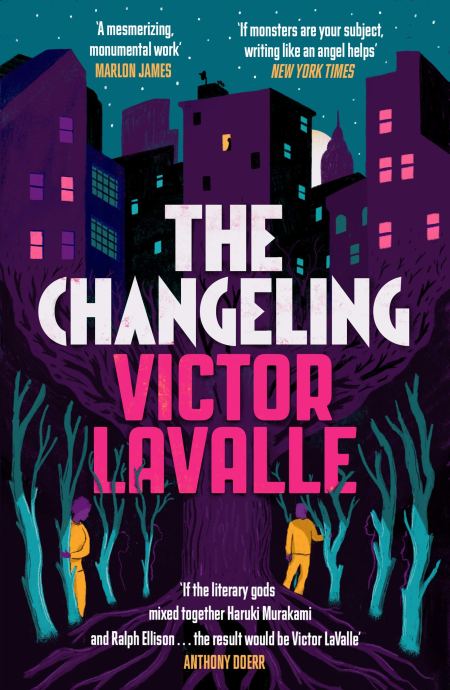
The colours tho…
I really ought to get started on the Hugos, but the Becky Chambers is staring at me none-too-welcomingly so… I’m procrastinating it a little while longer. Which turned out to be a good decision, because apparently, the World Fantasy Award (joint*) winner for 2018 was bloody good.
If anything, this is another one for “oh my god, when they decide to /write/, suddenly I realise what I’m missing”. Because LaValle is really getting into his prose, his characterisation. It’s fundamentally just as much about how he’s writing and who he’s writing as the story he’s telling, if not more so, and I am here for it. You spend a good half of the book on some beautifully crafted scene-setting and character development and I just… I miss this shit. I enjoy reading stuff like Daggerspell, don’t get me wrong, it’s great fun and ridiculous and I love it to bits but… this is another level. I am so so glad it’s award-winning too. Reward the people who write actual prose! I want more nice prose in my genre please! Moaaaaaar!**
I think the thing I’m contrasting this most with, at the moment, is Spinning Silver. I’d describe both of them as “fairytale retellings” but it does them both something of a disservice making that comparison, because they sit very much in different places in that little subgenre. Spinning Silver is taking a lot of familiar fairytale elements, especially including when and where they’re set, and adapting them into a modern novel. The fairytale parts are, for the most part, familiar in tone and trope, if not in specific story, and the novelising of it is about making it into a modern SFF novel, rather than fundamentally recrafting the story from the ground up. It’s a reworking of the familiar into something palatable to modern tastes, more or less. Whereas what LaValle is doing here is taking the spirit of what a fairytale is mean to be, and embedding that into an entirely modern imaginative space, working right from the ground up rather than reworking existing ideas. So what you get is a modern fairytale in the most literal sense – it’s entirely grounded in that modernity, it couldn’t exist without its modern setting and attitudes. He’s taken what a fairytale exists to be, and made something that fills that niche for a person coming to it right now.
And that is just… really really cool. And much less common than reskinning existing ones either to weld them into a modern setting, or to expand them to make a modern novel. I like it.
The fundamental story follows a man who loses his father young, and how that relates to his life with his wife and later his own son, and the tragedies that come as he grows up. It’s a story about fatherhood and childhood, and being shaped by your memories of your past. It’s introspective and thoughtful, while also having a sense of humour about what those things all mean right now. There are a lot of knowing winks and eyerolls about “new dads” for instance, which landed very well.
And, because it’s so focussed on that introspection, we get a lot of time inhabiting the main character’s mind. He is incredibly well crafted, and has the complexity you need for someone who’s going to carry you through a difficult emotional journey. He’s not always likeable, he’s not always right, and you certainly don’t always agree with the choices he makes… but you never stop wanting to follow along with him anyway. He’s sympathetic throughout, and fascinating, and has a distinctive voice with which he talks about his inner world and the world he lives in – exactly what you need from a viewpoint character.
The novel is also very rooted in the physical world of its setting. I’ve read more than one book in the last couple of years that’s set in New York and making such a Thing of it that it’s put me off – looking at you New York 2140 – but this isn’t that. It’s not taking pains to get out the hammer of “isn’t New York amazing” at beat you round the head with it. It’s just aware of what it’s working with, and careful to link it into the story, keeping everything tied together where it needs to be. Nothing in excess.
If I had any criticism, it might be that the initial scene-setting is just a touch too slow, as you do get a fair way into the novel before things really “start”, but honestly, by the time I got to the end, I was entirely happy with it. Yes, it is slow, but nothing it spends the time doing is wasted or falls flat, and so it feels worth the wait to build you up to that. Sure, it’s not a pacey, plot-driven thrill-ride, but that’s not what I was after when I picked it up, and I’m not disappointed it isn’t what I got in the end.
My main feeling is that this is someone who’s a literary author writing an SFF story, and I… like that a lot. The older I get, the more I like that more… worked style you tend to get more often in litfic. The feeling of more time taken, slower pace and more craft in the prose, and this has exactly those elements, and done so well. But it doesn’t detract from it being a fairytale – if anything, I feel like the slower, dreamy pace enhances the slightly magical atmosphere, and works better for what LaValle is trying to achieve than a simple, driven plot would ever manage, as well as just… well… this is more what fairytales are like in the original. There’s a place for turning them into pacy, plot-driven novels – there’s a reason Robin McKinley was popular when I was in my teens – but I honestly think what LaValle has done here is far more a fairytale than even the ones retelling real stories from the Brothers Grimm. Tone is important.
Another one to add to the growing list of truly brilliant books I’ve read this year.
*Along with Jade City, which I really enjoyed but is… very much in a different realm to this. They’re doing vastly different things in different ways, so it feels weird for them to be sharing a win.
**Look, I’m a little bit overexcited because the boyfriend is currently baking spiced apple muffins. Shush.
 And we’re back to the sweary Celts. I’m just enjoying how thoroughly readable this series is (and not just because it’s helping me claw my way back to being on target with my reading goal*). It’s so restful, especially after reading a load of Nebula nominees I wasn’t super interested in.
 Holy shit. I mean really, holy shit this one was good. I was sold it as “like Ann Leckie and Iain M. Banks” and when people say that kind of thing to you? You just go “sure, sure” and mentally downgrade it a bit. Saying something is the next equivalent of the Culture novels is like saying something’s the next Harry Potter or the next Tolkien. It’s never actually accurate. But this one… I think it actually might be. It’s seriously bloody good.
 Final Nebula nominee, and with time to spare. Go me.
 Penultimate Nebula! So close! The finish line nears!
 And back to the Nebulas, so I can actually finish (and blog) before the winner is announced. This year, I definitely will! I’m reading the last one as we speak (ssh, yes I am a blogpost behind).
 I’ve actually been reading this for a while, but it’s a very pretty hardback I’ve not wanted to ruin by carrying around in my bag, so it’s been something I’ve been dipping in and out of at home, rather than taking with me as my go-to reading. It helps that it’s a series of short sections about various different people, rather than one coherent narrative. It was very easy to dip in and out of.
 … why yes I did read the sequel only a couple of books later, why do you ask?
 You know what the smartest plan is, when you’re behind on your Goodreads reading goal? Picking up an absolute brick of an 830 page fantasy epic to speed you along.
 A brief interlude from the Nebulas, to read some escapist fantasy trash.
 A Reader of Else