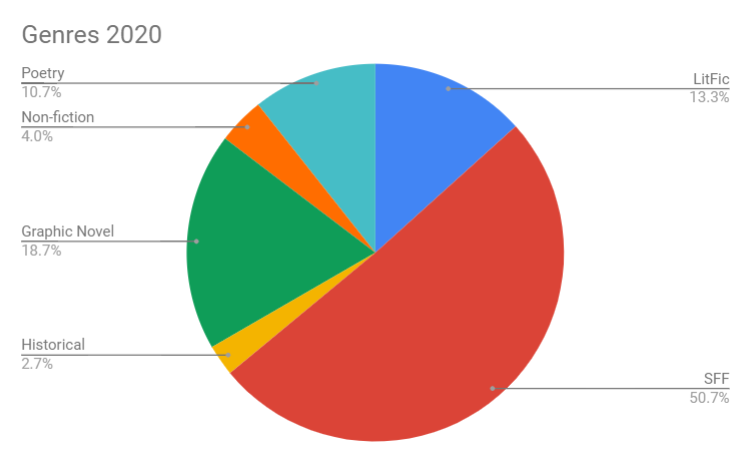
Hugo Nominees 2021 (Reprise)

I’ve had many extra months to read the Hugo nominees compared with a normal year. Have I used any of that extra time to do so? Nope! I have, as per usual, rushed through near the deadline and submitted on the last day. But I at least finished everything I wanted to finish. This is my rundown in brief* of what I thought of things, and how my ballot went.

Novels
1 – Harrow the Ninth – Tamsyn Muir
2 – Piranesi – Susanna Clarke
3 – The City We Became – N. K. Jemisin
4 – The Relentless Moon – Mary Robinette Kowal (ok I read the second one but I couldn’t bring myself to read this one)
5 – All Systems Red – Martha Wells (standing for Murderbot in general – I read a book for this, just didn’t want to read the whole lot to catch up)
6 – Black Sun – Rebecca Roanhorse

On the one hand, I’m super glad Harrow and Piranesi have made it on here, especially as Harrow didn’t make the Nebulas, and it really deserves the love. On the other… the rest are so meh. There’s a huge gap for me between my second and third place choices. I can see why someone might like them, I guess… but none of them really felt award-worthy to me, especially when I can think of other things I read throughout the year that really did shine. Particularly, I read the second Lady Astronaut book (optimistically thinking I might then read the third) and I just couldn’t bring myself to continue with the series because I didn’t care. Some of that is because I just don’t have the excitement for the nuts and bolts of going to space that some people do (a related theme is going to come up shortly on this one), but also I didn’t particularly care about any of the characters, and I found one of the central premises of book two flawed… because I agreed with the sort-of antagonists more than the protag/general vibe of the book. That’s never a good sign.

So basically, my “line of grumbling” is below Piranesi, which means I’ll almost certainly be grumbling, because I suspect The City We Became is going to win.

Novellas
1 – Empress of Salt and Fortune – Nghi Vo
2 – Riot Baby – Tochi Onyebuchi
3 – Ring Shout – P. Djèlí Clark
4 – Finna – Nino Cipri
5 – Upright Women Wanted – Sarah Gailey
6 – Come Tumbling Down – Seanan McGuire

The novellas, most of which were new to me, were at least a bit more promising. I genuinely liked my 1, 2 and 3 spots, and I was fine with 4 and 5, so it was only Come Tumbling Down I actively disliked. And even that was alright. While Empress of Salt and Fortune is far and away my favourite – seriously, I adore it – I’m really glad I read both of Riot Baby and Ring Shout, at least the latter of which I don’t think I’d have picked up on my own. Horror isn’t my jam, but I felt like the horror in this one was sufficiently directed that it was worth my discomfort.

Going back to my Lady Astronaut point above, Upright Women Wanted mostly suffered because I have precisely zero emotional investment in the Old West. Like, I’m glad someone did a queerer, more feminist dystopian future version of it here. Hurrah for that. But it’s a setting I have no interest spending time in, and the book and characters, while good, weren’t good enough to push me past that.

On the flip side, I really liked the idea of Finna, but it felt like the idea was all that was carrying me through. Idea and vibe. Both of which where delightful, but it really needed the support of more gripping plotting/characters to seal the deal.

Come Tumbling Down… ok this is the one I felt the main weakness wasn’t so much about my preferences, and more that it just wasn’t very well written. Like, it’s fine. It’s another portal fantasy book, nothing wrong with that as an idea. But everything about it felt just that little bit clunky and overdone.

My line for the novellas is around where Finna is, but I’m much less invested in the grumbling here, because for all that I didn’t massively like either it or Upright Women Wanted, I had a perfectly pleasant time reading them so… eh, I guess it’s someone else’s cup of tea.

Novelettes
1 – “Monster” – Naomi Kritzer
2 – “Helicopter Story” – Isabel Fall
3 – “The Inaccessibility of Heaven” – Aliette de Bodard
4 – “Two Truths and a Lie” – Sarah Pinsker
5 – “Burn, or the Episodic Life of Sam Wells as a Super” – A. T. Greenblatt
6 – “The Pill” – Meg Elison

A… mixed bag here. Although my overriding feeling about the lot of them is “grim”. It was definitely not a jolly afternoon I spent reading them all.

I haven’t reread Helicopter Story, but I did read it when it came out, and before the Discourse got properly going (a friend had a story out in the same issue of Clarkesworld, so I think I just kept reading? Or maybe he prompted me to read it, I honestly can’t remember). In any case, it’s hard to look back and find my original opinions, untouched by the Discourse** that came after, and certainly a reread now would be coloured by it all, but as far as I can recall, I thought it was well written, but also that I wasn’t in a brilliant position personally to critique the core gender elements of the story. I personally think they’re well done, but… what do I really know?

Monster, meanwhile, was new to me, and I rated it highly (on my spreadsheet, shush) when I finished it… but when I came to look back at my rankings after I’d finished the short stories and graphic novels as well… I found I’d forgotten what it was about. Having now reminded myself, I think what sucked me in was the mystery of it, the slow unfolding of the facts to lead you to what was going to happen, and an ending that, while in some ways unexpected, felt inevitable too.

Having read her novels in a similar vein, Aliette de Bodard’s The Inaccessibility of Heaven was an interesting counterpoint to what I didn’t like about them. While I didn’t think this was perfect, I think I enjoyed its more… typical urban fantasy vibe and atmosphere, when compared to the stranger tone of House of Shattered Wings.

Neither of Two Truths and a Lie nor Burn, or the Episodic Life of Sam Wells as a Super really landed for me, but nor did I think either of them were particularly bad. Two Truths was creepy and memorable but also… really creepy, which is not my thing. Whereas Burn felt blander and less interesting… but also didn’t scare me.

And then… The Pill. This is by far the Hugo nominee, across all categories, that has emotionally affected me the most. I’ve put it last, but I don’t hate it exactly. I’m not even sure I think it’s bad. I’m too close to the issues involved in it to really comment. The whole story is a commentary on our fatphobic society and diet culture and how fat people are viewed and view themselves, and how fatness is pathologised… and it just… hurt. At some points, I think it’s meant to. It’s meant to shake a reader into looking at our society and going “oh shit”. But at turns, it also feels… cruelly pointed. The way the fat protagonist talks about her fat brother, the disdain and dismissal, while a realistic reflex of internalised fatphobia, are so harsh, and so hard to read, and so against some of the tone of the story… I found myself confused about the author’s point. Likewise, the ending was dystopian in the extreme, but also in some ways without a resolution. It’s left me picking at it in the back of my mind, unable to quite leave it behind, but not in that challenging way stories like Riot Baby have. It’s like I need to find answers about what it all means and can never quite get to them, and never feel satisfied.

I don’t think all stories need to have a “point”. Things don’t have to be morality tales to be worthwhile. But this one… it felt like it’s meant to, and that I somehow missed it, because I can’t quite see a fully realised argument in there, and so it feels like the emotional suckerpunch of reading it was for nothing, because if it wasn’t for enjoyment, and it wasn’t to make a point… what was it for?

I’m hoping to see other people’s commentary on it, because I’m genuinely interested to know what someone might think about it who isn’t so emotionally tied up in the issues.

Short Stories
1 – “A Guide for Working Breeds”, Vina Jie-Min Prasad
2 – Little Free Library, Naomi Kritzer
3 – “The Mermaid Astronaut”, Yoon Ha Lee
4 – “Metal Like Blood in the Dark”, T. Kingfisher
5 – “Badass Moms in the Zombie Apocalypse”, Rae Carson
6 – “Open House on Haunted Hill”, John Wiswell

In a total reversal, the main vibe for a lot of the short stories was “delightful”. Even the dark ones were quite sweet, in parts. I genuinely liked all of them bar my sixth place (if I’d been rating on Goodreads, they’d all get 4 stars and it 3), and I had a lovely time reading them.

A Guide For Working Breeds makes the top spot for being delightful, playing with structure, and having two characters whose personalities immediately shone out of the page. I just really loved it.

Little Free Library felt like a prologue to a longer adventure story, but managed to make that be a mark in its favour. I’m not sure I can say I loved it for much more than “vibe”. But I did like that an awful lot.

Both The Mermaid Astronaut and Metal Like Blood in the Dark were fascinatingly non-human viewpoints with personalities that also shone through, and both from authors I like anyway doing something quite different to their norm. The Mermaid Astronaut caught me that little bit more just for the mixture, without apology or discomfort, of the SF and the F, and for feeling somewhat fairytale, despite someone going to space.

Badass Moms in the Zombie Apocalypse, while not super my thing, managed to get past the “I don’t like zombies” by mainly not being about the zombies. It covered a part of a zombie apocalypse I hadn’t particularly thought about before (childbirth), and made it a decent story, not just a thinly veiled treatise on “what if”.

Open House on Haunted Hill didn’t really land for me, but mainly just because the premise felt a bit meh, and I don’t think the storytelling did much to elevate it past that. It was fine, no objections, but not up to the standard of the rest of them.

Graphic Novels
1 – Once & Future vol. 1: The King Is Undead, written by Kieron Gillen, Illustrated by Dan Mora, colored by Tamra Bonvillain, lettered by Ed Dukeshire
2 – DIE, Volume 2: Split the Party, written by Kieron Gillen and Stephanie Hans, letters by Clayton Cowles 
3 – Monstress, vol. 5: Warchild, Author: Marjorie Liu, Artist: Sana Takeda
4 – Invisible Kingdom, vol 2: Edge of Everything, Author: G. Willow Wilson, Artist: Christian Ward
5 – Parable of the Sower: A Graphic Novel Adaptation, written by Octavia Butler, adapted by Damian Duffy, illustrated by John Jennings
6 – Ghost-Spider vol. 1: Dog Days Are Over, Author: Seanan McGuire, Artist: Takeshi Miyazawa and Rosi Kämpe

I am firmly on the Once & Future bandwagon. I get it issue by issue, rather than waiting for the trades, and a day when they come in the post is a Very Good Day. I want it to win so very very badly because I adore it. It’s a really original and exciting world inspired by Arthurian myth, but not afraid to interrogate some parts of the mythos (oh boy yeah). It’s laugh out loud funny in parts, utterly gripping, and gorgeously drawn. A++, will read again.

DIE was my fave last year, and it pains me to put it in second place because volume 2 is also great, but this is purely a testament to how much I love Once & Future. They do a really good job of continuing the threads of the first volume and building on the story and characters, while obviously building towards later things. If this wins, I won’t be that sad, because it’s great and it deserves it – second volumes are just hard, and doing it right is impressive.

This is definitely one of the weaker Monstress volumes, and there’s a general “middle of the series” air to it, where it feels like it’s doing all the leg work with none of the payoff. As it happens, I have already read the next volume, and that definitely feels like step up, so this isn’t a death knell to the greatness of Monstress, but sad that a series I’ve enjoyed so much so far had to have this dip. But hey, it happens, and that legwork has to happen somewhere. And frankly, for all that it’s a dip from the usual Monstress quality… that quality is usually pretty high, so I shouldn’t be too harsh.

I didn’t love the first Invisible Kingdom. It’s a shame, because I 100% adore Ward’s art, but the story just did not do it for me, without me being able to quite put my finger on why. It was a meh, rather than a dislike. Unsurprisingly, volume 2 continues in the same vein. But hey, the art is still pretty.

I toyed with putting Parable of the Sower in Invisible Kingdom‘s slot, so they’re very close for me. Two things pulled it down in the end – the feeling that I would have enjoyed it more reading it in prose form, and the fact that the art style didn’t really work for me, so it felt like a detriment rather than a bonus. In some ways, it reminded me of the art from last year’s LaGuardia, which likewise I could never quite switch off my dislike of, and which ultimately got in the way of me enjoying the story it was telling (although it was worse in that instance). I like Butler’s work generally, so I will probably seek out and read Parable in its original form now, but I feel like this version is a shadow of Butler’s own version of it… and so why make it at all?

Last place was an easy pick. I don’t read a tonne of superhero comics (the main ones I’ve consumed being Squirrel Girl and Ms. Marvel), so I may not be 100% in touch with the norms of the genre, but this left me quite cold. It was, to be blunt, a bit dull. The art was fine but not special in any way. I think I’ll have forgotten about it in a few months. And I kept thinking about Into the Spiderverse, which played with the same ideas but just so, so much better.

I really hope one of my top two wins, because for all that I love Monstress as a series, this isn’t its best iteration, and it’s already had three wins in previous years. It certainly felt to me like DIE missed out last year, and so a win now would be a nice resolution for that, but ultimately, I think Once & Future is just better story telling (and possibly better art too, in parts). I don’t really know what I think /will/ win, though… I’ve not got as much of a handle on the Hugo vibe for graphic novels as some of the others.

Other Categories

I’ve not consumed all the media in the other categories, but there are a few things I was super keen on – Hades was an absolute stonker of a game (despite being a format I don’t particularly like normally) and I really, really, really hope against all hope that it wins, because it was joyously, obsessively good. Film-wise, I desperately want The Old Guard to win, because it’s a beautiful film of a brilliant graphic novel, and I desperately want Eurovision not to win, because, if nothing else, it’s not actually SFF. Thinking it’s SFF really misses the point of the elements one might, I suppose, claim to be SFF. Also I think it’s quite a bad film and couldn’t they get someone actually Icelandic for the lead role? I died of cringe watching it. And I love real Eurovision. Of the rest, I’d be perfectly happy if Tenet or Birds of Prey won, although the latter was a bit too bloody for my personal tastes.

And that’s it. No doubt I’ll be wrong on all counts and angry about something come the actual awards. Such is the way of things.

Next time, I’ll actually try to write about a book I’ve read, because I’ve not done that in ages (despite having read a Lot of books).

*Not at all in brief, it turns out. Whoops.
**If you missed that Discourse, honestly well done you. It was a proper trashfire that Fall did not deserve in the least.

Posted in All, Fantasy, Graphic Novels & Comics, Horror, Not A Review, Science Fiction, Short Stories | Tagged , , | 2 Comments

Big Yellow Queer Fantasy Books (or “Hey, I pay attention to twitter”)

There have been three books doing the rounds on the bit of book twitter I inhabit. Well, more than three, but three that are notable in their confluence – they’re all yellow, they’re all epic fantasy, they’re all queer and they’ve all been getting a lot of hype*. So, because marketing absolutely doesn’t work on me, I decided to read them all.

They are:

The Jasmine Throne by Tashi Suri
The Unbroken by C. L. Clark
She Who Became The Sun by Shelley Parker-Chan

I started with The Jasmine Throne. I’ve never read any Tasha Suri before, but her work has been mentioned on and off a fair bit among people I know, and I follow her on twitter for excellent bunny content, so it felt like About Time I got around to her.

The story follows a maidservant and a sidelined, scheming princess who have been thrown together in a rebellious province of a politically tumultuous empire. They have to work together, despite their goals being disparate, to fight against the emperor and win their individual/people’s freedom. I’m normally tentative about spoilers but I think it is super obvious, even from that scant blurb, who’s gonna be the queer romance here. Plus I knew that before I read it. It does not spoil it at all to know that, I promise.

Unfortunately, I was a bit meh on this one. The setting is cool, and the political scheming is entirely reasonable (you’d think this would be a low bar but I’ve read some things…), everyone’s motives make sense and it’s a good web of who wants what and why they’re all working together politically… buuuuut I felt very little chemistry between the two love interests. And outside of that, I felt very little chemistry in most of the personal relationships, even the ones where there was a lot of heated feeling described. It just didn’t feel there, even as it was stated. The prose is also… perfectly fine? There’s nothing wrong with it, but it’s very fade-into-the-background, which isn’t my preference. I’d like to occasionally go “ooooh, that’s a nice phrase”.

But! The political stuff is the mainstay of the plot, and I think the multiple viewpoints and the pace of the reveal of past incidents, really do that part of it a lot of justice. It’s an excellent take on someone who’s been wronged by power but struggles with what the impact of fighting that will be on those around them, as well as seeing people for whom that maths weighs up differently. There is also an amount of religious conflict touched upon which, when we see it, is done very well, but I feel could have been explored further without detriment to the rest of the plot. It does a good line in including both the belief and the cultural sides of a religious conflict, for me, and manages to rescue itself from straying too far into “strong belief always leads to bad things”, though that’s definitely a risk at times.

There was one character I did like though (Bhumika) – she’s someone who has managed to retain privilege under an oppressive regime in her own country, by selling out to them to some extent, in order to use her (limited) power to help her own people. There’s plenty of critique for this path as a choice she made, and I feel like the exploration of her role, and of that critique, is well crafted, and makes her a sympathetic character, even as you disagree with her choices – you see why she’s put herself where she is, why she thinks it’s the best path… and I’m not sure one could honestly argue, come the end, whether she was always wrong about the outcomes. It’s a take I was really interested to see, in a book where it might be easy to come down hard on a side of a single, unnuanced, moral right.

Aside from the political parts of the setting, the book is also reasonably strong on conjuring a sense of place. I had no real trouble visualising what and where things were happening, and the images conjured were ones I feel will linger with me, I think in part because the description focusses strongly not just on the visual – there is a lot about rain and heat, and being in the weather, that roots the narrative into its ground, as well as the descriptions of plants and places.

All in all, it was a very easy read, I blitzed through it when I did sit down to read it… but I didn’t find myself super excited to do that, and that was mainly down to the lack of character relationship chemistry, I think. It got three stars, and I was never really torn on giving it anything else. It hasn’t made me super excited to read the sequel(s?), or anything else by Tasha Suri, but I’d also not object if circumstances put me in a position where I had to do so.

Next up – literally, it was the next book I read – The Unbroken by C. L. Clark. This is the one I’d been seeing most doing the rounds on twitter, with a Lot of high praise from a lot of people. I’ve heard the thing about how marketing needs you to see something five separate times to grab you, and it’s been way, way more than that, so I guess it was inevitable I’d give in and get it?

Trigger warning for this one (not for this post, but for the book) – mention of/flashback of attempted rape.

In a very similar vein to The Jasmine Throne (and this won’t be the last time I’ll be saying that), The Unbroken follows a woman who was taken from her home as a young child to become a soldier of the empire that conquered them, and the princess-regnant, seeking to claim the throne of her empire from her regent uncle, as they navigate trouble in the rebellious province from which the soldier, and many of her fellows, were taken. They too are thrown together by circumstance and necessity to try to bring peace where outright rebellion is threatening to boil over.

Again, this is a multiple viewpoint narrative, so we get to see the perspective of both the ruled and the ruler (again, although currently marginalised and trying to regain the power she believes is her due). And again, I think the switches between when we get those viewpoints are good, as are the political stakes set out at the start of the story. The soldier – Touraine – has, for me, a strong narrative of confused loyalties and difficult choices, made by someone who’s been put in an impossible position. She doesn’t always make what I would say are the right choices, and I certainly think the narrative disagrees with some of them too, but it’s easy to sympathise with her, easy to see why she chooses what she chooses, and feel how difficult some of those choices were to make. It never feels like any of the decisions she makes are for bad reasons, and it’s very easy to feel for her when other people… aren’t so keen on her choices.

The princess… is more complicated on that front. I think she starts out well, but I feel by the end of the story, she loses some of her coherence, and not all in a way that can be excused by the events of the plot (although some of it certainly implies an attempt to). While she certainly is pulled in several different directions by the events of the story, some of her vagaries feel as though the author wants her to fill multiple roles, some of which are at odds with one another, and so leave her feeling morally/politically chaotic, rather than the person struggling with different wants and needs that we’re told she is.

That being said, I feel like the chemistry between them, at least some of the time, is more palpable than that of The Jasmine Throne, and this is doubly true in Touraine’s relationships with other characters. There’s a good amount of stuff about community and family and how one finds them and feels with them that I think is well explored and feels real, which it needs to to fuel some of the less fun (i.e. most of them) parts of the book. Those other characters are also a good selection, many of whom manage to be pleasingly complex, even when they don’t get a lot of page time. There are two in particular who impact heavily on Touraine’s worldview, and their conflicting influences play out, for me, super well.

The religious conflict – another similarity – which features heavily is also… interesting. The conflict between an emphatically a-religious empire and the so-called “uncivilised” subjugated nations who still follow (now banned) faiths is one I wasn’t expecting to see, and I do think is a great concept. But like a lot of the book, I think it loses its coherence towards the end. It sets up some good and interesting ideas, and definitely resolves some of them… but not all. There are lingering questions, or areas of lacking clarity, and not in a way that suggests a sequel will swoop in to resolve them.

Once again, though, there is a very strong sense of place and atmosphere – there are some really strong images of buildings and locations in the narrative, and one in particular that does a great job of conveying the wonder of religious architecture, and again, the weather and the climate play strongly into this grounding. The main setting is on the border of a desert, and the heat and the sand and the vagaries of that geography are looped in in the right places to make envisaging how it fits into the plot super easy. You could very easily feel being there, as well as see, and I really like that.

For the first two thirds, I think The Unbroken does a lot of stuff better than The Jasmine Throne, and for me particularly, the realness of the personal relationships is what tips the scales. I cared far, far more about Touraine and a lot of the people around her than I did about most of the characters in The Jasmine Throne (Bhumika notwithstanding). But… the last third of the book really lets it down. Things seem to spiral outwards, and the author doesn’t seem to have a firm focus on drawing all those threads in together, nor feel for pacing once the crescendo starts to build. I was convinced, at several points, that we were going into the big dramatic end-game par- oh wait no, never mind, back again. Which was somewhat frustrating.

So in the end, it got 3 stars as well, although a much more divided one. 4 stars for the beginning and 2 for the ending, perhaps.

Third of the bunch, She Who Became the Sun is very much the different one of the three (and, getting it in now, in my opinion the best). The big difference I noticed is the extent to which the central queer relationship was much less the focus of the book. I’m not saying it’s totally sidelined, because it’s not, but it takes us a lot longer to get to it and it feels a lot less… inevitable? Tropey? Than the other two.

She Who Became the Sun, a queered reimagining of the founding of the Ming Dynasty and expulsion of the Mongols from China, follows a peasant girl (Zhu) who, after her brother is prophesied greatness and herself nothing, chooses to seize her brother’s name and fate as her own and claim the greatness fate has not offered her on her own terms. She has to work against everything in the world that would hold a young, poor, ethnically Chinese girl back in a world where she is a second class citizen to those in power, and do so by the sheer force of her will to live, and keep on living.

I don’t know how closely the story cleaves to the actual historical events of the period as it’s not a bit of history I know a great deal about, but there are definite wanders into… historical ambiguity? Without going into too much detail, I don’t know the extent to which some of the fantastical elements are intended to be ahistorically fantastical, or simply a literal portrayal of symbolic/other occurrences through the eyes and context of someone seeing them at the time. Honestly, I like that ambiguity. I say this as someone with a deep and abiding fondness for things like paladins, wizards, witches, vampires and the like, simply for their own sake, but I’m not sure the story needed anything much in the way of the explicitly fantastical, or certainly no more than it has. It would get in the way of what’s already there… which feels odd to say, but I was so gloriously invested in the internal life of the protagonist, and the events of the rebellion as she becomes a part of it, that I didn’t want something shiny and distracting to come along and dilute that.

By which I mean, the main character is great. The whole story is very very situated within her worldview, and her way of thinking and seeing and feeling, and she’s an incredibly compelling mind to ride inside. But often, when you get that sort of book, everyone else becomes somewhat backgroundy, simple because you’re so involved in the one viewpoint. As well as giving us some other viewpoint characters (particularly Ouyang, a eunuch enslaved by the Mongol rulers in China, and risen to a position as general in their army) to enjoy, this one also does a really good job of showcasing the non-viewpoint characters, even though we’re seeing them through the lens of one character’s viewpoint. They feel authentically like people, even through all that, and it’s really something.

Likewise, and much in contrast to The Jasmine Throne, the relationships feel authentic. There’s palpable chemistry between several characters, not just romantically, and the way people respond to one another… arghgh it’s just so good. I really wanted a book full of people dealing with each other and I got it and that just made me super happy.

As did the prose, which is fucking excellent. It’s definitely not backgrounded, get out of the way so you can enjoy the adventure writing, like the other two. There are noticeable turns of phrase that are just so nice and I wanted to stick post it notes in so I could find them again later to discuss with people. The way Parker-Chan describes the inner thoughts of her characters particularly is just poetic and gorgeous… it’s part of what makes their introspection so vivid, the way she finds words to put to those indescribable feelings of the inner self, and makes them the focus.

I could talk about the pacing and plot too, which are both great – there’s a real sense of slow but insatiable build to Zhu’s progress, balanced by the growing, inescapable, sucking momentum of Ouyang’s fate – or the vivid descriptions of place, but they’re not the thing that will stick with me as time passes. They’re good. I have no complaints. But they’re not what I’m going “oh my god” to. That’s the prose and the people.

I honestly can’t find much to criticise about it. It had the rare quality of a book I liked so much I wasn’t able to just devour it, I had to stop and appreciate it before dipping back in another time, and that was a strange balance of lovely and infuriating. I wanted to want to burn through it in a sitting, but at the same time knew that would be such a waste, as well as emotionally somewhat… traumatic.

Oh yeah, because this too takes place during a rebellion, it is not a happy fun time book. None of them are, nor are they trying to be, but this is the one that really got to me. There were people I was desperately hoping against hope would survive, people I hated, people I loved, and I was just so, so dug into the events, that it mattered to me, in way neither of the other two really fully managed.

I gave it five stars without a second thought, and I fully intend to be nominating it for awards come next year, unless the end of this year has a phenomenally good array of new stuff. Possibly one of the best new SFF books I’ve read this year (alongside A Desolation Called Peace, primarily).

It’s interesting to have three so similar books coming out so close together – not just because they’re yellow and queer, but they all look at power and rebellion, about the sacrifices people need to make to achieve freedom, and what imposed power does to people and civilisations, and about finding love in that context, and how flawed and difficult that love can be when it’s surrounded by conflict. I feel like The Unbroken dealt best with the impact of domination on other peoples, and with the visceral cost to those who suffer under it, but didn’t quite live up to the others in terms of plotting, especially towards the end. The Jasmine Throne did a great job of conjuring politics and a sense of place, but lacked the authenticity and chemistry in its personal relationships that I would most look for. She Who Became the Sun meanwhile feels like the best crafted of the three, the one where you can see the work on every word on the page, as well as the one with the best, or at least most grabbing, characters. The second viewpoint character occupies a similar(ish) role to the protagonist of The Unbroken, but the way we see through his eyes makes him that much more raw, more painful, and it’s heartbreaking.

The fact that it uses real history as its basis no doubt lends a hand to the plotting of She Who Became the Sun, but it’s not in its plot that most of my joy lies. Parker-Chan’s way with words, more than anything, is what is lingering with me after reading it, and it’s enough that, pretty much regardless of topic, I’ll buy whatever of hers I see come out next. Much though I didn’t mind reading the other two, I can’t say the same for either of them. I’ll read something else of theirs… if it comes up. If there’s a reason. But this is the one that will stick with me.

I’m glad I read them all, obviously, but honestly, it would have been worth it even if the other two were awful, just to have got to the third one.

*And references to… I can’t tell if they’re Australian chocolate bars or ice creams? But apparently “Golden Gaytime” is a thing you can buy. Twitter truly is a place of learning.

Posted in All, Fantasy, History/Myth | Tagged , , , , , , , , | 1 Comment

A Deadly Education – Naomi Novik

It’s been a while since it came out, but I remember at the time there being some kerfuffle about A Deadly Education, and then… entirely forgot what the kerfuffle was about. Which meant I never got round to seeking it out to read, without ever really thinking about why. Until someone lent it to me, as an easy read and I figured, why not, at least I’d know now.

It was surprisingly interesting, not least because the book is very much an easy beach read, for the most part, and they don’t tend to be interesting at all.

Having now read it, and asked someone else who remembered, the kerfuffle as I understand it comes down to the way the book… reduces people down to the languages they speak, for the most part, and commodifies that aspect of their personality and culture, while ignoring basically everything else about them. There is a book-internal logic for this, so it’s not completely out there, but it is a little jarring to read, and is potentially only saved ever so slightly by the fact it comes across as pretty much universal. It’s not… good. But it’s not as bad as my memory of the twitter drama at the time suggested it might be. Which I suppose is unsurprising, given twitter.

For me, far more jarring in any given moment was the fact that Novik… has a mixed grasp of Britishisms. A Deadly Education follows a girl at a magic school… but not just any magic school. Nope, it’s a ludicrously dangerous, health and safety nightmare of a Hogwarts on steroids. You think Dumbledore would make an ofsted inspector weep? This place would have them fainting in the halls. She’s alone and without allies, and needs to find a way to survive the school and get out to be a wizard in her own right… but even her own powers are against her. Dun dun duuuh etc. etc., you know the drill. But the school was supposedly founded by a Brit and has a disproportionate British contingent, due to this heritage. The protagonist herself is from Wales. So why on earth are we dealing with sophomores and shop class and boxes of milk in the cafeteria?

It would annoy me, but if Novik had stuck entirely American, I think I could have tuned it out, but she wobbles in between semi-accurate British stuff (calling someone a “twat”, for instance, and talking about Welsh rugby culture) and then pure Americana (the description of the cafeteria was only familiar to me as school I see in American visual media; it bore no resemblance to any experience I have of the UK school system… where it would be a canteen, for a start). And the wobbling means you’re never quite sure which way it’s going to go. The protagonist’s voice never felt that authentic to me, in a large part because of this, and it took a long time for me to stop being knocked out of the prose every time something came up.

It also didn’t help that the protagonist spends most of the first third of the novel almost entirely on grumbling, without… a huge amount of plot actually happening… so it’s very easy to get knocked out of the prose as I’m rolling my eyes at her anyway. It’s not that the grumbling is unwarranted – it’s really not, her life as portrayed in the book enormously sucks and anyone would be very right to be annoyed and upset about it – but there’s a Lot of it, and after a while… that’s just not enjoyable reading. It gets samey. And when she’s not grumbling, it’s laying on the exposition really quite thick, or doing both at the same time… which again… like, exposition is necessary. I need to understand some of the world I’m reading about* to get to grips with what’s going on. But I’m not, primarily, reading books for the world building, so much as for the story and characters, and for me, over-egging the world building at the expensive of having a plot happen or people doing people things just… gets dull. If I wanted that, RPG manuals exist. Or Dune. So this, combined with a character whose primary trait appears to be “aggrieved” and… eh.

From which you might think I hated the book, 1 star, do not read. You certainly wouldn’t think I’d have already pre-ordered the sequel which comes out in September. And yet.

About… half way in, the book changes a lot. Things… actually start happening. Characters have actual character. El, our protagonist, interacts with more than one of them, and on more than a superficial level. There are problems to be solved. Dramatic stakes are at stake. It gets fun. It gets exciting. It turned into a really compelling page turner, where there are several characters I like and want to know more about, the protagonist becomes only reasonable levels of grumpy, and the book is actually about… stuff. Not just a self-referential manual on the world Novik has created. And when it does make that switch, we’re back into the page-turning plotting that Novik is really good at, and all that overkill on the world-building pays off, because you’re really immersed in this stupid, ridiculous world. Everything that wasn’t working at all pulls together and becomes legitimately great, in a bizarre alchemy over the course of about 50 pages.

By the end, I was hooked. I want to know what happens next. I’m invested in the characters and the world. I care. But if you’d asked me at 50 pages… I would never have seen it coming.

I suspect some of this is because the book is trying to be two things at once, and the switchover is the point at which it changes which is the dominant force on the narrative. At the start, it feels like a heavy handed critique of the magical school genre (which isn’t unwarranted, but isn’t necessarily a fun read, imo), where the bit where it’s being an actual novel that people might enjoy reading is somewhat on the backburner. It’s much like the very early Pratchett books** (while being… entirely unlike them), in that it’s more concerned with making its humorous-ish point than being its own self, and it only really comes into its own (like Discworld) once it’s done that groundwork and decided to just be its own thing and put the commentary/jokes in the background. I think both of them benefit from having done that early work of “lol, I am satirising <thing you all know about>”, but I suspect I’m very unlikely to read The Colour of Magic again, because well, it’s done its job for me now. Discworld has been kickstarted into existence, and that referential satire was a catalyst for the creation of something interesting in its own right… but wasn’t super fun outside of that. A Deadly Education does at least cram all of that down into half of one book, leaving the second half to just be a fun narrative set in the world it did all that work on… but that mismatch is really weird to read through.

It’s lucky the latter half is really quite good enough to make up for it. I cannot emphasise enough how sucked in and invested I was by the end. There’s a twist. There’s a hanging plot thread I need an answer to. There’s an emotional arc that really needs a resolution. It’s all there. But I can’t really use that to excuse how not invested I was at the start. It’s tricky.

If I could separate it out, it’d be a 2 star start and a 4 star ending… so it gets 3 stars to average it out, but it’s a “mixed” 3 stars, and definitely not a “meh”. For me, the ending really is worth it, and there’s 50% of a really, genuinely good fun book in there. But ymmv quite a bit on how worthwhile getting through the first half is to get there.

*Ok that’s not true, some of my favourite books go “exposition? never heard of her” and drop you right in, but never mind. For the ones where you’re expected to understand what’s going on at all.
**I’ve spoken to three different people about this book, and I think this point came up in one of those three conversations, but I can’t remember if one of them or I made it. Whoever it was, it was a good point, and it’s stuck with me, so here it is. Sorry guys.

Posted in All, Fantasy | Tagged , , | 1 Comment

The Midnight Bargain – C. L. Polk

And we end the Nebula nominee reading with an exasperated sigh. I didn’t like Witchmark – I thought it was poorly written, twee and a bad pastiche of post WWI Britain – so I wasn’t expecting a great deal out of The Midnight Bargain, although maybe a slight hope the writing had got less clunky, in the intervening books. But nope. It’s still the same rubbish prose that I can’t see how it ended up on an award shortlist.

The Midnight Bargain follows a young woman in a pseudo-Regency world in which she is entering the “bargaining season”, to find a husband. In this world, magic exists, and it is a very desirable trait in a woman… at least inasmuch as it means she may produce sons with strong magic. Women are forbidden to pursue magic for themselves, or to study it as men do, and when they marry, they are locked into a magic-inhibiting collar until they reach menopause. Our plucky protagonist wants none of this, only to be allowed to study the magic she loves, and has such a strong talent for, in spite of her family’s wishes, and indeed need for her to find a good husband, and to save their currently dwindling fortunes.

As a premise… well, it’s coming on a bit strong, maybe, but there are worse ideas out there. Sure it’s unsubtle, but hey, who doesn’t like a bit of feminism and fancy dresses? Could be fine. But hoo boy are there some issues. Possibly some spoilers? (Ok no in retrospect I got carried away, definitely some spoilers).

  1. Love it* when a fantasy/SF book has an equivalent bigotry to the real world, but has to give it a “reason” in-universe. Women can’t use magic, because they might give birth to children whose souls have been replaced by nefarious spirits! So the collars keep them “safe”. I honestly can’t think of an example of this “explaining” of fictional bigotry that doesn’t end up undermining it. Maybe society is just bigoted. Maybe it never needed a reason. Don’t give the bigots a justification.
  2. Once again, the pastiche of the world, this time Jane Austen-y regency manners novels, is clumsy enough that it reads as unwitting parody. The twee. Oh god the twee. It’s merry olde England as it appears to an American. Ew.
  3. But it’s ok, because there’s a nice man, from the nice country, where people are free-er. Is it in-world magical America? Possibly. Although my first reading of it was magical Wales, because of the orthography, so who even knows.
  4. He also doesn’t really work as a character. He has to occupy this huge zone that encompasses “loves the protagonist for being a Free Spirit and wants to help her” as well as “totally cool with the status quo and appears to have barely ever thought about the issues with it before” and “entirely happy to be challenged by the Free Spirit and then pretty much immediately changes his mind” yet “still happy with all his status quo-enjoying friends and with no critique to offer basically anyone (unless required by the protagonist)”. Does he actually have a personality of his own? I’m not even sure. “Nice” along is not a personality. Nor is “nice and also pretty”.
  5. Actually, why does the protagonist fall in love with him? He’s apparently pretty… and uh… well ok he immediately changes his mind and agrees with her when challenged. And is less of a horrific, obnoxious prick than the first suitor she meets. But that’s about it. And yet he’s positioned as an equivalent wrench on her heart as the abiding, lifelong love of magic for which she was willing to overturn a huge amount of societal and family expectation and go through much plot and turmoil. I suppose he does have a big fortune?
  6. I mean… most of the people in the book don’t have much personality beyond That One Trait. The fact he gets 2-3 maybe means he stands out.
  7. It’s ok, we solved misogyny!
  8. Oh no, the men did not like it that we solved misogyny. How sad.
  9. But it’s ok! We told the totally disenfranchised women behind the men’s backs, haha, that’ll show them. Oh, the solution to misogyny requires the co-operation of the husbands? Sorry, lalala, can’t hear you, solved all of misogyny forever. Pat on the back for protagonist. (Ok I’m exaggerating a little here, but not as much as I’d like)**.
  10. Ok no I already said about the writing, but the writing. Especially at the start it was like… you could see the scaffolding? Every new bit of info provided you could see exactly what it was meant to be doing here and why and how, and it just felt really clumsy.

I could go on. It’s the sort of book where once you start to actually think about it, the cracks start to show, and every “hey, wait what about this bit…” turns into a whole systematic flaw. It’s exasperating.

On the plus side, it was an extremely easy read. Once I got over rolling my eyes at it, I sped through it over two days, and the only stopping points were to poke fun at it, rather than actually struggling to get through it. The protagonist is a decently fleshed out character with a realistic internal struggle about the needs of her family versus her desire to study magic. Does she fall into the trap of seeming at the start to be maybe a bit pretty/good at magic but fairly unremarkable and then by the end actually she’s irresistable? Yeah sure, but that happens in a lot of books. It’s stupid, but if I started holding it against stuff I’d never stop. She has big protagonist energy, but beyond that, she makes sense, and her stupid choices are believable stupid choices.

If you wanted a beach read that you weren’t planning to examine too closely, I think it would be dead on for that, but it would suffer massively in something like a book club environment, because so much of it only just holds together. The slightest nudge of scrutiny and things begin to fall apart. So I don’t really see why it’s on an award shortlist. Even leaving aside all the other stuff, I keep coming back to “the writing is so clumsy!”. That alone, surely, should be enough to keep it off. In the end, I gave it two stars, for being perfectly easy reading and not aggressively awful, but kind of crap otherwise.

The other thing that comes up about The Midnight Bargain, which isn’t really to do with the book but more about its reception, is how seminal it is as a melding of the romance and fantasy genres (which seems to have been rattling around on twitter as a Thing, a little bit). I mean, on the one hand, I can’t think of another book that is explicitly a melding of the two… but on the other, there’s a load of books I can think of where the romance plot isn’t secondary, but rather a core part of the story. The Deverry books, for instance. There is pretty much no plot if you take that romance away. But they are fantasy books with a core plotline that is a romantic one, not romance/fantasy, and I’m struggling to think of quite how I’m articulating the difference (except maybe marketing?). Obviously the two go very closely hand in hand in a lot of YA, but this isn’t YA. I guess I’m just not sure how important that distinction is, and how important this novel should be considered as a work blending the two, when it’s not so much doing something new as just admitting it out loud. Taking that last final step, rather than a massive leap.

I guess a lot of the stuff I can think of that has the romance so core to the plot is… well… girl-fantasy. Not so much the recent stuff, but especially things from the 90s (and early 00s?) and before, where you had your girly fantasy books that definitely had strong romance plots, and then your boy fantasy books where there might be a romance subplot, but it was far more about the other stuff. I’m glad it’s less clear-cut now, obviously, but I think we do a little disservice to all that stuff that came before that did have a very strong romantic element to it by making a fuss about this being new and shiny.

But then again, I don’t know the extent to which any of those take from Romance-the-book-genre, rather than just romance-the-plot-thing, because I don’t really read romance books. Can you even distinguish the two? An sff book with murder-solving in would necessarily be in conversation with the books/films/tv shows about murder-solving because how can you write about solving murders without being influenced by them… and certainly as a Brit, I don’t think there’s a person among us who hasn’t at the very least seen Midsomer Murders. The tropes, the ways of talking about things, they’re out there generally, even if you don’t seek them out. Is it the same with Romance/romance? I just don’t know enough to know.

So my final Nebula list runs thus:

1 – Piranesi 
2 – Mexican Gothic
3 – The City We Became
4 – All Systems Red (standing for Murderbot in general)
5 –  The Midnight Bargain
6 – Black Sun

It is very likely the bottom two of those would come below “no award” if I were voting on these as Hugos. I’d have to have a proper think about it, because that’s quite a harsh judgment, but they’re both books I think are not well enough written that they deserve to be on an award shortlist, so… I dunno. Luckily, not an issue, as I’m not a member of the SFWA.

I have one Hugo book left to read, but I’m leaving that for now as I’m hoping to get it as part of the voter pack, so next post will hopefully be something that I read of my own free choice. I may still end up disliking it, but then it’ll at least be my own damn fault.

*emphatically do not love it
** so I wrote this post a few days ago and have since thought about it some more, and the solution… really actually has a lot of flaws in it that bug me. I don’t think pointing out logical gotchas in plots is particularly big or clever of me (usually because if the story is good enough, I won’t care anyway, so if I care, it’s because the rest of the story isn’t carrying me along so maybe critique that instead), but this one has been bugging me for days. There are so many ways in which, even if the men involved were entirely well meaning, it might not actually work, let alone in a society with deeply entrenched misogyny, as this one seems to have. And this is kinda… the solution the book was building towards? It works specifically for the protagonist’s situation but I can think of many ways in which it wouldn’t elsewise and this really undermines the impact her solution has on the story’s world.

Posted in All, Fantasy, Romance | Tagged , , , , , | Leave a comment

The City We Became – N. K. Jemisin

More Nebula (and now /Hugo, since they’ve been announced) shortlist reading. I read several books in between that I enjoyed, but aren’t getting their own blog posts… however if you want my opinion, Seamus Heaney’s translation of Beowulf is great. I also read the graphic novel of The Old Guard, having recently seen (and loved!) the film, and was surprised how close the narratives of the two remained for most of the way through, while still both being very good in their own medium.

But The City We Became is what I’m actually going to discuss properly, because Nebulas. This is the first in a new series (The Great Cities) for Jemisin, and I think(?) the first of hers I’d describe as urban fantasy. The blurb runs thus:

Five New Yorkers must come together in order to defend their city.

Every city has a soul. Some are as ancient as myths, and others are as new and destructive as children. New York City? She’s got five.

But every city also has a dark side. A roiling, ancient evil stirs beneath the earth, threatening to destroy the city and her five protectors unless they can come together and stop it once and for all…

The only other thing I knew about this book going in, besides the above, was that there might be some Lovecraftian weirdness in there somewhere.

I should set out my stall on this one before I get into it: I have never loved a Jemisin book I’ve read. I thought The Hundred Thousand Kingdoms was absolute shite (made more so by the fact I ended up having to read it twice). I thought the Broken Earth Trilogy was better, but I still never saw why people adored it. It was good – it was fine, I couldn’t really see much wrong with it. There were neat things it did that I went “ooh, that was clever” to, or ideas I liked or parts I found vividly visual (the floating obelisks). But it never sang to me, and I never connected particularly with any of the characters. I never liked any of them. But hey, this is Jemisin doing urban fantasy right? I like urban fantasy. Maybe this time it’ll be different? Maybe I’ll really like this one?

Yeah that is not how it went down.

I have three issues with the book, overall. Two of them I think are entirely legit issues, and one of them I think could very easily be a book issue, a me issue, or both simultaneously. So I’m going to start with that one.

When you’re reading an urban fantasy book, situating it firmly within its specific urban environment is a big part of the deal, right? All the ones I’ve read and enjoyed, the ones I’ve seen do well critically, are ones where the urban setting is intrinsic to the telling of the story – it’s as much about the city as the characters and the plot and the magic. But this obviously creates a problem – ideally, not everyone who’s read the book will have been to the city, or have such a strong working knowledge of it that they’ll recognise all your name-dropped streets and pancake houses*, so you need to make the setting accessible to your readers who aren’t already familiar with it, or make the lack of accessibility worthwhile because everything else is so good. And there are definitely novels that do make it work – I’ve never been to Johannesburg, but I enjoyed Lauren Beukes’ Zoo City. I’ve never been anywhere in Russia at all, and I loved all the Sergei Lukyanenko Night Watch books. The latter particularly was a great example of novels that conjured up a vivid sense of place, and tied it in to often very specific sites, but without so much assumption on my part that it became impenetrable. Things came up that I did not expect but it was apparent in the way the story was told how they fit in, whether they were unfamiliar because they were invented for the story, or simply a product of an unfamiliar city.

The City We Became… does not achieve this. Part of this is surely because I have a horrifically limited knowledge of New York, where it’s set. If you’d asked me to name the five boroughs of New York, I definitely wouldn’t have succeeded. I’m not sure I’d have got more than “Manhattan” right, although the names of them were familiar to me once they got introduced**. We’re talking a very very low baseline of knowledge, here. But the amount of knowledge the books assumes of me is… not that. A lot of what goes on with the characters and settings assumes I have preconceived ideas about the idiosyncrasies and character of the different boroughs, and relies on my being party to shared cultural touchstones that I’m just… not. And like, yeah, that’s on me. I know sod all. But it felt like the book had zero interest in hand-holding me through it, or making the book particularly worth my while without that fluency in New York, and so it just felt a bit hollow. There’s a huge lot of what’s being done that I can’t really assess, because I have nothing to tally up Jemisin’s picture of the Bronx against. And that’s just unsatisfying. I can’t speak to the London urban fantasy I’ve read, but the ones set in other cities do do something to get me an in, to let me connect with it as a place they’re choosing to mythologise and this… just doesn’t.

I suspect it’s a me + book (like, I’m sure some of the London ones are just as bad, it’s just that I know enough about London), but hey, it’s the big takeaway I’ve come away with.

But I do have some other points. The first is pacing – I swear about two thirds of the book was setup, and my god that setup felt slow. I felt like I spent far, far longer reading the first 20% than I did the last 50%, because it was just drudgey, and took so much time to pick up the pace, at such small increments… it felt like a long, looooong book. Which is generally not my experience with urban fantasy, making it particularly grating.

The other issue, which somewhat feeds into the slowness is that I just failed to connect to any of the characters. Like with the Broken Earth series, I can see why, logically, they are interesting characters, but something about them just failed to click with me, there was never that real sense of connection, that really makes things come alive. That spark, more than anything, tends to be what pushes me through a book, what makes it sing… and without it, especially in something so slow… I’d really need to be there for the enjoyment of the setting, and well… see above.

Basically, it all compounded together to make what should have been a pacey, engaging read into something treacley and dull, and just a solid meh. I dithered between two and three stars for it, and settled on two mainly because I very much believe that Mexican Gothic (to which I gave three) is a noticeably better book.

So my Nebula rankings run thus:

1 – Piranesi 
2 – Mexican Gothic
3 – The City We Became
4 – All Systems Red (standing for Murderbot in general)
5 – Black Sun

I dithered somewhat about where to fit it in, if I’m honest. If I had to read one of them again, I think I’d reread Black Sun first… but I think a lot of that was because it was that much of a quicker, easier read, so it would be a less painful experience, not on the quality of the book. There’s very little, for me, in between City and Murderbot. They’re both extremely, extremely meh books. But now I’m examining that, I’m finding City juuuust nudges above, in my estimation… but I gave Murderbot a 3… so City gets a 3, but a low, resentful 3 as I update Goodreads now. There’s a pretty big gap between 1 and 2, and between 2 and 3.

I have one book left to read to complete the Nebulas (The Midnight Bargain by C. L. Polk), but I’m not enormously looking forward to it, so I’m allowing myself a couple of fun books in between (The Old Guard vol 2 and Pandora’s Jar by Natalie Haynes).

We also now have the Hugo shortlist (ordered according to my preference on the ones I’ve read), which is unsurprisingly similar to the Nebulas, with one notable (and extremely welcome, nay, necessary, addition):

1 – Harrow the Ninth 
2 – Piranesi
3 – The City We Became
4 – All Systems Red (standing for Murderbot in general)
5 – Black Sun
? – The Relentless Moon

I haven’t yet read The Relentless Moon, and as it’s the third in the Lady Astronaut series, I need to decide if I’m going to read the middle one first. I am led to believe one does not strictly need to, which appeals to the side of me that thought the first book in the series was cringey crap, but we do already own it, which appeals to the completionist in me, especially as I’m chickening out of reading the actual Murderbot novel. I do at least have until December to decide, because the Hugos are weird this year. I doubt I’ll be in much of a rush.

While I’m extremely glad Harrow has made it into the list here, I am somewhat disappointed in the rest of it. There are several genuinely good novels, or at least novels better than those in the shortlist, that have been missed off (though at least The Unspoken Name gets a nod because A. K. Larkwood is up for the Astounding), but then again, I’d already read those.

Also, despite a concerted effort to read more novellas and pay some attention to short stories this year, the venn diagram of “what I have read” and “the shortlist” hasn’t got an enormous overlap, which does at least mean the voter packet is going to be big chunk of reading for me whenever it comes through. I’m also already invested in several things winning in non-novel categories (Once and Future is so good and deserves so much love, and I’m so so glad The Old Guard is up for dramatic presentation), so maybe this year I’ll spread my obsession around, rather than focussing all my disappointment into one place.

*I was amused that the pancake place opposite my old work came up in Rivers of London.
** I can name you “bits” of New York, but I’m not sure which ones are boroughs (or what that means in terms of New York politically/culturally) and which are neihgbourhoods or something else entirely. I very well might have guessed things like “Harlem” or “Hell’s Kitchen” or “SoHo” because *expansive shrugging*.

Posted in All, Fantasy, Horror | Tagged , , , , , | Leave a comment

Two for One – Nebulas Continue

A quick double bill (mainly because one of them was slightly cheating so doesn’t deserve a full post), as I continue to read this year’s Nebula nominees. This time, Mexican Gothic by Silvia Moreno-Garcia and All Systems Red by Martha Wells (I’ll get to my explanation on why in a sec).

Mexican Gothic is, pretty much as the title suggests, a gothic romance set in Mexico (although I believe in the 1940s). It’s creepy, atmospheric, and slightly weird, and follows the story of a spirited young woman trapped in an old house with people behaving extremely oddly. For me, it was extremely authentically the gothic romance feel, set somewhere that wasn’t Victorian England, and that was quite cool. However… I am a massive wuss. An enormous, colossal wuss. So I had to stop reading it at night time, because it was freaking me out (this is not an indication really at all that the book is anything other than mildly creepy). I don’t like being creeped out. It’s why I don’t read horror, or much in the way of horror-adjacent things, so I’m in the tricky position of having enjoyed parts of this, but not really its raison d’être. I liked some of the characters – certainly enough that I was cheering on/hoping against certain events by the end of the book because I wanted things to go their way. I was extremely sucked into the feel, captivated by the atmosphere. I found some of the descriptions of place and people and especially clothing – a detail which felt quite true to gothic romance generally – again, very vivid and appealing… a lot of the book conjured up for me the swish of skirts and the crinkle of fabric, the clothing seemed almost tactile at times (as did some other, less fun stuff). There was a wobbling focus on certain details that lodged them firmly into my mind, but none of them events… textures, sounds and feelings, for the most part… and I found that gripping… and yet also a hugely strong anchor for the creepy.

My whole feel of the book keeps see-sawing like that. Cool thing… that serves the creepy. Exciting… creepy thing. Vivid…ly creepy. It ended up getting 3 stars because I could not reconcile myself by its many good qualities to like a genre I just don’t like. I appreciate it, in many ways, and I found the barefacedness of the racist English family satisfyingly just… there. No preamble, no dissembling. They’re just really awful and proud of it (in an appropriately eugenicsy way for the time they were alive, ick). A lot of the time, I appreciate subtlety in my bad characters, but sometimes, a slap in the face does the job just as well, and this felt exactly like that. But… yeah, I cannot overlook that I did not enjoy it.

It goes in the middle of the pack in the Nebula nominees, above the line of *visible confusion*. I get why it’s here. I get why people like it. They’re just less cowardly than I am.

As for the Martha Wells… you will note that All Systems Read is not one of the nominees for this year’s Nebula novel award… because it is neither a novel nor one from last year. But this is because I have read absolutely none of the Murderbot books up until now. I know the one nominated for this year (Network Effect: A Murderbot Novel) is meant to be standalone, but I reasoned that I could read the novella we already have on Kindle, and if I liked it, move onto the novel (skipping the umpteen works in between) and if I didn’t… well I only had to read a novella.

I’m not going to read the novel, let’s put it that way.

Which is weird, because I have seen a Lot of hype for Murderbot over the last couple of years, from a lot of different people (both ones I actually know and authors like Ann Leckie, who seems to love them)… and it did not land with me in the slightest. I didn’t hate it, it wasn’t particularly bad, I just didn’t connect with it at all, and especially not with the protagonist, which is the chief compliment I’ve generally seen going around about the books. The praise is very closely centred on Murderbot being a really compelling character for a lot of people, to the extent that I genuinely can’t recall seeing anything else written about the books that I’ve come across. And so for me to not have a strong reaction (I’d have understood hating them a bit more) is a bit confusing. It’s also not something I can really explain. Sometimes you just don’t feel it, and there’s nothing you can really do about that.

I do have some more concrete critiques of other parts of the book, at least. I definitely found it to be tech-heavy, and made-up-tech-language-heavy, in a way that felt detrimental to the story. I found myself skipping some paragraphs because it was tech-jargon that didn’t enhance my understanding of plot, setting or characters, and I couldn’t be bothered with it. Is that a failing on my part? Probably. But it was there, and it happened enough that I noticed it as a thing running through.

My other issue… I suppose could be explained away by it being a novella, perhaps. The book is obviously very closely centred on Murderbot and their personal experiences and feelings about situations, but I felt this came at the expense of a plot that felt properly fitted together. I get why everyone else did what they did, but I don’t get it. Their motivations are definitely explained, but they don’t feel fully realised – we’re only seeing them from Murderbot’s perspective, which is limited and specifically focussed, and I feel the absence of the additional context I might have had in another book. I think this would be true even if I loved Murderbot. Without a particular connection to the character, it felt like something not quite complete, like the pieces I might have latched onto (there was another character, although I’ve already forgotten their name – the person whose title was Dr. – who felt like, in a longer novel or one with more focus on secondary characters, I might have had the space to really like) weren’t there, or weren’t quite sufficient. It just… didn’t satisfy what I wanted out of a story.

Obviously this isn’t the novel that’s actually in the award, but if I were ranking this, I’d put it below Mexican Gothic, and hovering around the line of *visible confusion*, but probably just sneaking in above, more or less. I don’t get it, I didn’t particularly enjoy it, and it wasn’t just because it’s not my thing (and certainly not because of being in a genre of not my thing).

So my Nebula ranking currently runs thus:

1 – Piranesi 
2 – Mexican Gothic
3 – All Systems Red (standing for Murderbot in general)
4 – Black Sun

I’ve got two left to read (I’ve been alternating Nebula with not Nebula, so just finished A Brightness Long Ago by Guy Gavriel Kay, which was stonkingly, heart-wrenchingly good, in his particular way), and I will likely read The City We Became next, especially because The Midnight Bargain isn’t out on Kindle yet, and I wasn’t paying for the hardback version. I’ll be done in plenty of time for the Hugos…

Oh wait, I’ll be done in plenty of time, because they’ve actually been moved back to December. We’re getting the shortlist this week (Wednesday?) but the awards won’t be until the end of the year, as they’ve decided to do Worldcon in person, when that might actually be feasible. Makes sense, but alas for me having to be more patient than usual. I would like to know when they’re going to share the voter packet, because I’d really like to start reading sooner rather than later, while the Nebulas are still fresh in my mind, but I’m sure I can at least wait to find that out. It shouldn’t really be a shock that things are still weird.

As an aside, I attended a (very small) amount of Eastercon virtually and uh… I can see why people are not 100% on board with cons being virtual and only virtual. It was not the best experience in the world.

Posted in All, Horror, Science Fiction | Tagged , , , , , , | Leave a comment

Black Sun – Rebecca Roanhorse

It’s Nebula time again! Distressingly, despite feeling like I’d put in more effort than usual to read books eligible for the Nebulas and Hugos, I’ve somehow read fewer of the Nebula shortlist. Go figure. If you’ve not already seen it, this year’s list runs thus:

Piranesi – Susanna Clarke (already read)
The City We Became – N. K. Jemisin (not read but expected to see)
Black Sun – Rebecca Roanhorse (not previously read)
Network Effect: A Murderbot Novel – Martha Wells (not read, nor any of the previous books in the series)
The Midnight Bargain – C. L. Polk (not read)
Mexican Gothic – Silvia Moreno-Garcia (not read)

Firstly, boo. Secondly, where the fuck is Harrow the Ninth?? Thirdly… it’s just not a super inspiring list. Piranesi was, admittedly, great, but I’m just not excited about anything in the list. At least I got slightly less resentful when I realised this C. L. Polk wasn’t the third in the painfully twee Edwardian England with magic series… I read the first of that and it was crap… I don’t want to have to read a crap middle book for the sake of a crap third again (looking at you, sequels to The Three Body Problem). At worst, this is new crap. For the rest, some of them I expect will be good but just… not my thing. I liked the book of Silvia Moreno-Garcia’s that I read, but this sounds horror-adjacent and horror is very much not me, for instance. And there’s a reason I haven’t got round to reading any of the murderbot books yet.

I dunno, I’m just not feeling it.

And so it really did not help matters that I finished Black Sun and it was… not good. Not in a “not my thing” way, more in a “this isn’t very well done” way. In a “it felt like a low 3/5 most of the way through and then the ending dropped it to 2/5 and caused me to exclaim “what the FUCK??” at the boyfriend” way. In a “I spent some of the time I was reading it complaining of being bored” way. So uh. Yeah.

For the non-spoiler version, I have two main issues with the book. Firstly, the characters. I didn’t like any of them, which is bad enough, but they didn’t feel fully realised either. There are three main viewpoints for most of the way through – creepy crow man, sexy pirate lady and chief priest. Roanhorse clearly wants all of their chapters to feel tone of voice for the characters, which is great, but two of them it just… doesn’t really work. Creepy crow man (Serapio) does not seem to do complex thought or emotion, really. And while his backstory makes having the emotional depth, complexity and maturity of a 10 year old make sense, that’s just quite dull to read. Especially when I’ve recently read a book with an actual pre-teen in it whose viewpoint was genuinely brilliant (once again, Arkady Martine is great). Meanwhile chief priest (Naranpa) is in a Complex Political Situation(TM) and seems spectacularly oblivious to and bad at any sort of politics, but not really in a way the narrative acknowledges. Politics seems to happen around her, and she naively keeps assuming people will help her for… no discernible reasons? Despite their clearly stated motives to do… the opposite of that?? Repeatedly??? She’s haplessly drifting through her own story while the narrative behaves as if she’s actually contributing and it’s downright weird. Sexy pirate (Xiala), at least, seems to have a fully realised personality, a complex backstory and actions that make sense for her context. I just find her kind of annoying.

The second issue is something of a repeat of what I felt about Trail of Lightning – while the setting and worldbuilding is good (if not stunningly amazingly omgthis), the story seems to be relying on that to be the attraction, and has massively copped out on the plot. Tropes are not inherently bad, sure, but when it’s all trope it’s just… eh… what was the point? It was wholly predictable, and tired and worn, and the only good bit was the world building. I think I might have forgiven this a little more if it had been world building and good characters that I wanted to invest in emotionally but, well, see above. I think it was this, more than anything, that made me bored of it. I felt like I was going through the motions by reading it, that I wasn’t gaining anything from the experience because it was all same old same old. And there’s no worldbuilding good enough, at least for me, to make that worthwhile.

There are also two spoilery criticisms, so skip the next paragraph if you want to avoid those (not really plot spoilers, but both reference things that happen in the last 10% of the book).

The only reason I do not count this book’s sex scene as the creepiest I have read is that the god phallus from The Hundred Thousand Kingdoms remains etched into my brain. Nor is it the cringeist, because the rocket jokes from The Calculating Stars damn near killed me. But it’s having a jolly good crack at both. Maybe it’s just because I had no investment in the characters, but I find taking someone with whom you are not in a relationship into a room with a bath, then undressing them, washing them, and then starting a sex thing (when you have been persistently refusing sex things with them so they assume you’re not into it), while they have no warning of what’s going on, weird as fuck. I think it was supposed to read as romantic and sad (because of impending things) but it Did Not. I was creeped out. I flapped my hands around a lot. Not a good time. And then, as my second thing… the book ends like, three chapters too early. It just cuts off dead. Not in a cliffhangery way, just… no seriously where’s the rest? It is really really jarring, and is probably what dropped it down to the two stars. Like, the plot stuff around there isn’t great either, but it was mainly the fact that someone macheted off the ending without any care for rounding off the story. I am so confused about that.

Ok, back to non-spoilery.

Overall, I liked it less than her other book I’ve read, but there’s definitely a continuity in the things I didn’t like about them. This one was just… really not very engaging. I may get angry about books I don’t like quite often, but bored is a much less common one, and I think it’s a pretty dramatic failing to have that little to latch onto. It gets 2 stars on Goodreads, entirely unapologetically, and falls below my threshold of “making sense to be an award nominee”. It’s just not very good. Why is it here, please? What am I missing?

So, current Nebula rankings:

1 – Piranesi – it really is stunningly good (and I didn’t even like JSaMN all that much), as well as inventive, unexpected, and beautifully crafted. It’ll take a lot to shift it from the top spot.
2 – <please let something fit in here>
3 – Black Sun

*hopefully begins humming “Things Can Only Get Better”*

P.S. No pictures and possibly dubious formatting because an iPad is really not the best medium for this sort of thing.

Posted in All, Fantasy | Tagged , , , , , | Leave a comment

Gingerbread – Helen Oyeyemi

It’s been rather a while since I’ve written a blog post. Some of this is pandemic-induced inertia, but most of it is down to the fact that my laptop has died, and so I have two choices for writing anything longform. A) use my iPad and its itsy bitsy keyboard that makes my hands cramp or B) borrow the boyfriend’s laptop, which induces gratitude/guilt and also a lot of swearing because the keyboard is just fucking weird in its proportions (it’s too big for my hands; trying to hold shift and hit the asterisk one handed doesn’t work… that should totally work), and so typing on it makes me angry and bad at spelling*.

But. I just finished a book that demands so insistently to be blogged about that I am willing to brave the oversized keyboard to do so, so here I am.

I can’t actually remember where I first saw Gingerbread by Helen Oyeyemi mentioned, or why I felt compelled to buy it. I don’t think I’d even seen it multiple times and so given in to the obvious pressure of the universe hinting at me. Sometimes books just happen. It’s blurbed as being a fairytale-esque story focussed around one family of women and centred on their inherited recipe for gingerbread… and this is absolutely true, but entirely unhelpful as a blurb nonetheless.

Better to say “this is a book that strives not to retell a fairytale, but to capture the distilled essence of what a fairytale feels like”. I think that’s the best way I can sell it. The book is meanderingly weird and delightfully odd. While it has a plot, more or less, it’s in now way driven by it, but at the same time, it is barely driven by its (compellingly peculiar) characters either. Is it possible for a book to be atmosphere driven? If so, this is one of those books. It exists and continues to exist to serve the strange vibe it perpetuates, and then stops when the fuel for that feeling has run out, when the stories of which it is composed have run their course and can no longer give rise to that weird atmosphere anymore. Which makes describing it by the events of the plot or by the characters somewhat irrelevant. If you like it, they won’t be why, and if you don’t, it’ll probably be because they felt insufficient. Or because it was infuriatingly tight-lipped with regard to explaining literally anything about its internal world.

For me, one of the critical things about fairytales is how they have their own peculiar logic. Sometimes they tell you in clear words what that logic is, but often they don’t, and yet you get to the end and somewhow the weirdness that has happened makes an intuitive sense. Of course she was actually a bear. Of course the gold was never really gold. There’s no Chekhov’s gun, nothing you can point to that signposted what was coming, but it felt absolutely right anyway. Satisfying nonsense. Gingerbread, as I read it, felt like it was trying to capture that exact spirit, while writing in the form of a full-length novel. Personally, I think it succeeded remarkably well. I loved it. I had no idea what was going on or what was coming next or why any of any of it could possibly occur for the entire length of the book, and yet I loved it. Each subsequent piece fit with all the ones that came before, although there’s no good sense to why that might be the case. They just… do. And it’s that feeling of inexplicable rightness that felt like it captured the magic of fairytales, while at the same time pulling in more pieces of world building and description and character, so it felt like a proper novel, more or less, at the same time.

My first thought upon finishing it was to be impressed. It’s a mad, wonderful book, and I can’t even begin to imagine how someone went about thinking it up. I had to have a little think before I could tell if I loved it or whether I just appreciated it an awful lot, but on reflection, love it was. It’s not the proselytising love I have for most books, though. I’m not going to be foisting it into the virtual hands of anyone who’ll listen, though. It’s more a quiet satisfaction of something that fit neatly and perfectly into exactly what you wanted, but didn’t realise it at the time. Of course I’d love to talk about it if I knew someone else who’d read and loved it. But it doesn’t need that the way some books do.

Someone who came to our bookclub for a little while once described a book I liked – I can’t even remember which book – as being “wank”. While I disagree with him entirely, I do have a sense for what he meant, and the sort of books that fit into that category. If you are of a mind to dismiss books as wank, this book is maybe one to skip. It’s wanky in the extreme. It’s rather preoccupied with itself, and I know that that kind of self-regard is not a universal hit. It’s got one of the lowest aggregate ratings on Goodreads of anything I think I’ve chosen to read for myself, and while I’m sad about that, since it’s great and deserves better, I’m not in the least bit surprised.

The two books I can think of that it reminds me of are Lanny by Max Porter (which I barely know anyone who’s read it, to my knowledge) and Folk by Zoe Gilbert. All three are books that embrace a very traditional approach to explaining their weirdness (i.e. “why bother, it’ll feel right or right enough by the end”) and have a drifting, dreamlike quality that undercuts any possible feeling of pace. They’re all books meant to be meandered gently through, that thrive on “feel” more than anything you can really pin down into words. But they are all utterly absorbing. They’re all books where I felt entirely sucked into the world, visually and atmospherically, while feeling in no particular rush to get where they were (ever so gently) leading me. I love all three in a way I can’t really justify. If you read them and disliked them, and tried to get into an argument with me, I’d be forced to just shrug. There’s no reason to any of it, to their stories, their world, their magic or their rules. It all just feels right. And that’s all I can really say about it.

For all that it has been ages since my last blog, I am intending to try to do a bit more this year than last (even sans laptop, although I am hoping to get that fixed when any of the computer shops near me decide to open). I’ve nominated books for the Hugos (being able to do so is great, will absolutely purchase this power again, 10/10), and so may well be posting periodically following that, as people inevitably nominate different things that I’ve not read and I have opinions about it. If you’re reading the Hugos nominees or nominating this year, do let me know what you’re reading/nominating because it’s super interesting to be involved this early on**.

*Also I want to save up my gratitude/guilt for borrowing his laptop to play Dragon Age: Inquisition again.
**I can also theoretically vote in the BSFAs, because I have virtual Eastercon membership, but probably won’t, because their shortlist is NOT short (10 books! 10!), there’s only a limited amount of time, and I’ve only read one of them on my own recognisance so catching up seems like a lot of effort. Also some of them look shit/are by authors whose work is really not for me.

Posted in All, Awesome, Fantasy, History/Myth, Literary | Tagged , , , , , | Leave a comment

2020 in Books

So uh… I think I made like… plans or goals or something for my reading in 2020? That seems like something I might have done. What even were they…

  1. I considered dropping the Hugo reads, because I do often struggle with them (people like shit books, what can I say), but it went better in 2019, so go on, I’ll stick to both Hugo and Nebula.
  2. Keep up the 75 book reading goal (lol, definitely not making it bigger, not a fool).
  3. Keep reading current fiction, maybe aim to get that up to 50%.
  4. Read one book from the Booker or Women’s Prize shortlist.
  5. Reduce the blogging – just do the ones I think are interesting or worth talking about, keep it to about 2/3 of books I read, or thereabouts.
  6. Read more litfic. I love it, it makes me happy, I should stick with it.
  7. Read more non-fiction.

I’ve actually succeeded at more of these than expected (by which I mean, I succeeded at one of them), for a year in which it feels like I spent half of it not reading and the other half obsessively powering through comfort reads. Big win, despite being at one point I think 15 books behind my target, I did in fact read 75 books (precisely 75, even) in 2020, so reading goal achieved. The rest of it though?

I did read some of the Hugo and Nebula nominees. I only skipped one Nebula and that was because it was about a pandemic, but of the Hugo novels… I did less well, and those were mostly ones I’d read already anyway. That bit of the year was a frankly terrible period for reading. I spent a lot of time binge-playing Dragon Age Origins, then 2, then Inquisition… then all the Mass Effect games… rather than doing literally anything else (why yes I hated being on furlough, thank you for asking). But! But! I did read a pretty large swathe of the other categories. In fact all of the novellas, novelettes, short stories and graphic novels. But short fiction doesn’t count towards my reading goal because that would be Cheating. That being said, I really enjoyed engaging with the voter pack, and then getting to vote, so it feels like a win anyway, regardless of my novel reading failure. Also lol no I did not read the series category nominees. Who has the time.

Everything else on that list? Big ol’ fail. I sacrificed a lot of thinking about precisely what I was reading for the sake of finding something, anything at all, that made me want to read. Which makes my reading stats all the more interesting, to me at least. Because nearly every other year, there’s an element of aspiration to what I read. I want to read more litfic, I want to read more non-fiction, and so on, and so I do, because I have the headspace to push myself into things that are harder but ultimately rewarding. This year, however, we get the year of just me reading the corest of core things-what-I-just-enjoy-reading. And it’s not… actually quite what I expected.

Apologies but data incoming. Skip if you don’t like charts.

This is my reading in 2019, by genre:

And this is my reading in 2020:

Key points here: litfic has gone UP and SFF has gone DOWN. This is… not the way round I’d have predicted if you’d asked me. Poetry has also gone up, but I find that less surprising. It’s a format that is very easy to consume when you’ve not got a lot of mental bandwidth, because I can just read one poem while sat on the sofa then go do something else. Or between bits of work. Poetry never really feels like a chore. Likewise, the uptick in graphic novels… well… they’re very very easy to read.

But if you’d asked me, I’d have said I read litfic more aspirationally and SFF for comfort and… well, apparently that’s not the case and I’ve been unfairly judging myself this whole time. Huh.

What this doesn’t show, because when I set up this spreadsheet lo those many moons ago (2017), I didn’t care about the distinction between SF, Fantasy and the-sundry-other-bits-that-are-SFF-but-not-SF-or-F, is that that SFF chunk is overwhelmingly fantasy, or fantasy-esque. There’s a distinct absence of space ships and lasers, in general, in things I find comforting, and a preponderance of swords, wizards and more swords. Although I think some of that is just down to there not being as much Dragon Age for me to play as I want there to be, so I tried to find it in books as well**.

In slightly less secure stats, my breakdown of author demographics does not show a horrifying retreat into “stuff written by straight white dudes” that I worried comfort reading might lead to. I suspect at least the fact that I went for new books rather than the stuff I read as a teen/in my twenties accounted for that, but I’m grateful either way.

20192020
Percentage Women/NB63.2%64.0%
Percentage PoC26.3%25.3%
Percentage LGBTQ+15.8%26.7%
Percentage Current39.5%42.7%
Percentage Rereads2.6%5.3%
With both gender identity and ethnicity, where possible I try to find a source where the author describes themself, rather than relying on anything else. But some authors (especially obscure poets) are really really hard to Google.

I can’t do the stats without also doing a humble-brag. I’m only slightly sorry. So in the first half of the year, as I said, I read very very little. Like… reading was just really hard and I did other things. And so the only reason I made my reading goal at all is because, for reasons unknown even to me, I was overcome in August by some sort of demon of determination, and this happened:

Those weren’t the Hugo novellas either; most of those were in July. Don’t get me wrong, I’m very pleased with myself, but I’m also really confused about… how? How did I read 21 books in a month? How can I repeat this in future please? I think the answer is “I can’t”, because August was some sort of weird, feverishly obsessive rush of BOOOOOK. But hey, nice to know I can do that sometimes, even if not on command.

Ok charts over.

Back to more normal things, I haven’t blogged a lot this year, but there have been some bookish highlights I want to talk about, in the vein of my normal book “awards”.

Best Novel:

There are several choices here, but they all come at the idea of “best” from a different angle. Fen by Daisy Johnson was eerie and atmospherically beautiful. Harrow the Ninth by Tamsyn Muir was the most unexpectedly inexplicable yet glorious thing that could possibly have followed Gideon the Ninth. Hild by Nicola Griffith was just… impossibly effective at putting me inside the head of a woman who died over 1300 years ago. Paladin’s Grace felt like it was written to be the most comforting, cosy and cheering thing for me personally that was ever possible.

It’s an impossible choice, but I think Harrow wins it… just. If I split it out like I often do, with SFF and litfic separate… Hild would probably grab the other spot, and is a solid second place here. Both manage to be entirely unlike nearly all other novels and utterly compelling in their weirdness.

Best Graphic Novel:

There’s no question here, despite that I actually read quite a lot of graphic novels, especially for the Hugos. Once and Future vol. 1 beats them all, hands down, no question. Yes, it’s even better than Die. I don’t know why but everything it did just landed absolutely perfectly, and I wanted to take photos of every page to tweet-yell them until people read it too. Be grateful I have some restraint, frankly.

Best Poetry:

I think I’ve read enough this year that this is a category worth considering. The Emperor’s Babe by Bernadine Evaristo was an absolute joy and Tongues of Fire by Sean Hewitt was unputdownable. But Inua Ellams continues to be probably my favourite poet at the moment – especially after having seen him live omg – and so The Actual gets the top spot. Absolutely the right balance between being current and impactful and emotionally resonant but without relying just on emotion – like so many of the other poetry things I’ve been reading – at the expense of writing something that feels like an actually good poem. Will continue to buy anything he puts out, frankly, because his work is just great.

Best Non-Fiction:

I’d been told yonks ago to read Emma Southon, and indeed I bought the beautifully titled Agrippina: Empress, Exile, Hustler, Whore but just… didn’t get round to it. Mea culpa, it turns out, because I read her A Fatal Thing Happened on the Way to the Forum and both learnt many things and frequently laughed out loud. And inflicted it on another human pretty promptly. She has a way with words that made it difficult to put down, and absolutely infectious – the poor boyfriend definitely got too many of the choice lines just read out at him because they needed to be shared. It was also great to see someone dealing with classics with a moral viewpoint that was willing not to pull the punches, and accept the whole “no this really was a shockingly awful period in history from a human rights perspective” deal as is, without denying that it’s a compelling period of history all the same. It’s extremely refreshing to hear that told in plain words, to hear it just accepted as is, not dressed up, and it, along with the humour, made the whole thing feel like a slightly tipsy rant from an educated friend in a pub. Energy I think should absolutely be a big part of pop history. Also she talks about “these fighty bastards in Rome” and claimed that Tiberius Gracchus had gone “full centrist dad”, and so she must be saluted.

Worst Novel:

I only gave one book this year 1 star, but it was a book so bad I had to get drunk to finish it (I genuinely just had to check that was this year; March feels like aeons ago). And then the author found my post and told me off for being inaccurate in my drunken yelling. A learning experience all round. But even so, it remains an absolute trashfire of a book, whose women are all characterless yet “sinuous”, written in such a way that I thought it was from the fifties, and yet in fact an award nominee from the year of our lord twenty thirteen. Alongside Ancillary Justice. Yes, it’s Fire with Fire by Charles Gannon, and I am still angry at it for being both shitly written, somehow award nominated, and morally repellent. It ticked all the boxes of shitness. Thank you, Nebulas, for nominating the nth in that series, so I had to read this shit. I refer back to NYE 2019 me’s point about the award nominators having no taste.

Most designed to appeal to me personally:

Ok this is just me trying to find a way to say how great Paladin’s Grace is again but it IS and it’s my blog so you can’t stop me. It was a hug in book form. I felt warm and happy and SEEN by it. It made me wonder about the author’s opinions on characters from Dragon Age (and she replied to my tweet about it confirming that Alistair is loved and Blackwall is hated by her, so all remains well). I wanted comfort reading, and I was so comforted. I will read it again. It will join The Magician’s Guild for the rereads that cheer me up, no matter what. I will foist it upon others. I will buy a hard copy for that very purpose. It is, in my heart, the most beloved book of 2020, and so it gets its own section.

Most unexpected enjoyment

The boyfriend read The Goblin Emperor back in… I think 2016. A long-ass time ago, anyway. And from his opinion of it, and his telling me about it, I concluded it would be MEH and I would not read it. It only took four years and umpteen other mentions of it from friends, twitter, blog posts and the internet at large, but finally a conversation with a friend who does not recommend me books often, but when he does, is invariably bang on the money, pushed me over the edge and into reading it. And I was a fool. It was a lovely, delightful book with a protagonist I adored – the boyfriend has taken to mocking me for my favourite characters being Good Boys and honestly, he’s not wrong, I accept it – and I should have read it sooner. The only saving grace is that it means I have less time to wait for the sequel.

And lastly, it doesn’t fall into any specific category of best or favourite, but I really enjoyed reading The Unspoken Name by A. K. Larkwood. It was somehow a very familiar fantasy romp and yet also new and different. I look forward to sequels and hope it makes some of the nomination lists in 2021.

So, if I had ten books I read for the first time this year that I would recommend to anyone who got this far through all my ramblings, they’d be:

  1. Harrow the Ninth – Tamsyn Muir (by which I mean read Gideon, if you haven’t already)
  2. Hild – Nicola Griffith
  3. Once and Future – Kieron Gillen
  4. The Actual – Inua Ellams
  5. A Fatal Thing Happened on the Way to the Forum – Emma Southon
  6. Paladin’s Grace – T. Kingfisher
  7. The Goblin Emperor – Katherine Addison
  8. Fen – Daisy Johnson
  9. The Emperor’s Babe – Bernadine Evaristo
  10. The Unspoken Name – A. K. Larkwood

And so, looking forward, my reading goals for 2021.

  1. Firstly, I’m sticking with a reading goal of 75. If I can manage it in this year of all years, I can do it again.
  2. But I am going to try to read more non-fiction, which does slow me down. I bought a lot of non-fic I haven’t yet read this year, because good stuff came out, so I’d best get on it.
  3. Actually read the Hugo and Nebula novel nominees this time.
  4. But also engage more with the short fiction categories, because the voter pack was a delight.
  5. Vote in the Hugos again – it was great fun!
  6. Blog more again. It definitely fell off the list this year, and I’m not sorry, but I miss it.

Nebulous goals that I think stretch me without being impossible, and all things I feel like I’ll enjoy once I actually kick myself up the arse and get on with them. Truly, the energy I need for the year to come.

As ever, if anyone wants to yell at me while also reading along with the Hugos and Nebulas, I’d very much welcome it. My preferred yelling forum is twitter, but anywhere I am reachable by yelling (other than actually yelling at me… or video call… I hate video calls) is fine. The more accountable I am to other people, the more likely I am to finish it.

I ended last year’s Year In Books blog with the following:

“Fingers crossed for another year of good books, beautifully written books, feminist books, extremely gay books, and books that make me have an enormity of feelings.”

And frankly, the same is absolutely true once more. All of the above. And possibly less Dragon Age, though I promise nothing.

* Pro-tip: do not read the Dragon Age novelisations. I thought this would help with the cravings. It emphatically did not help. The Stolen Throne is about the adventures of King Maric (Alistair’s dad) and he’s so much just… off-brand, budget Alistair that it made me miss the real thing.

Posted in All, Else, Not A Review, Off-Topic | Tagged , | Leave a comment

A Pair of Contrasting Books, or Trash is REALLY COMPLICATED GUYS

I talk about books as being “trash” a lot, right? And it’s often not derogatory… I love me some trash sometimes. I suppose a better term for them might be “beach reads”, as a lot of friends call them, but honestly, I think it’s helpful to go “this thing? it’s not a good thing and yet I still like it”. Being aware that “my taste” and “things being well written” doesn’t perfectly align all the time* is healthy and tbh I think more people should embrace it, but that’s a rant for another time.

My last two books were both trash, by my usage of the term. Neither of them were stunningly well written or desperately original, and they were both squarely fitting into the “fast paced, action adventure, let’s all have some fun” style of narrative. They were tropey as all heck, often silly, rarely introspective, and were both books I absolutely would expect to have forgotten in a year or two, unless someone feels the need to prompt me about them… and even then, they’ll be “the space Alexander the Great one” or “the one with magical fantasy Jedi**”. But until that point, I think they’re an interesting contrast in why trash is a) extremely personal, b) rather contextual and c) occupies the most interesting zone of the Goodreads rating scale, where the 2-3 band is ENORMOUS in scope.

But before I get to all that, the books in question:

51dhopzzjcl._sx319_bo1204203200_Book 1 – Unconquerable Sun by Kate Elliott, in which the (very rough) story of Alexander the Great is gender swapped, gains some more gay and is projected into SPAAAAAAACE***.

Book 2 – Ashes of the Sun by Django Wexler, in which we try to bingo-card our way through fantasy tropes (but with more gay) and a young magic-Jedi and her rebellious, anti-establishment brother have separate but intersecting adventures in a post-apocalyptic magico-techno world.614zm514qkl

Both are not… particularly well written. US (they’re both getting abbreviated because I’m lazy) has just some really clunky writing generally that knocked me out of the narrative a fair amount of the time, while AotS is really, shockingly bad at naming literally anything. Both lean on tropes a lot, and have a very laissez-faire attitude to their world-building and general backgrounding. Both are… not particularly great at giving any background characters much in the way of page time. Neither of them exceeded 3 stars for me on Goodreads. And yet the reading experience and the enjoyment I got out of them? Totally, totally different.

With AotS, I got out of it exactly what I expected to get out of it. I sped through a silly story, where it didn’t super matter about the details and I just… had fun. I rolled my eyes at the characters/world building/ALL THE NAMES but I never stopped being enough into the story that any of it was a problem. It carried me along, and I got the right emotions and narrative beats for it to be fundamentally satisfying. If I stopped to think about any of it, as I’m doing now, it doesn’t hold up to scrutiny and it falls apart into ridiculous, tropey chunks. But I didn’t feel compelled to do that while I was in the actual moment of reading.

Whereas with US… I couldn’t stop doing that. I got distracted trying to figure out which ancient civilisations the different cultures were meant to be, because the details were conflicting and they bugged me. I got thrown out because the prose was clunky and awkward. I occasionally stopped to take photos of bits of the text to yell at people online because wtf. I had to stop to go “why is this character doing this, it is BLATANTLY STUPID and goes against how she’s been described to us”. I fundamentally did not get the right emotions the story wanted me to get, and so felt really disjointed from the characters and the narrative.

In the moment, in my enjoyment of them, one of them was a vastly, vastly better book. But in the abstract, stepping away from them? I don’t think they’re actually that different in quality. So we come back to my three points from earlier.

a) trash is extremely personal – I remain, unto the end of my days, a massive classics nerd, and that is something of a double edged sword when it comes to reading fantasy. Whether something with classics in lands or not for me… extremely tricksy. It’s not a question of “has to be absolutely word perfect on the source material” because… well one of my favourite reinterpretations is Ody-C and that fucks around with things no end. I honestly love the Codex Alera books (otherwise known as “Romans with Pokémon”), and they’re both shit and… only extremely tenuously Romans, and they get plenty either wrong or so different as to be indistinguishable. I’m deeply in love with the Hades game at the mo and that fucks about with things plenty. I love Xena. Anyway, you get the point. The only way I’ve been able to pin it down is that for me, it’s about getting the feel or the spirit of the original (whatever of it you’re trying to capture) right, and the details can look after themselves. If I’m starting to nitpick at the details it means you’ve probably lost me ages before on the general gist, but I’m resorting to the concrete to gripe about because it’s a lot easier. And so US is always going to be a tricky sell for me. It has to get the feel right or I’m going to be endlessly griping, because it’s obviously not trying for detail accuracy – that’s not the point of it. The setting is a hodge-podge nonsense mélange (entirely by design), but it also riffs legit actual scenes from Alexander’s life really closely. It’s meandering vaguely around classical inspiration, and if I’m not on board, there is a whole lot I could be deeply pissed by. But these issues aren’t going to be issues for the person who isn’t me, necessarily.

Meanwhile, AotS is sort of generic fantasy medieval but with bits of weird future techno and post-apocalyptic and I just rolled with it… either because I don’t care (not entirely true, although certainly not to the same extent) about those sorts of setting or because it grabbed me on nebulous feel and so I was willing to let it do whatever it was doing without complaint. Something in what it was doing, in a way I find impossible to pin down, said “yes” to me where US said “no”. And you can’t legislate for that. Feel is feel. It’s not totally unknowable, but it’s vague and variable and complex and sometimes arbitrary and you just have to accept that sometimes this one works and this one doesn’t for you.

b) trash is rather contextual – but then of course, sometimes it’s not about me at all. Sometimes I read a book and I just came to it at the wrong time. Maybe I read it after a similar book and it compared unfavourably. Maybe what I wanted to read was a totally different genre. Maybe I just got annoyed by someone called Mike and so the protagonist being called Mike grated on me. I’m a petty woman. Or, for instance, maybe I’ve seen a book hyped a lot on social media, with respected authors whose work I like saying it’s amazing and great and new and wonderful, and so I go in with really high hopes and then… it’s meh. When, had I gone in cold, maybe I’d have been fine with meh. US got a LOT of buzz on my twitter, and I think it really suffered from it, because I went in wanting it to be something it wasn’t. Whereas AotS, I have only ever heard about from the one friend who recommended it to me when I asked for fantasy trash. I knew it was going to be trash, and it was, and so it satisfied my expectations. If everyone had told me it was going to be Uh-May-Zing I’d have probably hated it too. Or if I’d read it… not straight after a trash book that aggravated me. Or just a different week.

c) trash occupies the most interesting zone of the Goodreads rating scale, where the 2-3 band is ENORMOUS in scope – I love the 3 star zone. Genuinely. It’s either impossible to blog about, or full of rant, or contradictions central. 3 could be “meh”, or “bits I hated and bits I loved” or “not for me” or just… all sorts of things. You know where you stand with other ratings. 5 is just “this book? Great. Wonderful. I loved it.” and an unambiguous endorsement. 4 is “great but something about it wasn’t top notch… like but not love”, so you expect a “but” at the end of the review but over all, pretty positive. 1 is me just rage typing my blog post, or possibly having to consume alcohol to finish the book. But 3, and to a lesser extent 2… anything could be going on in there. They’re the ones where you keep coming back to the book and picking at it, the ones where you’re balancing “well, I liked this” with “well, that was terrible”. Trash is endlessly fascinating because it’s always in this uncertain, vast and contrasting zone, and you don’t really know until you get into it what sort of a 3 something is. I can pin down my emotional responses for 1, 2, 4 and 5 pretty easily… but a 3 could run the gamut of all but the strongest of emotions either way.

AotS is a “meh” 3. I enjoyed myself reading it, no question. But what I enjoyed was the experience of escapism, not the book itself – the book was more a facilitator of switching off my brain and thinking about stories than it is a piece of art in and of itself. US technically got a 2, but only because I was pretty grumpy at the time****. It possibly deserves a 3, and it would be the “it’s complicated” sort of 3. There are things it does really wrong. Things that made me really annoyed, especially in the moment. But it’s a great idea, and some of what it does is genuinely interesting and praiseworthy.

I find it genuinely interesting how close these books are in terms of what the blurbs and ratings suggest I’d get out of them, and yet how far in terms of the actual reading experience. Trash is just such a strange category and I love it (except when I don’t).


*See also: my taste in films, tv shows, pop music and things I watch on YouTube. I don’t know why but shitty hack videos are really compelling ok?
**Uhhh… I mean… Jedi in an explicitly fantasy (ish… ok only kinda) setting. They have magic swords, not technoswords. It’s different.
***Which is subtly different to “space”. Mainly cooler and more future-y.
****It possibly wasn’t helped because I was alerted early on in my reading experience that someone in the book speaks in iambic pentameter and I spent a lot of my time trying to figure out who. There’s one character it could be, but if it is them, it’s done badly enough that I spent the whole book doubting and trying to figure out if each new character was the one instead. This is not a good reading experience. And totally not the fault of the person who alerted me… I am just really, really bad at letting a mystery go. I’m still not over it. I NEED CONFIRMATION. I was this close to getting a pencil to double check scansion over the dialogue at times.

Posted in Else, Fantasy, Not A Review, Off-Topic, Science Fiction | Tagged , , , , , , , , , , | Leave a comment