Nature Notes # 702~ Plieated Woodpecker~Dryocopus pileatus

Join Nature Notes from Mondays at 11:00 pm EST to Friday at 11:00 pm EST.
More information can be found at the top of the blog on a separate page, but it really is easy. What are you or have you seen and enjoyed in nature? It can be from your own backyard, the local park, out on a hike or anywhere. What plants and animals catch your interest? Do you garden? Have you read a good book on nature?
Write a blog post with a photo, a story, a poem, or anything goes because I love to see what Mother Nature is up to in your area. Please submit one blog post per week and link back to Nature Notes in some way.
Last Week’s Nature Notes Bloggers

| 1. | Marina | 4. | Lee@ NEGardening | 7. | Cloudia Honolulu |
| 2. | Shiju Sugunan | 5. | Sallie (Full Time- Life) | 8. | GOULBURN RIVER |
| 3. | Pigeon | 6. | Pat in Colorado |
***********
I was so excited to hear some springtime sounds even though it is very cold and snowy still and will be for some time. I heard a very loud drumming coming from the wetland woods. There is only one woodpecker that drums that loudly that it carries so well.
SOME PHOTOS ARE MINE AND OTHERS ARE ATTRIBUTED.
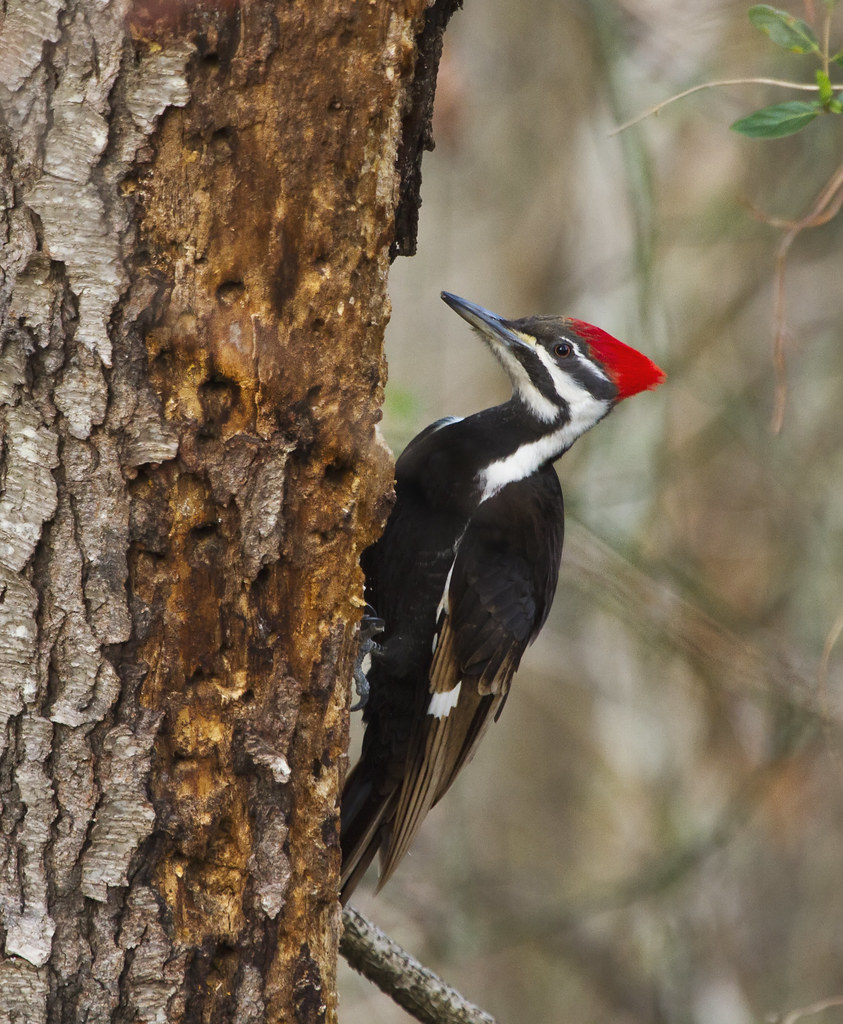
“Pileated Woodpecker” by ShenandoahNPS is marked with Public Domain Mark 1.0.
The pileated woodpecker is a very large bird the size of a crow. It took me some time to figure out what bird was making that loud call and flying from one woods to another.
It reminds me of a favorite cartoon character from my childhood…. Woody Woodpecker…

Woody Woodpecker
Pileated Woodpeckers forage in large, dead wood—standing dead trees, stumps, or logs lying on the forest floor. They make impressive rectangular excavations that can be a foot or more long and go deep inside the wood. These holes pursue the tunnels of carpenter ants, the woodpecker’s primary food. The birds also use their long, barbed tongue to extract woodboring beetle larvae (which can be more than an inch long) or termites lying deep in the wood. When hammering into this soft wood, Pileated Woodpeckers use their long neck to pull far back from the tree, then make powerful strikes with their heavy bill, pulling with their feet to increase the strength of the blow. The sound is often audible as a heavy thunk, and large chips of wood collect on the ground below.

pileated woodpecker photo cc Ramblingwoods
Sadly our woods and many woods were populated by ash trees. The emerald ash borer has killed millions of these trees leaving dead trees that eventually fall down. This is great for all woodpeckers. The photo above is not good but you can see the dead tree across the pond and the holes already and currently being drilled. These woodpeckers drill big holes. These holes are only used once by the pileated woodpecker and may benefit other cavity nesting birds and even wood ducks.

Pileated Woodpecker photo cc Rambling Woods
The pair mate for life and stay together defending their territory year round. When one member of a pair dies, the other often gains a new mate, and this is one of the main ways that new individuals get a chance to breed and hold a territory. Their flight is strong, but slow and slightly undulating; the wingbeats are deep but quick and somewhat unevenly paced.
Pileated Woodpeckers live in mature deciduous or mixed deciduous-coniferous woodlands of nearly every type, from tall western hemlock stands of the Northwest to beech and maple forests in New England and cypress swamps of the Southeast. They can also be found in younger forests that have scattered, large, dead trees or a ready supply of decaying, downed wood. Throughout their range, Pileated Woodpeckers can also be found in suburban areas with large trees and patches of woodland.
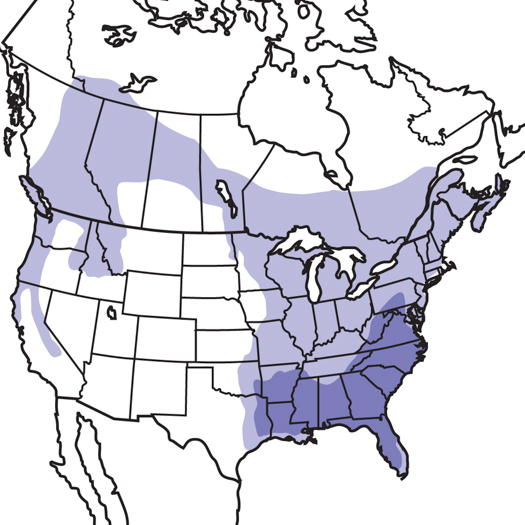
Pileated Woodpecker range cc Cornell
The Pileated Woodpecker’s primary food is carpenter ants, supplemented by other ants, woodboring beetle larvae, termites, and other insects such as flies, spruce budworm, caterpillars, cockroaches, and grasshoppers. They also eat wild fruits and nuts, including greenbrier, hackberry, sassafrass, blackberries, sumac berries, poison ivy, holly, dogwood, persimmon, and elderberry. In some diet studies, ants constituted 40 percent of the diet, and up to 97 percent in some individuals. Occasionally, Pileated Woodpeckers visit backyard bird feeders for seeds or suet.

“Pileated woodpecker nest” by NatureServe is licensed under CC BY 2.0.
NEST DESCRIPTION from Cornell
The male begins excavating the nest cavity and does most of the work, but the female contributes, particularly as the hole nears completion. The entrance hole is oblong rather than the circular shape of most woodpecker holes. For the finishing touches, the bird climbs all the way into the hole and chips away at it from the inside. Periodically the adult picks up several chips at a time in its bill and tosses them from the cavity entrance. Pileated Woodpeckers don’t line their nests with any material except for leftover wood chips. The nest construction usually takes 3-6 weeks, and nests are rarely reused in later years. Cavity depth can range from 10-24 inches.
This is a video clip that was through a window again. These birds are very shy and will leave if I go outside. There were three of them and a parent was feeding them suet from one of our suet feeders. There is a hairy woodpecker who was waiting. No bird wants to take on this huge woodpecker…
The photo below shows tow woodpeckers and then a young piliated woodpecker waiting on the right side foe the parent to get some suet for it. And they regurgitate the food for the babies

Pileated woodpecker photo cc ramblingwoods

Below..This is a video from Leslie The Bird Nerd for anyone who is interested. I enjoy her videos..

Nature Notes (# 701)~Celebrating Nature Notes from 2009-2026

Welcome to Nature Notes
Last week’s Nature Notes Bloggers

| 1. | Sallie (Full Time- Life) | 4. | Roses | 7. | YARRA RIVER |
| 2. | Marina | 5. | Pat in Colorado | ||
| 3. | Lisa | Handmade in Israel | 6. | Shiju Sugunan |
**************************************************
I didn’t even notice but last week’s Nature Notes was number 700. I looked back at some of the Nature Notes posts and I am sharing a repeat Nature Notes from 2009 which was the first year of Nature Notes….
********************************
Nature Notes Meme-“If I can stop one Heart from breaking I shall not live in vain If I can ease one life the Aching Or cool one Pain Or help one fainting Robin Unto his Nest again I shall not live in Vain~Emily Dickinson

I am going to challenge myself and hopefully you to take a look at nature. What’s going on in your area? Is it spring in your part of the world or are you heading into cold weather. Take a little walk, look at something you might never had paid attention to..a flower…a plant..an animal…What changes are taking place?..Is your garden starting to come to life again?..Step outside and close your eyes. What do you hear? ….
I’d really like to know how my blogger friends observe about nature. Post a photo or a poem or just a paragraph about what you see, how you felt and maybe something you hadn’t paid any attention to before…
Just a way of noting nature…Leave me comment and let me know if you posted your own “Nature Note” Give it a try..I will be doing this on Thursdays unless it’s a bad day for anyone else you wants to join me.
Grab the “Nature Notes” badge and link back to Rambling Woods
Today the Robins are back!!!!!! I had to hurry and soak some raisins in hot water so I could put them out on a dish as it is difficult for the Robins to find food in the frozen ground.

American Robin Eating Raisins
I was so excited that Pam from Finding Pam took up the Nature Notes Challenge and wrote a beautiful post starting with “When I close my eyes and really listen, I can hear the fast sway of the trees as the wind blows them…” Please visit Pam. She does what I can’t .. write beautifully….

Nature walks are wonderful. But you don’t have to travel to special location to enjoy Mother Nature. There is so much to see in your own neighborhood or even in your own back or front yard. Get a guide-book of the wildlife in your area and learn the calls of birds and frogs and toads. So many times I hear a bird that lets me know what I am looking for in the trees.
********
Nature Notes (# 700)~This year’s relentless winter in the East continues
Welcome to Nature Notes
Last week’s Nature Notes Bloggers

| 1. | The Early Birder | 3. | Snow in Paris | 5. | Natasha Musing |
| 2. | Shiju Sugunan | 4. | Pat in Colorado | 6. | MERRI CREEK |

This year’s relentless winter in the East continues
A brutally cold weekend awaits more than 100 million people in the northeastern quarter of the nation as Arctic air lunges southward straight from eastern Canada. A fast-moving storm system is expected to move through parts of the northern United States on Friday. Bob Oravec, a meteorologist at the Weather Prediction Center, said heavy snow was expected in some places, particularly across areas downwind of the Great Lakes. There could be up to six inches or more starting Friday night, including in major cities such as Cleveland, Buffalo, Rochester and Syracuse. In its wake, temperatures will plummet once again. Is it the polar vortex? Yes, a lobe of the polar vortex at lower levels of the atmosphere (known as the “tropospheric polar vortex”) is responsible for this intense cold,
BUT COME MARCH….the wind pollinated silver maple flowers will bloom…..

Silver Maple Flowers-ramblingwoods
COME MAY…… Beautiful violets will bloom all around the back yard……….

Common Violet-ramblingwoods
And sunshine itself….. Golden Groundsel……

Golden Groundsel-ramblingwoods

Tulip-ramblingwoods

Trillium-ramblingwoods
Nature walks are wonderful. But you don’t have to travel to special location to enjoy Mother Nature. There is so much to see in your own neighborhood or even in your own back or front yard. Get a guide-book of the wildlife in your area and learn the calls of birds and frogs and toads. So many times I hear a bird that lets me know what I am looking for in the trees.
 ~RAMBLING WOODS