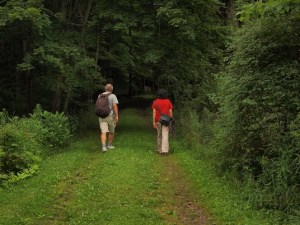
MY TOPOI EXPERIENCE
In 2013, when we started the project W and I were reading “Body and World” by the late American phenomenologist Samuel Todes. In many respects it was an eye opening experience. Todes’ goal is to describe categories of perception in parallel to Kantian categories of reason, and he points out to the constitutive role of our bodily presence in the world. “Body and World” is a dense theoretical treatise employing the phenomenological method, but at the same time Todes’ everyday life examples, make his arguments very appealing. Here is one: Look at the table over there. It has a smooth uniform top. Yesterday I put a glass on it in. It is no longer there, but I remember where it was. It was here, in this particular place. This place, this particular spot, is only here for me. I made it.
W and I read the book together and talked about in on our walks. Many questions came to mind. How do we get to know where we are? How is one place different from another? Where does one place end and another begin? What objects do we pay attention to, and what objects we are not aware of? What makes and object? When A, MC and I talked about it when I visited them in the summer of 2013, we thought it would be a good idea to try develop a nonverbal conversation on such question by taking pictures.
For me, taking pictures is a natural way of extending a conversation. While traveling, or hiking with a companion, a very natural reflex is to point. Look at this, look at that. Not only I like to do it, sometimes it is hard to control myself and not to do it. Sharing visual experiences seems to be a very natural instinct. If one travels alone, taking pictures becomes for me a substitute for direct sharing. Shoot now, point later. So when we started the project, I became more conscious of how I decide what to point at and what to shoot. What makes me react to this particular landscape, or that particular object. Looking at the pictures posted by the four of us one can instantly see that each selection can be recognized by a particular style. What makes styles of those pictures so recognizable? We photographed various places (on several continents) trying to show each other something, and surely, there is much in those picture one can learn about the topoi they depict, but one also learns something, perhaps less obvious, about the picture takers. Todes argues that by finding objects in space, we find ourselves. Here we have a record of who found what through their camera lenses.
We have been contributing to the project on and off for more tan three years now. It had an interesting effect. I, and other report it too, started to think topoistically. Now, when on a walk something catches my attention I often think, oh, that would be a perfect topoi picture, but then I resist and do not take it. It may be because I took a similar picture before, and there is nothing new I can say with another one, it also may be because of a specific Heisenberg effect: taking pictures changes ones perspective on what one sees. Perhaps now it is time to reflect, summarize and continue but in a different way.
A FEW WORDS ABOUT MATHEMATICAL THINKING
An interesting question that MC and W have been asking is whether one can discern traces of mathematical thinking in A’s and my posts. How do mathematicians think, and how does it impact the way we perceive the world?
Modern mathematics takes place at high level of abstraction. To follow its development one has to constantly learn and absorb new concepts, concepts that have precise formal definitions, but often come with motivation and intuitions that are vague and not easily communicable. We are constantly involved in creating ideas, and we struggle to understand ideas of others. All that must leave some trace on how we think outside of mathematics. Clearly, mathematical sense of humor is somewhat special. Once a colleague of mine travelled with a group of mathematicians to a seminar. When they got there, someone asked him “Did you come in two cars?”, and he said, “No, I usually come in one.” I find it funny, but I think that there something specifically mathematical here. Or how about this joke: two plus two is five for a sufficiently large value of two. That one is funny too, but probably for a very limited audience.
We do tend to theorize, conjecture, abstract quickly, or sometimes too quickly. We are trained to see analogies, and we actually specialize in looking for analogies in places where they are hard to find. We analyze extremes. We treat zero (nothing) as a counting number, and we consider the empty set (nothing) a legitimate set, and to make things worse, we think it is a subset of every other set (including itself!). Does such thinking have an effect on how one sees the world? I am sure it does, but not everyone if affected the same way. Despite commonalities, there are many different styles of doing mathematics. Some of us think in terms of dynamic processes, change, fluctuation. Other prefer to see mathematical objects as fixed, eternal structures whose intricate design needs to be uncovered. I may be wrong, but I would put A in the first group and myself in the second. Once you make a distinction like that, you may also notice a similar difference in our photographs. Watching A’s pictures I have a sense of action. Something is happening there, and this action to a large extent defines the character of the place. It is the character of “here and now.” My pictures are static. I tend to capture objects or groups of objects in stable configurations. The older the object, the more it catches my attention, like a dysfunctional metal piece still attached to an old tree—a piece of technology blended with nature establishing a link to an already distant past. It is here now, and it seems that it has been here forever. It has evolved, but it has evolved slowly. By the presence of this piece, the topos, of which the old object is a constitutive part, gains another temporal dimension: its past.
So this is about how, in a rough sketch, I see differences between A’s and mine contributions to this project. Are there also similarities that show influence of our mathematical training? Perhaps MC and W can tell.
 project topoi