Balanced clock hands

Given an analog clock with sweeping hour, minute, and second hands, at what times are the hands most evenly “balanced”– that is, most equally separated in angle?

It’s a standard high school algebra problem to compute all of the times at which just the hour and minute hands are aligned on top of each other. And it’s relatively straightforward to show that all three hands, including the second hand, are only exactly aligned twice per day, at 12 o’clock. But this problem is different: here, we would like the three angles made by the three hands to be as equal– that is, as close to 120 degrees each– as possible.

As we will see shortly, there is no time at which all three angles are exactly 120 degrees. (This is another nice exercise to prove just using pencil and paper.) So, how close can we get? This post was an admittedly somewhat frivolous excuse to experiment with SymPy, the Python symbolic mathematics library bundled with SciPy. My approach was pretty brute-force, letting SymPy do all of the heavy lifting with very few lines of code, including evaluating multiple different metrics defining what we mean by “balanced.” (All of the code discussed here is available on GitHub.)

The problem is complicated by the floor functions that would be buried in the cost function if we were to use a single parameter to represent the continuously varying time over the entire 12-hour domain. Instead, let’s divide the domain into 12×60=720 one-minute intervals, each specified by a fixed integer hour and minute, and for each, only let the second hand sweep through the single revolution of that one minute of time, computing the resulting three angles between consecutive hands:

def hand_positions(hour, minute, second):
    """Return positions in [0, 360) of clock hands."""
    r_60 = sym.Rational(60, 1)
    return (360 * (hour + minute / r_60 + second / (r_60 * r_60)) / 12,
            360 * (minute + second / r_60) / r_60,
            360 * second / r_60)

def hand_angles(hands):
    """Return angles between clock hands."""
    x, y, z = sorted(hands)
    return (y - x, z - y, x - z + 360)

At any given time, what yardstick should we use to measure how “balanced” the clock hands are? There are at least a couple of reasonable alternatives, even if we restrict our attention to (piecewise) linear cost functions. The first that occurred to me was to “maximize the minimum” angle: by the pigeonhole principle, at least one of the angles is at most 120 degrees, so let’s try to make that smallest angle as large as possible, measuring the deficit:

def max_min(*time):
    """(120 minus) minimum angle between clock hands."""
    return 120 - min(hand_angles(hand_positions(*time)))

Rather than maximizing the minimum angle, another option is to “minimize the maximum” absolute deviation of each angle from the desired optimal 120 degrees. This cost is implemented below. (I had initially also implemented the Manhattan distance, i.e., the sum (or equivalently, the average) of absolute deviations from 120 degrees. But it’s another nice problem to show that this is unnecessary: the sum of absolute deviations yields the same ordering as the maximum of absolute deviations… but this would not generally be true if our clocks somehow had more than just three hands (why?).)

def min_max(*time):
    """Max. deviation from 120 deg. of angles between clock hands."""
    return max(abs(a - 120) for a in hand_angles(hand_positions(*time)))

At this point, the key observation is that the only possible candidate times at which these cost functions are optimized are at their critical points (or at endpoints of the domain). And because these costs are piecewise linear, the critical points are easy to enumerate: either two of the angles are equal (when maximizing the minimum angle), or one of the angles is exactly 120 degrees (when minimizing the absolute deviation). The following function lumps all of these possibilities together into one list:

h, m, s = [sym.Symbol(v) for v in 'hms']

def critical_points():
    """Generate possible critical positions of sweeping second hand."""
    yield 0
    for x, y, z in permutations(hand_positions(h, m, s)):
        a, b, c = (y - x, z - y, x - z + 360)
        for lhs, rhs in ((a, b), (a, c), (b, c), (a, 120), (b, 120), (c, 120)):
            yield from sym.solve(lhs - rhs, [s])

The resulting “most balanced” times are shown below. There are a couple of interesting observations. First, a solution won’t be unique; times come in “mirror image” pairs with the same cost. Second, although the two cost functions considered here do yield slightly different optimal times, they differ by less than 3 hundredths of a second, and the same four or five best mirror pairs are all clustered within about 8 hundredths of a second of each other– all at approximately 2:54:34, along with its mirror time 9:05:25.

The two “mirror” times with the same minimum maximum absolute deviation of clock hand angles from 120 degrees: 2:54:34 394/719 (at left) and 9:05:25 325/719 (at right).

Finally, what if the second hand doesn’t sweep, but ticks from one integer second to the next? (When I was a kid, this was the magic method to distinguish between the real and fake Rolex watch, neither of which any of us had actually ever seen.) In this case, the most balanced times– that also appear within about a tenth of a second of the nearby overall top ten times– are at 5:49:09, along with its mirror time 6:10:51, as shown below.

The two “mirror” times that are most balanced if we constrain the second hand to “tick” at integer numbers of seconds: 5:49:09 (at left) and 6:10:51 (at right).

What is the probability of a tie vote?

This article was discussed on Reddit.

It is time to vote for a new mathematics department chair. All n=20 voting faculty members are on the ballot as eligible candidates… but no one really cares about the job, so each faculty member simply votes randomly, selecting a name uniformly at random from the n names on the ballot. The candidate receiving the most votes wins the election. What is the probability of a tie vote, that is, what is the probability that more than one faculty member receives the same maximum number of votes, requiring a runoff?

I found this problem interesting for a couple of reasons. First, the original version of the problem as presented to me was slightly different, where each candidate is excluded from voting for themselves (not only do they not care about the job, they actively avoid it). This seems significantly more difficult– or at least, much more computationally expensive– to solve. See the messy details at the end of this post.

The second interesting aspect of this problem was the potentially weird limiting behavior as the number of voting candidates grows large, as shown in the figure below.

Probability of a tie vote in an election vs. number of voting candidates.

Does the probability of a tie approach a limit as n \to \infty, or does it continue to persistently meander around? The latter would be really interesting, but perhaps not entirely unexpected: van de Brug, Kager, and Meester (see reference below) analyze the “group Russian roulette” problem, where at each time step, the survivors from an initial group of n people each shoot and kill a random other person. The probability that eventually there are no survivors (that there is a deadly tie for the win, so to speak), does not approach a limit, but instead repeatedly– but ever more slowly– varies up and down as the group size increases.

Following are my notes on the solution to both voting problems. First, the probability p(n) of a tie vote where candidates may vote for themselves is

p(n) = 1-\frac{n}{n^n}\sum\limits_{v=2}^{n}[\frac{x^n}{n!}]\frac{x^v}{v!}\left(\sum\limits_{k=0}^{v-1}\frac{x^k}{k!}\right)^{n-1}

If we constrain each candidate to vote for someone other than themselves, the resulting probability is the even more unpleasant

p^*(n) = 1-\frac{n}{(n-1)^n}\sum\limits_{v=2}^{n-1}\sum\limits_{k=0}^{n}(-1)^k [\frac{x^{n-k}}{(n-k)!}](

{{n-1} \choose {k-1}}\frac{x^{v-1}}{(v-1)!}\left(\sum\limits_{j=0}^{v-2}\frac{x^j}{j!}\right)^{k-1}\left(\sum\limits_{j=0}^{v-1}\frac{x^j}{j!}\right)^{n-k}

+ {{n-1} \choose k}\frac{x^v}{v!} \left(\sum\limits_{j=0}^{v-2}\frac{x^j}{j!}\right)^k\left(\sum\limits_{j=0}^{v-1}\frac{x^j}{j!}\right)^{n-k-1})

It’s unclear to me whether these exact formulas may be simplified, or whether they even help with analysis of asymptotic behavior.

Reference:

  1. T. van de Brug, W. Kager, R. Meester, The asymptotics of group Russian roulette. [arXiv]

Counting edge-matching puzzles

I recently re-discovered a puzzle that I had mostly forgotten from when I was a kid. The problem is simple to state: rearrange and rotate the seven hexagonal pieces shown below so that each of the twelve pairs of facing edges have matching labels. (Currently, only the 0s at 2 o’clock and the 3s at 5 o’clock match as required.)

Example hexagonal edge-matching puzzle.

The original puzzle wasn’t exactly the one above; the edge labels were different, but the basic idea was the same. What snagged my interest here, decades later, was not solving this puzzle, but counting them. That is, if hexagonal pieces are distinguishable only by their pattern (up to rotation) of edge labels 0 through 5, then how many different possible puzzles– sets of seven such pieces packaged and sold as a product– are there?

I think this question is not “nice” mathematically– or at least, I was unable to make much progress toward a reasonably concise solution– but it was interesting computationally, because the numbers involved are small enough to be tractable, but large enough to require some thought in design and implementation of even a “brute force” approach.

(My Python solution is on GitHub. What I learned from this exercise: I had planned to implement a lazy k-way merge using the priority queue in the heapq module, but I found that it was already built-in.)

There are several variants of the question that we can ask. First and easiest, let’s ignore solvability. There are 5!=120 different individual hexagonal pieces, and so there are {7+120-1 \choose 7}, or 84,431,259,000 distinguishable sets of seven such pieces.

However, most of these puzzles do not have a solution. It turns out there are 4,967,864,520 different solvable puzzles… but there are at least a couple of ways that we might reasonably reduce this number further. For example, over a billion of these solvable puzzles have multiple solutions– 1800 of which have twenty different solutions each. If we constrain a “marketable” puzzle to have a unique solution, then there are… well, still 3,899,636,160 different possible puzzles.

Of course, many of these puzzles are only cosmetically different, so to speak. For example, the puzzle shown above has four identical pieces with the same 0-through-5 counterclockwise labeling. If we arbitrarily distinguish this “identity” piece, then although some puzzles have none of these pieces, they are not really “different” in a useful way, since we could simply relabel all of the edges appropriately so that they do contain at least one identity piece. There are only 281,528,111 different puzzles containing at least one identity piece, of which 221,013,350 have a unique solution.

The Fisher-Yates shuffle is backward

Given a list of n elements, such as cards in a deck, what is the right way to shuffle the list? That is, what is the appropriate algorithm to (pseudo)randomly permute the elements in the list, so that each of the n! possible permutations is equally likely?

This is an interesting problem, in part because it is easy to get wrong. The standard, all-the-cool-kids-know-it response is the Fisher-Yates shuffle, consisting of a sequence of n-1 carefully specified random transpositions, with the following basic implementation in Python:

def fisher_yates_shuffle(a):
    """Shuffle list a[0..n-1] of n elements."""
    for i in range(len(a) - 1, 0, -1): # i from n-1 downto 1
        j = random.randint(0, i) # inclusive
        a[i], a[j] = a[j], a[i]

Note that the loop index i decreases from n-1 down to 1. Everywhere I have looked, this is how the algorithm is always presented. The motivation for this post is to wonder aloud why the following variant– which seems simpler, at least to me– is not the “standard” approach, with the only difference being that the loop runs “forward” instead of backward:

def forward_shuffle(a):
    "Shuffle list a[0..n-1] of n elements."""
    for i in range(1, len(a)): # i from 1 to n-1
        j = random.randint(0, i) # inclusive
        a[i], a[j] = a[j], a[i]

It’s worth emphasizing that this is different from what seems to be the usual “forward” version of the algorithm (e.g., this “equivalent version”), that seems to consistently insist on also “mirroring” the ranges of the random draws, so that they are decreasing with each loop iteration instead of the loop index:

def mirror_shuffle(a):
    "Shuffle list a[0..n-1] of n elements."""
    for i in range(0, len(a) - 1): # i from 0 to n-2
        j = random.randint(i, len(a) - 1) # inclusive
        a[i], a[j] = a[j], a[i]

There are a couple of ways to see and/or prove that forward_shuffle does indeed yield a uniform distribution on all possible permutations. One is by induction– the rather nice loop invariant is that, after each iteration i, the sublist a[0..i] is a uniformly random permutation of the original sublist a[0..i]. (Contrast this with the normal Fisher-Yates shuffle, where after each iteration indexed by i, the “suffix” sublist a[i..n-1] is essentially a uniformly permuted reservoir-sampled subset of the entire original list.)

Another way to see that forward_shuffle works as desired is to relate its behavior to that of the original fisher_yates_shuffle, which has already been proved correct. Consider the set of independent discrete random variables \{X_1, X_2, \ldots, X_{n-1}\}, with each X_i distributed uniformly between 0 and i, inclusive. These X_i are the random draws returned from random.randint(0, i).

Imagine generating the entire set of those n-1 independent random draws up front, then applying the sequence of corresponding transpositions (i, X_i). The original Fisher-Yates shuffle applies those transpositions in order of decreasing i, while forward_shuffle applies the same set of random transpositions, but in reverse order. Thus, the permutations resulting from fisher_yates_shuffle and forward_shuffle are inverses of each other… and if a random permutation is uniformly distributed, then so is its inverse.
There is nothing special here– indeed, this forward_shuffle is really just a less dressed-up implementation of what is usually referred to as the “inside-out” version of Fisher-Yates, that for some reason seems to be presented as only appropriate when shuffling a list generated from an external source (possibly of unknown length):

def forward_shuffle(source):
    "Return shuffled list from external source."""
    a = []
    for i, x in enumerate(source):
        a.append(x)
        j = random.randint(0, i) # inclusive
        a[i], a[j] = a[j], a[i]
    return a

I say “less dressed-up” because I’ve skipped what seems to be the usual special case j==i comparison that would eliminate the swapping. The above seems simpler to me, and I would be curious to know if these (branchless) swaps are really less efficient in practice.

Among Us: Morse code puzzle

In the online game Among Us, players who visit the Comms room hear a fuzzy audio recording of a series of high-pitched beeps that sound like Morse code. I first heard the recording here, but this more recent video also plays it at around 5:00, followed by a good explanation of the problem with trying to decipher the code.

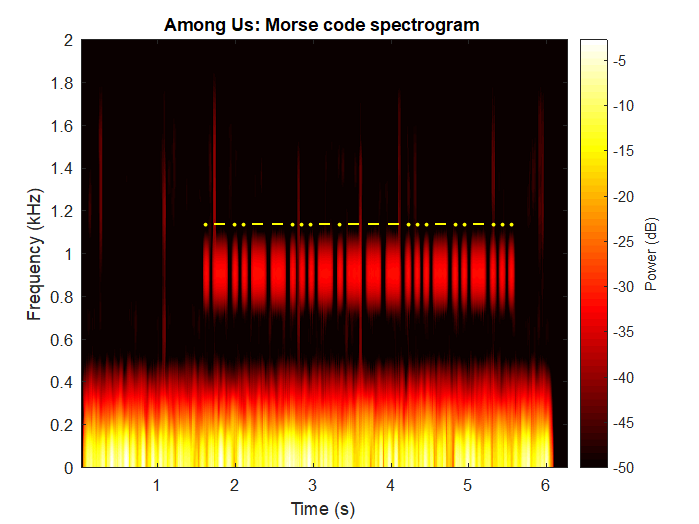
The following figure shows a spectrogram of the audio clip, with time on the x-axis, and each vertical slice showing the Fourier transform of a short (roughly 50 ms) sliding window of the signal centered at the corresponding time. We can clearly see the “dots” and “dashes” at around 1 kHz, with the corresponding translation overlaid in yellow.

Spectrogram of the Comms room audio, with the translated Morse code also indicated in yellow.

Now that we have the Morse code extracted from the audio (which, for reference if you want to copy-paste and play with this problem, is “.-..--...-.---...-..-...“), we just need to decode it, right? The problem is that the dots and dashes are all uniformly spaced, without the required longer gaps between letters, let alone the still longer gaps that would be expected between words. Without knowing the intended locations of those gaps, the code is ambiguous: for example, the first dot could indicate the letter E, or the first dot and dash together could indicate an A, etc.

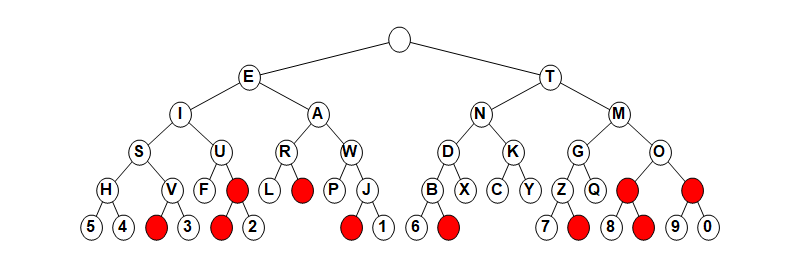
That turns out to be a big problem. The following figure shows the decoding trie for Morse code letters and digits; starting at the root, move to the left child vertex for each dot, or to the right child vertex for each dash. A red vertex indicates either an invalid code or other punctuation.

Morse code represented as a decoding trie; each left and right edge indicates a dot or dash, respectively.

If we ignore the digits in the lowest level of the trie, we see that not only are Morse code letters ambiguous (i.e., not prefix-free), they are nearly “maximally ambiguous,” in the sense that the trie of letters is nearly complete. That is, for almost any prefix of four dots and dashes we may encounter, the gap indicating the end of the first letter could be after any of those first four symbols.

This would make a nice programming exercise for students, to show that this particular sequence of 24 symbols may be decoded into a sequence of letters in exactly 3,457,592 possible ways. Granted, most of these decodings result in nonsense, like AEABKGEAEAEEE. But a more interesting and challenging problem is to efficiently search for reasonable decodings, that is, messages consisting of actual (English?) words, perhaps additionally constrained by grammatical connections between words.

Of course, it’s also possible– probable?– that this audio clip is simply made up, a random sequence of dots and dashes meant to sound like “real” Morse code. And even if it’s not, we might not be able to tell the difference. Which is the interesting question that motivated this post: if we generate a completely random, and thus intentionally unintelligible, sequence of 24 dots and dashes, what is the probability that it still yields a “reasonable” possible decoding, for sufficiently large values of “reasonable”?

Counting Hotel Key Cards

Introduction

Suppose that you are the owner of a new hotel chain, and that you want to implement a mechanical key card locking system on all of the hotel room doors. Each key card will have a unique pattern of holes in it, so that when a card is inserted into the corresponding room’s door lock, a system of LEDs and detectors inside the lock will only recognize that unique pattern of holes as an indication to unlock the door.

(I have vague childhood memories of family vacations and my parents letting me use just such an exotic gadget to unlock our hotel room door.)

When you meet with a lock manufacturer, he shows you some examples of his innovative square key card design, with the “feature” that a key card may be safely inserted into the slot in a door lock in any of its eight possible orientations: any of the four edges of the square key card may be inserted first, with either side of the key card facing up. Each key card has a pattern of up to 36 holes aligned with a 6×6 grid of sensors in the lock that may “scan” the key card in any orientation.

Examples of hotel key cards each with a 6×6 grid of 36 possible holes.

The lock manufacturer agrees to provide locks and corresponding key cards for each room, with the following requirements:

  1. A manufacturer-provided key card will only open its assigned manufacturer-provided lock and no other; and
  2. A manufacturer-provided key card will open its assigned manufacturer-provided lock when inserted into the slot in any orientation.

How many distinct safely-locked rooms can the manufacturer support?

A simpler lock is a harder problem

The problem as stated above is a relatively straightforward application of Pólya counting, using the cycle index of the dihedral group of symmetries of the key card acting on (2-colorings of) the n \times n grid of possible holes in the card. When n is even, the cycle index (recently worked out in a similar problem here) is

Z(D_4) = \frac{1}{8}(x_1^{n^2}+2x_4^{\frac{n^2}{4}}+3x_2^{\frac{n^2}{2}}+2x_1^n x_2^{\frac{n^2-n}{2}})

Evaluating at n=6, x_i=2 yields a total of 8,590,557,312 distinct key cards– and corresponding hotel room door locks– that the manufacturer can provide.

However, these locks are expensive: the second requirement above means that each lock must contain not only the sensing hardware to scan the pattern of holes in a key card, but also the software to compare that detected pattern against the eight possibly distinct rotations and reflections of the pattern that unlocks the door. (For example, the key card on the left in the figure above “looks the same” to the sensor in any orientation; the key card in the middle, however, may present any of four distinct patterns of scanned holes; and the key card on the right “looks different” in each of its eight possible rotated or flipped orientations.)

Which leads to the problem that motivated this post: to reduce cost, let’s modify the second requirement above– but still retaining the first requirement– so that a manufacturer-provided key card will only open its assigned manufacturer-provided lock when inserted into the slot in a single correct orientation labeled on the key card. This way, the sensing hardware in the lock only needs to “look for” a single pattern of holes.

Now how many distinct key cards and corresponding room locks are possible?

Counting regular orbits

The idea is that, referring again to the figure above, key cards may only have patterns of holes like the example on the far right, without any rotation or reflection symmetries. In other words, given the (dihedral) group G of symmetries acting on colorings of the set X of possible key card hole positions, we are counting only regular orbits of this action– i.e., those orbits whose colorings are “fully asymmetric,” having a trivial stabilizer.

So how can we do this? My approach was to use inclusion-exclusion, counting those colorings fixed by none of the symmetries in G-\{e\}. To start, we represent each element of G as a list of lists of elements of X, corresponding to the disjoint cycles in the permutation of X. For a given subset S \subseteq G-\{e\} in the inclusion-exclusion summation, consider the equivalence relation on X relating two key card hole positions if we can move one to the other by a sequence of symmetries in S. Then the desired number of k-colorings fixed by S is k^{m_S}, where m_S is the number of equivalence classes.

We can compute this equivalence relation using union-find to incrementally “merge” the sets of disjoint cycles in each permutation in S (all of the code discussed here is available on GitHub):

def merge(s, p):
    """Merge union-find s with permutation p (as cycles)."""
    def find(x):
        while s[x] != x:
            x = s[x]
        return x
    def union(x, y):
        x = find(x)
        s[find(y)] = x
        return x
    for cycle in p:
        reduce(union, cycle)
    for x in range(len(s)):
        s[x] = find(x)
    return s

It remains to compute the inclusion-exclusion alternating sum of these (-1)^{|S|}k^{m_S} over all subsets S \subseteq G-\{e\}.

def cycle_index_term(s, k=2):
    """Convert union-find s to cycle index monomial at x[i]=k."""
    #return prod(x[i]**j for i, j in Counter(Counter(s).values()).items())
    return k ** sum(Counter(Counter(s).values()).values())

def asymmetric_colorings(group, k=2):
    """Number of k-colorings with no symmetries in the given group."""

    # Group G acts on (colorings of) X = {0, 1, 2, ..., n-1}.
    G = list(group)
    n = sum(len(cycle) for cycle in G[0])

    # Compute inclusion-exclusion sum over subsets of G-e.
    G = [g for g in G if len(g) < n]
    return sum((-1) ** len(subset) *
               cycle_index_term(reduce(merge, subset, list(range(n))), k)
               for subset in chain.from_iterable(combinations(G, r)
                                                 for r in range(len(G) + 1)))

Evaluating the result– and dividing by the size of each orbit |G|=8— yields 8,589,313,152 possible “fully asymmetric” key cards satisfying our requirements.

Questions

At first glance, this seems like a nice solution, with a concise implementation, that doesn’t require much detailed knowledge about the structure of the symmetry group involved in the action… but we get a bit lucky here. The time to compute the inclusion-exclusion summation is exponential in the order of the group, which just happens to be small in this case.

For a more complex example, imagine coloring each face of a fair die red or blue; how many of these colorings are “orientable,” so that if the die rests on a table and we pick it up, put it in a cup and shake it and roll the die to a random unknown orientation, we can inspect the face colors to unambiguously determine the die’s original resting orientation? We can use the same code above to answer this question for a cube or tetrahedron (0 ways) or octahedron (120/24=5 ways)… but the dodecahedron and icosahedron are beyond reach, with rotational symmetry groups of order 60.

Of course, in those particular cases, we can lean on the additional knowledge about the structure of the subgroup inclusion partial order to solve the problem with fewer than the 2^{60}-ish operations required here. But is there a way to improve the efficiency of this algorithm in a way that is still generally applicable to arbitrary group actions?

Exploiting advantage from too few shuffles

Introduction

A few days ago a friend of mine referred me to an interesting podcast discussing card shuffling, framed as a friendly argument-turned-wager between a couple about how many times you should shuffle a deck of cards. A woman claims that the “rule” is that you riffle shuffle three times, then quit messing around and get to dealing. Her partner, on the other hand, feels like at least “four or more” riffle shuffles are needed for the cards to be sufficiently random.

A mathematician is brought into the discussion, who mentions the popular result that seven shuffles are needed… at least according to specific, but perhaps not necessarily practical, mathematical criteria for “randomness.” (There is some interesting preamble about the need to define exactly what is meant by “random,” which I was disappointed to hear defined as, “any card is equally likely to be in any position in the deck.” This isn’t really even close to good enough. For example, start with a brand new deck of cards in a known order, and simply cut the deck at a uniformly random position. Now each and every card is equally likely to be in any position in the deck, but the resulting arrangement of cards can hardly be called sufficiently random.)

A win for the man, right? But the woman’s side is vindicated in the end, by noting that even in casinos– where presumably this has been given a lot of thought– a standard poker deck is typically only shuffled three times. Several dealers are interviewed, each describing the process with the chant, “riffle, riffle, box, riffle, cut.”

The wash

A couple of observations occurred to me after listening to this discussion. First, it’s true that casino dealers don’t shuffle seven times… but they also don’t just shuffle three times. Particularly when presented with a brand new pack, before any riffle shuffling, they often start with a “wash,” consisting of spreading the cards haphazardly around the table, eventually collecting them back into a squared-up deck to begin the riffle-and-cut sequence.

Depending on how thorough it is, that initial wash alone is arguably sufficient to randomize the deck. If we think of a single riffle shuffle as applying a random selection of one of “only” 2^{52} possible permutations in a generating set, then the wash is roughly akin to making a single initial selection from a generating set of all 52! possible arrangements. If the wash is thorough enough that this selection is approximately uniform, then after that, any additional shuffling, riffle or otherwise, is just gravy.

When does it really matter?

The second observation is one made by a dealer interviewed in the podcast, who asks what I think is the critical practical question:

The real question is, what’s the goal of the shuffle? Is it to completely randomize the cards, or is it to make it so that it’s a fair game?

In other words, if we are going to argue that three, or any other number of shuffles, is not sufficient, then the burden is on us to show that this limited number of shuffles provides a practical advantage that we can actually exploit in whatever game we happen to be playing.

We have discussed some examples of this here before. For example, this wonderful card trick due to Charles Jordan involves finding a spectator’s secretly selected card, despite being buried in a thrice-shuffled deck. And even seven shuffles is insufficient to eliminate a huge advantage in the so-called New Age Solitaire wager.

But it’s an interesting question to consider whether there are “real” card games– not magic tricks or contrived wagers– where advantage may be gained by too few shuffles.

I struggled to think of such a practical example, and the following is the best I can come up with: let’s play a simplified version of the card game War (also discussed here recently). Start with a “brand new” deck of cards in the following order:

A “new deck order” of cards prior to shuffling for a simplified game of War.

Riffle shuffle the deck three times, and cut the deck. In fact, go ahead and cut the deck after each riffle shuffle. Then I will deal the cards into two equal piles of 26 cards, one for each of us. At each turn, we will simultaneously turn over the top card from our piles, and the higher card wins the “trick.” Let’s simplify the game by just playing through the deck one time, and instead of a “war” between cards of the same rank, let’s just discard the trick as a push. At the end of the game, whoever has taken the most tricks wins a dollar from the other player.

If three shuffles is really sufficient to make this a “fair” game, then the expected return for each player should be zero. Instead, I as the dealer will win over two out of three games, taking about 42 cents from you per game on average!

Of course, this is still contrived. Even the initial deck order above is cheating, since it isn’t the typical “new deck order” in most packs manufactured in the United States. And if we play the game repeatedly (with three shuffle-cuts in between), the advantage returns to near zero for reasonable methods of collecting the played cards back into the deck.

So, I wonder if there are better real, practical examples of this kind of exploitable advantage from too few shuffles? And can this advantage persist across multiple games, with the same too-few shuffles in between? It’s interesting to consider what types of games involve methods of collecting the played cards back into the deck to shuffle for the next round, that might retain some useful ordering; rummy-style games come to mind, for example, where we end up with “clumps” of cards of the same rank, or of consecutive ranks, etc.

Giant Yahtzee

In the game of Yahtzee, players roll five standard dice, then repeatedly re-roll subsets of the dice, trying to obtain various scoring combinations, the most valuable of which is a “Yahtzee,” or five of a kind, i.e., all five dice showing the same value.

If we strip off the complexities of the multiple players, limited number of re-rolls, and various other scoring combinations (e.g., straights, full houses, etc.), there is a nice mathematical puzzle buried underneath:

Roll n dice each with d=6 sides, and repeatedly re-roll any subset of the dice– you can “keep” any or none of your previous rolls, and you can re-roll dice you have previously kept– until all dice show the same value (e.g., all 1s, or all 2s, etc.). Using an optimal strategy, what is the (minimum) expected number of rolls required? In particular, can we solve this problem for “Giant Yahztee,” where we are playing with, say, n=100 dice?

Edit 2020-10-05: Following are my notes on this problem. Given that we (re)roll r of the dice– setting aside the remaining s=n-r already identical dice– let the random variable X_r indicate the resulting new number of identical dice. The distribution of X_r is given by

P(X_r \leq t) = \frac{1}{d^r}[\frac{x^r}{r!}] \left(\sum\limits_{k=0}^t \frac{x^k}{k!}\right)^{d-1} \left(\sum\limits_{k=0}^{t-n+r} \frac{x^k}{k!}\right)

P(x_r = t) = P(X_r \leq t) - P(X_r \leq t-1)

so that the transition matrix P for the absorbing Markov chain with state space {0, 1, 2, \ldots, n} indicating the current number of identical dice has entries

P_{s,t} = P(X_{n-s}=t), 0 \leq s,t \leq n

which we can use to compute the desired expected number of rolls. See the comments for a nice closed form solution for the cumulative distribution function for the number of rolls when n=5.

MATLAB’s colon operator and for loops

Introduction

The MATLAB colon operator is surprisingly complicated, given that its job seems pretty simple to describe: generate a vector of regularly-spaced values, with a specified starting point, step size, and endpoint. For example, to create the vector x=(0, 0.1, 0.2, \ldots, 1.1, 1.2):

x = 0:0.1:1.2;

At least some complexity is understandable, since as in this example, the “intended” step size and/or the endpoints may not be represented exactly in double floating-point precision. But in MATLAB’s usual habit of trying to “helpfully” account for this, things get messier than they need to be. The motivation for this post is to describe two different behaviors of the colon operator: it behaves in one special way in for loops, and in a different way– well, everywhere else.

Creating vectors with colon syntax

First, the “everywhere else” case: as the documentation suggests,

The vector elements are roughly equal to [start, start+step, start+2*step, ...] … however, if [the step size] is not an integer, then floating point arithmetic plays a role in determining whether colon includes the endpoint in the vector.

That is, continuing the above example, note that ismember(1.2, x), despite the fact that 0+12*0.1 > 1.2. But the actual implementation is even more complex than just computing the “intended” endpoint. The output vector is effectively constructed in two halves, adding multiples of the step size to the starting point in the first half, and subtracting multiples of the step size from the (computed) endpoint in the second half.

So far, this seems reasonably well known, despite the broad strokes documentation. There is a good description of the details of how this works on Stack Overflow. Let’s not worry about those details here, though; instead, what seems less well known is that the same colon expression, such as in the example above, behaves differently when it appears in a for loop.

For loops with (and without) colon syntax

First, it’s worth noting that MATLAB for loops don’t have to use the colon operator at all. With not-quite-full-fledged iterator-ish semantics, you can iterate over the columns of an arbitrary array expression. For some examples:

for index = [2, 3, 5, 7]
    disp(index); % 4 iterations
end

for index = x
    disp(index); % 13 iterations
end

(Technically, iteration is over first-column “slices” of the possibly multi-dimensional array. This can cause some non-intuitive behavior. For example, how many iterations would you expect over ones(2,0,3)? What about ones(0,2,3)?)

But here is where things get weird. Consider the following example:

x = 0:0.1:1.2;
for index = 0:0.1:1.2
    disp(find(x == index));
end

This loop only “finds” 7 of the 13 elements of the original vector above, which was created using exactly the same colon operator expression!

So what’s going on? First, while the colon operator documentation was perhaps merely incomplete, the for loop documentation is downright misleading, suggesting that the behavior is to “increment index by the step on each iteration.” That sounds to me like repeatedly adding the step size to the value at the previous iteration, which would be even worse in terms of error accumulation, and is fortunately not what’s happening here.

Instead, experiments suggest that what is happening is essentially the overly-simplified description in the colon operator (not the for loop) documentation: the statement for index = start:step:stop iterates over values of the form start+k*step — i.e., adding multiples of the step size to the starting point– with the added detail that the number of iterations (i.e., the stopping point) seems to be computed in the same way as the “normal” colon operator. That is, the documentation is also wrong in that it’s not as simple as incrementing “until index is greater than stop” (witness the example above, where the last value is allowed to slightly overshoot the given endpoint). I have been unable to find an example of a colon expression whose size is different depending on whether it’s in a for loop.

Conclusion

What I find most interesting about this is how hard MathWorks has to work– and is still working— to make this confusing. That is, the colon syntax in a for statement is a special case in the parser: there are necessarily extra lines of code to (1) detect the colon syntax in a for loop, and (2) do something different than they could have done by simply always evaluating whatever arbitrary array expression– colon or otherwise– is given to the right of the equals sign.

And this isn’t just old legacy behavior that no one is paying attention to anymore. Prior to R2019b, you could “trick” the parser into skipping the special case behavior in a for loop by wrapping the colon expression in redundant array brackets:

for index = [0:0.1:1.2]
    disp(find(x == index)); % finds all 13 values
end

However, as of R2019b, this no longer “works;” short of using the explicit function notation colon(0,0.1,1.2), it now takes more sophisticated obfuscation on the order of [0:0.1:1.2, []] or similar nonsense to say, “No, really, use the colon version, not the for loop version.”

Computing the angle between two vectors

Introduction

Given two vectors in three dimensions, what is the most accurate way to compute the angle between them? I have seen several different approaches to this problem recently in the wild, and although I knew some of them had potential issues, I wasn’t sure just how bad things might get in practice, nor which alternative was best as a replacement.

To make the setup more precise, let’s assume that we are given two non-zero input vectors \mathbf{u}, \mathbf{v} \in \mathbb{R}^3, represented exactly by their double-precision coordinates, and we desire a function that returns a double-precision value that most closely approximates the angle 0 \leq \theta \leq \pi between the vectors, with all intermediate computation also done in double precision.

Kahan’s Mangled Angles

William Kahan discusses three formulas in the “Mangled Angles” section of the paper linked below. The first is the “usual” dot product formula:

\theta = \cos^{-1}\frac{\mathbf{u}\cdot\mathbf{v}}{\left|\mathbf{u}\right|\left|\mathbf{v}\right|}

with the following C++ implementation, which as Kahan points out requires clamping the double-precision dot product to the interval [-1, 1] to avoid a NaN result for some vectors that are nearly parallel:

double angle(const Vector& u, const Vector& v)
{
    return std::acos(std::min(1.0, std::max(-1.0,
        dot(u, v) / (norm(u) * norm(v)))));
}

Kahan subsequently describes another formula using the cross product:

\theta = \begin{cases}\sin^{-1}\frac{\left|\mathbf{u}\times\mathbf{v}\right|}{\left|\mathbf{u}\right|\left|\mathbf{v}\right|} & \text{if }\mathbf{u}\cdot\mathbf{v} \geq 0, \\ \pi-\sin^{-1}\frac{\left|\mathbf{u}\times\mathbf{v}\right|}{\left|\mathbf{u}\right|\left|\mathbf{v}\right|} & \text{if }\mathbf{u}\cdot\mathbf{v} < 0 \end{cases}

with the following implementation:

double angle(const Vector& u, const Vector& v)
{
    double angle = std::asin(std::min(1.0,
        norm(cross(u, v)) / (norm(u) * norm(v))));
    if (dot(u, v) < 0)
    {
        angle = 3.141592653589793 - angle;
    }
    return angle;
}

Interestingly, Kahan does not mention that this formula also requires clamping the asin argument to the interval [-1, 1]; following is an explicit example of inputs demonstrating the potential problem:

\mathbf{u} = (-0.6171833037218851, -0.4342100935824679, 0.6561603190059907)

\mathbf{v} = (-0.32014601021553196, 0.9003703730169068, 0.29468580477598927)

Finally, despite referring to the above formula as “the best known in three dimensions,” Kahan finishes with the following “better formula less well known than it deserves”:

\theta = 2\tan^{-1}\frac{\left|{\left|\mathbf{v}\right|\mathbf{u} - \left|\mathbf{u}\right|\mathbf{v}}\right|}{\left|{\left|\mathbf{v}\right|\mathbf{u} + \left|\mathbf{u}\right|\mathbf{v}}\right|}

with the following implementation:

double angle(const Vector& u, const Vector& v)
{
    double nu = norm(u);
    double nv = norm(v);
    return 2 * std::atan2(norm(nv * u - nu * v), norm(nv * u + nu * v));
}

That’s a lot of square roots. I didn’t focus on performance here, but it would be an interesting follow-on analysis to compare the speed of each of these formulas.

Other approaches are possible; following is the formula that I thought was the most accurate, before reading Kahan’s paper:

\theta = \tan^{-1}\frac{\left|\mathbf{u}\times\mathbf{v}\right|}{\mathbf{u}\cdot\mathbf{v}}

double angle(const Vector& u, const Vector& v)
{
    return std::atan2(norm(cross(u, v)), dot(u, v));
}

This has the added benefit of involving just a single square root. This is the formula that I used to compute the “true” angle between vectors to compare errors, using arbitrary-precision rational arithmetic to compute the square root (actually, a reciprocal square root, which is slightly easier) and arctangent. All of the source code is available on GitHub.

And finally, the approach that I saw most recently that motivated this post, using the Law of cosines:

\theta = \cos^{-1}\frac{\left|\mathbf{u}\right|^2 + \left|\mathbf{v}\right|^2 - \left|\mathbf{u}-\mathbf{v}\right|^2}{2\left|\mathbf{u}\right|\left|\mathbf{v}\right|}

double angle(const Vector& u, const Vector& v)
{
    double u2 = u.x * u.x + u.y * u.y + u.z * u.z;
    double v2 = v.x * v.x + v.y * v.y + v.z * v.z;
    Vector d = u - v;
    return std::acos(std::min(1.0, std::max(-1.0,
        (u2 + v2 - (d.x * d.x + d.y * d.y + d.z * d.z)) /
        (2 * std::sqrt(u2) * std::sqrt(v2)))));
}

Results

The relative accuracy of each formula depends on the magnitude of the angle between the input vectors. The following figure shows this comparison for angles near 0 (i.e., nearly parallel vectors), near \pi/4, near \pi/2 (i.e., nearly orthogonal vectors), and near \pi (i.e., nearly “anti-parallel” vectors).

Absolute error between computed and exact rounded double-precision angle, vs. true/exact angle.

The x-axis indicates an offset from the “true” angle between the input vectors, computed to roughly 200-bit accuracy. The y-axis indicates the error in the double-precision output, compared against the true angle also rounded to double-precision. The points hugging the bottom of each figure are my poor man’s attempt at indicating zero error (note that these are on a log-log scale), i.e., the 64-bit double-precision output matched the corresponding value rounded from the 200-bit true angle. (In many ways this figure feels like a failure of visual display of quantitative information, and I’m not sure how best to improve it.)

So what’s the takeaway? If you don’t care about absolute errors smaller than a few dozen nanoradians, then it doesn’t really matter which formula you use. And if you do care about errors– and angles– smaller than that, then be sure that your inputs are accurate in the first place. For example, did you normalize your “real” input vectors to unit length first, and if so, how much error did you unintentionally incur as a result? We can construct very small angles between vectors if we restrict to “nice” two-dimensional inputs like (1,0,0) and (\cos \theta, \sin \theta, 0). But it’s an interesting exercise to see how difficult it is to construct vectors “in general position” (e.g., randomly rotated) with a prescribed small angle between them.

As expected, the two arccosine formulas behave poorly for nearly parallel/anti-parallel vectors, and as Kahan describes, the arcsine formula behaves poorly for nearly orthogonal vectors. The two arctangent formulas are the most consistently accurate, and when the one mentioned by Kahan is better, it’s typically much better.

Reference:

  1. Kahan, W., How Futile are Mindless Assessments of Roundoff in Floating-Point Computation? [PDF]