
Nearly 15 years ago, I wrote about the following trick attributed to William “Fitch” Cheney, Jr., in [1]:
Effect 1: While the magician turns their back or even leaves the room, a spectator shuffles a standard deck of 

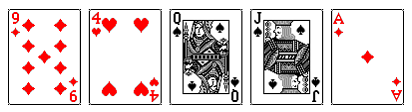
The assistant arranges 

Upon observing this arrangement, the magician announces the fifth selected card, in this case the ace of diamonds.
The article linked above describes how the trick works in practice (including Python source code demonstrating both the assistant and the magician), as well as a proof that the following condition on 

Intuitively, the LHS binomial coefficient counts the number of spectator selections that may be presented to the assistant, and the RHS falling factorial counts the number of arrangements that may be presented to the magician.
The motivation for this post is to observe that this basic argument, applying the König-Egerváry theorem to a bi-regular graph to find a saturating matching, is more generally applicable: it should be possible to perform other “Fitch-like” tricks, whose feasibility rests on similar counting arguments. For example:
Effect 2: A spectator rolls 


This trick is feasible if and only if:

For another example of this same form, 
The linked proof shows that both of these tricks are feasible in principle— but it’s a separately interesting challenge to come up with a practical scheme for performing them. In this case, there is a relatively simple solution left as a puzzle for the reader; but things can get complicated quickly, as in this puzzling.stackexchange.com post that discusses the 
Effect 3: A spectator selects any 
In this case, the trick is feasible if and only if:

Of these two variants, I think this one would be the more powerful effect. Note that unlike Fitch’s original trick, the spectator gets to not only choose the cards, but to arrange them in any chosen order as well. The assistant’s only freedom is in which card(s) to flip face-down.
Here again, the obligatory puzzle is to determine a practical scheme for performing this trick. I’m not sure how much it helps as a hint to note that, in this particular case of
Reference:
- Kleber, M., The Best Card Trick. Mathematical Intelligencer, 24 (2002). [PDF]
 Possibly Wrong