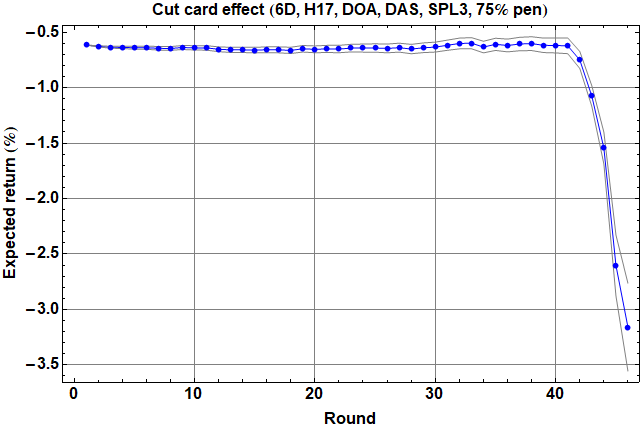
This is a follow-up to an article from nearly a decade ago, answering what I didn’t recognize at the time as an interesting question, buried in an otherwise offhand remark. To repeat the setup, suppose that we shuffle together decks of playing cards, and play a series of rounds of blackjack, each using the same fixed CDZ- playing strategy, stopping at the “cut card”, a marker inserted in the shoe indicating when to reshuffle. Let’s place the cut card at “penetration” , that is, stop and reshuffle when at most decks or 78 cards remain in the shoe. Let the random variable be the outcome of the n-th round. The figure below shows estimates of , in percent of initial wager, from just 1000 simulated shuffled shoes.
Expected return vs. number of rounds dealt from the shoe, playing fixed CDZ- strategy optimized for full 6-deck shoe. The mean of 1000 randomly shuffled shoes is shown in blue, with standard error of the sample mean shown in gray.
That steep drop in expected return late in the shoe is the “cut card effect.” An intuitive, hand-waving explanation goes something like this: although the position of the cut card is fixed, the number of rounds needed to reach it varies from one shuffled shoe to the next. If near the end of the shoe we have played a larger-than-typical number of rounds, then each of those rounds must have consumed fewer-than-typical number of cards on average, and so were likely rich in tens. The remainder is thus poor in tens, a disadvantage for the player.
Inspection of the above figure suggests that the cut card effect “begins” at approximately round or so (for this particular choice of rules, playing strategy, and penetration). The motivation for this post is to show that the cut card effect actually “begins” much earlier in the shoe, at round in this case.
Extended True Count Theorem
The cut card effect is interesting because, at first glance, it seems to contradict a very useful theorem, first proved by Thorp, that is easy to state incorrectly, so for now I’ll state it vaguely:
Theorem: For each round played with the same fixed strategy, , provided we do not run out of cards.
In other words, compute the exact expected return from playing our fixed strategy off the top of the shoe: this is . Now compute the expected return from playing a second round, after having played a first round off the top of the shoe: this is , and the above theorem states that these two expected values are equal. Similarly, the expected return from playing the third round into the shoe is , etc.
Looking again at the figure above, the small variations in estimated expected return for small are purely due to sampling error. If we could in principle evaluate not just 1000 randomly shuffled arrangements of cards in the shoe, but all possible arrangements, computing each expected return exactly, then the above theorem states that this curve would be exactly constant for those small .
But clearly something different is happening for , so what counts as “small” ?
Integer linear programming
This is where the vague “not running out of cards” comes in. There are two conditions that must be satisfied to guarantee : we must be guaranteed to reach round , and we must be guaranteed to be able to complete round .
I think the latter condition is simpler to describe. We need to ensure that, no matter how the previous rounds play out, we have enough cards left in the shoe to complete the subsequent round , with neither the player nor the dealer running out of cards. For these rules and CDZ- playing strategy, we will consume at most 33 cards in any single round, so as long as we don’t start the round before the cut card, there is no danger of “running out of cards.”
It’s the former condition that is trickier, and is the heart of the problem here: we must, with probability 1, complete prior rounds before reaching the cut card. Otherwise, to even define the random variable , we must condition the population of possible shuffled arrangements of cards in the shoe to exclude those cases where we reach the cut card too soon.
So, how many rounds are we guaranteed to be able to play before reaching the cut card? This is an integer linear programming problem: for each of the 3,054,067 possible subsets of card ranks consumed in a round, let be the number of cards of rank consumed. Then the problem is to find non-negative integers :
minimizing
subject to
The code is on GitHub: C++ to compute all possible subsets of cards comprising the player hands in a round, and Mathematica to do the same for the dealer, to compute the outer product of player and dealer outcomes, and to solve the linear programming problem.
Interpreting results
The resulting minimum value of the objective function is 18. This means that it is possible– albeit unlikely– to reach the cut card after having played just 18 rounds. If we could eliminate the sampling error in the above figure, the actual exact expected return would be constant for .
But the extended true count theorem has nothing to say about the expected return from round or later. Empirically, these mid-shoe departures from are almost certainly very small… but they are just as almost certainly non-zero.
At a blackjack table, imagine next to the dealer is a display indicating the number of the round to be played, that increments by one after each round, and resets to 1 after each reshuffle. Further imagine that we walk up to the table in the middle of the shoe, and observe the displayed round number, with no information about any cards that have been dealt since the last shuffle. If we observe , then we can be confident that the expected return from playing the upcoming round is the same as if we walked up to a full shoe: . On the other hand, if we observe, say, , then the expected return is almost certainly not exactly equal to … but we can’t say for sure, let alone the magnitude or even the sign of the difference.
In practice, such a display does not exist; if we walk up to a table cold we don’t know how many rounds have been played up to that point. But suppose instead that we observe not the number of the round, but the number of cards left in the shoe before the cut card. How can we tell when we are in the “safe zone” of no cut card effect, with expected return exactly equal to ?
If there are 234 cards left in the shoe, before the 75% penetration cut card, that’s a full shoe, so the expected return from the round is . But suppose that there are as many as 162 cards still left in the shoe. Seems like that should still be plenty… but with even that many cards remaining, we are already “in the cut card effect,” where the extended true count theorem provides no information about the expected return from the next round. (It’s an exercise for the reader to show that this minimum of 162 cards remaining is the solution to another linear programming problem, but one that we can solve in our head.)




 Possibly Wrong