
I recently saw a WOW board, which seems to be a popular approach to rewarding positive behaviors in elementary classrooms. The idea is pretty simple: start with an 

In most descriptions of WOW boards that I found online, the students must fill the entire grid of all 100 squares. But this particular variant was more mathematically interesting: the grid squares were numbered 1 to 100, and the teacher kept a container of slips also numbered 1 to 100; each time a student filled in a square, they didn’t simply pick any open spot on the board, but instead drew one of the slips from the container (without replacement) to determine which square to write their name in. The cool-something happens when the students first complete any row or column of the grid.
How long, on average, does this take? That is, what is the expected value of 
This is essentially a special case of the game of Bingo discussed here before. However, the analysis approaches presented there required computing sums with an exponential number of terms: 


It’s a nice problem to show that we can more efficiently compute the probability distribution– and thus the expected value– of


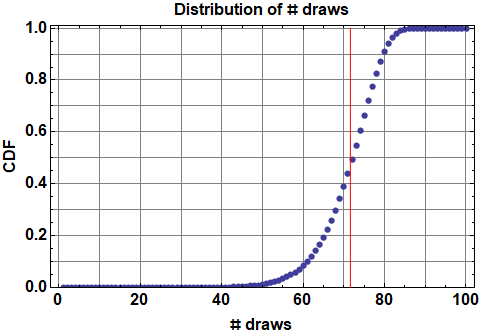
The resulting cumulative distribution for a 10×10 grid is shown below in blue, with the expected number of draws– about 71.6– shown in red.
An open question that I don’t know how to answer: what is the value of

That is, as the WOW board grid size grows large, do we expect to need to fill closer and closer to 100% of the squares before first filling a row or column?

I suspect the answer is yes, but I’m not sure how to prove it.
 Possibly Wrong