
My niece and nephew introduced me to a card game that they called Tricks, also known as Nomination Whist or Oh Hell. It’s a fun and interesting game, with simple rules but also with the potential for complex strategy. This post focuses on just one round in the game, played as follows:
Each of 


Between the deal and the play of the hand, each player in turn bids one or zero points (more generally up to
Since you have no choices in how to play a hand with just one card, only bidding presents an opportunity for strategy. (Things are more complicated in rounds with more cards in the hand, hence the focus on the one-card case here.) How you should bid depends on the probability of winning the trick, which is in turn determined by one of four possible cases:
- Trump high: your card is in the trump suit, and ranks higher than the trump card.
- Trump low: your card is in the trump suit, and ranks lower than the trump card.
- Off suit lead: your card is off suit and leads, i.e., you are the player left of the dealer.
- Off suit follow: your card is off suit and follows, i.e., you are not the player left of the dealer.
The following table and figure show the formulas and probabilities, respectively, in each of these cases, as a function of your card’s rank 
| Your card | Probability of winning |
| Trump high |  |
| Trump low |  |
| Off suit lead |  |
| Off suit follow |  |
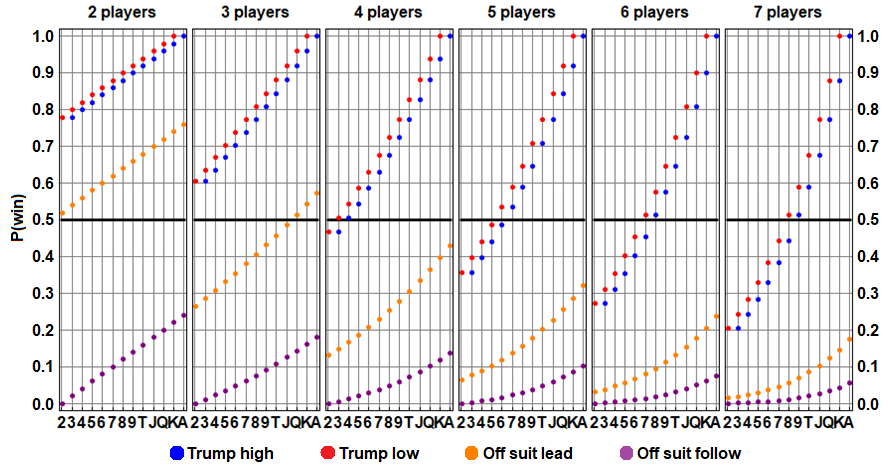
If everyone bids simultaneously, then this is essentially the whole story: bid one point if and only if the probability of winning indicated above is greater than 1/2. For example, in a four-player game, you should never bid for the trick with an off suit card, and always bid with trump… except with a deuce, or with a three where the deuce is the trump card.
But this oversimplifies the problem, since everyone does not bid simultaneously. Earlier players’ bids may inform and affect later players’ bids. The strategy complexity blows up quickly– analyzing even the simplest two-player game presents an interesting challenge: is optimal strategy a random mix of bluffing and/or slow play?
 Possibly Wrong