
In the online game Among Us, players who visit the Comms room hear a fuzzy audio recording of a series of high-pitched beeps that sound like Morse code. I first heard the recording here, but this more recent video also plays it at around 5:00, followed by a good explanation of the problem with trying to decipher the code.
The following figure shows a spectrogram of the audio clip, with time on the x-axis, and each vertical slice showing the Fourier transform of a short (roughly 50 ms) sliding window of the signal centered at the corresponding time. We can clearly see the “dots” and “dashes” at around 1 kHz, with the corresponding translation overlaid in yellow.
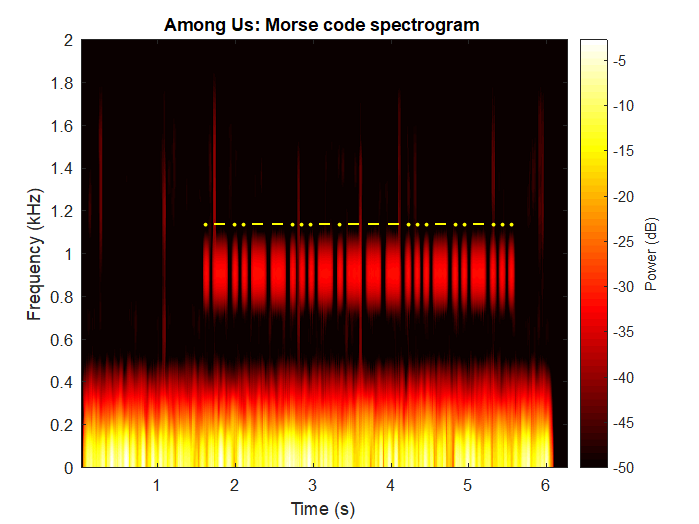
Now that we have the Morse code extracted from the audio (which, for reference if you want to copy-paste and play with this problem, is “.-..--...-.---...-..-...“), we just need to decode it, right? The problem is that the dots and dashes are all uniformly spaced, without the required longer gaps between letters, let alone the still longer gaps that would be expected between words. Without knowing the intended locations of those gaps, the code is ambiguous: for example, the first dot could indicate the letter E, or the first dot and dash together could indicate an A, etc.
That turns out to be a big problem. The following figure shows the decoding trie for Morse code letters and digits; starting at the root, move to the left child vertex for each dot, or to the right child vertex for each dash. A red vertex indicates either an invalid code or other punctuation.
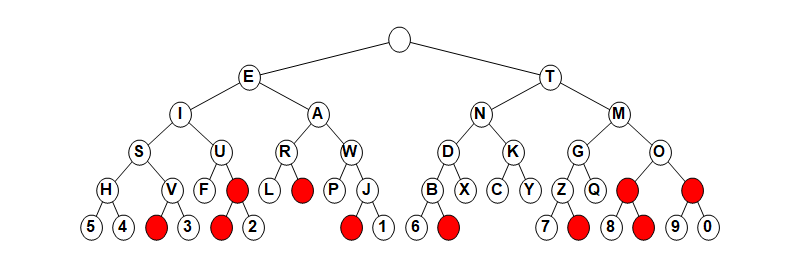
If we ignore the digits in the lowest level of the trie, we see that not only are Morse code letters ambiguous (i.e., not prefix-free), they are nearly “maximally ambiguous,” in the sense that the trie of letters is nearly complete. That is, for almost any prefix of four dots and dashes we may encounter, the gap indicating the end of the first letter could be after any of those first four symbols.
This would make a nice programming exercise for students, to show that this particular sequence of 24 symbols may be decoded into a sequence of letters in exactly 3,457,592 possible ways. Granted, most of these decodings result in nonsense, like AEABKGEAEAEEE. But a more interesting and challenging problem is to efficiently search for reasonable decodings, that is, messages consisting of actual (English?) words, perhaps additionally constrained by grammatical connections between words.
Of course, it’s also possible– probable?– that this audio clip is simply made up, a random sequence of dots and dashes meant to sound like “real” Morse code. And even if it’s not, we might not be able to tell the difference. Which is the interesting question that motivated this post: if we generate a completely random, and thus intentionally unintelligible, sequence of 24 dots and dashes, what is the probability that it still yields a “reasonable” possible decoding, for sufficiently large values of “reasonable”?
 Possibly Wrong