
Introduction
A friend of mine has been playing the board game Chutes and Ladders recently with his son. The game is pretty simple: starting off of the board (effectively on “square zero”), each player in turn rolls a die (actually, spins a spinner) and– if possible– moves forward the indicated number of squares in serpentine fashion on the board shown below:

Chutes and Ladders board layout. In some variants, the chute from square 48 to 26 starts at square 47 instead.
If a player lands on the tail of an arrow, he continues along the arrow to the indicated square, ending his turn there. (“Chutes” are arrows leading backward, and “ladders” are arrows leading forward.) The first player to land exactly on square 100 wins the game.
My friend emailed me with the question, “What is the expected number of turns before the game is over?” I think this is a nice problem for students, since it yields to the usual two-pronged attack of (1) computer simulation and (2) “cocktail napkin” derivation of an exact solution.
This is certainly not a new problem. See the references at the end of this post for just a few past analyses of the game as a Markov chain. My goal here is to provide an intuitive derivation of the exact expected length of the game as a solution to a system of linear equations, while staying away from the more sophisticated machinery of Markov chains, fundamental matrices, etc., that younger students may not be familiar with.
Unbounded vs. infinite
Before getting to the exact solution, though, it is worth addressing a comment in the referenced DataGenetics blog post about Monte Carlo simulation of the game:
“Whilst the chances of a game running and running are essentially negligible (constantly landing on snakes [i.e., chutes] and going around in circles), there is a theoretical chance that the main game loop could be executing forever. This is bad, and will lock-up your code. Any smart developer implementing an algorithm like this would program a counter that is incremented on each dice roll. This counter would be checked, and if it exceeds a defined threshold, the loop should be exited.”
I strongly disagree with this. The valid concern is that there is no fixed bound on how many turns a particular simulated game might take; that is, for any chosen positive integer 
There are situations where games can take an infinitely long time to finish– Chutes and Ladders just isn’t one of them. For example, in this multi-round card game, everything is fine as long as 


Recursive expected values
To see how to analyze Chutes and Ladders, first consider the following simpler problem: how many times should you expect to flip a fair coin until it first comes up heads? Let 
- It comes up heads, in which case we are done after a single flip; or
- It comes up tails… in which case we are right back where we started, and so should expect to need
That is,

Solving yields 


Solution
We can apply this same idea to Chutes and Ladders. Let 


where 


So we have a system of 100 linear equations in 100 unknowns, which we can now talk the computer into solving for us (in Python):
import numpy as np

n, m = 100, 6
chutes = {1: 38, 4: 14, 9: 31, 16: 6, 21: 42, 28: 84, 36: 44,
          48: 26, 49: 11, 51: 67, 56: 53, 62: 19, 64: 60, 71: 91,
          80: 100, 87: 24, 93: 73, 95: 75, 98: 78}

A = np.eye(n)
b = np.ones(n)
for i in range(n):
    for j in range(1, m + 1):
        k = i if i + j > n else chutes.get(i + j, i + j)
        if k < n:
            A[i][k] -= 1.0 / m
x = np.linalg.solve(A, b)
Results
The following figure shows all of the resulting values 
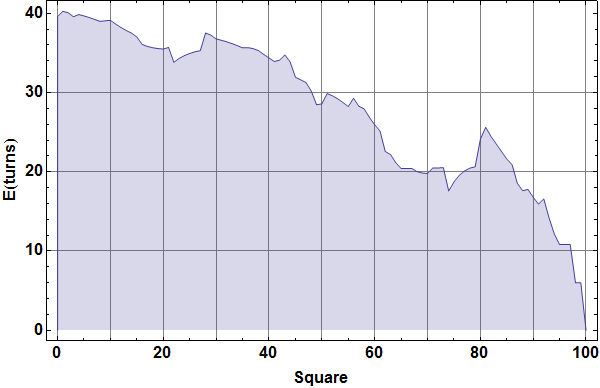
Expected number of (additional) turns to finish game starting from the given square.
Note that we can easily analyze the “house rule” used in the DataGenetics post– allowing a player to win even when “overshooting” square 100– simply by changing the k=i in line 12 to k=n. The result is a modest reduction in game length, to about 36.1931 turns. (Edit: However, this is not the whole story. See this subsequent post addressing the fact that the game involves multiple players.)
References:
 Possibly Wrong