
This is just a follow-up in response to a couple of requests for a solution to last week’s problem about hitting a golf ball on the Moon. Given the speed of the club face 


It is helpful to consider two different frames of reference, one to handle the “bounce” of the ball off the club, and another to handle the resulting flight of the ball:
First, in the “club frame,” the club face is fixed, and the ball approaches the club at speed 

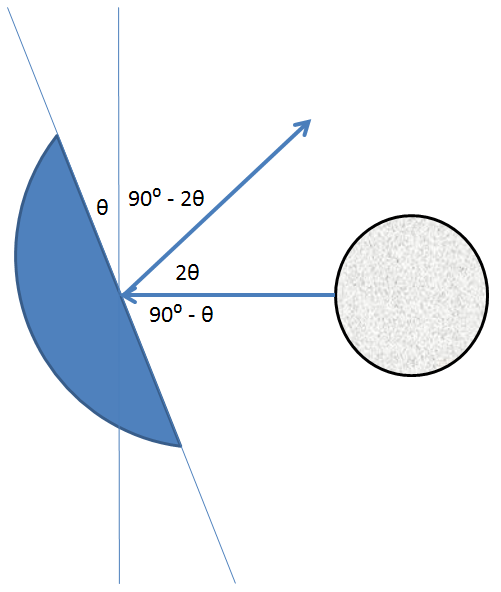
In the moving frame of the club face, the ball is launched at twice the loft angle of the club.
However, in the “Moon frame,” the club face– and thus everything in the figure above– is also moving to the right at speed

At this point, we have a straightforward projectile motion calculus problem. Assuming this initial velocity, we compute the distance traveled, then maximize as a function of
(An interesting but non-obvious side note: the “actual” launch angle of the ball– in the Moon frame– ends up equaling the loft angle! (Why?) That is, for example, if we hit the golf ball with a loft angle of 45 degrees, then the ball’s initial trajectory will also be 45 degrees. However, it will not be traveling as fast as it would if we hit it at a lower angle. The problem is to determine the “sweet spot” between lowering the angle to increase speed, and raising the angle to increase time of flight.)
I’ll skip most of the details. The distance the ball travels is given by

The maximum distance is realized when the loft angle
 Possibly Wrong