Everything Is Possibly Wrong

But it usually isn’t.

This past week, scientists at CERN announced some very interesting results suggesting that neutrinos may be able to travel faster than the speed of light.  This is understandably big news, so you almost certainly didn’t read it here first.  I just have a few additional observations.

First, the initial paper is available on arXiv.org here.  I am no particle physicist, but the basic story is not very complicated, and with my usual educational bent, I think this makes for an interesting and useful exercise even for young students… because it essentially boils down to distance = rate * time.  Scientists measured the time required for neutrinos to travel 731.278 km (about 454 miles) from a particle accelerator in Switzerland to a detector in Italy.  For those here in the U.S., imagine particles traveling underground between Baltimore, Maryland, and Martha’s Vineyard in Massachusetts– or for those reading back home, between Kansas City and Dallas, Texas.

Traveling at the speed of light (exactly 299,792,458 meters per second), the trip should take about 0.0024392808 second.  However, detection equipment on the receiving end observed the arrival of neutrinos about 60 nanoseconds earlier than this, suggesting that the particles were traveling faster than light.  That’s not much less time… but it’s a lot more speed.  It means that neutrinos would beat light to the finish line by just about 60 feet (one light-nanosecond is approximately one foot), but in doing so they exceed the speed of light by more than 16,000 miles per hour, about the speed of the Space Shuttle or the International Space Station in orbit around the Earth.  (This is a small fractional increase in speed, though, relative to the speed of light: just about 25 parts per million.)

As usual, I recommend reading the original source.  Something that the “popular” press frequently seems to miss in this story is that it’s not completely new.  Neutrinos have behaved in funky ways before; the paper mentions and references similar observations back in 2007, although with admittedly less precise measurements.

Finally, it is the improved measurement technique and precision that are under much of the scrutiny in this most recent experiment.  As described in the paper, the scientists are not able to actually measure the times of departure and arrival of any single neutrino.  Instead, they collect timing information for multiple particles over a larger interval, and use statistical techniques to “shift” entire distributions of departure/arrival times until they “line up.”  Even for the non-physicist, there is some interesting mathematics involved.

As I said, I’m not a particle physicist.  But even watching from the sidelines, I find it exciting, and not a little inspiring, to watch science in action like this.  There is an enormous amount of attention, review, and criticism of these experiments, and that scrutiny is what science is all about.  The basic practice of science may not be changing, but I think the speed of science may very well be undergoing a radical increase even as we speak.  Similar to the polymath projects started by Timothy Gowers, today’s technologically small world allows very large numbers of eyes and brains working on a problem, which can have the doubly-beneficial effect of “parallelizing” more exploratory investigation while at the same time more quickly recognizing and abandoning dead ends.

Do I think the result will be fundamental changes to our current understanding of physics?  My uneducated guess is that I doubt it.  It could turn out to be as simple as some unexpected systematic measurement error.  Or maybe there really is a new phenomenon here, but one that merely requires refinement, not complete rejection, of currently prevailing theories.

But I could be wrong.

If the Earth Were a Cube

What if the Earth were a cube instead of (approximately) a sphere?  I saw this same strange question twice in the last couple of weeks, first in a Reddit post linking to a good Ask a Mathematician article, then again in a recent Straight Dope column, with the usual entertaining-while-informing reply from Cecil.  Both are very interesting reading, and I do not intend to rehash all of their observations here.  The purpose of this post is to provide some additional details that I found interesting, as well as to point out a couple of possible errors in the earlier write-ups.

I like “what if” questions like this, mostly because they are fun, but also because they are good exercise.  Thought experiments like this one often lead to additional or clearer insight into a more general problem.  In this case, what I found most interesting about this problem is how strange the effects of gravity would be on a cube-shaped planet; I learned that I did not understand gravity quite as well as I thought I did.  There is a reason why physicists prefer their chickens to be spherical.

But first, let’s define the problem.  For the most direct comparison with our experience, it seems reasonable to assume that our cube planet has the same mass and volume (and thus mean density) as the Earth, as in the figure below.

The Earth and a cube with the same volume.

An immediately noticeable difference is the enormous range of altitudes.  Using the center of each face of the cube as a reference, each edge is approximately 1,300 miles (2,100 km) higher (i.e., farther from the center of the cube), and each corner is 2,300 miles (3,800 km) higher.  Compare this with the Earth, where altitudes vary over just tens of kilometers.

(The Ask a Mathematician article gives larger altitudes that suggest an assumption of a larger cube that contains the Earth, with a side length equal to the Earth’s diameter.  This would imply that the cube has either a larger mass or a smaller density than the Earth.)

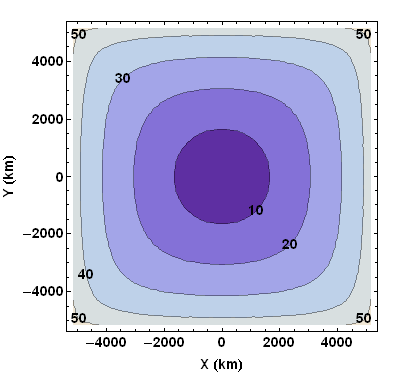
Beyond just these geometric differences, the physical effects of gravity are even weirder.  First, of minimal weirdness is the observation that gravity is much weaker near the edges and corners than at the center of a cube face.  This makes sense, since the edges and corners are “farther away” from the center of mass of the cube.  The figure below shows the magnitude of the force of gravity over the surface of each cube face, normalized by 1 “Earth g“:

The force of gravity on the cube surface, in Earth g's.

At the center of each cube face, the force of gravity is almost exactly 1 g; at each corner, however, it is just 0.646 g, meaning that a person weighing 200 lbs. here on Earth would weigh only 129 lbs.

(Using this same example, the Straight Dope article suggests that this weight is only 103 lbs.  This value assumes that the cube and the person at the corner are point masses, which is a safe assumption when the bodies in question are spherical.  But when they are not, things get complicated, even for relatively simple shapes like a cube, as we will see shortly.)

A slightly weirder effect is that, standing on the flat surface of a cube-shaped planet, the force of gravity is not always “down.”  That is, as you walk in a straight line from the center of a face toward a corner, gravity causes the flat face of the cube to seem to get steeper and steeper, so that you are eventually climbing instead of walking.  This also makes sense, since the force of gravity is directed approximately toward the center of the cube, which is only “straight down” at the center of each face:

The "steepness" of the perceived hill, or the angle in degrees between the gravity vector and the cube surface normal.

Finally, I think the most interesting part of this problem, and what caught my attention in the first place, is the following innocuous statement in the Ask a Mathematician article:

“… Gravity on the surface wouldn’t generally point toward the exact center of the [cube] Earth anymore.”

In other words, when calculating the force of gravity exerted by the cube, even on a point mass, the direction of that force is not always toward the center of (mass of) the cube.  This was a surprise to me; I had to think about it for a while to realize that, even with all of the nice symmetry, constant density, etc., of the cube, the correspondingly “nice” Shell Theorem, or Gauss’ flux law, etc., do not help us here.  We essentially have to resort to the triple integral to work out exactly how gravity behaves on our cube-shaped planet.  The details of the derivation are at the end of this post.

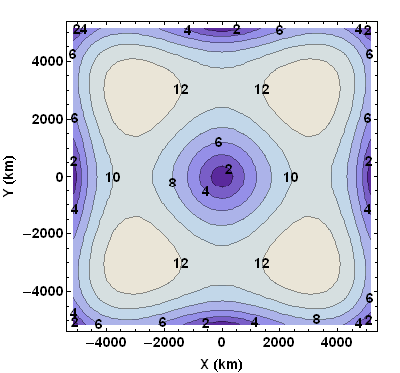
And it is not a small effect.  I was surprised by just how much the direction of the force of gravity deviates from the center of the cube, nearly 14 degrees in some places, as shown in the figure below.  The overall effect is essentially to reduce the “steepness” effect described above, so that the force of gravity is directed more nearly straight down than directly toward the center of the cube.  As expected, the deviation is zero at the center of each face, at the center of each edge, and at the corners.

The angle in degrees between the gravity vector and the vector to the center of the cube.

The Gravitational Potential for a Cuboid

I initially tried the brute-force numeric integration approach, but particularly for points near the surface of the cube where we are interested, the integrand is not very well-behaved.  At the other extreme, the Werner-Scheeres paper referenced below describes an interesting algorithm for computing the exact gravitational field for arbitrary polyhedra.  Fortunately, the cube is sufficiently simple that we can work it out by hand, with a little help from Mathematica.

We can generalize slightly by considering a cuboid with side lengths (2a, 2b, 2c).  The acceleration due to gravity is the gradient of the potential function U defined at a point (x_0,y_0,z_0) by

U(x_0,y_0,z_0) = G\rho\int_{-a-x_0}^{a-x_0}\int_{-b-y_0}^{b-y_0}\int_{-c-z_0}^{c-z_0}\frac{1}{\sqrt{x^2+y^2+z^2}}dx\,dy\,dz

where G is the gravitational constant and \rho is the density of the cube.  Note the change of variables to shift the origin to (x_0,y_0,z_0), which has the convenient effect that the integrand does not involve any of the limits of integration.  So after each of the three integrations, we can eliminate any summation term that does not involve all three variables x, y, and z, since the term will evaluate to zero in the final result.

Mathematica does most of the heavy lifting, with some nudging simplification, yielding the following expression for the potential function:

U(x_0,y_0,z_0) = G\rho(w(x,y,z)+w(y,z,x)+w(z,x,y))]_{x=-a-x_0}^{a-x_0}]_{y=-b-y_0}^{b-y_0}]_{z=-c-z_0}^{c-z_0}

w(x,y,z) = x y \ln(z+\sqrt{x^2+y^2+z^2}) - \frac{1}{2}x^2 \arctan{\frac{y z}{x\sqrt{x^2+y^2+z^2}}}

References:

1. R. Werner and D. Scheeres, Exterior Gravitation of a Polyhedron Derived and Compared With Harmonic and Mascon Gravitation Representations of Asteroid 4769 Castalia.  Celestial Mechanics and Dynamical Astronomy, 65 (1997):313-44. [PDF]