



Abstract
Aim:
Shiga toxigenic Escherichia coli (STEC) strains as emerging groups of foodborne pathogens are responsible for most foodborne illnesses. The aim of this study was to determine the antibiotic resistance pattern in STEC isolated from traditional milk products and their molecular characterization.
Materials and Methods:
A total of 116 samples were randomly purchased from local markets in Kashan, Iran, and evaluated for the occurrence of STEC by culturing and molecular methods. The antibiotic resistance of obtained isolates was determined by Kirby Bauer method. Furthermore, isolates were assayed for the presence of Shiga toxins (stx1 and stx2) and intimin gene (eae).
Results:
The incidence of E. coli in 60 ice cream, 30 yoghurt, and 26 cheese samples was 8.33%, 10%, and 11.54%, respectively. The findings showed that 11 out of 11 (100%) E. coli had both stx1 and stx2 while eae gene was not found in E. coli isolated of traditional milk products. For E. coli strains carrying stx1 and stx2, highest antibiotic sensitive levels were related to trimethoprim/sulfamethoxazole, norfloxacin, chloramphenicol, and ciprofloxacin, respectively.
Conclusion:
The results showed relationship between the presence of virulence factors and antimicrobial resistance. These results can be used for further studies on STEC as an emerging foodborne pathogen.
Keywords: Escherichia coli, milk products, molecular characterization
Introduction
Raw milk products such as traditional cheese, ice cream, and yoghurt can be a main source of potentially harmful bacteria to human, such as Escherichia coli. Foodborne disease outbreaks have been reported by consumption of raw milk and raw milk products in developing and developed countries [1]. In Iran, traditional milk products are consumed, especially in some rural and urban areas.
E. coli is one of the most important pathogenic bacteria, which is a normal inhabitant of large intestine in human and warm-blooded animals [2]. Therefore, E. coli can be transmitted to raw milk and milk products by fecal contamination during milking process along with poor hygienic practices [3,4].
In recent years, Shiga toxigenic E. coli (STEC) strains as emerging groups of foodborne pathogens are responsible for most foodborne illnesses [5]. The pathogenicity of these strains almost related to the ability of the microorganism to produce the one or two cytotoxins called Shiga toxins (stx1 and stx2), and the presence of the intimin (eae) gene, which is responsible for intimate attachment of the organism to the intestinal epithelium [5,6].
Previous studies have demonstrated that antibiotic resistance levels in STEC are increasing. In addition, there is a great probability of association between the presence of virulence factors and antibiotic resistance [5,7]. When, at the same time, the presence of virulence factors with antibiotic resistance in bacteria happens, the antibiotics use may potentially increase the selection of bacteria carrying virulence genes, accelerating the expansion of virulence genes within bacteria [8].
Assumpção et al. [5] reported from 561 E. coli isolates, 90 (16.0%) were carriers of stx1, 97 (17.3%) of stx2, and 45 (8.0%) of eae genes singly. 37 (6.6%) isolates were carriers of stx1 and stx2, 110 (19.6%) were carriers of stx1 and eae, and 67 (11.9%) were carriers of stx2 and eae. Other studies showed multidrug resistance (MDR) E. coli in food animals, milk and dairy products, and meat and meat products [9-11].
Therefore, the aims of this study were to investigate the prevalence and molecular characterization of E. coli in traditional milk products collected from different localities and markets located in Kashan of Iran.
Materials and Methods
Ethical approval
No ethical approval was required as no live animals were used in this study.
Sample collection
A total of 116 samples of various traditional milk products including ice cream (n=60), yoghurt (30), and cheese (n=26) were purchased from randomly selected retail markets located in Kashan, Iran, from March 2016 to August 2016. All samples were immediately transferred to the food microbiology laboratory, Kashan University of Medical Sciences, in portable insulated cold-boxes. The samples were analyzed on the day they were collected.
Isolation and identification of E. coli
A 10 g portion of each food sample was added to 90 mL of nutrient broth (Merck Co., Darmstadt, Germany) and stomached for 1 min. From the homogenate, 0.1 mL aliquots were spread plated on the MacConkey and EMB agar (Merck Co., Darmstadt, Germany) in duplicate following incubation for 24±2 h at 35±0.5°C. The phenotypic confirmation of the isolates as E. coli was done using Gram’s staining, catalase, oxidase, triple sugar iron agar, and IMViC tests [12].
Antimicrobial susceptibility
Antimicrobial susceptibility testing of the E. coli and Salmonella isolates was performed by the Kirby-Bauer disc diffusion method using Mueller-Hinton agar (Merck Co., Darmstadt, Germany) according to the Clinical and Laboratory Standards Institute (CLSI) [13]. The following used antibiotics were tested: Ampicillin (10 µg), amoxicillin/clavulanic acid (30 µg), gentamycin (10 µg), tetracycline (30 µg), trimethoprim/sulfamethoxazole (10 µg), ceftazidime (30 µg), ciprofloxacin (10 µg), nitrofurantoin (300 µg), norfloxacin (30 µg), kanamycin (30 µg), ceftriaxone (30 µg), and chloramphenicol (30 µg) (HiMedia Laboratories Pvt. Ltd, Mumbai, India). Briefly, a bacterial suspension with equivalent turbidity to 0.5 McFarland standard (1.5 × 10⁸ CFU/mL) was prepared in sterile phosphate buffered saline (PBS) (137 mM NaCl, 10 mM phosphate, 2.7 mM KCl, pH 7.4). The sterile swab stick was dipped into bacterial suspension and then on the surface of agar was uniformly inoculated. Afterward, antibiotic disks were placed for each plate and incubated at 35°C for 24 h. Inhibition zones on agar plate were measured, and the results were recorded in accordance with interpretive criteria provided by CLSI.
Molecular methods
For extraction DNA from E. coli isolates, 1 mL overnight brain heart infusion (Merck Co., Darmstadt, Germany) broth culture (approximately 108 bacteria), was centrifuged at 4,000 rpm for 5 min. The pellets were then washed in 1 mL of PBS, resuspended in 0.5 mL of H2O, and boiled (100°C) for 15 min. The cell debris was pelleted by centrifugation at 12,000 rpm for 5 min, and the supernatant containing the released DNA was transferred into a fresh microtube. The DNA purity and concentration were measured by a NanoDrop-1000 (NanoDrop Technologies, Wilmington, DE, USA).
The presence of genes encoding for the 16S RNA, stx1, stx2, and eae were detected by multiplex polymerase chain reaction (PCR) using specific primers (Takapou Zist Company, Tehran, Iran) (Table-1) [6,14].
Table-1.
Primers used for polymerase chain reaction identification of E. coli, stx1, stx2, and eae genes.
| Target gene | Primer | Sequence | Base pair | Reference | |
|---|---|---|---|---|---|
| E. coli | Eco 2083 F | 5′- GCTTGACACTGAACATTGAG-3′ | 662 | [14] | |
| Eco 2745 R | 5′- GCACTTATCTCTTCCGCATT-3′ | ||||
| stx1 | stx1-F | 5′- CAACACTGGATGATCTCAG-3′ | 349 | [6] | |
| stx1-R | 5′- CCCCCTCAACTGCTAATA-3′ | ||||
| stx2 | stx2-F | 5′- ATCAGTCGTCACTCACTGGT-3′ | 110 | [6] | |
| stx2-R | 5′- CTGCTGCTGTCACAGTGACAA-3′ | ||||
| eae | eae-F | 5′- GTGGCGAATACTGGCGAGACT-3′ | 890 | [6] | |
| eae-R | 5′- CCCCATTCTTTTTCACCGTCG-3′ |
E.coli=Escherichia coli
The multiplex PCR procedure was performed according to Hessain et al. [6]. The PCR reaction mix included 2 μL of DNA, 5 μL of 10× PCR buffer, 2 μM dNTPs, 20 μM of each primer, and 2U Taq DNA polymerase and the volume of this mix was adjusted to 50 μl with sterile water. For multiplex PCR, the amplification was carried out in a thermal cycler (Eppendorf Master Cycler®, MA) with the following thermal cycling profile: An initial denaturation at 95°C for 5 min was followed by 30 cycles of amplification (denaturation at 95°C for 30 s, annealing at 50°C for 40 s, and extension at 72°C for 30 s), ending with a final extension at 72°C for 5 min. All PCR amplification products were separated on 1.5% agarose gel and visualized by staining with ethidium bromide using an ultraviolet light transilluminator.
Statistical analysis
Chi-square and Fisher’s exact tests were used for the analysis of associations using SPSS software version 14. A p<0.05 was considered to be statistically significant.
Results
From 116 samples collected of traditional milk products, it was isolated 11 (9.48%) E. coli strains. It was found that the incidence of E. coli in 60 ice creams, 30 yoghurt, and 26 cheese samples was 8.33%, 10%, and 11.54%, respectively (Table-2).
Table-2.
Characterization of the recovered E.coli by multiplex PCR from traditional dairy product samples.
| Types and number of collected traditional dairy product samples | E.coli (%) | Multiplex PCR of E. coli | ||||
|---|---|---|---|---|---|---|
| stx1 | stx2 (%) | eae | stx1 and stx2 (%) | stx1, and stx2 eae | ||
| Ice cream (60) | 5 (8.33) | 5 | 5 | 0 | 5 | 0 |
| Yoghurt (30) | 3 (10) | 3 | 3 | 0 | 3 | 0 |
| Cheese (26) | 3 (11.54) | 3 | 3 | 0 | 3 | 0 |
| Total (116) | 11 (9.48) | 11 (9.48) | 11 (9.48) | 0 | 11 (9.48) | 0 |
E.coli=Escherichia coli, PCR=Polymerase chain reaction
All isolates identified by cultural method were confirmed as E. coli by PCR (Figure-1). Furthermore, the results showed that 11 out of 11 (100%) E. coli had both stx1 and stx2 while eae gene was not found in E. coli isolated of traditional milk products (Table-2).
Figure-1.
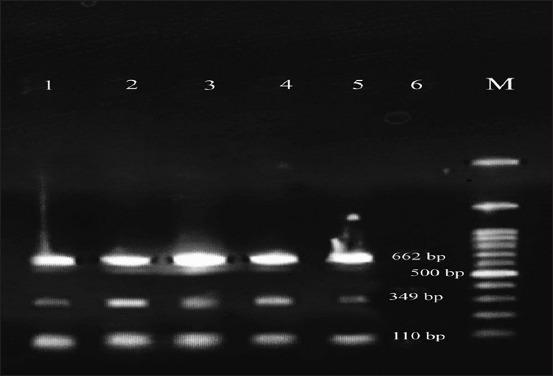
Gel picture is showing multiplex polymerase chain reaction-amplified products. M, 100-bp DNA marker; lane 1-6, 16S RNA Escherichia coli, stx1, and stx2 positive; lane 6, negative control.
The frequencies of resistance to antibiotics were verified with all E. coli strains carrying stx1 and stx2 as virulence factors. For E. coli strains carrying stx1 and stx2, highest antibiotic sensitive levels were related to trimethoprim/sulfamethoxazole, norfloxacin, chloramphenicol, and ciprofloxacin, respectively (Table-3). The 1 (9.1%), 4 (36.36%), 4 (36.36%), and 2 (18.18%) E. coli strains were resistant to 9, 10, 11, and 12 antibiotics, respectively.
Table-3.
Frequency of resistance to antimicrobial agents among E. coli isolates harboring stx1 and stx2 from traditional dairy product samples (n=116).
| Antimicrobial agent | Ice cream (%) | Yoghurt (%) | Cheese (%) | Total (%) |
|---|---|---|---|---|
| Ampicillin | 5 (100) | 3 (100) | 3 (100) | 11 (100) |
| Amoxicillin – clavulanic acid | 5 (100) | 3 (100) | 3 (100) | 11 (100) |
| Ceftazidime | 5 (100) | 3 (100) | 3 (100) | 11 (100) |
| Ceftriaxone | 5 (100) | 3 (100) | 3 (100) | 11 (100) |
| Kanamycin | 5 (100) | 3 (100) | 3 (100) | 11 (100) |
| Gentamicin | 5 (100) | 3 (100) | 3 (100) | 11 (100) |
| Tetracycline | 5 (100) | 3 (100) | 3 (100) | 11 (100) |
| Trimethoprim/sulfamethoxazole | 0 (0) | 2 (66.6) | 1 (33.3) | 3 (27.27) |
| Norfloxacin | 2 (40) | 2 (66.6) | 1 (33.3) | 5 (45.45) |
| Nitrofurantoin | 5 (100) | 3 (100) | 3 (100) | 11 (100) |
| Chloramphenicol | 5 (100) | 2 (66.6) | 3 (100) | 10 (90.9) |
| Ciprofloxacin | 4 (80) | 3 (100) | 3 (100) | 10 (90.9) |
E. coli=Escherichia coli
The results showed that a statistically significant association was detected between antibiotic resistance and virulence genes in this E coli population isolated of traditional milk products (Table-4).
Table-4.
Pairwise statistical associations between antimicrobial agents and virulence genes.
| Antimicrobial agent | stx1(%) | stx2(%) | eae | p value* |
|---|---|---|---|---|
| Ampicillin | 11 (100) | 11 (100) | p=0.00 | |
| Amoxicillin – clavulanic acid | 11 (100) | 11 (100) | p=0.00 | |
| Ceftazidime | 11 (100) | 11 (100) | p=0.00 | |
| Ceftriaxone | 11 (100) | 11 (100) | p=0.00 | |
| Kanamycin | 11 (100) | 11 (100) | p=0.00 | |
| Gentamicin | 11 (100) | 11 (100) | p=0.00 | |
| Tetracycline | 11 (100) | 11 (100) | p=0.00 | |
| Trimethoprim/sulfamethoxazole | 3 (27.27) | 3 (27.27) | p>0.05 | |
| Norfloxacin | 5 (45.45) | 5 (45.45) | p>0.05 | |
| Nitrofurantoin | 11 (100) | 11 (100) | p=0.00 | |
| Chloramphenicol | 10 (90.9) | 10 (90.9) | p=0.02 | |
| Ciprofloxacin | 10 (90.9) | 10 (90.9) | p=0.02 |
-=Not detected eae gene in E. coli isolates. E. coli=Escherichia coli
The eleven E. coli isolates (100 %) were resistant to one or more antibiotics. All of the E. coli isolates were resistant to amoxicillin/clavulanic acid, ampicillin, nitrofurantoin, tetracycline, kanamycin, and gentamycin. Only eight of E. coli isolates were sensitive to trimethoprim/sulfamethoxazole, and six isolates were sensitive to norfloxacin (Table-3).
Discussion
Hence, many of people are consuming unpasteurized milk and traditional products made from it. Increased nutritional qualities, flavor, and benefits have all been supported as reasons for interest in raw milk consumption [3]. Nevertheless, Claeys et al. [15] reported the occurrence of a number of pathogenic bacteria in raw milk and their products, including Bacillus cereus, Brucella spp., Campylobacter spp., pathogenic E. coli, Listeria monocytogenes. Therefore, consumption of raw milk and traditional milk products can be caused foodborne pathogens outbreaks.
In this work, 116 random samples of traditional milk products were investigated for the presence of E. coli. It is evident from the results demonstrated in Table-2 that the prevalence of E. coli in traditional milk products was 9.48%. Furthermore, in our work, all of the strains were harbored both stx1 and stx2. Interestingly, no strains were harbored eae gene.
The occurrence of E. coli in raw milk, Karish cheese, and Ras cheese in Egypt was 76.4%, 74.5%, and 21.7%, respectively. Out of 222 E. coli strains, 104 (46.8%) isolated carried one or more virulence genes. The prevalence of stx1, stx2, and eae genes was 0.9%, 0.9%, and 0.45%, respectively [16].
Our results are in agreement with those of Elhadidy and Mohammed [1], who reported that STEC incidence in 124 cheese samples was 11.29%. All recovered isolates harbored stx2 gene 100% either single or in association with the stx1 gene, while stx1 was present in 64.28% of isolates. They reported that intimin gene (eae) was present in 21% of isolates, while in our study any isolates had not eae gene. The percentage of positive raw milk and milk products with STEC in other studies was 17.2% [17] and 12.5% [18]. Rey et al. [18] showed that 3 STEC carried stx1 gene, 5 possessed stx2 gene, and 1 both stx1 and stx2. Whereas only O157:H7 serotype showed eae virulence gene.
The pathogenicity of STEC is attributed to the production of stx1 and stx2 as verocytotoxin [6]. A previous study reported that stx2 is the most important virulence factor and most of hemolytic-uremic syndrome cases in humans are caused by STEC strains harboring stx2 gene [1]. The eae gene is an accessory virulence factor for STEC that is thought to enhance the virulence of STEC, while some STEC strains not harboring eae gene have been shown to cause human illnesses [19,20]. Further, Douellou et al. [21] demonstrated that the virulence gene profiles of dairy products and human STEC strains were similar.
Our data revealed an association between virulence factors and antimicrobial resistance in E. coli strains isolated from traditional milk products. All of the MDR STEC harbored Stx1 and Stx2. Nagachinta and Chen [7] reported an association between virulence factors and antimicrobial resistance in E. coli strains isolated from dairy cows.
Cergole-Novella et al. [22] showed that the highest resistance rates of STEC were identified for tetracycline (100%), streptomycin (78%), and trimethoprim-sulfamethoxazole (56%). Furthermore, all strains were harbored stx genes.
Assumpção et al. [5] demonstrated that the STEC isolates that carried stx1 only showed highest antimicrobial resistance to streptomycin (85.6%), followed by kanamycin (72.2%), and nalidixic acid (70.0%). Furthermore, STEC strains carrying stx2 only showed highest antimicrobial resistance to streptomycin (73.2%), followed by kanamycin and nalidixic acid (70.1%). However, no statistically significant association was detected between any antimicrobial resistance phenotype and virulence genes. In our study, the STEC isolates that carried stx1 and stx2, the highest antimicrobial resistance levels were to ampicillin, amoxicillin/clavulanic acid, gentamycin, tetracycline, nitrofurantoin, and kanamycin (100%).
The presence of antimicrobial resistance with virulence genes among STEC strains is worrisome. Therefore, when relationship between virulence genes and antimicrobial resistance occurs the antimicrobial resistance might be selected through the antimicrobial use, and as a result, the virulence genes would be selected as well [3,23].
Conclusion
Findings of this work suggest that various traditional milk products at retail markets located in Kashan harbor multidrug-resistant E. coli which underscores the need of implementation of hygienic practices during production, transportation, and storage. Moreover, further researches are needed to study the incidence and prevalence of other harmful microorganisms and impact of their toxins produced in this product.
Authors’ Contributions
RSC designed the study. FSC, NMA, and AN collected and processed the samples for isolation and identification of bacteria. RSC, EA, and AN were done PCR and electrophoresis. FSC and RSC interpreted the results and analyzed the data. RSC prepared the manuscript. All authors read and approved the final manuscript.
Acknowledgments
The authors are grateful to Research Deputy and the personnel of Research Center for Biochemistry and Nutrition in Metabolic Diseases, Kashan University of Medical Sciences, Kashan, Iran (Grant no; 94119).
Competing Interests
The authors declare that they have no competing interests.
References
- 1.Elhadidy M, Mohammed M.A. Shiga toxin-producing Escherichia coli from raw milk cheese in Egypt:Prevalence, molecular characterization and survival to stress conditions. Lett. Appl. Microbiol. 2013;56(2):120–127. doi: 10.1111/lam.12023. [DOI] [PubMed] [Google Scholar]
- 2.Lara V.M, Carregaro A.B, Santurio D.F, de Sa M.F, Santurio J.M, Alves S.H. Antimicrobial susceptibility of Escherichia coli strains isolated from Alouatta spp. feces to essential oils. Evid. Base. Compl. Altern. Med. 2016;1643762(10):30. doi: 10.1155/2016/1643762. [DOI] [PMC free article] [PubMed] [Google Scholar]
- 3.Garbaj A.M, Awad E.M, Azwai S.M, Abolghait S.K, Naas H.T, Moawad A.A, Gammoudi F.T, Barbieri I, Eldaghayes I.M. Enterohemorrhagic Escherichia coli O157 in milk and dairy products from Libya:Isolation and molecular identification by partial sequencing of 16S rDNA. Vet. World. 2016;9(11):1184–1189. doi: 10.14202/vetworld.2016.1184-1189. [DOI] [PMC free article] [PubMed] [Google Scholar]
- 4.Sharafati-Chaleshtori R, Rafieian-Kopaei M. Screening of antibacterial effect of the Scrophularia striata against E. coli in vitro. J. Herb. Med. Pharmacol. 2014;3(1):31–34. [Google Scholar]
- 5.Assumpção G.L.H, Cardozo M.V, Beraldo L.G, Maluta R.P, Silva J.T, Avila F.A.D, McIntosh D, Rigobelo E.C. Antimicrobials resistance patterns and the presence of stx1, stx2 and eae in Escherichia coli. Rev. Bras. Saúde Prod. Anim. 2015;16(2):308–316. [Google Scholar]
- 6.Hessain A.M, Al-Arfaj A.A, Zakri A.M, El-Jakee J.K, Al-Zogibi O.G, Hemeg H.A, Ibrahim I.M. Molecular characterization of Escherichia coli O157:H7 recovered from meat and meat products relevant to human health in Riyadh, Saudi Arabia. Saudi J. Biol. Sci. 2015;22(6):725–729. doi: 10.1016/j.sjbs.2015.06.009. [DOI] [PMC free article] [PubMed] [Google Scholar]
- 7.Nagachinta S, Chen J. Transfer of class 1 integron-mediated antibiotic resistance genes from shiga toxin-producing Escherichia coli to a susceptible E. coli K-12 strain in storm water and bovine feces. Appl. Environ. Microbiol. 2008;74(16):5063–5067. doi: 10.1128/AEM.00517-08. [DOI] [PMC free article] [PubMed] [Google Scholar]
- 8.Boerlin P, Travis R, Gyles C.L, Reid-Smith R, Janecko N, Lim H, Nicholson V, McEwen S.A, Friendship R. Antimicrobial resistance and virulence genes of Escherichia coli isolates from swine in Ontario. Appl. Environ. Microbiol. 2005;71(11):6753–6761. doi: 10.1128/AEM.71.11.6753-6761.2005. [DOI] [PMC free article] [PubMed] [Google Scholar]
- 9.Zhang P, Shen Z, Zhang C, Song L, Wang B, Shang J, Yue X, Qu Z, Li X, Wu L, Zheng Y, Aditya A, Wang Y, Xu S, Wu C. Surveillance of antimicrobial resistance among Escherichia coli from chicken and swine, China, 2008-2015. Vet. Microbiol. 2017;203:49–55. doi: 10.1016/j.vetmic.2017.02.008. [DOI] [PubMed] [Google Scholar]
- 10.Cook A, Reid-Smith R.J, Irwin R.J, McEwen S.A, Young V, Butt K, Ribble C. Antimicrobial resistance in Escherichia coli isolated from retail milk-fed veal meat from Southern Ontario Canada. J Food Prot. 2011;74(8):1328–1333. doi: 10.4315/0362-028X.JFP-10-495. [DOI] [PubMed] [Google Scholar]
- 11.Odenthal S, Akineden O, Usleber E. Extended-spectrum beta-lactamase producing Enterobacteriaceae in bulk tank milk from German dairy farms. Int. J. Food Microbiol. 2016;238:72–78. doi: 10.1016/j.ijfoodmicro.2016.08.036. [DOI] [PubMed] [Google Scholar]
- 12.Momtaz H, Dehkordi F.S, Rahimi E, Asgarifar A. Detection of Escherichia coli Salmonella species, and Vibrio cholerae in tap water and bottled drinking water in Isfahan, Iran. BMC Publ. Health. 2013;13(1):556. doi: 10.1186/1471-2458-13-556. [DOI] [PMC free article] [PubMed] [Google Scholar]
- 13.CLSI, Clinical and Laboratory Standards Institute. Performance Standards for Antimicrobial Susceptibility Testing; Twenty-Fourth Informational Supplement. 2014. [Accessed on 20-03-2017]. Available from: http://www.microbiolab-bg.com/wp-content/uploads/2015/05/CLSI-2014.pdf .
- 14.Hande G, Arzu F, Nilgün G, Serhat A.S, Alper Ç, Ece K, Serhat A, Murat F. Investigation on the etiology of subclinical mastitis in Jersey and Hybrid Jersey dairy cows. Acta Vet. 2015;65(3):358–370. [Google Scholar]
- 15.Claeys W.L, Cardoen S, Daube G, De Block J, Dewettinck K, Dierick K, Herman L. Raw or heated cow milk consumption:Review of risks and benefits. Food Contr. 2013;31:251–262. [Google Scholar]
- 16.Ombarak R.A, Hinenoya A, Awasthi S.P, Iguchi A, Shima A, Elbagory A.R, Yamasaki S. Prevalence and pathogenic potential of Escherichia coli isolates from raw milk and raw milk cheese in Egypt. Int. J. Food Microbiol. 2016;221:69–76. doi: 10.1016/j.ijfoodmicro.2016.01.009. [DOI] [PubMed] [Google Scholar]
- 17.Paudyal N, Anihouvi V, Hounhouigan J, Matsheka M.I, Sekwati-Monang B, Amoa-Awua W, Atter A, Ackah N.B, Mbugua S, Asagbra A, Abdelgadir W, Nakavuma J, Jakobsen M, Fang W. Prevalence of foodborne pathogens in food from selected African countries-a meta-analysis. Int. J. Food Microbiol. 2017;249:35–43. doi: 10.1016/j.ijfoodmicro.2017.03.002. [DOI] [PubMed] [Google Scholar]
- 18.Rey J, Sanchez S, Blanco J.E, Hermoso de Mendoza J, Hermoso de Mendoza M, Garcia A, Tejero N, Rubio R, Alonso J.M. Prevalence, serotypes and virulence genes of Shiga toxin-producing Escherichia coli isolated from ovine and caprine milk and other dairy products in Spain. Int J Food Microbiol. 2006;107(2):212–217. doi: 10.1016/j.ijfoodmicro.2005.08.025. [DOI] [PubMed] [Google Scholar]
- 19.Neill M.A. Overview of verotoxigenic Escherichia coli. J. Food Protect. 1997;60(11):1444–1446. doi: 10.4315/0362-028X-60.11.1444. [DOI] [PubMed] [Google Scholar]
- 20.Kruger A, Lucchesi P.M. Shiga toxins and stx phages:Highly diverse entities. Microbiology. 2015;161(3):451–462. doi: 10.1099/mic.0.000003. [DOI] [PubMed] [Google Scholar]
- 21.Douellou T, Delannoy S, Ganet S, Fach P, Loukiadis E, Montel M.C, Sergentet-Thevenot D. Molecular characterization of O157:H7, O26:H11 and O103:H2 Shiga toxin-producing Escherichia coli isolated from dairy products. Int. J. Food Microbiol. 2017;253:59–65. doi: 10.1016/j.ijfoodmicro.2017.04.010. [DOI] [PubMed] [Google Scholar]
- 22.Cergole-Novella M.C, Pignatari A.C, Castanheira M, Guth B.E. Molecular typing of antimicrobial-resistant Shiga-toxin-producing Escherichia coli strains (STEC) in Brazil. Res. Microbiol. 2011;162(2):117–123. doi: 10.1016/j.resmic.2010.09.022. [DOI] [PubMed] [Google Scholar]
- 23.Sharafati-chaleshtori R, Sharafati-chaleshtori F, Karimi A. Antibiotic resistance pattern of staphylococcus strains isolated from orange and apple juices in Shahre-Kord, Iran. Pak. J. Med. Sci. 2010;26(3):615–618. [Google Scholar]