
Native Identify

Native Identify
In honor of National Native American Heritage Month the Arts Council of Moore County will showcase the works of four local Native American artists, Karina McMillan, Marcus Dunn, Shantonia Chavis-Bullard and Betty Mangum, in an exhibit titled “Native Identity,” opening on Friday, Nov. 6, at the Campbell House Galleries, 482 E. Connecticut Ave., Southern Pines, and running through Saturday, Dec. 19. McMillan, Chavis-Bullard and Mangum all share Lumbee Tribe heritage, while Dunn is Tuscarora. “It’s been kind of on our radar for a long time,” says Kate Curtin, the programs and gallery director. “I grew up in the Northeast, and the artistry, the traditions were everywhere.” Here’s a chance to explore a few of them.
Karina McMillan
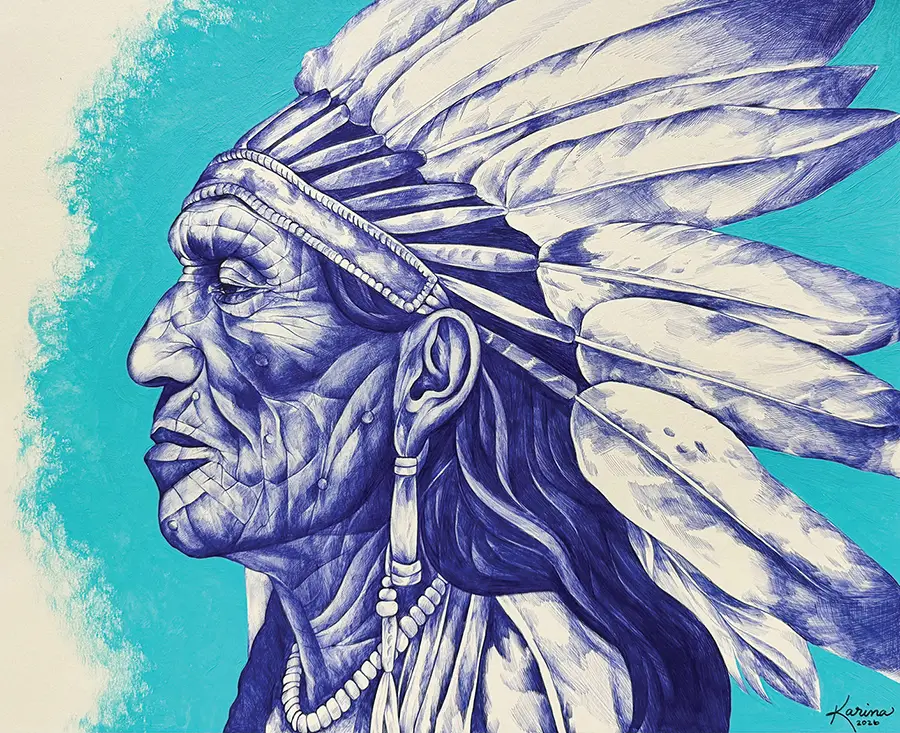
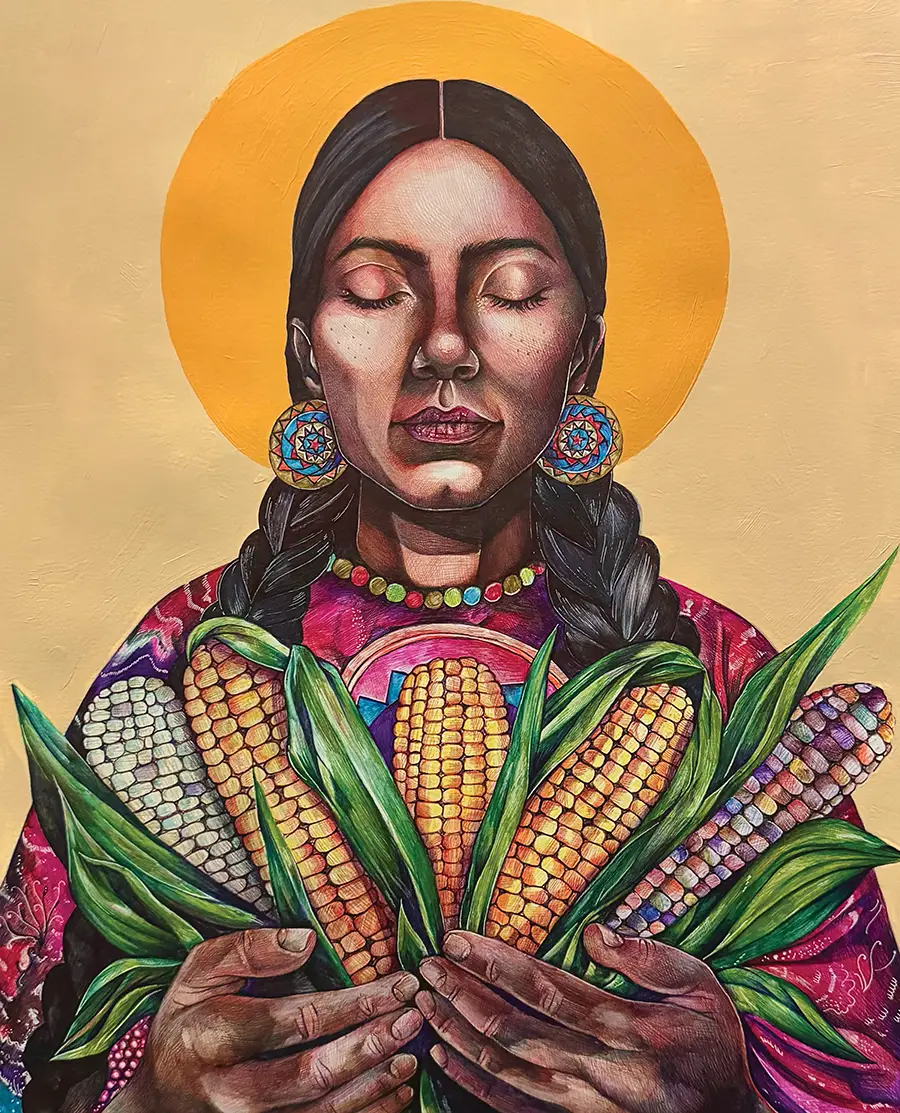
“When the artist Karina McMillan was growing up in rural Robeson County, she spent long days outside in the woods and in the surrounding fields of cotton, soybean and tobacco near her house, and long hours with her family, steeped in the culture of the Lumbee Tribe of North Carolina. Never far from her side were the ballpoint pens and paper she used to draw all of it, and all of them,” wrote Liza Roberts in the May edition of PineStraw. Those pens have propelled McMillan’s art to extraordinary heights.
“I am especially drawn to the possibilities of ballpoint pen as a medium. What is often viewed as an ordinary, everyday tool becomes a way to create intricate, intentional compositions built through layers of line, texture and detail,” says McMillan.
“My work explores identity, memory and cultural continuity through the lens of my experience as a Lumbee artist. Through drawing, printmaking, painting and mixed media, I create visual narratives that reflect the connections between personal history, Indigenous heritage and the stories carried across generations.”
“Karina McMillan’s work is extraordinary,” says Sara Segerlin, director of the Gregg Museum of Art & Design at N.C. State University. “Her paintings carry a power that goes far beyond color or technique. She brings forward portraits of resilience, memory, pain and strength, stories that refuse to be forgotten.”


Marcus Dunn
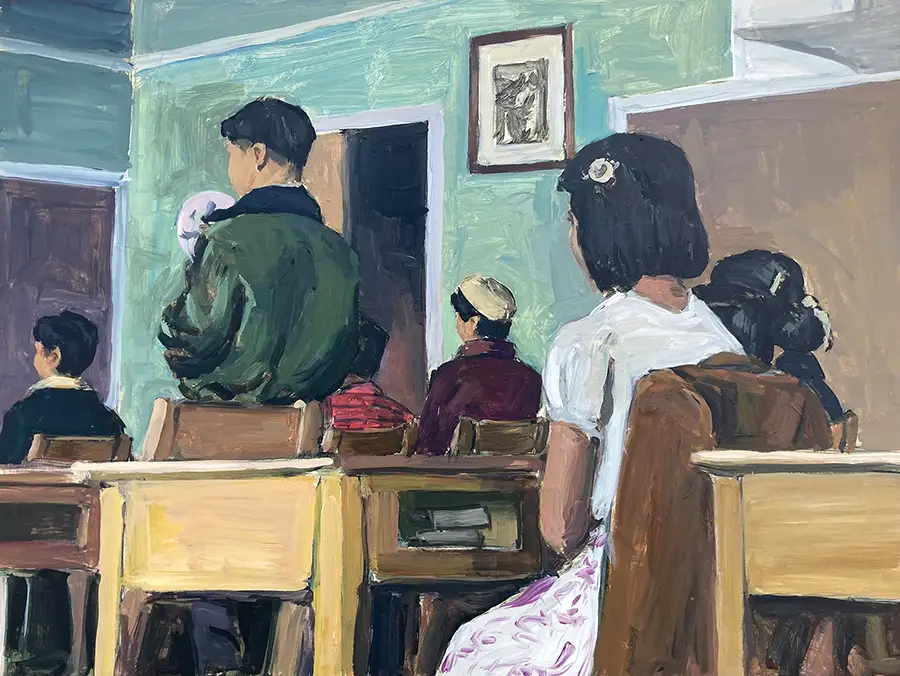
An art professor at Richmond Community College in Hamlet, Marcus Dunn has exhibited his work at the SCAD Museum of Art in Savannah, Georgia (where he earned an MFA), and the Institute of American Indian Arts Museum of Contemporary Native Arts in Sante Fe, New Mexico, to name just two. He is the 2022 South Arts Southern Prize recipient for North Carolina and is an alumnus of the Skowhegan School of Painting & Sculpture. Dunn is also an active participant in the United Kahtenuaka Longhouse, with a focus on language and traditional song and dance practices honoring his native Tuscarora heritage. Through his art, Dunn has spent years scouring archives for photographs of boarding schools and related forms of assimilationist educational practices, transforming such images into richly textured impressionist paintings, giving presence to the lives transformed by the boarding school system. “The most dramatic formal aspect of a Dunn painting is that it has a swift one-pass-of-the-brush feel,” writes Stephen Knudson in ARTPULSE. “This way of painting leaves holes in objects and figures. It is just enough, and it is the language of something forming and of something disappearing — the primary thesis of this work.”

Betty Mangum
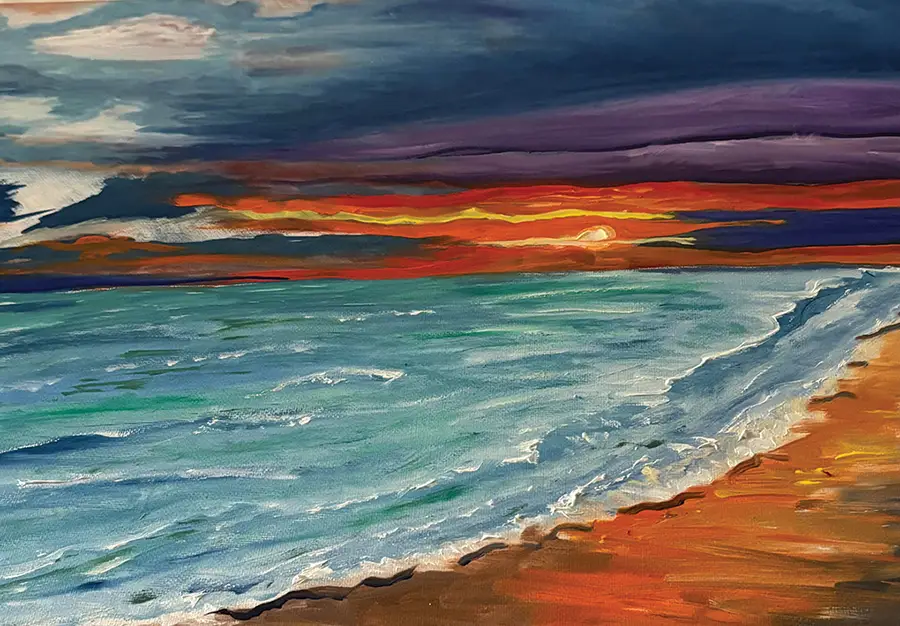
Now in her late 80s, Betty Mangum grew up on the campus of the University of North Carolina at Pembroke, where her father was the dean of students when it was still known as Pembroke State College. She took up painting after attending a “paint ‘n sip” class given by Jane Castinelli at Elliott’s on Linden just eight years ago. “Mind you, my drawing is not good at all, but I love slapping paint on a canvas,” says Mangum. Her preferred medium is oil paint. “I tried acrylic, but it dries too fast. I make a lot of mistakes. Oil you can go back and rework it lots of times,” she says. “I’m a big picture person. I’m not a small detail person. That doesn’t seem to be my personality. I just have a folksy style.” Mangum is drawn to both water scenes and faces as subjects. “I don’t seem to have a wide variety of things that I enjoy painting, but water I find very soothing, and people’s faces I find very interesting,” she says. Though she came to painting late in life, Mangum was always a lover of the arts, particularly music and theater. “I’m just kind of drawn to beautiful things,” she says. “I’m Lumbee Indian. I like colors. If you’ve looked at Indian regalia or have been around Indian people, they mostly are colorful personalities and wear a lot of color. The regalia is always very bright. Nothing subdued about it. I tend to paint kind of loudly.”
Shantonia Kai Chavis-Bullard
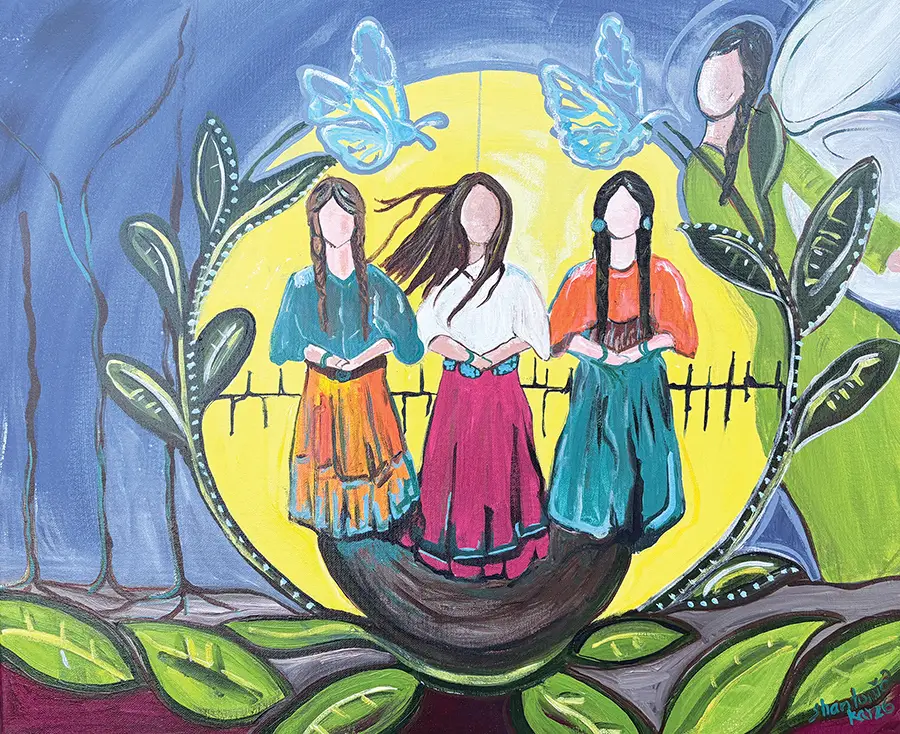
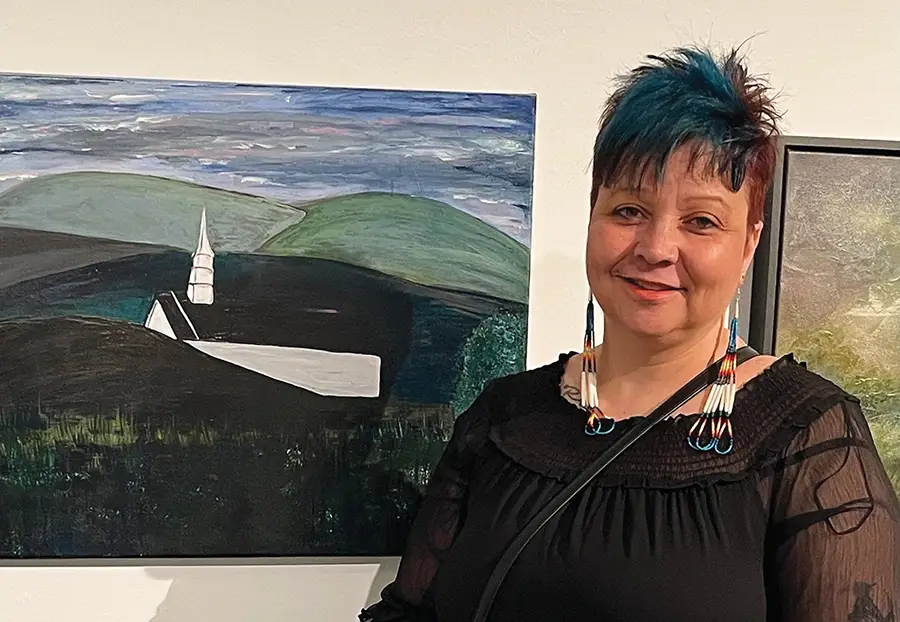
“Art grounds me,” says Shantonia Kai Chavis-Bullard. “As a Lumbee artist, my work connects deeply with my community and reflects my personal interpretation of the world.” A retired art teacher with bachelor’s and master’s degrees from the University of North Carolina at Pembroke, Chavis-Bullard works mainly in acrylic but also enjoys batik, pastels and ceramics. “Acrylics are my favorite because they allow me to build layers, experiment with texture and work intuitively as ideas develop,” she says. “My work explores themes of memory, identity, spirituality, womanhood, healing and the emotional landscapes we carry within us. As a Lumbee artist, I am inspired by my culture, family history and the strength of Native women, as well as by my Christian faith and personal experiences. Rather than creating traditional portraits, I use symbolic figures and expressive environments to tell stories that invite viewers to find pieces of their own journeys reflected in the work. I paint the unseen — those quiet places where memory, spirit and emotion shape who we become.” PS