Showing posts with label Vaclav Havel. Show all posts

Friday, 27 March 2026

Taking a stand, living in truth

"[Let's look at] the example of the greengrocer, living in an authoritarian state [who] habitually puts a sign 'Workers of the world, unite!' in his shop window each day even though he doesn’t believe the slogan but understands it is necessary to demonstrate his loyalty to the regime and ensure he stays out of trouble.

"One morning he decides he will no longer put out the sign .... His seemingly trivial action enables him to live more honestly even if he risks official penalties. ...
 
"Czech playwright Václav Havel ... who became President of his country in 1989 after the Soviet-backed, communist government collapsed. ... argued that private individuals [lie our greengrocer] can help overturn repressive systems simply by refusing to participate in expected rituals of obedience, no matter how minor.

"And random acts of resistance like the greengrocer’s can give courage to others similarly tired of enforced conformity in totalitarian states — or in liberal democracies. ...

"What Havel saw so clearly is that totalitarian systems don’t primarily run on violence — they run on the complicity of the population. Each person who goes along with the ritual reinforces the illusion that the ritual reflects genuine consensus. Each greengrocer who puts up the sign makes it harder for the next one to refuse.

"New Zealand’s version of this operates through social rather than state coercion, which in some ways makes it harder to name and resist. ... The country is small and the networks are tight; the social cost of being known as a dissenter is higher in a place where everyone knows everyone.

"The result is a kind of pre-emptive self-censorship that Havel would recognise immediately. ... The New Zealand consensus is not a single monolithic ideology but a cluster of positions that have achieved a kind of sacral status ...

"Some of the most charged include the application of Treaty principles across virtually all public policy, certain framings within debates about Māori sovereignty and co-governance, consensus around specific approaches to climate and housing policy ... To question them is to be located, socially and professionally, as the kind of person who questions them, which is itself a disqualifying mark.

"Havel’s prescription is deceptively simple and genuinely demanding: live in truth. ... It means saying plainly, in your own sphere, what you actually think.

"The greengrocer who refuses to put up the sign does something that seems trivially small but is in fact a profound disruption — he breaks the illusion of consensus ...

"In a New Zealand context this looks like the scientist who publishes findings that complicate the preferred narrative, even knowing it will generate institutional discomfort.
  • It looks like the journalist who covers a story the consensus would prefer left alone.
  • It looks like the professional who declines to sign the ritual statement and explains why calmly and without apology.
  • It looks like the historian who prefers to deal in objective facts rather than subjective “stories” and won’t bow to a critical theory neo-Marxist dialectic.
  • It looks like the council member who won’t participate in a prayer (disguised as a karakia) before a meeting because of its religious significance.
  • It looks like your author who will not use Aotearoa for New Zealand or insert te reo words into a narrative written in English.
  • It looks like the ordinary person who says at a dinner table, 'I don’t think that’s quite right,' and is willing to sit with the social discomfort that follows.
"What Havel emphasises is that this is not heroism in any dramatic sense -- it is simply the refusal to participate in the agreed-upon falseness. And its power is precisely that it is available to anyone. You do not need a platform or an institution or a movement. You need only the willingness to say what you see."
~ David Harvey from his post 'Above the parapet'

Monday, 19 December 2011

Vaclav Havel (1936-2011)

image

THE SINGLE MOST IMPORTANT HISTORICAL event of the last fifty years was the collapse of Communism, and with it the liberation of hundreds of millions from slavery.

One of the most important figureheads in that fall died last night: Vaclav Havel, dissident playwright, Velvet Revolutionary, the first president of the free Czechoslovakia he and his colleagues wrested from the Soviets, and the man who successfully guided the Czech Republic from communism to relative freedom.

His story is as inspiring as his understanding that authoritarianism can never last; that the collapse was inevitable; that authoritarian rule is inevitably the victim of a "lethal principle" that will always destroy it:

"Life cannot be destroyed for good," he wrote in a widely-circulated samizdat letter in the last years of Soviet rule. “A secret streamlet trickles on beneath the heavy crust of inertia and pseudo-events, slowly and inconspicuously undermining it. It may be a long process, but one day it has to happen: the crust can no longer hold and starts to crack. This is the moment when something once more begins visibly to happen, something new and unique."

HAVEL—PLAYWRIGHT, POET, MAGAZINE editor and a dissident against totalitarian rule since the mid-sixties—led the 1989 ‘Velvet Revolution’ which overturned the Communist government of Czechoslovakia, and remained as President of the new country until he retired.

The Velvet Revolution was a revolution of ideas - ideas that in the end saw the Communists concede rather than confront them; Havel won with his principles, which he developed in his many battles to beat the Bolshevik bastards back. He and his supporters were regarded as a major threat by the communists not because of their numbers, but because of what they said. More particularly, the communist government knew that when Havel said something, HE MEANT IT.

Vaclav Havel had no intention of ending up in his country’s presidential palace; it was his fight to keep his own magazine, Tvar, alive and un-banned that got him involved in politics, but the way he fought eventually brought down a government. His fight was based on ideas, it was based on principle, and it required an almost ineffable patience.

Havel learnt a crucial lesson in the power of principle very early in his career. He learned to never rely on the “moderates”—that it is these creatures who are your biggest enemies; it is them who will knife you in the back while smiling.  He learned this when he was sold out by his own fellow writers and imprisoned; sold out by souls so cowardly, so in thrall to the Soviets - so craven - that they would rather die on their knees than even give thought to the notion of standing up for their own freedom. Havel and his supporters learnt then that if they were ever to achieve anything they must stand up for themselves. They did, and eventually they won their country.

Two years before the ‘Velvet Revolution’ there were no outward signs that his years of struggle would ever have any tangible effect, yet Havel remained adamant that the struggle was worth it; he was convinced that totalitarianism contained within it a ‘lethal principle’ which would eventually kill it.  He described this principle in a illicit ‘samizdat’ essay widely-circulated in the desolate years after the Soviets had crushed the Prague Spring

[Havel] described a society governed by fear - not the cold, pit-of-the-stomach terror that Stalin had once spread throughout his empire, but a dull, existential fear that seeped into every crack and crevice of daily life and made one think twice about everything one said and did.
   
The essay was, in fact, a state of the union message, and it contained an unforgettable metaphor: the regime, the author said, was "entropic," a force that was gradually reducing the vital energy, diversity, and unpredictability of Czechoslovak society to a state of dull, inert uniformity. And the letter also contained a remarkable prediction: that sooner or later, this regime would become the victim of its own "lethal principle." "Life cannot be destroyed for good," [Havel] wrote. “A secret streamlet trickles on beneath the heavy crust of inertia and pseudo-events, slowly and inconspicuously undermining it. It may be a long process, but one day it has to happen: the crust can no longer hold and starts to crack. This is the moment when something once more begins visibly to happen, something new and unique." *

"Life cannot be destroyed for good." Fifteen years after Havel wrote those words in a samizdat pamphlet those streamlets burst forth, sweeping away communist regimes from Berlin to Bucharest and carrying the playwright Vaclav Havel from the ghetto of dissent to the world stage. Those extraordinary events of 1990 enrich that letter with new levels of meaning.

HAVEL FIRST BECAME INVOLVED in political resistance in the mid-sixties in his efforts simply to survive; to keep alive his small literary magazine, Tvar, in the face of pressure from the Communist Party to close it down. In resisting, he discovered what he called "a new model of behaviour":

When arguing with a center of power, don't get sidetracked into vague [nitpicking] debates about who is right or wrong; fight for specific, concrete things, and be prepared to stick to your guns to the end.

That model of principled behaviour served him well:

On Tuesday morning, November 28,1989, Havel led a delegation of the Civic Forum to negotiate with the Communist- dominated government. The issue was not a magazine this time, it was the country. Ten days before that, the "Velvet Revolution" had been set in motion by a student demonstration in Prague; that was followed by a week of massive demonstrations culminating. in a general strike on Monday, November 27. Early Tuesday afternoon, following the meeting, the government announced that it had agreed to write the leading role of the Communist Party out of the constitution. We do not know what was said at the meeting, but I don't think we would be far wrong to assume that the discussion stayed very close to the concrete issue of amending the constitution, and that the Civic Forum delegation stuck to their guns. A principle that Havel and his colleagues had learned decades before now stood them in good stead.

By the end of that month, Havel was President of the country in a process that readers of Atlas Shrugged could easily recognise. The battle begun simply to save Havel’s magazine had ended by saving the people of Czechoslovakia.

Yet he recounts how he began this battle simply by resisting pressure from his local 'Writers Union' to 'persuade' him to close the magazine. He quickly realised that his real enemies were not the Soviets. His real enemies were all those who Lenin had once called his ‘useful idiots’ – all those like the Writers' Union who are prepared to compromise with their enemies and to sell out their friends - supposed allies who, in accepting servitude for themselves, happily impose it on others.

In the end though and despite his resistance, [the banning of Tvar] became more and more inevitable. The Central Committee of the Union had to make it appear as though they were doing it on their own initiative, but in fact they were ordered to do it by the Central Committee of the Communist Party. Left to themselves, the anti-dogmatics [as the wowsers were descriptively called] would not have banned us, but we weren't worth a rebellion inside the party so they did it anyway. Of course they explained it to us in their traditional 'anti-dogmatic' way: The struggle for great things - the general liberalization of conditions - demands minor compromises in things that are less important . It would not be tactical to risk an open conflict over Tvar, because there is bigger game at stake [etc., etc]. … This is [the very] model of self-destructive politics. …

We argued that the best way to liberalize conditions is to be uncompromising precisely in those "minor" and "unimportant details, such as the publication of this or that book or this or that little magazine. Our argument was not heard. Nevertheless, a kind of hangover from this experience remained in anti-dogmatic circles. And it began to spread rapidly when we refused to accept their ultimatum silently, and refused to accept the rules of the game as they had played it until then.

Havel and his Tvar team mobilised to defend themselves, organising petitions and meetings amongst their fellow writers, refusing - in Ayn Rand's words - to accept the sanction of the victim. Used to more compliant behaviour from their victims, this unusually principled resistance got under the skin of the Central Committee:

I think our efforts had a great importance, one that has not been recognized, even today. We introduced a new model of behaviour: don't get involved in diffuse … polemics with the centre, to whom numerous concrete causes are always being sacrificed; fight "only" for those concrete causes, and be prepared to fight for them unswervingly, to the end. In other words, don't get mixed up in back-room wheeling and dealing, but play an open game.

I think in this sense we taught our anti-dogmatic colleagues a rather important lesson; … They realized that many of their former methods were hopelessly out of date, that a new and fresher wind was blowing, that there were people - and there would obviously be more and more of them - who would not be stopped in their tracks by the argument that a concrete evil was necessary in the name of an abstract good. In short, I think that Tvar had an educational effect on the anti-dogmatic members of the writing community. Suddenly here was the party taking us, a handful of fellows, more seriously than the entire anti-dogmatic "front." And they were taking us more seriously for the simple reason that we could not be so easily talked out of our convictions.

In 1969, Havel wrote to Alexander Dubcek, the face of the brief 'Prague Spring' before it was crushed by the Soviets, pleading with him to leave political life rather than let himself be used as a propaganda pawn. Dubcek did leave office. Reflecting on that letter seventeen years later, Havel wrote:

I had written that even a purely moral act that has no hope of any immediate and visible political effect can gradually and indirectly, over time, gain in political significance. In this I found, to my own surprise, the very same idea that, having been discovered by many people at the same time, stood behind the birth of Charter 77 and which to this day I am trying - in relation to the Charter and our "dissident activities" - to develop and explain and, in various ways, make more precise.

In an interview two years before the Soviets fell, when from the outside things still seemed apparently hopeless, Havel reflected that years of seemingly hopeless resistance had indeed produced effects, though not ones that everyone would notice :

[Our various actions], of course, have wider consequences. Today far more is possible. Think of this: hundreds of people today are doing things that not a single one of them would have dared to do at the beginning of the seventies. We are now living in a truly new and different situation. This is not because the government has become more tolerant; it has simply had to get used o the new situation. It has had to yield to continuing pressure from below, which means pressure from all those apparently suicidal or exhibitionistic civic acts. People who are used to seeing society only 'from above" tend to be impatient. They want to see immediate results. Anything that does not produce immediate results seems foolish. They don't have a lot of sympathy for acts which can only be [practically] evaluated years after they take place, which are motivated by moral factors, and which therefore run the risk of never accomplishing anything. …

Unfortunately, we live in conditions where improvement is often achieved [only] by actions that risk remaining forever in the memory of humanity [as] an exhibitionistic act of desperate people.

Havel, reflects that it is the sum total of these many 'hopeless acts' of 'exhibitionism' that in the end force change; that only by not lying down in the face of an apparently hopeless struggle are these crucial and very tangible victories achieved:

To many outside observers [the many small victories of principled action] may seem insignificant. Where are your ten-million strong trade unions? they may ask. Where are your members of parliament? Why does [the President] not negotiate with you? Why is the government not considering your proposals and acting on them? But for someone from here who is not completely indifferent, these [small signs] are far from insignificant changes; they are the main promise of the future, since he has long ago learned not to expect it from anywhere else.

I can't resist concluding with a question of my own. Isn't the reward of all those small but hopeful signs of movement this deep, inner hope that is not dependent on prognoses, and which was the primordial point of departure in this unequal struggle? Would so many of those small hopes have "come out" if there had not been this great hope "within," this hope without which it is impossible to live in dignity and meaning, much less find the will for the "hopeless enterprise" which stands at the beginning of most good things.

Freedom lovers everywhere might reflect on Havel’s words, and his experience. We must sometimes seem to be such an apparently "hopeless enterprise" as he describes, engaged in a doomed an unequal struggle.

But we can learn from Havel that such an apparently "hopeless enterprise" can eventually ignite success. As he suggests, if our own actions are to ever become "the beginning of … good things" we must always let our hope "within" motivate us to action.

We must realise we ourselves are the change we hope to make in the world; that our ostensive enemies are really only paper tigers supported by nothing but lies; that our real enemies are the inertia of thousands with heads full of mush, and our so-called friends with nothing in their souls but marshmallow.

Havel himself had to spend four years in jail before his battle was won. Little wonder. Power does not concede without a struggle. As former American slave Frederick Douglass said, struggling for freedom in the century before Havel’s: " The struggle may be a moral one; or it may be a physical one; or it may be both moral and physical; but it must be a struggle! "

The struggle for freedom goes on, its path lit by heroes like Douglass and Havel.

We mourn the loss of Vaclav Havel, and celebrate his life.

* * * *

* Quotes are from the book Disturbing the Peace.

Thursday, 25 June 2009

Quote of the Day: Vaclav Havel on reacting to Iranian evil

The hero who led Czechoslovakia’s Velvet Revolution that threw off Soviet rule has a few thoughts on what is possible in response to Iranian protests, and the Mullahs’ crackdown”

    Iranian president Mahmoud Ahmadinejad  “is a man possessed. Unfortunately we are living at a time when a man possessed could easily inflict damage to a lot of people, due to modern technology.
    “What is possible and what I would repeatedly warn against is the policy of compromise and the notion that if we don’t provoke evil, it will just go away by itself. On the contrary, that would just make it stronger.”

[Source: Bloomberg News.  Hat tip Reason’s Hit and Run.]standby

PS: You might be interested in what I had to say  about Vaclav Havel on the occasion of the political retirement of the great man.

PPS: An account by a young participant in the Velvet Revolution, at the time an apparently hopeless cause, might help to explain why young people are taking to Iranian streets in an apparently hopeless cause. She writes:

    I was then a teenager, with a twist - I knew that I had no control over my future and that I faced two choices only. In order to blend in, accept the evil around me in exchange for a semblance of a 'normal' life. Or follow in my parents' footsteps and forsake all that is considered good and rewarding in a healthy society, such as higher education, travel, even family and potentially freedom. I may have been very young but, alas, not young enough to be blind to the full horrors of such life. After all I had seen those around me living with similar decisions. As it happens, that choice was not real - having been part of the dissident movement, I was weighted, marked and tagged as the enemy of the state. I belonged to the dark forces undermining the society - a phrase so beloved of the communist media.
    I remember the nervous elation of the 'now or never' moment, as we walked to the main square to meet thousands of others who felt the same. It was a powerful sensation to be surrounded by hundreds of thousands of people knowing that they are there for the same reason - an experience unprecedented in a fractured and diseased society under communism...

PPPS: Cartoonist John Cox reckons

Charles Krauthammer is wonderfully succinct describing how the Obama administration is sitting the bench during Iran's tumultuous election fallout. Please read this excellent editorial.

I strongly concur.  Read: Hope and Change -- but Not for Iran, by Charles Krauthammer.

Ariya_melaat-590x445

Wednesday, 14 February 2007

A great politician

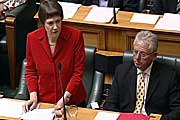
While Helen Clark was awash in a feel-good sea of sustainability yesterday -- blathering ineffectually about biofuels, climate change and how many trees six government departments are going to plant to save the planet -- another world leader was making much more sense.

Since 1990 (and in distinct contrast to our own unfortunate history in this regard) the Czech Republic has been blessed with two wonderful leaders: first 'velvet revolutionary' Václav Havel -- described by Reason magazine as "our era's George Orwell" -- and now Václav Klaus.

Václav Klaus is not a warmist. Speaking to a Czech economics daily, Klaus deconstructed the IPCC climate panel of the United Nations, and their latest Summary for Policymakers released in Paris earlier this month. Harvard physicist Luboš Motl translates Czech to 'Czenglish':
  • [Questions and answers about European politics are omitted]
  • ...
  • Q: On Wednesday, the European Commission has approved carbon dioxide caps for new cars. One week earlier, the U.N. IPCC climate panel released a report that has described, once again, the global warming as one of the major threats for the whole civilization. The Stern report about similar threats was published before that. And you suddenly say that the global warming is a myth. Try to explain, how did you get this idea, Mr President?
  • A: It's not my idea. Global warming is a myth and I think that every serious person and scientist says so. It is not fair to refer to the U.N. panel. IPCC is not a scientific institution: it's a political body, a sort of non-government organization of green flavor. It's neither a forum of neutral scientists nor a balanced group of scientists. These people are politicized scientists who arrive there with a one-sided opinion and a one-sided assignment. Also, it's an undignified slapstick that people don't wait for the full report in May 2007 but instead respond, in such a serious way, to the summary for policymakers where all the "but's" and "if's" are scratched, removed, and replaced by oversimplified theses.
    This is clearly such an incredible failure of so many people, from journalists to politicians... If the European Commission is instantly going to buy such a trick, we have another very good reason to think that the countries themselves, not the Commission, should be deciding about similar issues.

  • Q: How do you explain that there is no other comparably senior statesman in Europe who would advocate this viewpoint? No one else has such strong opinions...
  • A: My opinions about this issue simply are strong. Other top-level politicians do not express their global warming doubts because a whip of political correctness strangles their voice.

  • Q: But you're not a climate scientist. Do you have a sufficient knowledge and enough information?
  • A: Environmentalism as a metaphysical ideology and as a worldview has absolutely nothing to do with natural sciences or with the climate. Sadly, it has nothing to do with social sciences either. Still, it is becoming fashionable and this fact scares me. The second part of the sentence should be: we also have lots of reports, studies, and books of climatologists whose conclusions are diametrally opposite.
    Indeed, I never measure the thickness of ice in Antarctica. I really don't know how to do it, I don't plan to learn it, and I don't pretend to be an expert in such measurements. However, as a scientifically oriented person, I know how to read science reports about these questions, for example about ice in Antarctica. I don't have to be a climate scientist myself to read them. And inside the papers I have read, the conclusions we may see in the media simply don't appear. But let me promise you something: this topic troubles me which is why I started to write an article about it last Christmas. The article grew in size and it became a book. In a couple of months, it will be published. One chapter out of seven will organize my opinions about the climate change.
    Environmentalism and green ideology is something very different from climate science. Various findings and screams of scientists are abused by this ideology.

  • Q: How do you explain that conservative media are skeptical while the left-wing media view the global warming as a done deal?
  • A: It is not quite exactly divided to the left-wingers and right-wingers. Nevertheless it's obvious that environmentalism is a new incarnation of modern leftism.

  • Q: If you look at all these things, even if you were right ...
  • A: ...I am right...

  • Q: ...Isn't there enough empirical evidence and facts we can see with our eyes that imply that Man is demolishing the planet and himself?
  • A: It's such a nonsense that I have probably not heard a bigger nonsense yet.
  • Q: Don't you believe that we're ruining our planet?
  • A: I will pretend that I haven't heard you. Perhaps only Mr Al Gore may be saying something along these lines: a sane person hardly. I don't see any ruining of the planet, I have never seen it, and I don't think that a reasonable and serious person could say that he has. Look: you represent the economic media so I expect a certain economical erudition from you. My book will answer these questions. For example, we know that there exists a huge correlation between the care we give to the environment on one side and the wealth and technological prowess on the other side. It's clear that the poorer the society is, the more brutally it behaves with respect to Nature, and vice versa.
    It's also true that there exist social systems that are damaging Nature - by eliminating private ownership and similar things - much more than the freer societies. These tendencies become important in the long run. They unambiguously imply that today, on February 8th, 2007, Nature is protected incomparably more than on February 8th ten years ago or fifty years ago or one hundred years ago.
    That's why I ask: how can you pronounce the sentence you said? Perhaps if you're unconscious? Or did you mean it as a provocation only? And maybe I am just too naive and I allowed you to provoke me to give you all these answers, am I not? It is more likely that you simply present your honest opinion.
  • ...
  • [Questions and answers about Czech politics omitted]
Oh for similar sense from a NZ politician -- from any side of the aisle!

LINKS: Václav Klaus on global warming - The Reference Frame
Such timidity - DPF
Retirement of a velvet revolutionary - Peter Cresswell, SOLO

RELATED: Global Warming, Politics-World, History-Modern

Saturday, 19 November 2005

The day the Velvet Revolution began

Adriana at Samizdata remembers the anniversary this week of the Velvet Revolution, the day that communist rule in Czechoslovakia began to crumble. She writes:

I was then a teenager, with a twist - I knew that I had no control over my future and that I faced two choices only. In order to blend in, accept the evil around me in exchange for a semblance of a 'normal' life. Or follow in my parents' footsteps and forsake all that is considered good and rewarding in a healthy society, such as higher education, travel, even family and potentially freedom. I may have been very young but, alas, not young enough to be blind to the full horrors of such life. After all I had seen those around me living with similar decisions. As it happens, that choice was not real - having been part of the dissident movement, I was weighted, marked and tagged as the enemy of the state. I belonged to the dark forces undermining the society - a phrase so beloved of the communist media.

I remember the nervous elation of the 'now or never' moment, as we walked to the main square to meet thousands of others who felt the same. It was a powerful sensation to be surrounded by hundreds of thousands of people knowing that they are there for the same reason - an experience unprecedented in a fractured and diseased society under communism...

Read Adriana's full post here. And if you like, you can read my own tribute to Vaclav Havel, who the Velvet Revolution catapulted into the Czech Presidency.