Showing posts with label Tiny House. Show all posts

Monday, 19 September 2016

Micro-housing v modern zoning


Lamon-Luther-Tiny-House-Interior
Laman Luther Tiny House, interior

Over the past almost one hundred years, the unintended consequences of well-meaning zoning regulations have destroyed housing opportunities for thousands. Attempts to “fix” the problems with more regulation often make matters worse – Seattle’s story of the killing of micro-housing – small cunningly crafted spaces that young folk can afford – is just another in the long and lengthening case file.

Beginning in 2009, developers in Seattle became leaders in micro-housing [“a niche option in cities with expensive housing”]. As the name suggests, micro-housing consists of tiny studio apartments or small rooms in dorm-like living quarters. These diminutive homes come in at around 15–22 square metres, each and usually aren’t accompanied by a lot of frills. Precisely because of their size and modesty, this option provides a cost-effective alternative to the conventional, expensive, downtown Seattle apartment model.
    Unfortunately, in the years following its creation, micro-housing development has all but disappeared. It isn’t that Seattle prohibited micro-housing outright. Instead, micro-housing’s gradual demise was death by a thousand cuts, with a mushroom cloud of incremental zoning regulation finally doing it in for good. Design review requirements, floor space requirements, amenity requirements, and location prohibitions constitute just a few of the Seattle Planning Commission’s assorted weapons of choice.

It began so optimistically as a way for young folk especially to get their own albeit small space in the city and embrace the urban lifestyle economically from their own place.

The story begins in 2009, when micro-housing appeared in Seattle’s interior neighborhoods, spurred on by the renowned late local developer Jim Potter. Production ramped up in the next few years, and by 2013 micro-units accounted for nearly a quarter of Seattle’s housing growth, with 1,800 units produced that year. By 2015, the ‘Seattle Times’ claimed that, with another 1,600 units in the pipeline, Seattle was by far the national leader in the trend.

So what happened? Seattle architect David Neiman takes up the story. Outlawing “a smart, affordable housing option for thousands of its residents,” Seattle’s grey ones killed micro-housing “one bad policy at a time.”

There’s no one single moment when we lost the war. Rather, it’s been a process of accumulated bad decisions. In short, rule changes made by the city mandate larger and therefore costlier units, drastically limit the areas in which they can be built, require the extra process and expense of formal design review, and discourage participation in the city’s multi-family tax exemption, a program that lowers rents substantially for working-class households.

His article ‘How Seattle Killed Micro Housing’ is “a case study in how regulations can metastasize indirectly”

It’s not that any one Seattle law states, point-blank, that micro-housing can’t exist. But the units have become so burdened by design reviews, parking mandates, micromanagement of layout, and location limits, that they make little economic sense for developers, and few are built. In this respect, they have become de facto “illegal.”

Neiman’s chronological sketch plans for Seattle micro-housing tell the story in pictures (dimensions are in feet):

Neiman

As a result of the exacting new regulations placed on tiny homes, explains Vanessa Brown Calder, Seattle lost an estimated 800 units of low-cost housing per year.

While this free market (and free to the taxpayer) solution faltered, Seattle poured millions into various housing initiatives that subsidise housing supply or housing demand, all on the taxpayer’s dole.

To a politician or bureaucrat, that is how you “fix” a problem. Any problem.

Sadly, Seattle’s story is anything but unusual. Over the past almost one hundred years, the unintended consequences of well-meaning zoning regulations have played out in counterproductive ways time and time again. Curiously, in government circles zoning’s myriad failures are met with calls for more regulations and more restrictions—no doubt with more unintended consequences—to patch over the failures of past regulations gone wrong.
    In pursuit of the next great fix, cities try desperately to mend the damage that they’ve already done.  
    Euphemistically-titled initiatives like “inclusionary zoning” (because who doesn’t want to be included?) force housing developers to produce low-cost apartments in luxury apartment buildings, thereby
increasing the price of rent for everyone else.
    Meanwhile, “housing stabilisation policies” (because who doesn’t want housing stabilised?) prohibit landlords from evicting tenants that don’t pay their rent, thereby increasing the difficulty low-income individuals face in getting approved for an apartment in the first place.
    The thought seems to be that even though zoning regulations of the past have systematically
jacked up housing prices, intentionally and unintentionally produced racial and class segregation, and simultaneously reduced economic opportunities and limited private property rights, what else could go wrong?
    Perhaps government planners could also determine how to restrict children’s access to good schools or safe neighbourhoods. Actually, zoning regulations already do that, too.

Just ask all the non-residents of Double-Grammar Zone properties in Auckland.

Given the recent failures of zoning policies, it seems prudent for government planners to begin exercising a bit of humility, rather than simply proposing the same old schtick with a contemporary twist.

But as they say, never expect a bureaucrate to reconsider.

.[Plans by architect David Neiman. Pic by Inhabitat]

.

Wednesday, 31 August 2016

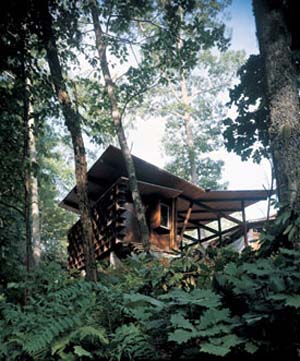
Peters-Margedant ‘Tiny House,’ by William Wesley Peters


Arch_Rendering.0.0

One thing Auckland’s new Unitary Plan makes more difficult, if not bans entirely, is so-called Tiny Houses – those oft-ingeniously crafted tiny spaces that are an many urbanites’ answer elsewhere to the problems of rocketing house prices.

A very early modern Tiny House was this 50m2 gem designed in 1934 by Frank Lloyd Wright apprentice (and eventual son-in-law) William Wesley Peters – who had at this point just left the Wright orbit.

"This might be one of the only early organic designs in the small house movement," says Dennis Au, Evansville’s Historic Preservation Officer…
    According to Adam Green, a local architect working with the
Peters-Margedant House Preservation Project, the home was likely built on spec, funded by Peters’s father, Frederick Romer Peters, the editor of the Evansville Press. Even though it’s named after his cousin, James Margedant—who, along with his wife, four kids, and dog managed to live in the home for 11 years—Green believes the young Peters, then only 22, designed it as means to showcase his practice, and hopefully drum up interest from a developer. (It’s also unlikely a 552-square-foot home was designed for six people). Peters even did much of the carpentry on his own.
    "What blows me away is that Peters was 22 when he did this," says Green. "It’s a bold step to take, to invest in yourself. He’d just got his architectural license, and just walked away from this great position. This is a bold decision for a young man just starting his career to make."

Not a bad start.

[Rendering by Adam Green from Curbed]

.

Monday, 15 August 2016

Auckland Council’s new Unitary Plan creaks closer


The change-a-minute process bringing us the Auckland Council’s new Unitary Plan appeared to be creaking towards some certainty, with the Plan now expecting to be notified on Friday. These are the councillor’s final amendments/decisions on the more controversial decisions:

  • Retain standards around the minimum size dwellings have to be, to avoid “shoebox” apartments or units being built…
       
    Under the rule, a studio apartment in the centre city will have to be at least 35m², or 30m² plus a 5m² balcony. For one or more bedrooms the minimum size is 50m², or 42m² plus a 8m² balcony.

This effectively does to the local Tiny House movement what Simon Bridges is trying to do to Uber.

    • Retain the pre-1940 building demolition control on the Queen Street Valley Precinct, which will enable these buildings to keep their character.
    • Retain the objective that provides for the management of heritage values in the Regional Policy Statement.

A sop to NIMBYs demanding the city and suburbs become a museum-piece instead of somewhere affordable in which to live.

    • Delete the Rural Urban Boundary from rural and coastal towns, enabling growth in new and existing rural and coastal towns.

A sop to “environmentalists” in places like Okura, these environmentalists being folk who already have their own mulit-storey bush cabin barring others from doing the same.

  • Amend the threshold for requiring resource consent from three or more dwellings to five or more dwellings in the Mixed Housing Suburban and Mixed Housing Urban zones.

Helpful on the face of it, but since the extensive rules in the Plan are likely to trigger a resource consent in any case, only a paper victory.

    • Delete Retained Affordable Housing provisions, which would have required 10% of homes in developments of more than 15 new dwellings to be affordable.

This was always a nonsense provision, ridiculously expensive to provide, wildly bureaucratic to oversee, and sensible only to those who’ve never encountered the subject of building economics before – particularly the concept of ‘churn.’

  • Delete standards related to building work and internal design matters, addressed in the Building Code. These include standards around the amount of daylight dwellings need to be exposed to and universal access to residential buildings. 
  • Have no minimum car parking provisions for retail and commercial activities in centres.

Sensible. Otherwise every new cafe would need to find several carparks just be allowed to open. Ridiculous.

    • Delete the Sites and Places of Value to the Mana Whenua overlay and associated provisions.

The deletion of what’s been called the Taniwha Tax: the requirement to consult up to a dozen different iwi to by the right to  work on your own property. One of the few major victories in this final Draft, and almost entirely due to the heroism of Lee Short and the Democracy Action team he led. It is “the first push back against the racist agenda of tribal elites being pursued throughout New Zealand.”

This is just so-called “virtue signalling” on the part of councillors about a place that few would either know nor care about. It costs councillors nothing, but would-be home-owners dearly.

    • - Retain objectives around rural subdivision that prevent “inappropriate” and “sporadic” subdivision and promote the “enhancement of indigenous biodiversity”.
    • Retain policies to focus growth within the existing metropolitan area.

This is the planners’ ring-fence around the city that makes land-bankers rich, home-buyers poor, and guarantees progressive carpet sprawl as the city expands in the only way the planners allow: thirty metres or so at a time.

That this provision is retained shows these councillors have really learned nothing, and forgotten nothing.

Retained too over most of the city, it seems, is a ridiculous rule not seen in the city for decades mandating that every new house or addition must maintain a one metre separation from both side boundaries – and this in a plan that is supposed to encourage intensification!

Final publication on Friday of the Complete Works of the Auckland Council Planning Department will be fascinating.

It’s not pretty, it’s not expansionary, and virtually everything will require a planner’s permission of some description, but at least we will have a modicum more certainty in what property-owners themselves may plan.

Wednesday, 10 August 2016

Unitary Plan: The planners strike back*


RMA-web

The many-mirrored maze through which Auckland’s proposed Unitary Plan is finally decided upon – the plan through which planners gain detailed control of your property – lurches closer towards resolution.

When it came out of the Independent Hearings Panel, it was much less then this common-law loving blogger would have liked, but far better than anyone with my sympathies could have expected. And then it went on to the planners for them to tinker with it again. And the planners have struck back!

Not for them to sit back while some Independent Panel of geeks knocks some of their new power-base form under them.  Their recommendations to council, reviewing those of the Panel, put back in many of the more intrusive things the Panel recommended leaving out.

Of the Panel’s headline recommendations, I found one bad, one very bad, three good, one mostly good, and one very good. That’s not bad. But what is bad is what the planners have done now.

What I was calling very good news is now gone – the Taniwha Tax is back. So that’s now very bad.

They’ve essentially put the kibosh on any ambitions Aucklanders may have for Tiny Houses, those often cunningly crafted wee places folk are falling into overseas as a means to get into a city economically. Nah, say our planners. Not welcome here. We are going to insist on “minimum dwelling sizes” in our city. Fuck you, planners. Fuck you very much. Very bad news.

The planners want to strengthen the city’s ring-fence – what they call the rural-urban boundary – the thing that delivers land-bankers risk-free profits and guarantees future carpet sprawl. That thing. They insist we keep it. More very bad news.

There is more, and it’s massive, and none of the news is good.

The Council themselves are expected to vote on this final 618-page set of recommendations next week. Goog luck with that.

And good luck with knowing what the final outcome is going to be. It’s going to be a bunfest, that’s about all we do know.

And this bunfest has been going on now for years.

So if you’ve found yourself wondering why many empty sites around town are still empty, one answer is probably this: Regime Uncertainty. If you’re uncertain what decrees the regime in power is going to issue, then any wise investor ready to unleash his supply chain is going to sit on his hands until he knows what’s up. And he’s going to do that, even if folk are crying out even when supplies are running short …

[* Thanks to Toby  Manhire for the quip]

.*

Tuesday, 15 March 2016

Salter House by Walter Burley Griffin, 1922-24


404

Architect Walter Burley Griffin, formerly head of Frank LLoyd Wright’s Chicago office, introduced to Australia the humble bungalow.

Using an inexpensive block sytem that he invented, his ‘knitlock’ bungalows were deceptively sophisticated, spaces nesting and interweaving to make these small spaces something of wonder.

SalterHouse

Though much-delayed by council procrastination due to the innnovative system, his house in Toorak, Melbourne, for Stanley Salter was an early example (plan above).  Bearing Griffin's distinctive Knitlock concrete construction, this ground-breaking home was once described by Robin Boyd as “among the finest house designs of the century.”

Based on Griffin’s own 42m2 Tiny House, dubbed Pholotia (“the mushroom that sprang up overnight”)* – a series of nooks around a single central space with no doors, only curtains running beneath the organising central ceiling deck (see plan below) – a place his wife and collaborator Marion Mahoney called “the cheapest and most perfect house ever built” -- he expanded the concept to include a central organising ‘nature court,’ bringing nature right into the very centre of the house that, even in resolutely suburban Melbourne, was already well surrounded.

“The site is [or was] large and from the street slopes perhaps 3-4m up to the house, which is placed tightly, within 6m, of the rear property line,”explains Donald Johnson in his book on The Architecture of Walter Burley Griffin. “The living room, or lounge, being forward of the side dining and reception spaces … provided an imposing view from the sreet level.  The total effect on approaching the house was of a dignity seldom achieved in a small single-storeyed house.”

The building's position at the rear of the block articulates Griffin's regard for the relationship between the building and the landscape, though unfortunately the extensive front garden area, once planted with native trees and featuring a curved drive lined with rocks, has been replaced by a second house on the site [which you can see from the existingt lounge, below].

walterr burley griffin house toorak living room

Architect Geoff Crosby spent time at the house in its original state in his early teens, which had a huge effect on him.

The house was perched at the top of a steep block with the front living room pushing out, like the bow of a ship on a wave, over the deep front bush garden below. It was designed in 1923 out the Knitlock wall system Griffin had developed. The centre of the plan was a small garden courtyard that, at the time I knew it, was covered with fly wire and contained a jungle of plants very much as the original plan shows….
    The Salter house does not have and internal courtyard as a ‘lifestyle’ element in the house. It is not a place to hang out in. It captures nature, or does it protect nature? Or display it, Is it like a giant display case? Or is like a lung for the house?

In photographs now, it is a gentrified space full of yukkas.

23509da53687ec2de041dde75b95a10e

Mind you, that could make it the perfect intimate space for an early-evening martini.

Capture

Pholiota:

2208-03_0246_Pholiota

Pholiota

Pics: Walter Burley Griffin Society, Donald Leslie Johnson, ArchitectureAU, Home Page


* Not quite overnight, sadly. While construction itself was rapid, council again looked aghast at a system they couldn’t begin to understand. So instead of permitting the project as a house, Mahoney and Griffin instead sought permission simply to construct a “doll’s house,” which they did.