Showing posts with label Rust Belt. Show all posts

Wednesday, 16 April 2025

The US 'Rustbelt' explained

"[M]any people reflexively blame trade for the decline of [what's become knows as the American] 'Rustbelt.' ...
    "But ... [d]oes trade explain the decline of steel employment from roughly 190,000 to 84,000?


If trade [alone] explained the loss of employment in steel mills, then you would expect to have seen a precipitous decline in domestic steel production. In fact, there’s been very little change in steel output during a period where employment has plunged sharply:


"[I]mports have had some impact on employment in manufacturing. But the primary cause of job loss has been automation [exacerbated by] unionisation forcing jobs to other parts of the country, rather than trade."
~ composite quote by Scott Sumner and Jon Murphy from Scott's post 'Trade as a scapegoat'

Tuesday, 22 August 2023

The Trouble With Trump-O-Nomics [updated]


"Donald Trump’s approach to economics was downright primitive. He essentially held that America was falling from greatness due to trade policy stupidity and corruption in Washington and especially owing to a penchant for bad deals by past presidents. The undeniable economic decline of Flyover America, therefore, amounted to a kind of Global Grand Theft from [America by everybody with whom Americans traded. This was bollocks. Destructive bollocks. Destructive to rust-belt Americans in those places already hollowed out by tax burdens, meddling bureaucracy, and high-wage pro-union legislation, and also to those with whom Americans were still trying to trade. People like us down here. The cost of his antediluvian protectionism is still being paid both financially and in the world's growing security threats. (Remember the old warning: when goods don't cross borders, armies will.)]...
    "[The Donald's ongoing Border Wars were both anti-trade and anti-immigrant. And both campaigns were ultimately Anti-American.] The ... false argument for the Donald’s Border Wars [for example] —that immigrants take American jobs– is utter nonsense. For crying out loud, immigrants are filling, not stealing, lower paying domestic jobs because for reasons of culture and welfare inducements the native-born simply won’t take them. [And the increase in productivity from the expansion of local markets and multiplication of the division of labour makes immigration almost always a productivity boon -- one that The Donald did his best to bury.]
    "[The effect of Trump-o-Nomics was almost wholly negative.] Donald Trump inherited an economy that was tepidly coasting forward on the momentum of the post-crisis cyclical recovery, but he then hammered it into a violent tailspin [especially] during his last year in office... [His protectionism helped destroy whatever recovery was beginning to occur. His propensity for borrow-and-spend, the unthinking resort off the short-termist politician trying to conjure up growth in a maladjusted mess of an economic system, left it more maladjusted and misaligned than ever before.]...
    "[The Donald used debt and bankruptcy to build his property empire. As president this propensity for reckless borrow-and-spend exploded, overseeing the third-biggest deficit increase of any president ever.] This was nowhere more evident than in his endless promotion of a large-scale national infrastructure programme, costing at least $1 trillion in new infrastructure spending over 10 years—all of it paid for by borrowing -- a theme that the Trump White House resurrected multiple times during the Donald’s tenure....
    "The American economy is [now] a debt-entombed, speculation-ridden stagflationary mess, and you can fairly blame a goodly share of its perpetuation and its latest metastasis on Joe Biden. But the shaky foundation on which it rests has been long in the making—with the c
oup de grâce coming during the misbegotten era of Trump-O-Nomics. ...
    "As we have documented extensively, Donald Trump is not an economic conservative in any way, shape or form. On everything that matters for prosperity and liberty—fiscal rectitude, sound money, free markets and small government—he’s on the wrong side of the policy fence. So to repeat: The Donald is simply an opportunistic, self-promoting demagogue [who helped ride America into the ground seemingly either to preen his overweening narcissism, or simply to stave off his many creditors] ..."
~ summary and interpolation of several posts by David Stockman (former Reagan White House budget director) on the topic of 'The Trouble With Trump-O-Nomics' and 'The Trumpian Myth Of Global Grand Theft'
UPDATE, from Stockman:

"Between them, Trump and Biden have raised the national debt by nearly $13 trillion. That’s 40% of all the money that’s ever been borrowed by presidents since George Washington....
    "When it comes to the core matter of fiscal discipline, the Donald was no disrupter at all. He was actually the worst of the lot among Washington spenders, and by a long shot, too. … All of the hideous excesses of the COVID bailouts were launched on his watch, signed into law with his pen and/or legitimized with the imprimatur of an ostensible Republican president … 
    “When you compare the constant dollar growth rate of total Federal spending during his four years in the Oval Office with that of his recent predecessors it is evident that the Donald was in a big spenders' league all of his own … the Donald’s record stands first among no equals on the wall of shame.”
    "[He is truly] the King of Debt.... Ultimately, excessive, relentless public borrowing is the poison that will kill capitalist prosperity and displace limited constitutional government with unchained statist encroachment on the liberties of the people. So for that reason alone, the Donald needs to be locked-out of the nomination and out of the Oval Office.”


Thursday, 29 April 2021

"China’s future will depend on which tendency wins out in the end."


"Homo sapiens is a cooperative species. Compared to many other animals, we are not particularly strong or fast, we don’t have armour, we can’t fly and are not very good at swimming. But we have something else that gives us an overwhelming advantage: we have each other....
    "Man is a trader by nature. We constantly exchange know-how, favours and goods with others, so that we can accomplish more than we would if we were limited to our own talents and experiences....
    "Present-day globalisation is nothing but the extension of this cooperation across borders, all over the world, making it possible for more people than ever to make use of the ideas and work of others, no matter where they are on the planet. This has made the modern global economy possible, which has liberated almost 130,000 people from poverty every day for the last twenty-five years....
    "[A]uthoritarian China is not a counter-example to the case that progress depends on openness. When China was most open it led the world in wealth, science and technology, but by shutting its ports and minds to the world five-hundred years ago, the planet’s richest country soon became one of its poorest. China’s present comeback is the result of a new, partial opening since 1979, and it is doing spectacularly well in the areas that have been opened, and failing miserably in the ones that have not. Chinese businesses competing on world markets have lifted millions of workers out of poverty, but protected state-owned enterprises are destroying wealth in growing rust belts. When Chinese scholars work in areas the party approves of, they end up in prestigious science journals, but when they sound the alarm about a new virus or something else that embarrasses its leaders, they end up in jail. China’s Communist Party wants both the benefits of openness and the certainty of control. China’s future will depend on which tendency wins out in the end."
          ~ Johan Norberg, from his book Open: The Story Of Human Progress

Monday, 21 November 2016

Trump’s tax and trade policies could hurt Australia, NZ and the world


Trump’s tax and trade policies could hurt Australia and the world,” say Australian columnist Henry Ergas. Could hurt Australia and the world and, by necessity, us in New Zealand.

You see, if you remember, “at the heart of Trump’s programme are sweeping cuts in personal and corporate taxes….” However,

Those declines in revenues aren’t matched by expenditure cuts: on the contrary, many outlays are set to rise. In defence, Trump has supported a 350-ship navy, which, the Congressional Budget Office estimates, would add $US120 billion to projected outlays, along with expansions in the army, the air force and the marines that would cost nearly as much…

So an already stratospheric deficit made astronomic, just as interest rates themselves are beginning to climb.

The effects are predictable: as US interest rates rise relative to those elsewhere and foreign savings flow into the US to finance the budget deficit, the US dollar will strengthen, much as the Australian dollar did in the wake of former prime minister Kevin Rudd’s stimulus spending… The dollar’s further rise will only accelerate the deterioration [of American manufacturing], with a sizeable part of the fall in the current account balance likely to come from increased ­imports of manufactured goods.
    This is hardly the first time that has happened. Rather, experience has repeatedly shown the devastating effects of large, unfunded, tax cuts on US competitiveness.
    Never were those effects clearer than in the early 1980s, when the combination of a tight monetary policy associated with Federal Reserve chairman Paul Volcker and an expansionary fiscal policy associated with president Ronald Reagan increased long-term interest rates, attracting capital inflows that drove the currency to a 40-year peak.
    Equally, the tax cuts initiated by president George W. Bush were ultimately funded by foreign purchases of US government bonds, propping up the dollar and worsening American manufacturing’s decline.
    As Jeff Shafer, a former undersecretary of the US Treasury for international affairs, has argued, those exchange rate effects — which are symptoms of poor domestic policy settings — have swamped other factors in distorting the American economy, shrinking the traded goods sector and shifting resources into services (and in the lead-up to the ­financial crisis, housing).

And as Trump’s deficit increases, the effects on the Rust-Belt voters he claims to be looking after will become progressively worse, their pain steadily greater. What then?

As that pain makes itself felt, it will be harder and harder for Trump to back away from the anti-trade rhetoric that dominated his campaign, with China — whose currency is weakening because of capital flight — squarely in the protectionists’ sights. Reagan was a committed free trader who worked hard to contain cries for protection when the trade balance soured; Trump is not.
    The risks that poses for Australia [and New Zealand] are obvious. Already now, the world is hardly in great shape. With the inauguration just 60 days away, expect it to get uglier.

[Hat tip Catallaxy Files]

Thursday, 29 September 2016

Trump’s economic plan: Deep denial about the deep doodoo of deep voodoo


Trump’s economic “plan” was voodoo economics when first touted, and is even deeper voodoo in the new and unimproved model rolled out recently.

The tax plan in short: big tax cuts on incomes and entities looking suspiciaoulsy similar to Trump’s own with precisely zero intention to commensurately cut spending.

In the Tax Policy Center’s analysis of the Republican candidate’s proposal, the institute said that Trump’s plan would reduce federal revenues by $9.5 trillion over its first decade, and an additional $15.0 trillion over the next 10 years. Including interest costs, the Center said, the proposal would add $11.2 trillion to the national debt by 2026….
    Trump’s plan continues to stomp down the road of massive debt accumulation we are already on. It takes us further down this path than we’ve ever gone before and does it for all the foreseeable years to come.

Sure, everyone from the Tax Policy Center to his couldn’t-lie-straight-in-bed opponent has berated the plan for its promises of “tax cuts to the rich” – the very opposite of her own plan which promises to soak them. And though “Mrs. Clinton’s proposal would only affect those in the top income bracket,” acknowledges an economist who does understand how things work, “she may be surprised to learn that those are the only people who can afford to make investments in startups.”

We’ve seen this “soak the rick” schtick before, everywhere; it’s one of the main reasons for the very American rust belt that Trump claims he wants to resurrect and make great again: soaking the industrial rich, depriving the factories of the financial seed corn of reinvestment, was one of the very reasons the former industrial heartland is now so poor.

But we’ve seen Trump’s voodoo economics before too – Reagan, Bush I and Bush II all making voodoo incantations amounting tax cuts without spending cuts, every single one dangerously increasing the debt.  This is the main reason America embarked on the journey of indedtedness it is in today, becoming so seriously indebted that the Federal Reserve is now desperately monetising all the debt by “printing” money – and knows of no way out!

To this fiscal calamity Trump would now have another $11.2 trillion poured onto the flames that are already a whopping $19 trillion and threatening to burn down the house.

CsafRqKVYAA7CsE

This is no time for self-serving voodoo. If ever there were a time to talk turkey on the national debt it is now. Yet as Thomas Sowell says so sagely,

When you want to help people, you tell them the truth. When you want to help yourself, you tell them what they want to hear.

Look at that graph and those raw numbers, and you know yourself which game Trump is in.

A game in which a typical politician’s wish-list of promises is floated in order to get elected (a wall, extra military and veterans spending, six months of federally-paid maternity leave, “investment” in infrastructure, “a push” against illegal immigration, and a health-care reform plan that would cost nearly a half-trillion dollars more over the course of a decade — and lead to nearly 21 million people losing their health insurance.)

But if he were to ever tell the truth, or if his ignorant economic advisers were to ever tell him, then the truth about his voodoo economics might sound something like the truth told by former Reagan Budget Director David Stockman, that “the Trump campaign’s stab at a semi-coherent economic plan is

a dog’s breakfast of some plausible policy ideas, really bad fiscal math and a relapse to the discredited, 35 year-old dogma of sweeping income tax cuts which pay for themselves.
    They don’t. As the great Dwight D. Eisenhower proved in the context of the modern welfare and warfare states,
politicians have to earn the right to favour the voters with tax reductions by first dispensing the pain of spending cutbacks and without an exemption for the military-industrial complex, either.
    Following those precepts, Ike balanced the budget several times; generated an average deficit of less than 1% of GDP during his tenure; shrank the defense budget by 33% in real terms; and presided over the strongest 8-year growth rate (about 3.3%) of any post-war GOP president, including Ronald Reagan.
    By contrast, the Reagan White House—me included—-fell for the theory of “dynamic scoring” and that the big cuts in the income tax rates would partially pay for themselves via revenue “flowback”. Back in those days the latter was expressed in an economic forecast known as Rosy Scenario, which assumed that in response to the supply side tax cuts, the US economy would get up on its hind legs and leap forward at a real GDP growth rate of more than 4% per year, and as far as the eye could see.
    What happened instead, of course, is that the US economy plunged into the drink of the deep 1982 recession and the Federal deficit soared to 5% of GDP—a truly shocking outcome back in those innocent days when the old-time fiscal religion still had roots inside the beltway. And
it would have also caused enormous economic havoc had not the Gipper’s advisors—me included—talked him to signing three tax bills over 1982-1984 that recaptured roughly 40% of the revenue loss from his cherished tax cuts.
    Even then, the public debt grew by 250% during Reagan’s eight years—-or by more than under any peacetime President in American history. Yet even to this day the GOP politicians and their economic advisers profess a case of heavy duty amnesia about what happened, claiming that real GDP grew by upwards of 4.5% and that these results were proof positive that “dynamic scoring” of budget of tax cuts is valid.
    Worse still, they appear to have convinced Donald Trump of this same fallacious revisionist history because it was embedded at the core of the Thursday speech’s fiscal math.

Conclusion:

So, yes, tax  cuts stimulate the economy. I would never argue that they don’t [says the Great Recession blog], but they do not stimulate it enough to pay for themselves, as Stockman is willing to honestly admit, but Trump’s advisors are not. Since Trump cannot make the deep cuts that his spending increases and tax cuts require, he simply promises that the economy will be so stimulated that it will automatically make up the difference. (Been there; done that; didn’t work.)
    Do you simply want to hear what you want to hear or want the truth? That’s what this comes down to.

Good question.

One thing is certain to anyone who is capable of learning from thirty-five years of history: the debt under Trump will be great … really great. It’ll be a great debt like you’ve never seen before.

Here’s the American National Debt Clock:


.

Tuesday, 21 June 2016

The Keynesian Blessing: People Are Broke


Guest post by William Anderson

_KeynesWriter Neal Gabler recently “confessed” his “secret shame” in an Atlantic Monthly article on how a huge percentage of the middle-class are living beyond their means, existing paypacket-to-paypacket, and are mired in personal debt. He writes:

I never spoke about my financial travails, not even with my closest friends—that is, until I came to the realisation that what was happening to me was also happening to millions of others, and not just the poorest among us, who, by definition, struggle to make ends meet. It was, according to that Fed survey and other surveys, happening to middle-class professionals and even to those in the upper class. It was happening to the soon-to-retire as well as the soon-to-begin. It was happening to uni graduates as well as high-school dropouts. It was happening all across the country, including places where you might least expect to see such problems. I knew that I wouldn’t have $400 in an emergency. What I hadn’t known, couldn’t have conceived, was that so many others wouldn’t have the money available to them, either.

The article is worth reading if only to track the spending habits and lifestyle of someone who has done well income-wise, but now is caught in a huge financial trap, and things will only deteriorate from there. Gabler tries to find and fix the blame, and it ranges from the banks to individuals to “keeping up with the Joneses.” That is all well and good, but he fails to point out the role of central banks and the American Federal Reserve System and the poisonous ideology that undergirds all their actions: Keynesianism.

No Emergency Funds: A Triumph for Keynesians

There is a sad irony in Gabler’s article, and that is that what he understands as a real financial crisis in middle-class households actually is the ideal state of things via the Keynesian lens of economic thinking. In the upside-down world of Keynesianism, the fact that most of the middle class now live hand-to-mouth without any appreciable savings is a triumph and is the key to prosperity, at least in the Land of Keynes. Let me explain.

In the 1950s, the so-called Keynesian Revolution began to steamroll its way through university faculties as “The New Economics” became the rage. John Maynard Keynes, in his alleged “path-breaking” book,The General Theory, had demonstrated that far from blessing an economy with the means of capital formation, household savings instead were actually a curse and when “too many” households saved too much money, the so-called Paradox of Thrift would take hold and actually drive down the economy into the dreaded Liquidity Trap.

Keynes1The middle class at the time were not aware of this new Holy Doctrine and continued to save. For example, I knew a single mother who for most of her working career made little more than minimum wage, yet upon retirement was able to purchase a home with cash for $100K and she has continued to live well into her 90s. Her mother and father were poor farmers, yet they managed to save an astonishing amount of money despite their very low incomes.

This was not unusual back then. Americans especially were known for their savings habits and continued to save even as Keynesian economists began to admonish them for denying that the economy needed “spending” to keep us at “full employment.” Like all Progressives, Keynesians believed that if people were not willing to do what they considered necessary, in this case, to allegedly sustain full employment levels, then the federal government would need to “nudge” them in compliance. Politicians were all-too-happy to earn the praise of the professoriate while also getting their chance to use their nudging gun.

And so little by little governments changed the economic landscape in order to conform to the Keynesian “ideals.” The most important official change in policy was the promotion of inflation. True, officials claimed that inflation was a bad thing, and could be “fixed” by application of wage and price controls, but at the Keynesian-dominated central banks and American Federal Reserve System, officials already were setting “inflation goals” in order to keep the economy from slipping into deflation.

While Keynesian “theory” sprouts many myths, one of the main ones is that inflation (read, monetary debasement) helps to create full-employment and that it is necessary because, if left to its own devices, a free-market economy quickly will deteriorate into a downward deflationary spiral and end up in a perverse “equilibrium” in which unemployment is high and economic activity is low. Only inflation can stop the spiral, and if it isn’t “high enough,” according to Keynesians, then the system will implode into the depths of deflationary depression.

To Austrian economists, none of this makes sense, at least if one is speaking about real economics, not politics. If Keynes were correct, then the government’s inaction during the recession of 1921 would have resulted in a major depression during the 1920s.

For that matter, since the government had not intervened in previous depressions and recessions, the Keynesian logic would have meant that the US economy would have been in permanent depression – and that upon exiting WWII and drastically dropping government spending governments would have started depressions and not recovery.

The Benefits of Saving and Investment

The historical results parallel economic theory. Economies do not grow because governments inject doses of  “aggregate demand;” they grow because entrepreneurs develop better uses of factors of production that permit more goods to be produced and also allow for more resources to be applied in areas where they have not been used, or at least used in lesser amounts.

Take the development of the washing machine, for example. Before washing machines were developed and made available to households, washing clothes was a huge chore that might take at least one day and maybe even longer than that. For the most part, household laundry chores were performed by women who worked for hours to clean clothes and other materials.

CaptureWashing machines, however, enabled housewives to do more laundry in less time, thus allowing them to apply some of their other skills elsewhere. Multiply this sort of thing across an economy, by putting capital together to make these new inventions, and one can have an idea how the development of such goods enables economic growth, which enables to the development of even more goods, and on and on.

Contra Paul Krugman and other modern-day Keynesians however, capital formation does not exist as a “given.” Instead, capital formation not only is a function (to use a mathematical term loosely) of savings, it must be so because modern economies involve a mix of capital and consumer goods, and their ratios are related to individual time preferences. One cannot consume all of its present production and simultaneously abstain from consumption in order to create capital goods that will produce more consumption goods in the future.

For example, if people (like our ancestors) are willing to save large portions of their incomes, it is not because they are irrational or are “hoarding” money (as Krugman would tell us), but rather because they wish to postpone some current consumption in order to be able to consume more in the future. Investors take that savings pool and then invest in the kinds of capital goods that would allow for the creation of even more goods to be consumed at a future time.

The key indicator in whether or not investors are going to invest in long-term capital (that results in fewer consumption goods made in the short run, but brings about much more consumption in the long run) is the interest rate. In a free-market economy, low interest rates mean that individuals are saving large amounts of their income, making a larger pool of “liquid capital” available, while high interest rates indicate that consumers prefer to consume now and save less — precisely the state of things right now.

Keynesians, on the other hand, claim that since the true economic “multiplier” is equal to 1 over the rate of savings, then the less a society saves, the more economic growth that economy will experience. (For example, if all individuals in a society save 10 percent of income, then that economy has a multiplier of 10. If the individuals save 5 percent, then the multiplier is 20. It reminds me of the ditty we used when I was in school in which we “proved” that the less we studied, the more we knew.)

Low Interest Rates vs. Reality

Of course, interest rates are not high, and certainly do not reflect current societal time-preferences. A society featuring a dearth of savings should have high rates, not low ones. Neal Gabler’s article, that I began with above, chronicles a life of spending and not saving -- whether it is paying for a daughter’s wedding or coming up with large amounts of money to pay for a pricey elite college education for the children. With central banks suppressing interest rates to less than 1 percent, there almost is no incentive for people to put money into savings accounts, given there is almost no appreciable return, and few of us are equipped to enter the equities markets without making serious investment errors. Multiply that across the economy and one finds a dearth of savings and a preference for present consumption — exactly what Keynes and his modern-day followers claim is the formula for prosperity: we spend ourselves into wealth.

So, we are left with a huge irony. We have low interest rates, but clearly the kind of real long-term capital investment is not common in most economies at the present time. (Of course, given the hostility of the American Political Class to private investment and given the fact that Sanders is running a campaign based on attacking and ultimately destroying private enterprise in the USA (with Clinton not far behind), American investors are reading the tea leaves and taking their money elsewhere, something that infuriates the Political Class. Not surprisingly, the Political Class is demanding laws that effectively would build a Berlin Wall around American investment, making it illegal for Americans to invest outside America. One does not need to be very astute to know immediately what a disaster that would bring, but given that the Political Class exists by looting others, its members would be somewhat shielded from the economic carnage.)

Lest anyone doubt that current American savings rates are low, the chart below presents an ominous picture. It also demonstrates beyond a doubt that the biggest offender in conducting policies that discouraged savings was not the Obama administration — as bad as it is  but the Bush administration with its housing bubble that exposed what Peter Schiff often has called the “phony economy.”  If you want to see the reason for America’s “rust belt” and the demise of many of its once-great manufacturing cities, then this is among the greatest of them:

Personal saving rate

The chart itself exposes much about the past 35 years that is harmful to the economy. Yes, there has been the rise of the high-technology sector and the improvements in transportation and telecommunications, thanks to the deregulation efforts of the Carter administration (something for which Carter never takes credit because his Democratic Party ideology tells him that private enterprise and profit are bad things).

CapThe steepest drop in the rate of savings came with the Clinton and George W. Bush administrations, and I don’t think that we should be surprised that during those years, the Fed actively pushed down interest rates and helped create two massive financial bubbles, each of which burst and created destruction in their wake. From the Fed’s own statistics, savings has somewhat recovered during the Barack Obama years, even though Obama’s administration is extremely hostile toward savers.

But here we are. After decades of what essentially could be called a new “Industrial Revolution” with the advent of computers and the internet, the US government has managed through its monetary authorities and through its other policies to decimate savings and leave millions of Americans financially vulnerable.

It has been no accident. People are able to resist force only for so long before giving in, and given that the Keynesian war on savings has continued unfettered for decades, and has been blessed at the highest levels of government and academe, not to mention touted in the news media, we should not be surprised that people save less. We also should not be surprised to know that all of us will pay a steep price for this spendthrift way of life, even as the political classes scramble to protect themselves from the consequences of their actions.


anderson_0Bill Anderson is a professor of economics at Frostburg State University in Frostburg, Maryland. His Ph.D. in economics is from Auburn University, and he serves as an associate scholar with the Mises Institute.

He has published numerous articles and papers on economics and political economy, including articles in The Independent Review, Reason Magazine, The Free Market, The Freeman, Public Choice, The American Journal of Economics and Sociology, Quarterly Journal of Austrian Economics, and others.

This post first appeared at the Mises Daily.

.

Thursday, 10 March 2016

The Reserve Bank’s war on capital


So the Reserve Bank just lowered interest rates to a record low – making the price of debt cheaper than ever before, opening a new front on the war on savers ( a war that all but demands those living off their income look for riskier and risker places from which to yield it) – and giving the lie to all those bullshit stories spouted about this being a “rockstar” economy.

The Reserve Bank’s move is predicated wholly and solely on the notion that if the price of debt is lowered, then more will be borrowed, more will be spent, and the economy will therefore produce stable inflationary growth.  This is the basic notion every time the Reserve Bank lowers interest rates. This is what they and all the learned commentators commenting on the rate drop hope will happen.

They ignore entirely the deflationary instability produced by the very malinvestment all that newly-created counterfeit capital creates.

They ignore in toto the asset bubbles created by this new debt at the very same time as the prices of commodities produced by all those gobs of previous debt are collapsing.

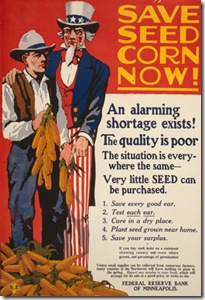
Save Seed Corn Now!They ignore completely that over the last several years (since the central bankers last crashed the world’s economies) every 18 dollars of their newly-created debt created just one dollar of GDP. Eighteen dollars to produce just one! You wouldn’t take those odds out at the track – unless perhaps you were a central banker or one of their ‘learned’ commentators.

It is, quite frankly, a fucking stupid and flatly destructive notion – that new debt creates stable inflationary growth – but the poor lambs really do have no other. (If they did, then talk of Negative Interest Rates to “jump-start” something would not even be on the table.) But since every one of those bankers and the commentators that brown-nose them still worships at the altar of John Maynard Keynes and his cultish notion that all growth comes from new debt, that fucking stupid notion and the war on saving and destruction of real capital it engenders will continue to blow up new bubbles, consume our seed corn and just generally eat out our substance.

This war on saving and on the real capital it represents – on the pool of real savings that actually does fund all production – has an endpoint. As George Reisman explains, it is the picture of America’s decaying rust belt.

The Keynesians' preoccupation with the utterly fictitious problem of saving as a cause of poverty bears major responsibility for the very real problem of growing poverty as the result of a lack of saving. Based on their hostile economic analysis of saving, the Keynesians have brought about the enactment of correspondingly hostile government economic policies towards saving. The result has been economic stagnation and decline, whose nature and significance are captured in the words: the rust belt. Over a span of approximately two generations [now three], the intellectual rot of Keynesianism has helped to bring about the physical rot of the industrial heartland of the United States.

That intellectual rot is all pervasive.

We heard it this morning oozing out of the Reserve Bank, and from the industry flunkies who religiously follow their utterances.

RELATED POSTS:

  • “Well, load up on drugs and bring your friends, because New Zealand is being talked up as the “rock star” economy for 2014. Hee haw!
        “But there are problems here—the first problem being in the way these alleged economists measure growth.”
    We’re rock stars! – NOT PC, 2014
  • “The price of all commodities are at historical lows, not just these, and the reason for all is the same: the creation in the last seven years of counterfeit capital at record rates. This is what “stimulus season” finally wrought: an avalanche of malinvestment creating a mountain of over-supply.”
    Dairy, oil, iron, rubber, steel, malinvestment – NOT PC
  • “As you’ve probably noticed, we are in an asset bubble and have been for some time. With interest rates on the floor and investors desperate for yield, folk have been able to make risk-free profits using banks’ almost free money to buy bonds and shares and houses and flats…and sit back and marvel at their brilliance as their prices go up.
        “But there is a problem: we haven’t been growing capital, we’ve been consuming it.
        “We’ve been eating our seed corn. And we think it’s been making us rich.”
    Housing bubble is consuming our capital – NOT PC, 2015
  • “But  first, let’s understand in very simple terms what does causes economic progress. The seed corn of economic growth is capital—capital put to work producing economic wealth, and still more capital.  It’s an ongoing virtuous cycle dependent on one thing: that you keep growing your seed corn instead of consuming it.
        “’“Capital is accumulated on a foundation of saving. Saving is the act of abstaining from consuming funds that have been earned in the sale of goods or services.
        “’Saving does not mean not spending. It does not mean hoarding. It means not spending for purposes of consumption. Abstaining from spending for consumption makes possible equivalent spending for production. Whoever saves is in a position to that extent to buy capital goods and pay wages to workers, to lend funds for the purchase of expensive consumers' goods, or to lend funds to others who will use them for any of these purposes.’”
        “As I quoted John Stuart Mill here the other day saying, ‘What a country wants to make it richer, is never consumption, but production.’”
    “Tax cuts don’t cause growth”? – NOT PC, 2010
  • “Here's a curly one for you: What's the difference between capital expansion and credit expansion?  It's important.  The answer could well affect your future for some years to come. Give up?  Here's George Reisman with the answer…”
    Counterfeit capital – NOT PC, 2008

Wednesday, 24 July 2013

Today Detroit, tomorrow the world

image

If you discount the life-giving value of continuing economic growth and progress, then check out what happens in a city that has abandoned both.

It teeters on the brink of bankruptcy. Members of the City Council have simply stopped showing up for work. Whole blocks are seemingly abandoned. Emergency calls to 9-1-1 take, on average, almost an hour for help to arrive. Police solve – this is apparently true – 8.7% of crimes. 8.7%! The only reason the sky-high crime rate isn’t higher is, apparently, a shortage of available innocent victims.

And look at this description of Detroit from this week’s Observer:

What isn’t dumped is stolen. Factories and homes have largely been stripped of anything of value, so thieves now target cars’ catalytic converters. Illiteracy runs at around 47%; half the adults in some areas are unemployed. In many neighbourhoods, the only sign of activity is a slow trudge to the liquor store.

Just a few decades ago, Detroit—aka “Motown,” the world’s centre of automotive production—was arguably the world’s richest city. Now, it’s a dystopian shithole.  A hovel carved out of industrial greatness,  A bankrupt degenerate wasteland.

There, but for the grace of profits, goes every city.

A lesson for every city and country in the world that thinks prosperity is forever—and today’s prosperity can be borrowed from tomorrow’s.

Like the death of every American industrial centre, and like the slow strangulation of Japan, the death of Detroit was a man-made disaster. Detroit was once the world’s showcase of capitalism. It is now the place that shows the world you can’t kick the can down the road forever.

Like the entire western world, Detroit was built by profits. It was destroyed by those who took those profits for granted; who thought the profits would last forever, no matter what was done to destroy them. Now, all the vultures have to pick over is the rotting carcass their policies produced.

Chrysler, Ford and General Motors built their profits on delivering automotive excellence to the world. But the unions thought those profits were rightfully theirs. They began the transformation of the companies into carcasses upon which they could feed while tying their hands and feet with arbitrary work rules that prevented them from competing. And the companies caved in. And the Asian competition took over.

To keep great companies going, it is not enough just to reproduce the innovations that made you great. You have to continuously re-innovate or die. But from Ralph Nader on the notion grew that men from government centres could write rules about how cars should be produced, how they should run, and how they should be constructed. They shackled the companies with safety and “pollution” rules in which the big companies acquiesced, thinking the regulation of the industry would help raise barriers to entry for smaller competitors. Instead, the calcification of the industry it produced opened the door to the foreign competition that killed them.

And all that regulation everywhere else made everyone at least 75% poorer, and less able to buy what was produced.

To keep great companies growing, it is necessary to continually reinvest the profits in maintaining the capital goods that are producing the profits, and invest in new capital goods to produce more.  This is the process of capital accumulation that represents real growth and progress, built on the reinvestment of profits that constitutes real saving. But politicians riding the welfare gravy train to electoral success were busy sucking those profits dry with their taxes. 

And as those politicians printed money to pay their welfare bills, the inflation the money-printing caused raised the taxes those companies paid even more, while also raising the price of new capital goods, making new investment increasingly more difficult—until, bit by bit, it finally became impossible.

Yet as the profits declined, the welfare politicians kept on going back to the well. The well their policies have finally run dry.

They were helped in their economic genocide by the intellectual poison produced by John Maynard Keynes—especially by the Keynesians’ manic hostility to saving. i..e, the process whereby consumption is delayed so that prior production can be reinvested into new production.  As economist George Reisman points out,

The Keynesians' preoccupation with the utterly fictitious problem of saving as a cause of poverty bears major responsibility for the very real problem of growing poverty as the result of a lack of saving. Based on their hostile economic analysis of saving, the Keynesians have brought about the enactment of correspondingly hostile government economic policies towards saving. The result has been economic stagnation and decline, whose nature and significance are captured in the words: the rust belt. Over a span of approximately two generations, the intellectual rot of Keynesianism has helped to bring about the physical rot of the industrial heartland of the United States.

Detroit is the bastard child of Keynesian economics and welfare politics.

British MP Daniel Hannan recognises today’s Detroit in the rotting industrial city of Starnesville Ayn Rand described prophetically in her novel Atlas Shrugged.  “Statism is turning America into Detroit, he says in this week’s Telegraph. “It is Ayn Rand's Starnesville come to life.”

Hannan sets his sights too low. Because every country in the western world suffers from the same intellectual rot as America.

And if that rot can eat out the soul of the richest industrial city the world has ever seen, it can consume anything.

Monday, 1 July 2013

Inventor(s) of the Day: Recommended Reading List

Adam Mossoff is another writer who’s fascinated by invention and discovery.

Friends and colleagues have been asking me with increasing frequency for recommendations of the books I’ve read on these subjects.  I’m happy to provide this list, as these books have deepened my understanding of the history of science and technology, as well as the nature of innovation and the role of patents in securing the fruits of productive labors to innovators.  I have in fact relied on many of these books in producing my scholarship, including my article on the Sewing Machine War of the 1850s [demonstrating there is nothing either new or anti-development about so-called “patent thickets”] and another article, A Simple Conveyance Rule for Complex Innovation, which explains how and why American patent law has long secured commercialisation rights to patentees.

The following list is by no means complete, as it does not include books I am still reading …  I may have forgotten some books I read a long time ago.  It also excludes books that I have read that I have not enjoyed for various reasons.

I hope people enjoy the following books as much as I have enjoyed them.  (The list is in alphabetical order by last name of author.)

  • Harold Evans, They Made America: From the Steam Engine to the Search Engine: Two Centuries of Innovators (2004) [purchase here]
  • John Steele Gordon, A Thread Across the Ocean: The Heroic Story of the Transatlantic Cable (2002) [purchase here
  • Thomas Hager, The Demon Under the Microscope: From Battlefield Hospitals to Nazi Labs, One Doctor’s Heroic Search for the World’s First Miracle Drug (2006) (the book steers into unnecessary politics toward the end, although this is still an interesting history on how the FDA’s authority was expanded as a result of the use of sulfa antibiotics) [purchase here]
  • Sam Kean, The Disappearing Spoon, and Other True Tales of Madness, Love, and the History of the World from the Periodic Table of the Elements (2010) [purchase here]
  • David McCullough, The Great Bridge: The Epic Story of the Building of the Brooklyn Bridge (1983) [purchasehere]
  • Richard Preston, American Steel: Hot Metal Men and the Resurrection of the Rust Belt (1991) [purchasehere]
  • Richard Preston, First Light: The Search for the Edge of the Universe (1996) [purchase here]
  • T. R. Reid, The Chip: How Two Americans Invented the Microchip and Launched a Revolution (2001) [purchase here]
  • William Rosen, The Most Powerful Idea in the World: A Story of Steam, Industry, and Invention (2012) [purchase here]
  • Charles Slack, Noble Obsession: Charles Goodyear, Thomas Hancock, and the Race to Unlock the Greatest Industrial Secret of the 19th Century (2003) [purchase here]
  • Dava Sobel, Longitude: The True Story of a Lone Genius Who Solved the Greatest Scientific Problem of His Time (reprint ed., 2007) [purchase here]
  • Dava Sobel, Galileo’s Daughter: A Historical Memoir of Science, Faith, and Love (1999) [purchase here]
  • Les Standiford, Meet You in Hell: Andrew Carnegie, Henry Clay Frick, and the Bitter Partnership That Changed America (2006) [purchase here]
  • Barry Werth, The Billion-Dollar Molecule: One Company’s Quest for the Perfect Drug (1994) [purchase here]

I can personally and wholeheartedly endorse Adam’s recommendations of Longitude, A Thread Across the Ocean, and The Great Bridge. They tell three stunning stories.  If the others are half as good as these, they’ll be well worth it.

Wednesday, 11 August 2010

QUOTE OF THE DAY: What happened to ghost towns?

I liked this comment over at Australian blog Catallaxy Files, just as relevant here in the wake of the debate over how welfare has changed over the last few generations.  Seems like what would once have become ghost towns these days become bogan towns instead…

_Quote Why do ghost towns exist? Because the economic activity that once supported them dried up, so the people upped and moved to someplace else.
    We don’t seem to be creating ghost towns any more...  [Instead], economically dead places are being supported by indirect government handouts, like the dole.

Anyone who just said either “creative destruction” or “rustbelt” to themselves while reading that earns a point.