Showing posts with label Ron Paul. Show all posts

Tuesday, 4 February 2025

"Economic wars often turn into military wars."


"President Trump made it clear during his presidential campaign that tariffs will be a part of his policy-making. He has followed through on that. But tariffs are very risky business. Yes, you can get lucky with them being a political tool at times. 
    "But tariffs can also turn very bad, especially when egos get revved up. American history is littered with the use of tariffs going very badly. 
    "President Trump, and the American people, should always keep that in mind. 
    "Economic wars often turn into military wars. 
    "Given the bankrupt state of our nation, any type of war should be the furthest thing from our minds. It could end up being the last nail in the coffin. 
    "Best to focus intensely on cleaning our own house."
~ Ron Paul


Monday, 29 April 2013

The War on Drugs is a Failure

..we don’t treat alcoholics like this.  Starring Chris Christie, Ron Paul, and the dubious powers of Autotune.

Monday, 12 March 2012

Thursday, 12 January 2012

No blogging

Sorry.

No blogging today.

I’ve been assassinated by a crazed Ron Paul supporter.

Monday, 9 January 2012

Ron Paul

I’ve had to discuss Ron Paul frequently over the holiday break. Not because I brought him up. For some reason, friends wanted to talk about him. Here below are links saying a little of what I tried to say about him in response, summarised by those more knowledgeable about the subject than I.

Short summary? Ron Paul is not a libertarian. He

  • rejects the Jeffersonian principle of a "wall of separation" between religion and government;
  • is anti-immigration (“to the right of most Republicans” says Vodka Pundit Steve Green);
  • is anti-abortion (Paul describes "the rights of unborn people” [sic] as “the greatest moral issue of our time," and "abortion on demand" as "the ultimate State tyranny");
  • “plays footsie” with racists and kooks;
  • is a hypocritical supporter of pork-barrel earmarks for his own congressional district;
  • is opposed to free-trade agreements (like NAFTA); and
  • is appallingly “blame-America-first” on  foreign policy.

In addition, he is a Creationist—a point of view disqualifying the holder from intelligent discussion of, well, virtually everything.

In short, then, and to repeat, he is not a libertarian: he is a “states-rights” religious conservative, with all the intellectual confusion that implies—yet his growing public prominence as a self-proclaimed spokesman for the ideas of liberty gives grave concern for the fate of those ideas.

UPDATE:  Clearly, Ron Paul is far from the secular freedom lover many would like him to be. Argues Gus Van Horn,

   he functions as a Trojan horse for the religious right even as he pretends that personal freedom is as obviously good and uncontroversial as breathing on a regular basis. (Personal freedom is good, but this is neither obvious nor uncontroversial.)
So what then about his claims to being a lover of freedom? What exactly is Paul's vision of "a free society"?  On that subject, this Open Letter to Ron Paul is an eye-opener, written by one Duncan Bayne in response to this article by Paul criticising the 1993 BATF & FBI assault on the Branch Davidians in Waco. Says Bayne:
   While I agreed with many of your criticisms of BATF and FBI tactics & strategy, it became apparent to me that your article was not primarily concerned with those criticisms: the main thrust of the article was to whitewash the monstrous evil committed by David Koresh and his followers. You wrote:
‘The community of faith that once lived at Mount Carmel in Waco, Texas, believed the promise of a free society.’
“This is the "community of faith" that sacrificed twelve-year old girls to Koresh so they could serve as his 'wives' - some of whom bore his children. If that level of barbarism - a religious community complicit in the slavery and rape of young girls - represents anything approaching your idea of what is a ‘free society,’ then I don't want you having any say in how society operates.

    Too true. There is no need to defend the barbarism and paedophilia of Koresh’s supporters in order to attack the BATF and FBI goons who killed them. Yet Paul is happy to embrace the barbarity, and in doing so demonstrates the Objectivist argument against irrational libertarianism.  Without a rational philosophical foundation, argue Objectivists, without a decent "philosophical infrastructure," politics becomes a dangerous pursuit of empty words, floating abstractions, and range-of-the-moment compromises. How can you call libertarians allies in freedom, ask hardcore Objectivists, when libertarians such as Ron Paul can't even agree on what the word "freedom" stands for?  And how can you call someone an advocate of freedom at all when their vision of a "free society" apparently includes the the freedom to rape twelve-year-old girls?

It's clear, just as Van Horn charges, that freedom is neither obvious nor uncontroversial. In fact, personal freedom can and does (and must) be predicated on the base of reason, not of subjective whim.  As Michael Berliner points out in this article on Ayn Rand,

    She understood that to defend the individual she must penetrate to the root: his need to use reason to survive. ‘I am not primarily an advocate of capitalism,’ she wrote in 1971, ‘but of egoism; and I am not primarily an advocate of egoism, but of reason. If one recognizes the supremacy of reason and applies it consistently, all the rest follows.’ This radical view put her at odds with conservatives, whom she vilified for their attempts to base capitalism on faith and altruism. Advocating a government to protect the individual's right to his property, she was not a liberal (or an anarchist). Advocating the indispensability of philosophy, she was not a libertarian.
The point could hardly be clearer. Van Horn concludes:
   The fight for freedom is, as I have pointed out, a war on two fronts: the political and the intellectual. Of the two, the intellectual is the more fundamental, and cannot be lost. The longer enemies to freedom like Ron Paul can masquerade as friends, the longer it will take for people to become aware of the actual requirements for a society that respects individual rights.

That he can masquerade as a friend to freedom at all demonstrates how far the intellectual battle for freedom still needs to travel.

Because the harsh fact about Ron Paul is that on the few occasions he takes off the tinfoil hat and talks Austrian he’s damn good. But when he’s wearing the tinfoil headwear, as he does the rest of the time, he’s rotten.

Tuesday, 25 May 2010

Paul the Younger

Even Radio NZ is now starting to discuss the victory of Tea Party candidate Randal Paul in the Kentucky Republican primary (perhaps the first time a winning candidate in a minor Republican primary has been mentioned on Radio NZ at all).  Clearly, there’s more than just the Tea Party connection that got Radio NZ interested enough to comment.

Just for the record, despite the popular contraction of his first name to “Rand,” Randal wasn’t named after novelist-philosopher Ayn Rand, but he does enjoy her novels. It just Ayn’t true.

But what of his politics?  Is a man surfing the Tea Party wave like Paul good simply because he’s successfully surfed that wave? Well, maybe not. The intellectual banner of the Tea Party itself is mixed, and so too it is Paul the Younger. “Rand Paul, like his libertarian father Ron Paul, is a Christian-influenced ‘isolationist,’” argues Objectivist Scott Holleran, which is troubling news. 

It’s often said that, speaking in traditional pol-sci terms, libertarians are “fiscal conservative and social liberals”; in those terms, Randal’s father Ron is both a fiscal conservative and a social conservative—meaning he hardly deserves the freedom-loving applause he gets. So if Paul the Younger is cut from similar cloth then, Houston, we do have a problem.

We have a problem because both Paul Senior and Paul the Younger are not just another pair of faceless politicians.  Despite policies which frankly contradict the claims, Paul Senior achieved “growing public prominence as a self-proclaimed spokesman for the ideas of liberty,” and Paul the Younger has certainly capitalised on that widespread national prominence, even as he’s chanted the anti-concept of so-called state’s rights (an invitation, as Rand the Original once pointed out, simply to replace federal tyranny with local tyranny), and sought the backing of social conservatives like the far-Right theocratic group Concerned Women for America (allowing Paul the Younger to boast on his website that his "socially conservative views have earned the respect and trust of church leaders across Kentucky."

Not exactly exciting news for freedom-lovers, is it—nor for those eager to make the connection with Rand the Original, who would have been appalled.

    “Consider how Rand saw Reagan and his friendly relations with the Moral Majority:

            ‘The appalling disgrace of his administration [said Rand the Original] is his
        connection with the so-called ‘Moral Majority’ and sundry other TV religionists,
        who are struggling—apparently with his approval—to take us back to the Middle Ages,
        via the unconstitutional union of religion and politics.’

    “Rand said Reagan was trying to ‘arouse the country by some sort of inspirational appeal. He is right in thinking that the country needs an inspirational element. But he will not find it in the God-Family-Tradition swamp.’ So while Randal Paul was sucking up to the social conservative religionists, Ayn Rand had called their ideology a ‘swamp’ and wanted nothing to do with them.”

Vodka Pundit Steve Green’s expressed early concern about Paul Senior, about “the impact that his representations of those ideas are having [and will have] on a national audience.”  Given Paul the Younger’s name and his Tea Party associations, those concerns are even more relevant about Paul the Younger since his own performance has the potential to damage the former and derail the second.

It’s nothing personal. The concern is about the fate of those ideas, and not for Paul’s fate as a candidate for higher office—particularly since his choice to exploit the “Rand” name makes his mis-identification with Rand’s ideas so much the easier for the ill-informed.

The first week after Randal’s victory already offers further cause for concern.  It was a week mired for him in the hash he made of an ill-advised appearance on Rachel Maddow’s TV show, a week in which he went first one way on civil rights and property rights, and then another, until at the end of it no-one could be quite sure what his position was on race, on civil rights, on the rights of employers and property-owners—and even on Rachel Maddow. (Although his own confusion doesn’t justify the abject confusion of some commentators on almost everything).

So in summary,  until I see something both more principled and more substantial from Ron Paul’s son, I can only wish to see in reality the sentiment once expressed in the title of the Shayne Carter & Peter Jefferies song: “Rand(olph)’s Going Home.”

Tuesday, 12 February 2008

I love it when he talks Austrian

Ron Paul.  "I love it when he talks Austrian," says Dale Amon.
Hayek? .... Check!
Hazlitt? .... Check!
Von Mises? .... Check!

Ron Paul gave an extremely cogent economics talk to Seattle Business leaders which you can watch here.  He even wants to dump Sarbanes-Oxley. What more could you ask?
Well, as a commenter suggests, how about a candidate who doesn't wear a tinfoil hat and who will finish the job in Iraq.  That said, when he takes off the tinfoil and talks Austrian he is damn good.  Given Alan Bollard's regular departures from reality and Don Brash's own venture into tinfoil-hat territory in the middle of last week, it's a speech they urgently need to listen to themselves.
UPDATE: By the way, if you're in or near Auckland and you too want to talk Austrian economics, then my colleague Julian is about to start delivering a comprehensive year-long course based on George Reisman's textbook Capitalism, which will involve one lecture a week and deliver the goods like nothing else will [course details here].  There are still a couple of places left, so email me if you're interested: [email protected].

Friday, 18 January 2008

Who wrote Ron Paul's material? (updated)

I mentioned yesterday that Ron Paul's ridiculous "leave them alone and they'll go away" foreign policy was based largely on the wishful thinking of the late libertarian theorist Murray Rothbard, who, in attempting to woo the anti-war left with his own anti-war ravings, showed he was nothing if not willing to sacrifice facts and robust policy for the sake of populism and the wilful self-delusion of the post-modern intellectual.  That Paul is attracting that same support now for the same insane policy -- for the idea that if you simply stop defending yourself then the bad guys will just go away -- shows Rothbard's intellectual influence in the Paul campaign, even from beyond the grave, and  also demonstrates how Rothbard's influence has damaged libertarianism.

You see it turns out the "racially charged talking points and vocabulary" in Ron Paul's early newsletters -- for which Paul has been widely and rightly lambasted -- were largely the work of Rothbard acolyte Lew Rockwell who, when he's not friend and adviser to Ron Paul, is unfortunately the head of the Mises Institute (which Rothbard helped set up, and of which Paul is a prominent patron).  And as Reason magazine points out (see here for their investigation of the articles' authorship) they were written with the same "coalition-building" strategy in mind as was intended with Rothbard's "peace and love" foreign policy, "exploiting racial and class resentment to build a coalition with populist 'paleoconservatives'." Selling liberty by means of selling it out.  What could be less ingenious.

Paul supporters like The Whig dismiss this news simply as "the old story of libertarians trying to pander to fellow fringe groups for support, I'm afraid.  Silly boys."  That would be true enough, except that the self-destructive strategy begun by Rothbard in the Vietnam era in order to woo the anti-war left has so infected American libertarianism that it's now sadly all but synonymous with it.  If you stand for anything, then in the end you stand for nothing.  And notice too Rockwell hasn't resiled from this strategy either -- he's continued the ideological coalition with 'paleoconservatism' built up in the era in which he helmed Paul's newsletters in the direction he's taken with the Mises Institute (with Paul in tow), which when it's not publishing excellent pieces on economics along the lines you'd expect from the name on its masthead is peddling encomia to the slave state of the US Confederacy, to the hunting down of "illegals," and to the see-no-evil pacifism now espoused by the Ron Paul campaign.

In other words, it's rapidly becoming a parasite on the reputation of one the world's finest economists, just as Rothbard's libertarianism was itself largely a parasite on the ideas of Ayn Rand (whose ideas Rothbard frequently borrowed, usually without either attribution or understanding).  In fact, Henry Hazlitt's famous description of Keynes could easily be applied to Rothbard and to Rockwell, that neither is either true or wholly original -- their original ideas are not true, and those that are true are not original -- the true ideas have been filched, and the original ideas are mostly destructive. 

No wonder Ayn Rand called Rothbard and his followers "hippies of the right," and counselled rational lovers of liberty to have nothing to do with them.  That goes now for the Paul campaign as well.

paul UPDATE:  Robert Bidinotto's New Individualist magazine goes much further than I have in repudiating Paul's candidacy. The cover (pictured right) gives you an idea of the opprobrium in which Paul is deservedly held; the cover story by Vodka Pundit Steven Green

focuses solely on Cong. Paul's growing public prominence as a self-proclaimed spokesman for the ideas of liberty -- and on the impact that his representations of those ideas are having on a national audience. The article expresses concern for the fate of those ideas, and not for his fate as a candidate for public office.

As this post on Bidinotto's blog makes clear, even apart from as the views and authorship of those Ron Paul newsletters, his credentials as a spokesman for liberty are such that his further advocacy can only damage the cause -- as more and more are realising as his campaign unravels.

[The] revelations about Cong. Paul's more outrageous views and his intimate association with a disreputable fringe cult within the libertarian movement have touched off an explosion of media scorn and expressions of outrage in recent days -- much coming from the more responsible libertarian circles. For example, the editors of Reason magazine -- who, in sharp contrast to TNI, published a glowing cover feature about "the Ron Paul phenomenon" in their latest issue -- are now expressing their disgust and distancing themselves from his candidacy. (Here are comments from the magazine's editors, Nick Gillespie and Matt Welch. Reason contributor Jesse Walker weighs in here, and former contributor Tim Cavanaugh here, while past editor Virginia Postrel comments here and here.) Likewise, Cato's David Boaz offers his own repudiation here. (I could cite many, many more denunciations from various prominent libertarians.)
In the meantime, many commentators are also taking Cong. Paul to task for views that thoroughly refute his claim to being a consistent champion of individual rights, liberty, and the Constitution.
Steve Green's article in TNI cited Paul's highly restrictive position on immigration (to the right of Tom Tancredo), his hypocritical support of pork-barrel earmarks for his own congressional district, his opposition to various free-trade agreements (like NAFTA) on wacko-conspiratorial grounds that they surrender U.S. sovereignty to Evil International Institutions, and his appalling, blame-America-first version of "noninterventionism" in foreign policy.
To that,
Wendy McElroy points to Cong. Paul's pro-federal-interventionist anti-abortion bill (read her whole commentary), which would deny women the right to end a pregnancy and even deny the courts the power of judicial review in the matter -- a clear violation of separation of powers, which is a curious position for this self-proclaimed champion of the Constitution.
But what can you expect from a religious conservative who, on Lew Rockwell's website,
rejected the Jeffersonian principle of a "wall of separation" between religion and government? As the congressman put it, "The notion of a rigid separation between church and state has no basis in either the text of the Constitution or the writings of our Founding Fathers."

Read Bidinotto's full post here (complete with links), and a link to Steve Green's article here.

Wednesday, 16 January 2008

The highly deluded Ron Paul

Presidential candidate Ron Paul's brand of do-nothing foreign policy is deservedly eviscerated by Bret Stephens in today's Wall Street Journal, and unfortunately it demonstrates why not everyone waving a libertarian banner is a libertarian's friend.

Paul's remedy for the world's ills is for America to leave them alone.  Leave them alone and all the terrorists will go home, wagging their tails behind them.  This is not a policy, it's wishful thinking.  And it's not libertarianism, it's the same brand of fantasy-laden pacifism espoused by Ron Paul's hero Murray Rothbard -- a pacifism that led Rothbard to conclude at the very height of the Cold War that the Soviet Union was not expansionist, was "devoted to peace," and so posed no threat to the United States who should therefore disarm completely. Talk about rationalistic delusion in pursuit of foreign policy.  It's the sort of foreign policy you find espoused either in lunatic asylums, or in Keith Locke's and Ron Paul's foreign policy teams.  But I repeat myself.

Stephens reminds readers of George Orwell's observation of English pacifists that pacifism is a doctrine that can only be preached behind the protective cover of the Royal Navy.  And it's worth observing that Thomas Jefferson's rational foreign policy of "trade with all, and entangling alliances with none" -- a policy badly mangled by Paul -- led inexorably to the building up of the US Navy to sweep the North African coast of pirates threatening the world's trade routes. 

What's truly unfortunate, as I've had cause to point out here before, is that to the extent that Paul is successful in having his deluded brand of do-nothing foreign policy equated as being libertarian, he is doing serious harm to rational libertarianism -- to the basic recognition that the right to self-defence requires the means of self-defence, both at home and abroad, particularly at this time when threats from abroad are so malignant.  It is wrong, as Stephens does, to identify this necessary protection with the Leviathan state, but it is Paul's irrational libertarianism that encourages him to make that connection.

It is for reasons such as these that a rational libertarian has to conclude that Ron Paul is not a friend of liberty, and that the extent his candidacy is successful in capturing public attention is the extent to which he damages liberty's cause.

Wednesday, 28 November 2007

What's wrong with Ron Paul?

    Who's the scarier presidential candidate: Ron Paul, or the Rev Mike Huckabee?
    Both Jonah Goldberg and Gus Van Horn consider the question, but with opposite results. Despite Ron Paul's "disastrous" foreign policy and his sometimes scary coven of supporters, Goldberg plumps for Huckabee as the scariest – Huckabee, says Goldberg, s a "compassionate conservatism on steroids," and "an all-around do-gooder who believes that the biblical obligation to do "good works" extends to using government -- and your tax dollars -- to bring us closer to the Kingdom of Heaven on Earth."
    That’s frightening enough, so Ron Paul would have to be plenty scary to bet that.  And he is,as Gus Van Horn explains:
    “The Reverend Mike Huckabee is dangerous for wanting to mix religion and politics, but at least he is honest about wanting to do so. Paul pretends to be a secular candidate, and does the same thing. In that sense, he is more dangerous to our secular republic than the Reverend, because he will fool some who would otherwise oppose the agenda of the religious right.
    “And I haven't even touched on the fact that as a libertarian, Paul is a poor proponent of individual rights generally and, in particular the philosophical arguments for them espoused by Ayn Rand, who is often mistaken for (or smeared as) a libertarian.”
     Phew, more than a few points there to wrestle with. On the first point, Paul's opposition to abortion shows he deserves the charge of smuggling in religion, and place him firmly at odds with any claim to being an advocate for freedom. "Abortion on demand," says Ron Paul, "is the ultimate State tyranny." On June 4, 2003, speaking in the House of Representatives, Paul described "the rights of unborn people” as “the greatest moral issue of our time."
    The ultimate State tyranny? The greatest moral issue of our time? The man's either unhinged or blind, but however good his pronouncements on economics might be (and they’re normally very good), it's clear that he's far from the secular freedom lover many would like him to be. At the very least, continues Van Horn,
    “This means in sum that Paul, as an allegedly secular candidate who is, as such, dismissed as a threat to personal freedom in America, functions as a Trojan horse for the religious right even as he pretends that personal freedom is as obviously good and uncontroversial as breathing on a regular basis. (Personal freedom is good, but this is neither obvious nor uncontroversial.)”
And here we get straight to the second point. What about his claims to being a lover of freedom? What exactly is Paul's vision of "a free society"?  On that subject, this Open Letter to Ron Paul is an eye-opener, written by one Duncan Bayne in response to this article by Paul criticising the BATF & FBI assault on the Branch Davidians in Waco. Says Bayne:
    “While I agreed with many of your criticisms of BATF and FBI tactics & strategy, it became apparent to me that your article was not primarily concerned with those criticisms: the main thrust of the article was to whitewash the monstrous evil committed by David Koresh and his followers. You wrote:
‘The community of faith that once lived at Mount Carmel in Waco, Texas, believed the promise of a free society.’
“This is the "community of faith" that sacrificed twelve-year old girls to Koresh so they could serve as his 'wives' - some of whom bore his children. If that level of barbarism - a religious community complicit in the slavery and rape of young girls - represents anything approaching your idea of what is a ‘free society,’ then I don't want you having any say in how society operates.”
    Too true, and here we get to the root of the Objectivist argument against irrational libertarianism.  Without a rational philosophical foundation, argue Objectivists, without a decent "philosophical infrastructure," politics is a dangerous pursuit of empty words, floating abstractions, and range-of-the-moment compromises. How can you call libertarians allies in freedom, ask hardcore Objectivists, when libertarians such as Ron Paul can't even agree on what the word "freedom" stands for?  And how can you call someone an advocate of freedom at all when their vision of a "free society" apparently includes the the freedom to rape twelve-year-old girls?
    It's clear, just as Van Horn charges, that freedom is neither obvious nor uncontroversial. In fact, personal freedom can and does (and must) be predicated on the base of reason, not of subjective whim.  As Michael Berliner points out in this article on Ayn Rand,
    “She understood that to defend the individual she must penetrate to the root: his need to use reason to survive. ‘I am not primarily an advocate of capitalism,’ she wrote in 1971, ‘but of egoism; and I am not primarily an advocate of egoism, but of reason. If one recognizes the supremacy of reason and applies it consistently, all the rest follows.’ This radical view put her at odds with conservatives, whom she vilified for their attempts to base capitalism on faith and altruism. Advocating a government to protect the individual's right to his property, she was not a liberal (or an anarchist). Advocating the indispensability of philosophy, she was not a libertarian.”
The point could hardly be clearer. Van Horn concludes:
    “The fight for freedom is, as I have pointed out, a war on two fronts: the political and the intellectual. Of the two, the intellectual is the more fundamental, and cannot be lost. The longer enemies to freedom like Ron Paul can masquerade as friends, the longer it will take for people to become aware of the actual requirements for a society that respects individual rights.”
And that, in 'short,' is the argument.  When he takes off the tinfoil hat and talks Austrian he’s damn good. But when he’s just got the tinfoil headwear, he’s rotten.
paul 
UPDATE:  Robert Bidinotto's New Individualist magazine goes even further in repudiating Paul's candidacy. The cover (pictured right) gives you an idea of the opprobrium in which Paul is deservedly held; the cover story by Vodka Pundit Steven Green
    “focuses solely on Congressman Paul's growing public prominence as a self-proclaimed spokesman for the ideas of liberty -- and on the impact that his representations of those ideas are having on a national audience. This article expresses concern for the fate of those ideas, and not for his fate as a candidate for public office.”
As this post on Bidinotto's blog makes clear, even apart from as the views and authorship of those Ron Paul newsletters, his credentials as a spokesman for liberty are such that his further advocacy can only damage the cause -- as more and more are realising as his campaign swiflty unravels.
    “[The] revelations about Cong. Paul's more outrageous views and his intimate association with a disreputable fringe cult within the libertarian movement have touched off an explosion of media scorn and expressions of outrage in recent days -- much coming from the more responsible libertarian circles. For example, the editors of Reason magazine -- who, in sharp contrast to The New Intellectual, published a glowing cover feature about "the Ron Paul phenomenon" in their latest issue -- are now expressing their disgust and distancing themselves from his candidacy. (Here are comments from the magazine's editors, Nick Gillespie and Matt Welch. Reason contributor Jesse Walker weighs in here, and former contributor Tim Cavanaugh here, while past editor Virginia Postrel comments here and here.) Likewise, Cato's David Boaz offers his own repudiation here. (I could cite many, many more denunciations from various prominent libertarians.)
    “In the meantime, many commentators are also taking Cong. Paul to task for views that thoroughly refute his claim to being a consistent champion of individual rights, liberty, and the Constitution.
    “Steve Green's article in The New Intellectual cited Paul's highly restrictive position on immigration (to the right of Tom Tancredo), his hypocritical support of pork-barrel earmarks for his own congressional district, his opposition to various free-trade agreements (like NAFTA) on wacko-conspiratorial grounds that they surrender U.S. sovereignty to Evil International Institutions, and his appalling, blame-America-first version of "non-interventionism" in foreign policy.
    “To that, Wendy McElroy points to Congressman Paul's pro-federal-interventionist anti-abortion bill (read her whole commentary), which would deny women the right to end a pregnancy and even deny the courts the power of judicial review in the matter -- a clear violation of separation of powers, which is a curious position for this self-proclaimed champion of the Constitution.
    “But what can you expect from a religious conservative who, on Lew Rockwell's website, rejected the Jeffersonian principle of a "wall of separation" between religion and government? As the congressman put it, ’The notion of a rigid separation between church and state has no basis in either the text of the Constitution or the writings of our Founding Fathers.’”
    “Read Bidinotto's full post here (complete with links), and a link to Steve Green's article here.”

Wednesday, 14 November 2007

Ron Paul on inflating the dollar

Republican presidential candidate Ron Paul makes an awful lot of sense when he talks about what he knows: how central banks destroy the value of a currency. ABC News summarises his questioning of Fed chairman Ben Bernanke, the head of the US central bank, in the latest Senate hearings [hat tip Vigesimal Pundit]:
When people crow to the Fed to lower interest rates and make larger sums of money more accessible, argued Paul, they're not really asking for the interest rates to be lowered; they're asking for the government to print more money.

"But they never ask you, and I don't hear you say too often, 'The only way I can lower interest rates is I have to create more money. I have to lower the discount rate, I have to make it generous, I have to increase reserves, I have to lower the interest rates and fix the interest rates.'"

Later, Paul called it "a fallacy" that made the dollar "weaker" and "invites inflation."

"It is that not only have we had a subprime market in housing; the whole economic system is sub prime," Paul railed. "We artificially lower interest rates. And it wasn't under your tenure in office; it's been going on for 10 years and longer and now we're bearing the fruits of that policy." Paul argued the government shouldn't be concerning itself with deceptive lending practices but with its deceptive monetary policy.
All too true, and much the same here in New Zealand where the Reserve Bank has inflated the currency year on year by around fifteen percent -- and this is in a bid to reduce inflation!

Paul is the only American politician who understands the economists' injunction that "inflation is always and everywhere a monetary phenomenon. Such a shame he's also a supporter of conspiracy nuts, and a total flake on foreign affairs.

Tuesday, 7 August 2007

US presidential candidates quiz

The 2Decide website has a quick quiz for you to rank US presidential candidates' platforms against what yours might be, giving scores out of a possible 125 [Hat tip Richard]. Here's my tally below, showing there's no one with whom I agree more than about one-quarter of the time. Based on this alone you'd have to say I'd be staying home on voting day. How 'bout you?

Rudy Giuliani (R) 33
John McCain (R) 32
Duncan Hunter (R) 18
Tommy Thompson (R) 12
Sam Brownback (R) 12
Mike Gravel (D) 7
Tom Tancredo (R) 3
Ron Paul (R) 2
Bill Richardson (D) -3
John Cox (R) -5
Huckabee (R) -8
Mitt Romney (R) -12
Dennis Kucinich (D) -13
Barrack Obama (D) -22
John Edwards (D) -23
Chris Dodd (D) -28
Hillary Clinton (D) -33
Joe Biden (D) -33

UPDATE: Oops, you have to be careful about answering some of the questions since not all are set up as you might think. I've updated my scores to reflect a run through that more closely reflects my views.

Thursday, 28 June 2007

"Libertarian hottie" for First Lady

I might rethink my opinion on Ron Paul for US President.

Despite him being a complete flake on the threat from totalitarian Islamists (his policy consists of being nice to them in the hope they go away), these videos by "libertarian hottie" Rachel Mills have changed my mind.

As she says, it's great that everyone thinks her ideas about Ron are really hot, but doesn't she have a great chest too. I can't argue with that.

Thursday, 21 June 2007

People of the 20th century: Admire, or not admire?

Gallup reports these eighteen people below as Americans' most admired of the twentieth century. [Hat tip David Slack]. Not by me for the most part -- but at least the Dalai fucking Lama isn't there. Here's Gallup's question: “
Now I'm going to read you a list of people who have lived this century. For each one, please tell me if you consider that person to be one of the people you admire most from this century; a person you admire, but not the most; a person you somewhat admire; or someone you do not admire at all...
Here's Gallup's list along with my ratings, using their four-point system:

1. Mother Theresa - NOT
FOR: Nothing
AGAINST: An Albanian witch obsessed with suffering, and making the suffering suffer more.
READ: 'How to Help the Poor,' 'The Diabolical Works of Mother Teresa,' 'Paris Hilton or Mother Teresa' and 'Christopher Hitchens on Mother Teresa.'
WATCH: Penn & Teller on the Albanian Witch - You Tube; and Penn & Teller on the Friends of the Albanian Witch. "I would describe mother Teresa as a fraud, a fanatic and a fundamentalist ... Everything everybody thinks they know about her is false. Not just most of the things ... all the things." - Hitchens.

2. Martin Luther King Jr.- ADMIRE
AGAINST: Religionist. Big government advocate. Opened the door to Jesse Jackson and Al Sharpton.
FOR: "I have a dream that my four children will one day live in a nation where they will not be judged by the color of their skin but by the content of their character..." Magnificent!

3. John F. Kennedy - SOMEWHAT
FOR: Faced down Kruschev and won.
AGAINST: Big government state worshipper (e.g, "...ask what you can do for your country" ... bleech!); enmired the US in the Vietnam War.
LISTEN TO: Ayn Rand on Kennedy's 'Fascist New Frontier.'

4. Albert Einstein - ADMIRE MOST
AGAINST: Minor quibbles. Move along now, nothing to see here.
FOR: Genius!

5. Helen Keller - NOT
AGAINST: Dripping wet, but hardly the worst.
FOR: Inspired Annie Sullivan to become a tremendous teacher; inspired a tremendous film, 'The Miracle Worker.'

6. Franklin D. Roosevelt - NOT. AT. ALL.
FOR: Winning WWII. Dying in time so Truman could face down Stalin at Potsdam.
AGAINST: Getting into WWII by dishonesty; losing the Cold War before it began; delivering 170 million people into communist slavery; extending the Depression for a decade; permanently fucking American money; ushering in the era of bloated government; inventing the United fucking Nations. Eleanor.

7. Billy Graham - NOT
AGAINST: Fake, fraud, phoney, religionist.

8. Pope John Paul II - SOMEWHAT
AGAINST: He's a goddamned Pope!
FOR: Helped inspire resistance to end the Cold War.

9. Eleanor Roosevelt - NOT
FOR: No redeeming features. Not one.
AGAINST: A complete oxygen thief.

10. Winston Churchill - SOMEWHAT
AGAINST: Tonypandy; Antwerp; Gallipoli; Yalta; Great Depression.
FOR: Oratory; resistance to Hitler's appeasement; pugnacity; inspiring Britons in their darkest hour; Chartwell.

11. Dwight Eisenhower - ADMIRE MOST
AGAINST: Let Soviets take Berlin, ensuring fifty years of German communist enslavement; as president, did nothing to arrest growth of big government.
FOR: D-Day; liberating Western Europe; being a 'do-nothing' president.

12. Jacqueline Kennedy Onassis - NOT
FOR: ?
AGAINST: Stole Aristotle Onassis from Maria Callas, who died of it.

13. Mahatma Gandhi - NOT
FOR: ?
AGAINST: Retarded Indian industry for nearly forty years.

14. Nelson Mandela - ADMIRE
AGAINST: Wet liberal. Racial quotas. Collapse of law and order. Winnie.
FOR: Demonstrates that looking forward with optimism achieves more than looking back with hatred. Unlike nearly every black African leader who took power in similar circumstances, didn't turn into Robert Mugabe or Idi Amin.

15. Ronald Reagan - ADMIRE MOST
AGAINST: Failed to arrest growth of big government; Reagan Doctrine helped activate Al Qaeda. Nancy.
FOR: Revived spirit of freedom in America, and spirit of optimism around the world; straight talker; infuriated socialists; Reagan Doctrine dismantled the Soviet Empire and won the Cold War.

16. Henry Ford - ADMIRE
AGAINST: Hitler sympathiser
FOR: Model A; productive genius.

17. Bill Clinton - SOMEWHAT
AGAINST: Spent too little time with his pants down, and too much on big government programmes. Hilary.
FOR: Less big government than he seemed. Rolled back welfare. Helped defeat Al Gore.

18. Margaret Thatcher - ADMIRE MOST
AGAINST: Poll tax; handing back Hong Kong (turned out better than anyone hoped, though); supported Pinochet, apartheid South Africa, and John Major; didn't notice that Nigel Lawson's rocket fuel was fucking the British economy.
FOR: Revived spirit of freedom in Britain; broke the unions' stranglehold, and rolled back Britain's suffocating state socialism; resisted big government Europeans; infuriated nearly everyone; straight talker; famously resolute; helped win the Cold War, and Gulf War I.
* * * * *
UPDATE 1: So who do you vote for? My own top five?
  • Ayn Rand - the twentieth century's greatest and most passionate advocate of reason, individualism and capitalism.
  • Frank Lloyd Wright - produced architecture that put man in possession of the earth, while all around him for much of the century seemed intent instead on tearing it all apart.
  • Duke Ellington - the twentieth century's finest composer.
  • Ludwig Von Mises - no finer thinker in economics has existed in any century.
  • Thatcher - picture the pit of despair into which Britain and the world had sunk in 1979 - "No Future" sang the Sex Pistols just three years earlier -- and then remember the state of Britain and the world when she left office eleven years later, and contemplate the fact that Thatcher did more to turn around the latter quarter of the century for the better than anyone else.

UPDATE 2: Let's add more heroes as you list them, for which we can all give our assessments:
  • Lech Walesa
  • "Don't forget young Jan Palach, he burnt a torch against the Warsaw Pact."
  • Vaclav Havel
  • Kemal Ataturk. George makes the case: "Beat the crap out of the Anzacs, Poms, French, Greeks, and Russians. Was in full possesion of his troops and gunline at hostilities end. Survived death sentences by reactionary government and the attentions of mad mullahs. Defeated same. United Turkey after civil war. Gave universal franchise, outlawed islamic political influence, educated his people. Gave the imans compulsory foxtrot dance lessons to get them to loosen up, or else. Kept Turkey out of future wars, gave them 90 years [and counting] of progress and improved prosperity."

Thursday, 17 May 2007

Some quotable quotes for Budget Day

Another Budget Day, another advance auction of stolen goods, another opportunity to post some classic thoughts and quotes on the nature of taxation:

"To steal from one person is theft. To steal from many is taxation." - Jeff Daiell

"I think coercive taxation is theft, and government has a moral duty to keep it to a minimum." - former Massachusetts Governor William Weld

"See, when the Government spends money, it creates jobs; whereas when the money is left in the hands of Taxpayers, God only knows what they do with it. Bake it into pies, probably. Anything to avoid creating jobs." - Dave Barry

“The art of taxation consists in so plucking the goose as to obtain the largest possible amount of feathers with the smallest possible amount of hissing.” - Jean Baptiste Colbert

"The American Republic will endure until the day Congress discovers that it can bribe the public with the public's money." – Alexis De Tocqueville

"A society of sheep must in time beget a government of wolves. - Bertrand de Jouvenel

'We shall tax and tax, spend and spend, elect and elect.' - 'New Deal' luminary Harry Hopkins

"Most of the presidential candidates' economic packages involve 'tax breaks,' which is when the government, amid great fanfare, generously decides not to take quite so much of your income. In other words, these candidates are trying to buy your votes with your own money." - Dave Barry

“Taxation is just a sophisticated way of demanding money with menaces.” - Terry Pratchett

“For every benefit you receive a tax is levied.” - Ralph Waldo Emerson

"It's sad to realise that most citizens do not even notice the irony of being bribed with their own money." - Anon.

"[There are dangers in] the disposition to hunt down rich men as if they were noxious beasts." - Winston Churchill

"When Barbary Pirates demand a fee for allowing you to do business, it's called 'tribute money.' When the Mafia demands a fee for allowing you to do business, it's called 'the protection racket.' When the state demands a fee for allowing you to do business, it's called "sales tax." - Jeff Daiell

"Taxation is far greater an evil than theft. It is a form of slavery. If you cannot choose the disposition of your property, you are a slave. If you must ask permission to work, and/or pay involuntary tribute to anyone from your wages, you are a slave. If you are not allowed to dispose of your life (another way of defining money, since it represents portions of your time and effort, which is what your life is composed of) in the time, manner and amount of your choosing, you are a slave." - Libertarian writer Rick Tompkins

"The man who produces while others dispose of his product is a slave." - Ayn Rand

“We contend that for a nation to try to tax itself into prosperity is like a man standing in a bucket and trying to lift himself up by the handle” - Winston Churchill

"Taxation without representation is tyranny." - James Otis

"Taxation WITH representation ain't so hot either." - Gerald Barzan

"Our forefathers made one mistake. What they should have fought for was representation without taxation." - Fletcher Knebel

"When a new source of taxation is found it never means, in practice, that the old source is abandoned. It merely means that the politicians have two ways of milking the taxpayer where they had one before." - HL Mencken

"What is the difference between a taxidermist and a tax collector? The taxidermist takes only your skin." - Mark Twain

"Government's view of the economy could be summed up in a few short phrases: If it moves, tax it. If it keeps moving, regulate it. And if it stops moving, subsidize it." - Ronald Reagan

"Death and taxes are inevitable; at least death doesn't get worse every year." - Unknown

"When more of the people's sustenance is exacted through the form of taxation than is necessary to meet the just obligations of government and expenses of its economical administration, such exaction becomes ruthless extortion and a violation of the fundamental principles of free government." - former US President Grover Cleveland

"Rulers do not reduce taxes to be kind. Expediency and greed create high taxation, and normally it takes an impending catastrophe to bring it down." - Charles Adams

"The mounting burden of taxation not only undermines individual incentives to increased work and earnings, but in a score of ways discourages capital accumulation and distorts, unbalances, and shrinks production. Total real wealth and income is made smaller than it would otherwise be. On net balance there is more poverty rather than less." - Henry Hazlitt

"The poor of the world cannot be made rich by redistribution of wealth. Poverty can't be eliminated by punishing people who've escaped poverty, taking their money and giving it as a reward to people who have failed to escape." - PJ O'Rourke

"A government with the policy to rob Peter to pay Paul can be assured of the support of Paul." - George Bernard Shaw

"Freedom is the quality of being free from the control of regulators and tax collectors. If I want to be free their control, I must not impose controls on others." - Hans F. Sennholz

"There's only one way to kill capitalism--by taxes, taxes, and more taxes." - Karl Marx

"The way to crush the bourgeoisie is to grind them between the millstones of taxation and inflation." - Vladimir Lenin

"Giving money and power to government is like giving whiskey and car keys to teenage boys." - PJ O'Rourke

"A society of sheep must in time beget a government of wolves." - Bertrand de Jouvenel

"The power to tax involves the power to destroy." - former US Supreme Court Justice John Marshall

"Taxes are not levied for the benefit of the taxed." - Robert Heinlein

"Taxes are the sinews of the state." - Cicero

"Be wary of strong drink. It can make you shoot at tax collectors, and miss." - Robert Heinlein

* * * * *
BTW: Labour's taxes keep us poor, and tax cuts aren't inflationary. Who says? I do.

Thursday, 9 November 2006

Doom, gloom and fume

A while back I was challenged to post anything showing that there were man-hating environmentalists about in the mainstream of environmental thought. So I did. [See this post: 'QUOTE: "The extinction of the human species may not only be inevitable, but a good thing..."']

Today I figured readers might like to see some, just some, of the fatuous environmental predictions made by worry-worts and misanthropic headline-hunting doomsayers.

  • Britain's industrial growth will come to a halt because its coal reserves are running out “… it is useless to think of substituting any other kind of fuel for coal... some day our coal seams [may] be found emptied to the bottom, and swept clean like a coal-cellar. Our fires and furnaces ... suddenly extinguished, and cold and darkness ... left to reign over a depopulated country."
    --Economist William Stanley Jevons, writing in 1865
  • Demographers agree almost unanimously on the following grim timetable: by 1975 widespread famines will begin in India; these will spread by 1990 to include all of India, Pakistan, China and the Near East, Africa. By the year 2000, or conceivably sooner, South and Central America will exist under famine conditions....By the year 2000, thirty years from now, the entire world, with the exception of Western Europe, North America, and Australia, will be in famine.
    --Peter Gunter, a professor at
    North Texas State University. Spring 1970 issue of ‘The Living Wilderness.’
  • …some scientists estimate that the world's known supplies of oil, tin, copper, and aluminium will be used up within your lifetime.
    --1990s school textbook The United States and Its People, quoted by Ronald Bailey in testimony to US House Subcommittee on Energy and Mineral Resources,
    Feb 4, 2004
  • The period of global food security is over. As the demand for food continues to press against supply, inevitably real food prices will rise. The question no longer seems to be whether they will rise, but how much.
    --Worldwatch Institute founder Lester Brown, 1981
  • The world's farmers can no longer be counted on to feed the projected additions to the world's population.
    -- Worldwatch Institute founder Lester Brown, State of the World Report, 1994
  • The continued rapid cooling of the earth since WWII is in accord with the increase in global air pollution associated with industrialization, mechanization, urbanization and exploding population.
    —Reid Bryson, “Global Ecology;
    Readings towards a rational strategy for Man”, (1971)
  • The battle to feed humanity is over. In the 1970s, the world will undergo famines. Hundreds of millions of people are going to starve to death in spite of any crash programs embarked upon now. Population control is the only answer.
    —Paul Ehrlich, in The Population Bomb
    (Ballantine Books 1968)
  • I would take even money that England will not exist in the year 2000.
    —Paul Ehrlich in (1969)
  • In ten years all important animal life in the sea will be extinct. Large areas of coastline will have to be evacuated because of the stench of dead fish.
    —Paul Ehrlich, Earth Day (1970)
  • Before 1985, mankind will enter a genuine age of scarcity…in which the accessible supplies of many key minerals will be facing depletion.
    —Paul Ehrlich in (1976)
  • There are ominous signs that the earth’s weather patterns have begun to change dramatically and that these changes may portend a drastic decline in food production—with serious political implications for just about every nation on earth. The drop in food production could begin quite soon… The evidence in support of these predictions has now begun to accumulate so massively that meteorologist are hard-pressed to keep up with it… This [cooling] trend will reduce agricultural productivity for the rest of the century.
    --Science writer Peter Gwynne writing in ‘The Cooling World,’ ‘Newsweek’ magazine,
    April 28, 1975
  • This cooling has already killed hundreds of thousands of people. If it continues and no strong action is taken, it will cause world famine, world chaos and world war, and this could all come about before the year 2000.
    —Lowell Ponte in his book The Cooling, 1976 (which was endorsed by US Senator Claiborne Pell and current Bush adviser on global warming Stephen Schneider)
  • If present trends continue, the world will be about four degrees colder for the global mean temperature in 1990, but eleven degrees colder by the year 2000. … This is about twice what it would take to put us in an ice age.
    —Kenneth E.F. Watt on air pollution and global cooling, speaking on Earth Day 1970. Watt is
    Editor in Chief, Encyclopedia of Human Ecology Advisory Board Member, Center for the Study of CO2 and Climate Change
  • Indeed, when we wake up 20 years from now and find that the Atlantic Ocean is just outside Washington, D.C., because the polar icecaps are melting, we may look back at this pivotal election.
    --New York Times foreign affairs columnist Thomas Friedman, writing in NY Times,
    Dec 8, 2000.
  • Frostban -- a harmless bacteria genetically engineered to protect plants from freezing temperatures -- "could irreversibly affect worldwide climate and precipitation patterns over a long, long period of time.
    -- Founder and president of the Foundation on Economic Trends, Jeremy Rifkin, 1986
  • The economic impact of BIV (Bovine Immunodeficiency Virus) on the beef and dairy industries is likely to be devastating in the years to come.
    --Jeremy Rifkin, Beyond Beef 1992
  • Biotech crops will "run amok"; they will create "super bugs"; they will lead to farmers using "greater quantities of herbicides."
    --Jeremy Rifkin, 1999
    Boston Globe
  • The use of biotechnology might "risk a fatal interruption of millions of years of evolutionary development? Might not the artificial creation of life spell the end of the natural world? ... cause irreversible damage to the biosphere, making genetic pollution an even greater threat to the planet than nuclear or petrochemical pollution?”
    -- Jeremy Rifkin, The Biotech Century 1999
  • Current estimates that a flu pandemic could infect 20% of the world's population and cause 7.5 million deaths are "among the more optimistic predictions of how the next pandemic might unfold.”
    --
    Osterhaus et al. Nature May 2005
  • The next flu pandemic could kill as many as 150 million people.
    --
    Dr. David Nabarro. WHO spokesman Sept 2005.
  • As many as 142 million people around the world could die if bird flu turns into a "worst case" influenza pandemic and global economic losses could run to $4.4 trillion - the equivalent of wiping out the entire Japanese economy for a year.
    --
    Report entitled Global Macroeconomic Consequences of Pandemic Influenza, from the Lowy Institute in Australia. Feb 2006.
UPDATE: If you've read this and asked yourself, "Where's the misanthropy?" as some commenters have, you might like to now read (or re-read) the post linked above, which is a differently focussed list of related quotes: <'QUOTE: "The extinction of the human species may not only be inevitable, but a good thing..."'
RELATED: <Environment, Conservation, Ethics, Quotes

Friday, 3 November 2006

Selling disaster: The four horsemen of modern apocalypse

"The whole aim of practical politics is to keep the populace alarmed - and hence clamorous to be led to safety - by menacing it with an endless series of hobgoblins, all of them imaginary." -H.L. Mencken

There's money and power and headlines aplenty in scaremongering (and much less and many fewer in good news), but how often is the scaremongering accurate? And does it matter? Disaster sells. It sells politically, and it makes a fair return through the cash register as well. But do the facts matter when we're scaring ourselves to death, or is it okay to lie in order to "wake people up" to calamity?

For the benefit of those readers either not paying attention or under thirty-five (insert obvious jokes here), let's have a look at three hugely influential granddaddies of modern environmental scaremongering: these three invented the 'sky-is-falling' 'something-must-be-done' technique peddled so effectively as a political tool in recent times. Doom and gloom, we're all going to die, the four horsemen of the apocalypse -- these three books launched that whole alarming trend in public relations and political activism; between them they raised pessimism to an art form, and "there-ought-to-be-a-law-against-it" whinging to a central part of contemporary political debate.
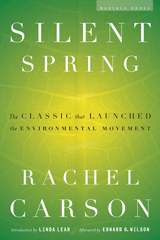
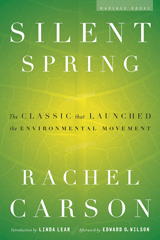
Rachel Carson's Silent Spring (1962) began the popularisation of environmental disaster for political ends. She claimed that DDT, used for malaria control, is killing birds, harmful to humans, and should be banned forthwith. People bought the book in droves. DDT was banned in 1972. The result of the ban was that millions died because of a resurgence in the disease that was formerly being controlled by judicious application of the chemical Carson called a killer. It wasn't. Her book was.
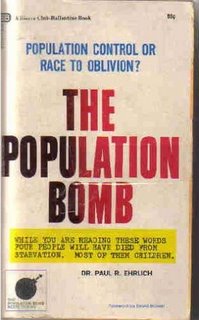
Paul Ehrlich wrote the 1968 best-seller The Population Bomb. Like Thomas Malthus two centuries before him, Ehrlich used shoddy arithmetic to predict a worldwide explosion of population that would see "future generations" stepping on each other's feet all day every day just to survive, and used scary rhetoric about this nonsense to fire up the activists. Fired up they were, and scary indeed were his predictions:
  • Not just millions but "hundreds of millions" would die from "a coming overpopulation crisis in the 1970s," he said, and by 1980 life expectancy in the United States would be just forty-two years.
  • "If I were a gambler, I would take even money that England will not exist in the year 2000."
  • "The battle to feed all of humanity is over. In the 1970s and 1980s hundreds of millions of people will starve to death in spite of any crash programs embarked upon now. At this late date nothing can prevent a substantial increase in the world death rate..."
Nothing except perhaps good sense, hard work and entrepreneurial activity -- and of course the facts. As PJ O'Rourke notes, "Crowded as the country is, is overcrowding even its main problem? Hong Kong and Singapore both have greater population densities (14.315 and 12.347 per square mile, respectively) than Bangladesh, and they're called success stories. The same goes for Monaco. In fact, the whole Riviera is packed in August, and neither Malthus nor Ehrlich have complained about the topless beaches of St. Tropez."

None of Ehrlich's predictions have failed to come to pass -- unless of course you do count the overcrowding of topless beaches of St. Tropz in mid-summer -- but these were not predictions, he now says, they were "scenarios." Despite his abysmal failure as a prognosticator however, the sad old hippy is still tripping over wind chimes and bothering the adults. On the release of Bjorn Lomborg's book Skeptical Environmentalist: Measuring the Real State of the World Ehrlich ranted, "If Lomborg had done some arithmetic, he could have . . . spared us a book as thick as a brick and almost as intelligent." And if Ehrlich had spared us his comment, he might have spared us forming for ourselves the fairly obvious conclusion about himself...

But perhaps Ehrlich was still just pissed off because Lomborg's hero Julian Simon had famously embarrassed him in their 1980 bet on the price of a chosen basket of resources. Ehrlich bet $10,000 and his reputation as an alarmist that the price would go through the roof as resources ran out; Simon bet the opposite. Simon won.
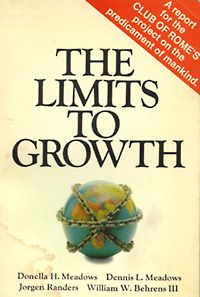
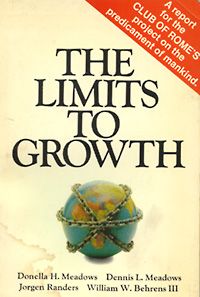
Which leads us on nicely to another failed pack of alarmists and their own contribution to sensationalist history, The Limits to Growth (1972). Like Ehrlich, the Club of Rome had also read Thomas Malthus and had re-used his static arithmetics in the cause of alarmism. You name it, they said, and we're running out of it. "There will . . . be a desperate [arable] land shortage before the year 2000"; we would run short of gold by 1979, they said, of silver and mercury by 1983, of tin by 1985, of zinc by 1988, of petroleum by 1990, and of natural gas by 1992. Um ...

What they got wrong of course was not just their arithmetic, but their whole understanding of the role of price signals and entrepreneurialism -- indeed of the capitalist economy as a dynamic rather than a static engine of production. The capitalist engine of creation is a supple beast when left free and unshackled, allowing human minds to read price signals and opportunities, and to adapt their own resources to suit. The results are astonishing. As Ronald Bailey observed in 2001,
Since the 1970s, the weight of the average car has fallen by 25 percent. Food cans are 50 per cent lighter than they were 50 years ago. A flexible plastic pouch that replaces a steel can reduces the packaging weight by 93 percent. Plastic soda bottles are 30 percent lighter than they were in the 1970s -- which were already much lighter than the glass ones that preceded them. Similarly, plastic grocery bags are 50 percent thinner than they were 20 years ago and lighter than the paper bags they replaced. The invention of the steel frame building did away with structures that needed heavy thick walls to support their own weight.

Functionality is increasing throughout the economy as well—as computers get smaller and faster, air conditioners, refrigerators, furnaces, and all manner of appliances become more efficient and longer-lasting.

. . . [C]orn yields per acre in the United States have more than tripled since 1950. Improving crop productivity is based entirely on technological improvements such as fertilizer, pesticides, and better seeds.
He also notes,
A copper wire can transmit 24 voice channels or about 1.5 megabytes of information per second. Far thinner and lighter optical fiber can transmit more than 32,000 voice channels and more than 2.5 gigabytes of information per second. The first American communications satellite, Telstar 1, was launched in 1962 and could handle 600 telephone calls simultaneously. Modern Intelsat satellites can handle 120,000 calls and 3 TV channels at the same time.
So much then for the three granddaddies of today's scaremongering. Everything about them was wrong, tragically wrong in the case of Carson, but the spectre of their various apocalypses still haunt debate today.
Bidding to joining this prestigious club this week is a new candidate on the scene, a fourth horsemen predicting global apocalypse if Something Isn't Done Now. The already famous Stern Report on Climate Catastrophe is a "bombshell study" was greeted even before its release by a whole Stern Gang of waiting politicians -- it reports We Face Depression If We Don't Act Now! Worse, much worse, Than Even the Great Depression of the 30s! Calamity, catastrophe and 20% of our wealth stripped from our pockets if We Don't Do Something Now! Right Now!!

Guess what? Says Bjorn Lomborg of that headline-grabbing figure:
This figure, 20%, was the number that rocketed around the world, although it is simply a much-massaged reworking of the standard 3% GDP cost in 2100--a figure accepted among most economists to be a reasonable estimate.
In a series of ingenious steps, the modest 3% figure for a century hence if nothing is done now has been "tricked" and finessed and inflated with more imaginary "scenarios" -- Stern, says Lomborg, is "inventing, in effect, a "worst-case scenario" even worse than any others on the table" -- in order to grab headlines and to scream disaster. (And that's just one problem with Stern's report, as Lomborg and others have been pointing out since its release.)

Inventing catastrophe for political effect. What could be more ingenious.

"It's okay to lie," say activists, if you're doing it in the name of a good cause. Is it? Say those same activists: "Bush lied; people died." If it's wrong for Bush to lie, as they claim he has, then why doesn't that work both ways? A founder of Greenpeace Patrick Moore split recently over exactly this issue. "Beginning in the mid-1980s," he says, "Greenpeace, and much of the environmental movement, made a sharp turn to the political left and began adopting extreme agendas that abandoned science and logic in favor of emotion and sensationalism..."
Environmentalism has turned into anti-globalization and anti-industry. Activists have abandoned science in favour of sensationalism. Their zero-tolerance, fear-mongering campaigns would ultimately prevent a cure for Vitamin A deficiency blindness, increase pesticide use, increase heart disease, deplete wild salmon stocks, raise the cost and reduce the safety of health care, raise construction costs, deprive developing nations of clean electricity, stop renewable wind energy, block a solution to global warming, and contribute to deforestation. How sick is that?
Answer: Very bloody sick. Scaremongering sells -- but you don't have to buy it. And neither should you sell it on anyone else's behalf.

UPDATE: George Reisman's in an end-of-days mood, but one of a rather different character to the apocalyptic four. He argues that the Stern Review on Global Warming could be environmentalism’s swan song.

He raises a crucial point about the "action" called for in the report, a similar problem to Erlich's and the Club of Rome's own nightmare "scenarios": Stern simply fails to understand that a capitalist economy is a dynamic, not a static entity. Stern declares that disaster and hellfire and that depressive 20% drop in wealth production will be the inevitable conseqences of "not acting," but as Reisman points out,
Sir Nicholas’s use of the words “don’t act” is very misleading. What he is urging when he speaks of “action” is a mass of laws and decrees—i.e., government action. This government action will forcibly prevent hundreds of millions, indeed, billions of individual human beings from engaging in their, personal and business private action—that is, from acting in ways that they judge to serve their own self-interests. Thus, what he is actually urging is not action, but government action intended to stop private action.
LINKS: Hooray for DDT's life-saving comeback - Africa Fighting Malaria (AFM)
Julian Simon's bet with Paul Ehrlich - Overpopulation.Com
Dematerializing the economy: We're doing more with less. That's good for Planet Earth - Ronald Bailey, Reason Magazine (2001)
Stern review: The dodgy numbers behind the latest warming scare - Bjorn Lomborg, Wall Street Journal
How sick is that? Environmental movement has lost its way - Patrick Moore, Greenspirit

RELATED: Environment, Global Warming, Conservation, Economics, Politics, Politics-UK