Showing posts with label Rodney Hide. Show all posts

Monday, 9 March 2026

New blog: Brash + Mitchell

There's a 'new' blog in town, and it's called Brash + Mitchell.

It's not entirely new, of course. With the thankful departure of Michael Bassett and Rodney Hide, their old blog of Bassett, Brash + Hide has become Brash + Mitchell -- that's Don Brash and Lindsay Mitchell to you.

I have no idea why Bassett and Hide departed, but I'm glad they've gone. 

Without them we might expect the blog to be both more principled, less self-congratulatory -- and certainly less wet. 

And since Lindsay Mitchell's solo blog is so criminally under-read, here's hoping her writing will attract a much wider audience.

I commend it to your attention:

Monday, 11 August 2025

15 YEARS AGO: Here's how Key helped fuel the gravy-train

One advantage of having blogged so long is having written about so many things.

One disadvantage of having blogged so long is watching things you've warned about being ignored.  Here's from 2010, with Eric Crampton's warning in particular now looking especially prescient....

AS YOU MAY HAVE NOTICED, the Government you voted for has signed you up to the UN Declaration on the Rights of Indigenous Peoples—something Helen Clark herself was opposed to, citing fears it would create “two classes of citizenship and … give indigenous people veto rights over laws made by Parliament.” 

But we already have two legal classes of  citizen, don’t we—something confirmed by Doug Graham when, as Minister in Charge of Treaty Capitulations, he told taxpayers, “The sooner we realise there are laws for one and laws for another, the better." 

So one law for all is officially dead. Pita Sharples grand-standing announcement merely throws another shovelful of dirt on that particular colour-blind aspiration. 

Instead, we now have another aspiration. One endorsed by your government without any conditions whatsoever, despite John Key’s insistence that the Declaration itself is “aspirational and non-binding.” 

Now naturally, Hone Harawira and co have a different view.  Hone has already been on radio insisting the Declaration will be used to support a gravy train of claims for other people’s property, and for truckloads of taxpayers’ money—and one suspects he speaks for many others when he says that, including those who will sit in judgement on such claims. 

And Mai Chen, eager to get in on the gravy, insists the declaration will “have an impact.”

   "‘Declarations … are international obligations and they do form part of the backdrop, the context within which courts do interpret, but it's not just courts its the Waitangi Tribunal and its also direct negotiations… [T]he entire country would appear to fall within the scope of the article, and [the text of the Declaration] generally takes no account of the fact that the land might be occupied or owned legitimately by others.’ 
    “Ms Chen said the Declaration would 'shape Maori expectations in negotiations.”

And the Declaration itself begins by affirming its “good faith in the fulfilment of the obligations assumed by States in accordance with the Charter.” 

So one suspects that this government signing up to the Declaration is going to involve more than just a little “aspirational” window-dressing. 

SO WHAT DOES IT CONTAIN,THIS DECLARATION? It should be no surprise to find that a UN Declaration with “rights” in the title contains a welter of manufactured “rights” that trample over genuine rights And if it were simply an enumeration of genuine rights—rights to life, liberty, free speech, the pursuit of property and happiness—it would hardly need the modifier “rights of indigenous people” added to it, as if by virtue of their indigeneity some individuals are more endowed with rights than others. 

As if to confirm that, The Declaration’s preamble talks about being “the basis for a strengthened partnership between indigenous peoples and States”—affirming as clearly as one could that “there are laws for one & laws for another.” 

It speaks of affirming to “peoples their right to self-determination”—ignoring that such a right pertains only to individualsnot to a collective

And the Declaration itself outlines specific “rights” which it says shall be upheld by “the States” which have affirmed it: 

  • “the right [of indigenous people] to freely determine their political status”

Which “right” is a recipe for separatism.

  • “the right to autonomy or self-government in matters relating to their internal and local affairs”

Which “right” is a guarantee that separatism will be upheld by “the State.”

  • “the right not to be subjected to forced assimilation or destruction of their culture… States shall provide effective mechanisms for prevention of, and redress for [this]”

Which “right” requires the State to subsidise for ever whatever parts of indigenous culture claimants will assert are being destroyed.

  • “the right to belong to an indigenous community or nation, in accordance with the traditions and customs of the community or nation concerned”

The “right” to subsidised separatism, in whatever form of tribalism that will manifest itself.

  • “the right to revitalize, use, develop and transmit to future generations their histories, languages, oral traditions, philosophies, writing systems and literatures, and to designate and retain their own names for communities, places and persons.”

A “right” to the subsidised education of tribalism and mysticism, and to the re-naming of New Zealand.

  • “States shall … take effective measures, in order for indigenous individuals, particularly children… to an education in their own culture and provided in their own language.”

The “right” to kohanga reo for ever.

  • “the right to establish their own media in their own languages”

The “right” to Maori TV for ever.

  • “the right to participate in decision-making in matters which would affect their rights, through representatives chosen by themselves in accordance with their own procedures, as well as to maintain and develop their own indigenous decision-making institutions.”
  • “States shall consult and cooperate in good faith with the indigenous peoples concerned through their own representative institutions in order to obtain their free, prior and informed consent before adopting and implementing legislative or administrative measures that may affect them.”

The explicit creation of two classes of citizenship, and the “right” to veto that Helen Clark was so concerned about.

  • “the right … to the improvement of their economic and social conditions, including, inter alia, in the areas of education, employment, vocational training and retraining, housing, sanitation, health and social security. 
    States shall take effective measures and, where appropriate, special measures to ensure continuing improvement of their economic and social conditions…”

The “right” to special racist welfare. 

  • “the right to maintain and strengthen their distinctive spiritual relationship with their traditionally owned or otherwise occupied and used lands, territories, waters and coastal seas and other resources”

The “right” to dream up a new basis of land claim for any part of New Zealand whatsoever.

  • the right "to own use, develop or control lands and territories they have traditionally owned, occupied or used"

As New Zealand's former permanent representative to the UN, diplomat Rosemary Banks, says “the entire country was potentially caught within the scope of that article. ‘The article appears to require recognition of rights to lands now lawfully owned by other citizens, both indigenous and non-indigenous ... Furthermore, this article implies indigenous peoples have rights that others do not.’"

  • “the right to redress, by means that can include restitution or, when this is not possible, just, fair and equitable compensation, for the lands, territories and resources which they have traditionally owned or otherwise occupied or used, and which have been confiscated, taken, occupied, used or damaged without their free, prior and informed consent.”

Providing the basis for a whole new cycle of claimants to ride a new gravy train. 

I COULD GO ON, BUT I suspect you already get the point. 

This is simply a whole litany of bogus “rights” with which the Hone Harawiras and Tame Itis of this country will have a field day.  For them and their lawyers, this is like Christmas in April. 

The affirmation of these bogus rights is John Key writing a blank cheque on taxpayers to buy the Maori Party for a generation. And just in case you think this isn’t the sound of someone putting their hand in your pocket, take a look at Article 39

    “Indigenous peoples have the right to have access to financial and technical assistance from States and through international cooperation, for the enjoyment of the rights contained in this Declaration.”

The Declaration is nothing less than a manifesto for subsidised separatism. 

As Ayn Rand said of a similar list of entitlements “rights”: 

    “A single question added to each of the above eight clauses would make the issue clear: At whose expense?     “[These so-called rights] do not grow in nature. These are man-made values—goods and services produced by men. Who is to provide them?     “If some men are entitled by right to the products of the work of others, it means that those others are deprived of rights and condemned to slave labor.     “Any alleged "right" of one man, which necessitates the violation of the rights of another, is not and cannot be a right.”

Take note here that “The State” itself has no money of its own—every dollar must first be taken from others. The bogus “rights” affirmed here, to which New Zealand is now a signatory, require of taxpayers that they provide a cradle-to-grave ATM machine for whatever tribalists want, including the property of taxpayers, creating “two classes of citizenship and … giving indigenous people veto rights over laws made by Parliament,” just as Helen Clark feared it would. 

One law for all is officially dead. 

And parliament’s One-Law-For-All party?  The party propping up a government giving tribalists more even than Helen Clark was prepared to? What about them? Fear not, punters, for fearless leader Rodney Hide says the Declaration and the secrecy with which it was announced “is not a deal-breaker." 

Given what ACT supporters have already swallowed, one wonders if anything ever would be.

NBEric Crampton sees informative parallels “between New Zealand signing on to the UN Declaration on the Rights of Indigenous People and Canada's constitutional wranglings over Quebec as a'"Distinct Society'." 

Wednesday, 30 April 2025

ACT leader whimpers about ACT leader

ACT LEADER DAVID SEYMOUR IS outraged that Auckland Council plans to set up a co-governed committee to manage the Waitākere Ranges. "Auckland Council’s plan to set up a co-governed committee to manage the Waitākere Ranges shows why Kiwis need councillors who believe in democracy," says ACT Leader David Seymour.

Democracy.

“The Waitākere Ranges belong to all Aucklanders [says the ACT leader] and should be managed democratically. But Auckland Council’s plan would see unelected decision-makers closing tracks and dictating land use in the surrounding rural areas."

Dictating.

“The ranges are governed under the Waitākere Ranges Heritage Area Act," notes the ACT leader. And the Waitākere Ranges Heritage Area Act calls for a "Deed of Acknowledgement" recognising and giving power to tangata whenua. If the ACT leader has a problem with the Deed of Acknowledgement and the giving of power then — since it's the Waitākere Ranges Heritage Area Act that requires the acknowledgement and gives such power — then it's the Waitākere Ranges Heritage Area Act that he has a problem with.

One can only imagine that the ACT leader then was just as outraged.
Minister for Local Government, 2008-11

Except ... it should be further noted that the Waitākere Ranges Heritage Area Act was introduced by the Minister for Local Government in 2008, and brought into law in April 2008. And that ACT leader was himself Minister of Local Government for three years from 2008 to 2011, in which he had ample opportunity to amend the Act.

He didn't.

Ample opportunity to restrict the powers of  local government to those in which it enjoyed a "general competence."

He didn't.

What did he do instead?

Oh, that's right. He spent his time, ego, and rapidly dwindling political capital on super-sizing Auckland's already tumescent council, all but ensuring citizens' rates bills would be equally super-swollen.

Dictating to Aucklanders how their "democracy" would work.

Local government in New Zealand exists because central government created it, and grants it powers. Instead of drastically shrinking the power of local government, as an ACT leader should have done, that ACT leader instead awarded this super-sized council many more. Including the power — nay, the necessity — to set up a co-governed committee to manage the Waitākere Ranges. 

It's a bit late now to watch this ACT leader whimpering about it.

Friday, 9 February 2024

3 questions for a regulatory reform minister


So let's say you're a minister in a reforming government, a rare enough beast. And that you're someone who has both the job and the intention of reforming regulations. (An even rarer animal in any political environment!)

Economist Jon Murphy offers 3 simple questions to guide your work. And they start with Ronald Coase ...

As many economists have been pointing out since at least Ronald Coase’s famous 1960 paper 'The Problem of Social Costs,' we exist in a complex world of pre-existing social, economic, legal, and legislative arrangements. These arrangements influence our actions. Like Chesterton’s Fence, we cannot pretend they do not exist, nor discard them because we do not understand their purpose.
    And yet, many interventionists do ignore current arrangements.
Many interventionists simply load new intervention upon old intervention, assuming either the new intervention will fix the unintended consequences of the old intervention — or, worse, ignoring altogether that the old interventions exist!

But let's assume our political reformer is honest as well (an even rarer beast in politics!) Then your first question would be:
Question 1: What is the current state of affairs?

... Of course, it is impossible to articulate every single aspect of the current state of affairs. Rather, one should focus on the most salient (eg, direct laws, institutions, etc). ... There are all sorts of preexisting arrangements that influence [affairs]. These preexisting arrangements, as Coase pointed out, are crucial. If they are misunderstood, then interventions can make the situation worse.
    Answering this question also helps understand why existing patterns are what they are.
As Hernando de Soto liked to point out, if you see people doing insane things, then that's your clue there are some bad laws against which people are trying to just do their best. Talking about the developing world's shanty towns, for example, he pointed out it's no surprise that folk there tend to build their furniture before their roof: the reason being that the laws give them no chance to get secure land title, so their lounge suite will always be more secure than their shelter. People respond to incentives, even if bad law only encourages shitty ones.

Which leads us to the next question.
Question 2: Why have pre-existing arrangements failed?

If the answer to Question 1 leads one to conclude that there is indeed a failure, now we need to understand why that failure has occurred. Is there something about the current state of affairs that triggers that failure? What are the actual causes of the failure? What are the incentives people face?
Understanding those shitty incentives is the key here. And Do Soto's example is still on point: we should assume that people making apparently bad decisions are acting rationally. It's not they are irrational; it's the incentives they face that are irrational. So, in our example, our reforming political animal should examine  how poor property rights protection encourages these poor property decisions.

Here at home, he could do worse than start with the bad outcomes of the RMA and the Building Act.

And then consider ...
Question 3: Is your proposed solution the best method achievable?

Hopefully, by this point, [our enlightened political beast] has a pretty good understanding of the current state of affairs. Now is the time to start considering proper interventions. Note that this question actually has two elements to meet: 
  1. the intervention is the best method to achieve the goal, and
  2. the intervention is achievable.
... What is "best" may not be a positive intervention (meaning that one takes a new action) at all. Indeed, while investigating Questions 1 and 2, one may discover that the best thing to do is remove an existing intervention! 
Given the encrustation of existing legislation and regulation, that would be an enlightened first option.  
The second element relates back to our first question. Whether or not some intervention is achievable will depend on the current institutions. ...
And more crucially, will depend on the principles and political agility of the reformer, and the support they can garner for their goals.

My own suggestion would be to always head in the direction of more freedom, however small the increment, just as long as there is no new impediment to freedom imposed. That would be a principled, practical approach to reform. More white with no new black.

Or set off one or two small steps that would self-initiate many more, such that the liberating process might be unstoppable. (This was Hernando De Soto's approach with title registration in South America.)

We've seen more than one pinstriped "reformer" end up preening their ego rather than doing the work. But if the reformer's motivation were to remain sound, great things could be achieved even in small steps.

Tuesday, 29 November 2016

No new parliamentary building for MPs, says NOT PC: Make room downtown instead


Parliament-560x317

Some years ago back when Rodney Hide was busting perks rather than enjoying them, he busted the government’s plans for a new parliamentary building that was going to cost taxpayers millions. (This may be the only service he ever performed for the country.)

The plan to give hundreds of millions of taxpayer dollars to Wellington builders and interior designers didn’t disappear like his morals, however, it just slumbered. And with the lease on  Bowen House soon to expire, Sleeping Beauty has been dusted off – this time with the boast that it will cost “only” $100 million this time. Plus cockups.

Naturally, the Government’s David Farrar is big on the boasting, arguing it’s better not to pay foreigners $6 million a year to rent Bowen House to house MPs, and to build big instead. A commenter there identifies the false alternative however, and with it calls the National blogger’s bluff in a way that saves us both costs: given that National had promised to slash bureaucrat numbers, surely it’s better to use one of the many government buildings that should now be sitting empty for lack of staff to fill them? And if there are not, then why not.

And since we know that rather than slashing numbers as promised the Key Government has instead raised them, perhaps some genuine opposition to the government could extract some sort of a promise from them: that instead of either building big or renting again, that it has until the Bowen House lease expires to find office space in Wellington by laying off enough surplus staff to make room for Bowen House’s soon-to-be ex-tenants.

Tick tock.

PS: If anyone thinks the cost of building for MPs is ever cheap, they need to read (or re-read) the story of Europe’s most costly building of its size ever constructed. Situated in Westminster and connected by tunnel to its parliamentary host, just like Bowen House, the cost of Portcullis House became so rapidly inflated by all the extras that British MPs desired for themselves that the palace was built (eventually) at a cost of £1.2m for each MP.

And they’re still suing.

[Pic from the Government Blogger]

[Pic from.

Thursday, 18 August 2016

When did homes start becoming unaffordable?


When did homes start becoming unaffordable? Good question.

From 1957 to the late-1980s the median New Zealand house price was between two-to-three times the median annual household income. Back then they were affordable.(A city’s housing affordability is generally defined as having the median house price less than or around three times the median income.)

By the late 1990s, the average house price had already risen to four times the average household income, and houses began becoming inexorably unaffordable.

It wasn’t until 2008 however that headlines began happening and home-buyers became seriously worried, as prices peaked at a seriously unaffordable six and a half times the median household income in 2008.  

Houses11

They peaked in other places. But in Auckland they just kept on going up. In Auckland now, they’re rapidly approaching a severely unaffordable ten times the median household income.

Houses14

If you're paying for your house out of your average income, I think you'd agree that's a very rapid rise into the territory marked as "severely unaffordable."

Great if you’re a home-owner.

Murder if you're not.

So what happened in the 90s to begin that tick up into unafforability?

Well, the 1992 Building Act is one. Far from being deregulation, as some still risibly claim, it implemented a new multi-volume building code, a new building bureaucracy, and an ageing and failing superbureaucrat to oversee it all. He failed very soon, as it happens, but we are left with the rotting bureaucratic system he left us that adds months to a consent preparation and application, and many thousands to the building cost of every house. (And as costs became higher and profits lower, fewer spec builders bothered to even try building-to-sell the new houses they had previously.)

Another thing that happened in the 1990s was National’s Resource Management Act, introduced by Simon Upton and then administered without change by Nick Smith (yes, children, that Nick Smith now insisting he must change it), an Act that brought about the greatest attack on property rights since the war and, with it, the most severe restrictions on the supply and use of building land ever seen before in this once nearly-Freeland.

So those are two reasons for home-buyers to weep right there. (Three, if you include the thought of Nick Smith.)

And what happened in Auckland around 2011? If you answered “Rodney Hide’s super-fucking-bureaucracy began really kicking in,” I reckon you might just get the prize. The new super-bureaucrats have made the city more expensive, building more difficult, and planning a development infinitely more uncertain – especially with the six-year process of implementing their Unitary Plan, which has created tremendous regime uncertainty1 among property owners and investors.

Even with an earthquake that destroyed most of its inner city and eastern suburbs, Christhurch has done better – which makes Rodney Hide’s amalgamation a bigger bloody housing disaster than their earthquake.

Auckland2

And while the city has always been ring-fenced by the central planners, it is only perhaps in the last few years that the ring-fence has become a serious constraint – one that the new Unitary Plan is reported to retain!

The story remains that unaffordable cities are generally cities that are constrained from building, and constrained from expanding.

More tomorrow.

NOTES:

1. Regime uncertainty is a concept developed by Robert Higgs describing a pervasive lack of confidence among investors in their ability to foresee the extent to which future government actions will alter their private-property rights.
    Higgs uses this concept to explain the seriousness and prolonged duration of some economic crises, like the Great Depression or the current 'Great Recession.‘
    According to Higgs, regime uncertainty explains at least in part the sluggish pace of the current economic recovery.
    Regime uncertainty pertains to more than the government's laws, regulations, and administrative decisions. For one thing, as the saying goes, "personnel is policy." Two administrations may administer or enforce identical statutes and regulations quite differently. A business-hostile administration [such as Len Brown’s] will provoke more apprehension among investors than a business-friendlier administration [sorry, can’t think of one], even if the underlying "rules of the game" are identical on paper.

.

Tuesday, 3 November 2015

Rodney Hide still defending the indefensible

_RodneyHoodHe’s back: The man who sold out a city's ratepayers for the sake of ministerial power, and all-but destroyed a political party in the process.

Rodney Hide took all of ACT’s declining credibility and bet it on the losing horse of super-sizing Auckland council amalgamation—so bad a bet he had to leave the city, ashamed to show his face in front around the ratepayers he shat on. Yet he’s back this week, flogging that same dead horse, telling punters in the face of the abundant evidence to the contrary appearing in every spiralling rates demand they receive that “nothing has changed,” and at the same time that all the changes are “under the hood.”

Apparently service is better, infrastructure is better, bylaws are better, and now every new home has a pony. Sadly, there are nowhere near enough new homes. Partly because of the planners’ plans being written by Rodney’s super-sized and wholly unaccountable council planners…

Housing affordability measures are an excellent ‘test’ of how well local government is performing and coping with growth [points out Hugh Pavletich] …
    Around the time of the Auckland Councils amalgamation, 3rd Qtr 2010 data ( 2011 7th Annual Demographia Housing Survey) shows that Auckland housing was then 6.4 times household earnings …

    http://www.demographia.com/dhi2011.pdf

    … and by the 3rd Qtr last year, as this year’s 11th Annual Demographia Housing Survey illustrates, Auckland housing had hit 8.2 times household earnings …
   
http://www.demographia.com/dhi.pdf
    … with Auckland’s housing inflation exploding these past 12 months by 25.4% from a median price of $615,000 through to $771,000 … near 10 times annual household earnings.
    What this means is that the young couple on say $100,000 a year could expect at the time of amalgamation to pay $640,000 to house themselves … but now it is close to a million dollars.

As commenters say in replies to the odious prick’s self-serving Herald puff-piece

image

image

image

Rodney Hide sold the idea of super-sizing council as delivering smaller council, greater efficiencies and lower rates. Every promise has proved disastrously wrong. The myth-making continues: “We didn't just push eight councils together,” says Hide. “We disestablished eight councils and built a new one. Nothing like it has ever been attempted in Australia or New Zealand.”

Well, yes it had been tried before: in Brisbane. And in Adelaide. And just like Auckland’s council amalgamation, they were disasters.

And it had been tried before in New Zealand, by Michael Bassett, delivering the same result as this amalgamation: not disestablishing eight sets of councils and their staff, but building a whole new set of council parasites on top – with egos, power-trips and huge rates bills to match.

Hide has learned nothing and forgotten everything.

If he had simply remained as the perk-buster who turned poacher he could have simply remained just another political joke. That he instead had the power-trip that saddled us with Len Brown’s super-shitty super-sized council bills means he deserves only contempt.

I suggest you punch him next time you see him. Punch him hard.

RELATED POSTS:

Monday, 10 August 2015

PCP

“When I was young
PC meant ‘Police Constable.’
Nowadays, I can’t seem to tell the difference…”

- Manic Street Preachers, ‘P.C.P.

“…political correctness: that strange, nebulous world of safety and
compliance that seems to be binding us all in hoops of steel at the moment.”

- Stephen Fry

Well-meaning young folk offended by Donald’s Trump’s offensiveness have latched onto his attack on political correctness, saying “political correctness is a phony idea,” that it doesn’t really exist as a concept – that being “sorry for being un-PC" is simply “a way to shift the responsibility for one's bigotry.”

Well, they might be right about Trump. (Although there are many, many more reasons than this one to revile the man as a candidate.) But there is nothing phony or non-existent about about the concept political correctness. It is real, it exists, and it is a vile shackling of free speech: at the same time a system of self-imposed pre-digested opinion with a voluntarist imposition of silence – “Systemised atrocity ignored, As long as bi-lingual signs [are] on view.”

Since they may be too young to remember when it first emerged, here’s a documentary to explain it.  You can tell how old it is because the bloke presenting it is holding a pipe.

Here’s Stephen Fry on Spooks and political correctness. Yes, that sentence makes sense. It’s the concept that doesn’t.:

PS: ‘NOT PC,’ Friday, November 04, 2005

Political Correctness: A classic documentary now online

I thought it was time that a classic documentary on Political Correctness was taken out and dusted off: a forty minute radio documentary put together by Lindsay Perigo and Deborah Coddington for BBC World Service Radio just over a decade ago [that’s twenty years ago now!]. (I've transferred it to MP3 and put it online, with links below.) How far have we come since then?
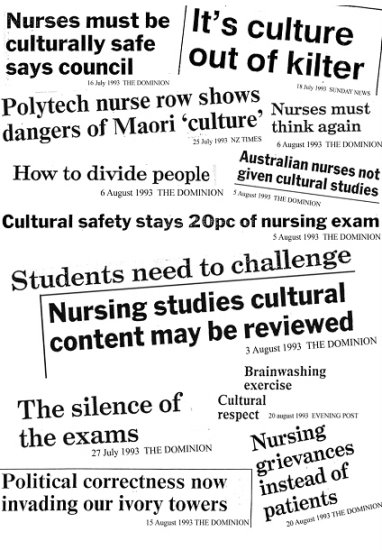
    The documentary covers the origins and effects of political correctness, the local and overseas manifestations of the phenomenon, and of course takes the piss out of PC whenever possible. The case of Anna Penn is discussed (Penn, if you recall, was the trainee nurse failed for being 'culturally unsafe' -- ahem, 'deficiency-achieved' -- in 1993, despite having a 92% average in the rest of her course) and there is also commentary from and interviews with luminaries such as journalist Carol du Chateau, economist and commentator Walter Williams, then-lecturer Rodney Hide, scientist and former Professor Robert Mann, and philosopher Gary Hull.
    Hull points to post-modernism and its relativist, deconstructionist cousins as being responsible for political correctness. Says Williams, the corruption of language that political correctness demands brings to mind George Orwell's important point in 1984, that "to introduce totalitarianism into society, you first have to corrupt the language."
    How far have we come since 1993, and how much closer to 1984? You decide.

Monday, 20 July 2015

Surprise: I agree with Martyn Bradbury

How often is it possible to agree with a Martyn Bradbury post?

For me, it’s never happened before. Then astonishingly, over the weekend, I went from zero to two in as many minutes.

First when he attacked the outrage of private prisons – “If you voted National or ACT at the last election, you voted for this [“fight club”] atrocity at Serco.” And so you did. You voted for the ultimate in cronyism: the actual privatisation of force, with all the temptation to corruption and abuse that goes with it. The moral argument against private prisons is that the concept puts the gun in the service of the dollar. The practical argument is that it puts profits at the whim of bureaucratic management. The necessary outcome of both is what we now see in your headlines.

My second agreement with Bradbury was his defence of someone we both loathe, “but no one, not even Rodney Hide deserves to be treated like this…” Rodney’s story of state harassment suggests the surveillance state is already taking its powers so much for granted it doesn’t bother them who they bully, and for what.

You won’t hear me say this often, and maybe never again, but you should probably read both of Martyn Bradbury’s weekend posts:

RELATED POSTS:

Wednesday, 10 June 2015

So why would you want to amalgamate councils anyway?

There are many lessons that could be drawn from super-sizing Auckland’s council. I’m astonished that one of them from different parts of the country is still “let’s do that too.”

What? Are they blind?

Sure the bureaucrats’ bureaucrats at the Local Government Commission are always going to want more power for bureaucrats. Why wouldn’t they?

But why would a ratepayer, a home-owner, a would-be builder (to take just a few) want to replicate in their own places the disaster Rodney Hide and John Key bequeathed to Auckland?

So thank goodness that the push to amalgamate councils around Northland and Wellington are off the table. For now.

So it’s just Hawkes Bay that’s currently under threat – where plans will proceed “unless 10% of a current Council’s population call for a referendum.” (Get onto that people. Now.)

Aucklanders were sold the Super-Sized City on the basis of promised "efficiencies" and putative cost savings. That canard should be shoved back up Rodney Hide’s arse along with Aucklanders’ pole-vaulting rates bills.

Auckland’s cost blow-outs are only a symptom of the big problems with amalgamation. Here’s one problem that’s compounded by amalgamation: The oxymoronic “power of general competence” granted all councils by the 2002 amendments to the Local Government Act, enabling already over-extended bureaucrats and planners to expand into new areas totally outside their limited areas of competence.a big cause of all the rest.

And that, with amalgamation, unleashed a major power: the Power of Big Egos.

imageLet me tell you a story about that. Let’s go back to 1985, before Michael Bassett amalgamated borough councils, and you want to add a carport to your house.You go to your local borough council office, talk to a chap or chappess who knows your street and can virtually tell you then and there what you need to do, and what council’s decision will be.  If you’re not already talking to the chap who will be making that decision, that person is probably only one office away – and you can talk to them if you want.

Fast forward to 2005, and the chap or chappess you’re talking to barely knows your street, and the person making the decision is on the next floor – and you can talk to them, maybe if you make an appointment. See, that person is suddenly “important.” And they do a lot of meetings.

And now, in 2015, and you want to add a carport to your house … you talk to someone with no knowledge of your area, little knowledge of your issue, no ability to make a decision – and the person actually making the decision is on the top floor. They’re “very important.” They write policy. They have meetings. They attend conferences – many of them. And they’re a whole new layer of parasites on top 0f the layer that began emerging after Bassett’s blunder.

These are people with egos. Real egos, with salaries and well-appointed corner offices to match.

And egos don’t build or restore multi-million-dollar infrastructure; they build multi-billion dollar monuments – and then have the arrogance to send you the bill.

Instead of “rolling out” more super-sized councils, we should instead be dismantling the one we have.

RELATED POSTS:

Tuesday, 17 March 2015

Entitle-itis starts at the top

There are few things all MPs can agree on. Keeping up their taxpaid international travel perks for life is one of them.

image

Tau Henare and Trevor Mallard might punch each other out in their spare time, but when it comes to full wallets out and the threat their pork might stop flowing they’re like blood brothers.

image

The sense of entitlement of the country’s most highly-paid beneficiaries crosses all parts of what passes for a political spectrum -- Ministers are 'entitled' to dip into tax purse, said Rodney Hide when taking his then mistress to London; “It's something I'm entitled to,” wailed Roger Douglas when sprung milking the taxpayer for multiple trips abroad to see grandchildren.

So what did the Greens do to upset the apple-sauce cart?

Did they suggest this plunder should go? Did they propose it be stopped altogether? Or be limited only to those currently in parliament

No, they agreed taxpayers should pick up MPs tab for life; they merely suggested the amounts be somewhat limited not be increased.

Because there’s one thing all MPs can agree on, both past, present and future – and that’s that the trough is there for their snouts.

For life.

And face with an opportunity to cut the crap, or even make a stand on principle, newish MP and new Labour leader Andrew Little, who could have argued he hadn’t been responsible for the rort, instead elected to blow whatever chance he had of taking some moral high ground this morning with a fumbling, mumbling defence of the iniquitous status quo.

Because there’s one thing on which all MPs can agree: they’re entitled.

Wednesday, 25 February 2015

“Turning to social liberalism, the issue I would suggest ACT focuses on is voluntary euthanasia.”

David Farrar was asked to talk to last weekend’s ACT conference on how ACT might gain more voters to increase their representation in parliament and decrease their reliance on the Epsom electorate?

Mark Hubbard will be pleased…

…I think a clear message of opposition to most forms of corporate welfare has potential appeal to not just economic liberals on the right, but also to many on the left. It would make it hard for the left to paint ACT as the party of big business, if they are signing up to your campaigns against corporate welfare.

Turning to social liberalism, the issue I would suggest ACT focuses on is [voluntary] euthanasia. Is anything a more fundamental human right than being able to choose between quantity of life and quality of life?
    This is not some abstract issue. Sadly for many families, they have been through the horrors of a loved one who was unable to make an informed choice to reduce their suffering.  I actually used to be against euthanasia until I listened to the speech Rodney Hide made in 2003 about the death of Martin Hames. It reduced me to tears and made me realise how harmful the current law can be, and converted me to favouring a law change.
    It is an issue that is both very real to many, but also very popular. The last public poll on this issue saw 61% in favour of terminally ill people being able to choose when to end their lives and only 18% opposed. A 3:1 ratio in favour is about as good as it gets.
    Labour has banned their MPs from advancing this issue, because it may distract them from their core mission of getting more people to join a union. National MPs are discouraged from doing bills on conscience issues. In fact I think National discourages their MPs from doing any bills that haven’t been written by Chris Finlayson for them. The highlight was the West Coast MP’s bill on reforming the law of habeas corpus.
    NZ First are generally against euthanasia, except for immigrants. The Greens are admirably supportive, but the suspicion is they see it as a way to reduce carbon emissions. 
    More seriously there is an opportunity for ACT here to lead on this issue, and connect to New Zealanders on an issue that resonates, as well as clearly position themselves as the only party not wanting the state to interfere in decisions that belong to individuals.

Tuesday, 2 December 2014

Auckland grandomania ever-more costly for ratepayers

ACT leader David Seymour has written a great short piece in the Herald attacking Auckland’s “Super-Council” for its debt, over-spending and rates rises.

Auckland Council needs to stop and take a breath, he says, citing its vote

by a narrow majority to impose grotesquely large rate increases on thousands of Auckland's ratepayers. The increases are staggering: 126,000 households will face increases of 10 per cent or more, 25,000 of 20 per cent or more, and almost 4000 of more than 40 per cent…
    The increased pressure on rates is largely due to three factors: setting the Uniform Annual General Charge (UAGC) at far too low a share of rates revenue; not having a gradual transition to a property value basis for rating; and … what is perhaps our biggest challenge - the council's spending surge.
    Grandiose spending plans are driving projected rate rises of 4-5 per cent a year to 2022. The draft annual plan has capital expenditure running at more than 10 per cent a year from 2017 to 2020.
    The council's debt level is set to nearly triple in just 10 years, rising from $4.8 billion to $12.5 billion by 2022. And who could possibly believe there won't be cost-overruns pushing this even higher?
    What happens if interest rates rise more than expected?
    Last month, international ratings agency Standard & Poor's put Auckland Council's 'AA' long-term credit rating on negative watch because of concerns about rising debt.
    And remember, the rating is only 'AA' because ratepayers are on the hook for whatever might happen.
    When you're in a hole, you should stop digging. This council is instead digging all the more furiously.

All very good and valid criticism.

And all fatally weakened because every reader sympathetic to his viewpoint will remember how we got this over-spending “Super Council” in the first place – a process in which grandstanding former ACT leader Rodney Hide delivered a grandiloquent super-bureaucracy over which a mayor would have significant executive powers to a mayor infected with grandomania.

Which suggests a grand old problem for this latest ACT leader to get his head around. He must at some stage either repudiate the many failings of that previous leader, or remain silent for evermore on the many and catastrophic failures of this  “Super-Council” Hide bequeathed upon us.

Which is not a position a diligent Epsom MP can really take.

Thursday, 18 September 2014

The All-New, 100% Pure, Official 2014 Liberty-Lover’s Voting Guide [update 2]

Every MMP election you have two votes, and two questions: to whom should I give my party vote, and to whom should I give my electorate vote.

Well, three questions really, the this being: should I vote at all?

My default answer to this is always: don’t vote, it only encourages the bastards.

My default position on voting has always been not to vote for bastards. To vote only to vote for what I believe in. Voting for the lesser of two evils still results in evil. And voting against a greater evil just results in the folk you’re voting for ruling with the help of your blank cheque, and their pathetic claim for your mandate.

For every election since 1996, liberty lovers  been able to give their party mandate to something they could believe in, but now that option is gone I personally had been intending to stay home.

I’d been intending to stay home until I became bowled over by what I like to call New ACT.  Especially by their promise, finally, to abolish the RMA and replace it with common law.

Old ACT deserved to die. But David Seymour and Jamie Whyte are for once genuine liberty lovers, and Jamie Whyte has done an outstanding job of promoting policies that any liberty lover can get behind. I gave him four out of five; Liberty Scott gave them 8 out of 10. And as Lindsay Mitchell notes

There have been so many polls I missed the Colmar Brunton poll that has ACT on 1.2%.
That'll do it. I feel I can safely give them my party vote without wasting it.

To the incredulity of many of you who’ve read me tearing strips off this party for 18 years – and, truth be known to my own incredulity as well -- I’m now intending to do the same. I think you should too.
[UPDATE 1: Lindsay Perigo draws my attention to ACT’s 5-point plan now resiling from abolishing the RMA, and retreating back the weasel word of “reform.” Since driving a stake through the heart of that Act is my litmus test for a party’s support for property rights, my own personal bottom line, I’m now wavering from lending them my support until I have that clarified.
UPDATE 2: Clarification here.]

But what about your electorate vote?

Every election the irrepressible Liberty Scott offers readers the official rooting, tooting all-shooting liberty-lover voter’s guide to how to fill out your electoral ballot, with which I only ever have minor quibbles. (Mostly because he’s too nice to the bastards.) Same again this time except for two minor caveats.

First, given all National has done to Christchurch, if any Cantabrians even consider voting National they can quit moaning for ever about the state of their city.

Second, there’s no point recommending votes for the racist seats. The only thing to recommend there is abolition.

So with that done, let’s take a deep breath and dive right in …

Liberty Scott's 2014 New Zealand voting guide for lovers of liberty (IN PROGRESS)