Showing posts with label Rodin. Show all posts

Tuesday, 5 April 2016

‘Fugit Amor,’ by Auguste Rodin


9867f0db1e56d32bb8a78f7d1dfa6778

"Fugit amor" is the Latin for fugitive or transient love…

Capture

The Rodin Museum explains the piece:

‘Fugit Amor’ is without question one of Rodin’s most beautiful compositions: the two straining bodies are combined in one perfect flowing movement. This two-figure group, which appeared twice on ‘The Gates of Hell,’ [depicting figures from Dante’s ‘Inferno,’ and] was exhibited as an independent work from 1887 under the names ‘The Dream’ and ‘The Sphinx,’ which show how closely it related to the Symbolist aesthetic of the enigmatic woman.  
    In the second circle of Hell, Dante describes the eternal wandering of couples bound by their sin of forbidden love, [the two depicted here being Paolo & Francesca,] to which Rodin added a Baudelarian theme.
   This sculptural interpretation of the fantasies and anguish of Rodin’s generation was a huge success, so much so that numerous versions in bronze and marble now exist.

Fugit_Amor,_Auguste_Rodin,_1881_(17032139755)


rodin_fugit_amor

[Pics by Musee Rodin, Art Archive & ARTExplorer]

Friday, 13 November 2015

‘Cathedral’ – Auguste Rodin

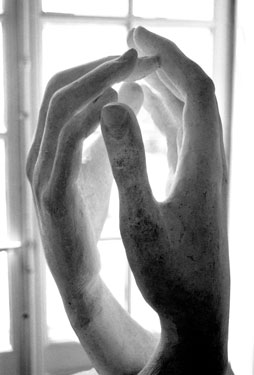
It would be his birthday today (so I was reminded by Homepaddock), so an ideal time to consider that what Auguste Rodin could do with a mere pair of hands, other sculptors struggled to do with whole galaxies of complete human figures. When I first posted this a few years ago, I quoted now-silent Wellington blogger Oh Crikey'.

_QuoteWho would've thought a mere 'hand' could convey so much anguish & torment, or tenderness & delicacy? ... In Maori terms, we could say Rodin's sculptures have a mauri, or a 'life force.' The more rational among us will scoff, ‘Oh, that's silly, inanimate objects can't possibly have a life force!’ But they're dead wrong, Rodin is alive!

Rodin: the sculptor who breathes life into mere stone.  In a beautiful photo by Mark Klym.

NB: You might enjoy some rare footage of Rodin from 1915 that’s been recently uncovered. Posing for the camera more than really working, but still fascinating to see the great man in motion:

[Hat tip Sandrine L.]

Thursday, 8 October 2015

'La Belle Heaulmiere' by Rodin


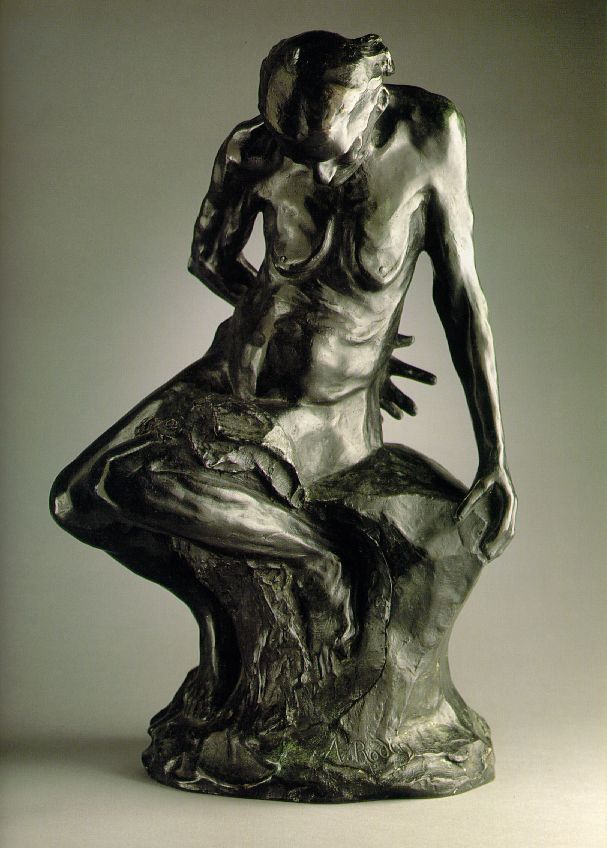
Now, this piece will confound a few of you: La Belle Heaulmiere by Rodin, also known as 'She who was once the Helmet-Makers Beautiful Wife,' or 'The Old Courtesan.'

You might see this work by Rodin and ask, “WTF?” "Why the ugliness?” “Who would want to look at that old crone?"

In answer, let me quote the words of two masters.

An artist can look at a pretty girl and see the old woman she will become. A better artist can look at an old woman and see the pretty girl she used to be. A great artist can look at an old woman, portray her exactly as she is... and force the viewer to see the pretty girl she used to be... more than that, he can make anyone with the sensitivity of an armadillo see that this lovely young girl is still alive, prisoned inside her ruined body.
~ R. Heinlein via Jubal Harshaw, speaking about on 'La Belle Heaulmiere' in Stranger From a Strange Land.
Or you might consider the sentiments of Shakespeare from his Sonnet 73, apposite here, in which he spoke of:
Bare ruin'd choirs, where late the sweet birds sang.
In me thou seest the twilight of such day
As after sunset fadeth in the west…

So, d'you think Rodin has pulled it off the task described by Harshaw?

Or do you have the sensitivity of an armadillo?

(Or, perhaps, are you just not letting on . . . )

[Previously posted in 2007]

Wednesday, 7 October 2015

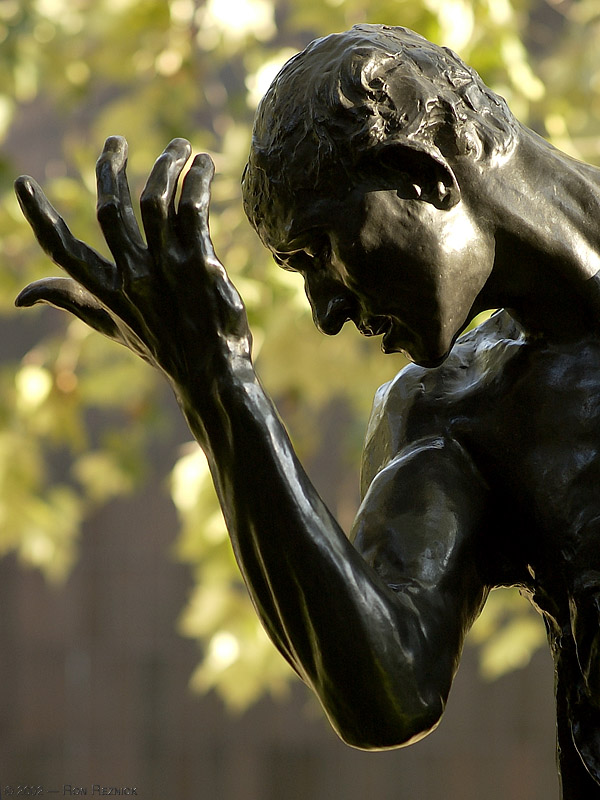
Pierre de Wiessant - Auguste Rodin

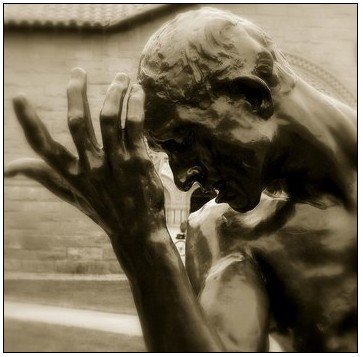
The character ‘Pierre,’ from Rodin's evocative Burghers of Calais ensemble sculpture is a great figure in his own right, one of Rodin's finest in my view, and part of a piece of intense nobility and powerful human drama -- and doesn't that hand just say so much?

The Burghers of Calais (Les Bourgeois de Calais) is one of the most famous sculptures by Auguste Rodin, completed in 1888. It serves as a monument to an occurrence in 1347 during the Hundred Years' War, when Calais, an important French port on the English Channel, was under siege by the English for over a year.

The story goes that after a victory in the Battle of Crécy, England's Edward III laid siege to Calais, whereupon Philip VI of France ordered the city to hold out at all costs.

Philip himself failed to lift the siege and starvation eventually forced the city to parlay for surrender. The dealing did not go well. Edward offered to spare the people of the city if any six of its top leaders would surrender themselves to him, presumably to be executed. Edward demanded that they walk out almost naked with nooses around their necks, and be carrying the keys to the city and castle. The burghers volunteered, to save their city, and began their final short journey  …

Tuesday, 13 November 2012

Happy birthday Auguste Rodin

image

Today would have been Auguste Rodin’s birthday. He would have been 172.

Burghers of Calais Auguste Rodin

He had the almost unique ability to breathe life into mere stone—to grant a life force to inanimate objects.  He could do with a pair of hands what other sculptors could never manage even with whole constellations of subject matter.

Hands Cathedral Auguste Rodin

After him, sculpture was truly never the same again. 

image

IMAGES from top to bottom: ‘The Kiss’ aka ‘Francesca da Rimini’; ‘ Cathedral’; Pierre di Wissant from the ‘Burghers of Calais’; ‘The Eternal Idol’ at The Musee Rodin in Paris.

Tuesday, 29 June 2010

‘Cathedral’ – Auguste Rodin

What Auguste Rodin could do with a pair of hands, other sculptors struggled to do with whole galaxies of complete human figures. When I first posted this a few years ago, I quoted Oh Crikey'. 

_Quote Who would've thought a mere 'hand' could convey so much anguish & torment, or tenderness & delicacy? ... In Maori terms, we could say Rodin's sculptures have a mauri, or a 'life force.' The more rational among us will scoff, ‘Oh, that's silly, inanimate objects can't possibly have a life force!’ But they're dead wrong, Rodin is alive!

Rodin: the sculptor who breathes life into mere stone.  In a beautiful photo by Mark Klym.

Thursday, 22 April 2010

Le Penseur – Auguste Rodin

Le_Penseur
I haven’t posted anything from my favourite sculptor for a long time, so since I came across this great captioned version of ‘The Thinker’ in a thoughtful post over at Ultra Orange, I figured tonight was the night to remedy that.
Enjoy.

Wednesday, 5 August 2009

Toilette de Venus - Auguste Rodin

Rodin-Toilette-de-Venus-3

Another beautiful bronze by French sculptor Auguste Rodin (1840-1917) emanating from his ‘Gates of Hell’ series.

artwork_images_425649297_459238_auguste-rodin

See more posts on the master sculptor here.

Tuesday, 14 April 2009

Some of me 'oliday snaps

Melbourne is one of the world's great cities. No question. When it comes to the Melbourne-Sydney debate, "I'd give you all of Sydney harbour (all that land, all that water)" for that city's promenades. Nineteenth-century architects used to use the metaphor, "God made the country, Man made the town." Cities add civitas to landscape, and some cities do it better than others. Melbourne is one. Sydney's not.

Sydney has one of the world's greatest harbours, and with rare exceptions (Bennelong Point, Eastern Suburbs) it's made a pig's ear of it. Outside those rare exceptions, it's like Henderson spread over several hundred square miles. Melbourne on the other hand started with nothing -- a dull landscape, a drab harbour, a river that flows upside down -- and in that unpromising landscape it has built a real, genuine city: it's a man-made town in every respect.

From the World's-Good-People file comes this wee snap of myself enjoying Melbournian hospitality with Prodos and friends over the weekend -- fine people all of them.

Let me tell you that if you don't read Prodos regularly, or listen to his great online interviews, you should. (He's the chap with the top hat and flag, by the way.)

And being Easter, it's only appropriate that two pilgrims should find themselves down at Kardinia Park between the hours of dawn and dark (note absence of banners flying high, by the way) . . .

. . . before heading to the Cathedral of Sport (known sometimes as the MCG) to watch Geelong smash the Pies. And this was an Easter without miracles for Collingwood, to the gratification of every right-thinking sports-lover. That's the two team run-throughs you can see being erected.

And here's another friend I like to visit regularly, Rodin's Balzac at the Melbourne Art Gallery, with a new friend behind: the Eureka Tower -- the world's tallest residential building -- seen to much better effect here at its website.

Friday, 8 August 2008

Sketches - Rodin

D4186g11_12-rodin_rainbowAuguste  Rodin was not just one of the world's most expressive sculptors, he also had a fine line in a dynamic form of sketching. 

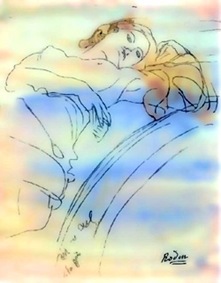
Fascinated with the human form and its infinite expressive variations, Rodin would let nude models loose in the studio while he dashed off literally thousands of pencil and watercolour sketches, often without even lifting the pencil from the page. D7174g

 D4309g They weren't studies for new sculptures as such, more a method for automatising his feeling for human form. and an attempt to express living motion in a static art.

“Be angry, dreamy, praying, crying or dancing,"was the only instruction the models ever got. "It is up to me to capture and maintain the line that appears truthful.”

These are just some of the many thousands of sketches he dashed off, and then pored over, studied and often cut up and reassembled. (Click the pics to enlarge.)

                                                        D4146g

Thursday, 31 July 2008

The Poet - Auguste Rodin

                                            denker2 

Like The Kiss, you've seen Rodin's Thinker so often you barely see it at all anymore.  But did you know it was first intended to grace a large relief representing the characters from Dante's Divine Comedy, the figure herein intending to represent The Poet, out of hose head the story and all the characters emerged.

Here it is in that setting.  It is Rodin's masterpiece, which is to say it's one of the world's finest artistic creations.

Wednesday, 30 July 2008

'The Kiss' - Auguste Rodin

                                    kuss

Everyone has seen Rodin's 'The Kiss' so often it's almost become a dead metaphor.  Here's it is in its original 86cm high clay study, from a different angle than you'll be used to.

And did you know, like Rodin's 'Thinker,' it was inspired by Dante's Divine Comedy?  'The Kiss' itself was first titled Francesca da Rimini, and illustrates the noblewoman immortalised in Dante's Inferno (Circle 2, Canto 5) who falls in love with her husband's younger brother while together they read the story of Lancelot and Guinevere, and is killed for her indiscretion by her jealous husband. Rodin places the storybook in the male's hand...

Friday, 14 September 2007

Hand of God - Rodin


.
.
.
.
.
.
.
.
.
I love Rodins' figures emerging from the stone of which they're made -- as if the very rocks he works with are alive.

Thursday, 26 July 2007

The Kiss - Rodin


Yes, we've all seen it so often it might be hard to see it afresh . . . but this is magnificent sculpture. Nothing before or since approaches either its subject or its style. Rodin is one of the geniuses of sculpture.

Tuesday, 20 March 2007

REPOST: 'La Belle Heaulmiere' by Rodin


'La Belle Heaulmiere' by Rodin, also known as 'She who was once the Helmet-Makers Beautiful Wife,' or 'The Old Courtesan.'

You might see this work by Rodin and ask, "Why the ugliness? Who would want to look at that old crone?" Let me quote the words of two masters.
An artist can look at a pretty girl and see the old woman she will become. A better artist can look at an old woman and see the pretty girl she used to be. A great artist can look at an old woman, portray her exactly as she is... and force the viewer to see the pretty girl she used to be... more than that, he can make anyone with the sensitivity of an armadillo see that this lovely young girl is still alive, prisoned inside her ruined body.

--R. Heinlein via Jubal Harshaw, on 'La Belle Heaulmiere' by Rodin,
Or you might consider the sentiments of Shakespeare, from his Sonnet 73, in which he spoke of:
Bare ruin'd choirs, where late the sweet birds sang.
In me thou seest the twilight of such day
As after sunset fadeth in the west,
So, d'you think Rodin has pulled it off the task described by Harshaw? Or do you have the sensitivity of an armadillo? (Or are you just not letting on.)

RELATED: Art, Sculpture

Thursday, 8 March 2007

Pierre de Wiessant - Auguste Rodin

The character Pierre, from Rodin's evocative Burghers of Calais ensemble sculpture, which I was considering using for the latest Free Radical cover until we discovered the perfectly suited image you now see.

But Pierre de Wiessant is a great figure in his own right, one of Rodin's finest in my view, and part of a piece of intense nobility, and powerful human drama -- and doesn't that hand just say so much?
The Burghers of Calais (Les Bourgeois de Calais) is one of the most famous sculptures by Auguste Rodin, completed in 1888. It serves as a monument to an occurrence in 1347 during the Hundred Years' War, when Calais, an important French port on the English Channel, was under siege by the English for over a year.

The story goes that England's Edward III, after a victory in the Battle of Crécy, laid siege to Calais and Philip VI of France ordered the city to hold out at all costs. Philip failed to lift the siege and starvation eventually forced the city to parlay for surrender. Edward offered to spare the people of the city if any six of its top leaders would surrender themselves to him, presumably to be executed. Edward demanded that they walk out almost naked and wearing nooses around their necks and be carrying the keys to the city and castle...
NB: MOMA has a great booklet discussing the Burghers. Definitely worth a read.

RELATED POSTS ON: Art, Sculpture

Sunday, 14 January 2007

Schrodinger's Cat novelist dies

I've just seen the news, courtesy of blogger Benzylpiperazine, that novelist Robert Anton Wilson has died.

Wilson's best fiction inhabited the many wrinkles and fertile wormholes of surrealism, quantum physics and the speculations therefrom, and were never less than entertaining -- and provided perhaps the best and only decent use of the ultra-speculative physics of alternative universes. You might call him a gonzo Douglas Adams.

My own favourite, his Schrodinger's Cat Trilogy, is brilliantly imaginative science fiction. Wilson's own review of a novel within the novel -- in which the world is saved from nuclear destruction by the far-sighted actions of a presidential intern -- gives you the flavour:
The whole novel was rather didactic, Simon decided. It was written only to prove a point: Never underestimate the importance of a blow job.
Always good advice. In any universe.

LINKS: Robert Anton Wilson (1932-2007) - Erowid Character Vaults
Schrodinger's Cat Trilogy (excerpts) - Robert Anton Wilson website
Schrodinger's Cat Trilogy - Amazon.Com

RELATED: Books, Obituary, Science

Tuesday, 7 November 2006

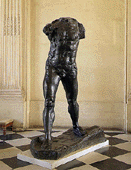
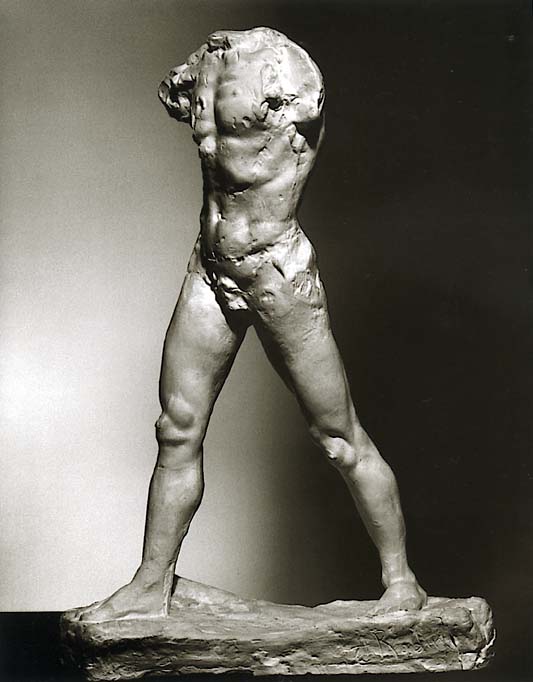
Walking Man - Rodin

The 'Walking Man' of sculptor Auguste Rodin. Shown here is a 27 cm clay maquette of the final bronze sculpture, completed about 1880.


Here we see movement imparted to a human figure by a simple yet ingenious artifice that requires the viewer to add something to the figure themselves. Rodin himself explains:
'Take my St. John, for example,' Rodin explained to Paul Gsell, `While he is represented with both feet on the ground, a snapshot of a model executing the same movement would probably show the back foot already raised and moving in the direction of the other one.'
As the viewer's eyes travels up one leg and down the other, each time finding something anatomically unexpected, the rhythm imparted by our own eye movement gives motion to the figure. We sense this bare torso is walking.

LINK: Walking as art - University of Vienna

RELATED: Art, Sculpture

Friday, 29 September 2006

Pierre de Wissant - Auguste Rodin

Pierre de Wissant, a figure from sculptor Auguste Rodin's tragic group of city saviours, the 'Burghers of Calais.' Story here.

This really is great art. Look how much Rodin does just with gesture and intensity -- he makes even an open hand tell a story of decision and resignation.

RELATED: Art