"Trump has lots of bad qualities; stupidity, extreme egotism, corruption, dishonesty, cruelty, incompetence, bad taste, bigotry, no sense of humor, cowardice, I could go on and on. He has no good qualities, unless one views a talent for conning voters to be a positive attribute. But his complete lack of negotiating skills turns out to be a plus for America, even if it’s just one more of his seemingly endless bad qualities.".
~ Scott Sumner, from his oped 'Worst Negotiator Ever'
Showing posts with label Politics-World. Show all posts
Showing posts with label Politics-World. Show all posts
Wednesday, 1 August 2018
QotD: "Trump's complete lack of negotiating skills turns out to be a plus for America"


Thursday, 26 July 2012
The Shift to a New Global Currency Alters International Relations
The present economic depression has been going five years, with no sign of abating. We now that in times of worldwide economic depression, one thing to suffer is worldwide free trade—and without being able to freely trade for energy and resources, some nation states will be worse off than others.
Which is why they’re making a grab for resources now…

Last week I wrote about how Israel's newfound natural gas wealth is catalyzing a shift in Middle-Eastern relations. It was a topic that generated much discussion in our office - we knew that the Mediterranean Sea resource is highly significant for the Jewish state, which has long struggled with energy insecurity, but the deeper we delved into the issue the more we realized that Israel's new resource is already having wide global implications. In particular, we were very intrigued to realize just how cozy Russia and Israel are becoming - this being the same Russia that usually supports Iran and Syria, Israel's sworn enemies.
The article generated a fair bit of feedback from our readers as well, including several good questions. In answering the questions and in continuing to discuss the issues among ourselves, we placed Russia's advances on Israel as but one part of a shifting global web, wherein old allegiances are being dropped in favor of new friends with benefits. Those benefits are energy resources, and the race to control them is changing the way the world turns.
Dozens of countries are slowly altering their international allegiances because of energy considerations. Here I will shine a light on a few of the more significant transitions and how they might impact US and EU energy security.
Russia's Strategic Steps Toward Israel
I discussed this at some length last week, so rather than repeat myself I will just summarize the situation in order to address some questions that arose following that Dispatch. The gist of it is this: The Middle East has long been informally divided into two camps, with US allies such as Saudi Arabia, Egypt, and Qatar making up the camp that can get along with Israel, while Iran and Syria lead the group that cannot befriend the Jewish state. In a holdover from the Cold War, Russia has long backed the anti-Israel group, providing arms to Syria and support to the increasingly isolated Islamic Republic.
Now Israel, long the oil- and gas-poor brother in the squabbling Middle-Eastern family, has delineated trillions of cubic feet of offshore natural gas. It is hard to overstate the significance of this discovery. Instead of having to rely on a strained peace with Egypt for its natural gas, Israel now has far more natural gas than it can use - the country will be self-sufficient in terms of gas to generate electricity and will be able to fill its coffers with export revenues.
Israel's transition from a nation constantly in need of resources to one that could well play a major role in the global gas trade is earning it new respect. Greece and Cyprus are discussing paths for potential pipelines to Europe. Turkish leaders are likely kicking themselves for having destroyed what was a close friendship with Israel in recent years; now Turkey will have to sit on the sidelines and watch as Israel, Greece, and Cyprus work together to develop these gas riches. Egypt's Islamists, finally in power after decades of having to abide their nation's peace accord with Israel, have been stripped of the opportunity to cut off Israel's gas supplies - the Jewish state doesn't need Egyptian gas anymore. Syria and Lebanon, among others, are considering how to stake their claims on the gas bounty, which sits in waters laced with international boundaries.
And then there's Russia. Vladimir Putin's third official international trip after retaking the Russian presidency in May was to Israel. The two nations now share $3 billion in annual trade and considerable immigration. Arching over all those ties is the fact that, in the wake of the Arab Spring, Russia and Israel share an interest in preventing the rising tide of radical Islam.
The Russia just described sure doesn't sound like a very good friend to Iran, does it? But why the shift - is Russia that concerned about radical Islam? No, Putin has never cared much about religion; his decisions are always far more strategic than that. The reason is simple: Israeli gas.
That brings us to the most common question we were asked following last week's energy Dispatch: Why does Russia, a natural gas giant in its own right, want Israeli gas? To our questioners, you are absolutely right: Russia does not need any more gas for itself. Russia is home to one-quarter of the world's known natural gas resources, roughly 1,600 trillion cubic feet (TCF) according to the EIA. And that doesn't count potential reserves of unconventional gas. We think that all told, Russia may control as much as one-third of the world's natural gas.
Russia has gas. What Putin desperately wants is to maintain his country's stranglehold over European natural gas supplies.
Putin loves using control over resources to enhance Russia's power, and natural gas is a key part of his scheme - we dedicated an entire issue of the Casey Energy Report to this topic recently. It was only a few years ago that Russia cut off gas supplies to Europe for a few days in the middle of winter in order to punish Ukraine for siphoning fuel from Russian lines. Europe relies on Russia for 34% of its natural gas; Putin wants to increase that reliance. To that end, he has spent years building new pipelines to Europe that avoid transiting troublesome countries (i.e., Ukraine). As if controlling Europe weren't enough, Putin is also developing Russia's ability to sell gas to Asia by jumping into the liquefied natural gas (LNG) scene with new facilities in the Far East. And he's several steps ahead of the United States in this LNG game.
How does Israel factor in? Israeli gas could join the world market in two ways: through a pipeline to Europe running under the Mediterranean Sea (with a stopover in Cyprus); and/or as LNG, which would be sold to Europe and beyond. Both would turn the Jewish state into an unexpected competitor in Putin's plan to continue controlling European natural gas supplies. Since he can't prevent Israeli gas from flowing, Putin is trying to control where it flows and siphon off some of the profits.
That control is so important, it seems that Putin is considering coming out as a full-fledged friend of Israel. Such a move would almost certainly sever those long-time ties between Russia and Iran, but when the currency in question is energy then alliances formed over decades can change overnight. If Russia does take that strategic step away from Iran and toward Israel, it will rock the ever-delicate Sunni-Shiite balance in the Middle East... to what end is anyone's guess. As for whether Israel will reciprocate Russia's advances: never forget that Israel is a pragmatist nation, its very survival dependent on making strategic decisions. We would not be surprised to see the Jewish state playing both sides of the ex-Cold War game, if that's what makes sense for them.
Africa's New Best Friend: China
Late last week the news broke that China will lend $20 billion to African governments over the next three years. The funds will be directed at infrastructure and agriculture projects, but to anyone who views the world with an eye out for strategic resource relationships, the growing friendship between China and Africa is all about energy and minerals.
Specifically, China is cultivating the relationship very carefully in order to cement its role as Africa's best friend and top ally. Caring for Africa's needs puts China in a perfect place to negotiate resource deals with countries across the African continent - after all, aren't sharing and caring the first rules of friendship?
This isn't a new tactic - Chinese involvement in Africa has increased dramatically over the past decade. Today annual trade between the African continent and the People's Republic is worth more than $166 billion, a threefold increase since 2006. What is new in the relationship is China's new breadth and depth of caring. Until recently, most Chinese aid to Africa went to projects that were clearly designed to primarily benefit China's extractive industries on the continent, not Africa's people. To boot, Chinese laborers were brought to work on the projects, reducing the number of jobs available for Africans. The result: China was accused - by Africans and by international observers alike - of being dastardly self-serving in its African endeavors.
This has become particularly problematic in Angola, which has received more Chinese money than any other African nation. Angola is rich in oil, diamonds, gold, and copper, but a devastating 27-year civil war destroyed most of the country's infrastructure. China has been helping Angola rebuild by providing infrastructure-related loans in exchange for oil; bilateral trade between the countries topped $25 billion in 2010. But the projects, such as rebuilding the 840-mile Benguela Railway, are all designed to make it faster and easier for China to access Angola's resource wealth, and Chinese laborers are now a common sight in Angola. With jobs and resources ending up in Chinese hands, Angolans in recent years have started questioning whether China has their interests in mind at all.
Lopsided relationships like this are nothing new for Africa. From colonialism to aid dependency, Africa has been in a lopsided relationship with Europe for decades. However, it seems the continent has learned from the past and now wants to try to craft a deeper relationship with China... one that would hopefully result in a more sustainable partnership.
"Africa's past economic experience with Europe dictates a need to be cautious when entering into partnerships with other economies," said South African President Jacob Zuma at the recent Forum on China-Africa Cooperation in Beijing. He continued to say that China has demonstrated its commitment to Africa with investment and development aid and that Africans are generally pleased that they are treated as "equals" in the relationship. However, he cautioned that the trade balance "... is unsustainable in the long term."
It was seemingly in response to that worry that Chinese President Hu Jintao promised $20 billion in loans aimed at projects specifically not related to mining or oil. Instead, the money is earmarked for agriculture, manufacturing, education, safe drinking water, protected lands, and the development of small businesses.
Has the Chinese leadership suddenly taken to caring for the health, welfare, and economic prospects for the people of Africa? It might be nice to think so, but the truth is much more strategic: China realized that it needs to improve its standing in the hearts and minds of Africans if it wants to continue securing access to African oil, gas, and minerals. And it did so with a bang - the $20 billion pledged for the next three years is twice what China pledged for the last three-year period.
With a show of renewed friendship and caring, China will now go about seeking new resource deals to add to the plethora of extractive deals it has signed with African countries in recent years. In Nigeria, China is spending $23 billion to build three oil refineries and a fuel complex; the two countries are also building one of Africa's largest free-trade zones near Lagos, a $5-billion, 16,000-hectare project. In Sudan, where Darfur-related sanctions bar American companies from investing, China has invested billions in oil ventures and buys 90% of the country's oil exports. A billion dollars in bilateral trade between China and Mauritania revolve around oil; the magnitude of China's investment in the country has carried Sino-Mauritanian relations through two military coups in the last decade. In Botswana the expansion of the Morupule coal-fired power station is being funded through an $825-million Chinese loan, but that is only one of 28 infrastructure projects that China is b acking in the country.
China has money, Africa has resources, and both have tainted views of many other global powers. It's a match made in heaven.
Asia Stakes a Claim on Canada
They came only a month apart: two multibillion-dollar offers from Asian energy giants to buy up Canadian oil and gas companies. The first was in late June, when Malaysian state energy company Petronas offered $5.5 billion in cash for Canadian natural gas producer Progress Energy Resources. The offer represented a 77% premium over Progress' closing price the day before the deal was announced and is the biggest deal to date for Petronas. Why did the Malaysian firm play such a huge hand? Because Progress has 1.9 trillion cubic feet of proved and probable gas reserves in British Columbia's Montney shale region, a massive resource that Petronas hopes to export to Asia asLNG.
News of the second deal broke just yesterday; the dollar size of the deal sent it reeling across business headlines around the world. China National Offshore Oil Company (CNOOC) is buying Canadian oil and gas producer Nexen (T.NXY) for $15 billion in cash. It is the largest investment China has ever made into Canada - its previous Canadian investments total $23 billion - and the offer represents a 66% premium to Nexen's 20-day volume-weighted average share price.
CNOOC wants Nexen for its diverse project portfolio - the company has operations in Colombia, Yemen, the North Sea, and the United States - but it is the company's Canadian projects that hold the vast reserves that China seeks. Nexen is only a mid-sized player in the Canadian oil sands, but it has 900 million barrels in proven oil reserves plus another 5.6 billion barrels of less-certain contingent resources. In addition, Nexen is on the cusp of producing from its significant shale gas reserves in BC. Between those two forays - oil sands and shale gas - Nexen has major exposure to two of the world's most rapidly growing, major energy sources.
New, fast-growing supplies are exactly what Asian energy giants need. In the race to secure oil and gas resources for the future, importers have to look beyond historic suppliers to new frontiers. Big oil reserves in historic producing countries are generally either state-owned and therefore closed to investment - examples include Saudi Arabia, Iran, Mexico, and Venezuela - or have already been staked out and carved up among domestic and international partners who aren't likely to give up an inch of their claim.
That means nations looking to buy up international oil and gas reserves have to look at newer regions - the oil sands, the Arctic, the shale fields of North America, the sub-salt oil riches off Brazil's coast, and the like. The risks and costs may be higher, but at least these regions still offer the opportunity to stake a claim on a massive resource. When it comes to the oil sands and the shale fields of British Columbia and Alberta, the fact that these massive resources are in western Canada - pretty darn close to the Pacific Ocean - makes the opportunity almost picture-perfect.
That is precisely why Asian energy giants are moving on Canadian oil and gas companies... though to be fair, they were invited to do so. Led by Prime Minister Stephen Harper, the Canadian government has been actively courting Asian investment for its energy riches; these two multibillion-dollar deals are the first fruits of that labor.
The growing, energy-based relationship between Asia and Canada represents a seismic shift for Canada, which until now relied on the United States market to buy almost all of its oil and gas. Today, southbound oil pipelines are almost at capacity and political theater is slowing the approval process for new lines to a snail's pace, just as production in the oil sands is set to ramp up. Similarly, shale gas discoveries across western Canada have delineated vast new reserves that are begging for new buyers.
Canada needs to diversify its export list if it wants to capitalize on its unconventional energy resource wealth. Asian nations, led by China, are racing to put down payments on the oil and gas deposits that will fuel their futures. Sure, Canada and Asia are in the honeymoon stage of a new relationship, with multibillion-dollar deals keeping things new and exciting. When CNOOC, Petronas, PetroChina, Mitsubishi, Korea Gas, and the other Asian energy firms pressing Canada to permit oil and gas pipelines to the west coast come up against regulatory roadblocks and popular opposition, the new relationship will get a real test.
For now, however, it looks like the United States is losing a race that it has always led - the competition for Canadian energy resources (it's especially losing out to China, whose purchases of North-American energy resources include a stake in a Texas oil shale project). Interestingly, this is happening a few short years after the army of oil refineries along the Gulf Coast spent billions upgrading their facilities to process heavy oil in preparation for an onslaught of Canadian oil sands bitumen. If Asia beats out the US for access to Canadian oil, US refiners will be left paying a premium for heavy oil from other suppliers - not an ideal situation.
It's also interesting that this is happening just as the US seems to be at risk of finding itself distanced from two of its strongest Middle Eastern energy allies - Egypt under its new Islamist government and Israel, which might move gently away from the US in order to secure strategic ties to Russia. Is a hegemonic outlook still clouding US views on the security of its relationships and energy supplies, leaving the nation complacent while its competitors race to lock up new resources and secure new friends?
It's a very interesting thought, but the details of that discussion are best saved for another day. The point for today is that increasing desperation from resource-needy nations to secure oil and gas for their futures is putting the world's complex web of relations under incredible pressure. Longstanding allegiances are being tested, and any nation that assumes its historic friends and suppliers will simply stay by its side risks losing precious supply streams. Lubricated with money and the potential for future profits, new friendships are being forged that could alter the global balance of power.
Energy security underlies every country's abilities for today and prospects for tomorrow. Without secure access to the resources that power buildings, move vehicles, connect people, and enable growth, a country's economy will stagnate and its global influence dwindle. From that perspective it is easier to understand why Russia is considering a 180-degree shift in its Middle-Eastern relations, why China is willing to spend tens of billions of dollars on schools, wells, and hospitals in Africa, and why Asia is offering fat premiums to take over Canadian energy producers in a down market.
Energy is the new global currency, and its influence is starting to change the rules of the global diplomatic game. China is playing, Russia is working its hand, and countries with resources from the Black Sea to the Horn of Africa are placing their bets. As for the United States, it seems to be a couple of steps behind and had better figure out a game plan before new allegiances solidify and the US finds itself alone.
Marin Katusa is the chief investment strategist, Energy Division, of Casey Research, publishers of the Casey Energy Speculator and Casey Energy Confidential Alert Service.
Tuesday, 23 August 2011
Quote of the Morning: On Libya [updated]

Few will mourn the passing of Muammar Qaddafi, but does that mean we should already be celebrating the winners? I don't often agree with him, but I'm with Matt Yglesias when he says:
"...let’s wish the best of luck to people of Libya. Part of the problem with this intervention has always been that the fall of a dictator seems to me just as likely to lead to a bloody civil war or a new dictatorship as the emergence of a humane and stable regime. The effort to build a better future really only starts today."
So it does. And for many rebels, that future seems to hold sharia...
UPDATE 1: And, like Perry de Havilland at Samizdata, now that Qaddafi is on the skids “I cannot help but hope the dirty secrets now emerge of how overseas politicians aided and abetted Qadaffi over the years, in particularly the disgusting deal over [Pan Am bomber Abdelbaset al Megrahi. It would be wonderful to see the polities in England and Scotland take one in the face if the unlovely details eventually come out.”
It will also be interesting to watch details emerge about all the nasty little deals done by businesses seeking favour from the corrupt thug. For instance, a friend in Uganda tells me this morning about a juice processing plant in Kampala owned by Qaddafi and sons, which is happily churning out juice for Coca Cola. Perhaps, wonders my friend, Qaddafi is already holed up in the five-star hotel in Entebbe he also owns with his sons…
UPDATE 2: Steve Negus at The Arabist has been watching how the rebels established their authority in Benghazi over recent months, and has some pluses and minuses about what we might expect to see in the wider Libya. Meanwhile, former Aussie diplomat Philip Eliason sees dark days ahead for Libya. “He is not optimistic — the rebel movement is not coherent (expect fighting to continue even after Qadhafi escapes, is captured or killed) and has shown worrying signs that it will seek retribution against its enemies.” [Hat tip Macrobusiness.com.au]
Tuesday, 22 March 2011
President Zero's "Pretend War"
The “leader of the free world”—that’s what the office of the U.S. President was once popularly called. Remember Ronald Reagan standing up at the Brandenburg Gate, talking directly to the thugs over the wall. Remember the words on behalf of the free world: “Mr Gorbachev, tear down this wall!”
The title “leader of the free world” once had some meaning.
The bombing of Libya shows what that title is now worth. The foreign policy of the present incumbent is best described by the posture of of one of Britain’s most forgettable (and forgotten) Prime Ministers:
I must follow them.
I am their leader.

That’s the best comparison I can make of a foreign policy committed to following, in the words of President Obama, “the entire international community, almost unanimously”:
“Some sort of action.” “Core principle.” One could be forgiven for thinking that President Zero’s only “core principle” here is that when dragged kicking and screaming by the domestic press to confront an issue he resolves to take action. Some sort of action. Any action. Paraphrasing Sir Humphrey Appleby:
This is some action, therefore we must take it.

The no-fly zone itself being a “bob each way” kind of action that sees action being taken against dictator Qaddafi without actually taking any action against dictator Qaddafi. Talk about the politics of Alice in Wonderland. Says Michael Hurd about President Zero's "Pretend War":
The British Ministry of Defense, the French government and the American White House all insist: The target of the military attack on Libya is not Qaddafi; it's only military buildings.
So let me get this straight. We're attacking Libya because the dictator Qaddafi is oppressing his people -- yet we're not attempting to kill Qaddafi.
I guess this is how liberals fight wars. Just as you cannot call a terrorist a terrorist, you cannot call a war -- a war. This is noteworthy, but should not be a surprise. These are the same people who insist that socialized medicine lowers the cost and increases the quality of health care. These are the same people who believe that increased taxes on wealth producers generates economic growth.
My question is: Why are we attacking Libya, if not to punish Qaddafi? …
Obama, although he also opposes Qaddafi, goes after Qaddafi but expects us to believe ... he's not going after Qaddafi.

This is Obama’s “little war.” A pretend war. A war that’s neither one thing nor another. A war whose goal is the opposite of the little war’s stated intention. The result, other words, of the foreign policy of a Zero.
Monday, 21 March 2011
QUOTE OF THE DAY: On liberating slave pens
Dictatorship nations are outlaws. Any free nation had the right to invade Nazi Germany and, today [1963], has the right to invade Soviet Russia, Cuba or any other slave-pen. Whether a free nation chooses to do so or not is a matter of its own self-interest, not of respect for the non-existent "rights" of gang-rulers. It is not a free nation's duty to liberate other nations at the price of self-sacrifice, but a free nation has the right to do it, when and if it so chooses…
- Ayn Rand, on Dictatorship

Tuesday, 1 February 2011
Ayatollah ElBaradei
Although some are still fooled by the talk of “freedom” around Cairo, the onset of an Islamic dictator in 2011 is looking all but inevitable in Egypt, with consequences as profound for the Middle East (and the world) as when an Islamic dictator first took over Iran in 1979—the most important turning point in Middle Eastern geo-politics since Napoleon took the pyramids.
(Check out yesterday’s post for some background on today’s fire in Cairo, and this video below for a short summation of the views of the folk in and around “Liberation” Square, Cairo, who want nothing more than to be free to destroy, and have nothing to offer the world but blood, tears and genocidal hatred .)
It will only have added irony if the vehicle by which that dictatorship comes is the man whom the UN had inspecting Iran’s nuclear facilities—”nothing to see here” was his message when he came back from Tehran—the same man who now says of the Muslim Brotherhood, the progenitors of Al Qaeda and Hamas, that “We should stop demonizing them.”
The heroic Ayaan Hirsi Ali gave her take on Egypt this morning, one to which most of us would like to give a resounding “Yeah!”:
"We should help the secular democrats with a campaign of 'Yes to freedom. No to shariah.'
Well, yes we should. But the fact has to be faced that hoisting that sentiment in the face of the Islamist whirlwind is little more than wishful thinking. In the battle of Mid-Eastern ideas, freedom lost out to shariah centuries ago, and everything since has been the consequence of that.
I suggested yesterday what’s been obvious for some time, Egypt is going Islamist, as has Lebanon last month, as did Iran in 1979, and there’s very little you or I or Ayaan can do about it.
The mystic blood-letters are taking over from their secular cousins.
To commiserate with those few folk of reason in Egypt, who will soon be shot by both sides, here’s a sing-along from 1979 that is almost as topical today: Ayatollah, by Phil Judd and the Swingers.
Monday, 31 January 2011
The inevitable conflagration in Cairo [updated]
There will be no attractive outcome from the incipient revolution in Cairo’s streets. On one side, fighting for survival, a nationalistic sense of “nationhood” going back several millennia that has been represented in recent decades by the brutal military dictatorships of Nasser, Sadat and Mubarak; on the other, fighting for its biggest conquest since the Iranian Revolution, a brand of toxic, militant Islam from which sprang the ideology of hate that powers Al Qaeda and related Islamic murderers.
Whoever wins in the street battles, the results will not be pretty.
All that can be said in favour of the dictators is that they were and are opposed to the militant mystics—helping make Egypt one of the more secular, “westernized” Islamic nations in the Middle East. But the price at which this was bought was a militant dictatorship maintaining control by political oppression—an environment of overarching brutality in which the odious mystic hate-mongers flourished underground. Like a bacillus.
That bacillus is now out of the cellars and into the streets, and whichever particular individual takes over after the violence subsides (and note that the leading opposition candidate Mohammed ElBaradei is backed by the same Muslim Brotherhood from which Al Qaeda mentor Sayyid Qutb emerged) the eventual victor will assuredly be the bacillus.
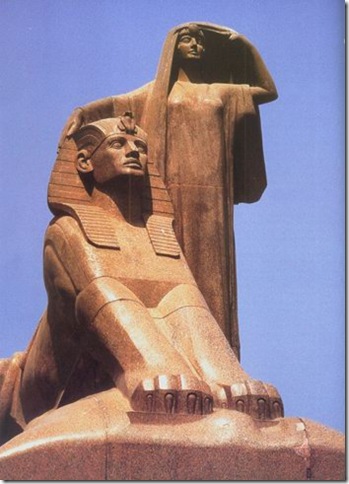 It was always inevitable. If Egypt ever had a renaissance, it was only in 1919 to 1928 in the wake of World War I when Egypt's rising tide of nationalism re-emerged in the modern form of secular socialism, building a “modern Egypt” in the likeness of a worker’s Soviet and such lifeless monuments to its dead past as this one shown here by Mahmoud Mokhtar. Egypt’s sense of nationhood certainly goes back centuries, (as historian Scott Powell explains “an implicit premise embedded in Egyptian thinking that extends back to its “glorious” pharaonic past, of which the ever present pyramids and temples [and mortuaries and funerary palaces] provide a constant reminder”), but without the philosophical base responsible for these past glories, its modern “renaissance” could never rekindle the full power of its past (as Mokhtar’s soulless sculpture adumbrates). The strident militant nationalism of Nasser/Sadat/Mubarak could never be a real substitute for the full-on pharaonic metaphysics.
Hence, since the death of Nasser, Egyptian nationalism's most vigorous standard bearer, Egypt's nationalism has withered in the face of the more explicit and integrated metaphysics and values of Islam, both of which are widely accepted by the Egyptian population. As I blogged a couple of years ago,
the values of these two ideological forces have been in open warfare ever since the formation of the Muslim Brotherhood in 1928 -- the suppression of the Brotherhood and the murder of Nasser's successor Anwar Sadat by Muslim Brotherhood killers being two ready symbols of the conflict played out between the secular but disintegrating nationalism and the vigorous, violent and persistent Islamism that the brotherhood embodies.
This can be a conflict with only one victor. Scott Powell argues at his 'Powell History Recommends' blog that because nationalism is merely a set of disintegrated implicit notions whereas Islamism is an "all-encompassing and explicit system of ideas," it is therefore "only a matter of time before it takes over."

Only a matter of time . . .
An Egyptian Islamist theocracy? Don’t bet against it.
Why does this matter to us?
Let us profoundly hope not.
Here’s The Cure:
UPDATE: Egypt and the world face a crossroads, says Liberty Scott.
For if it were to happen, do not be deluded that it will cost in lives, and could create a new age of conflict that makes Iraq and Afghanistan seem like they were easy. . .
For if it is a bad dream for Egyptians to be suppressed by the Mubarak regime, it would be one of our worst nightmares to have an Ayatollah of Cairo.
Not that Obama would know. Looks like while Cairo burns, Obama parties.
Tuesday, 30 November 2010
War & WikiLeaks
"A universal peace, it is to be feared, is in the catalogue of events which will
never exist but in the imaginations of visionary philosophers, or in the
breasts of benevolent enthusiasts."
-- James Madison
It’s impossible to easily summarise all that flood of WikiLeaked paper, although people have been trying, but at this early stage I tend to agree with Andrew Bolt’s summary, that
the overall tenor of these leaks is like the last, which confirmed just how wildly Lancet and other activist-captured bodies had exaggerated the death toll in Iraq. They tend to confirm that the perils the US confronts are real, and the claims made by its enemies tend to be false.
In this case we get further evidence that the Saudis indeed are financing al Qaeda; that Iran and North Korea are indeed are in an axis of evil, trading missiles; that Iran really is using Red Crescent ambulances to ferry arms to Hezbollah, as Israel has long claimed; that Iran is seen as not only a threat by the West, but the Arab world; that China was a conduit for the arming of Iran; that Russia is in a new authoritarian phase, and that China is sabotaging computer systems in the West and hacked into Google’s.

Like it or not, the world is still a dangerous place. Even Rachel Maddow agrees.
Which is why the non-response of of the U.S. president to cross-border murder by North Korea is so dangerous, since it says to the world’s many potential aggressors of today that they will meet no serious opposition from this occupant of the White House.
We can recall how Neville Chamberlain’s agreement to back down over Czechoslovakia famously emboldened Hitler and led to world war. We might recall how (not quite to famously) US ambassadorial assent to turn a blind eye to Saddam Hussein’s view that Kuwait was really a province of Iraq emboldened that aggressor, and led to the First Gulf War. So how to take Obama’s response to North Korea’s unprovoked attacks on the U.S.’s military ally, which barely amounts to a stiffly-worded memo.
Early on Tuesday morning, as the Koreans were collecting their dead, the president's press secretary, Robert Gibbs, issued a statement calling on North Korea 'to halt its belligerent action and to fully abide by the terms of the armistice agreement' signed in 1953. ...
Dispatches from Washington Tuesday evening said President Obama wasn't planning to speak publicly about the shelling on the peninsula, preferring to issue a written statement later on.
Why rush? It'll doubtless be neatly typed.
Can you imagine a Harry Truman, or, for that matter a Reagan or Kennedy or Eisenhower or either Roosevelt just having an aide issue a press release when an ally comes under fire? Isn't it time for the current occupant of the White House, officially acclaimed a great statesman by the Nobel committee, to say something to both enemies and friends to assure the peace? Or do we have to sit through another yawner from his soporific press aide? ...
As I write these lines, the current occupant of the White House remains silent, as in Silence Gives Consent. In this case, to war…
[Hat tip for James Madison quote to the Patriot Post]
Monday, 23 August 2010
I Ran [updated]
Q: What’s more important in world politics than the mis-named Ground Zero Mosque?
A: The fact that the world’s biggest sponsor of terrorism has just gone nuclear—in rhetoric as well as reality.
Q: And how was this allowed to happen?
A: Thirty years of bipartisan appeasement:
Consider the rise of Islamic Totalitarianism. In 1979, a new Iranian regime founded on Islamic [] principles held fifty-two Americans hostage for four hundred and forty-four days, while America helplessly begged for their return and Iranian leaders had a world stage to proclaim their superiority to the nation they call the ‘Great Satan.’ … [W]ith America on her knees, the burgeoning anti-American movement achieved a crucial victory.
[Did this] warrant a military response? Did it rise to the level of a direct attack sufficient to place us at the point of ‘last resort’ with Iran and other nations that sponsor Islamic terrorism? Not according to Jimmy Carter. What about after two hundred and forty-three marines were killed in Lebanon in 1983? Not according to Ronald Reagan. Or after Khomeini’s fatwa offered terrorists a bounty to destroy writer Salman Rushdie and his American publisher for expressing an ‘un-Islamic’ viewpoint in 1989? Not according to George Bush, Sr. Or after the first World Trade Center bombing in 1993? Not according to Bill Clinton. The pattern is telling.

It is a pattern that has allowed Iran’s Mullahs to pursue the Islamist Holy Grail combining nuclear enrichment with the sponsorship of world terrorism—from Lebanon to Gaza to Iraq to Afghanistan—while allowing themselves to think the pursuit will attract no response.
Since future decisions are so often made on the basis of past actions, it underscores again how a forceful response at the right time can quell a conflict before it starts; whereas the lack of one so frequently leads to dangerous escalation, and much more force being necessary much later.

U.S. "reassures" Israel that Iran is "at least 12 months" from nuclear bomb despite starting reactor today… There, there. You're not going to get obliterated today; it's just later on where things could get a little dicey… Just try not to think of the idea that the "dying" Lockerbie bomber could, theoretically, outlive your country as you know it.
Monday, 28 June 2010
The return of street-fighting man
 They’re out on the streets again. Burning. Looting. Vandalising.
From The Battle of Seattle to the destruction of Toronto’s main shopping street, thugs and vandals have been out in force destroying the property of local business owners to (somehow) demonstrate by that destruction the iniquity of global capitalism,and the evil of multinational corporations.
The vandals argue that the alleged “violence” of global capitalism justifies their own violence against what they say are the “symbols” of symbols of global capitalism, from banks to multinational franchises from Starbucks to Nike, to the G20 summit itself. A broken storefront window, they say, “becomes a vent to let some fresh air into the oppressive atmosphere of a retail outlet.” A burning building becomes “a message board to record brainstorm ideas for a better world.” And somehow a billion-dollar meet-up of politicians becomes a symbol of capitalism, instead of its very opposite.
This form of postmodern protest is clearly as ironic as it is irrational.
Because in the first place, these thugs meet up to smash windows and score headlines only at the times and places that politicians meet up to talk to each other. And the only relationship that politicians have with capitalism, particularly these ones sitting around today's G-20 table, is getting in its way.

If there’s any violence here, the only place it can be found is in their own violence against both property and logic.
As it happens, the news of the Toronto
That’s a lesson that opponents of foreign investment here in New Zealand still haven’t grasped.
And the article also identifies the heart of the leftist opposition to the multinational corporation, i.e., “the Leninist concept of imperialism.” That’s a well-exploded fallacy that unfortunately still lies at the heart of so much opposition.
Now since the article is now online (as are all from The Freeman’s archives, a great resource), and since The Freeman’s publishers grant permission to republish their articles, here is a large part of it. It makes fascinating reading twenty-six years later, especially considering the examples the uses and the trends begun then (and sometimes expunged since by the political predecessors of today’s G-20 politicians). (References, by the way, can be found in the online article.)
The Multinational Corporation
by Mark Peterson (January, 1974)
Thursday, 3 June 2010
Gaza: A reality check [updated]
Gazans are suffering under a yoke of Israeli-inflicted poverty. Yeah right.
Hamas just wants peace with Israel. Yeah right.
Their peace-loving government is unmercifully oppressed by Israel. Yeah right.
Palestine is at the mercy of America’s pro-Israel foreign policy. Yeah right.
Palestinians just want peace and a better life. Yeah right.
There can be no justification for Israel’s blockade against Gaza. Yeah right.
The peace flotilla was organised and manned by peace activists. Yeah right.
It’s all about getting aid to suffering Gazans. Yeah, right.
UPDATE: The convoy: another reality check courtesy The Roadkill Diaries:
Peter Hitchens on a certain "Aid Convoy":
“If you want to be wholly dispassionate, you might call it a 'convoy' without adornment. But to call it an 'Aid Convoy' is itself a departure from neutrality. I myself would call it a propaganda fleet, but then I am openly partisan on this issue. The use of the expression 'humanitarians' is likewise suspect, as is the use of the word 'activists' without saying what sort of activists they are. ..
“It emerges that these ships were not entirely peopled by pacifist vegetarian idealists from the Isle of Wight.
“For instance…”
Wednesday, 2 June 2010
There’s no charity in Viva Palestina [updated]
Following the appearance of Gaza faux-tilla fool Nicola Enchmarch last night on the alleged current affairs show Sunday, I’m re-posting this critique from last week of the organisation for which she works.
Repeaters have been reporting that New Zealand woman Nicola Enchmarch, being held in Israeli custody, works for what they is an “aid organisation” called Viva Palestina.
HERALD: “Enchmarch is a member of the British aid group Viva Palastina”
STUFF: “ ... one of a number of people[working for] aid organisation Viva Palestina”
TV3: “…working for a British aid organisation - Viva Palestina”
If Viva Palestina is an aid organisation, then I’m the UN Secretary General.
Viva Palestina was founded by George Galloway. Remember him? The former British MP who received millions of dollars stolen from the United Nations Oil-For-Food Program, in exchange for his public denunciations of the UN sanctions against Iraq. Who once told Saddam Hussein, "I salute your courage, your strength, your indefatigability.” Who recalls the day that the Soviet Union fell as the worst day of his lifeWho used to fly the Palestinian flag over the Dundee Town Hall. Who set up the Mariam Appeal as an anti-sanction “charity” whose stated purpose was "to provide medicines, medical equipment and medical assistance to the people of Iraq.” But a four-year inquiry by the House of Commons Select Committee on Standards and Privileges found massive amounts of incontrovertible evidence -- including bank records and Iraqi government vouchers -- that Galloway had used the money largely to enrich himself, suspending from the House of Commons for his egregious breach of ethics.
This is the founder of the front organisation for which Miss Etchmarch works—an organisation founded by Galloway holding up a bag of money and declaring: “This is not charity ... This is politics.” One set up explicitly “as a challenge to international law”; one that has given given millions of dollars as well as non-cash aid directly to Hamas. “It’s not about charity ... but in every way that we cut it, it is political.” That’s how Lamis Deek, a member of both Viva Palestina and Al-Awda, described it.
Viva Palestina does not hold formal charity status; rather (like other radical organisations) it uses the tax-exempt status of The Interreligious Foundation for Community Organization/Pastors for Peace (IFCO) as a conduit to funnel funds and materiel to Hamas.
Their last convoy, in January, saw Viva Palestina protestors erupt in violence at the Egyptian-Gaza border, leaving dozens injured and an Egyptian soldier dead.
Viva Palestina is not about charity ... but in every way you cut it, it is political. And can be violent.
So let’s stop this nonsense about calling it a charity organisation, shall we.
[Thanks to David Horowitz’s Discover the Networks for many of the links.]
UPDATE: It now appears the “peace activists” on board the Mamara who confronted the boarding Israelis with peaceful iron bars, knives and molotov cocktails were recruited by Turkish organisation IHH, who co-organised the flotilla with the Free Gaza Movement.
“Better known by its Turkish name (Insani Yardim Vakfi) and acronym (IHH), the Foundation's initial mission was to supply aid to Bosnian Muslims during their conflict with Christian Serbs in the Yugoslavian civil war. To this day, IHH continues to send aid to distressed areas throughout the Middle East – in the form of food, medicine, vocational education, and the construction of schools, hospitals, medical clinics, and mosques. According to Reuters, IHH “has been involved in aid missions in Pakistan, Ethiopia, Lebanon, Indonesia, Iraq, Palestinian territories and other places.” In recent years, IHH has also established branch offices in a number of European countries.
While IHH is involved in the foregoing humanitarian activities, its overall objectives are much broader…” Read on here.
Tuesday, 13 April 2010
Mr Key goes to Washington [updated]

As a meeting it would be as much use, and with as much chance of success, as trying to persuade Sione Lauaki not to pinch your beer.
Key’s real whistle-stop is his lunch with Agriculture Secretary Tom Vilsack. It would be nice to think that John Key explained David Ricardo’s Principle of Comparative Advantage to Mr Vilsack, demonstrating that both US and NZ consumers—and consumers all around the Pacific Rim—would be better off with freer trade through the proposed Trans-Pacific Partnership. This presumes, of course, that Mr Key understands that principle himself.
Whether or not that conversation happened, Mr Vilsack will undoubtedly be telling Mr Key that whatever the multiple benefits of free trade, inefficient American farmers can’t afford to allow our cheaper and better produce to appear in American shopping trolleys, and the frank truth is that American senators can’t afford not to have the donations of these inefficient farmers. He’ll be told quite bluntly, I suspect, that Mr Vilsack and his colleagues would rather please one inefficient American producer (who, to a Senator, is known as a donor), than please several million hard-pressed American consumers (who, to a Senator, are known as prize saps).
So let’s not get too excited about today’s meetings. These are politicians we’re talking about, not high achievers.

Such as the fact that the nuclear genie is long out of the bottle, and no amount of hand-wringing is going to put it back again. (You can wish upon a star all you like, but unless you confront that basic fact you have dreams that will never come true.)
Such as the deal OBambi just signed agreeing that Vladimir Putin and Dmitri Medvedev may essentially do whatever they like with 34 tons of surplus weapons-grade plutonium. (Burn it in a breeder reactor. Bury it out back. Play pinochle with it. Whatever.)
Or the deal that India signed with the US to re-process spent US fuel into weapons-grade plutonium (encouraging erstwhile US ally Pakistan to seek some similar favour from China).
Or the fact that the two who at present loom largest in the world’s ‘most-likely-to-push-the-button’ contest (not to mention their high-ranking in the most-likely-to-give-fissile-material-to-terrorists stakes), North Korea and Iran will both be conspicuous by their absence—conspicuous, at least, to anyone who doesn’t take the communiqués of non-proliferation summits seriously. And, if we might continue being blunt, even if they were there they would hardly be taking the proceedings any more seriously than France’s Nicholas Sarkozy, who was quoted after leaving the White House recently as calling OBambi “insane,” and “appalled” at Obama’s “vision” of what the World should be under his “guidance” and “amazed” at the American Presidents unwillingness to listen to either “reason” or “logic.”
So we might say in summary of the summit that rather than making the world a safer place, by encouraging those who do constitute genuine threats it’s likely to leave the world less safe. Suggesting the only communiqué that might make sense would be this:
"With all of the preparations and posturing, with all of the media coverage, citizens of the world live in quiet hope that the proliferation of non-proliferation summits has peaked and that time and money can be redirected to more obtainable goals such as a Mars landing."
Everything else is just smile-and-wave.
Wednesday, 17 March 2010
Cuddling enemies while telling Israel to go to hell [update 4]
Before his election Mr Obama said of foreign affairs that he would talk to anyone, even murderers.
And he has.
But “anyone” seems to exclude allies.
All things are equal to the Obama Administration.
When Saudi Arabian leaders fund terrorism against America, Obama bows.
When Tehran, the home of Shi’ite terrorism, sends missiles into Israel by proxy, insurgents into Iraq by command, and publicly beats thousands of Iranians for the sin of protest, the Obama Administration offers gently soothing words.
When Hamas fires those missiles into Israel, blows up buses full of human beings, and calls for Jihad against America, the Obama Administration sends aid.
But when Israel, the freest country in the Middle East, builds houses—yes, build houses--the American State Department can only make threats, talk about “insults,” and deliver demands it knows can not be met.
It was once said of basic diplomacy that the principle to be followed was to “keep your friends close and your enemies closer.” The Obama Administration can’t even be that cynical. They appear to believe in keeping their enemies close, and telling their allies to go to hell.
No wonder the number of their friends is dwindling so fast.
NB: Some background here:
Barack Hussein Obama vs Israel- SULTAN KNISH.
What Obama is Actually Trying to Do in Israel – THE ATLANTIC
“Biden, a buffoon, will get over the humiliation. He has the resilience of a rubber mouse pad.
“Obama and Company would rather not see that construction take place because it would upset the Palestinians. The stateless Palestinians, you see, seem to be a better ‘client state’ and ally to the U.S. than is Israel. The Palestinians do not recognize Israel’s right to exist -- indeed, Israel is missing from the maps Palestinian school books -- while Israel is expected to recognize their right to swamp Israel with its stateless manqués and so destroy it. The land at issue is land Israel won during the 1967 war.
“Why would Obama and company side with losers? What could they possible gain in their ostensive fantasy of seeing Palestinians mix and mingle peacefully with Israelis in some Hegelian thesis-antithesis apotheosis? Daniel Pipes offers some advice to Obama, Clinton, and other policymaking denizens of the White House:
‘It concerns not a life-and-death issue, such as the menace of Iran's nuclear buildup or Israel's right to defend itself from Hamas predations, but the triviality of the timing of a decision to build new housing units in Israel's capital city. Wiser heads will insist that White House amateurs end this tempest in a teapot and revert to normal relations.’
“That advice is premised on the assumption that Obama and Company care about Iran’s nuclear buildup and Israel’s right to defend itself against Iran and the stateless beggars of non-existent Palestine, armed as they are by Hamas and Hezbollah. It presumes that the White House’s amateurs value ‘normal relations’ with Israel. It asks that Obama and his fellow amateurs appreciate that it is a matter of life-and-death for Israel.
“But, in truth, Obama does not value Israel. He would rather see it compromise and negotiate itself out of existence. Just as he would rather see America submit to socialism.”
UPDATE 3: And meanwhile, while Biden and Obama and Clinton (Mrs) keep talking about “insults” from Israel, deadly rocket attacks against Israel began again this morning from her peace-loving neighbours in Gaza. And do you think anyone of Biden or Obama or Clinton (Mrs) have taken time out from denouncing Israel for building houses to denounce the attacks, to denounce the Al-Qaeda linked attackers, to denounce Hamas—whose responsibility it is to control Gaza—or to denounce Tehran, who supplies the materiel for the rockets. Do you think for one moment they’d open their yaps to denounce that?
Don’t make me laugh. That might look too much like taking a moral stand.

Monday, 15 March 2010
Simple Simon: Stay Away
Philip Duck from SOLO wants to know why New Zealand is required to prostrate itself before the world’s torturers?
New Zealand's Justice Minister Simon Power and a small army of bureaucrats from various government ministries and departments have been ordered to New York to front up to the United Nations Human Rights Committee.
The Minister will, over a two-day session, be asked by the representatives of countries such as Egypt, Algeria, Tunisia and Morocco, to 'provide detailed information on cases in which electro-muscular disruption devices, Tasers, have been used by the police.’ And Power is also going to be asked to provide information on ‘Operation Eight’ and explain whether ‘Maori individuals and their families were victims of violations of their rights and subjected to discriminatory treatment.’
So, the Algerian government, which is highly corrupt, controls the judiciary and routinely uses its secret police to beat journalists, is going to interrogate Power on New Zealand’s unarmed police force's use of the Taser?
And the government of Egypt, which refuses to make spousal rape illegal, allows the searching of people and places without a warrant, detains without charge for 'security-related' offenses more than 12,000 people every year and, in 2008, shot and killed at least 32 migrants attempting to get into Israel, is going to challenge Power on ‘Operation Eight?’
The reason for the Minister’s trip is sick; it is not just a waste of time and money. It is far worse than that. By appearing before the committee, Power will not only deflect attention away from the worst of the world’s human rights abusers and the governments of countries such as Iran, Zimbabwe, China, Egypt, North Korea and Sudan, he will also allow them to continue to engage in the sickest of moral equivalency and say, “Look! Don’t pick on us, human rights problems are everywhere!”
If Simon Power were truly concerned about the worst of human rights abuses he would pull down his trousers and give the U.N his very own performance of a Whakapohane while telling the committee to sod off.
Wednesday, 21 October 2009
Afghanistan “on the brink” says Michael Yon
In this interview at Pajamas TV, journalist Michael Yon (one of the good guys) argues that indecision, prevarication and political posturing leaves Afghanistan “on the brink.” “It’s going very poorly,” he says [hat tip Robert Winefield].
"The war is being clearly being lost at this point..."
"The coalition is slowly but surely dissolving..."
”The Taliban can sense blood in the water.”
"The British are under resourced..."
"The German's are being badly handled..."
"The Dutch are thinking of taking a secondary role..."
”It’s the perfect storm for the enemy at this point.”
”We’re on the final play here.”
Meanwhile, despite pledging to make Afghanistan his focus once in office, Obama is still not taking the calls of his field commander in Afghanistan, General McChrystal.
So What Went Wrong in Afghanistan? asks Elan Journo:
“How did America, the world's most powerful nation, find itself in this morass? A shortage of troops and resources? Reliance on a corrupt Afghan regime (a fact highlighted by the charges of massive election fraud, to name a comparatively tame example)? Some combination of these themes? No, the problem goes far deeper. Our post-9/11 policy--in Afghanistan and across the board--was subverted by a factor that few have thought to examine: the basic moral ideas that animate our foreign policy.”
Basically, a morality dedicated to goals other than overwhelming victory is achieving its aim.
Subscribe to:
Comments (Atom)