Showing posts with label Plague. Show all posts

Thursday, 22 February 2024

A question for libertarians in plague times


Here’s a simple hypothetical question I’ve yet to see libertarians address properly, and now's as good a time as any to ask it: What is the role of government in a time of actual plague?

Now, if you’re an anarchist, you can leave the chat now, since you don’t think there’s a role for government at all. That things will all just magically work out for the best when there’s a market for force. (Good luck to you on that one.)

No, I'm talking here to principled libertarians who aren’t primarily anti-government but pro-liberty. So I’m asking this of principled pro-liberty libertarians who support the idea that the proper role of government is the protection of citizens’ individual rights, that governments should be tied up constitutionally, and that such governments derive their authority from the consent of the governed. Let’s call it one such administration Government X. And I'm asking: What should our Government X do in a time of actual plague? 

Argue here if you like that a carrier of an infectious disease can in no way violate anyone else’s individual rights, in which case you’re either making a damn good argument for that position (and could apply it for example to HIV/AIDs as well), or you’re probably also leaving the chat at this point to join the anarchists.

But (to concretise the question for you), imagine Government X were in power when a plague slowly took over the country. To keep it somewhat concrete, imagine if you like that we’re in Elizabethan times, in London, when plagues would regularly ravage the place, and the Master of the Rolls would shut down the London theatres so the plague wouldn’t spread that way. Now you can say, as I would, that there shouldn't be a Master of Rolls. And you can argue, as historians have done, that his decision helped spread the plague even more widely because the theatre companies went on tour, taking plague rats with them. But do you say that our Elizabethan Government X wouldn’t at least have a conversation about theatre attendance, and make some decision about it? Perhaps, at least, to devise some objective rules by which if they're followed theatres and other places may stay open (remembering that the Elizabethans didn’t even know rats’ fleas were plague’s cause, and that those wanting to attend the theatres might themselves be eager to see evidence of some kind of protection; and that Elizabethan theatre insurance probably didn't cover damages from killing your audience.)

Let’s make the decision even more difficult for you. Imagine that it’s a serious plague; that it's often (but not always) fatal within a certain period of time; and that a patient infected with our plague generally doesn’t even know they have it for several days, during which time they are already terribly infectious to others. So, it’s a new plague about which even those whose advice you value know little yet (that’s ‘cos it’s new, and Elizabethan science advice wasn't always that great — they still recommended leeches, if you recall). But those two deadly observations about this new plague seem to be the emerging facts. 

This puts an even more complex complexion on things, doesn't it. If this were so, don’t you think our whole population would would be having a chat about it, not least our Elizabethan Government X? About how to deal with apparently uninfected folk infecting uninfected others, without infringing the rights of either? (And if you’re saying at this point that we should all be left "free" to be infected, then you’re probably about ready to leave the chat and buy a straitjacket.) 

It’s no good just saying about our Elizabethan Government X that “they have no role,” since clearly they do: if I have an infection that can prove fatal to you, and I insist on still visiting the theatres, there’s as much a role for government as there would be if I went to one wearing a suicide vest. (And you need to leave more than just the chat if you think there isn’t.) And Government X would have as much of a legitimate interest in this plague being spread from theatres as in a bareback brothel boasting a harem with full-blown HIV/AIDs. 

Now, you can insist (as I expect on past evidence many libertarians might) that “this isn’t really a plague” — except here we’ve already stipulated that it is. Or that our Elizabethan experts are wrong (which we’ve already agreed they might be). Or that the government is full of power-lusters who are just using the plague to advance their power — as many probably would, as they do in times of war as well, but this doesn’t devalue the very threat of this special plague we’ve imagined, and ignores that we’ve already agreed that we’re talking here of a principled Government X.

So, I ask you again: what is the proper role in such times of our principled Government X?

You tell me. 

Here's Monty Python:


Wednesday, 24 January 2024

"The differences between how the two pandemics — HIV/AIDS and COVID-19 — were managed are probably quite instructive"


"Still, Dr Turville is acutely aware of the vitriol frequently directed at people who promote COVID safety.... This both puzzles and amuses him. ...
    "Then again, the differences between how the two pandemics — HIV/AIDS and COVID-19 — were managed ... are probably quite instructive, says Dr Turville. With HIV, experts and health ministers collectively built a strong public health strategy that they strove to protect from politics. 'When we look at COVID, it was political from the start and continues to be,' he says. We also now lack a 'mid to long-term plan to navigate us through' this next phase of COVID-19: 'Some argue that we are no longer in the emergency phase and need to gear down or simply stop,' he says. 'But should we stop, and if not, what do we gear down to as a longer-term plan?'..
    "'I think there's a lot of patting on the back at the moment — job well done. And that's nice, but I think it's somewhat job well done, there goes the rug,' he says. 'I think it's the apathy that's the concern. And I think it's coming top-down ... I just don't understand why, like we had with HIV, there can't be a mid-term strategy'."

~ from the article 'The COVID-safe strategies Australian scientists are using to protect themselves from the virus'

Monday, 1 November 2021

Rule of Law v Rule of Men (Plague Edition)


On Saturday afternoon I watched a mob of what seemed 10,000 closely-assembled shouters, mouth-breathers and sovereign-citizen conspiracists crawl past my office window. They were chanting "freedom" -- a subject about which I do profess to know a little -- yet the only freedom about which there appeared any articulated concern seemed to be the freedom to ignore reality.

It's ironic. For years I've struggled to interest folk in freedom. I would have given my left ball to have a parade of 10,000 people marching to demand freedom. But I would really have wanted a reasonable percentage of that number to know what they were talking about. 


I was asked the other day why so many apparent libertarians themselves don't seem to know what they're talking about when it comes to dealing with a pandemic. Or freedom. I suggested it's the difference between being genuinely pro-freedom (recognising that a context-sensitive application of rights will require govt involvement, and may require quarantines/vaccines/masks etc.) and simply being anti-govt (throwing your toys out of the cot and looking for guidance from the likes of Brian Tamaki, Mother Teresa, and Princess Diana*). It's a divide that since its inception has continue to plague (ahem) libertarianism -- the division between anarchy (no govt, on its way to mob rule) and the rule of law.

Mind you, if laws are imposed, such as laws about things like quarantines/vaccines/masks etc, the proper rule of law requires they be imposed objectively. Shops, offices, factories, schools, hospitals, employers, employees should be able to see understandable, predictable, objectively-derived criteria by which they may open, and how. Governments everywhere are trying, and flailing (and failing), but this is the standard we should stick them with: that all law, when applied -- even in times of plague -- must be objective. Which means that it must be objectively defined, interpreted, applied, and enforced. This is something all freedom-lovers should be focussed on, at all times. Not just now.

What does that mean, you ask -- too focus on new law being objective? Well, you're in luck: here's a short summary from University of Texas philosopher Tara Smith (courtesy of Stephen Hicks , who's running a course on this) of what it means, and how it's different to other views.


Any questions?

* I swear, I am not making this up.


Thursday, 21 October 2021

"...but Hitler."


I understand the agitation. I sympathise with the reluctance to be told what to do about masks, vaccination and partying on the North Shore. I recognise the problems with keeping businesses afloat in lockdown. A abhor the knee-jerk bossiness of it all...

... and it all makes me think of nothing so much as Winnie the Pooh. Or, at least, the author thereof: one A.A. Milne.


A.A. Milne served in the First World War, after which he was so horrified at the carnage he wrote a short book called Peace With Honour -- a thoroughgoing argument against war, and an explanation in depth of why it is never justified to go to war. 

He wrote it, he said, “because I want everybody to think (as I do) that war is poison, and not (as so many think) an over-strong, extremely unpleasant medicine.” I have it here on my bookshelf. It is magnificent. Well argued, highly convincing, near-impossible to argue against.

Yet just six years later he wrote another book repudiating it all. On every page of Peace with Honour, he advised, and at the and of every argument therein, you must write the words "...but Hitler."

Hitler changed the whole context of his argument. Hitler, quite simply, made peace with honour impossible.

It's somewhat similar in times of plague.

All the arguments about the right to travel freely, the right to associate, the right not to be tracked and traced ... they all come out of the argument for individual rights, which is based on individual rights being a contextual absolute, i.e., an absolute in the context in which they are promulgated. Which is peacetime, essentially. Or plague-free times.

Which is to say that virtually all the arguments whinging I'm hearing about quarantine, all the protests against masks and vaccines, all the reasoning about being able to open up on December 1st come what may, should all have appended to them the simple two words "...but plague."

Because in case you hadn't noticed, there is a different context out there at the moment. The context of "...but plague." And in times of plague, a proper context-sensitive application of rights (which are intended to protect me from you and you from me) includes things like quarantine. And might involve things like masks and vaccination.

Is that nannying? No, it's context. 

Why? Because plague.

Monday, 28 September 2020

How COVID gives us insight into one of Shakespeare's greatest plays


The great plot twist in Shakespeare's Romeo and Juliet is all but buried to a modern audience. Only now, says author Ben Cohen, only now in our own time of pandemic can we understand that Shakespeare was writing -- and his audience were watching -- in a time bathed in plague. And as Ben Cohen explains to Russ Roberts on his EconLog podcast, that made all the difference:
Russ Roberts: Well, let's turn to Shakespeare.... So, Shakespeare has a really good year in, I think, 1605, right? He publishes--he writes King Lear, MacBeth, and Antony and Cleopatra. ...

Ben Cohen: ... [W]hat changed in 1605 and 1606 that allowed Shakespeare to get hot, it was not just Shakespeare: it was the world around him. 
 
What changed is that it was a plague year. The plague was sort of Shakespeare's secret weapon, in many ways. The plague was this constant force in Shakespeare's life, which I didn't realise until writing this book. I mean, he probably should have died from plague when he was an infant. His parents had already lost children to the plague when the plagues swept through Stratford-upon-Avon when he was very, very young, and it killed sort of indiscriminately.

So, the fact that he lived was a matter of chance. He baked the plague into Romeo and Juliet. I mean, the plague is really what turns the most famous love story ever into a tragedy, which, I'm sort of embarrassed to admit that I did not realize when I read the play in eighth grade and I did not realize when I majored in English in college--one of those faults is probably much worse than the other.

And, then, the plague is what allows him to get hot in 1605 and 1606--for many reasons. It puts theater-goers into a state of mind where they want to see his plays again. It closes certain playhouses. In a very macabre way, it sort of kills off his competition a little bit.

But, he is able to take advantage of these very unlikely circumstances....

Russ Roberts: So, let's digress for a minute, just because it's too much fun to talk about
Romeo and Juliet ... And, we forget that when it was performed the first time, nobody knew how it ended. So, when Juliet takes a potion that's going to put her to sleep, and make her look like she's dead, Romeo finds her, thinks she is dead, kills himself. She wakes up, sees that he's dead and kills herself instead of them being reunited. And that's the spoiler alert.

And when the crowd sees this on stage first time, the gasp of shock and horror and realisation of how this is going to turn after they're all wanting it to go a different directions, it's so--it's so powerful.

Ben Cohen: It's so interesting, though, because when she does take the potion, you could easily see it becoming a comedy, right? Where
 they have this crazy twist that leads to them running away--

Russ Roberts: Yeah, run off to Rio, start a new life. Yeah, it's going to be great.

But, what I didn't realise, which I learned from your book ... is that that plot twist that he doesn't know that she's faking the potion and that it's a coma, not death, and she's going to wake up, he was supposed to get a message about that. And the reason he doesn't get the message is? 

Ben Cohen: Because the messenger who is sent gets stuck in quarantine... 

And so, the reason why Romeo doesn't know that Juliet has taken this potion and that she is simply sleeping and not actually dead is because this whole harebrained scheme had not been explained to him because he never gets the letter.

So, if you think about it, it's really a bonkers plot line. The flyer says, 'I will--Juliet, take this sleeping potion, it will knock you out. Your family will think you're dead. When they think you're dead, Romeo is going to come back and he's going to sweep you away and take you and live happily ever after.'

Now, this is the stuff that like you wouldn't even see on a reality show or some terrible soap opera now. And yet, it's our most famous love story.

And so, why does it fall apart? She takes the sleeping potion, right? She gets knocked out. Her family thinks she's dead. Romeo comes back and sees her in the open crypt. All of the crazy stuff actually turns out--where the whole scheme falls apart--is simply on getting a letter to Romeo. And it falls apart because the plague is sweeping through and the messenger gets stuck in quarantine.

So, all of this is the plague.

Russ Roberts: And, as you point out, which I thought was a brilliant insight--it's four lines where the guy says to the other guy, 'Oh, did you get that message to Romeo?' 'Oh, no I couldn't get it to him. Sorry.'

Ben Cohen: But, the subtext was so clear back then. You don't hit the audience over the head.

Now, 400 years later, you kind of do, right? I think I write in the book that it's the same as if someone now were to tweet something and end it with "Sad!" We all know what that's a reference to.

But, if someone is reading that tweet 400 years from now, God forbid, they might not understand that we are making an allusion to the way that the President of the United States tweets--

And so nobody in the theater would have wanted to hear about the plague. It's like being on a cruise ship and watching
Titanic. I mean, you understand the risk and you don't want to think about that. But they all understood what was happening. We just don't understand what was happening, now....

Russ Roberts: But, I think that point, which is so fabulous that you don't need a two-page, 10-minute dialogue about the letter not getting there, because everybody in the crowd has experienced horrible things because of the quarantine--they all are very aware of it. And so, this is just a standard real life plausible thing.

Looking back on it before this COVID tragedy, we would have said, 'Oh, that's weird. Why didn't he make it clearer?' Because: they didn't need to then.

Ben Cohen: Or, why didn't the messengers just leave the quarantine house? Right? Could it really have been that bad?

And yet, that scene now feels oddly resonant in the same way that people in 1606 would have understood: of course he's not leaving the quarantined house. I mean, we all understand that now. Like, yeah: you're not going out to deliver a letter to somebody ... t
hat was a plague, and it was a lot worse.

Tuesday, 19 May 2020

This time, recovery will be different.


The economic crash was already baked in before the virus arrived. It was already going to be bad. The shortest ever recent recession, in 1980, lasted for six months. And this one -- the popping of the "everything bubble" was already going to be big.
"Coronavirus is acting as a red herring," Jesse Colombo told FOX Business. "People are thinking things are falling apart because of the coronavirus. It’s just the pin that burst that bubble." ...
Colombo predicts that hard times for American businesses and layoffs for American workers because of bubbles bursting.
"Since the global financial crisis of 2008, the world has taken on almost 100 trillion dollars of new debt. We threw another debt party and made all the same mistakes," Colombo said. "We kicked the can down the road, and now we can’t kick it any longer."
But this time it's different! That's what they always say. Hopefully.

Yes, this time the recovery will be different. Because this time the virus has made everything very different indeed.

In every recession, or what we used to call a depression, whole industries are wiped out. But remember that a depression is actually the recovery phase of the economic cycle. When everything being done that can't be done profitably any more (or on which too many resources have already been wasted) is flushed out, and we can all get on with doing those things that more people do want (and that make more profits, therefore), that's when a new normal can be arrived at.

But what's really different this time is what many of those most profitable things will be. Going by what happened under our house arrest, that's possibly things like takeaway food instead of eating in. Online shopping. Netflix. New gizmos to make your home and living spaces work better (time to upgrade that stereo; replace the garage-door opener; install that new wall heater; erect that backyard swing set). Safer consumption. More courier delivery. During a normal recession, almost all industries experience decline. But not this one. (Zoom shareholders will be celebrating even as we speak!)

And consumption patterns will change. NZers can't travel overseas (and tourists can't come here) but will NZers see their country before leaving home, and fill that gap? So more camping gear? More boats? Will more folk renovate their current home instead of buying anew? Will we want bigger homes, the better to self-isolate again? More home offices being used?

With reduced consumption there is at least more saving. And more saving makes more new investment possible in these new lines, and in new lines like them. And, just as Jean Baptiste Say could have told us (and did) there will be no recovery without production. Even the new money creation pumping out of central banks right now still relies upon existing production to pay for it all.
But increasing the number of units of the particular item used as money does not, in itself, increase the physical quantities of all the other goods that people want to acquire through exchange to satisfy their wants and desires. These other goods that people actually want must be produced, manufactured, transported and made ready in the forms and at the places desired by members of society. They do not fall from the sky and do not miraculously appear by waving pieces of paper money (or their electronic and computer equivalents) above your head after offering some incantation to the “manna from heaven” god.
As they say, "even a sack of gold is not the same as a stock of desired goods."

But you can't produce anything if you're still locked up, either. Even in a time of plague, which this is, production still needs to happen somehow. To produce, you have to be free. And as long as governments everywhere are closing borders and paying everyone to tread water, it will take time to establish which directions people can and will be going in.

A government can do a lot to discourage recovery. But what can they do to help? Putting us all on welfare? Micro-managing production and supply chains? Redirecting resources to proven losers? Picking winners and preserving privilege? Printing money and funding cronies?

We could do worse than to learn from how Germany arose after the absolute destruction and devastation of the war. It was a miracle, but not one that government created by paying favours to businesses. The German economic miracle was founded on a principles-based approach distilled into what economist Walter Eucken called "seven principles of the social market economy":
  1. a functioning price system; the only way to judge what is wanted and in which quantities is to leave price signals alone so entrepreneurs can read them and plan appropriately;
  2. monetary stability; so prices can rise and fall as they need to, and interest rates can send their own special price signals undistorted by central bank meddling;
  3. open markets; so producers are all free to produce and trade and employ, and to keep the fruits thereof;
  4. freedom of contract, such that all voluntary agreements are honoured;
  5. liability for one's actions and commitments; especially important now (and with all appropriate due process) when something we do can severely damage another's health;
  6. steadiness of economic policy; the steadier the better, and the more manageable for everyone; predictable policy means entrepreneurs' planning can be longer-range, with greater time horizons, and greater productivity.
Economist Oliver Hartwich, who was born and grew up in Germany, and now lives in New Zealand, reckons these seven principles are as relevant to us today down here in New Zealand as they were to a Germany climbing out of the destruction of war. "If we follow these principles," he says, "we can build New Zealand's recovery and bring prosperity to all New Zealanders."
.


[Hat tip Richard Ebeling, Oliver Hartwich, and Scott Sumner -- even though his recommendations are mostly appalling.]

Monday, 20 April 2020

But how does a government official decide what's essential?


When a government official can determine how essential someone’s livelihood is, then everyone is vulnerable. A government's job is to protect rights: it does have a role in a pandemic. And this is a serious virus. The problem here is due process -- specifically, the lack thereof.

It's said that only essential businesses and organisations may be allowed by officials to re-open under Level 3. But how does a government official decide what's essential

Given that a supply chain these days can take in the entire globe, how is the official to know whose making "essential" parts and who's not? How, even, are manufacturer's to know, if the screws they're making are just the ones that are needed to hold together this machine that when running properly makes that machine, and that machine is the one that makes ventilators, say? 

And basing the decision on what's "essential" has nothing to do with safety. Last week's announcements, for instance, suggested that staff at early childhood centres should go back to work (which are all but impossible to keep safe), whereas golf club greenkeepers, for example, should not -- which is all but impossible not to do safely. (And those greens aren't going to mow themselves!) Staff at takeaway bars may be able to go back to work, but staff at bottle stores may not. Staff at supermarkets should continue to work, but staff at local butchers and green-grocers should not even think about it.

There's a lack of objectivity here, which is a problem. If it's the government's job to protect rights, which it is, then the principle of due process demands that rules that were written to protect you-from-me and me-from-you are widely understood, have strong public support, and are objectively applied. Rules and standards written clearly and precisely so that anyone -- anyone at all -- can objectively determine for themselves whether their activity, or one they contemplate, can be done safely or not by those standards.

But it's not even clear that the officials drawing up these lists are applying any such rules or standards. Or else, how do early childhood centres make the cut? (Yes, yes, we know they're only discussing these being re-opened because "essential" workers need somewhere to park their children while doing essential work. But that just gets us back to that first point: that the proper standard should not be "essential." It should be safety.)

Back in Shakespeare's time, the theatres were regularly closed due to plague. Plague would sweep through London, the Master of Revels would announce theatres in the city were closed, and the three or four theatre companies would repair to the countryside (if they were lucky), or simply hunker down and wait for plague to pass. This was "back in plague times" -- a sentence we used to use about the past, not the present -- and this would be a semi-regular thing. But those decisions to close were as often as not based on whim as much as they were on hard a sense -- and the more puritan Masters were more eager to close down the revels than others, and were often eager to grab the opportunity. (Perhaps the same thing applies here with those bans on green-keeping, and surfing, and hunting ... )

We need to have whim removed from any decision like this that affects people's lives and livelihoods -- or else everyone's lives and livelihoods "is vulnerable to the whims of politicians and their lack of economic understanding." We need to see consistently applied the sound standard of safety rather than the bogus and unworkable standard of "essentiality." And we need to see objective rules by which all of us can decide how to make our businesses and workplaces and activities actually and objectively safe, and therefore whether or not they can and should safely re-open.

We need due process.
.

Saturday, 11 April 2020

"You often can’t tell the difference between a 'serious-but-lesser' and a world-historical event as it’s happening. Nonetheless, from where I sit, coronavirus falls into the former and not the latter category." #QotD


Check-in area at Frankfurt Airport on April 5, 2020, emptied by Coronavirus (Stefan Moechel/Shutterstock).
"My first observation is that even major things like coronavirus seldom change the course of history. While there are genuine 'world-historical' events—Constantine’s adoption of Christianity as a state religion, the fall of the Roman Empire, the collapse of China’s Song Dynasty, the 1347-51 Black Death, colonisation of the Americas, the Mughal conquest of India—they are few and far between. Instead, what serious but lesser happenings do is enormously amplify and accelerate trends that were already present. Of course, you often can’t tell the difference between a 'serious-but-lesser' and a world-historical event as it’s happening. Nonetheless, from where I sit, coronavirus falls into the former and not the latter category."
        ~ Helen Dale, from her post 'Life After the Plague'
.

Friday, 3 April 2020

How Isaac Newton Turned Isolation From the Great Plague Into a “Year of Wonders”


Here's one measure of the scale of this pandemic. Since its establishment eight-hundred years ago, in the year of our lord 1208, England's Cambridge University has been shut down just twice. Once, in the 1660s, for plague. And again just three weeks ago, for this pandemic.
The ‘Great Plague’ of 1665–6 was the worst outbreak of plague in England since the black death of 1348.  As “social distancing” orders emptied campuses throughout England, young student Isaac Newton, a 24-year-old student from Cambridge, was among those forced to leave campus and return indefinitely to his childhood home. As Kerry McDonald explains in this guest post, it became his "year of wonders"....

Isaac Newton, 1642-1727, widely recognised as one of the most influential scientists of all
time and as a key figure in the Enlightenment and scientific revolution.
[Portrait of Newton at 46 by Godfrey Kneller, 1689.  Wikimedia Commons]

How Isaac Newton Turned Isolation From the Great Plague Into a “Year of Wonders”

University students around the world left campus this month, unsure when they would return and what daily life would look like until then. Forced to leave their friends and classmates behind and return to their childhood bedrooms, young people, who on average are less impacted by COVID-19’s dire health effects, may understandably feel angry and resentful. Free and independent, with their futures full of possibility, these students are now home and isolated. It can seem wholly unfair and depressing. But the story of another college student in a similar predicament might provide some hope and inspiration.
Isaac Newton's Quarantine Experience

In 1665, “social distancing” orders emptied campuses throughout England, as the bubonic plague raged, killing 100,000 people (roughly one-quarter of London’s population), in just 18 months. A 24-year-old student from Trinity College, Cambridge was among those forced to leave campus and return indefinitely to his childhood home.

His name was Isaac Newton and his time at home during the epidemic would be called his “year of wonders.”

Many town-dwellers, like Newton, retreated to the relative safety of the countryside. What is different is how he set his mind to work in this period. Whilst most of us are unlikely to come up with theories that change science and the world as we know it, it is inspiring what can be achieved, even in periods of isolation and change.

Previously undistinguished as a student, away from university life and unbounded by curriculum constraints and professor’s whims, Newton dove headfirst into discovery. “Without his professors to guide him, Newton apparently thrived.” At home, he built bookshelves and created a small office for himself, filling a blank notebook with his ideas and calculations. Absent the distractions of typical daily life, Newton’s creativity flourished. During this time away he explored optics, experimenting with prisms and investigating light; he discovered the differential and integral calculus; and he formulated a theory of universal gravitation that encompassed the whole known universe!

Newton biographer James Gleick writes: “The plague year was his transfiguration. Solitary and almost incommunicado, he became the world’s paramount mathematician.” And its foremost scientist.

Newton himself would say about this forced time away from university life:
"For in those days I was in the prime of my age for invention & minded Mathematics & Philosophy more than at any time since."
The Great Plague eventually ended and Newton returned to Trinity College to complete his studies, becoming a fellow and ultimately a professor. The discoveries he made during his time away from campus, though, would form the foundation of his historic career for years to come and become some of the greatest scientific breakthroughs.

This is a trying time for all of us, as our lives are upended and our routines are disrupted due to the pandemic. There is much to despair about. But this could also be a time for reflection and discovery. The sudden change to the rhythm of our days, and the associated isolation, could unleash our imaginations and inventiveness in ways that might have been impossible under ordinary circumstances.

Rather than being a nadir, this “social distancing” experience could be the peak of your creativity and production. This could be the time when you formulate your greatest ideas and do your best work. This could be your own year of wonders.

An astronaut from the European Space Agency reads Newton's landmark work on
gravity, Principia Mathematicathat helped make space travel possible.
* * * * * 


Kerry McDonald is a Senior Education Fellow at the Foundation for Economic Education and author of Unschooled: Raising Curious, Well-Educated Children Outside the Conventional Classroom (Chicago Review Press, 2019). She is also an adjunct scholar at The Cato Institute and a regular Forbes contributor. Kerry has a B.A. in economics from Bowdoin College and an M.Ed. in education policy from Harvard University. She lives in Cambridge, Massachusetts with her husband and four children.
This post previously appeared at FEE.
.

Friday, 20 March 2020

#Covid19 Responses: Isn't human ingenuity amazing! [update 2]


Never in the field of modern human history has the need for relevant cliches been so important! So ... when you get coronavirus lemons, let's make lemonade.

People are.

Isn't human ingenuity amazing!

LOCKED INSIDE YOUR HOMES (as many of you now are) we're seeing meetings, concerts, gigs training sessions and conferences have been going online -- conferences have suddenlybecome webinars; gigs have become impromptu webcasts or organised livestreams (don't miss the APO's Beethoven 250 Livestream coming up!) -- and with the gigs and conferences I've already caught, there've been way more 'attendees' online than would have ever been there on the ground! The thirst for learning and entertainment and social interaction hasn't gone away, and we need to feed it now more than ever. (And shareholders in Zoom, Blackboard, Crowdcast et al will be smiling...) [UPDATE 1: See below too for some great online economic, social and philosophical perspective on the pandemic and economic crash.]

Folk are loading up on movies while they're sitting at home -- or watching some of the few ball sports on the planet still being played -- and talking to each other online about them as they go. (Who wasn't #wearewatching last night, as Richmond faced off against Carlton at an otherwise empty MCG -- Carlton defenders staying the regulation 1.5m away from their opposition as the hashtag #AFLTigersBlues began trending worldwide even in New Zealand!]

Museums and art galleries have added to their already stunning digital resources and put online tours, pictures, paintings, artefacts and interviews. (Here's a list of 2,500 you can visit right now! Feel free to add your favourites in the comments.) [UPDATE 2: Here's another huuuge list of online educational resources, recommended by a leading Montessori blogger.]

The possibilities are huge! Lots of ad-hoc remote collaboration is going to be happening. Let's embrace it all.

(And if it's reading you're wanting, what could be better than Five Books About Plagues and Pandemics and Five Books to Make You Feel Better ... )

AND ENTREPRENEURS ARE SPOTTING opportunity and shifting focus:

Restaurants, cafes and bars are already struggling. So entrepreneuers have been helping people "direct money to their favourite places to help them get through:
Crowdfunder.co.uk, for example, with support from Enterprise Nation, have allowed the use of their platform for supporting affected UK businesses entirely for free. Likewise, in San Francisco, married couple Kaitlyn Trigger and Mike Krieger spent a weekend setting up SaveOurFaves, a platform for restaurants to be able to sell gift cards, getting some up-front cash to enable them to reopen when the crisis is over. Similar initiatives seem to be popping up all over the world.
Shops are running out of hand sanitiser at the same time as demand in bars for alcoholic drinks is going down -- so several gin and whiskey distillers have begun producing and supplying truckloads of hand sanitiser based on the pure ethanol they distil and the gel recommended by the W.H.O. (And in France, perfume makers have shifted to making the gel.)

The whole world is going to be short of medical ventilators, at the same time that fewer people will be buying cars. In the UK, car and auto-parts makers have been retooling to urgently make more ventilators. In Italy, when a hospital in Brescia desperately needed new valves for its machines, and the manufacturer was unable to supply replacements, they turned to a number of local 3D-printing companies to manufacture the part. And nerds everywhere are open-sourcing files for 3d-printed ventilators.

Not to mention all those entrepreneurs who produced all the social media and online webcast tools that we're just as happy to take for granted as we are to keep using to keep talking (thanks Jack Dorsey, Mark Zuckerberg et al), who invested in and are running all the massive server farms that make all our conversations and meet-ups work (thanks Jeff Bezos, Sergey Prin et al), and who are growing, making supplying, restocking and delivering groceries as fast as they can organise trucks and shelf-stockers (thanks to every single owner, investor and manager of every supermarket in the country -- and every grower, maker and producer who are going to extra lengths to keep us fed, clothed and fully stocked with goodies).

And that's just how we're coping!

RESEARCHERS HAVE ALREADY CLOCKED up many hours in examing, learning about and analysing this bastard that's killing people, and were damned quick to get started. With days, using AI, they had sequenced the genome. Researchers in South Korea were working on a test for the virus before it had even escaped China -- so successfully that South Korea is the only country doing thorough testing (which means it's the only place with anything close to reliable figures on contagion and fatality rates).
It used artificial intelligence to rapidly identify the chemicals needed for the test – a thought-saving invention that allowed them to complete the process in just a matter of days, rather than the usual months. The test was ready and approved by the authorities within a matter of weeks. And due to South Korea’s widespread use of robots, the tests themselves can be undertaken extremely rapidly. Robotic arms test 94 patient samples at once, returning results in only 4 hours – significantly faster and less prone to error than doing so by hand. As a result, the country has conducted over a quarter of a million tests for the virus – almost five times as many as the UK, despite having similarly sized populations. South Korea continues to test as many people as possible, while the UK has apparently scaled back its testing of mild cases, presumably due to a lack of testing capacity. In the US, due to a severe lack of testing kits, some biologists in San Francisco have organised a volunteer effort to manufacture them.
Teams of scientists around the world are applying similar ingenuity to researching and testing vaccines.
The Kaiser Permanente Washington Health Research Institute, in Seattle, has just begun a 6-week trial of a prospective vaccine, mRNA-1273, in healthy adult volunteers. It has shown promising results in animals, but the human test will be the clincher. This is not just a matter of determining its effectiveness and safety, but about working out the most effective dosage – those brave volunteers, for example, are testing doses of 25, 100, and 250 micrograms. Likewise, scientists at Russia’s Vector Institute have begun vaccine tests in animals, and researchers at China’s Academy of Military Sciences are beginning human trials too. Israel’s Institute for Biological Research is also about to begin its own trials.
And onwards to treatments! (And just this once the FDA might get out of the way so scientists, investors and entrepreneurs can do their stuff.)

Even low-tech research is going great guns: even as we speak, researchers are testing old cheap drugs, like malaria tablets, which seem to show promise against either symptoms or cause of the virus.
One of the top candidates is remdesivir, which was apparently successful when used to treat the US’s first patient. The drug now needs to be properly compared with placebos, though fortunately its general safety for humans is already well-established. It had already been tested as a candidate for treating ebola and MERS. Remdesivir is now the subject of a few randomised controlled trials, some of which should be reporting soon, and the manufacturer is already ramping up production just in case.
Chinese officials have also reported success using favipiravir, after trialling it in hundreds of patients, though Japanese trials (it is a Japanese-made drug) so far suggest it only works in milder cases and there are concerns there about potentially serious side-effects. Physicians in various countries have also reported success with drugs like Kaletra (a combination of lopinavir and ritonavir), typically used to treat HIV, as well as chloroquine, which has been used to treat malaria for decades (as well as a variant, hydroxochloroquine). As with remdesivir, however, we’re still waiting for their efficacy to be fully confirmed in randomised controlled trials.
THE WORLD HAS CHANGED since last week.

Hell, it's changed just since this Monday!

And people everywhere are hunkering down and seeing how they can put their skills to use in other ways.

Britain is enlisting a volunteer army. Students in Wellington have re-started the student help scheme.
A number of apps have been developed seemingly overnight, to link up healthy people with those who may need deliveries of essential supplies while they are self-isolating. [In Britain], the Entrepreneurs Network has partnered with a scheme covering London, called Dare to Care Packages.
And as folk get warier down the line and schools and childcare centres close, even as health workers need childcare, apps are already there to put them together with babysitters.
Companies like Bubble in the UK, for example, are supporting hospital staff and other key workers to find vetted babysitters while they go to work (though the government should probably look at adapting its tax-free childcare policy to such solutions, as the system is not yet set up to account for digital platforms).
Me? (Thanks for asking.) Since people could be working from home for a while, and the need for a good work environment never changes, among other things I'll be helping folk to set up productive, ergonomic and attractive home office arrangements that don't break the bank. ("What did you do during the plague, grandad?" "I rearranged people's desks, youngster.") Need help with this? Let me know.

There's always something everyone can be doing. No matter how trivial it seems.

What are you going to get up to during the shit storm? Let us all know in the comments ...

[NB: Thanks to Dr Anton Howes from The Entreprenuers Network (TEN) for many of these examples. Follow him on Twitter at @antonhowes]

UPDATE:

Just some of the smart folk around who are offering some well-reasoned much-needed perspective...


  • How are you satisfying your urge to connect in these strange new times in which we find ourselves? What are you worried about? What will be the economic impact of the coronavirus? The social and cultural impact? These questions and more were the core of a special conversation between EconTalk host Russ Robert and Tyler Cowen in this bonus episode of ECON TALK.
  • The COVID-19 pandemic and the responses to it from both business and government are now dominating the headlines and overwhelming our lives. As we all begin to grapple with the wide-ranging effects of both the disease and the steps being taken to fight it, there’s a need to take a step back and survey the situation with a philosophic eye. Watch this special episode of Philosophy for Living on Earth. Onkar Ghate and Greg Salmieri discuss how philosophy can help guide our thinking about the impact of the pandemic on our lives, our economy, and about our government’s response to it:

.

Tuesday, 4 November 2014

‘Oh! What a Lovely Pestilence!’: Why Governments Love Destruction (and Always Fail to Act)

Paul Krugman and Joseph Stiglitz must be prancing around like excited schoolgirls about Ebola, say Chris Campbell & Daniel Oliver in this Guest Post.

Why Governments Love Destruction (and Always Fail to Act)We’ve given Ebola a lot of thought this weekend.  And how different this crisis would be without the government getting in the way.
    Despite the insanely underwhelming (yet typical) response from the government, most people can’t imagine that we could deal with any type of crisis without government intervention.
    Most are inundated with the idea that we need government in our lives for crises like these.  We know this simply isn’t true. It’s when the government gets out of the way that the magic happens.

How effectively would the private sector act if the state got out of the way?
    While pondering this, we came across the same question on the inquiry website Quora. (Quora, if you haven’t been, is a place where people can ask questions and let others vote on the answers. It’s a great research tool. Highly recommended.)
    The question was, how would a non-interventionist state respond to the Ebola crisis?
    The answer, of course, is they wouldn’t have to.
    Here’s a screenshot of the original question…

LibertarianResponse

And here’s the highest-voted answer from one user, Rob Weir:

I’m puzzled about what part of the state’s lacklustre response you would hold up as a shining example of what only an interventionist state could do?

In any case, a libertarian response would include things like:

Friday, 17 October 2014

‘Napoleon Visits the Plague House at Jaffa,’ by Antoine-Jean Gros


Bonaparte visitant les pestiférés de Jaffa, 1804, oil on canvas, 5320mm × 7200mm, Louvre, Paris

Dictator visits the severely afflicted, affecting Christ-like stature.

This is a huge canvas (17 feet high and 23 feet wide) divided in three, portraying the conquering hero as a cross between Christ and Apollo, visiting his afflicted troops in Egypt stricken with the deadly disease.

In reality, he was leaving Egypt in defeat, having order the patients’/prisoners’ death.

Such is the power of great art that the portrait nonetheless sticks.

Wednesday, 22 April 2009

ANZAC WEEK: The Horsemen of non-apocalypse

I ended my Anzac Day post last year with the thought "if you want to give thanks for peace, then thank a soldier."

All too relevant this year, in a week in which it looks like the defence of this country is once again about to be taken for granted.

Before we give thanks this weekend to those in the past who fought and died for the freedom we enjoy today -- just before the arsenals of today's soldiers, sailors and airmen are made even more barren of anything remotely aggressive, and left undefended from the air -- it's important to be reminded that a desire for peace is worthless without the capacity to defend that desire, or the ability to understand what makes it possible.

It is as worthless to desire peace without arming against those who would destroy it as it is to wish for peace without any understanding of what would make it possible.  If the four horsemen of apocalypse are to be kept at bay, then both actual and intellectual ammunition will be necessary: if you truly desire peace, you must oppose the roots of war.
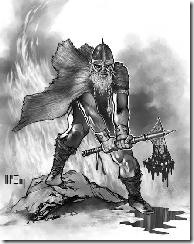
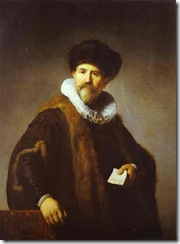
D9-vikingrembrandt112To understand the roots of peace, you must understand that war's greatest opponents are not those whom your schoolteachers might have led you to believe.  

The opponents of peace are legion -- it is because of them that armed defence is necessary; the opponents of war are too few.

The truth is that across all the pages of history  there have been two fundamental antagonists who have been variously venerated and eviscerated:  the trader, and the warrior -- the former the bringer of peace, the latter the bringer of violence.  The man of peaec, and the man of war. The man who relies on voluntary exchange to mutual advantage, and the man who loots and plunders. The man who produces value, and the man who destroys it. The bringer of peace and prosperity, and all the benighted horsemen of the apocalypse.

Cultures that venerate the warrior culture are mired in violence.  Cultures that venerate the trader enjoy peace, prosperity and all the good things that come from those twin blessings

For most of history it has been the warrior who has been most venerated, and the trader who has been most attacked.  This explains the darkness of so much of human history.

The trader buys and sells to everyone's advantage; he relies on voluntary action and peaceful cooperation -- in his work he demonstrates the harmony of interests of free men.  The trader is a man of peace: relying on peace and freedom to function, out of that he acqquires by voluntary exchange the human values that mean civilisation.  The warrior by contrast is a man of plunder, someone who needs and feeds on destruction.  His values are inimical to human life.  He is a destroyer.

I invite you to keep this fundamental antagonism in mind as you read on, and to reflect on the all too obvious fact that despite the trader being the force for peace, it is the warrior who has always got the better press.

The trader is the figurehead of what we might call, 'the three horsemen of peace': three values and institutions which both historically and intellectually underpin the pursuit of peaceful conduct among man.  The first amongst these is trade itself.

Trade.   Trade works.  Trade is simply the voluntary exchange of goods and services to mutual advantage.  In the words of the economists, when I trade my apples for my neighbour's oranges, it is because I value the oranges more than my apples, and my neighbour values my apples more than his oranges. We both see mutual advantage in the exchange, and since both sets of goods are each moved froma  'lower value' to a 'higher value,' the nett result of this and every voluntary trade is that both traders win - everyone kicks a goal! -- and from each trade new wealth is created thereby: the economy is greater for the sum of the higher values achieved, and my breakfast table is richer by some freshly squeezed orange juice -- and my neighbours by my apples.

It us thus that men live by production and voluntary exchange, not by plunder. This is the benevolent 'invisible hand' of which Adam Smith spoke.  It is a hand of peace, since as Frederic Bastiat observed, "when goods don't cross borders, armies will." Countries that trade with each other don't go to war with each other: there's too much to lose.

    "Free trade helps quell government's passion for war. It creates powerful lobbying groups on all sides that demand the preservation of peace and the triumph of diplomacy over hostility. International trade networks create intermediating structures of business relations that work as a barrier to bombs and belligerence. 
    
Trade trumps conquest. Rather than seeing trade itself as a conflict, as something involving embargoes, sanctions and aggressive 'trade wars,' we should realise that peace and free trade are mutually dependent."

Let those who are actually concerned with peace observe, for example, that the free trade era of the nineteenth-century trade brought to the world the most peaceful century yet known.And in the twentieth century, post-war trade brought benefits to twentieth-century Germany and Japan that their earlier destructive attempts at conquest never could.  (You can read that short lesson here: Trade versus Conquest.)

The second horseman is capitalism.

"Laissez-faire capitalism is the only social system based on the recognition of individual rights and, therefore, the only system that bans force from social relationships," observed Ayn Rand in her article 'The Roots of War.' "By the nature of its basic principles and interests," she observd, "it is the only system fundamentally opposed to war.

    "Statism—in fact and in principle—is nothing more than gang rule. A dictatorship is a gang devoted to looting the effort of the productive citizens of its own country. When a statist ruler exhausts his own country’s economy, he attacks his neighbors. It is his only means of postponing internal collapse and prolonging his rule... 
    "Statism needs war; a free country does not. Statism survives by looting; a free country survives by production."

By contrast:

    "Men who are free to produce, have no incentive to loot; they have nothing to gain from war and a great deal to lose. Ideologically, the principle of individual rights does not permit a man to seek his own livelihood at the point of a gun, inside or outside his country. Economically, wars cost money; in a free economy, where wealth is privately owned, the costs of war come out of the income of private citizens—there is no overblown public treasury to hide that fact—and a citizen cannot hope to recoup his own financial losses (such as taxes or business dislocations or property destruction) by winning the war. Thus his own economic interests are on the side of peace. 
    "
In a statist economy, where wealth is “publicly owned,” a citizen has no economic interests to protect by preserving peace—he is only a drop in the common bucket—while war gives him the (fallacious) hope of larger handouts from his master. Ideologically, he is trained to regard men as sacrificial animals; he is one himself; he can have no concept of why foreigners should not be sacrificed on the same public altar for the benefit of the same state. 
    "
The trader and the warrior have been fundamental antagonists throughout history. Trade does not flourish on battlefields, factories do not produce under bombardments, profits do not grow on rubble. Capitalism is a society of traders—for which it has been denounced by every would-be gunman who regards trade as “selfish” and conquest as “noble.” 
    "
Let those who are actually concerned with peace observe that capitalism gave mankind the longest period of peace in history—a period during which there were no wars involving the entire civilized world—from the end of the Napoleonic wars in 1815 to the outbreak of World War I in 1914."

The third horseman of peace is industrial civilisation, and all the values that underpin it.

Industrial civilisation and the values that gave rise to it are fundamental antagonists to the values of war and conquest.  The benefits of industrial civilisation are fundamentally dependent on freedom -- the freedom to trade; the freedom to produce; the freedom to pursue our own individual happiness, secure in our right to do so.  Just as aggressive war is antagonistic to every one of these fundamental freedoms, so too are the fruits of war and conquest.  For centuries man pursued wealth by conquest -- the industrial revolution and the industrial civilization it produced now demonstrates conclusively that wealth comes from production, not from destruction.  Says George Reisman:

    "It is vital to recognize the enormous contribution that the essential vehicle of economic progress, namely industrial civilization, has made to human life and well-being since its birth over two centuries ago in the Industrial Revolution. 
    "Industrial civilization has radically increased human life expectancy: from about thirty years in the mid-eighteenth century to about seventy-five years today. The enormous contribution of industrial civilization to human life is [dramatically] illustrated by the fact that the average newborn American child has a greater chance of living to age sixty-five than the average newborn child of a nonindustrial society has of living to age five. These marvelous results have come about because of an ever improving supply of food, clothing, shelter, medical care, and all the conveniences of life . . . 
    "In the last two centuries, loyalty to the values of science, technology, and capitalism has enabled man in the industrialized countries of the Western world to put an end to famines and plagues, and to eliminate the once dread diseases of cholera, diphtheria, smallpox, tuberculosis, and typhoid fever, among others. . . 
    "As the result of industrial civilization, not only do billions more people survive, but in the advanced countries they do so on a level far exceeding that of kings and emperors in all previous ages . . . "

Trade and the fruits of industrial civilization beat all the conquests made by all the kings and emperors throughout all history into a cocked hat.

    ". . . not only do billions more people survive, but in the advanced countries they do so on a level ... that just a few generations ago would have been regarded as possible only in a world of science fiction. With the turn of a key, the push of a pedal, and the touch of a steering wheel, they drive along highways in wondrous machines at sixty miles an hour. With the flick of a switch, they light a room in the middle of darkness. With the touch of a button, they watch events taking place ten thousand miles away. With the touch of a few other buttons, they talk to other people across town or across the world. They even fly through the air at six hundred miles per hour, forty thousand feet up, watching movies and sipping martinis in air-conditioned comfort as they do so. In the United States [and most other industrialized parts of the world] most people can have all this, and spacious homes or apartments, carpeted and fully furnished, with indoor plumbing, central heating, air conditioning, refrigerators, freezers, and gas or electric stoves, and also personal libraries of hundreds of books, records, compact disks, and tape recordings; they can have all this, as well as long life and good health—as the result of working forty hours a week."

These are the benefits of production, not of destruction; of science and technology put to human ends, not to martial ends; of the fruits of freedom and individual rights, not of tribalism, or nationalism or the gang rule of dictatorship.

Ludwig von Mises saw at first hand the destructive result of two world wars.  After the second, he observed:

    "The statement that one man's boon is the other man's damage is valid only with regard to robbery war and booty. The robber's plunder is the damage of the despoiled victim.  But war and commerce are two different things... 
    "What distinguishes man from animals is the insight into the advantages that can be derived from cooperation under the division of labor...  The emergence of the international division of labor requires the total abolition of war.  Such is the essence of the laissez-faire philosophy of [free trade] ...  This philosophy is of course incompatible with [state worship]... 
    "The root of the evil is not the construction of new, more dreadful weapons.  It is the spirit of conquest...  Modern civilization is a product of the philosophy of laissez faire.  It cannot be preserved under the ideology of government omnipotence...  To defeat the aggressors is not enough to make peace durable.  The main thing is to discard the ideology that generates war."

Which, in summary, is to discard completely the ideology of state worship and omnipotent government.  

Which is to say if you want to give thanks for peace, then thank a soldier.  But do not forget to thank the trader more.