Beware the trick of the carefully selected stat, especially one that excludes a whole nation born and raised on the per-capita criteria.


UPDATE:
Post title changed at the suggestion of Duncan Bayne.
Beware the trick of the carefully selected stat, especially one that excludes a whole nation born and raised on the per-capita criteria.
UPDATE:
Post title changed at the suggestion of Duncan Bayne.
Economist Robert MacCulloch notes that New Zealand's productivity growth, as measured in Olympic medals, is astonishing.
In the 1924 Paris Olympics, New Zealand won one bronze medal in total. It was in athletics for the 100m by Arthur Porritt. The race was later immortalised in the film, 'Chariots of Fire.' NZ had a population of around 1 million back then. Just over 100 years later, the tally is 10 golds, 7 silvers and 3 bronzes*, which after adjusting for population increase, is a huge rise. Meanwhile the United States won 45 Golds at the 1924 Paris Olympics, a tally which has plummeted down to around 37 at the Paris 2024 Olympics. So productivity in this sphere in New Zealand, compared to other countries, is phenomenal.
As you're probably aware, for all sorts of reasons New Zealand is shit at economic productivity.

So why the difference?
On this MacCulloch suggests the reason for this is simple: In sports, unlike elsewhere, New Zealanders value meritocracy "where the fastest, highest, longest .. the best .. wins, regardless of other considerations?"
Kiwis clearly respond to merit being rewarded and produce amongst the finest output in the world when it is. Meanwhile in many other spheres in NZ, everything but meritocracy is winning the day. And productivity is paying the price.
In microcosm, he's probably right. And it's great to see these athletes triumph.
Mind you, if I were to carp — and I will, even if it's a mite too soon — I can't help wondering how much taxpayers and ratepayers are dunned for all this nationalistic gold. You know, how many millions it's cost taxpayers per medal.
Consider, Arthur Porritt paid his own way to Paris in 1924. So that was zero-taxpayer-dollars** per gold then. And now? Well, I'd like someone somewhere to do the calculation ...

* I've updated the totals.
** Yes, it was pounds then. But using that there would be too confusing.
"A comedian asked today if his audience was getting bored from all these slow-news days. Let’s consider the tumult:
"Over the weekend, President Joe Biden did what he said he would not do and quit his race for a second term as US president. He also endorsed Kamala Harris for the bid. Overnight millions and millions of mega-donor and celebrity donations poured in for Kamala and the Democrats now that their favorite fossil was out of the race. ..
"Suddenly, former President Trump has a real campaign to run against veritable competition, and reports started emerging that his campaign people are now doubting hopeful VP Vance is up to the new job because he was supposedly picked to electrify the MAGA faithful, but with the new fight for independent voters, the race becomes a different beast. ... Democrats have swung from all-out despair to surging hope over the course of a weekend. ...
"That graze by a bullet and deaths caused by the assassination attempt have finally united a divided congress to the task of dividing the Secret Service from its leader. ...
"This isn’t just the most tumultuous year of political chaos in the US, geopolitics has ramped up in the last couple of months to suddenly outweigh inflation as a concern for markets ... [with] the prospect of an increasingly fractious Europe, isolationist America and a slowdown in the pulse of world trade. ... after a roaring rally, money is rushing out of potential flashpoints - such as Taiwan's stock market - and into havens such as gold, which hit an all-time high last week….
"'All of Trump's policies are likely to be inflationary - be it tax cuts, immigration, or re-shoring, and hence dollar bearish...so the [US] dollar is likely to depreciate against gold,' ...
"China’s growth is slowing even more, resulting in rescue packages from the Chinese government. So is growth under Bidenomics. ...
"At the same time more than $100 billion has been wiped from the market value of Taiwan Semiconductor Manufacturing Co in less than a week after Trump sounded equivocal about his commitment to Taiwan's protection and chip industry. ...
"Things are also only getting hotter in the Middle East ... Israel bombing Yemen with F-15s in reprisal to a drone attack in Israel by the Houthis ... Russia [moving] ships out of Crimean ports due to decimation of its Black Sea navy by the Ukraine ... Meanwhile, in the West, the Paris Olympics look like a police state, while Europe is gearing up for more war with the introduction of military conscription … In fact, Paris now hosts the largest military camp inside of Paris since WWII so that soldiers (not police) can reach any part of the Paris Olympics, which are scattered around the city, in thirty minutes. ...
"And, of course, on Friday we had the biggest global internet crash in history. ... part of the mad mix of events that have happened all around the world in less than one week’s time. ..."~ David Haggith from his post 'The Year of Chaos Roars!'
There are two regular periods of hiatus in the media.
One comes every year around Christmas-time when everyone pisses off to the beach, and if there is any news around there is no-one around the newsrooms to report it. Media mavens call this the Silly Season, because what does appear in what passes for news is evern sillier than what we normally see.
Seriously.
The other hiatus arrives once every four years when thousands of reporters are flown to the Olympics several weeks before they start, to find they have nothing yet about which to report until the Games actually commence. So, finally sick of interviewing each other and being ignored by the masses they think are following them, they occupy the bar writing stories about how Olympic venues are only half-ready, their water is only half-drinkable (poor lambs), and the air everywhere is only half-breathable. (You want to respond, “so only breathe the toxic half. Please.”)
It’s half-baked. It’s happened every Games since Heracles was a lad. And it’s tiresome.
They could just copy and paste their stories from every other year – and do.
They’ll be right one year. Or maybe half-right.
Which would be a better score than normal for most of them.
.
Interesting to hear that golfers are talking about pulling the plug on Rio because of their fears about the Zika virus, and the feeling that being there doesn’t mean that much to them.
The fears of the Zika virus are real, and only the fact the Olympics these days have become a virtual Government-Games means that decisions about the disease‘s threat to the athletes are not being made rationally, or individually, but by committee.
But the golfers talking about how much competing at the Olympics maybe doesn’t mean to them highlights again that, just maybe, some of the sports now appearing at the Olympics shouldn’t even be there at all. Because every new one that does appear at the Games (like sevens, like soccer, like tennis, like golf, all of which have much bigger fixtures to fry than this one) dilutes the impact of those events that have always been there and always have been associated with the Olympics – the gold medal for which is the biggest thing in an athlete’s life, for which they would crawl across broken glass if they had to.
A simple standard to follow if judging inclusion of a sport or game could be: if the Olympic gold is not the highest trophy in your sport, then your your sport should not be there.
Which is like saying that, you know, unless the Olympic gold means this much to the sportsmen and women involved (and let’s face it, golf isn’t even a sport!) then maybe just give this one away and stick to your Wimbledons and World Cups:
.
In case you were wondering what all those athletes get up to in the Olympic village once their events are over ... the answer is yes, they do. A lot. It's all here in the Times story: 'Sex & the Olympic City.'
As 'Joe' says in the comments, it should be all the news teenagers need to take sporting success more seriously.
"It's a bit crude," says Helen Clark, for newspapers to be doing back-of-the-envelope calculations indicating that $10 million was extracted from New Zealand taxpayers for every medal New Zealand athletes won at Beijing.
 Bugger that. For all that we feel good when an athlete wearing a silver fern gets to stand on an Olympic podium -- and yes, let's admit it, it's a thrill -- isn't it more than a bit crude to extract the money to pay for those moments by force? Not to mention the failures.
At $10m per medal, and with a total sum of eighty million dollars extracted from taxpayers and doled out to athletes both successful and unsuccessful, that makes NZ athletes the country's most highest-paid beneficiaries.
That's not right. As former Wimbledon tennis finalist Chris Lewis said in The Free Radical magazine a few years back,
whenever a problem arises that needs fixing - whether it be sport or any other problem of national concern - the most popular response is: "The government should do something." And more often than not, it does. Alas.
It is individual freedom that is the one thing, due to our inherent nature as thinking, choosing beings, that any proper society should recognise as man's absolute right. To survive, freedom is what man requires above all else; it is his by right, and therefore what the government should do all in its power to protect. The right to my - and your - freedom does not come at anybody's expense, whereas a "free" education, "free" air time, and government assistance with the pursuit of gold medals does; each demands and necessitates an act of government theft. Such acts are moral crimes, they are direct attacks on what life requires - individual freedom - and why I am totally opposed to government funding of sport, Olympic or otherwise, or to any other government programmes or agencies that are funded with stolen money.
Can an athlete get to the top without stolen money?
I did. [So has young golfer Danny Lee.]
"To anyone who holds freedom as sacred," said Lewis, the most urgent problem facing this country is not the number gold medals we win every four years, however many or however few, but "the vile anti-individual philosophies of collectivism and statism that have given rise to this relentless onslaught of the government's violation of individual rights, which includes the proliferation of intrusive, politically correct, government agencies charged with the 'responsibility' of fixing all our problems." Concludes Lewis,
If ever there were a problem that desperately needs fixing, this is it - and I say that the government really should do something. It should get out of the economy and out of our lives as soon as possible. What would soon follow is such a massive flourishing of the gold medal-winning character virtues - virtues of independence, ambition, determination, self-reliance and pride - that New Zealanders would soon lead the world in the most important race of all - the race of life.
Think about it. Now that all the excitement is over, and you're left to look at your bill for it all -- eighty million dollars in total -- just sit back and reflect on the mentality that demands government take responsibility for everything, including making us feel good while watching sport.
Mark Hubbard enjoyed last night's interview with canoeist Ben Fuohy, whose responses (unlike the braindead questions) were refreshingly free of the usual pabulum:
'What do you think went wrong?'
'Doesn't take a blind man to see that. [Looking back down the course]. The winning boat was there, my boat was way back there, damn hard to win a race with a boat in front of you like that.''And do you think you'll take something from this race 'going forward.''
[Fouhy looking at interviewer as if he just arrived from Planet Prime Time.] 'Probably not. No.'
Very forthright. Meanwhile, and from two opposing world-views, Nick Provenzo in posts here and here , and new Tumeke correspondent Phoebe Fletcher both remind us that we should taihoa somewhat in our enjoyment of the Olympic spectacle, lest we forget that China has still to completely shake off its authoritarian past.
UPDATE: Rather than applauding the literally extraordinary Michael Phelps and Usain Bolt for their outstanding victories, as Mindy reports there are some hateful harridans -- hateful of the good for being the extraordinarily good -- who damn their achievement as a means by which to damn achievement per se.
Its very much worth understanding the phenomenon, since this is the mentality of socialism: far better, to this mentality, to ensure the failure of many than to stand back in admiring wonder at the success of a few.
Leave them to their misery. As Jamaican-born John Newnham says, "Isn't it just an effing joyous thing to watch someone *achieve*?!!"


 Who wants to see nude female Olympians? No? Then how about partly dressed Olympian goddeses?
Don't be prudish, now. The pictures are stunning, the links are mostly safe-for-work (just make sure you keep your balls on the fairway and out of the rough) -- and, as the historians in the audience will recall, the Ancient Olympic games were always conducted in the nude.
So as long as the nudity isn't that of Bulgarian wrestlers, what's not to be admired?
Pictured left is Australian diver and Athens gold medallist Chantelle Newbery. Now that's some goddess.
Sp!ked journalist Brendan O'Neill reckons there's only one genuine Olympic value on show every four years: win, win, win . I think however there's one more: athletic beauty.
No wonder the Olympics is still so popular.
Bring it on!
Who, with any sense of life, will be able to resist the two week spectacle of excellence on which all these athletes have been focused for the last four years.
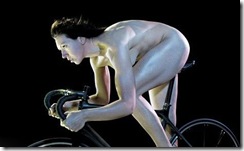 I'm looking forward to seeing champion athletes who've spent years perfecting the skills of their sport demonstrating the heroism of which top sport is chock full -- and modelling the skimpy outfits that show off their champion bodies. (And since the point of laws against performance-enhancing drugs is to protect the purity of sport from athletes using equipment to give them an unfair advantage, I submit that the Olympics should go back to the nudity which was de rigeur in the Ancient Olympics, and applaud those athletes like Rebecca Romero above who obviously shares this view.)
What I'm not looking forward to is the incipient outbreak of nationalism that goes with every Olympics -- expect the outbreak to be even more virulent given this year given the Olympics' proximity to two major elections.
And I'm prepared to be amused by the likes of a question from Keith Locke to Helen Clark in Parliament on Tuesday, asking the Prime Minister if she would be "advising New Zealand athletes to wear face masks" to protect themselves against Beijing's smog. Instead of advising Mr Locke that unlike himself world champion athletes might have some clue themselves about how to protect their own air passages should that be necessary, instead of telling him to grow up and get his own life, instead of telling him that what New Zealand athletes wear is not the business of the Prime Minister ... instead of any of that, she told him that on TV the other night she "saw patches of blue sky" over Beijing, so she thought such advice wasn't necessary.
It's hard to know who's more stupid.
The Olympics are about to start. Bring on the human drama!
UPDATE: Scott Powell says, "One of the things I love about world sporting events such as the Olympic Games, other than the displays of fantastic athleticism, is that they provide an opportunity for people to escape from oppressive regimes by seeking asylum in freer countries. The fact that this won’t be possible in 2008 because the Olympics are being held in one of history’s most oppressive nations is only one dimension of the travesty that are Olympic games in China, but at least one athlete may have found a way around the problem...." Read on here for the story.
The murder of sixteen Chinese policemen by Islamist militants in western China, just five days before the Olympics start in Beijing (where security is being stepped up), highlights once again that complacency about worldwide Islamist terror is based more on wishful thinking than it is on observation and thoughtful analysis of what's actually going on in the world.

A student of Frei Otto, who produced the astonishing Munich Olympic Stadium roof, architect Thomas Herzog designed these stylish timber shells to shelter temporary displays at the World Expo 2000 in Hannover, Germany. Architect Penny Richards describes what's going on:
The canopy comprises 10 modular elements, each one measuring 40m x 40m, at a height of 20m above ground level. The elements are timber double-curved lattice shells, each supported on a central structure.
The roof shells cantilever out on all sides looking like giant whale tails. The shells are covered by a pre-stressed translucent membrane and the rainwater is collected and brought to the ground through each of the central structural supports. These supports are each cut from a single tree trunk, from the classic Silver Fir, of the Black Forest. Seventy trees 50m tall were selected. The bark was stripped with high-pressure water jets and the trunks were cut in half lengthwise, to form each of the four corner columns.
This elegant but robust canopy is a demonstration of a tree reborn from the forest to the structure. The columns represent the simple vertical structure of the tree, and the filigree lattice shells represent the tree canopy. The timber lattice allows daylight to penetrate below, just as it does in the forest.
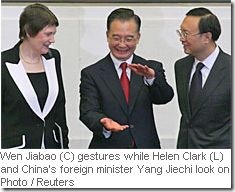 Free trade? Free trade doesn't come with tariffs, employment restrictions and other protectionist restraints on trade. It doesn't come with pages and pages of agreements on duties, tariffs and quotas, and the continued entanglement of the state with economics. Free trade is what it says it is: trade that's free of all government restrictions on sellers and buyers.
Genuinely free trade doesn't need pages and pages of lofty documents to protect them -- all that capitalist acts between consenting adults need to flourish is the disentanglement of the state from the loading docks and business houses of importers and exporters. It's said that the US Declaration of Independence was written on one piece of parchment, and the ten commandments on two pieces of stone, but the European Union regulations on trade in bananas fill four hefty volumes that are less readable than a your average book of Chinese algebra. That's not how genuine free trade looks.
On that basis, the agreement the New Zealand government has just signed is not a free trade deal, but merely a freeish trade deal.
But that's still a good thing. And it's damned exciting to see two countries letting the breath of freeish air blow through their trade relations .. and damned refreshing to see politicians from all persuasions celebrating the opening up of trade and to announcing the slow abandonment of protectionism. What we have today is better than we had yesterday -- even if it's not as good as we'll have in 2019 when the last of the tariffs is supposed to run out -- and more than you'd expect from two governments both on the reddish end of the political spectrum.
For those opposed, let's just remind ourselves of the chief benefits of trade:

Not everyone can see these benefits however, or if they do recognise them they raise other issues.
The fact is that this freeish trade deal is something to celebrate, just as it's something to celebrate that so many commentators are prepared to celebrate it. That' real cause for a double celebration. Cheers!
UPDATE: Not all commentators are prepared to celebrate. John Minto, as you may have guessed, isn't prepared to celebrate. He had an anti-trade piece in the Christchurch Press yesterday. Paul Walker makes a few comments on his article here, and good ones they are too. He concludes, not unreasonably, "Mr Minto should enrol in a first year economics course, he would learn much. But he would then have to buy the textbook ... and that is most likely to be imported."
"The 2008 Olympics will 'open up' China about as effectively as the 1936 Olympics opened up Germany," said Robert Tracinski in 2001. Recent events in Burma and Tibet and the ongoing human rights abuses and continuing existence of slave labour gulags show he and other commentators making similar points were right. With the Olympics just months away, Chinese politics now looks little different to Chinese politics at the time of the Tiananmen Square massacre.
The chief question for New Zealanders to consider as we read news of Buddhist monks being shot on the streets of Lhasa is whether free trade will 'open up' China more effectively than the Olympics.
I have my own views on that, but I'd be interested in hearing others. What do you think? Given that the chief importance of a NZ-China free trade deal to the Chinese is their hope that our deal will presage others, what do you think the effect of free trade with China will have on China itself?
I'd love to hear your views in the comments.
Some undercover photos suggest perhaps not.
UPDATE: Aaron at Save the Humans has gone undercover to find the six mascots in the running to represent the '08 Beijing Olympics. They include:


 Built for the 1992 Winter Olympics in Albertville, France, this is Santiago Calatrava's competition winning Airport Railway Station for Lyon-Satolas - as a sketch (right), as a model (above), and as the real thing (left).
Attention now turns to Helengrad: How does Mallard spin these two votes to sidestep the resounding "No" vote? What deals can he do? And does he have the numbers to get the necessary legislation voted through? Herald summary here.In summing up just before the vote, ARC Chairman, Mike Lee says it all came down to a matter of costs, not just of building the stadium, but on Ports of Auckland and the environment.
He also counted the moral cost of over-riding the Resource Management Act, the precedent and moral dilemma that it would create for councillors. Mr Lee says those costs are just too great.


 The canopy comprises 10 modular elements, each one measuring 40m x 40m, at a height of 20m above ground level. The elements are timber double-curved lattice shells, each supported on a central structure.