Showing posts with label Libertarian Party. Show all posts

Friday, 24 May 2024

What’s Donald Trump Doing at the Libertarian Party Convention?


What the hell is Donald Trump doing at a Libertarian party convention? As David Boaz hints in this guest post — and Peter Goettler makes clear in his linked op-ed — it's probably because the US Libertarian party is now sadly un‐​libertarian ...

What’s Donald Trump Doing at the Libertarian Party Convention?

by David Boaz

The Libertarian Party presidential nominating convention is coming up this weekend, with Donald Trump as a featured speaker. This is apparently the first time in US history that a political party has had another party’s nominee at its own nominating convention. And what a choice!

The Libertarian Party was founded to “challenge the cult of the omnipotent state and defend the rights of the individual” and to specifically run candidates for office on a platform of personal liberty, economic liberty, and a peaceful foreign policy.

Needless to say, that’s not Donald Trump’s platform, nor does it describe his actions as president. Which is why most libertarians, except the LP faction that won control of the party in 2022, are mystified and appalled about why a self‐​proclaimed libertarian party would invite a would‐​be autocrat to dominate media coverage of its convention.

Just posted at the Washington Post is a column by Cato president and CEO Peter Goettler exploring this mystery. Goettler explains what libertarianism is:
Libertarianism, at its core, is the modern manifestation of classical liberalism, the transformative movement that, beginning in the 18th century, challenged monarchs, autocrats, mercantilism, caste society, slavery and religious persecution. As heirs to that tradition, libertarians believe in individual freedom, equality under the law, pluralism, toleration, free speech, freedom of religion, government by consent of the governed, the rule of law, private property, free markets and limited constitutional government.
And how Trump differs (as if it wasn’t obvious):
He allowed government spending and debt to continue to spiral upward, increasing the national debt by $8.4 trillion. Federal outlays soared from $4 trillion his first year (2017) to $6.8 trillion in his last year. He persists in railing against immigration and free trade, supports further expansion of presidential power and seeks to crack down on political enemies.
Goettler also points out how sadly un‐​libertarian the LP’s current leadership and its messaging are.

Read the whole thing.

* * * * 

David Boaz is a distinguished senior fellow of the Cato Institute. Over more than four decades as vice president for public policy and executive vice president, he played a key role in the development of the Cato Institute and the libertarian movement. He is the author of The Libertarian Mind: A Manifesto for Freedom and the editor of The Libertarian Reader.

Thursday, 30 June 2016

You know, there *are* better options than #ClintonTrump


This is two minutes worth sharing for any voters not happy with the Clinton/Trump option in 2016 (and who in the hell they would both make would be happy?):


But these Libertarian Party candidates have no chance, you say? But Johnson is polling between 12% - 16% in battleground states – and once polls show the ticket at15% then by law (yes, I know) Johnson must be included in all presidential debates. (And you know what a gamechanger that would be.)

But it’s still a wasted vote? The only wasted vote is one for something you don’t believe.

And you can hardly, seriously, say that you could believe in what either of the alternatives represent, can you. Come on, repeat after me:

Flag.

[Hat tips Monica B.]

.

Thursday, 2 June 2016

Times are changing: Liberalism is back!


f_fh_garyjohnson_160528

Guest post by Jeffrey Tucker

I just returned from a historic event, the nominating convention of the Libertarian Party. (I spoke but was not a delegate and declared no support for any particular candidate.) It was a thrilling, raucous, contentious, fun, serious, and, ultimately, an ebullient event filled with high drama and intense argument.

I had keynoted the last convention in 2014, and the difference between that event and this one was palpable. What made this one historic where the other was not? The remarkable events of this year within the two major parties have created an unprecedented opportunity. The sense of this was easily discernable. This was not a civic club. This was not a social gathering. This was not a liberty-themed meetup: it was a meeting to nominate a serious candidate for the world’s highest political office.

Liberalism2This is a political party. And it matters. The Trump takeover of the GOP, and the entrenched power of the Clinton machine with the Democrats, mean that people who are looking for freedom from power have nowhere within the system to go. This opens the possibility that a new and clear voice can be heard within national politics that points the way not toward more government control but toward the cause of human liberty itself.

What struck me, however, is how the big-picture significance of all of this was largely lost on most commentators and delegates at the LP convention. Despite the ominous sense of responsibilities, they argued ad infinitum about ideology, theory, personality, and strategy. But I found few people who understood the full meaning of what is taking place.

What we have developing here is a new epoch in American politics: an authentically liberal (in the classical sense) political movement in the US is being born as an alternative to a deeply corrupt and ideologically dangerous mainstream dominated by two parties that have trended inexorably socialist and fascist.

In terms of mainstream politics, it’s the interwar period all over again: brown shirts versus reds—one wing of statist thugs arguing with the other over the political carve-up. Except there is a way out this time. This new movement has a message that is clean and clear: Enough is enough; let us be free. Freedom works; government power does not. The emergence of a national political party that stands for liberty might be necessary but it is surely not sufficient. It is a sign of the rise of a broader and potentially transformative social, cultural, and intellectual movement that offers a third way beyond left and right.

Labour, Tory, and Liberal

Consider the way politics has fleshed itself out in most developed democracies over the last 150 years. There have been three broad camps (or parties), which we can call Labour, Tory, and Liberal. The names of the first two have changed (left, right, socialist, fascist, Democrat, Republican, Conservative, fake “Liberal”) but the themes have remained the same. The third force is known in most parts of the world as liberal except in the U.S. where it is called libertarian today.

Labour was born in opposition to free markets, from the conviction that wealth was being wrongly distributed toward “capital” and at the expense of labour. This party has included labor unions, welfare statists, social democrats, socialists and even communists. It generally favours higher taxes, more regulatory control, and restrictions on commerce. Over time it came to represent the public sector bureaucracies and, finally, to embody every resentment against free enterprise you can dream up.

Liberalism3The Tories represent a different branch of the ruling class: the large banks, corporations, landed aristocracy, the dominant racial heritage, and the rich generally. They later came to include the interest groups that had a strong interest in an imperial foreign policy. This party had a different set of complaints against commercial freedom: It is too disruptive of tradition. It rewards the wrong people. It threatens business monopolies. The Tories long favoured their own flavour of government control to restrain the “excesses” of freedom.

What the Tories and Labour have always shared was a common desire to curb laissez faire based on their conviction that society needs some plan emanating from the top, imposed by wise and public spirited people with the power to rule. In U.S. history, these parties have had different names, but everyone knows them today as Democrats and Republicans. They have traded places many times but always moved toward the same general goal: an ever-bigger state and ever-less liberty.

The Liberal Party

And who are the Liberals? The liberal idea was born in the high middle ages and Renaissance, with the rise of commercial freedom and the prosperity that followed. It grew further with the realisation that religious freedom is possible and need not send society reeling into chaos. (Thus did liberalism in its infancy chastise both political and religious powerbases, earning their eternal emnity.)

The idea of freedom extended out during the Enlightenment to include speech, press, property rights, and foreign trade. By the 18th century, it came to include a love of peace and an aspiration for universal human rights.

Liberalism came of age in the 19th century, and its achievements were legion: social mobility for the whole population, new technologies of liberation, the end of slavery, the advance of women’s rights, the explosion of population, and the vast and wholy unprecedented expansion of income and living standards. Its economic form was capitalism, the greatest generator of wealth for the masses of people ever discovered. The message of Liberalism was clear and exhilarating: all humans have rights that cannot be violated by the state, and, so long as this is the case, society can manage itself without authoritarian control.

Liberalism4It was a beautiful period, filled with optimism. But Liberalism had its enemies on the left and on the right. The storm clouds gathered and disaster struck in the 20th century. Liberalism was dealt a terrible blow by World War One and the government controls that followed in its wake. In the course of one decade in most parts of the developed world, we saw vast and sweeping victories against liberty as wrought by both the Labour and Tory forces: labour controls, income taxes, central banking, product regulation, racial segregation, zoning, marriage controls, speech controls, prohibitions, and imperialism as a national habit.

Even before the Great Depression kicked off unprecedented experiments in central planning and economic control, Liberalism had nearly vanished from politics, academia, and popular culture.

Ludwig von Mises was writing in Vienna at the time and attempted one last explanation of the Liberal philosophy. His brilliant 1927 book on the topic remains a statement for the ages. He pointed out that at this stage of history, all existing political parties represented a lobbying force for some segment of the population. Only liberalism, which had no party, represents the common interest of everyone. But given the size and scope of government, even he doubted that liberalism would return in his lifetime, and sadly he was right.

The Liberal Diaspora

Given this situation, where did the liberals to go? They were homeless by the time World War Two broke out. In the U.S., following the war, they had been largely driven out of national politics. They were excluded from legislative priorities and media culture, not to mention academia. So the handful that existed turned to writing, publishing, independent educational ventures, civic organisations, and think tanks.

A beautiful example of this was the establishment of the Foundation for Economic Education in 1946 by Leonard E. Reed. He saw a need for liberalism to have a voice and made FEE its home. He preferred the term liberalism but, sadly, the term had been taken over by Labour and the left.

Reed was the first in the postwar period to suggest the substitute term “libertarian” and, later, came to reject all labels in favour of what he called the “freedom philosophy.”

By the early 1970s, the movement had grown to the point that it attempted its own political party. It was obvious that with Richard Nixon in control of the Republican Party, liberalism was without any American political voice. The preferred name of Liberal was still taken, so a new party was named the Libertarian Party. Despite some small victories, it has never really taken hold as a viable competitor to the two major parties. (You can read a good timeline of the party here.)

The Union of Tory and Liberal

Still, the Liberal movement grew, under the influence of FEE and the Mont Pelerin Society, among many new upstarts. The names of their intellectual leaders are now household names among libertarians: Mises, Hayek, Rothbard, Rand, Lane, among many others.

In the 1980s, in the United States and the UK, the Tories were led by two individuals who adopted liberal rhetoric: Ronald Reagan and Margaret Thatcher. In both their platforms, we saw a fusion of concerns for individual freedom (focussed on economic freedom) together with traditional Tory concerns for national security and restrictions on civil liberties.

Liberalism7This alliance of interests produced some remarkable results such as deregulation, tax reductions, reduced use of money printing, and freer trade. The results were brilliant by comparison to the malaise of the previous decade. Economic growth boomed. Technological innovations grew at an unprecedented pace. Such were the achievements not of the Tory element of the administrations but of its liberal sectors, that which curbed the growth of government and backed private enterprise, thereby unleashing human creativity all over the developed world, inspiring a global revival of Liberalism.

Within living memory, the party of Liberalism came to be stuck with this partnership. It has generally been beneficial, though muddy. The message of freedom became mixed up with other concerns central to Tory ideology: war, corporate monopoly, financial manipulation, prohibitionism, and social control. To this day, this is a serious problem for the Liberal party. We get stuck with the bad reputation of Tory policies, though we technically bear no responsibility for them.

The 21st Century Tory-Liberal Divorce

It was a long time coming but tensions finally boiled over in 2015 and finally with the apparent nomination of Trump in the spring 2016. Trump, representing an old Tory ideology devoid of the virtues of Liberalism, reasserted the raw statism of interwar politics. His central pillars are familiar to anyone of a certain generation: nationalism,mercantilism, migration restriction, military belligerence, censorship, prohibition, even to the point of praising internments and recalling a pre-Enlightenment view of religion and society.

Liberalism5It was as decisive as it was ugly: the liberal spirit had finally been purged from the Republican party. There was no more room at the table (and anyone who claims otherwise is not looking at reality). It represents a repudiation of Reaganism, Thatcherism, and the ‘liberal-Tory coalition’ that drove the world to recovery. You only need to compare the speeches of the Reaganites on economics and immigration with those of Trump. They are world’s apart.

The shattering of this coalition is the single most significant political event of our times. It is done. It is a fact. It is decisive. And it will change everything for the foreseeable future.

Liberalism Defines Itself

Just when everything seems lost, you look around and see something beautiful. For 45 years, activists have been struggling to keep the awkwardly named party alive. And it does live! It is on the ballot in every state. It has a full and well-developed platform. It is ready for action.

In the last six months, some awesome people stepped up, ready for the nomination at the top of the ticket. The results were not to every taste but still extraordinary in broad terms. The party rejected the extremes at all ends and voted to nominate two former governors as standard bearers, two men who speak plainly and clearly about freedom in all its forms.

People can complain about this particular issue or that one. But no one can dispute that both Gary Johnson and William Weld represent the Liberal spirit that is now called libertarian. The difference with the Republicans and Democrats is unmistakable. The LP is neither left nor right, neither Labour nor Tory, but a third choice: Liberalism as traditionally understood. That is the ethos of the party and the message of its candidates to the American people and the world at large.

It is a breathe of fresh air. 

Liberalism6In other words, believers in liberty are exactly where we need to be. It’s a big tent, as it should be. It includes as many varieties of Liberalism as there are people who want to be free

And please remember: it's not just about politics. In fact, politics is the least of it. The LP (and I wish it were called the Liberal Party) is finally positioned to be the political voice of a cultural, social, and entrepreneurial resistance movement to the left (Labour, Democrat) and the right (Tory, Republican). The takeover of the GOP by illiberal nativists/protectionists/authoritarians is what finally pushed it over the edge.

No, history does not end with this election. One could say that it is just now beginning, now that we finally have a choice, for the first time in our lives.

People often say that America has a two-party system. People always believe that the status quo will last forever. The truth is that the status quo always lasts until, suddenly, it doesn’t.

Times are changing. Liberalism is back.


tucker2Jeffrey Tucker is Director of Digital Development at FEE and CLO of the startup Liberty.me. Author of five books, and many thousands of articles, he speaks at FEE summer seminars and other events. His latest book is Bit by Bit: How P2P Is Freeing the WorldFollow on Twitter and Like on Facebook.
His post first appeared at FEE.


RELATED POSTS:

Wednesday, 1 June 2016

“I am finally done with voting for the lesser of two evils… I am not just for Johnson/Weld 2016. I am *enthusiastically* for Johnson/Weld 2016.”


13312599_10209713412095757_4751011182562816317_n

No, New Zealanders can’t vote in the American presidential elections. (Can someone please inform the more rabid locals who hallucinate otherwise?)

One of the more sane Americans I know living in New Zealand can vote, however, and she’s enthusiastic about a third-party candidate with more experience than either of the big-party teams. Listen up:

I am finally done with voting for the lesser of two evils. I have reached my limit. Many of you who were much wiser than me reached this limit a long time ago.

I get the general fear factor over Trump. I’ve spent a lot of time, with equal parts horror and fascination, analyzing him. But I cannot in good conscience pull the lever for Hillary Clinton merely because she’d be more predictable with the nuclear launch codes, even though I've contemplated doing so. I think this deserves a brief diversion because my own FB wall has been a general avalanche of Trump articles for nearly a year now.

Hillary Clinton very likely had Vince Foster, and possibly a dozen other people connected to Whitewater, killed. Add to this all of the rest of her murderous and traitorous scandals of the past 20 years (PardonGate, SniperGate, FoundationGate, BenghaziGate, EmailGate).

None of this should ever, ever be forgotten in America's current range-of-the-moment, attention-span-of-a-gerbil, theater-of-the-absurd — in which otherwise decent people ponder casting a vote for a vile, predictable psychopathic killer in order to prevent a vile, unpredictable, vulgar, misogynistic, racist, would-be psychopathic killer from achieving the highest elected office in the world.

And while I have used the ‪#‎neverTrump‬ and ‪#‎neverHillary‬ hashtags in the past, I’m done with them now. My political views are not based on negatives and what I am against.

I am for the Constitution. I am for individual rights. I am for free markets. I am for liberty.

Gary Johnson fulfills most of the above. And here’s something even more important to me than a candidate’s ability to mouth the right platitudes: a clear record of course-correction on quite a few issues over the years. (I've watched him closely over the years, and I'd be happy to discuss those details in the comments for those who wonder what they are.) Johnson is not an inflexible person who cannot admit his mistakes or errors.

This ties into that matter of character. While Johnson might lack polish, he is a sane, compassionate, honest, decent, and accomplished man with mostly good ideas.

It doesn’t get much better than that.

Our individual votes matter little. Yet what we do to influence how others vote probably matters quite a lot.

This is why, like the porcupine in my avatar, I bristle when people go to great lengths to give endless disclaimers about Gary Johnson, as they admit they will maybe… probably... grudgingly… finally... vote for him.

With friends like that, who needs enemies?

I am not just for Johnson/Weld 2016. I am enthusiastically for Johnson/Weld 2016.

As if you couldn’t tell. :)


RELATED POSTS:

  • And 2000 news articles (literally) about the Libertarian Party in the past 7 days.
    Gary Johnson Supporters 2016
  • Within minutes of Gary Johnson being named as the Libertarian Party nominee, he is dismissed by Donald Trump as a “fringe candidate.” Johnson supporters cheer.
    Donald Trump dismisses Gary Johnson as a ‘fringe candidate’ – WASHINGTON TIMES
    Libertarian Gary Johnson: This could be year for third party – STAR-TELEGRAM
  • Young people are the ones who have borne the brunt of the past two administrations' horrible policies. Maybe they'll wind up saving us from this mess.
    Do Not Dismiss Gary Johnson and the Libertarians – John Zogby, FORBES
  • "Just when everything seems lost, you look around and see something beautiful.
    "What we have developing here is a new epoch in American politics: an authentically liberal (in the classical sense) political movement in the US is being born as an alternative to a deeply corrupt and ideologically dangerous mainstream dominated by two parties that have trended inexorably socialist and fascist.
        “In terms of mainstream politics, it’s the interwar period all over again: brown shirts versus reds. Except for this: there is a way out this time. This new movement has a message that is clean and clear: enough is enough, let us be free. Freedom works; government power does not. The emergence of a national political party that stands for liberty might be necessary but it is surely not sufficient. It is a sign of the rise of a broader and potentially transformative social, cultural, and intellectual movement that offers a third way beyond left and right."
    The GOP Implosion and the Rebirth of (Classical) Liberalism – Jeffrey Tucker, FEE

.

Wednesday, 16 July 2014

Thursday, 7 November 2013

Those annoying third-party libertarians

Republicans in Virginian are spitting tacks that their candidate for governor, Ken Cuccinelli, was narrowly beaten by Democrat Terry McAuliffe—beaten by a margin less than the votes received by the Libertarian candidate Robert Sarvis.

“Thanks, Libertarians, for giving us Terry McAuliffe as governor.” That was a fairly standard response from Virginia Republicans—assuming without question that Libertarian votes somehow “belong” to Republicans. Libertarian-voting Scott Shackford at Reason tells them to get a life:

In the spirit of reconciliation, here are some tips from a typical third-party voter to major party movers and shakers who are trying to figure out how to approach us…
    We don’t like your candidate. Really, this should go without saying. We are not voting for your candidate because we don’t like your candidate and what he or she stands for. At least, he or she stands for enough things we don’t like to want to see your candidate lose… That the outcome was McAuliffe’s victory is also unfortunate, but don’t assume that Sarvis voters actually saw Cuccinelli as the lesser of two evils.
    You need to make an actual case for your candidate. Once you wade out of the red team versus blue team fight, you have to set aside the mentality that comes with it. Too many folks were still making the argument that Cuccinelli was better than McAuliffe when they needed to be making the argument that Cuccinelli was better than Sarvis…
     Respect that voters determine their own political priorities. I criticized Carney’s column because it felt to me like he was saying that those libertarians who were voting against Cuccinelli because of his social conservatism should deprioritise these concerns. He argued that “identity politics” was helping sink Cuccinelli. As frustrating as “identity politics” can be, it’s important not to confuse the term with the idea that voters have different priorities than you have. Voting against a candidate because you believe he will try to implement policies that will harm you or people you care about is not identity politics, even if the policies are connected to your identity. I have read a number of folks lamenting that voters turned against Cuccinelli on these “social issues.” The outcome of such a complaint is giving the voter the impression that you don’t care about or don’t respect their personal priorities when choosing a candidate. If that’s the case, how can you ever expect them to vote for yours?

There’s more, much more at:

Friday, 23 February 2007

Cue Card Libertarianism: LIBERTARIANISM

Each 'Cue Card Libertarianism' entry forms part of a series intended to introduce newbies to the terms used (or as used) by New Zealand libertarians. The series so far can be found archived here, and the Introduction here.

LIBERTARIANISM: Libertarianism as a political idea is four-square for freedom. At the basis of libertarianism is the principle that all adult human interaction should be voluntary, or to put it another way, that capitalist acts between consenting adults should be legal.

There are many ways to put the point. In a political context, freedom has only one specific meaning -- freedom from the initiation of force by other men. US libertarian Murray Rothbard puts it this way:
"The Libertarian creed rests on one central axiom: that no man or group of men may aggress against the person or property of anyone else. This may be called the non-aggression axiom. Aggression is defined as the initiation of the use or threat of physical violence against the person or property of anyone else."
This point has been well enough rehearsed under other Cue Card entries, but it should be noted at this juncture that many advocates of the Non-Aggression Principle, including myself, do not regard it as an axiom.

An axiom is a fundamental, self-evident truth; it does not require “grounding’.” The Non-Aggression Pinciple is fundamental, but far from self-evident; it does need grounding. The question for libertarians is how it is grounded.  Rothbard boasts that not insisting on such a foundation has enabled the Libertarian movement to be "eclectic." As the US Libertarian movement demonstrates, this has not been an unequivocal virtue, the "eclecticism" encompassing a "broad church" of adherents from all manner of philosophic (or non-philosophic) positions, including emotivism, hedonism, Kantian a priorism, Nozickism, neo-conservatism, pacifism and many others. Few of these positions are defensible. Most of them are represented in US Libertarianism.

 Objectivists in particular regard it as positively dangerous to treat the Non-Aggression Principle as axiomatic, and insist on the need for an ethical/epistemological foundation. Objectivist Peter Schwartz, for instance, says that without the correct philosophic base, "liberty means nothing…"
“Ultimately [however], liberty is justified because it is a necessary condition of human survival; force is unjustified because it is an attack on man’s means of cognition. Only philosophy can identify so fundamental a connection.” 
 Mr Schwartz goes on to attack (correctly) the more bizarre subjectivist elements of the American libertarian movement. As Shwartz points out, and this article explains, this principle of the non-initiation of force was formulated and popularised by Ayn Rand, and her advocacy of individual rights and limited government in her novels and speeches was largely instrumental in the rebirth of libertarianism in the 1960s. Sad that so many US libertarians fail to give her her due.

Her thought is still a major influence in the general libertarian movement, but Rand herself thought the differences so great that she rejected the label "libertarian," and called libertarian luminaries such as Rothbard (accurately) "Hippies of the Right." She preferred to be known as a "radical for capitalism." In the American context, I sympathise with that view.

In the New Zealand context, however, where any talk of freedom is foreign and libertarianism is still nascent, Not PC supports the position of both Schwartz and Rand but recognises that the perfect should not be made the enemy of the good.. For example, I would regard a Christian who endorses the non-initiation of force principle – however untenable the means by which he or she arrives at it – as less likely to threaten freedom in his actions than one who doesn’t, and as someone who can be persuaded to do better. Mr Schwartz, however, eschews such attempts. Such is his right.

Just to be clear, at this blog I use the term libertarian to denote, supportively, the Non-Aggression Principle; I believe in grounding this principle in sound antecedent principles; however for the most part I maintain (or try to maintain) cordial relations with those who regard the Non-Aggression Principle not as a principle, but as a self-sufficient, self-evident axiom, or with those whose antecedent principles we regard as unsound.

This is part of a continuing series explaining the concepts and terms used by New Zealand libertarians, based on the series originally published in The Free Radical in 1993. The 'Introduction' to the series is here.


RELATED POSTS ON: Cue Card Libertarianism, Libertarianism, Politics-World, Objectivism, Philosophy

Wednesday, 26 July 2006

Cue Card Libertarianism - Pro-Liberty, not Anti-State

Libertarians are not anti-state, they are primarily pro-liberty -- we define ourselves by what we are for, not what we are against. In the current state of the world, that difference makes all the difference in the world.

Pro-liberty libertarians understand that freedom in the political context means freedom from physical coercion, and in order to protect themseves from physical coercion individuals have the right to self-defence, to the use of retaliatory force. In order to bring this use of force under objective control, and to bar the initiation of physical force, governments are a necessity -- agencies, that is, that hold a monopoly on physical force in a given area. The job then is to tie up governments to do just this job, which is the reason constitutions were invented.

In the words of Ayn Rand: "A government is the means of placing the retaliatory use of physical force under objective control." To pro-liberty libertarians, this is the underlying purpose of governments, and the means by which liberty is assured. It is only by this means that the libertarian non-agression principle can be enforced, ie., that no person should initiate force aginst any other.

There are 'anti-government' and 'no-government libertarians' about however: they are more accurately called anarchists, or even anarcho-capitalists -- or as Ayn Rand used to accurately call them, "hippies of the right." Right on. You can find such types at sites such as AntiWar.Com, and LewRockwell.Com -- sites inhabited respectively by pacifists, who renounce the right to national self-defence altogether (it is national self-defence that causes all wars they will tell you), and by antediluvians (who frequently maintain that Abraham Lincoln was a Nazi and that the southern slave states should have won the Civil War).

Anarchism in either form is not pro-liberty; it does not bring force under objective control -- it cannot ensure the universality of the non-agression principle, or of any principle. Instead, at best, it simply sets up a market for competing forms of force.

Such a market can presently be seen in the suburbs and villages of Somalia and Lebanon.

There is one main area in which the difference between pro-liberty libertarians and anti-state anarchists is tragically apparent: Defence. Pro-liberty libertarians realise that to protect their citizens, governments must run credible defence forces that can protect against foreign invasion or interdiction. This is a legitimate role for governments: to uphold as Lindsay Perigo says, "the right to life, to liberty and the pursuit of one's enemies" when those enemies have designs on your life.

Anarchists however just wave their hands around and pretend this isn't necessary. Murray Rothbard for example, the godfather of modern anarcho-capitalism recognised that an anarchist society could not provide such a credible or unified force, and rather than dismissing as absurd his devotion to anarchy, he instead embraced the absurd by arguing it wasn't even necessary.

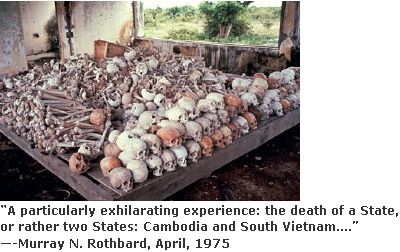
Rothbard's rationalistic devotion to his anti-state views led him to claim -- at the height of the Cold War -- first, that there were "no external threats to the US"; second, that what looked like a clear threat, the Soviet Union, was in fact "devoted to peace"; and third the real villain of the Cold War was in fact the United States, who was "more warlike than even Nazi Germany."

Not just bizarre, then, but disgraceful. This is the man who "rejoiced" at watching what he called “a particularly exhilarating experience: the death of a State, or rather two States: Cambodia and South Vietnam….” You might care to know, as Murray didn't, that between them the deaths of those two states led directly to the deaths of about five million human beings. As Tom Palmer says on this episode"it matters which state replaces which."

It sure does.

As I said at the outset, given the current state of the world and the many very real external threats to human beings from terrorists and Islamists, the difference between being pro-liberty and being anti-state has never held more implications for the future of liberty around the world, and for our civilisation that is based on that liberty.

The anti-state anarchist must of necessity deny the existence of any real threat, and instead simply blames The Warfare State (the repository of all evil) or America ("more warlike than even Nazi Germany") for all the evils that exist. The pro-liberty libertarian however understands that this is nonsensical; that for liberty and civilisation to exist and be maintained, it is right to hunt down the bloodsoaked enemies of liberty and freedom who say they love death and who wish to inflict it on us.

Given the current state of the world then, the difference between being pro-liberty and anti-state may just be the difference between liberty and death.

LINKS: Cue Card Libertarianism - Force - Not PC
Cue Card Libertarianism - Government - Not PC
Cue Card Libertarianism - Constitution - Not PC
Cue Card Libertarianism - Freedom - Not PC
Cue Card Libertarianism - Anarchy - Not PC
Apologetics for 'Death of a State' - Tom Palmer

RELATED:
War, Cue Card Libertarianism, Libertarianism, Politics-World, Israel

Tuesday, 17 May 2005

Cue Card Libertarianism -- Anarchy

Anarchy is the absence of government and law. Some anarcho-libertarians maintain that anarchy is the only state consistent with liberty, or that if we are to have government at all, it should take the form of private, competing governments. Most, including me, emphatically oppose these positions, arguing that whatever the nominal starting position of such a society, the result is gangsterism en route to something worse.

All that is spoken about by anarcho-capitalist ‘hippies of the right’ about the systems of anarchy amount in this view to no more than wishful thinking about the state of things and the nature of men. Some men. As James Madison said, “If all men were angels no government would be necessary. If angels were to govern men, neither external nor internal controls on government would be necessary.” But all men ain't angels, hence the need both for goverment and for controls on that government. We call those controls a constitution, just as Madison did.

Government and law then, ideally speaking, exist to protect the individual from physical coercion and from its derivative, fraud; in the absence of government and law there can be no such protection, and no proscribing of coercion in the first place. One cannot rely on spontaneous benevolence to effect a miraculous disappearance of compulsion from human affairs; human beings are volitional, and as such, capable of error and evil, from whose coercive forms it is legitimate to institute protection.

The agency of protection can be likened to a referee, beholden to no particular player, ensuring with scrupulous impartiality that the rules of the game (in this case, no murder, theft, rape, etc) are observed. To advocate anarchy is tantamount to saying that each player may make up his own rules and then enforce them as best he can – by enlisting anyone he chooses, in the case of advocates of private governments – clearly a prescription for the rule of brute force.

The need for an objective, neutral agency to which citizens can repair in the event of force being initiated against them is inescapable. That agency is government; good government is the means by which the retaliatory use of physical force is placed under objective control.

For more on this topic please see The Contradiction in Anarchism by Robert Bidinotto, Freedom vs. Anarchy by Lindsay Perigo, and A Comment on Anarchism by David M. Brown. And just remember what P.J O’Rourke said was the first thing an anarchist would be saying when visiting mid-eighties Beirut: “Uh, more police please.”

This is part of a continuing series explaining the concepts and terms used by NZ libertarians. Originally published in The Free Radical. The 'Introduction' to the series is here.