"[T]he American Revolution ... brought about enormous net benefits not just for citizens of the newly independent United States but also, over the long run, for people across the globe. ...
"[W]hat specific benefits came about because of the American Revolution. There are at least four momentous ones. They are all libertarian alterations in the internal status quo that prevailed, although they were sometimes deplored or resisted by American nationalists."1. The First Abolition: Prior to the American Revolution, every New World colony, British or otherwise, legally sanctioned slavery, and nearly every colony counted enslaved people among its population. ... [T]he Revolution’s liberating spirit brought about outright abolition or gradual emancipation in all northern states by 1804. ..."Global Repercussions ...
"[E]mancipation had to start somewhere. The fact that it did so where opposition was weakest in no way diminishes the radical nature of this assault upon a labour system that had remained virtually unchallenged since the dawn of civilisation. Of course, slavery had largely died out within Britain. But ... Parliament did not formally and entirely abolish the institution in the mother country until 1833.
"Even in southern colonies, the Revolution’s assault on human bondage made some inroads. Several southern states banned the importation of slaves and relaxed their nearly universal restrictions on masters voluntarily freeing their own slaves. Through resulting manumissions, 10,000 Virginia slaves were freed, more than were freed in Massachusetts by judicial decree. This spawned the first substantial communities of free blacks, which in the upper South helped induce a slow, partial decline of slavery....
"2. Separation of Church and State: ... With the adoption of the Constitution and then the First Amendment, the United States become the first country to separate church and state at the national level. ...
"3. Republican Governments: As a result of the Revolution, nearly all of the former colonies adopted written state constitutions setting up republican governments with limitations on state power embodied in bills of rights. ...
"4. Extinguishing the Remnants of Feudalism and Aristocracy: ... The U.S. Constitution’s prohibition on titles of nobility may seem trivial and quaint to modern eyes. But such titles, still prevalent throughout the Old World, always involved enormous legal privileges. This provision is, therefore, a manifestation of the extent to which the Revolution witnessed a decline in deference throughout society. No one has captured this impact better than the dean of revolutionary historians, Gordon Wood, in his Pulitzer Prize winning The Radicalism of the American Revolution. He points out that in 1760 the “two million monarchical subjects” living in the British colonies “still took it for granted that society was and ought to be a hierarchy of ranks and degrees of dependency.” But “by the early years of the nineteenth century the Revolution had created a society fundamentally different from the colonial society of the eighteenth century.”
"One can view this transition even through subtle changes in language. White employees no longer referred to their employers as “master” or “mistress” but adopted the less servile Dutch word “boss.” Men generally began using the designation of “Mr.,” traditionally confined to the gentry. Although these are mere cultural transformations, they both reflected and reinforced the erosion of coercive supports for hierarchy, in a reinforcing cycle. ..."The impact of the American Revolution on the international spread of liberal and revolutionary ideals is well known. Its success immediately inspired anti-monarchical, democratic, or independence movements not only in France, but also in the Netherlands, Belgium, Geneva, Ireland, and the French sugar island of Saint Domingue (modern Haiti). What is less well understood is how the Revolution altered the trajectory of British policy with respect to its settler colonies. Imperial authorities became more cautious about imposing the rigid authoritarian control they had attempted prior to the Revolution. Over time they increasingly accommodated settler demands for autonomy and self-government. In short, the Revolution generated two distinct forms of British imperialism: one for native peoples and the other for European settlers.
"This was immediately apparent in Canada. ... [with] Parliament’s Constitutional Act of 1791 divid[ing] Quebec into two colonies, Upper and Lower Canada, each with its own elected assembly. ... Although Australia upon initial British settlement in 1788 began as a penal colony with autocratic rule, agitation for representative government emerged early and was consummated with the Australian Colonies Government Act of 1850.
"British New Zealand was originally part of the colony of New South Wales in Australia, but it was separated in 1849 and got a representative government three years later. South Africa fell under sustained British rule in 1806. By 1854, the Cape Colony had its own parliament. ...
"Conclusion ..."[R]evolutions are always ... messy and produce mixed results. It also explains why so few revolutions actually bestow genuine benefits. ... The anti-slavery movement, first sparked by the Revolution, is one clear case.
The American Revolution is another such case. The embattled farmers who stood at Lexington green and Concord bridge in April 1775 were only part-time soldiers, with daily cares and families to support. Their lives were hard. The British redcoats they faced were highly trained and disciplined professionals serving the world’s mightiest military power. Yet when they fired the “shot heard ’round the world” that touched off the American Revolution, they initiated a cascade of positive externalities that not only U.S. citizens but also people throughout the world continue to benefit from today, more than two centuries later. They had no hope—indeed no thought—of charging for these non-excludable benefits. Nonetheless, they took the risk. What better reason to celebrate the 4th of July?~ Jeffrey Rogers Hummel (Professor of economics at San Jose State University and the author of Emancipating Slaves, Enslaving Free Men: A History of the American Civil War), from his article 'Benefits of the American Revolution: An Exploration of Positive Externalities'
Showing posts with label July 4th. Show all posts
Showing posts with label July 4th. Show all posts
Sunday, 6 July 2025
"The American Revolution brought about enormous net benefits not just for citizens of the newly independent United States but also, over the long run, for people across the globe."


Friday, 4 July 2025
America is dead. Long live America.

"If it is ever proper for men to kneel, we should kneel
when we read the Declaration of Independence...
probably the greatest document in human history,
both philosophically and literarily.”
~ Ayn Rand
Today is July the Fourth, here in NZ anyway, the day when the US celebrates the announcement of that great document, the Declaration of Independence, and everything that it meant and led to. That a new liberty was born in the world. A nation of liberty founded on the Enlightenment recognition that evey individual was rightly equal before the law (an identification so radical that it took another nine decades to realise its full implications). Something to celebrate.
Or so it used to be.
When I removed the Statue of Liberty from my masthead 12 years ago, I explained why, with much sadness. 12 years later, the sentiment goes double:
This year, finally, I’ve decided that the small face of liberty up there on this blog’s masthead really has to go.
July 4, 2013, American Independence Day, seems the appropriate day in which to begin the process—because the America that Lady Liberty once represented is now dead, and the symbol that more properly represents her now is no longer an image of liberty. It is their Eagle of State.There was a time when America’s Lady Liberty, a gift from France in the liberty-loving nineteenth century, represented a world in which the ideal of liberty was expounded, was expanding, and was taking over the world. Her creator, sculptor Frederic Bartholdi called her "Liberty Enlightening the World." That is the ideal that masthead of liberty is supposed to represent, and once did.
Nowhere represented that ideal more than America itself in her founding decades.
America was born in liberty. In resisting British tyranny, the American Founding Fathers harked back to European thinkers who had first and most thoroughly given voice to liberty—to Blackstone, to Montesquieu, to John Locke.
America was unique. Where other countries had been founded on accidents of geography or on tribal history, America was the first country in all history to be founded on an idea: that all men are created equal and are endowed with rights; that among these rights are those to life, liberty and the pursuit of property and happiness; that the proper job of government is not to usurp these rights, but to protect them; that these truths are held to be, or should be, self-evident.

That was what made America exceptional.
That was the country, in all its many imperfections, to which the Founding Fathers gave birth, and the Fourth of July celebration once commemorated. The celebration wasn’t just nationalistic jingoism—July 4 wasn’t just a day to celebrate American independence, but our own as well.
That is the spirit the masthead above is intended to represent.
That is not what the United Police States stands for today.
In the former Land of the Free, tyranny has been beating back liberty for nearly a century. This year, 2013, it is finally obvious tyranny has won. Instead of Lady Liberty peeking over the parapet ready to conquer—like the new sunrise of freedom the masthead’s figure is intended to represent—she is now the setting sun of an ideal that flamed, and burned, and has been slowly snuffed out.
The idea of America lives on. But America as the representation of that ideal is now dead.
Happy July 4th.
Tuesday, 4 July 2023
More 1776, less 1984 [updated]

[Hat tip Stephen Hicks]
UPDATE:
“In fact, the American Revolution, despite all its obvious costs and excesses, brought about enormous net benefits not just for citizens of the newly independent United States but also, over the long run, for people across the globe.”~ economist Jeff Hummel, from his article 'Benefits of the American Revolution: An Exploration of Positive Externalities'
"The principles enunciated in the Declaration of Independence were my principles. They spoke to me across centuries and across borders. The country of my birth, a good and decent place, could never be my country. From the time I was a boy, I knew my future was in America. Shortly after I graduated from high school, I left Canada to become an American.
"For the last 42 years I’ve resided in America’s universities, first as a student and now as a professor. Shortly after my arrival I discovered, first to my amazement and then to my disgust, that serious people no longer think true the principles that brought me to this country. Those ideas—individual rights, limited government, capitalism, and the pursuit of individual happiness—were, I was told by my professors, old fashioned and irrelevant at best and the source of much evil at their worst.
"For almost 100 years America's intellectuals have waged a war of attrition against the core values of American civilization. College professors regularly teach that reality is unknowable, that truth and intellectual certainty are a mirage, that there are no moral absolutes, and that all cultures and ways of life are of equal worth.
"Since becoming a professor, I have seen firsthand the damage that our college professors have done to American culture. The reigning moral orthodoxy of America’s schools, from elementary to secondary and post-secondary is the doctrine of moral relativism.
"It should come as no surprise, then, that many of today’s young people are not merely confused about what is right and wrong, but also that they have no sense that any real difference exists between the two....
"The United States was founded on the self-evident truth “that all men are created equal, that they are endowed by their Creator with certain unalienable Rights, that among these are Life, Liberty, and the pursuit of Happiness.” As a consequence of putting into practice and living by these principles the United States has become the freest, most just, most prosperous and most powerful nation in the history of the world.
"But “[t]hese are the times that try men’s souls,” as Thomas Paine noted in 1776. The question that now confronts us this: Do Americans still believe these principles to be true, and will they fight to defend them. What America needs most right now is a new moral clarity....
" It is no longer sufficient to rely on filiopieties, flattering slogans, or folksy speeches of doughface conservatives. Philosophically rearmed, we will then be able to defeat the searing cynicism of those nattering nabobs who have been morally disarming America for several generations."~ C. Bradley Thompson, from his 4 July post 'America, Seen from the Eyes of a Child'
"[John] Ridpath opens his essay [on George Washington] by considering America's fortune in so often having 'principled, moral leaders, directing this nation against history's tyrants and in pursuit of freedom and the rights of man' -- and I think he would agree that we could use such a leader now.
"What I find so striking about this essay, aside from that very reverential awe is that Ridpath's words are radically different from those of so many today.
"When is the last time, for example, you heard someone express authentic admiration for the character of someone running for President [or Prime Minister]? Who was the last political figure you heard touted as 'practical' that you would personally trust with anything important? When was the last time you heard someone famous held out as a moral example -- and wanted to live that kind of life here and now?
"It's been quite a while for me, too."~ Gus van Horn from his post 'Independence Day Inspiration'
Monday, 5 July 2021
"It’s been a hard time for the American Revolution..."
"It’s been a hard time for the American Revolution.
"It’s been smeared by the New York Times's 1619 project as a fight to preserve slavery. Juneteenth, a worthy event in its own right, is considered by some as a candidate to replace July 4, marking a supposedly more palatable and less flawed Independence Day. Statues of leaders of the Revolution have been vandalised and torn down.
"This is wrongheaded, ungrateful and destructive. Ours is the greatest revolution the world as ever known. It succeeded where so many other revolutions have failed, delivered a severe blow to monarchy and aristocracy, inspired republican movements around the world and won the independence of a country whose power and ideals have influenced the course of history for the better."~ Rich Lowry, writing in the New York Post on 'Saluting the American Revolution's Enduring Legacy'
"On July 4, 1776, the Founding Fathers declared to the world not only that the colonies would henceforth be independent from Britain, but also, and more fundamentally,'that all men are created equal, that they are endowed by their Creator with certain unalienable Rights, that among these are Life, Liberty and the pursuit of Happiness. That to secure these rights, Governments are instituted among Men, deriving their just powers from the consent of the governed, That whenever any Form of Government becomes destructive of these ends, it is the Right of the People to alter or to abolish it, and to institute new Government, laying its foundation on such principles and organising its powers in such form, as to them shall seem most likely to effect their Safety and Happiness.'"This was the beginning of the first moral country on earth—a country in which individual rights were to be explicitly recognised and protected."~ Craig Biddle, on 'What to Celebrate on Independence Day'
"American Revolutionaries were rebels with a cause. Despite the vicissitudes that befell them—the hardships of war, the blood and toil, the starvation, the imprisonment and torture, the destruction of home and property, the loss of family and loved ones, and finally death itself—American Revolutionaries refused to compromise, or to surrender their lives, their fortunes, or their sacred honour.
"The moral universe they inhabited might seem like a foreign place to 21st-century Americans, but we forget its moral lessons at our peril. Their revolution is surely one of history’s greatest monuments to human virtue. It is ours to remember, celebrate, and restore.
"Independence forever!!!"~ C. Bradley Thompson, on 'Why I Love the United States of America'
[Hat tip Louise Lamontagne]
Monday, 6 July 2020
"What to the Slave is the Fourth of July?"
On the weekend in which America should have had something to celebrate, a speech by former slave Frederick Douglass reminds us that the birth a nation dedicated to liberty was and still is something to celebrate for every being who aspires to be human ...
In an 1852 speech entitled, "What to the Slave is the Fourth of July," Frederick Douglass described America's founders and its founding documents thus:
They were peace men; but they preferred revolution to peaceful submission to bondage. They were quiet men; but they did not shrink from agitating against oppression. They showed forbearance; but that they knew its limits. They believed in order; but not in the order of tyranny. With them, nothing was ‘settled’ that was not right. With them, justice, liberty and humanity were ‘final;’not slavery and oppression. You may well cherish the memory of such men. They were great in their day and generation. Their solid manhood stands out the more as we contrast it with these degenerate times....
Fellow-citizens! there is no matter in respect to which, the people of the North have allowed themselves to be so ruinously imposed upon, as that of the pro-slavery character of the Constitution. In that instrument I hold there is neither warrant, license, nor sanction of the hateful thing; but, interpreted as it ought to be interpreted, the Constitution is a GLORIOUS LIBERTY DOCUMENT. Read its preamble, consider its purposes. Is slavery among them? Is it at the gateway? or is it in the temple? It is neither. While I do not intend to argue this question on the present occasion, let me ask, if it be not somewhat singular that, if the Constitution were intended to be, by its framers and adopters, a slave-holding instrument, why neither slavery, slaveholding, nor slave can anywhere be found in it... take the Constitution according to its plain reading, and I defy the presentation of a single pro-slavery clause in it. On the other hand it will be found to contain principles and purposes, entirely hostile to the existence of slavery...
Allow me to say, in conclusion, notwithstanding the dark picture I have this day presented of the state of the nation, I do not despair of this country. There are forces in operation, which must inevitably work the downfall of slavery. “The arm of the Lord is not shortened,” and the doom of slavery is certain. I, therefore, leave off where I began, with hope.
Thursday, 4 July 2019
"America, born of the Enlightenment, is the first nation founded on the principle that man the individual has a fundamental, inalienable right to his own life, and that government’s responsibility is to protect that right… that the people act by right, while the government acts by permission." Bonus #QotD
"The birth of the United States of America represents a towering and unprecedented philosophical achievement. America, born of the Enlightenment, is the first nation founded on the principle that man the individual has a fundamental, inalienable right to his own life, and that government’s responsibility is to protect that right… that the people act by right, while the government acts by permission."
~ Mike LaFerrara, from his post 'July 4, 1776: Words that Will Never Be Erased'
“It is . . . from the perspective of the bloody millennia of mankind's history . . . that I want you to look at the birth of a miracle: the United States of America. If it is ever proper for men to kneel, we should kneel when we read the Declaration of Independence."
~ Ayn Rand, from her article 'A Nation's Unity'
.
Thursday, 14 July 2016
Bastille Day!
Round about now France is waking up to the day that commemorates the storming of the Bastille, the beginning of the end of the Ancien Regime, and of everything good and bad that followed thereafter…

Eugene Delacroix: Liberty Leading the People, 1830
“The French Revolution and the Marseillaise should not be symbols of Liberty.
The art about the French Revolution should definitely be . . .”
~ Sandrine Lonchampt
“It was the best of times, it was the worst of times…” With those words, and a litany of hope and despair to follow, Charles Dickens began his novel of the French Revolution – the Revolution celebrated today on the anniversary of the Storming of the Bastille.
It was the best of times – the Revolution overthrew feudalism. It was the worst of times – it instituted dictatorship. It was the best of times – it proclaimed liberty. It was the worst of times – it enforced equality.
It was both thrilling and blood-chilling – like the anthem of blood lust to which it gave birth, and which it still so well reflects.
Proclaimed an excited Wordsworth: “Bliss was it in that dawn to be alive, and to be young was very heaven” – but he said it with the protection of La Manche between him and The Terror. He embraced the Bliss; he dismissed the Destruction.
“To destroy is the task,” said Victor Hugo, “to build is the work. Progress demolishes with the left hand; it is with the right hand that it builds. The left hand of Progress is called Force; the right hand is called Mind.” Both hands brought the French Revolution into the light; it was the left hand that eventually took the spoils.

It started in the Tennis Court at Versailles and ended on the field at Waterloo. It started with liberty, equality and fraternity, and ended in class warfare and the guillotine.
The French Revolution felt the impact of the American revolution, but misunderstood its message.
In the face of a colonial oppressor the American founding fathers raised a flag reading “Don’t Tread on Me”; in the face of a thousand years of feudalism the French Revolution raised the guillotine. The Americans threw off their colonial ruler and proclaimed a constitutional republic; the French threw off the miasma of feudalism, and replaced it with the the dead weight of dictatorship. The American Revolution threw up Washington and Jefferson; the French threw up Robespierre and St Just.
The American Revolution proclaimed the rights to life, liberty and the pursuit of happiness and then set out to protect them; the French Revolution proclaimed the “the General Good” and set up a Committee of Public Safety to protect them.
As Michael Berliner explains, "Jefferson and Washington fought a war for the principle of independence, meaning the moral right of an individual to live his own life as he sees fit"; Robespierre and Marat fought for the principle of the rights of the majority, meaning the the principle of all sovereignty resides essentially in the nation’s rulers. The American Revolutionaries fought to set up a government that protected individual rights; the French to set up a dictatorship protecting “collective rights” and killing “class enemies.” The Americans knew about Cromwell’s Protectorate and sought to avoid it; the French had forgotten it, and were fated to emulate it.
The Americans followed John Locke and Montesqieu and have since forgotten both; the French, Rousseau, whose name is lauded still.
The American Revolution was snatched out of the jaws of history, at a time unique in intellectual development; the French disaster just a few years later shows just how short that historical-intellectual window was. The lesson of the French Revolution, as Ayn Rand says below, “is that political freedom requires much more than the people's wish [to be free]. It requires an enormously complex knowledge of political theory and of how to implement it in practice.” America’s founding fathers knew it; her patrons and patricians of today have forgotten it; but France’s Committee of Public Safety never ever learned it. Both overturned a tyranny; the former to erect a government of laws, not of men, and wrote a consitution to give it effect; the latter to replace it with mob rule, The Terror and the committe of Public Safety. It is the American Revolution that has lessons to follow today; the French Revolution is one of many with lessons to avoid.
It took centuries of intellectual, philosophical development to achieve political freedom [observes Ayn Rand]. It was a long struggle, stretching from Aristotle to John Locke to the Founding Fathers. The system they established was not based on unlimited majority but on its opposite: on individual rights, which were not to be alienated by majority vote or minority plotting. The individual was not left at the mercy of his neighbours or his leaders: the Constitutional system of checks and balances was scientifically devised to protect him from both.
This was the great American achievement—and if concern for the actual welfare of other nations were our present leaders' motive, this is what we should have been teaching the world.
Instead, we are deluding the ignorant and the semi-savage by telling them that no political knowledge is necessary—that our system is only a matter of subjective preference—that any prehistorical form of tribal tyranny, gang rule, and slaughter will do just as well, with our sanction and support.
It is thus that we encourage the spectacle of Algerian workers marching through the streets [in the 1962 Civil War] and shouting the demand: "Work, not blood!"—without knowing what great knowledge and virtue are required to achieve it.
In the same way, in 1917, the Russian peasants were demanding: "Land and Freedom!" But Lenin and Stalin is what they got.
In 1933, the Germans were demanding: "Room to live!" But what they got was Hitler.
In 1793, the French were shouting: "Liberty, Equality, Fraternity!" What they got was Napoleon.
In 1776, the Americans were proclaiming "The Rights of Man"—and, led by political philosophers, they achieved it.
No revolution, no matter how justified, and no movement, no matter how popular, has ever succeeded without a political philosophy to guide it, to set its direction and goal.
Let’s remember the lessons of the French Revolution today, just as we remember the lessons of the American on July 4th – but let us not forget which of them has the lessons and the political philosophy we (and today’s America) might want to emulate.
Jacques-Louis David, The Tennis Court Oath, 1789 (unfinished)

..
Monday, 4 July 2016
America is dead. Long live America.
"If it is ever proper for men to kneel, we should kneel when we read
the Declaration of Independence... probably the greatest document
in human history, both philosophically and literarily.”
~ Ayn Rand.

It embraced it once. But sinking slowly into the ooze Americans now embrace, those days are long gone. The ideals once embraced on battlefields both intellectual and military are now denied, and betrayed.
Is there anything left for America to celebrate on Independence Day?
The America that Lady Liberty once represented is now dead.
The symbol that more properly represents her now is no longer an image of liberty. It is their Eagle of State:

There was a time when America’s Lady Liberty, a gift from France in the liberty-loving nineteenth century, represented a world in which the ideal of liberty was expounded, was expanding, and was taking over the world. Her creator, sculptor Frederic Bartholdi called her "Liberty Enlightening the World." That is the ideal that image of liberty was supposed to represent, and once did.
Nowhere represented that ideal more than America itself in her founding decades.
America was born in liberty. In resisting British tyranny, the American Founding Fathers harked back to European thinkers who had first and most thoroughly given voice to liberty—to Blackstone, to Montesquieu, to John Locke.
America was unique. Where other countries had been founded on accidents of geography or tribal history, America was the first country in all history to be founded on an idea: that all men are created equal and are endowed with rights; that among these rights are those to life, liberty and the pursuit of property and happiness; that the proper job of government is not to usurp these rights, but to protect them; that these truths are held to be, or should be, self-evident.
It was exceptional:
The doctrines of Europe [explained Thomas Jefferson] were that men in numerous associations cannot be restrained within the limits of order and justice, except by forces physical and moral wielded over them by authorities independent of their will …. We believe that man was a rational animal, endowed by nature with rights, and with an innate sense of justice, and that he could be restrained from wrong, and protected in right, by moderate powers, confided to persons of his own choice and held to their duties by dependence on his own will.
That was the ideal that gave it birth and the country in all its many imperfections to which the Founding Fathers breathed into life, that the Fourth of July celebration once commemorated. The celebration wasn’t just nationalistic jingoism—July 4 wasn’t just a day to celebrate American independence, but our own as well.
Jefferson was fully aware of the beacon their revolution represented:
May it be to the world [he wrote], what I believe it will be, (to some parts sooner, to others later, but finally to all,) the Signal of arousing men to burst the chains, under which monkish ignorance and superstition had persuaded them to bind themselves, and to assume the blessings & security of self-government. That form which we have substituted, restores the free right to the unbounded exercise of reason and freedom of opinion. All eyes are opened, or opening, to the rights of man. The general spread of the light of science has already laid open to every view the palpable truth, that the mass of mankind has not been born with saddles on their backs, nor a favoured few booted and spurred, ready to ride them legitimately, by the grace of god. These are grounds of hope for others. For ourselves, let the annual return of this day forever refresh our recollections of these rights, and an undiminished devotion to them.
Those are the thoughts her Founding Fathers wanted the annual return of this day to rekindle.
That is the spirit the image of Lady Liberty was intended to represent.
That is not what the United Police States stands for today.
In the former Land of the Free, tyranny has been beating back liberty for nearly a century. This year, 2016, it is clear as can be that tyranny has won. Instead of Lady Liberty peeking over the parapet ready to conquer—like the new sunrise of freedom the image at the top of this post is intended to represent—she is now the setting sun of an ideal that flamed, and burned, and has been slowly snuffed out. Euthanased by a people who cared too little to help her survive.
The idea of America lives on. But America as the representation of that ideal is now dead.
Happy July 4th, America.

.
Tuesday, 7 July 2015
Quote of the Day: Thomas Jefferson v feudalism
Stephen Hicks posted Thomas Jefferson’s letter to Roger Weightman, on the planned celebrations of the 50th anniversary of the Declaration of Independence, in which … well, read the emphasised section:
Monticello June 24,. 1826
Respected Sir
The kind invitation I receive from you on the part of the citizens of the city of Washington, to be present with them at their celebration of the 50th. anniversary of American independence; as one of the surviving signers of an instrument pregnant with our own, and the fate of the world, is most flattering to myself, and heightened by the honourable accompaniment proposed for the comfort of such a journey. it adds sensibly to the sufferings of sickness, to be deprived by it of a personal participation in the rejoicings of that day. but acquiescence is a duty, under circumstances not placed among those we are permitted to control. I should, indeed, with peculiar delight, have met and exchanged there congratulations personally with the small band, the remnant of that host of worthies, who joined with us on that day, in the bold and doubtful election we were to make for our country, between submission or the sword; and to have enjoyed with them the consolatory fact, that our fellow citizens, after half a century of experience and prosperity, continue to approve the choice we made. May it be to the world, what I believe it will be, (to some parts sooner, to others later, but finally to all,) the Signal of arousing men to burst the chains, under which monkish ignorance and superstition had persuaded them to bind themselves, and to assume the blessings & security of self-government. that form which we have substituted, restores the free right to the unbounded exercise of reason and freedom of opinion. all eyes are opened, or opening, to the rights of man. the general spread of the light of science has already laid open to every view the palpable truth, that the mass of mankind has not been born with saddles on their backs, nor a favoured few booted and spurred, ready to ride them legitimately, by the grace of god. these are grounds of hope for others. for ourselves, let the annual return of this day forever refresh our recollections of these rights, and an undiminished devotion to them. [Emphasis added.]
I will ask permission here to express the pleasure with which I should have met my ancient neighbours of the City of Washington and of it’s vicinities, with whom I passed so many years of a pleasing social intercourse; an intercourse which so much relieved the anxieties of the public cares, and left impressions so deeply engraved in my affections, as never to be forgotten. with my regret that ill health forbids me the gratification of an acceptance, be pleased to receive for yourself, and those for whom you write, the assurance of my highest respect and friendly attachments.
Th. Jefferson
[Source: Library of Congress.]
As my friend Olivia P. responded to Stephen’s post, “What an outstandingly beautiful letter. What a different world this would feel like if men still saw fit to express themselves with such grace, benevolence and clarity of purpose.”
And such principle.
Sunday, 5 July 2015
Quote of the Day: "The New Testament v the American Revolution" [updated]
"It is impossible to square the kind of violent rebellion that America’s revolutionary creators advocated and engaged in with the actual meaning of the scripture and accurate interpretations thereof.
"The New Testament demands complete submission and obedience to the state; submission to the emperor; payment of taxes; and submission to evil—including violent aggression. Considerations of things such as "due process" and "no taxation without representation" are simply alien to the New Testament.
"The Declaration of Independence is a moral argument for rebellion against an unjust state. The New Testament is a moral argument against rebellion in the face of tyranny. The respective purposes of the two texts are wholly at odds. ...
"The New Testament offers no advice on how to produce earthly wealth and achieve earthly happiness. On the contrary, it instructs followers not to worry about what they eat or wear, but rather to act like "the flowers of the field" that neither toil nor spin.31 And it contains no doctrine of individual rights. Rather, it commands followers to "turn the other cheek" when struck and to obey the state as God’s agent on earth.
"The main documents of the American founding—the Declaration of Independence and the U.S. Constitution—were written to enable individuals to pursue the goal of earthly prosperity. They are the products not of faithful obedience to divine commandments, but of rational thinking about the requirements of life and happiness on earth. The American Revolution was not in any sense driven by or supported by the New Testament; it was, in effect, nothing less than a spectacular repudiation of that scripture.
"Conservatives like to ask, "What would Jesus do?" With regard to the American Revolution, the answer is clear. If Jesus had been alive in the 18th century, he would have unequivocally opposed it—as, in principle, he emphatically did in the Gospels."
- James Valliant, from 'The New Testament versus the American Revolution' in The Objective Standard
UPDATE: The quote's author -- the author of the article to which the quote is linked -- is taking questions at the Facebook Group, 'For the New Intellectuals.’
RELATED READING:
James Madison:
“Religious bondage shackles and debilitates the mind and unfits it for every noble enterprise....During almost fifteen centuries has the legal establishment of Christianity been on trial. What have been its fruits? More or less, in all places, pride and indolence in the clergy; ignorance and servility in laity; in both, superstition, bigotry, and persecution.”
“Religion and government will both exist in greater purity, the less they are mixed together.”
Thomas Jefferson:
“They [the clergy] believe that any portion of power confided to me, will be exerted in opposition of their schemes. And they believe rightly: for I have sworn upon the alter of god eternal hostility against every form of tyranny over the mind of man.”
“In every country and in every age the priest has been hostile to liberty; he is always in alliance with the despot, abetting his abuses in return for protection to his own.”
“Our civil rights have no dependence on our religious opinions, more than on our opinions in physics and geometry…”
Thomas Paine:
“The Bible was established altogether by the sword, and that in the worst use of it — not to terrify but to extirpate.”
John Adams:
“I almost shudder at the thought of alluding to the most fatal example of the abuses of grief which the history of mankind has preserved — the Cross. Consider what calamities that engine of grief has produced!”
“Where do we find a precept in the Bible for Creeds, Confessions, Doctrines and Oaths, and whole carloads of trumpery that we find religion encumbered with in these days?”……..“The Doctrine of the divinity of Jesus is made a convenient cover for absurdity.”………“...Thirteen governments [of the original states] thus founded on the natural authority of the people alone, without a pretence of miracle or mystery, and which are destined to spread over the northern part of that whole quarter of the globe, are a great point gained in favor of the rights of mankind.”
“The government of the United States is not in any sense founded on the Christian religion.”
- “As the quotes on this page illustrate, the claim that America was founded on Christianity is a myth.”
A Christian Nation – Deism – RELIGION.AYN RAND - “What's the basis of western civilization? A commenter here at Not PC suggested that religion, specifically christian religion is the foundation for western civilisation.
“Now that's a widespread view to be sure, and one that is totally wrong. …”
A christian nation? – NOT PC - “Culture warriors, pseudo historians and opportunistic politicians have spent the last several decades peddling the myth that America was founded as a ‘Christian nation.’ The propaganda appears to be working… [In fact,] the drafters of the Constitution took the radical step of founding the first nation in history with no established religion. Truth be told, they had little choice.”
Dispelling the myth of a ‘Christian nation’ – Charles Haynes, WASHINGTON POST - “It was not Hebrew desert dwellers who most fundamentally gave birth to Western civilisation, but the ancient Greeks.”
“So, How Come You Keep Bashing Religion?” – NOT PC - But isn’t America a Xtian nation? Um, no. It’s not.
Is the United States a Christian nation? – Diana Hsieh, PHILOSOPHY IN ACTION RADIO [AUDIO] - The tragedy of theology: How religion caused and extended the Dark Ages – Andrew Bernstein, OBJECTIVE STANDARD
Friday, 3 July 2015
Happy Second of July
The promise of liberty that America once represented is tarnished, but still worth celebrating says David Boaz in this guest post. Maybe even today …
America’s Fourth of July holiday is America’s Independence Day, celebrating our Declaration of Independence, in which we declared ourselves, in Lincoln’s words, “a new nation, conceived in Liberty, and dedicated to the proposition that all men are created equal.”
The holiday weekend would start today if John Adams had his way. It was on July 2, 1776, that the Continental Congress voted to declare independence from Great Britain. On July 4 Congress approved the final text of the Declaration. As Adams predicted in a letter to his wife Abigail:
The second day of July, 1776, will be the most memorable epoch in the history of America. I am apt to believe that it will be celebrated by succeeding generations as the great anniversary festival. It ought to be commemorated as the day of deliverance, by solemn acts of devotion to God Almighty. It ought to be solemnized with pomp and parade, with shows, games, sports, guns, bells, bonfires, and illuminations, from one end of this continent to the other, from this time forward forever more.
The Declaration of Independence, written by Thomas Jefferson, is the most eloquent libertarian essay in history, especially its philosophical core:
We hold these truths to be self-evident, that all men are created equal, that they are endowed by their Creator with certain unalienable Rights, that among these are Life, Liberty and the pursuit of Happiness. — That to secure these rights, Governments are instituted among Men, deriving their just powers from the consent of the governed, — That whenever any Form of Government becomes destructive of these ends, it is the Right of the People to alter or to abolish it, and to institute new Government, laying its foundation on such principles and organizing its powers in such form, as to them shall seem most likely to effect their Safety and Happiness.
Jefferson moved smoothly from our natural rights to the right of revolution:
Prudence, indeed, will dictate that Governments long established should not be changed for light and transient causes; and accordingly all experience hath shewn, that mankind are more disposed to suffer, while evils are sufferable, than to right themselves by abolishing the forms to which they are accustomed. But when a long train of abuses and usurpations, pursuing invariably the same Object evinces a design to reduce them under absolute Despotism, it is their right, it is their duty, to throw off such Government, and to provide new Guards for their future security.
The ideas of the Declaration, given legal form in the Constitution, took the United States of America from a small frontier outpost on the edge of the developed world to the richest country in the world in scarcely a century. The country failed in many ways to live up to the vision of the Declaration, notably in the institution of chattel slavery. But over the next two centuries that vision inspired Americans to extend the promises of the Declaration — life, liberty, and the pursuit of happiness — to more and more people. That process continues to the present day, as with the Supreme Court’s ruling for equal marriage freedom just last week.
At the very least this weekend, if you’ve never seen the wonderful film 1776, watch it on DVD or Netflix.
David Boaz is executive vice president of the Cato Institute, where this post first appeared.
RELATED POSTS:
- The "Spirit" & Psychology of July 4th – Michael Hurd, DR HURD.COM
- VIDEO: Americans Have No Idea Why They Are Celebrating the 4th of July – INFOWARS
- America Isn't Getting More Liberal — It's Getting More Libertarian – David & Daniel Bier, ANYTHING PEACEFUL
- America is dead. Long live America. – NOT PC, 2013
- Happy July 4th! – NOT PC, 2010
Thursday, 4 July 2013
America is dead. Long live America. [updated]
July 4, 2013, American Independence Day, seems the appropriate day in which to begin the process—because the America that Lady Liberty once represented is now dead, and the symbol that more properly represents her now is no longer an image of liberty. It is their Eagle of State.

There was a time when America’s Lady Liberty, a gift from France in the liberty-loving nineteenth century, represented a world in which the ideal of liberty was expounded, was expanding, and was taking over the world. Her creator, sculptor Frederic Bartholdi called her "Liberty Enlightening the World." That is the ideal that masthead of liberty is supposed to represent, and once did.
Nowhere represented that ideal more than America itself in her founding decades.
America was born in liberty. In resisting British tyranny, the American Founding Fathers harked back to European thinkers who had first and most thoroughly given voice to liberty—to Blackstone, to Montesquieu, to John Locke.
America was unique. Where other countries had been founded on accidents of geography or tribal history, America was the first country in all history to be founded on an idea: that all men are created equal and are endowed with rights; that among these rights are those to life, liberty and the pursuit of property and happiness; that the proper job of government is not to usurp these rights, but to protect them; that these truths are held to be, or should be, self-evident.
That was the country, in all its many imperfections, to which the Founding Fathers gave birth, and the Fourth of July celebration once commemorated. The celebration wasn’t just nationalistic jingoism—July 4 wasn’t just a day to celebrate American independence, but our own as well.
That is the spirit the masthead above is intended to represent.
That is not what the United Police States stands for today.
In the former Land of the Free, tyranny has been beating back liberty for nearly a century. This year, 2013, it is finally obvious tyranny has won. Instead of Lady Liberty peeking over the parapet ready to conquer—like the new sunrise of freedom the masthead’s figure is intended to represent—she is now the setting sun of an ideal that flamed, and burned, and has been slowly snuffed out.
The idea of America lives on. But America as the representation of that ideal is now dead.
Happy July 4th.

ROLLING UPDATES:
- “The stupidity and wilful ignorance of our present era cannot dull the force and wisdom of Jefferson's ideas,” says Dr Michael Hurd. “Nothing ever will. ”Happy 4th of July: In celebration of what might have been, and what one day will be again.”
All of the following quotes are those of Thomas Jefferson, third President of the United States and author of the Declaration of Independence…. - "If it is ever proper for men to kneel, we should kneel when we read the Declaration of Independence... probably the greatest document in human history, both philosophically and literarily.”– Ayn Rand.
Sunday, 4 July 2010
Happy July 4th!
With bailouts to failures, subsidies to things that shouldn’t be and rampant attacks all round on freedom and capitalism, it would be hard to call the year so far a good one for America's founding fathers—or for the freedom and liberty they sought to cement into the America they founded.
Yet with Supreme Court decisions affirming (first) the constitutional right to self-defence, and then (second) annulling the government's power to arbitrarily slap moratoria on business, and the the rise of tea parties in which at least some of those involved understand the moral arguments behind the constitutional republic the founding fathers created (and who understand that it was a constitutional republic they created, not a democracy) it can’t be said that things are beyond hope altogether. Which is as important to us, in New Zealand, as it is important to them, in the States.
Because however much New Zealanders might like to ignore it, the events that Independence Day celebrate are as important to us down here as they to those up there. July 4 isn’t just a day to celebrate American independence, but our own as well.
What do I mean? Why does it matter to us down here at the bottom of the South Pacific that a bunch of gentlemen over two-hundred and thirty years ago pledged their "lives, fortunes and sacred honour" to constitute the first government in history dedicated to the task of protecting individual rights -- as expressed in Thomas Jefferson's magnificent Declaration of Independence, the rights to life, liberty and the pursuit of happiness?
Why should that matter to us? As Michael Berliner explains, "Jefferson and Washington fought a war for the principle of independence, meaning the moral right of an individual to live his own life as he sees fit." The principle of independence for which they fought is universal.
The United States of America was the first and still the only country on earth to be founded upon the specific idea that human life and human liberty are sacred. Upon the idea that individual rights be held sacred. July 4th is (still)that day when freedom's anthem is heard around the world!
Despite its occasional breaches in upholding the principle of human rights and human liberty consistently, it is nonetheless for this that we all celebrate (or should celebrate) Independence Day. That for the first time in human history a country was founded on the idea of human rights and human liberty; upon the notion that "life, liberty, and the pursuit of happiness" are sacred; upon the intention to constrain government to act only in defence of those rights.
This was not just a unique event in human history, it also worked like all hell for nearly a century-and-a-half; it worked because protecting those rights gave individuals the moral space, the freedom, within which to act and to flourish. It was not just that this made America and the world freer and more prosperous (which it did); it was not just that this protection for liberty gave a platform to criticise and remedy the breaches of the principle (which it did, most notoriously the regarding of some human beings as the property of others); it is also the profoundly important illustration that a country founded upon reason, individualism and freedom works. That liberty is moral. That liberty is right.
In that very important sense, The Declaration of Independence that Americans celebrate today was made on behalf of every human being on this earth. And the attacks on it, and on the ideas upon which it relied in in its founding, are attacks on the liberty of every human being on earth. (In this sense it is also, surely, no accident that the greatest presidential attacks on liberty since Franklin Roosevelt have come about at the hands of an erstwhile constitutional scholar.)
Said Thomas Jefferson in the last letter he was to write, reflecting fifty years later on the Declaration of Independence and the July 4 celebrations that commemorate its signing:
Amen. And let those thoughts be heard around the world! For as one commentator said on this day last year, July 4th is not just a National Day for Americans because the Declaration of Independence really is "freedom's anthem heard around the world":May it be to the world, what I believe it will be (to some parts sooner, to others later, but finally to all), the signal of arousing men to burst the chains under which monkish ignorance and superstition had persuaded them to bind themselves, and to assume the blessings and security of self-government. That form which we have substituted, restores the free right to the unbounded exercise of reason and freedom of opinion. All eyes are opened, or opening, to the rights of man. The general spread of the light of science has already laid open to every view the palpable truth, that the mass of mankind has not been born with saddles on their backs, nor a favored few booted and spurred, ready to ride them legitimately, by the grace of God. These are grounds of hope for others. For ourselves, let the annual return of this day forever refresh our recollections of these rights, and an undiminished devotion to them.

Whenever you hear news of people fighting for democracy, pause and give thanks for the Declaration of Independence. I am thankful every day that by blind luck I was born in this country. I want the whole world to have the comforts and the opportunities that have so enriched my life. When they tear down a wall in Berlin, when an oppressed group is granted a right in Latin America, when a business is allowed to exist in China, a protest is allowed in a former Soviet satellite, a woman attends a school in Afghanistan or a purple forefinger is raised in Iraq, I think to myself, “the world may not know all the lyrics, but they are definitely singing our song.”
 And he's right. America's creation was the great political achievement of the Enlightenment: the full political implementation of the concept of individual rights, with a government constrained to protect them. [What are individual rights, and why do they need the protection of government? Ayn Rand explains. What specifically was the nature of the government the American founding fathers tried to erect? Ayn Rand explains that too.]
With the exception of just a few words, the words could hardly be bettered today (although some of us have tried):
We hold these truths to be self-evident, that all men are created equal, that they are endowed by their Creator with certain unalienable Rights, that among these are Life, Liberty, and the pursuit of Happiness. That to secure these rights, Governments are instituted among Men, deriving their just powers from the consent of the governed. That whenever any Form of Government becomes destructive of these ends, it is the Right of the People to alter or to abolish it, and to institute new Government, laying its foundation on such principles and organizing its powers in such form, as to them shall seem most likely to effect their Safety and Happiness...
A wonderful, wonderful anthem to freedom that rings down through the years. If only the real meaning of those words could be heard and understood. As David Mayer says: We hold these truths to be self-evident, that all men are created equal, that they are endowed by their Creator with certain unalienable Rights, that among these are Life, Liberty, and the pursuit of Happiness. That to secure these rights, Governments are instituted among Men, deriving their just powers from the consent of the governed. That whenever any Form of Government becomes destructive of these ends, it is the Right of the People to alter or to abolish it, and to institute new Government, laying its foundation on such principles and organizing its powers in such form, as to them shall seem most likely to effect their Safety and Happiness...
To really celebrate Independence Day, Americans must rededicate themselves to the principles of 1776, and particularly to the absolute importance of individual rights – not the pseudo-rights imagined by proponents of the welfare state, but the genuine rights (properly understood) of individuals to life, liberty and the pursuit of happiness. We must also rededicate ourselves to the Declaration’s standard for the legitimacy of government – a government that is limited to the safeguarding of these rights, not to their destruction – and, with this, an acceptance of the principle that outside this sphere of legitimacy, individuals have the freedom (and the responsibility) of governing themselves.
 To really celebrate Independence Day, Americans must rededicate themselves to the principles of 1776, and particularly to the absolute importance of individual rights – not the pseudo-rights imagined by proponents of the welfare state, but the genuine rights (properly understood) of individuals to life, liberty and the pursuit of happiness. We must also rededicate ourselves to the Declaration’s standard for the legitimacy of government – a government that is limited to the safeguarding of these rights, not to their destruction – and, with this, an acceptance of the principle that outside this sphere of legitimacy, individuals have the freedom (and the responsibility) of governing themselves.
 If Americans are to use this day to re-dedicate themselves to the principles of 1776 as Mayer invites, then non-Americans might use it to take up Thomas Jefferson's challenge "to burst the chains under which monkish ignorance and superstition had persuaded [us] to bind [ourselves], and to assume the blessings and security of self-government."
Human liberty is the most sacred thing in the universe, and today is the pre-eminent day in which to celebrate it, and to salute the authors of America's Declaration of Independence.
To America's heroic founders, I salute you!
NB: Some final July 4 snippets for you:
- For the very best version of Star Spangled Banner to play over a martini or your Sam Adams, I recommend Licia Albanese's spontaneous combustion at a Mario Lanza ball a few years ago. Fortunately, Lindsay Perigo was on hand to record the eighty-year-old drowning out the young tenor who was supposed to be taking centre stage. Imagine the scene, click on this link, turn your speakers up to eleven, and just bask in the magnificence!
Saturday, 4 July 2009
Let Freedom Reign! Happy July 4th!
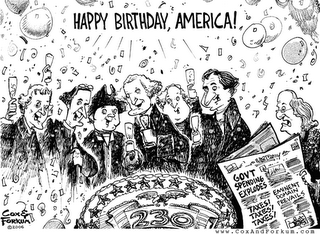
As most New Zealanders will have completely ignored, today (our time) is American Independence Day -- and tomorrow (our time) it's their time. If you see what I mean.
New Zealanders might like to ignore it, but the events that Independence Day celebrate are as important to us down here as they to those up there. July 4 isn’t just a day to celebrate American independence, but our own as well.
What do I mean? Why does it matter to us down here at the bottom of the South Pacific that a bunch of gentlemen over two-hundred and thirty years ago pledged their "lives, fortunes and sacred honour" to constitute the first government in history dedicated to the task of protecting individual rights -- as expressed in Thomas Jefferson's magnificent Declaration of Independence, the rights to life, liberty and the pursuit of happiness?
Why should that matter to us? As Michael Berliner explains, "Jefferson and Washington fought a war for the principle of independence, meaning the moral right of an individual to live his own life as he sees fit." The principle of independence for which they fought is universal.
The United States of America was the first and still the only country on earth to be founded upon the specific idea that human life and human liberty are sacred. July 4th is that day when freedom's anthem is heard around the world!
Despite its occasional breaches in upholding the principle of human rights and human liberty consistently, it is nonetheless for this that we all celebrate (or should celebrate) Independence Day. That for the first time in human history a country was founded on the idea of human rights and human liberty; upon the notion that "life, liberty, and the pursuit of happiness" are sacred; upon the intention to constrain government to act only in defence of those rights.
This was not just a unique event in human history, it also worked like all hell for nearly a century-and-a-half; it worked because protecting those rights gave individuals the moral space, the freedom, within which to act and to flourish. It was not just that this made America and the world freer and more prosperous (which it did); it was not just that this protection for liberty gave a platform to criticise and remedy the breaches of the principle (which it did, most notoriously the regarding of some human beings as the property of others); it is also the profoundly important illustration that a country founded upon reason, individualism and freedom works. That liberty is moral. That liberty is right.
In that very important sense, The Declaration of Independence that Americans celebrate today was made on behalf of every human being on this earth.
Said Thomas Jefferson in the last letter he was to write, reflecting fifty years later on the Declaration of Independence and the July 4 celebrations that commemorate its signing:
May it be to the world, what I believe it will be (to some parts sooner, to others later, but finally to all), the signal of arousing men to burst the chains under which monkish ignorance and superstition had persuaded them to bind themselves, and to assume the blessings and security of self-government. That form which we have substituted, restores the free right to the unbounded exercise of reason and freedom of opinion. All eyes are opened, or opening, to the rights of man. The general spread of the light of science has already laid open to every view the palpable truth, that the mass of mankind has not been born with saddles on their backs, nor a favored few booted and spurred, ready to ride them legitimately, by the grace of God. These are grounds of hope for others. For ourselves, let the annual return of this day forever refresh our recollections of these rights, and an undiminished devotion to them.Amen. And let those thoughts be heard around the world! For as one commentator said on this day last year, July 4th is not just a National Day for Americans because the Declaration of Independence really is "freedom's anthem heard around the world":
Whenever you hear news of people fighting for democracy, pause and give thanks for the Declaration of Independence. I am thankful every day that by blind luck I was born in this country. I want the whole world to have the comforts and the opportunities that have so enriched my life. When they tear down a wall in Berlin, when an oppressed group is granted a right in Latin America, when a business is allowed to exist in China, a protest is allowed in a former Soviet satellite, a woman attends a school in Afghanistan or a purple forefinger is raised in Iraq, I think to myself, “the world may not know all the lyrics, but they are definitely singing our song.”
And he's right. America's creation was the great political achievement of the Enlightenment: the full political implementation of the concept of individual rights, with a government constrained to protect them. [What are individual rights, and why do they need the protection of government? Ayn Rand explains. What specifically was the nature of the government the American founding fathers tried to erect? Ayn Rand explains that too.]
With the exception of just a few words, the words could hardly be bettered today (although some of us have tried):
We hold these truths to be self-evident, that all men are created equal, that they are endowed by their Creator with certain unalienable Rights, that among these are Life, Liberty, and the pursuit of Happiness. That to secure these rights, Governments are instituted among Men, deriving their just powers from the consent of the governed. That whenever any Form of Government becomes destructive of these ends, it is the Right of the People to alter or to abolish it, and to institute new Government, laying its foundation on such principles and organizing its powers in such form, as to them shall seem most likely to effect their Safety and Happiness...
A wonderful, wonderful anthem to freedom that rings down through the years. If only the real meaning of those words could be heard and understood. As David Mayer says: We hold these truths to be self-evident, that all men are created equal, that they are endowed by their Creator with certain unalienable Rights, that among these are Life, Liberty, and the pursuit of Happiness. That to secure these rights, Governments are instituted among Men, deriving their just powers from the consent of the governed. That whenever any Form of Government becomes destructive of these ends, it is the Right of the People to alter or to abolish it, and to institute new Government, laying its foundation on such principles and organizing its powers in such form, as to them shall seem most likely to effect their Safety and Happiness...
If Americans are to use this day to re-dedicate themselves to the principles of 1776 as Mayer invites, then non-Americans might use it to take up Thomas Jefferson's challenge "to burst the chains under which monkish ignorance and superstition had persuaded [us] to bind [ourselves], and to assume the blessings and security of self-government."
Human liberty is the most sacred thing in the universe, and today is the pre-eminent day in which to celebrate it, and to salute the authors of America's Declaration of Independence.
To America's heroic founders, I salute you!
NB: Some final July 4 snippets for you:
- For the very best version of Star Spangled Banner to play over a martini or your Sam Adams, I recommend Licia Albanese's spontaneous combustion at a Mario Lanza ball a few years ago. Fortunately, Lindsay Perigo was on hand to record the eighty-year-old drowning out the young tenor who was supposed to be taking centre stage. Imagine the scene, click on this link, turn your speakers up to eleven, and just bask in the magnificence!
- And of course, don't miss the fully star-spangled, sequinned, be-bannered Independence Day Objectivist blog roundup over at Rational Jenn's. It’s a beaut.
- Time to rededicate yourself to the fight, says cartoonist Bosch Fawstin:
Subscribe to:
Comments (Atom)