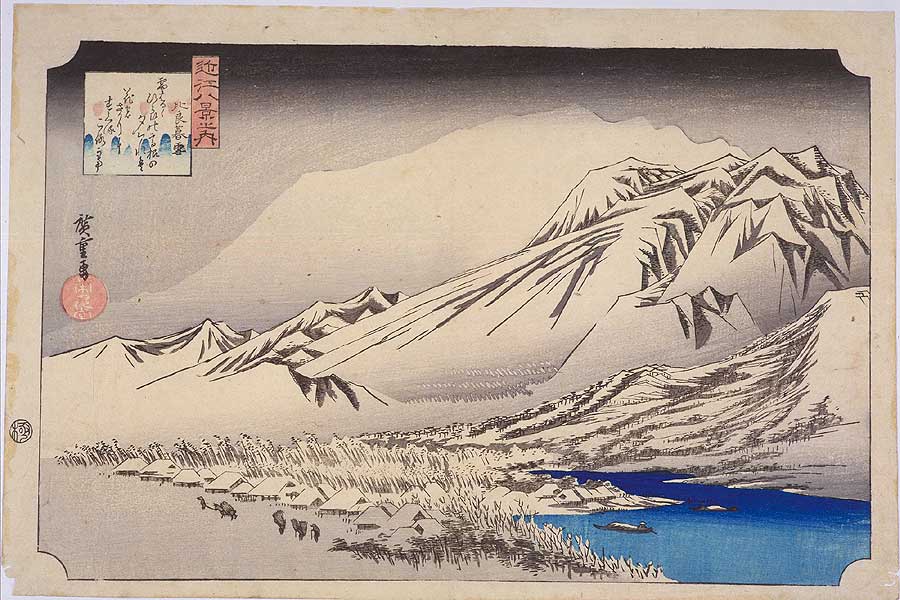
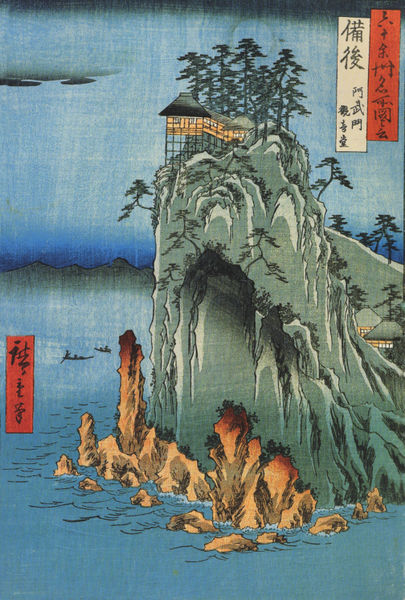
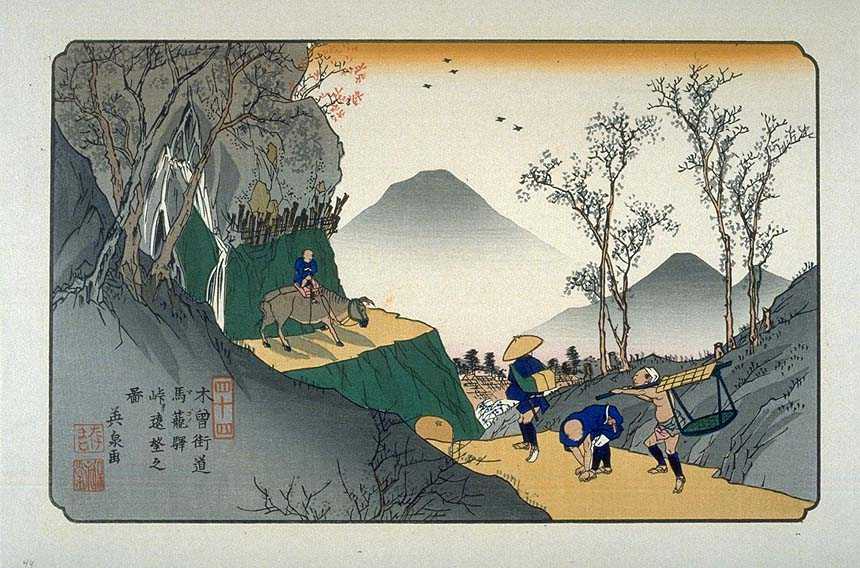
Another classic by the master of Japanese prints, Utagawa (Ando) Hiroshige (1797-1858). This print was from his last series “One Hundred Famous Views of Edo. First printed in 1858, Frank Lloyd Wright was said to have owned a copy.

Plate 11 from Ando Hiroshige’s set of wood block prints of The 53 Stations of the Tokaido.
Basil Stewart’s guide to Hiroshige describes it (somewhat anachronistically) thus: “A high peak, round the base of which, through a gorge, a daimyo's cortege is wending its way ; on the left the Hakone Lake, with Fuji in the distance. The peak is drawn in a peculiar angular manner, almost cubist in effect, which detracts somewhat from this view.”
Mr Stewart and I disagree somewhat in our evaluation of its merits. It’s like a much more exuberant Mt Fuji!


No, it’s not London – which I remember from 1991 as being beautiful in the snow. It’s Paris, painted from a ‘Japanese viewpoint’ borrowed from Hiroshige.
And this is beautiful too, Monet’s Boulevard des Capucines, from the First Impressionist Exhibition in 1874.

Another wood block print from Hiroshige's series Fifty-three Stations of the Tokaido.
Another deceptively simple scene from Hiroshige's 'Tokaido' series featured here this week. You see, this is one reason I like Hiroshige's work.: He doesn't do what to us would seem the obvious thing with his scenes.
In this print he depicts our travellers in Hamamatsu. Hamamatsu's most famous attribute was its castle, and any contemporary viewer of this work would expect to see it featured prominently; the castle is shown, but hardly in the foreground: the foreground instead shows our travellers warming themselves by a bonfire in the shelter of a large tree, and through several unusual compositional devices -- some of which, such as cutting the page in half with a tree trunk and leaving empty space at the corners, violate all the canons of traditional western art -- our eye is led out from the travellers to the background in which the castle is seen. The lower sheltering bank unifies the composition, and its curve comes out to embrace the scene and the travellers.
The view seen here reflects several similar 'Shakkei' techniques used to link Japanese houses and gardens to wider views beyond -- 'capturing the view alive' is the aim -- one of which is to 'capture with tree trunks,' and another to capture with elements linking foreground and background.
Open the drawing up to its largest size letting your eye roam around the page taking it all in, and then let yourself become aware of where and how Hiroshige makes your eye dance around the page. It's quite delightful how he does it...
PS: Here's a page of gorgeous Hiroshige prints that you can download and view as large files. Head over and browse for a while.
Another of Hiroshige's wood block prints from the Tokaido series, this is one of his most well known: station forty-six, 'Shono – Sudden Rain,' published c. 1831-4. In this depiction, our travellers are caught in a downpour near the town of Shono in Ise Province. Says author Tomikichiro Tokuriki,
Shono not only ranks with the best prints in this set but is one of the outstanding works in the artist's entire life. No other print treats the fall of heavy rain so well, or expresses the beauty of that rain. One almost hears it falling. Van Gogh also used rain as a subject matter, and it is remembered that he got ideas from the Japanese ukiyo-e print artists.
Another print from Hiroshige's 'Tokaido' series -- this one from the 'upright Tokaido' series published in 1855, showing our travellers crossing the snow-covered bridge at Numazu. The composition is simple -- almost stark -- but not static, with a winding path through the dominating landscape inviting our movement through it.
I was excited to pick up over the weekend a small book of wooblock prints by Japanese artist Ando Hiroshige (1797-1858) describing the Tokaido: the fifty-five 'stations' on the famous 'scenic route' from Edo (Tokyo) to Kyoto celebrated by artists, and poets like Matsuo Basho.
This is station eleven, looking down on Lake Ashi at Hakone. The climb here was considered one of the journey's most strenuous -- travellers can be seen making their way up the pass at bottom right -- but the reward was with this glorious view and the promise of the seven hot springs of Hakone. The easy simplicity of Hiroshige's style can be seen, and the compositional principle of 'balanced asymmetry' common to many Japanese wood block artists.


 The images show Japanese architect Kengo Kuma's museum for Ando Hiroshige, the master of Japanese woodblock prints whose images have featured from time to time here at Not PC.
 I must confess, hearing about the museum attracted me to exploring more about it, but beyond these few images I've found relatively little of the museum on the 'net, and the images I've found don't depict the building very clearly. I'm not clear, for example, just where the prints themselves get to be displayed...
 Anyway, enjoy the prints. I'm sure the weather at least will be familiar.