Showing posts with label Geoffrey Palmer. Show all posts

Monday, 26 August 2024

"Probably among the worst toxins you can inject into the democratic constitution of a trusting people ... "


Cartoon by Nick Kim

"'NEWSTALK ZB, Opinion: Constitutional law expert and former Prime Minister Geoffrey Palmer takes a deep, concerned look at the risks this Government is taking with hasty law changes.'
"Pretty rich coming from the man [right] responsible for s9 of the State Owned Enterprises Act, with its stupid reliance on undefined ‘principles.' It launched the courts into inventing their partnership metaphor for the Treaty. Lange raged to me in 1994 that Sir Geoffrey had assured him s9 was just ‘comfort’ to settle down iwi leaders. ‘It doesn’t have real legal effect’.
 
"I’m not aware of any apology from Sir Geoffrey for this grotesque error. Or even hindsight repudiation to limit the damage. 
"Probably among the worst toxins you can inject into the democratic constitution of a trusting people in a trust-based egalitarian law-abiding society, with an extraordinary level of intermarriage and other evidence of respectful race relations. 
"Setting lawyers free to make law instead of applying it. Enabling corrupt bullies to trash property rights (incidentally negating Article 2). And empowering courts and bureaucrats to exploit undefined (therefore unlimited) race privilege to trump equality before the law."
~ Stephen Franks on Twitter

Tuesday, 23 July 2024

"Much of the mess we are in can be blamed, in my view, on lawyers ... "


"In [New Zealand], much of the mess we are in can be blamed, in my view, on lawyers (and judges). ...
    "It was Geoffrey Palmer, a lawyer, who designed the original Resource Management Act, and it is David Parker, a lawyer, who's currently drawing up plans to implement wealth and capital taxes as part of the Labour Party's platform for the 2026 election. The current Chair of Kiwi Rail is a lawyer. His Deputy Chair is a lawyer. Most of NZ's big firms have boards dominated by lawyers (and accountants) who have no shop-floor experience in the industry in which "their" company is working. How have they got their jobs? From what I have learned, mostly by networking & schmoozing. Is this a world-wide phenomena? No. Who do companies like Tesla have on their boards? To give you a flavor, folks like Mr. Gebbia, co-founder of Airbnb, and Mr. Straubel, founder of Redwood Materials, a firm working to drive down the costs and environmental footprint of lithium-ion batteries by offering sources of anode & cathode materials from recycled batteries. ...
    "What has been the objective of those sitting in the Auckland law firms quietly earning incomes of way over $1 million a year? To maximise their fee income, of course. The legal & regulatory structures that have promoted monopoly power in NZ, the frameworks that govern race-relations, and the mountains of red-tape we all must navigate, have been made deliberately divisive, deliberately ineffective, and deliberately onerous by Kiwi lawyers, all to generate more disputes & work for law firms and their partners. The profession that has ground NZ's economy to a halt has been our legal profession — all in the name of its ... quest for higher incomes."
~ Robert MacCulloch from his post 'God Save New Zealand from Lawyers'

Tuesday, 23 January 2024

Treaty Principles: Still much the same after all these years?


"New Zealanders are involved at the moment in a somewhat introspective examination of what their heritage means to them," said Geoffrey Palmer. "To outsiders the process must seem somewhat curious. Yet it is not inappropriate in the 150th year after the signing of the Treaty of Waitangi."

What's that? ... 150 years?  ...when did he say that?


Thirty-five years ago! And we're still engaged in that same introspective examination.

It's instructive to compare Geoffrey's five principles -- as well as his argument for them and why they were thought necessary -- which is worth reading -- with those contained in this week's leaked Treaty Principles Bill.

The 3 principles in what's said to be the proposed Treaty Principles Bill are:
  1. A Governance principle: "the New Zealand Government has the right to govern all New Zealanders"
  2. A Rangatiratanga principle: ""the New Zealand Government will honour all New Zealanders in the chieftainship of their land and all their property"
  3. An Equality Principle: "all New Zealanders are equal under the law, with the same rights and duties"
Curiously, despite all the tedious scholarship since and the fumarole of huffing and puffing this week, those principles aren't a million miles from those espoused by Geoffrey Palmer's Government back in 1989, in response to recent decisions from the Court of Appeal and the Waitangi Tribunal:
In summary .... the Crown has identified five principles which will guide its activity in dealing with issues which arise out of the Treaty of Waitangi:

The Kawanatanga Principle [which] recognises the right of the Government to govern and to make laws.

The Rangatiratanga Principle[which]  recognises the right of iwi to organise as iwi and, under law, to control the resources they own.

The Principle of Equality [which] recognises that all New Zealanders are equal before the law.

The Principle of Reasonable Co-operation [which] recognises that both government and iwi are obliged to accord each other reasonable co-operation on major issues of common concern.

The Principle of Redress [which] acknowledges that the Government is responsible for providing effective processes for the resolution of grievances in the expectation that reconciliation can occur. This principle makes it clear to New Zealanders that the system of grievance resolution will be orderly, fair, and effective. We will take the steps necessary to ensure that justice is done and seen to be done.

I know that as the whole picture of this complex matter becomes clear to New Zealand the country will see that this is an issue that can be dealt with calmly and rationally. Moreover they will see that there are no hidden traps. That this is a process from which we can all emerge winners.
I make no judgement here on the value or otherwise of Palmer's Principles. 

I simply observe that while history doesn't always repeat, it does sometimes rhyme.

Monday, 27 November 2023

It’s those fantastical ‘Treaty of Waitangi Principles’ again


Since it's topical again (and will continue to be for some time), here's a re-post from wayback in 2012, changed only slightly to correct some typos and poor formulations...

Here we are again, having the same tired, washed-out old arguments:


YET AGAIN WE SEE all the political classes jumping into the trough for a mud wrestle over the so-called “Principles of the Treaty of Waitangi,” with the National Party wanting to diminish their impact in the partial sale of SOEs, the Maori Party wanting to use the bout to boost themselves, and Browntable iwi leaders hoping to further feather their nests.

The impossible-to-define "principles of the Treaty" were a late and pragmatic addition to law some twenty-five years ago [now thirty-five!]—and a leading lesson in the dangers of pragmatism in politics. As you might not know, the “the principles of the Treaty” are not part of the Treaty at all, just a recent accretion adding great confusion and a huge amount of expensive litigious activity. Not least because to this day they have still not been adequately defined.

FOR THOSE UNAWARE OF the history of these “Principles,”* you might be surprised to hear that were never there at the Treaty’s signing; they only emerged in recent times, and only because of the appalling political judgement of a former ACT Party luminary. A rushed addition to legislation that for the first time put the destructive ideas of “biculturalism” and race-based political “partnership” on the table, into the courts, and into the bank accounts of folk who saw the “Principles” as their main chance at piles of money.

So take a bow Richard Prebble while we tell the story of the birth of these “Principles” that have poisoned politics ever since.

Like Rodney Hide when he first got his feet under a ministerial table, Richard Prebble was so excited to “get things done” he didn’t care how he did them. So when, as Minister of State-Owned Enterprises in the Fourth Labour Government, he wanted to sell state-owned enterprises (a good thing, to help the country pay. its way), in order to quieten down the race-based dissent that started to affect Labour’s relations with its Maori voting base, he asked his colleague Geoffrey Palmer to insert a section in the new State-Owned Enterprises Act the phrase “principles of Treaty of Waitangi,” insisting that “decision-makers” must have regard to these "Principles." (A bad thing, and intended as no more than a sop.) 

This is all their now infamous Section 9 said:
Nothing in this Act shall permit the Crown to act in a manner that is inconsistent with the principles of the Treaty of Waitangi.
What were these "Principles"? No one knew.

Had they ever been defined? No, they hadn’t.

Did these two clowns have any idea what they might have started? Not a bit of it.

So in order to get the sales under way, these two simply brought these "Principles" into being without ever defining what these "Principles" are.

RICHARD PREBBLE DIDN’T CARE. He just wanted to sell things. Geoffrey Palmer did care, because his life’s work was based around writing legislation so vague, so ambiguous, that it allowed the courts to define things any way they wanted to. This, said the Idiot Palmer, is how you make law “flexible”: by giving the courts bullets which they could elect to fire in any direction they wished.

So much for the legal acumen of Geoffrey Palmer and the political nous of Richard Prebble. Because in the time it takes to say Motunui, a huge number of claims based on these newly-fangled "Principles" were rapidly being manufactured and presented, and the courts were beginning to dream up all sorts of stuff to fill up Palmer’s empty vessel.

This is where the fictions of “biculturalism” and race-based political “partnership” were born. And this was the beginning of the deluge of claims based on these twin fictions—a deluge unseen by the twin geniuses who gave birth to the legislation (“In the course of a relatively few years,” said the woeful Palmer for example, “most of the outstanding issues in this area will be settled. Most of the claims now are known…” )

The result is that to this day no-one knows with any kind of clarity what these “principles” are supposed to be. They were a legal fiction waiting for courts to define and redefine, and for litigants to quarry in an attempt to make their fortune—which they did, in their droves.

And because, over time, they were inserted in all their vagueness in virtually every piece of quasi-constitutional legislation written since, they became a poison that soon infected every piece of legislation they touched.

What that poison did—as subsequent court cases quietly morphed these “principles” into something ever more lucrative for the lawyers who lived off them—was to transfer the Treaty’s clear and straightforward promise of legal protection [Clause 2] and the recognition of rights [Clause 3] into the sort of vague, indefinable mush that helps lawyers afford large launches.

THE NET RESULT OF evoking "principles" that didn’t exist was to to create a Treaty that had never existed at all, except in the wet dreams o lawyers and activists. And thus was a whole Gravy Train created to feed off this New Thing.

It’s been a hard Train to stop now it’s got rolling.

It allowed the then Minister of Injustice and for Treaty Negotiations Doug Graham to mellifluously opine a few years later that “The sooner we realise there are laws for one and laws for another, the better.”

And with that invitation it has set the platform for a whole generation of youngsters to join the Grievance Industry and become, as virtually their sole occupation, professional Maoris. Three of this ilk, ironically, are now propping up John Key’s National government and throwing a tantrum over this very issue. Many others simply see the tantrum as yet another opportunity for a lucrative dip into this trough.

That this piece of human excrement, Douglas Montrose Graham, is on this very day before the law courts for fraud—for which his defence has been to limit his dishonesty by talking up instead his incompetence—is perhaps an appropriate contemporary comment on the fraudulent “Principles” themselves.

* * * * 

* "Principles" used in inverted commas here refers specifically to those "principles" invented by the courts in response to Palmer's invitation, especially those invented out of whole cloth such as "partnership" and "biculturalism." This is in contradistionctiin to the use of the word without inverted commas, wherein it refers simply to the word as defined in the dictionary.  Every law develops principles around it (without inverted commas), and good objective law will be written around those principles, allowing courts to use those principles o flesh out how the law is to be applied in particular cases. In the Palmer/Prebble formulation however, it is the courts who have been asked to invent the "Principles": i..e, to say what the law is, which is (or should be) the job of the lawmakers themselves.

Friday, 21 January 2022

From "meaningless phrase" to "a string of 'principles of co-governance'"


Cartoon by Nick Kim, from The Free Radical
"The innocent words 'principles of the Treaty of Waitangi' were included in the State-Owned Enterprises Act only because [David] Lange’s then attorney-general (Geoffrey Palmer) assured the cabinet the phrase was meaningless. Thanks to some judicial musing, this initial phrase became loosely associated with 'partnership.'* About thirty years on, this link was subtly extended to the 'principles of partnership.' Then that meaningless phrase was gradually manipulated into a linkage with co-governance. Now we have He Puapua working on converting that link into a string of 'principles of co-governance'.”
          ~ Barry Brill, from his article 'Does “partnership” mean the same as “marriage”?'

* Cooke P held that "the Treaty created an enduring relationship of a fiduciary nature akin to a partnership, each party accepting a positive duty to act in good faith, fairly, reasonably and honourably towards the other.”

Tuesday, 1 November 2016

Cue Card Libertarianism: Constitution


Geoffrey Palmer has resurrected his life-long desire for a written constitution that would undoubtedly entrench the fashionable-but-wrong interpretation of the Treaty of Waitangi and cement in so-called welfare rights.

In any case, it will with complete certainly be one that Thomas Jefferson and his friends would only barely recognise (even as we should recognise the repairs to the sacred document they draw up that are necessary for it to continue the job they hoped for it).

An appropriate time then to re-post (with new links!) my Cue Card on what a constitution is for.

Cue Card Libertarianism -- Constitution

Why do we need a government at all? James Madison puts the argument in a nutshell:

      “If men were angels no government would be necessary. If angels were to govern men,
       neither external nor internal controls on government would be necessary.”

Here in capsule form is the essential argument both against anarchy, and for a constitutional republic: Because men are not automatically angels, and because government does need to be controlled.

But how?  That’s the 64-million-laws question.

Let’s start by examining the purpose of government.  Government in essence is like a guard dog: to protect us from being done over by others. However, if that dog is badly trained and it gets off the chain, we can be badly savaged -- more than we would have been without the dog.

So we get to our first major point:

A constitution is our means of chaining up the government and training it to act only in our protection.

As I’ve said already in these Cue Cards, the purpose of government is to protect properly-formulated individual rights. The means by which it carries out this life-giving task is to protect us against physical coercion and its derivative, fraud. Good government is the means by which retaliatory force is brought under objective control. A good constitution, properly written, brings the government itself under objective control.

Such a constitution was the intent of America’s Founding Fathers, a clear and understandable document delineating a government that protects individuals’ rights, but after nearly two-hundred years the success has been only partial. Building on the success of the US Constitution and seeking to close the loopholes exploited since its introduction, New Zealand libertarians have written what we call A Constitution for New Freeland summing up what a good constitution should look like, and why:

The job of government is to protect our rights—a ‘Bill of Rights’ clearly outlines the rights to be protected.

The job of government is not to infringe the liberties of its own citizens without due process of law—a ‘Bill of Due Process’ clearly outlines under what circumstances and in what manner those liberties may be breached, and for what purpose.

The US Constitution has suffered from interpretations that have often been at odds with the declared intentions of the Constitution’s authors—the Constitution for New Freeland puts the intentions of its authors on the record in the ‘Notes on the Bills of Rights and Due Process.’

To prevent monopolisation of political power, a good government should have its powers separated—a formal statement is included as to how the rigorous separation is to be ensured, and each of government’s three branches – legislature, judiciary and executive – is given some specified veto power over all the others. The imperfect separation of powers in our present NZ constitutional arrangements shows the dangers of being without these essential checks and balances on political power.

Every good constitution relies on one further, crucial, restraint on the growth of Omnipotent Government: significant public understanding and support for the constitution and its protections, without which politicians and advocates of a ‘living constitution’ can pervert the constitutional protections as easily as the simple agreements given in the Treaty of Waitangi have been perverted. (On this much at least, Burke was right.)

Further, the task of constitutional law is to delineate the legal structure of a country’s law; it must therefore be superior to all other laws, and law stepping outside the bounds of what is declared unconstitutional must be able to be struck down – an accessible Constitutional Court makes this possible.

The superiority of a constitution to all other law is both a good thing and a bad thing. What’s good is that once a watertight constitution properly protecting individual rights is in place, it acts to chain up the guard dog and to keep it on its leash for good. What’s bad is that once in place, a poor or anti-freedom constitution is very difficult to get rid of.

imageAs history demonstrates -- and the constitutional conference of 2000, a previous Select Committee review of NZ’s constitutional arrangements, and now Palmer’s wet rag foreshadows – a bad constitution poorly written can give the erstwhile guard-dog control of the back yard and the house, and before you know it it’s chewing off your leg and attacking the baby. Rather than protecting us, it has no impediment at all to doing us over.

Liberty, as Thomas Jefferson suggested, requires eternal vigilance.

This is part of a continuing series explaining the concepts and terms used by libertarians, originally published in The Free Radical in 1993. The 'Introduction' to the series is here.

..

Monday, 15 August 2016

RMA: After 25 years, time to euthanase it


A fellow called Roger Partridge reminds us that the Resource Management Act is 25-years old this month, a shocking realisation for those opposed – and a timely reminder for everyone appalled at rampant housing unaffordability what is most behind the iniquity: this planning law that shackles the supply of new houses.

Yet over that time few voices have been strongly and consistently opposed. To paraphrase Ayn Rand, “When for a quarter-century the productive have been forced to seek permission from the unproductive in order to produce, with nary a word raised in opposition to that iniquity, then you may know that your culture is doomed.”

Mr Partridge’s headline says what his op-ed only hints at, that this Frankenstein Act must be slayed, but his conclusion at least is sound: that more tinkering will never tame this Frankenstein.

What can be done? The answer lies in the RMA’s great conceit: that planners and politicians are better placed to decide how resources should be used than their owners. As that approach has clearly failed, we need to start afresh.
    It is true that private property rights regulated by the common law will not always lead to acceptable outcomes. [Acceptable to whom, white man? – Ed.]  But that does not require a regime that places all decision-making in the hands of government. 
    The urban planning component of the RMA has been handed to the Productivity Commission for a reappraisal.
     We can only hope this will be a well-considered assessment of planning law that should have preceded the enactment of the RMA 25 years ago. [Cough, cough.]
    Where property is in private hands, the review should ask “what is wrong with letting private owners make their own decisions?” For centuries the law of property, contract and tort – with their focus on harm to third parties – did just that. And great cities were built on this basis.
    Indeed, our own cherished Victorian suburbs with their gracious villas were built with minimal help from town planners. Contemporary planners can learn from this.
    In Mary Shelley's masterpiece, though torn by remorse, Victor Frankenstein refuses to admit to anyone the horror of his creation, even as he sees it spiralling out of control.
    A quarter of a century on, let's hope Sir Geoffrey's heirs can do better.

I remain convinced this monster needs a stake through its heart – and that common law protections of environment and private property must be recognised again, starting perhaps with small consents, or perhaps with a codification of basic common law protections culminating with a re-statement of the Coming to the Nuisance Doctrine.

I remain unconvinced however that in the heirs of Geoffrey Palmer we should harbour any hope of anything whatsoever, except for much more of the same.

.

Monday, 13 July 2015

Hugh Pavletich blames the incompetent council. But who’s really to blame?

Exorbitant rates rises are only part of the severe imposition on Auckland home-owners. Housing commentator Hugh Pavletich blames the incompetent council:

If Auckland was a normal housing market, like most in North America, house prices would be at or below $300,000 for those on $100,000-a-year household incomes.
    Thanks to the incompetent Auckland Council, an Auckland family with a household income of $100,000 is forced to pay $820,000 for a house.
    The council is forcing them to pay an extra $520,000 for the house and this new study calling for more apartments in the suburbs is no solution to the crisis.
    That money for an Auckland house must come from a grossly excessive mortgage, crippling the city's residents for the remainder of their working life.
    Add the interest over the life of this inflated mortgage and this $100,000-a-year household is forced to pay over $1 million in excessive mortgage costs, and all because the Auckland Council is incompetent.
    The council is being deliberately misleading because it has lost control of its costs and has lost the capacity to meet its infrastructure responsibilities to its community.
    Land supply, infrastructure financing and processing for new housing are issues councils must tackle - and no council more than Auckland needs to deal with this.

But council aren’t the only ones to blame, are they.

Q: What gives Auckland Council power to blow out its costs, ignore infrastructure responsibilities, and lock up housing like this?
A: The Local Government reforms of 2002, that removed restrictions on how councils could waste ratepayers money, and the Resource Management Act, that grants council’s “planners” complete authority over your land.

Q: So who passed and introduced these?
A: The Alliance’s Sandra Lee under Helen Clark’s Labour Government passed the Local Government Act reforms, and National have adamantly refused to reverse them. Labour’s Geoffrey Palmer wrote the Resource Management Act, National’s Simon Upton introduced it, and fro many years Nick Smith administered it.

Q: So how come they got away with it?
A: Because NZ has no constitutional and little institutional protection for property rights. Because over many years folk have forgotten why property rights are important. And because all of you bastards keep voting for it all to happen.

So, in the end, you’ve only got yourselves to blame.

Suck it up.

PS: Auckland has been “wedded to a 1950s vision of uncontrolled sprawl,” say politicians.

“Auckland's mayor is standing firm against urban sprawl,” say commentators.

“Auckland’s sprawl is unsustainable and must stop,” says virtually every planner everywhere.

And yet … what uncontrolled sprawl?

Here’s Auckland just over thirty years ago, in 1984:

image

And here’s Auckland in 2012:

image

Can you spot all that “uncontrollable sprawl” after thirty years?

Fact is, New Zealanders’ fear of urban sprawl is wholly misplaced.

[NB:  The pictures above come from a really neat Time Lapse visualisation of the world here.  Use any of the pre-programmed settings—click on Las Vegas or Shanghai if you really want to see sprawl!—or just click on “Explore the World” and play.]

Wednesday, 3 September 2014

The drums are beating again to censor free speech

imageTaking every chance they can, and inflamed by revelations a blogger has been writing some angry posts, the opportunistic trial balloons are going up again to set the censors onto the blogosphere.

The world’s most boring man set the case for censorship yesterday, Wayne Mapp arguing on the back of Geoffrey Palmer’s egregious efforts over the weekend that the blogosphere is “as ungoverned as the Wild West.” 1

 But the revelation that the subject on an SFO Inquiry would allegedly pay a group of bloggers to besmirch the investigating office is surely a new low.

“A new low.” To write a blog expressing an opinion you can take or leave. Mr Boring continues:

[Geoffrey Palmer’s] Law Commission’s report into new media did not envisage that this could happen [!], but now has, or at least the released emails point to that.

This self-appointed paragon of morality elects to elude the fact these emails were “released” only in the sense that animal activists “release” captive animals. That is, they break in to someone’s property first. A very convenient elision.

And New Zealand is already full enough of the vaguely incoherent legislation penned or inspired by Jellyfish Geoffrey and his graduates (alcohol wowserism, the RMA, s9 of the State-Owned Enterprises Act, the end to the right to silence, a toothless BoRA, to name just several of his intentionally non-objective laws) without needing any more.

Mapp burbles on towards his conclusion nonetheless, dropping inanities as he goes like a horse dropping road apples:

Tuesday, 30 April 2013

The (First) Hooey From Helengrad

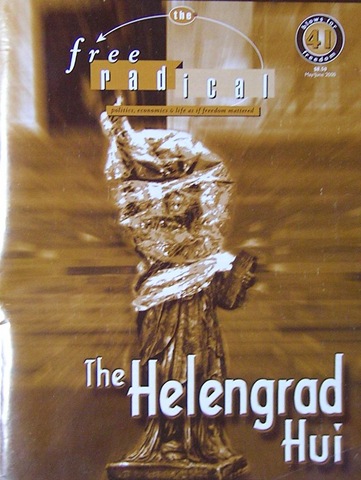
Since this government, at the invitation of its coalition partner, has opened the door to a “constitutional conversation”  that is rapidly emerging as a Treatyist monologue, I thought it might be interesting to post my on-the-post report from the last time a government set out to have the Treaty of Waitangi incorporated in a written constitution—back in early 2000, in the first months of the new Helen Clark Government. 
Curiously, back then, all the usual Treatyist suspects were agin’ incorporation since, they said, it would “confine” the Treaty. I invite you to consider what’s changed since then … 1

The Hooey From Helengrad
(originally written for The Free Radical
magazine, 2000)

In almost the first breath of her maiden speech, new Attorney General Margaret Wilson boasts she will amend this country's constitutional arrangements. With almost the first breath of this new government a debate is organised in parliament to discuss 'Building a Constitution.' Can any one doubt that these two events are linked?

Whatever the reason for them being gathered there in the Parliament Buildings for this auspicious yet hastily-assembled event— and many confessed to being more than a trifle unsure themselves what was afoot— 117 official 'invitees' four Maori gate-crashers and your lonely reporter took part in the conference. Wilson's former employer, the University of Political Correctness at Waikato, was itself well represented at the hui, as were other 'leading academics' such as Jane Kelsey, 'respected jurists' such as Eddie Durie, enough former Ministers, Prime Ministers and Governors General to form a faded sort of portrait gallery, along with tangata whenua with “real mana” such as lawyers Moana Jackson and Annette Sykes, and councillor and gate-crasher Atareta Poananga.

The large number of brown faces present — not all of them invited — contrasted with the extremely small number of people there who were not sucking off the state tit in some way.

I counted ten. At most.

Outside, a Libertarianz welcoming party including an eight foot high Statue of Liberty greeted invitees. To symbolise Wilson’s intent, liberty was suffocated with a giant condom. Inside, as a reminder of the power a good constitution is supposed to tie up, those attending could contemplate decorative pilaster panels displayed gorgeously rendered 'fasces,' the bundled stick motif adopted by the Romans and used ever since as a symbol of absolute political power. The contrast — to me at least — was striking.

For power was certainly on the agenda, or at least how to dole it out, and liberty was, as we suggested — largely uninvited to proceedings.

There was much criticism of the conference, ranging from Professor Jon Jensen, who called it a 'covert Waitangi plot'; to David Round: "If these overpaid mischief makers are allowed to drag our constitution off in their direction then New Zealand is finally stuffed"; to Roger Kerr: "If it ain't broke, then don't fix it"; to Annette Sykes: It's all a colonialist plot to hegemonise Maori (or something similar).

Margaret Wilson's view is that the 'accepted units' of constitution building are cultures, not individuals; that the fiction of “group rights” outweighs the substance of individual rights. The many calls for Maori sovereignty would not have disappointed her, but there were astonishingly few who favoured incorporating the Treaty into any new constitution. Geoffrey Palmer was one exception: "If the treaty is in a written constitution,” he puffed, “then it can protect rights against the legislature." Doug Graham by contrast: "We shouldn't incorporate a law that is so open to misinterpretation." Such incorporation, said Shane Jones, might of course “tie down the Treaty's mana' as a 'sacred covenant”—or as Ngatata Love said "I say what my tikanga is, not the law." (Translation: if law is clear and objective, then witchdoctors won't be paid a fortune to give this week's interpretation of ill-defined concepts like 'taonga.')

Roger Kerr stood athwart Wilson’s would-be juggernaut, arguing: "The basic issue is not brown versus white, but the individual versus the collective." Annette Sykes spoke in response for the brown collective, decrying a world which contrasts the "western 'one' and the non-western 'many.'" She proposed instead a balkanised apartheid state where 'the many' would be controlled by a 'hapu paradigm,' with all power shared amongst hapu leaders, who have a 'fluid' approach to power. No one mentioned Bosnia.

There were outnumbered voices I occasionally agreed with, often with some surprise. Tipene O'Regan: "All states commit theft. A constitution should protect us from that." Tom Lamby, Jonathan Darby, Rod Deane, Peter Shirtcliffe, Stephen Franks, and of course Roger Kerr each in his own way said that many are saying of government 'what are they going to do to us next?' and that consequently there is a need to limit government to stop it stepping on us. We should have one rule of law for all, they affirmed, with liberty and individual rights protected, and contracts upheld. Sykes’s response to this line was an eruption: "If we promote individual rights, then we can forget about our collective responsibility to the unborn"! Moana Jackson told us all that property rights are a myth, dreamed up and used to subjugate Maori. No one mentioned Zimbabwe, but Simon Upton at that point leapt to his pen, no doubt excited to hear an echo of his own previously expressed notion that rights are merely 'social constructs.'

A similar view of rights wasn't the only thing shared by these two — Upton spent the afternoon enthusiastically excavating his nasal cavity while wiping his trophies on his seat. Occupying that seat later on was Moana Jackson, gripping the sides fiercely as he no doubt treasured the many things he now shared unwittingly with Simon.

The most heated session took place over the issue of local government. Unsurprisingly, the head of Local Government Ross Jansen came out strongly in favour of bigger local government. Kerr and Franks came out strongly against, the latter describing Jansen's proposals as "a breathtaking crystallisation of the level of naivety that characterises much of this conference — and if that gives offence, I intend it!" It did give offence, and he was drowned out by the Jansenists. No one mentioned Adrian Chisholm, but by then no one could pretend they didn't know how big local government had smacked this man, because Chisholm was there thrusting into as many hands as he could shake copies of Deborah Coddington's Free Radical story showing what Auckland’s unrestrained council officers had done to him.

But in the end there was neither heat, nor light on display at the Hooey. Just mush. The overall impression of the event, as one participant said, was that it was not actually a debate at all – merely lots of people talking past each other. There was an aimlessness to the whole affair, a sort of purposeless action that suggested the purpose itself was contained somewhere else; that what we were seeing was a giant trial balloon, a test to see how well the issue would go over.

It did not appear to go over well, Clark conceding at the conclusion "that we're acting in the absence of any compelling demand to do anything".

Let us maintain our vigilance.

This post originally appeared in issue 41 of  The Free Radical magazine, 2000. It has been lightly revised.

PS: If enough of you are interested, I’ll pull out what I called “The Speech They Didn’t Want to Hear” that I tried to deliver on the day. Naturally however, they didn’t want to hear it.

* * * * *

1. Mostly, the confident assurance of the Treatyists that under current arrangements, the Treaty will end up confining what one would normally expect of a constitution.

Wednesday, 1 February 2012

It’s those fantastical ‘Treaty of Waitangi Principles’ again

Here we are again, having the same tired, washed-out old arguments:

image

YET AGAIN WE SEE all the political classes jumping into the trough for a mud wrestle over the so-called “Principles of the Treaty of Waitangi,” with the National Party wanting to diminish their impact in the partial sale of SOEs, the Maori Party wanting to use the bout to boost themselves, and Browntable iwi  leaders hoping to further feather their nests.

The impossible-to-define "principles of the Treaty" were a late and pragmatic addition to law some twenty-five years ago—and a leading lesson in the dangers of pragmatism in politics. As you might not know, the “the principles of the Treaty” are not part of the Treaty at all, just a recent accretion adding great confusion and a huge amount of expensive litigious activity. Not least  because to this day they have still not been adequately defined.

FOR THOSE UNAWARE OF the history of these “Principles,” you might be surprised to hear that were never there at the Treaty’s signing; they only emerged in recent times, and only because of the appalling political judgement of a former ACT Party luminary. A rushed addition to legislation that for the first time put the destructive ideas of “biculturalism” and race-based political “partnership” on the table, into the courts, and into the bank accounts of folk who saw the “Principles” as their main chance at piles of money.

So take a bow Richard Prebble while we tell the story of the birth of these “Principles” that have poisoned politics ever since.

Like Rodney Hide when he first got his feet under a ministerial table, Richard Prebble was so excited to “get things done” he didn’t care how he did them. So when, as Minister of State-Owned Enterprises in the Fourth Labour Government, he wanted to sell state-owned enterprises (a good thing), to quieten down the race-based dissent that started to affect the Labour’s relations with its Maori voting base, he asked his colleague Geoffrey Palmer to insert a section in the new State-Owned Enterprises Act the phrase “principles of Treaty of Waitangi,” insisting that “decision-makers” must have regard to these Principles. Here’s all their now infamous Section 9 said:

Nothing in this Act shall permit the Crown to act in a manner that is inconsistent with the principles of the Treaty of Waitangi.

What were these Principles? No one knew.

Had they ever been defined? No, they hadn’t.

Did these two clowns have any idea what they might have started? Not a bit of it.

So in order to get the sales under way, these two simply brought these Principles into being without ever defining what these Principles are.

imageRICHARD PREBBLE DIDN’T CARE. He just wanted to sell things. And Geoffrey Palmer didn’t care, because his life’s work was based around writing legislation so vague, so ambiguous, that it allowed the courts to define things any way they wanted to. This, said the Idiot Palmer, is how you make law “flexible”: by giving the courts bullets which they could elect to fire in any direction they wished.

So much for the legal acumen of Geoffrey Palmer and the political nous of Richard Prebble.  Because in the time it takes to say Motunui, a huge number of claims based on these newly-fangled Principles were rapidly being manufactured and presented, and the courts were beginning to dream up all sorts stuff to fill up Palmer’s empty vessel.

This is where  the fictions of “biculturalism” and race-based political “partnership” were born.  And this was the beginning of the deluge of claims based on these twin fictions—a deluge unseen by the twin geniuses how gave birth to the legislation  (“In the course of a relatively few years,” said the woeful Palmer for example, “most of the outstanding issues in this area will be settled. Most of the claims now are known…” )

The result is that to this day no-one knows with any kind of clarity what these “principles” are supposed to be. They were a legal fiction waiting for courts to define and redefine, and for litigants to quarry in an attempt to make their fortune—which they did, in their droves.

And because, over time, they were inserted in all their vagueness in virtually every piece of quasi-constitutional legislation written since, they became a poison that soon infected every piece of legislation they touched.

What that poison did—as subsequent court cases quietly morphed these “principles” into something ever more lucrative for the lawyers who lived off them—was to transfer the Treaty’s clear and straightforward promise of legal protection of and the recognition of rights into the sort of vague, indefinable mush that help lawyers afford large launches. 

THE NET RESULT OF evoking principles that didn’t exist was to to create a Treaty that had never existed at all, except in the wet dreams of a lawyers and activists. And lo, a whole Gravy Train was created to feed off this New Thing.

It’s been a hard Train to stop now it’s got rolling.

It set the platform for a whole generation of youngsters to join the Grievance Industry and become, as virtually their sole occupation, professional Maoris. Three of this ilk, ironically, are now propping up John Key’s National government and throwing a tantrum over this very issue.  Many others simply see the tantrum as yet another opportunity for a lucrative dip into this trough.

_DougGrahamAnd it allowed the then Minister of Injustice Doug Graham to mellifluously opine a few years later that “The sooner we realise there are laws for one and laws for another, the better.”

That this piece of human excrement  is on this very day before the law courts for fraud—for which his defence has been to limit his dishonesty by talking up instead his incompetence—is perhaps an appropriate contemporary comment on the fraudulent “Principles” themselves.

Friday, 26 August 2011

Time for a stiff drink—and a one-fingered salute to the wowsers

Parliament's Committee for Wankers, Wowsers and Bluestockings has finally returned its verdict on the Law Commission's proposal to hinder access to alcohol-fuelled fun and enjoyment for you and I and your dozen closest friends.

Want a good night out that goes on as long as the craic does? Want to fill your cocktail cabinet from the store down the street? Want to load up on beer as you load up on groceries?

To all these things, the Wowsers say “No!”

Like puritans everywhere, they’re agitated at the idea that someone, somewhere, might be having fun in a way for which they haven’t got a license. So in order to push back pleasure on all fronts, they've predictably tapped into existing competitive pressures to claim some kind of public support for their lemon-sucking.

They know that supermarkets would like to shut down local liquor sales, so they’ve joined supermarkets in trying to squash local liquor stores; they know that pub owners object to both, so they've joined with the Hospitality Association in trying to squash supermarket sales and local liquor shops; and they've joined with wowsers, bluestockings and the lemon-sucking lawyers at the Law Commission in trying to shut down drinking at any place at any time that’s after Geoffrey Palmer’s bedtime.

It's a rat's nest of self-interest harnessed for political effect, with no-one of sufficient volume to speak up for you and I who just want the freedom to enjoy ourselves—and virtually no-one at all to speak up for the owners of small local liquor shops who, since one of their number was murdered, have been taking it on the chin by virtually every political pressure group around, starting with the Prime Minister.

Neighbourhood liquor store owners selling to willing buyers appear to be the chief and easy scapegoat for every alleged social harm dreamed up by the writers of fiction researchers, from bad driving to burglary to broken families to the failure of Hosea Gear to make the final All Black squad.

The quality of the arguments against them can be seen from their argument against small neighbourhood liquor stores—the opening, closing and distribution of which, say Parliamentarians,  “should be up to communities to decide.” But local communities are already deciding those matters every single day.  What these numb nuts appear never to have understood is how markets work, since in every important sense the opening, closing and distribution of every single retailer is already decided by the members of their communities, in their capacity as consumers.

The quality of other argument is no better, climaxing in the abortion of a so-called “economic report” commissioned by the Law lords on which the figures on the so-called social costs of alcohol are pulled out of the researchers’ arses derived.

But neither facts nor sound reasoning are wanted here. Political self-interest is on the prowl, and when that’s allied to the puritanism of the lemon-suckers, we’ll all end up as losers.

I think I need a stiff drink, while I can still get one.

Wednesday, 16 February 2011

Legislate in haste, repent at leisure

RUSHED LEGISLATION HAS CAUSED much damage over many years. Rodney Hide’s rushed super-sized council legislation—whose lack of clarity is now giving cockroaches space in which to feed—is only the latest, and a particularly egregious, example.

As an eager new local government minister, Rodney Hide wanted to get things done. What he was told to do was to super-size Auckland’s councils—and he took to the job like a new puppy with his first bone. A puppy whose eyes had yet to form.

_RodneyHood Dear Rodney was so violently opposed to any idea of an elected race-based Board on his new super-sized Auckland Council that he threatened to resign on the issue.   But since he so desperately wanted to get things done, the excited minister rushed through his first piece of legislation in all of his fifteen years in parliament … which called for his new council to set up an appointed race-based Board.

What a dickhead.

That’s a change from bad to f’ing awful.

Nearly half-a-million ratepayer dollars to be paid to a Browntable full of racially-appointed troughers, simply to give effect to an idea of race-based political “partnership” that is both disgusting and historically indefensible.

And it was this local government minister and ACT Party leader that made it possible.

Yes, Virginia, I did say historically indefensible.

No, Virginia, there is nothing in the Treaty mandating any kind of political “partnership” or racial power-sharing.

Yes, Virginia, as both local government minister and ACT Party leader Rodney is responsible.Treaty_Principles (1)

AUCKLAND’S STATUTORY MAORI BOARD would not even exist were it not for Rodney’s legislation and the destructive ideas of “biculturalism” and race-based political “partnership”—and where these notions came from was the result of rushed legislation several years ago by yet another ACT Party luminary.

Take a bow Richard Prebble.

Like Hide, Prebble was excited to get his feet around the cabinet table.  And so excited was he to “get things done” that when he wrote his legislation allowing the streamlining and easy sale of state assets (i.e., the State-Owned Enterprises Act), to quieten down the race-based dissent the sales caused he and his colleague Geoffrey Palmer simply inserted into their legislation the phrase “principles of Treaty of Waitangi,” insisting that “decision-makers” must have regard to these without ever defining what these principles were.

So much for the political acumen of these two. (“In the course of a relatively few years,” said a woefully misguided Palmer for example, “most of the outstanding issues in this area will be settled. Most of the claims now are known…” )

Because problem was, to this day no-one knows with any kind of clarity what these “principles” are supposed to be.  They were a legal fiction waiting for litigants to quarry in an attempt to make their fortune—which they did, in their droves—and a poison that soon infected every piece of legislation written since.

What that poison did—as subsequent court cases quietly morphed these “principles” into something even more lucrative for the lawyers—was to transfer the Treaty’s clear promise of protection of ownership into the sort of vague, indefinable stuff that lawyers love and other cockroaches can feed off.

In evoking “principles” that didn’t exist, it created a Treaty that never did.

It set the platform for a whole generation of young people to join the Grievance Industry and become, as virtually their sole occupation, professional Maoris. (Which is the the only “profession” the new occupants of Rodney’s race-based Board actually have.)

Even more damaging, it quietly transformed the idea of self-ownership of one’s own resources (as promised by the Treaty) into the idea of shared political management, by race, of everyone’s resources (which was never countenanced in the Treaty at all).  This was the notion of race-based “partnership” that over the last few decades has become the fuel of fully-fledged legal separatism—and the legal fuel on which Auckland’s new Statutory Board will rely when they get to the High Court.

Just a few years after the gravy train was well and truly rolling, then Minister of Injustice Doug Graham mellifluously opined that  “The sooner we realise there are laws for one and laws for another, the better.”

Richard Prebble certainly got things done. What he should have done however is get things right.

How ironic that it will be his blunder as minister that will hasten the demise of his successor as party leader.

Friday, 12 November 2010

Nanny wins the day. Again.

The Nanny State is on the march again, with parliament voting 114 to 3 last night to make access to the demon drink more difficult, and life for its would-be sellers more onerous.

And disgracefully, the only serious opposition to the bill came from wowsers demanding even more busybodying than even this bill made possible.

Simon-Power The bill’s author, Simon Power-Lust, must have been giddy with delight as he celebrated the its win in Bellamy’s.  The only serious parliamentary opposition he encountered to running Geoffrey Palmer’s Attack-the-Proles programme was from wowsers who wanted to make it worse.

Meanwhile, as the world’s economies collapse in a welter of sovereign debt and currency wars—and businesses in these tiny islands struggle to keep their heads above water, from Bellamy’s came the cry that “This government sees overhauling our alcohol laws as a priority…”!

Lindsay Perigo states the case plainly:

_Quote Power-lust is More Harmful than Alcohol!
The 114 MPs who voted today in favour of the Alcohol Reform Bill should be drowned on the floor of the House in a flood of the sickliest, sweetest plonk available, says SOLO Principal Lindsay Perigo.
    “The Bill is yet another assault on individual liberty by an array of unedifying authoritarian specimens haunted by the fear, to paraphrase H. L. Mencken, that somebody, somehow, somewhere may just be managing to enjoy himself with an alcoholic beverage,” says Perigo.
    “It bans corner dairies from selling liquor. It raises the purchasing age to 20 in supermarkets and bottle stores. It bans alcohol products which are 'dangerous or particularly appealing to youth,' without specifying what these might be. It bans the 'promotion of the excessive consumption of alcohol'—meaning, in all likelihood, that Happy Hours will be criminalised. In the words of today's illiterate press release from Injustice Mistress Simone de Power-Lust, it 'makes licences harder to get and easier to loose [sic].'
    “…If this striped-skirted wannabe-dominatrix wishes to know why many youth binge-drink she need look no further than the airhead in her own office who doesn't know the difference between 'loose' and 'lose' any more than she does. The crippling of the minds of youngsters by the state education system has produced more than one generation of airheads and slobs who drink exactly as you'd expect airheads and slobs to drink. The fanatical hostility among our educators to reason and civilised values generally, which hostility reached its apogee when National's Lockwood Smith was Minister of Education, is what has produced Generation Airhead and the drinking habits one would expect of the conceptually-damaged.
    “Prohibition and wowserism are not the solution. The solution is to treat and respect citizens as the self-governing adults they inherently are; most will work their way through the damage and rise to the occasion. Even those who do not should become the government's concern only when they commit crimes against others.
    “Removing the vicious influence of nanny-statist, control-freak, power-addicted dregs like De Power-Lust from our lives would be a significant step towards a culture that respects individual sovereignty. Such a culture will assuredly sport alcohol without anarchy,” Perigo concludes.

Simon Power_128 One power-luster is more damaging than a hundred alcoholics.

The Nanny State is worse for all of us than a thousand necrotic livers.

A few lessons that a few wowsers, and their apologists, need to take to heart.

And who voted against this atrocity?  Just three heroic stand-alones.  The parliament’s so-called party of freedom barely manages a rump for their founding principles these days, with both ACT Party leader Rodney Hide and deputy John Boscawen casting their votes with the majority for more power-lust and less freedom.

Just another indication of what most ACT supporters should have worked out about their former party long ago.

Wednesday, 20 October 2010

Prepare to be offended

I’m astonished.  Observing that bloggers and talkback callers are still talking about Paul Henry, or using him in one-liners about cocks, I just did a Google search of news over the last two days for “Paul Henry” references.There are about 77,100 results.

77,100!  Including the news that TVNZ yesterday “upheld around 1500 complaints made against Paul Henry.”

1500 complaints. 77,100 people still wanting to talk about him.

Is this insane?

I think so. So many right-minded folk going out of their way to be offended, still. Or to talk about the giving and receiving of offence. Still.

So to help the rest of us out—those who are so oafish we might inadvertently cause offence—I wonder if one of those 1500 umbrage-takers could help the rest of us out.

Perhaps you could help we less enlightened folk by drawing up a charter to ensure readers, viewers and people being sent random YouTube clips are never inadvertently assailed -- nay, assaulted -- with bad thoughts, bad jokes, or actions likely to cause offence. Can't be too careful. Might offend some right-thinking person at any moment. Best to know in advance, right, what might offend some worthy “stakeholder.”

Perhaps you could start a group, or a committee of other "right-thinking people" –- maybe with Simon Power-Lust and Geoffrey Palmer in tow, since they're both such worthy candidates for bossing us the fuck around—and they’ve both got a goddamn stick up their arse about people expressing themselves and having a good time.

Perhaps Wikipedia will already have a list they can use?

(By the way, what do you call a Welshman with a stick up his arse? Answer: A taffy apple. 
And what should you call a politician with power-lust on his breath? Answer: Inmate.)

Sorry, couldn’t help myself. But please tell me if those jokes should be banned because they’re offensive? Or if I should be labelled a wrong-thinking person for laughing at them?

(Perhaps you can tell me when you get the stick out of your own arse.)

I need to know, you see, if those sorts of jokes are just too offensive, and just too, too wrong? Because I'm only an ignorant cracker arsehole, you see and I just can't tell.

Or how about these jokes ...

Q: Why can't Helen Keller drive?
A: Because she's a woman.

Is that too offensive?  Or how about Irish jokes ...

Q: What's the difference between an Irish wedding and an Irish wake?
A: One less drunk.

Or Jewish jokes...

Two Jews walking down the street pass a pretty girl going the other way. "Boy," says one, "I'd like to lend her one."

Q: What's a Jewish dilemma?
A: Free ham.

Or German Jokes...

Q: How do you tell the Lufthansa planes at the airport?
A: They're the ones with hair under the wings.

Or French ...

Q: Describe the French national flag?
A: A white cross on a white background.

Or other jokes about Welshmen...

Q: What do you call safe sex in Wales?
A:Marking an 'X' on the sheep that kick.

Or Mexicans...

Q: How do you starve a mexican?
A: Hide his food stamps under his work boots.

Or Canadians...

Q: How do you break a Canadian's fingers?
A: Punch him in the nose.

Chinese...

Q: What do you use to blindfold a Chinaman?
A: Dental floss.

Q: How do Chinese name their babies?
A: When they're born they throw up all their cutlery in the air to celebrate. Baby is named by the noise the cutlery makes hitting the ground.

American...

Two families moved from Pakistan to America. When they arrived the two fathers made a bet - in a year's time whichever family had become more American would win. A year later they met again. The first man said, "My son is playing baseball, I had McDonalds for breakfast and I'm on my way to pick up a case of Bud, how about you?" The second man replied, "Fuck you, towel head."

Jokes about Australia ...

Q: Why wasn't Jesus born in Australia?
A: Couldn't find three wise men or a virgin.

Aussie chicks...

Q: What do Australians girls put behind their ears to make themselves attractive to men?
A: Their feet.

Chicks...

Q: Why did god invent alcohol?
A: So fat women can get laid too.

Q: Why did god create women?
A: Because dogs can't get beer out the fridge.

Q: What's the best thing about dating a homeless chick?
A: It doesn't matter where you drop her off.

Can we even say “chicks”?  And can we still tell jokes about mothers-in-law...

Q. What's a mixed feeling?
A. When you see your mother-in-law backing off a cliff in your new car.

Or New Zealanders...

A kiwi walks into his bedroom with a sheep under his arm and says: "Darling, this is the pig I have sex with when you have a headache."
His girlfriend is lying in bed and replies, "I think you'll find that's a sheep, you idiot." The man says, "I think you'll find that I wasn't talking to you."

Q: What do you call a kiwi with a sheep under one arm, and a goat under the other?
A: A bisexual.

Q: Why are NZ sheepdogs such fast runners?
A; They've seen what happens to the fricken sheep.

Or about Cripples.

Q: What's better than winning the para olympics?
A: Having legs that work.

Q: What do you say to a woman with no arms and no legs?
A: Nice tits!

Epileptics...

Q: What do you do if an epileptic has a fit in your bath?
A: Throw your clothes in.

Indians...

Q: How do you tell when an Indian boy becomes a man?
A: When the diaper goes from the bottom to the top.

Q: What do you say to a Paki at Xmas?
A: A pint of milk, a loaf of bread and 20 Benson & Hedges please.

Q: Why can't Indians play soccer?
A: 'Cos every time they get a corner they want to put a dairy on it.

2 Indian heroin addicts injected curry powder by mistake. Both in intensive care !!
One has a dodgy tikka, and the other one is in a korma.

Pakis ...

Q: What do you call 500 pakis running down the street
A: Hindi 500

Poms...

Q:What's emptier than the non-alcoholic beer aisle in an Irish store?
A: The toothpaste aisle in an English store.

Muslims...

I went to a Muslim birthday party last night.
Fuck me if that wasn't the fastest game of Pass The Parcel I've ever seen!

I see police have released the names of 2 of the Glasgow car bombers:
Singe Majeep and Maheed Sonfayr.

New website to investigate. It's for muslim terrorists to get in touch with long-lost pals.
It's called Friends Re-Ignited.com.

The Metropolitan Police found a carbomb outside Finsbury Park mosque. Luckily, they managed to push it inside before it went off.

Aborigines...

Q: How do you make an Aborigine pregnant?
A: cum on her feet and let the flies do the rest.

Q: What do Aborigines use for birth control?
A: Fly spray.

And blacks...

Lad comes home from school and says to his mum "I've got the biggest knob in the third year, is it cos I'm black?". She says "No its because you're 19 you fucking retard".

Q: What do you call a black man with a BMW?
A: Defendant.

And white men...

Q: what's white, hard, and 9 inches long?
A: Nothing.

And blondes...

Q: How can you tell when a blonde is having a bad day?
A: When a tampon's behind her ear and she can't find her pencil.

And Jesus:

Q: What's the difference between Jesus and a picture of Jesus?
A: It only takes 1 nail to hang the picture.

Sure Jesus loves you, but does he swallow?

And Mormons...

Q: How do you circumcise a Mormon?
A: Kick his sister in the chin!

And Catholics...

Q: What's the difference between a Catholic priest and acne?
A: Acne waits until you're 13 to come on your face.

And Michael Jackson...

Victoria Beckham has announced she had an affair with Micheal Jackson; Jacko's lawyer said its all lies as he was in Brooklyn at the time.

And Stevie Wonder ...

From Rolling Stone magazine’s interview with Stevie Wonder:  "Stevie, what's it like being blind?"
Stevie: "Could have been worse. I could've been black."

And Mike Tyson...

Q: Why does Mike Tyson cry during sex?
A: Mace will do that to you.

And the Ku Klux Klan...

Q: What's the KKK's favourite film?
A: Roots. Played backwards.

And lepers...

Did you hear about the leper playing cards? He threw his hand in.

And old people...

Q: What's 60 feet long and stinks of piss?
A: A conga line in an old peoples home.

And South Auckland:

Q:Why do people in South Auckland go to garage sales?
A:To get their stuff back.

Ferrari's F1 team manager decided to employ some South Auckland teenagers as their new pit crew. This was because of their renowned skill when removing car wheels quickly. At the first practice session not only did they change all four wheels in 6 seconds but, within 12 seconds, they had re-sprayed, re-badged and re-sold the fucker to McClaren for 8 cans of Cody's, a bag of weed and an all-year pass at McDonald's.

And Arabs...

Q: Why do they call camels ships of the desert?
A: Because they're all full of Arab semen.

And lawyers...

New client asks lawyer how much he charges.
"Six hundred dollars for three questions," says the lawyer.
"Crikey, that's expensive, isn't it!?"
"Yes, it is. Now, What's your third question."

And rednecks...

Q: What's the last thing you usually hear before a redneck dies?
A: "Hey y'all... Watch this!"

Q: What does a redneck say when she loses her virginity?
A: "Gramps, you're crushin' my smokes."

Q: What's redneck definition of a virgin?
A: A girl who runs faster than her uncle.

Q: If a man and woman are married in West Virginia and move to California and get a divorce, are they still brother and sister?

And I have to presume there'd be no, absolutely no, under any circumstances, jokes like these about the sainted tangata whenua allowed. Like these ones ...

Q: What do you get when you cross a Scotsman and a Maori?
A: A pisshead who never pays for his drinks.

Q: What do you get when you cross a Maori and an octopus?
A: An shoplifter with eight hands.

Q: What does a Maori get for Christmas?
A: Your bike.

Q: Three Maoris and an Islander get into a car. Which one drives?
A: The police officer.

Scientist are trying to combat crime by combining the DNA of a Maori and a Samoan.
The are hoping to come up with a black arse too lazy to steal.

Q: In a race between a honky and a Maori through a tunnel, who would win?
A: The honky, because the Maori has to stop and write on the wall.

Q: What's black and white and rolls down a hill?
A: A Maori and a seagull fighting over a fish head.

After complaints that there aren't enough Maoris on TV, TVNZ has vowed to solve the problem.
They are now going to show Crimewatch 7 nights a week.

Maori walks into an employment agency.
"Hi. I really really wanna job. Do you have anything?" he asks.
The woman behind the desk looks up and replies; "You're in luck! One just came in. A multi-billionaire needs a driver to drive him around. He's only here one week out of the year, the rest of the time the top-of-the-line-car is yours. But you do have to look after his twin, model, nymphomaniac daughters whilst he's away. And this job pays 300k a year. Interested?"
The Maori starts to smile. "Come on... you're bullshitting me right?"
The woman looks up and says "Well, you started it."

Here's just some of the new Maori television line-up for December:
    The Young and the Jobless,
    Unmarried with Children,
    Little State House on the Prairie,
    Black Eye for the White Guy
, and
    H*A*S*H.

All far, far, far too offensive for right-minded folks, I'm sure.

In fact, why not just give up humour altogether. Far safer. Let's not even think about laughing at jokes like this:

Q: Why did Hitler commit suicide?
A: He opened his gas bill.

But even if you don't laugh you can still be in trouble. "It's great being a Jewish comedian," says Jewish comedian Josh Howie. "If people don't laugh it's not because you're not funny, it's because they're Nazis."

That's Howie's Hitler joke above, by the way. Did you laugh? That must mean you’re a bloody Nazi too. And also by the way ...

Q: What's the definition of a bigot?
A: Anyone who disagrees with a liberal.

So, point made?

Perhaps we could all simply listen to the wise advice of Hugh Laurie's former comedic partner Stephen Fry:

'It's now very common to hear people say, "I'm rather offended by that", as if that gives them certain rights. It's no more than a whine. It has no meaning, it has no purpose, it has no reason to be respected as a phrase. "I'm offended by that." Well, so fucking what?'

Or Bill Hicks:

"And I've got something else to say to those people who say, 'I'm offended', like some five-year-old child throwing a tantrum. Ready? There are a lot of things in life that are offensive, life itself can be offensive, I myself have a large list of things that offend me...So what!? Grow the **** up! We now live in the 'Age of being offended.' Get over it. Perhaps a little open-mindedness, tolerance, and acceptance may be the antidote to what ails you. Try it and see if your load isn't lifted just a bit. See if your pinched face of fear doesn't relax a tad. Why don't you exercise a little of the faith you say you believe in so much etc etc....you're offended by this material? Well you offend me, where can I send my letters? Huh!?"

Or George Carlin:

"Ohhh, some people don't like you to talk like that. Ohh, some people like to shut you up for saying those things. You know that. Lots of people. Lots of groups in this country want to tell you how to talk. Tell you what you can't talk about. Well, sometimes they'll say, well you can talk about something but you can't joke about it. Say you can't joke about something because it's not funny. Comedians run into that shit all the time... I believe you can joke about anything. It all depends on how you construct the joke. What the exaggeration is. What the exaggeration is. Because every joke needs one exaggeration. Every joke needs one thing to be way out of proportion"

This just before a joke about Elmer Fudd raping Porky Pig. Think about that for a moment. Then read Carlin on the English. As he says, "These are the kind of thoughts that kept me out of the really good schools":

"Are you sick of this "royal family" shit? Who gives a fuck about these people? Who cares about the English in general? The uncivilized, murderous backward English. Inbred savages hiding behind Shakespeare, pretending to be cultured. Don't be misled by the manners; if you want to know that lurks beneath the surface, take a look at the soccer crowds. That's true British character. I'm Irish and I'm American, and we've had to kick these degenerate English motherfuckers out of both our countries."

I believe you can joke about anything. It all depends on the exaggeration. And if your only response to humour is to whine "I'm offended by that," then don’t be surprised if the response you get, as you should get, is “Well, so fucking what?”

In other words, grow the fuck up. And get a life. And if you don’t like it, turn it the fuck off.

And to paraphrase Johannes Brahms, If there is anyone here whom I have not yet offended, I beg his (or her) pardon.

Tuesday, 27 April 2010

Wowser

Is there anything about Geoffrey Bloody Palmer’s plan (announced today) to turn us into a nation of wowsers that we didn’t already know about?

We discover that people like drinking.  Just imagine.

That “six in 10 drinkers had become intoxicated at least once in the past year”  Astonishing news!

That “one in three men aged 18 to 24 reported drinking enough to feel drunk at least weekly.”  At least weekly!

And that Geoffrey Bloody Palmer somehow considers it his business to change that with bans, extortionate tax  hikes, and early-closing restrictions on nightclubs.

Somehow, your drinking is his business.  The Tui billboards, which he wants to ban, are somehow his business. What you and I might do in Courtenay Place or the Viaduct after dark, which he wants to regulate, is somehow his business.

His business, it seems, is putting his own lemon-sucking wowserism into your business and saying “Suck on that.”

Why does this pin-headed former politician wish to use the bad behaviour of a few to impose his schtick on all the rest of us.

Why does he think it’s his business to tell us how we’re all going to spend our evenings?

And why, oh why, does this cretinous busybody seem to have as much authority now to recommend law changes as he did back when he was dreaming up the bloody Resource Management Act? 

The answer, I suspect, lies in the intellectual vacuum that is the top floor of today’s Beehive.

The first person to give the face of this life-long busybody what it deserves will get a very loud cheer indeed.  It should be delivered with the full moral rectitude of a job that sorely, and urgently, needs doing.k