Showing posts with label Eminent Domain. Show all posts

Friday, 25 March 2022

Can Special Economic Zones Help Ukrainian Refugees


More than 1 million refugees have already fled Ukraine., and that number could easily double. Fortunately, says  Thibault Serlet in this guest post, there’s a concept called refugee cities that may be able to help these people help themselves -- help them, he explains, by seeing them as more than just mouths to feed. Can these cities help fleeing refugees? Yes, he says, if they are done right...

Image Credit: UN Women Europe and Central Asia - Flickr | CC BY-NC 2.0

Can Special Economic Zones Help Ukrainian Refugees?

by Thibault Serlet

More than 1 million refugees have already fled Ukraine. Experts warn that number could double if the conflict continues to escalate. Fortunately, there’s a concept called refugee cities that may be able to help those fleeing the conflict.

The idea goes something like this: first, create a Special Economic Zone (SEZ) near a refugee camp. The SEZ will have incentives to facilitate doing business—such as tax incentives, less-restrictive labour laws, exemption from currency controls, and such. The goal would be to incentivise businesses to hire refugees and generate economic growth by enhancing economic freedoms.


The most well-known advocate of refugee cities is Dr. Michael Castle Miller, a well respected SEZ legal consultant who has contributed towards the creation of many of the best known SEZ frameworks in the world. He is the director of the Refugee Cities foundation dedicated to promoting the concept.

International support for refugee cities is growing. The World Bank has created a $2 billion USD fund to “support refugee haven countries.” A new European think tank called Solidarity Cities is also advocating for individual cities to step up and offer incentives to businesses who hire refugees.

There are a number of high profile success stories around the world, such as the Kigali Free Zone in Rwanda or Shenzhen in China, where SEZs have been used to promote economic freedom and have achieved incredible results.

Having said that, it’s important to caution that more government support might increase attempts at central planning, destroying the core principles of economic freedom required for a project like this to be successful. The third of SEZs that are not state funded are already doing great. According to an International Labour Organization and World Bank study from 2008, more than half of the world’s manufactured goods are produced in SEZs. That same study found that SEZs that are privately managed have lower vacancy rates, are less corrupt, and more efficient.

As one example, the government of Jordan has already created SEZs to create jobs for Syrian refugees. The programme has received significant support from the international community, with development finance institutions contributing more than $1.7 billion USD. The Jordanian government announced in 2016 that it hoped that its SEZs would create 200,000 jobs for refugees by 2021; however as of 2022 only 80,000 jobs have materialised. This is still 80, 000 more than would have otherwise been created.

Critics however argue that the infrastructure in the refugee zones is of generally poor quality, the incentives do not go far enough, and that without adequate job training programmes the zones can only act as low-wage labour camps. One critic explained that:
Even when opportunities have been advertised through job fairs few Syrians have taken up roles. Part of the problem is that the jobs available in these industrial parks are often in the garment sector or similar areas, low-skilled, low-paid jobs that commonly employ women. Many Syrians don't want these jobs: they'd rather take work in the informal sector, where pay and conditions are better.
The problem seems less to do with the concept, than with the general level and type of capital investment in Jordan itself -- and the 'institutional' reasons that this is so limited.

Ethiopia is also considering a similar programme, although it has yet to formally take off.

Refugee Cities Can Help Ukrainians… If They Are Done Right


With better institutional support -- more secure property rights, sounder contract law etc. -- European countries are well placed to consider reviving and revamping the idea of refugee cities to help Ukrainians fleeing the Russian invasion of their country -- to help them by freeing them to help themselves.

Refugee SEZs also have a major geopolitical advantage: neutral countries that want to avoid taking sides, like Switzerland, can safely create them without fear of compromising their neutrality.

To avoid repeating the mistakes Jordan made when attempting to create SEZs for Syrian refugees, they will need to ensure that:
  • refugee Cities / SEZs have adequate infrastructure
  • employers enjoy strong incentives (tax breaks, labour law exemptions, etc…)
  • there is adequate coordination with global development finance organisations (World Bank, UNHCR, and ERDC)
  • the focus is on creative private-sector jobs, not government-driven growth
  • there is a path for refugees to return to Ukraine when the war ends
The problem with past attempts at creating refugee SEZs or cities is that they did not prioritise economic freedom. They will succeed if refugee cities enshrine liberty, rather than infringe on the freedoms of investors and refugees. More money from the government will likely be counterproductive, yielding far worse outcomes for the people that these projects supposedly try to help.

In order to both improve the economies of their home countries and advance freedom -- and to give the best long-term support to fleeing refugees -- SEZs only need to do three things:
  1. Be entirely privately funded and managed
  2. Be located on land that is purchased on the market rather than seized through eminent domain or privatisation of informally owned land
  3. Be allowed to fail if market conditions do not favor the development of certain zones
Zones that follow these three rules will either succeed or fail, depending on whether or not market demand exists for what entrepreneurs therein have to offer. They will not become bloated state-sponsored leviathans that continue to survive year after year despite high vacancy rates. Only then, when zones are truly subject to market forces, will they begin to do what they are supposed to do, and quietly advance freedom.

Hopefully, there will soon be peace in Ukraine. But if the war continues, then hopefully refugee cities along these lines can help mitigate some of the human suffering.

* * * * * 


Thibault Serlet is the Director of Research at the Adrianople Group, a business intelligence firm that focuses on Special Economic Zones and master planned cities. He is also the architect of Open Zone Map, the world's largest SEZ dataset. He advises for Pronomos, a VC fund that invests in new city projects and co-founded the Startup Societies Network, a charter cities think tank. He frequently writes about SEZs, economic history, and the open data movement.
A version of this post previously appeared at the Foundation for Economic Education.

Tuesday, 27 October 2015

Productivity Commission dumps on land-owners

Governments pass laws to fix the unintended consequences of their previous laws. Today’s new law is tomorrow’s set of unintended consequences.

NZ’s severely hampered housing market has been so skewed, so hampered by decades of previous laws that have stripped property rights from land-owners, made building slower and more expensive, and given gobs of counterfeit capital to borrowers with which to buy existing houses that the median price of a house in Auckland is now rapidly heading towards ten times Aucklanders’ median income.

So along comes the Productivity Commission last week suggesting ways the whole clusterfuck can be fixed. Their recommendations however form a whole new clusterfuck of their own—recommending “changing everything” (everything? really?) from “the way rates are calculated to which buildings are protected.”

So, not “everything” at all then.

“Everything” for example does not include making property rights stronger. It does not include reducing Reserve Bank expansion of credit—or taking planners hands off land-owners’ throats. Instead, to “fix” the problems caused by the previous intrusions of government and its planners, the recommendations are for greater intrusions by even bigger government.

To a man, woman and small sausage dog however, the commentariat has ignored the big government bulldozer in the wings and talked instead about the only ‘more-market’ thing they noticed. What got the headline last week for example was the Commission’s recommendation that planners use price signals to rezone land. Nowhere however was there any recommendation from the Commission that the planners stop fricking zoning people’s landone important key to avoiding boom and bust, and a very important key to recognising land-owners’ property rights.  

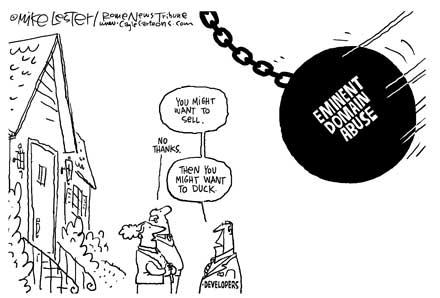
What should have made headlines but didn’t was the recommendation for the greatest intrusion possible by big-and-growing government, for an Urban Development Authority given virtually carte-blanche power to do anything they like, including steal your land. In America, where they’ve had these things before, they call these Authorities the Federal Bulldozer. And with good reason. Imagine a Federal Bulldozer driven by Gerry Brownlee and you might get some idea of the problem.

The Commission’s specific recommendation to create Brownlee’s Bulldozer is that

    • The Government should legislate to create a regime similar to Special Housing Areas whereby certain developments undertaken by local urban development authorities are designated by Order in Council as having the potential to deliver significant numbers of dwellings, and within which the urban development authority will operate with different powers and land use rules.

“Order in Council” means without parliamentary oversight (not that that means much anyway with the currently hopeless opposition). “Different powers and land-use rules” means that the Bulldozer can do whatever the hell it wants, and ignore whatever rules it wants to--much like the Government did when it decided to extend Mt Eden prison to block the view of the mountain itself, something no-one else would have been allowed to do.

More frighteningly, they recommend that

    • The Government should legislate to grant compulsory acquisition powers to local urban development authorities for ‘designated developments,’ subject to the normal processes, compensation and protections of the Public Works Act 1981.

“Compulsory acquisition powers.”

Got that?

As Daryl Kerrigan might explain, that means the power to acquire your land compulsorily.

In a word: Confiscation.

In the year that Magna Carta was commemorated – the legal foundation of the idea that a man’s home is his castle* – these meddling bastards propose confiscating people’s land to “coordinate residential development.”

Compulsory acquisition of your property if your face doesn’t fit the planners’ plans.

The taking of private land by the state, to be given (no doubt) to cronies who suck up to nanny.

You know, all those things that the Waitangi claims are supposed to be about, but proposed now, today, here in the Twenty-First Century.

And nothing at all about hammering a stake through the heart of the thing that has constrained for two decades what people can actually do with their own land: the RMA.

Nothing about fixing the disastrous planning rules that underpin the motivation of property owners to leave land undeveloped.

Instead: Legal theft.

Taking a hammer to the hampered housing market, with property owners being made to be the nut.

Another demonstration of the dictum that controls necessarily lead to further controls, and on ad infinitum.

Not even the Chinese have compulsory acquisition of private land.

But it’s in “the public interest” you say!

Bollocks. As Michael Reddel summarised the Commission’s draft doggerel: “there seems to be a too-ready sense that government is the source of on-going solutions, rather than the source of the underlying problems.”

At one level, the claim that “compulsory acquisition of property by the state can be justified if it is in the public interest” is circular.  What is “the public interest”?  The public interest might, for example, involve the protection of private property rights, including the right to hold property undisturbed. 
    This is another example of the Commission’s apparent reluctance to grapple with pervasive government failure and abuse of regulatory powers. 
    The
abuses of eminent domain powers in the United States should be a salutary warning here….

And so they should be. 

In the States, “compulsory acquisition” is known as “eminent domain.” Among the worst abusers of eminent domain is the odious Donald Trump, who once “persuaded” Atlantic City bureaucrats to confiscate the home of elderly widow Vera Coking so he could construct a limousine parking lot for the customers of his Trump Plaza Casino and Hotel. (Google "Susette Kelo" for another horrible story, or get hold of Ilya Somin’s new book on the problems with eminent domain, The Grasping Hand: 'Kelo v. City of New London' and the Limits of Eminent Domain.)

As PJ O’Rourke observes, when legislation is introduced about what’s bought and sold, the first thing to be bought is the legislators—those not politically connected are the first ones to suffer by it; those (like Trump) who are the first to gain.

The Commission simply washes its hands of such thoughts.

   As if to water down the rather shocking nature of this proposal, the report suggests that powers don’t need to be exercised much, as they can provide leverage (in the same way a mugger with a baseball bat won’t need to hit me to get my money) and the chair is also quoted as suggesting the powers might only be to deal with “holdouts”.    
    But it just is not clear why such powers should be given to public agencies.  In [an unhampered market], housing is readily provided by the private sector.  Public agencies and political leaders got us into this mess, and why would we expect that new powers would not be abused?  
    Have powers of compulsion worked well in central Christchurch?  It hadn’t been my impression.

Has it been anyone’s?

But, I hear you cry, don’t worry: Bill English and John Key would put a stop to this!

"It would be a bit of a stretch to get to compulsorily acquisition, but the idea of better co-ordination of building houses, of getting water and roads in place is an attractive idea," English said [yesterday], adding he wouldn't rule out compulsory acquisition because the Commission had only issued a draft report that was open to submissions.

Oops, maybe not.

But surely John Key … oops, maybe not: point 2a of his first "four-point plan" to fix housing envisioned forcing land-owners to build on their undeveloped land or face confiscation.

Fact is: This is an idea the politicians and planners just keep coming back to.

They can’t help themselves.

So it might presage the worst violation of property rights ever in this country. It might show what happens once respect for property rights is dead. It might be against the stated principles of the party presently in power.

So for all those reasons and more, don’t bet against the recommendations becoming law.

* * * *

Oh, there are other recommendations too. Like toll roads, “targeted rates,” and lifting councils’ debt ceilings (have you noticed them being reluctant top borrow?!). All recipes for growing control and growing governments so, quite naturally, all applauded by enthusiasts for both.

“There seems to be a too-ready sense that government is the source of on-going solutions, rather than the source of the underlying problems.” Daryl Kerrigan should have hung that up in his house.

Mind you, at least he could still afford to buy one.


* Famously commemorated in a superb film, the name of the Castle Coalition, and Lord Denning’s pithy observation in Southam v Smout[1964]:

The poorest man may in his cottage bid defiance to all the forces of the Crown.
It may be frail—its roof may shake—the wind may blow through it—the storm may enter—the rain may enter—but the King of England cannot enter—all his force dares not cross the threshold of the ruined tenement.” So be it—unless he has justification by law.

Thursday, 25 June 2015

It was ten years ago this week she lost her home …

Actually, Susette Kelo’s homee was never really lost. Not as such. In actual fact it was taken from her. Taken from her by government and given to private developers. So were her neighbours’ homes.

NZ’s Productivity Commission would like to see our government have power to take your home. They’d like the power for our government to take private property and give it to Len Brown.

Susette Kelo tells her story. Take careful note. If the so-called Productivity Commission have their way, it might become yours.

No U.S. Supreme Court decision in the modern era has been so quickly and widely reviled as the infamous Kelo decision,—decided ten years ago this week—in which the Court ruled that Susette Kelo’s little pink house in New London, Connecticut, and the homes of her neighbors could be taken by the government and given over to a private developer based on the mere prospect that the new use for their property could generate more taxes or jobs.
In this 2009 address at the
catoinstitute in Washington, D.C., Susette Kelo tells the tale of how she struggled to save her home, taking on the City of New London, a cast of characters too evil to be believed, and, ultimately, the U.S. Supreme Court, in a case that was followed by thousands and sparked a revolutionary change in state law across the country—except in the case’s home state.

Thursday, 18 June 2015

Productivity Commission pisses on property owners

So the Productivity Commission has thrown their hat in the ring to “solve” the housing affordability crisis.

Two things caught my eye in their recommendations. One was for more tinkering. The other was for confiscation.

Of the first, as Michael Reddel summarises at Croaking Cassandra, “there seems to be a too-ready sense that government is the source of on-going solutions, rather than the source of the underlying problems.”

These are people who appear never to have heard of the Law of Unintended Consequences.

The report doesn’t mainly focus on getting government (central and local) out of the way, but on finding smarter or better ways of the government being actively involved (eg “this means a greater degree of publicly-led development”).  Perhaps it shouldn’t be too surprising  –  after all, two of the three commissioners are former heads of government departments, and the Commission works on projects requested by government, in a process where ministers are advised by government department …

So the order of the day is more tinkering to fix previous meddling:

    • land-value rating
    • flexible zoning
    • land-supply targets
    • inventory public land holdings
    • planning rules related to existing infrastructure …

Yeah, I nodded off too as I read that soporific sophomoric dross. At least I did until I reached this phrase:

There is a place for a UDA [Urban Development Authority] to lead and coordinate residential development at scale in both greenfield and brownfield settings, working in partnership with private sector developers. Legislation would be required to establish and give powers (such as compulsory acquisition) to one or more UDCs in New Zealand

Did you spot it?

In the week that Magna Carta was commemorated – the legal foundation of the idea that a man’s home is his castle* – these meddling bastards propose confiscating people’s land to “coordinate residential development.”

Confiscation.

Compulsory acquisition of somebody’s property if it doesn’t fit the planners’ plans.

The taking of private land by the state, to be given to developers who suck up to nanny.

Nothing about hammering a stake through the heart of the thing that has constrained what people can do on their own land: the RMA.

Nothing about fixing the disastrous planning rules that underpin the motivation of property owners to leave land undeveloped.

Instead: Legal theft.

Taking a hammer to the hampered housing market, with property owners being made to be the nut.

Another demonstration of the dictum that controls necessarily lead to further controls, and on ad infinitum.

As a commenter at Kiwiblog observes,

Not even the Chinese have compulsory acquisition of private land.

But it’s in “the public interest” you say!

At one level, the claim that “compulsory acquisition of property by the state can be justified if it is in the public interest” is circular.  What is “the public interest”?  The public interest might, for example, involve the protection of private property rights, including the right to hold property undisturbed. 
    This is another example of the Commission’s apparent reluctance to grapple with pervasive government failure and abuse of regulatory powers. 
    The
abuses of eminent domain powers in the United States should be a salutary warning here…. 

And so they should be.  Among the worst of those abuses is presidential hopeful Donald Trump “persuading” Atlantic City bureaucrats to confiscate the home of elderly widow Vera Coking so he could construct a limousine parking lot for the customers of his Trump Plaza Casino and Hotel. (Google "Susette Kelo" for another horrible story, or get hold of Ilya Somin’s new book on the problems with eminent domain, The Grasping Hand: 'Kelo v. City of New London' and the Limits of Eminent Domain.)

As PJ O’Rourke observes, when legislation is introduced about what’s bought and sold, the first thing to be bought is the legislators--and those not politically connected are the first ones to suffer by it.

The Commission simply washes its hands of such thoughts.

   As if to water down the rather shocking nature of this proposal, the report suggests that powers don’t need to be exercised much, as they can provide leverage (in the same way a mugger with a baseball bat won’t need to hit me to get my money) and the chair is also quoted as suggesting the powers might only be to deal with “holdouts”.    
    But it just is not clear why such powers should be given to public agencies.  In [an unhampered market], housing is readily provided by the private sector.  Public agencies and political leaders got us into this mess, and why would we expect that new powers would not be abused?  
    Have powers of compulsion worked well in central Christchurch?  It hadn’t been my impression.

Has it been anyone’s?

But, I hear you cry, don’t worry: Bill English and John Key would put a stop to this!

"It would be a bit of a stretch to get to compulsorily acquisition, but the idea of better co-ordination of building houses, of getting water and roads in place is an attractive idea," English said [yesterday], adding he wouldn't rule out compulsory acquisition because the Commission had only issued a draft report that was open to submissions.

Oops, maybe not.

But surely John Key … oops, maybe not: point 2a of his first "four-point plan" to fix housing envisioned forcing land-owners to build on their undeveloped land or face confiscation.

Fact is: This is an idea the politicians and planners just keep coming back to.

They can’t help themselves.

So it might presage the worst violation of property rights ever in this country. It might show what happens once respect for property rights is dead. It might be against the stated principles of the party presently in power.

So for all those reasons and more, don’t bet against it.


* Famously commemorated in a superb film, the name of the Castle Coalition, and Lord Denning’s pithy observation in Southam v Smout [1964]:

The poorest man may in his cottage bid defiance to all the forces of the Crown.
It may be frail—its roof may shake—the wind may blow through it—the storm may enter—the rain may enter—but the King of England cannot enter—all his force dares not cross the threshold of the ruined tenement.” So be it—unless he has justification by law.

RELATED POSTS:

  • “The Productivity Commission has come up with the most appalling policy idea I have seen in I don't know how long, that is, the idea that there is a potential role for compulsory property acquisition in assembling large-enough land parcels for achieving proper economies of scale in construction of housing as a way of dealing with problems to do with the supply of land for homes.
    Fortunately not all of New Zealand is as crazy as the Commission…”
    Eminent domain – ANTI DISMAL
  • “But is compulsory property acquisition the only way of solving hold-out problems? And are hold-out problems even the binding constraint here? I have been a fan of option contracting as a way around hold-out problems…”
    Eminent domain – Eric Crampton, THE SAND PIT

Thursday, 18 February 2010

Who's holding the gun, Mr Brownlee?

[Guest Post by Julian]

Transpower continues to seek access to farm properties with the debate now moving to the South Island. Says Temuka farmer Jeremy Talbot, "There is to be no more access given to allow [...] work to be finished until we finally do get the settlement we've been seeking." Seems fair enough to me. Let him and Transpower negotiate in a civilised way as many people around this country do every day. I thought we had already dealt with this issue here at Not PC a few week ago.

Yet the South Island farmers’ attitude has annoyed Energy Minister Gerry Brownlee. Speaking on Morning Report this morning, he states his annoyance that some farmers are holding a gun to the head of government.  "Holding a gun to the head of government is simply not going to work," he whines. Excuse me, Mr Brownlee, but that is not what these farmers are doing. They are exercising their property rights. It is their land, their property.

If Mr Brownlee objects to the holding of guns at people's heads, then I suggest that he show equal disdain for his own government, a government that routinely bullies New Zealand taxpayers and property owners, using the threat of a gun to the head as its means of persuasion.

Thursday, 28 January 2010

Pylon pressure – more State bullying

Does Transpower have freely negotiated easements over farmers’ land, or does it not?

If not, then it owes an apology to everyone from farmer Steve Meier on down for using the powers of the state to march unwanted onto someone else’s property.  And for relying on such bullying as their primary means of protecting Auckland’s power supply.

Frankly, if any part of that is true then the whole situation is a disgrace from arse to elbow.
Just what the hell does Transpower CEO Patrick Strange think he’s doing bad-mouthing those whose property he is so shamefully abusing.  Just what the hell is he playing at relying on the good will of those he’s abusing to maintain a secure power supply to the country’s biggest city. The arse he’s sitting on needs kicking from here to Matangi.

Janet Wilson reckons Transpower's bullying of farmers over access shows the organisation as “a bureaucratic monster that embodies the worst faults of a giant government-owned corporation.”  And who could disagree.  She says:
    “Dr Strange may think he can ignore public opinion because he has the power of the state behind Transpower in what it does.”
That would appear to be precisely the case.  As I’ve said here many times before.

Sunday, 24 May 2009

Budget Week billboarding

Julian Pistorius’s billboards got some titivation ready for Budget Week – a simple reminder that this government is about to break its foremost campaign pledge . . .

Tax-Cuts

And a few other slogans were added around the Waterview area . . .

Castle

Thursday, 21 May 2009

NOT PJ: Long hard road in Mt Albert

This week Bernard Darnton takes all the jokes other people have made about Melissa Lee and gathers them in one place.

_BernardDarntonIt would be fair to say that Melissa Lee’s legend burned out long before her candle ever did.

Mount Albert voters have had a week to absorb the news that they’re going to get a new motorway. Where Labour had promised them a tunnel, National offered them two tunnels. At half the price. For a limited time only. Act now! Pick up the phone because our operators are standing by.

The only downside was that the motorway was going to bring in criminals from south of Auckland to steal people’s houses and bulldoze them.

There are always people who complain when new roads are built. When the Wellington bypass cut through Te Aro a few years ago some of the scruffs who lived nearby were quite upset. The odd thing is: in Te Aro none of the Not-In-My-Back-Yard types who complained about the bypass actually owned any of the back yards that the road went through. All the land was purchased voluntarily.

Not so in Mount Albert. There are residents there saying that the motorway will be built over their dead bodies. That will only encourage the land thieves. Ask the residents of the Bolton Street Cemetery, who gave way to another Wellington roading project in the 1970s, the Wellington Urban Motorway. They’d be turning in their graves if they still had graves.

The taking of part of the cemetery caused huge controversy when it happened. I’d like to think that turfing living people out of their houses would be just as – if not more – controversial. The media are more interested in Melissa Lee having her foot in her mouth than having her jackboot up the backsides of the local residents.

Not that any of the others are any better. National and ACT are happy to evict the residents of 400 houses before the government bulldozers flatten their soon-to-be-empty homes. Labour would have done the same for about two hundred homes around the tunnel entrances. The Greens would happily shift the entire population into detention centres – er, sustainable eco-villages – to make way for the 930,000 km of canals that would be required to shift all of New Zealand’s road freight onto solar-powered mule-drawn barges.

As usual, it’s only the Libertarianz candidate, Julian Pistorius, who’s suggesting that if you want something you should ask the owner nicely. It’s always valuable to be reminded that a government big enough to insulate your home today is big enough to smash it to bits with a wrecking ball tomorrow.

Faced with the stormtroopers of “progress” and the blitzkrieg of eminent domain, we should be more like the French. Wait – that’s obviously not right. Forget that analogy.

The government should be more like the French. Usually when I say that I mean that they should take long lunch breaks, long summer breaks, and don’t – under any circumstances – do anything under urgency. In this case I mean it more constructively.

French roadbuilders pick multiple routes, buy options on properties on all the routes, and then when one route is complete all the property owners on the route are paid out in full. The road is built. It turns out that pocketing a fat wad of Euros and buggering off is more popular than living in an intact house next to a motorway.

There’s no reason that the same scheme couldn’t be used here for roads, electricity pylons, nation-spanning cycleways (assuming that wasn’t just a joke – I live in hope), or any other construction that comes in an inconveniently long skinny shape.

If a politely worded letter and a suitcase stuffed full of cash is all it takes to make the French look organised we should at least consider it. If the letter was polite enough and the suitcase stuffed enough, it might even persuade miseducated lifestyle-block housewives that electricity pylons don’t microwave their kids’ heads and make them explode.

But the biggest advantage would be having a government that wasn’t a gang of looters and pillagers. Returning property rights in New Zealand from myth back into reality will be a long hard road but one well worth building.

* * Bernard Darnton’s NOT PJ column appears every Thursday here at NOT PC * *

Wednesday, 20 May 2009

More on stealing people’s homes

Paul Walker at Anti Dismal links to a piece by Don Boudreaux challenging the conventional idea that the existence of “hold outs” necessitates governments stealing people’s homes in order to build motorways, or power lines or railway lines.  Not so, says Boudreaux. 

While it is easy to imagine such problems [such as the recalcitrant homeowner], I doubt that they are significant enough to entrust politicians with the power to take private property.  .  .[Especially since] with skillful contracting maneuvers — for example, buying each plot of land contingent upon the successful purchase of all other plots of land necessary to build the road or airport — a government intent on serving the public should be able to do its job without powers of eminent domain.

Concludes Paul, “If only our government had the same skills as private developers.” But then they wouldn’t be in government, would they.

Frankly, if there’s burglars coming to Mt Albert by motorway, it’s the burglars who are there stealing people’s houses to build it.

Friday, 15 May 2009

Charles (Bud) Tingwell, R.I.P.

m866127 Australian actor Bud Tingwell (right) died today, but his work (and his blog) lives on – and one of his most well known roles, as the wise old lawyer in film The Castle who rescues the Kerrigan family from being thrown out of their house, is as directly relevant today as it’s ever been.  At least it is if you live in Waterview – or value private property rights.

Watch him here in this edited clip from the film, asking the court to consider the meaning of the words “the acquisition of property on just terms,” and how they relate to real people in homes from which they don’t wish to be moved.  Turns out it’s more than just the vibe.  [The words quoted start around 4:00 in, but the full speech is unfortunately cut short.]

PS: A good American resource on eminent domain abuses like this is The Castle Coalition. Check it out.

Thursday, 14 May 2009

Nats’ ad man attacks Nats’ bulldozer [updated]

The copywriter for National’s election billboards in 2008 (“Wave Goodbye to Higher Taxes” – Yeah Right!)  attacks National’s Waterview motorway decision this morning

“Residents of Mt Albert and Waterview in Auckland are preparing to defend their homes against government bulldozers,” says Glenn Jameson at SOLO of the decision by the government he helped to elect, “and every citizen in New Zealand who values their own property should stand beside them in solidarity”:

    Transport Minister Steven Joyce is planning to use 1.4 billion dollars that don’t belong to him to level 365 homes that don’t belong to him or the citizens who will benefit from the 4.5km motorway link. Using the excuse that it’s for the greater good of the community effectively crushes the rights of every member in that community – and the only ones who have the temerity to call that good are thugs.
    
One has to sympathise with resident Leonard Purchase: ‘Bastards. They're a bunch of no-hopers – rats. I've been here 23 years. I inherited this place from my father. My old man bought it [and] he died here – I thought I was going to die here too... Nobody's come to talk to me – it's just things that have come through the mail.’
    The day a government reserves the right to flatten your house without your permission is the day you cease to actually own your property. Your beloved garden, hand-built barbeque, and painstaking renovation are disposable chattels to the politician who coldly draws a line across a map on his way to building another monument to draconian law. It’s time we all linked arms and told the government to get off our land and bugger off out of our lives.

True.  You want to build a motorway without doing people over?  Then learn how to do it peacefully.

UPDATE:  Nat’s ad man Glenn Jameson clarifies in part:

While it is true I did co-write the National Party campaign I wish to point out a glaring and embarrassing inaccuracy from my own agency, which has only just now been linked to my attention: I have never been nor will ever be a "dyed-in-the-wool National Party supporter” . . .

Read the whole clarification here.

Quote of the Day: LGM on Melissa Lee [update]

Funny how this daft bat blames South Aucklanders for stealing when she is part of an outfit that is about to steal people's homes. I wonder if the irony of that ever occurred to her.”
- Little Green Man


UPDATE: And this, from commenter Buggerlugs at Kiwiblog is very good too, in response to Lee's "... it will stop criminals from South Auckland coming into the suburb to commit crimes . . . "

as opposed to the criminals currently living in Mt Albert? Oh, that’s right…one of them has already shifted out. To New York apparently.

Keep those quotes coming in.

Wednesday, 13 May 2009

Mt Albert: Where South Aucklanders come to burgle? [update 2]

Given Transport Minister Steven Joyce's announcement today of his decision for the Waterview motorway, tonight's Mt Albert electorate meeting -- a "Q&A on transport issues" -- was always going to be a debate on The Motorway. A noisy debate. Little did we know it was about to turn into a debate on South Aucklanders' propensity to burgle. On that more later.

First of all, as a Q&A it was hopeless: The politicians all brought their fictions to a fact fight. No candidate actually had the facts to answer the audience's questions. (Well, the Greens' Russel Norman did, but he preferred to make up whatever hurt the other candidates the most; and ACT's John Boscawen did, but unfortunately they weren't the facts about Steven Joyce's project but on the project Boscawen himself would like to see built.) It was all very bizarre, particularly as Melissa Lee's refrain for most of the evening was "I don't know," and "I'm here to listen."

Either National's Steven Joyce hadn't bothered to brief his party's by-election candidate about the motorway that's about to bisect her would-be electorate, or (being both a pretty girl and a former journalist) Melissa Lee simply hadn't bothered to find out the facts and thought a nice smile would be enough instead. Either way, it was apparent even to people in the room holding up National Party signs that when Melissa Lee says "I don't know" or "I can't remember" that on this much at least she's probably telling the truth.

I don't say that like it's a good thing. Clearly, details are not Ms Lee's thing. (And if she really was "there to listen," then why the hell was it so hard getting her to shut up when other people were talking?)

Details really are Russel Norman's thing. He thrives on details like the envirogeek he is, but he uses details less to explain than he does to explain away.
  • He berated National "borrowing billions" to fund the motorway (which Liberty Scott points out it won't be), but was happy to have it borrow several billions to pay for his train set. He lambasted National for for building a motorway that will "cut the community in two," but is happy to build a heavy rail line that will have the same effect.
  • He was happy to characterise the National proposal as "the above-ground option," when as he quietly conceded to David Shearer it is in fact to be in tunnels for around sixty percent of its length -- expensive tunnels built simply to avoid sites that are considered politically sensitive.
  • He talked about how some American cities have up to eighteen lanes in their motorways "and we won't need that if we invest in public transport" -- strangely oblivious to the fact that all major American cities have made significant investments in public transport, but people still choose to use their cars.
  • And in a question about the need to build roads to carry freight, he started blathering on about cycleways, prompting the person sitting next to me to ask if he really thought we were going to have the city's freight carried on a few cyclepaths?
Surprisingly though, I found Russel oddly impressive for a man who clearly believed hardly a word of what he was saying, but was comfortable just spinning these fatuous one-liners for the benefit of the Green goon squad in the room.

The one candidate who did mean what he said was Libertarianz candidate Julian Pistorius. (Disclosure: I was there carrying his pamphlets.) And ironically the one group with whom he made the strongest connection were the chaps from the Socialist Aotearoa grouping. It was only Julian, they pointed out, who is prepared to stand up for the people who the State is going to throw out of their homes against their will. And they're right. He is. Everyone else is prepared to use the "Federal Bulldozer" to ram through their own preferred option of either road or rail (and as Scott points out, if even the French can work out how to build motorways without throwing people out of their homes, then surely we could learn something from them, couldn't we? Couldn't we?) but only the Libertarianz candidate was prepared to point out that the government is supposed to protect people's property rights, not do them over.

And what of Labour's David Shearer -- "the grey machine man"? Well, his own goon squad was noisy, but he wasn't. His tie was colourful, but he wasn't. I'm sure he can write a memorable report, but whatever it was he said tonight left me as soon as I left the room. Perhaps that's why he was known as a bureaucrat's bureaucrat. What he said was so forgettable, but said with such authority, that he's bound to romp in come polling day.

In fact, most of what every mainstream candidate had to say on the night was both instantly forgettable and intended only for short-term political advantage. But there was one thing one candidate said that is now going to dog her through the rest of the campaign. Maybe longer. It will probably be the meeting's headline tomorrow morning. I say "her,"because the foot in the mouth belonged to Melissa Lee.

Asked to explain how the new motorway would most help the good people of Mt Albert, she explained that it would stop the bad people of South Auckland driving to Mt Albert to burgle people's homes. Asked to clarify by a questioner, she repeated the claim. Showing she's truly not one to stop digging when she creates a big hole for herself -- a hole as big as the number of open mouths in the room -- she insisted that the local police commander had told her this very morning that the biggest issue with which he has to deal is the number of South Aucklanders driving to Mt Albert to burgle people's homes.

I swear I am not making this up. It's true that the likely winner of the by-election, David Shearer, grew up in South Auckland . . . and in being Labour's "machine candidate" he could be said to be burgling the seat . . . but what the hell she was talking about, only Melissa Lee herself would know. Probably.

It was as incongruous and frankly ludicrous as Jenny Shipley's comment in Parliament several years ago (apropos of nothing relevant) that Polynesians tend "to climb in the windows of other New Zealanders at night." And it deserves to be treated with equal contempt.

UPDATE 1: Let me clarify something here. Steven Joyce and several commentators around the traps -- and now John Key -- have all suggested Melissa's South Auckland comment was made "in the heat of the meeting," "in the face of a hostile audience" and so forth.

That's not the case, and those commentators weren't at the meeting, which was hardly "hostile" in any sense. More bemused. Posting at Hard News, commenter Stephen Horsley is spot on:
I was at the meeting, and I would have to disagree [that this was a rushed response to a hostile audience]. It wasn't something that she just blurted out, in fact she seemed very pleased with herself for having thought of it. When asked to clarify the comment, she went into a fair amount of detail justifying herself. . . it appeared to be a view that she genuinely subscribed too.
That's exactly as I saw it too.

UPDATE 2: Liberty Scott runs the rule over the Mt Albert candidates, and says Vote For Freedom in Mt Albert:
I said on 4 May that "It might be better to just wait to see who all the candidates will be, before making a choice." of candidate. So I am pleased that Julian Pistorius is standing for Libertarianz.
Let's be clear, the motorway will be built, but only Julian can be a solid advocate for the private property rights of landowners who may face compulsory purchase, and for ways to respect that while progressing the road (for example, the Melbourne Citylink motorway was built by the private sector negotiating the land purchase from all those along its route).

Let's also be clear, a Labour MP will mean no change, a backbencher in a party that has no power over the next 2.5 years and which has shown a willingness to pillage taxes to buy an electorate.
A National MP will mean no change. Melissa Lee is already in Parliament, being MP for Mt. Albert will just give her a little more to do, but she won't be fighting for private property rights.
A Green MP will mean no change. Russel Norman will lead obstructive direct action against motorway building, whilst cheerleading on the pillaging of Mt. Albert taxpayers for a railway that even ARC has as a low priority.
ACT candidate John Boscawen has shown his level of judgment in voting for the W(h)anganui District Council (Prohibition of Gang Insignia) Act.
ALCP candidate Dakta Green is worthy of your vote if that one policy matters above everything else.
However, Julian Pistorius IS worthy of your vote if you want to shake up Parliament and get a man dedicated to standing up for Mt. Albert taxpayers and property owners. He wont be a backbench voice on a major party, or speaking to increase taxes or spend more of other people's money. He won't be claiming to speak for property owners on the motorway issue, but at the same time running roughshod over them with the RMA. He wont be supporting the megacity -- or even existing local government as long as it continues to have a legal "power of general competence" to do as it sees fit.
You see Julian will call for the government to undertake the tax cuts it promised. Julian will support private property rights as an absolute. Julian will also support the right of ALCP candidate Dakta Green to campaign to legalise cannabis without harassment, because Julian too supports legalising consumption and sale of cannabis for adults on private property.

Mt. Albert voters might baulk at voting Libertarianz when it is about choosing the government, but this is a by-election not a general election, and who could have a louder voice for Mt. Albert than a Libertarianz MP? Who will in principle oppose the confiscation of land for a road, or any purpose, and call for less government so Mt. Albert residents can make their own choices?
So go on Mt. Albert, vote Julian Pistorius as your local MP. Beyond anything else it will give Helen Clark the most unwelcome surprise when she wakes up in New York the next morning to see who she handed the seat over to.
Isn't that a delicious thought!

Vote Julian P in Mt Albert

To the Grey Machine Man, the Ginger Whinger, the world’s sexiest Asian MP, and Galt knows who else, Mt Albert voters can now add the choice of voting for Libertarianz candidate Julian Pistorius in the coming by-election.JP007

Unlike the other candidates, Julian – a former Libz Deputy – doesn’t have to leave home or a job with the UN to visit the electorate, and he’s keen to highlight some local and national issues that no other candidate will be brave enough to mention:

  • Who else is going to championwaterview1 the people whose homes are about to be stolen from them to build the new motorway, by a government to whom the words “property rights” are still a dirty word.  People like 85-year-old Leonard Purchase (right), who says of the thieves
        "Bastards. They're a bunch of no-hopes - rats. I've been here 23 years. I inherited this place from my father. My old man bought it [and] he died here - I thought I was going to die here too. The tunnel sounded all right, but this - where the hell am I going to go now? Nobody's come to talk to me - it's just things that have come through the mail. I didn't think for a minute that it would come to this. I don't feel like moving - this is my home - and now they're going to go right through. What are they thinking?"
       
    A government that did respect property rights wouldn’t need to bulldoze people’s property – they’d know it’s possible to purchase voluntarily a motorway route that’s been planned for decades, and they’d do it.
        Is Leonard the local Darryl Kerrigan?  Is National a party of principle?  Julian for one will tell ‘em they’re dreaming.
  • Who else is going to provide principled opposition to the ACT/National super-shitty Super City. It should embarrass local ACT supporters that their leader is setting up (in Owen McShane's words) "the first fascist state in New Zealand."
  • Who else is going to remind people that the new law on Gang Patches allows any local council to add themselves via regulation. Just another reason to worry about an out-of-touch Uber-City able to ram things through by decree (and local ACT supporters might also remember just which party leader’s vote tipped the balance on this bill? and which Mt Albert candidate and erstwhile supporter of free speech also voted for it!)
  • Is anyone else going to point out that National’s RMA “reforms” are not reforms in our favour, but are only intended to make it easier to bulldoze through Steven Joyce's billion-dollar Think Biggish infrastructure programme (of which this motorway is a lading part), and for councils to take your property rights away without challenge (of which every council District Plan is a leading example)?  If not us, then who?
  • It’s Budget Month, and is anyone else pointing out that National is about to break a major election promise – their pledge to cut taxes?  That they’re about to backtrack on a major part of their election platform? That they value their promise not to cut spending more than the promise to give taxpayers their money back when they most need it. That they must have either been lying about their intention to deliver them, or so incompetent they didn’t notice they were never affordable. They broke their promise on superannuation in 1991 – and they’re breaking this promise now.  Let’s make this a referendum on Trust in Taxation!
  • Is there anyone else going to defend local shop-owners who have the temerity to want to defend themselves?
  • Is any other candidate going to speak out on behalf of “political criminal” Dakta Green, Mt Albert candidate for the ALCP Party, bullied, harassed and arrested three times in one week for cannabis activism?

If not Julian, then who the hell else in Mt Albert is going to speak up on all these issues!

Look out for his billboards starting to go up this weekend. And if you’d like to help out, then why not email him: [email protected].  (And if you’re looking for dirt, just ask him about those photos. The ones with the coconuts.)  

UPDATE:  Keep up with Julian's campaign, or better yet join in, at his Facebook Campaign Page.  Go to it!

Friday, 20 February 2009

Property rights are human rights: let’s protect them say NZ academics! [updated]

I’m astonished.  The last two decades have seen attack after attack on New Zealanders’ property rights.

  • the imposition of the Resource Management Act, which gave planners full power over your land;
  • the confiscation of crown pastoral leases;
  • ‘right to roam’ laws attacking the sanctity of farmers’ land;
  • the destruction of Maori land value by Crown pre-emption rights;
  • the nationalisation of petroleum;
  • the partial nationalisation of Telecom;
  • the confiscation of the legal right to claim the foreshore and seabed under common law;
  • the destruction of value of pre-1990 forests under the Emissions Trading Scheme;
  • unwanted power pylons being imposed on Waikato farmers;
  • the attack on the value of shares in Auckland International Airport Ltd.

And in the last Parliament, when offered the opportunity to place the protection of property rights in NZ’s Bill of Rights Act, MPs peremptorily voted it down –- with John Key’s National Party being prominent in the ‘Noes’ lobby when it finally came to the vote.

Despite abundant historical evidence of the many blessings of property rights, and cogent arguments defending these life-sustaining rights, both academics and politicians of all stripes have been on the front foot against property rights for years.

So how astonishing then to see National Party hack Matthew Hooton promoting the work of two academics from the state-worshipping climes of Victoria University, who argue in advance of next week’s Jobs Summit that “if the new Government moves to protect property rights, there will be more jobs in our economy than otherwise.” 

Professor Lewis Evans and Professor Neil Quigley of the Institute for the Study of Competition and Regulation at Victoria University of Wellington, along with NERA Economic Consulting, entitled ‘Protection of Private Property Rights and Just Compensation: An Economic Analysis of the Most Fundamental Human Right Not Provided in New Zealand.’

The paper compares New Zealand’s record on property rights with the rest of the OECD; finds our record to be among the worst in the developed world; details the economic harm being done to all New Zealanders as a result; and proposes a legislative solution involving an amendment to the Bill of Rights Act to ensure a canary in the mine exists to alert the public if and when future parliaments seek to confiscate property rights without compensation.  [The full paper can be found at  http://www.iscr.org.nz/n493.html and it was also previewed on page six of today’s National Business Review.]

There is much to be disappointed with in an argument made on practical grounds alone, without any statement of the moral grounds on which property rights must be protected –- and much to object to in the notion that property rights equates only to ‘compensation for takings’ instead of outright protection against theft of what you own –- but in these times seeing support for property rights from any local quarter is welcoming.

And they’re right, you know. If the new Government does move to protect property rights, then there will be more jobs in our economy than otherwise. 

An understanding of the vital role of property rights and lawfulness in creating wealth should be basic knowledge for every thinking person, shouldn’t it?  Even a politician.

Tibor Machans' authoritative piece on the Right to Private Property would be a good place for honest thinking persons to start their education: "The institution of the right to private property," says Tibor, "is perhaps the single most important condition for a society in which freedom, including free trade, is to flourish."

UPDATE: Quote corrected.

Monday, 1 December 2008

RMA to be reviewed to promote easier theft-by-government

Despite what some of you are still pathetically hoping for, the revolting Nick Smith, the Minister for the RMA, promises no change at all to the heart of the RMA, which is where the real poison lies -- he exhibits explicit disinterest in property rights (which is what is so desperately needed at the heart of the RMA) -- and no interest at all in making the RMA work better for you and me: only in making it work better for the government's Think Biggish public works programme.

If you still don’t believe me, take a look at what this vile scum is promising.  The National/ACT Government, he says –- the Government that you voted for --  will review the Resource Management Act to, quote, “'look at how companies win the right to take private land.”  

Yes, you read that right.  To “'look at how companies win the right to take private land.”

This is what you voted for.

The first ones to be hit will be Canterbury farmers, who Nick Smith is preparing to set up for theft-by-government to make way for the Central Plains irrigation scheme. As Libertarianz deputy Richard McGrath points out, "Environment Minister Nick Smith doesn't even pretend to be concerned for the property rights of Canterbury farmers. His primary goal is to make it easier for a private developer to steal their land."

This is the “brighter future” you voted for.  You can’t say you weren’t warned.

Wednesday, 1 October 2008

National's RMA Policy "like a chocolate-coated turd"

National's Nick Smith released National's Resource Management Act policy yesterday.  Smith said within 100 days of forming a new government National would introduce a bill to "streamline" the Resource Management Act.

Responding for the Greens, co-leader Russel Norman says "the National Party's plans to reform the Resource Management Act are a misguided 'business-first, community-second, environment-last' policy:

Dr Norman says National's RMA gutting will undermine New Zealanders' ability to protect our environment..."

Actually, they're both wrong -- although they both gain politically by the ruse.

  • At the moment the RMA removes from property-owners rights over their own land, including the common law right of recourse over pollution by neighbours or downstream polluters.
  • It locks up land around the country's major cities, jacking up the price of new housing for new home-buyers.
  • It gives large polluters a "license to pollute" -- meat processors to dump their wastewater into rivers and oceans; farmers, pulp and paper mills and landfill sites to discharge their waste (with a license to pollute gifted to them by the RMA) into lakes and rivers; a developer to  dump sewage effluent directly into an ocean outfall at Akaroa with no recourse in law for those polluted by such discharges.
  • And the lengthy delays and seemingly arbitrary basis on which consents are granted makes it virtually impossible for producers to plan ahead, adding huge costs to every new project.

'Smith's dream' does nothing at all to address these serious problems, on top of which he wants to introduce two new bureaucracies -- an Environmental Protection Agency to make things even more restrictive, and a toothless "independent complaints mechanism" to give the appearance that someone gives a shit when the council stuffs you around.

The guy's a fool.

Smith's on record as calling the RMA "far-sighted environmental legislation" -- it isn't. 

Remember that Smith had three years as minister in charge of the RMA back in the nineties to change things -- he didn't. 

He promises nothing fundamental now, either.  The policy overflows with buzzwords like "fix," streamline" and "get business moving," but closer examination demonstrated Smith's large print giveth, but his small print taketh away.

Does he promise to put protection of New Zealander's property rights at the heart of the Act?  No.

Does he promise to take power over your property away from planners and council bureaucrats?  No.

To make it easier for a builder to get a subdivision consent and lower the price of land to buyers?; or for a supermarket owner to build a new supermarket in the face of a competitor?; or a developer to build a new village in the face of council opposition?  No, of course not -- not when you read the fine print. 

Will they abolish the likes of development levies, and squash the huge delays and rises in consent costs that add thousands, and sometimes millions, to every private project in the country?  No, of course they won't. 

Will they do anything at all to increase the supply of suitable land available on which to build houses, or to remove council planners the power to zone private land, and the power to set urban walls around New Zealand towns and cities?  No, emphatically not.

Not one of these things will happen under National.  Here's what they  promise instead:

"We want to get business moving again by addressing the needless bureaucracy that is frustrating so many homeowners, farmers, and businesses, and to enable New Zealand to get on and build much-needed infrastructure," he says.

Well adding a new bureaucracy is hardly a good start, is it?  And since there's nothing here to kill off planners, consultants and the sundry other needless parasites who leech off the Act and destroy enterprise, there's hardly cause to celebrate. (And don't forget, National have their own Emissions Trading Scheme to roll out as well, and don't think you'll be seeing any details of that before you go into the polling booth in November.)

National supports the underlying principles of the Resource Management Act...

The underlying principles of the RMA uphold the toxic collectivism of kaitiakitanga - or stewardship - while completely ignoring property rights; they uphold the nonsense of 'intrinsic values' while destroying distinctively human values; they tout 'effects-based planning' while prescriptively regulating and prohibiting human activities; they have empowered an enormous army of consultants to interpret and manage it; they protect trees, rocks and mud puddles while providing no protection for human life; they "protect" "future generations" while making it virtually impossible to build the infrastructure these generations will need. The RMA fails to even mention property rights in its 455 pages, while harbouring a savage penalties regime of fines up to $200,000, and up to two years in jail!

These are the underlying principles that the National Party supports.

National will simplify the Act by limiting the definition of environment to natural and physical resources...

Hardly a king hit to bureaucracy and red tape, just a very small baby step that consultants will very quickly learn to exploit.

...  and prohibiting objections with respect to trade competition.

The Act already prohibits trade competitors using the RMA to stifle competition.  But as North Shore supermarket and shopping centre owners will know, it hasn't stopped them using proxies.

We will also reduce the number of consent categories ...

But the increase in the number of consent categories has made consent applications easier (if only slightly); reducing them is going to make applications harder, not easier.

...replace the broad reference to Treaty principles with specific requirements for iwi consultation...

Which means the present vague references to consultation over taniwhas will be replaced with explicit demands for consultation over taniwhas.

...and remove the ministerial veto on coastal consents.

Which will be retained for much of the northern North Island in the Hauraki Gulf Marine Park Act, introduced by Smith in his previous term as minister.

The ministerial veto on coastal consents adds time and unnecessary uncertainty to applications. This was emphasised by the political interference of the Conservation Minister in the Whangamata Marina.

And as this dickhead is well aware, the Conservation minister's political interference with the Whangamata Marina -- and with the Whitianga Waterways -- was necessitated by his own Hauraki Gulf Marine Park Act.  The man has a tongue so forked he could hug a tree with it. What else does he promise with it?

Tens of thousands of people every year apply for smaller consents and are frustrated by breaches in statutory processing times, excessive fees, and unreasonable requests for further information from consenting authorities The bill will provide an independent complaints mechanism for these issues, where there will be a power to discount or waive consent-processing fees where statutory processing times are breached.

This is about as attractive as a chocolate-coated turd; it looks almost edible until the sugar coating is removed. 
    Councils are already adept at asking pathetic and irrelevant questions to extend the nominal twenty-day limit they have for considering resource consent applications without the delays being recorded as such; Smith's proposal just invites more of the same ruses.
    An "independent complaints mechanism" won't make consents arrive any earlier, or save anyone any money: instead we'll simply have yet another useless bureaucracy, while applicants will be assailed by councils processing their consents with even more stupid and irrelevant questions than they do now just to justify them "stopping the clock." 
    And although it's hard to image how much more stupid some of those questions can get, it's clear enough that the stupid questions will increase under Smith's stupid proposal. That he wants to hang his hat on this is a sign of how little he really understands the Kafka-esque problems with making and receiving Resource Consent applications.

The bill will simplify the process for councils amending and updating their plans... We will encourage regional and district councils to develop a single plan.

Irrelevant window dressing.

We will also encourage greater use of the Internet to replace onerous paperwork requirements.

Even more irrelevant window dressing.

We will provide for a system of approved contractors in areas like tree trimming to reduce the number of minor consents required.

Jobs for the boys.

And now, with the window-dressing out of the way, we come the crux of National's RMA policy -- at least, the crux of the policy for National:

National’s Resource Management Amendment Bill will provide for ‘Priority Consenting’ of major infrastructure projects.

This is what is gets Smith and his colleagues excited -- removing the major legislative impediment to "Thinking Big" -- requiring that projects unilaterally deemed to be of "national significance" to be consented in nine months, or else.

That won't help you or I get our projects built or our property rights protected, but it would allow a National government to steamroll over people's property rights to push through projects like the Waikato pylons.

Which all makes one thing very clear: They don't want to protect your property rights -- they want to promote their ability to steamroller over them.  They don't want to make it easier for you to build -- they only want to make it easier for them to build, using borrowed money.

Taken together then Smith's proposals are a mixture of irrelevant, meaningless, hopeless and more damaging -- much like himself really.

Nothing will be fundamentally altered.

The productive will still have to go cap in hand to to ask permission from the unproductive in order to produce.  It's just that under Smith's regime the unproductive would be saluting a different coloured flag.

Alas for the opportunity lost -- for the chance to tear down the bureaucratic monster of the RMA altogether, to drive a stake straight through its heart, to dump the RMA once and and for all, and to uncover the property-rights protection of common law that has over seven-hundred years of sophistication and success in protecting both property owners and environment.