Showing posts with label David Lange. Show all posts

Monday, 26 August 2024

"Probably among the worst toxins you can inject into the democratic constitution of a trusting people ... "


Cartoon by Nick Kim

"'NEWSTALK ZB, Opinion: Constitutional law expert and former Prime Minister Geoffrey Palmer takes a deep, concerned look at the risks this Government is taking with hasty law changes.'
"Pretty rich coming from the man [right] responsible for s9 of the State Owned Enterprises Act, with its stupid reliance on undefined ‘principles.' It launched the courts into inventing their partnership metaphor for the Treaty. Lange raged to me in 1994 that Sir Geoffrey had assured him s9 was just ‘comfort’ to settle down iwi leaders. ‘It doesn’t have real legal effect’.
 
"I’m not aware of any apology from Sir Geoffrey for this grotesque error. Or even hindsight repudiation to limit the damage. 
"Probably among the worst toxins you can inject into the democratic constitution of a trusting people in a trust-based egalitarian law-abiding society, with an extraordinary level of intermarriage and other evidence of respectful race relations. 
"Setting lawyers free to make law instead of applying it. Enabling corrupt bullies to trash property rights (incidentally negating Article 2). And empowering courts and bureaucrats to exploit undefined (therefore unlimited) race privilege to trump equality before the law."
~ Stephen Franks on Twitter

Lange: "The treaty itself contains no principles which can usefully guide government or courts.”


“It is with no disrespect for Maori feeling for the treaty that I have to say it means nothing to me. It can mean nothing to me because it has nothing to say to me. When I was in office I understood that the government had succeeded to certain legal and moral obligations of the government which signed the treaty, and that in so far as those obligations had not been met it was our responsibility to honour them. But that is the extent of it.
    "The treaty cannot be any kind of founding document, as it is sometimes said to be. It does not resolve the question of sovereignty, if only because one version of it claims one form of sovereignty and the other version claims the opposite. The court of appeal once, absurdly, described it as a partnership between races, but it obviously is not. The signatories are, on one side, a distinctive group of people, and on the other, a government which established itself in New Zealand and whose successors represent all of us, whether we are descendants of the signatories or not. The treaty cannot even resolve the argument among Maori themselves in which one side maintains that you’re a Maori if you identify as such, and the other claims that it’s your links to traditional forms of association which define you as Maori.
    "As our increasingly dismal national day continues to show, the treaty is no basis for nationhood. It doesn’t express the fundamental rights and responsibilities of citizenship, and it doesn’t have any unifying concept. The importance it has for Maori people is a constant reminder that governments in a democracy should meet their legal and moral obligations, but for the country taken as a whole, that is, and must be, the limit of its significance.
    "Here I come to the dangers posed by the increasing entrenchment of the treaty in statute.
    "The treaty itself contains no principles which can usefully guide government or courts. It is a bald agreement, anchored in its time and place, and the public interest in it is the same as the public interest in enforcing any properly-made agreement. To go further than that is to acknowledge the existence of undemocratic forms of rights, entitlements, or sovereignty.
    "The treaty is a wonderful stick for activists to beat the rest of us with, but it could never have assumed the importance it has without the complicity of others. It came to prominence in liberal thought in the seventies, when many who were concerned about the abuse of the democratic process by the government of the day began to see the treaty as a potential source of alternative authority. It’s been the basis of a self-perpetuating industry in academic and legal circles. Many on the left of politics who sympathise with Maori aspiration have identified with the cause of the treaty, either not knowing or not caring that its implications are profoundly undemocratic."
 
~ former Labour Prime Minister David Lange from his year 2000 Bruce Jesson Memorial Lecture. Quoted by Gary Judd in his post 'Treaty is a bald agreement, anchored in its time and place,' in which he concludes by reciting Lange's accurate observation that "The treaty itself contains no principles which can usefully guide government or courts.” 
"In the real world," Gary points out, "there are no principles of the Treaty. They exist only in a fantasy world created by the 1972-1975 Labour government’s Treaty of Waitangi Act. The magical possibilities of this fantasy world have expanded since then to the point where ordinary New Zealanders feel threatened by those who would claim on the basis solely of their identity, or who they identify with, that they have a superior place, and that democracy must be relegated to a subordinate position."

Friday, 4 August 2023

REPOST: Top ten best things about Winston Bloody Peters


Since the old faker has risen from the grave again -- as he does like clockwork every three years around this time -- I figured I'd repost this piece, largely unchanged*, from way back in 2005. Unchanged because it barely needs to be; and shows, no matter what you might think about him, the man is at least consistent. (The 11th best thing to say about him.) That is to say, consistently dishonest, demonstrating you can never underestimate the market for bare-faced, scaremongering xenophobia.

So getting right to it, here are the Top Ten Best Things about Winston Bloody Peters:
1. He's a perfect litmus test. You know immediately that when you meet someone wearing a NZ First rosette that you won't want them as a dinner companion. This immediately rules out 13% of the population, making the organisation of dinner engagements so much easier.

2.Sartorial elegance. As David Lange famously observed when Winston was late for a meeting, “I expect he’s been detained by a full-length mirror.” His focus on sartorial elegance over political substance at once raises the dress-sense of parliament and ensures little of substance is discussed there.

3. Unemployment. Winston has over the years offered benevolent assistance with unemployment for the otherwise unemployable. Who else for example would offer employment to the dozens of tailors’ dummies that occupy the other seats in the NZ First caucus?

4. The Perfect Politician. Winston is incurably lazy, possibly the laziest man in Parliament. In a politician, this is a good thing – a very, very good thing. The lazier they are, the less trouble they pose to us. As Winston showed when he was Treasurer, he doesn't want to work like a cabinet minister; he just wants a big office with his name on the door. This isn't entirely a bad thing: As Mark Twain observed, "No man's life, liberty, or property are safe while the legislature is in session" -- with more politicians in the legislature with Winston's work ethic, parliamentary activity would soon slow to a satisfactorily safe crawl.

5. Shamelessness. Winston offers willing students a master-class in baseless grandstanding. Winston doesn't care whether the mud he's throwing is based on fact (as it was with Peron) or on fiction (remember the [non] grounding of the Cook Strait ferry?), but just by pure chance some of the mud that needs to be thrown and wouldn't otherwise be chucked gets an airing that it wouldn't otherwise get – such as the disgraceful corruption surrounding the Berryman affair.

6. Winston keeps the country safer. The moonbat bigot constituency on which Winston has a stranglehold has been captured in other countries by thugs that are serious about the hatred they’re whipping up. The likes of Ian Paisley, [Jean-Marie] Le Pen and Slob Milosevic believe in the hatred themselves; they take the xenophobic bigotry seriously and do serious damage with it. Winston doesn't believe a word of it; he whips it up only so that he can be kept in a nice office and new Italian suits. As long as Winston is there, there’s no future for the National Front -- and no likelihood of civil war.

7. He’s not a professional Maori. Unlike countless others of rich beige hue who make a career out of that one attribute, Winston has eschewed that easy road to sucking off the state tit … and found another.

8. Entertainment value. In a sea of grey, bland parliamentary conformity Winston stands out – and that’s just in the NZ First caucus room. When Winston wakes up every three years, whatever else you might think he does at least makes the news worth watching again.

9. He likes a drink. That’s a good thing in and of itself in my book. As long as he’s buying.

10. No government. Since he does so little (see point 4, above) having Winston as a cabinet minister is certainly very much like having no government. The closest we're likely to get for years, anyway. But there’s even more to excite a libertarian! Remember the extended [post-election coalition] negotiations of 1996? When, for several exciting weeks, the country didn’t have a government at all? (And as people noticed the sky wasn’t falling in, The Independent was promoted to lead with the headline: "The Libertarianz were right all along.”) Meaning that, as long as Winston is still in with a shout, we have the exciting prospect every three years of an extended period in which we actually do have no government at all. 
If only that happy state of affairs could be replicated more often.

* I've added links where it might be helpful to anyone not alive, or lacking any memory, of what was around back in 2005, and deleted one phrase. And fixed a typo or two. Other than that: unchanged.

Monday, 23 January 2023

He's New Zealand's new Prime Minister, by the way.


Being a professional political blogger and all (and by 'professional' here I mean simply 'one who professes to be or do a thing to some degree of efficacy'), and since every other professional commentator is currently going through the 'H' section of their filing cabinets to pad out stories introducing Chris Hipkins to their readers, I thought I'd better examine what I've already written here about the profoundly unexciting young fellow. (He's New Zealand's new Prime Minister, by the way.)

Searching the scrolls here reveals he's caught this blog's eye only five times, which probably says something already.

Oddly, the first time he's mentioned is with a recommendation to vote for the fresh-faced new candidate in his first election. Yes, true story. And yes, there is a catch. (It's down near the end of the post, if you're really interested.)

The next time he catches this blog's attention is 8 years ago as minister of education, defending the teachers' unions. Our Dr McGrath describes the "boyish Labour MP and teacher's pet Chris Hipkins" who "seems convinced that if teachers in charter schools aren't registered, children will be at risk and the sky will fall." The good doctor's recitation of many registered teachers peccadilloes still suggests otherwise. 

As minister of education he also oversaw the introduction in the government's factory schools of new dumbed-down curricula, of course, including in science. Sorry, I mean in climate change, in which New Zealand children are now indoctrinated taught. ("As the post reminds us, "What happens in our schools is a very big part of shaping the future of New Zealand,"as Helen Clark herself crowed back in her day.)

Hipkins first emerged to prominent notice in his role as Minister in charge of Responding to Covid Headlines. As it happens, our own post's headline describes his work well, as compared to that of his colleagues: 'Even 'pretty inept' looks good compared to 'not at all.'

And with our last and most recent reference to this emerging talent, we're going to have to claim some kind of prescience in saying "it seems pretty clear: the most dangerous ministers in the current cabinet are the young and eager Wood and Hipkins, and the older, wiser and more devious Parker, Little, Faafoi and Robertson." (Okay, maybe not Faafoi.)

To be fair, it's not truly insightful analysis. And there is more about him we might have said, including about his time most recently as Minister Oveseeing Ram Raids (a suitable bench-mate then for his deputy, in her role as Minister for Social Mayhem), but he really is so dreadfully unexciting it's hard to say anything much at all. 

How his handlers decide to brighten him up for the electorate will be about the only interesting thing to observe about him in his last few months as Prime Minister -- playing as Geoffrey Palmer to Jacinda's David Lange.


Friday, 13 October 2017

Dear Stephen Franks: It was not ACT’s principles that killed the party, it was its people [updated]


Dear Stephen

You write at your blog about the ACT Party’s future, if it has one, about which your headline makes the promise to explain why no libertarian party rules (or thrives) anywhere.

Your headline is incorrect, and in relation to the ACT Party, irrelevant. But it seems to me that answering you helps explain what it is about ACT's approach that hasn't worked.

I will always respect you as being the only person in Parliament who argued against the Architects Institute maintaining their legal monopoly over a word. But as you yourself made clear on many occasions then and since, you yourself were not a libertarian, and neither, it’s clear were many other ACT MPs.

It’s not even clear that that party itself is libertarian — as David Seymour reminded me sharply a week before the election, instead it's something called “centre-right,” whatever that ill-defined term might mean.

You say, Stephen, that libertarians are "zealots [who] ignore and deplore what drives normal humans”; and that voters “will never trust a party, and people, who do not understand and reflect our collective impulses.” This, you imply, is to answer the promise of your headline.

Where to begin?

Perhaps, to start at the very beginning, you need to be reminded, Stephen, that the United States of America, one of the greatest nations on this earth, was founded on those very values you say are so ignored and abhorred. Yet, in the estimation of many of us, it was those very values that made America great, and their abandonment that has condemned it to the slow death we have all observed. If America is ever become great again, it will need to rediscover those values, and to embrace them.


Frankly, Mr Franks, it was not the ideas that disgraced the party’s people; it was the people who disgraced the ideas they purported to represent — a succession of both major and minor disgraces with which the honesty and integrity of everyone associated with the party are now tainted.

It was the party’s people who made the party toxic, not the principles they claimed to represent.

The abandonment of those principles began at the party’s very founding, the man who composed those fine words — that individuals are the rightful owners of their own lives and therefore have inherent freedoms and responsibilities; that the proper purpose of government is to protect such freedoms and not to assume such responsibilities — running from the party he helped form when he saw there was very little interest from party bearers in upholding them.

Today those words are nowhere to be found on the party website, replaced instead with heaping helpings of blancmange.

If the party’s own people frequently appear too embarrassed to uphold the principles they claim to follow, why indeed should the voting public take them seriously?

And just look at those who purported to uphold them.

Rodney Hide, allegedly a proponent of small government, dropped whatever principles he may have had when a Ministerial limousine beckoned, and promptly ran amok in Auckland — a city in which he can still no longer even show his face.

John Banks, presented to the party by Don Brash as a gift that just kept not giving, a man who never knew a principle even when he fell over one, was instead taken by the public to represent them, and as he fell so too did the party’s reputation.

It has never recovered.

A small party may may have survived one of these oafs. It could never survive them both. A short story is representative of many: One of the few announcements made by the party in recent years squarely based on its principles, Don Brash’s clarion call to legalise marijuana, was scuttled very public when Banks himself opposed it. The party quickly dropped the policy. It should have dropped the politician. The public, those who had already begun to embrace the policy, saw where things were going and dropped the party.


It was the people that let the principles down, not the principles themselves.

And it was not just the luminaries, and not just in recent years. The behaviour of the party’s minor figures over many years has also seemed to suggest that integrity is the very least of things to expect from this party’s people — or at least have allowed the media to present that notion this way.

Owen Jennings, for example, let his office be used for a madcap Get Rich Quick pyramid scam, after which he disappeared from public life.

Donna Aware-Huata distinguished herself before selection for nothing more than selling Maori stick games to government departments, and once near power for little more than putting her fingers into her charity’s till.

David Garrett: best known not as he might suppose for the three strikes legislation he introduced, but instead for acquiring a passport derived from a viewing of a dead baby’s grave. (“Can't say I blame David Garrett for creating a false identity,” responded one wag. "His real one is hardly something to be proud of.”)

And Deborah Coddington who, in her first year, made such a splash she was awarded accolades for being the most effective debutante in the Parliament, went —after achieving such wide public notice — off to Oxford for a year to pursue a programme of private study while still taking the taxpayer's dime. (And she was not the first ACT Party MP to so openly enjoy the parliamentary perks to which the party is supposed to be opposed, was she.)

These are only some of the minor constellation of party luminaries who have appeared in the public eye and given continual ammunition to the growing view that to be a classical liberal in these times must also to be a cocksmack. A succession of these ghastly people have made the party grate.

Even the founders - Quigley, Prebble and Douglas — are known in the public mind at least as turncoats. The whiff of Muldoonism never left Derek Quigley, nor the memory of how many years he purported to believe things to which his behaviour in government said otherwise. And Prebble and Douglas ... whatever you may think of the policies they carried out as Labour ministers, it’s fair to say that in their first round at least the public was entitled to wonder why they were never properly presented to them at election time. It seemed to suggest that to promote what its opponents call “neoliberalism” is somehow to necessitate duplicity in the policies’ promotion. (That the then-Labour MPs’ policy salesman himself, David Lange, resiled from the selling only seemed to reinforce this impression, particularly since neither Douglas nor Prebble themselves ever seemed to fully acquire this very necessary political skill.)

This miasma of betrayal also sadly infects Ruth Richardson who, in the estimation of many of us, did great things as Finance Minister — but did them without the previous imprimatur of having first presented them to public vote, the public instead feeling they had voted for something else and rebelling when they were offered ‘Ruthenasia’ (the public description) instead. (Her boss, Bolger, being far less gifted at selling the policies, and with even less interest in the principles represented, rarely even bothered to make a case.)

No, Stephen, it’s not the ideas the ACT party claims to hold to which the public appear implacably opposed*. It’s very possible the public don’t even know or understand what the party stands for at all. It was not even clear this election that all the party’s candidates did.

What the voting public do despise however is that the party seems associated not with principles and powerful persuasion but with duplicity and deception.

Is it any wonder the general public now associates the ideas with which the party sometimes dabbles, what their opponents call "neoliberal,” with these self-same toxins? With so powerful a toxicity that it drags down even the good principled people the party did and does still contain. No wonder Jamie and David could never build a real fire under the party.

Even the one principled thing at which the party did once achieve serious traction, its very public perk busting, was disgraced by Douglas and Hide themselves in loudly and proudly embracing the concept of sucking up expensive travel perks for themselves and their whanau for the period of their natural existence. “I’m entitled,” they both whined when found out.

What a disgraceful pair.

No wonder the voting public despises them.

They have, all of these entities, disgraced the ideas with which the voters associate the party. And very clearly, Stephen, it is that way around — there is no need for yet another party to reflect what you allege to be "most people’s need and respect for altruism, nationalism and other expressions of the social and collectivist part of our nature."

What there is a desperate need for however is a party of principle that can sell individualism to the public — sell those principles written for the party’s founding — and sell them untainted by these toxic monstrosities from the past.

It needs a top-to-toe transformation if it is to survive as a real force instead of as a limp and occasionally useful appendage to the Blue Team.

If it is ever to be able to slay dragons, it needs to kill the ghosts first.

* * * * *

* Indeed, the public in their ill-informed wooly way seem to the think the Blue Team which has already won three terms is some kind of soft representative of those free-marketish ideas. Strange, but true.

UPDATE: As part of his excellent post-election analysis, Liberty Scott writes:

ACT lost badly in part due to the Nats successfully scaring voters on the right to voting National, but also because David Seymour moved too far away from having a coherent position on issues.  He was seen as backing National, but whether it was too hard for him to get traction on multiple issues or he lacked ground support to campaign, the only policy that got a lot of publicity was in increasing teacher pay.  ACT once had a coherent less government, lower tax position that promoted more competition in public services, was tough on law and order and rejected identity politics.  Yet Seymour couldn't break through with such a message.  The brand is mixed, he made statements about abortion which would alienate some, but he tried hard.  ACT needs to work out who it is targeting and what message it is giving.   There is a gap on the right, one that will open up large when a certain Maori ex. National MP finally retires.  ACT can't fill much of that gap, but it sure can grab some of it...
And what now?
ACT needs to refocus

For those who think government does too much, who think individuals alone or with others should have more power and responsibility to find solutions to the problems of today, there is little to offer.   The best hope might be for ACT to be in Opposition, regardless.  To campaign more clearly on principles, which should be around private property rights, everyone being equal under the law (including the abolition of Maori-only political representation), opening up education to choice and diversity, tackling the culture of welfare dependency, opposing state subsidies for business, more taxation and more state ownership.  ACT should firmly come down on limiting the scope and powers   of local government, on ridding central government of wasteful politically-correct bureaucracies and taking on identity politics.   Yes it should support other parties when it comes to victimless crimes, but there should not be a unified view on abortion.  It should be tough on real crime, tough on parental responsibility, but also take on measures that governments have done that increase the cost of living.  This includes the constraining of housing supply, and immigration policies that mean new migrants utilise the capital of taxpayer funded infrastructure, without actually paying for it.

What Winston does as his possible swan song is of minor interest, what matters is there being a party that stands up for something different.  For now, only ACT can do that.

Thursday, 18 September 2014

The All-New, 100% Pure, Official 2014 Liberty-Lover’s Voting Guide [update 2]

Every MMP election you have two votes, and two questions: to whom should I give my party vote, and to whom should I give my electorate vote.

Well, three questions really, the this being: should I vote at all?

My default answer to this is always: don’t vote, it only encourages the bastards.

My default position on voting has always been not to vote for bastards. To vote only to vote for what I believe in. Voting for the lesser of two evils still results in evil. And voting against a greater evil just results in the folk you’re voting for ruling with the help of your blank cheque, and their pathetic claim for your mandate.

For every election since 1996, liberty lovers  been able to give their party mandate to something they could believe in, but now that option is gone I personally had been intending to stay home.

I’d been intending to stay home until I became bowled over by what I like to call New ACT.  Especially by their promise, finally, to abolish the RMA and replace it with common law.

Old ACT deserved to die. But David Seymour and Jamie Whyte are for once genuine liberty lovers, and Jamie Whyte has done an outstanding job of promoting policies that any liberty lover can get behind. I gave him four out of five; Liberty Scott gave them 8 out of 10. And as Lindsay Mitchell notes

There have been so many polls I missed the Colmar Brunton poll that has ACT on 1.2%.
That'll do it. I feel I can safely give them my party vote without wasting it.

To the incredulity of many of you who’ve read me tearing strips off this party for 18 years – and, truth be known to my own incredulity as well -- I’m now intending to do the same. I think you should too.
[UPDATE 1: Lindsay Perigo draws my attention to ACT’s 5-point plan now resiling from abolishing the RMA, and retreating back the weasel word of “reform.” Since driving a stake through the heart of that Act is my litmus test for a party’s support for property rights, my own personal bottom line, I’m now wavering from lending them my support until I have that clarified.
UPDATE 2: Clarification here.]

But what about your electorate vote?

Every election the irrepressible Liberty Scott offers readers the official rooting, tooting all-shooting liberty-lover voter’s guide to how to fill out your electoral ballot, with which I only ever have minor quibbles. (Mostly because he’s too nice to the bastards.) Same again this time except for two minor caveats.

First, given all National has done to Christchurch, if any Cantabrians even consider voting National they can quit moaning for ever about the state of their city.

Second, there’s no point recommending votes for the racist seats. The only thing to recommend there is abolition.

So with that done, let’s take a deep breath and dive right in …

Liberty Scott's 2014 New Zealand voting guide for lovers of liberty (IN PROGRESS)

Monday, 19 August 2013

“I Love You, Mr Lange”

Sean Plunket rather overstates his case about the magnitude of last  last week’s John-off on TV3, by comparing it with the justifiably famous 1984 television debate between a fading Muldoon and a rampant David Lange.  But it did make me re-watch the debate, which was fascinating after having not seen it for nearly thirty years.

This was truly a historic moment in New Zealand affairs—the moment when NZ turned from Muldoonist despair to a hope that Lange was so good at articulating, a moment Muldoon himself seemed to recognise in rolling over in that famous last line of the night.

And what producers of modern debates could learn from this one about allowing participants to properly confront each other, and what today’s interviewers could learn from Ian Johnson about keeping quiet…

image
[Click the image to head to the video … and allow time to watch all four clips.]

Monday, 30 April 2012

They endured David Cunliffe, but of vision there was none [update 4]

LABOUR’S DAVID CUNLIFFE yesterday released his economic vision for New Zealand in a community hall in Blockhouse Bay.

At least, we were told to expect by sundry bloggers, commentators and Mr Cunliffe himself to expect an “an economic vision worth fighting for,” “some ideas around economic development”—”a signal of where Cunliffe would take the party if he was in charge”-- “the most important speech given from a high ranking Labour Party politician since David Lange articulated NZ's independent foreign policy in the 1980's”—but it was in vain that I scrolled through his speech in search of either vision, or plans, or proposals for the future—or anything that might possibly make it “important.” 

I didn’t expect to agree with it, but I at least wanted to know what it is, this “vision” of his of “economic development.”

Now, his speech to the faithfully invited did indicate where he might take Labour if he were in charge, i.e., even further down the gurgler from where it is now, but what it mostly contained was not vision but bullshit, bluster and ego-driven ennui: a litany of historical errors and a mess of shop-worn cloth-cap clichés.

But there was nothing at all about economic development. Nothing at all to even suggest he understands how economies do develop. And if there is any “vision” at all in David Cunliffe’s head, the evidence is those visions are somewhat like those of Saint Joan’s—which is to say of himself at the head of some “True Labour” Column.

Perhaps he has forgotten she was burned as a heretic.

The whole sorry speech deserves a good fisk, but who has the time. So let me just pluck out a few of his more farcical pronouncements on history, on economics, and on politics… [Cunliffe’s flaccid prose is in italics.]

The major reason that voters didn’t vote for Labour, and sometimes didn’t vote at all, is simply that Labour failed to inspire voters that it was a credible alternative to National.

Really. No shit.

You hear the National government talking about the need to sell assets because we have so little money in this country. Do you know why we have so little money in this country? It’s because a large percentage of our economic assets are overseas-owned.

No, it’s so much spending of the spending in this country is poured down government holes instead of building up the capital structure—which means so much that New Zealanders do save goes to better homes overseas where they can find decent investments, instead of here.

And because so few large assets are easily bought by wealthier foreigners. (Cunliffe does realise that every purchaser of an asset has to hand over money to the local owners first, doesn’t he, who can then re-invest it here to make greater profits—essentially doubling available local capital with every foreign purchase?)

While the hippies were out protesting in the streets [in the 1970s], a professor at the University of Chicago called Milton Friedman, was selling his students the idea that taxation was evil and that businesses worked best when they were deregulated.

Actually it was Ayn Rand arguing that taxation is theft. Unfortunately, Milton Friedman and his Chicagoites just wanted to make taxation more “efficient.” Which they did: the total tax take under Roger Douglas and David Lange’s Labour Party went up to its highest ever level; something about Friedman would be delighted and Douglas was. But Rand would not be.

Does this sound familiar? It should be. The Republican Party in the US, the Conservative Party in England and the Labour Party in New Zealand enthusiastically took up Friedman’s philosophy, which is now called neo-liberalism.

This will be news to Ronald Reagan’s Republicans, who followed the blatherings of supply-siders, more than Friedman’s Chicago-ites. (Friedman had to go to Chile to try his ideas out properly.) And Margaret Thatcher’s Conservatives were followers more of UK-resident Hayek than that crass American from across the ditch. (Thatcher was famous for banging down Hayek’s book Road to Serfdom Constitution of Liberty on the cabinet table exclaiming “This is what we believe!” No similar stories exist about Friedman’s Free to Choose.)
And the “philosophy” is only called neo-Liberalism by people to the left of Jane Kelsey and Tim Hazeldine.

Neo-liberalism has become such a dominant economic philosophy that it is now the only economic philosophy taught in many universities.

This will be news to anyone studying politics or economics in virtually any university in the world, even in Friedman’s Chicago home-base. And to anyone studying under Jane Kelsey or Tim Hazeldine.

Friedman revived a belief in the “invisible hand” of the market. It was a fairy tale that Adam Smith had said a century earlier would automatically deliver the best of all possible economic worlds.

It was actually two centuries  before Friedman became popular that Adam Smith produced his analysis of what made nations rich--in the eventful year of 1776 to be precise. (Maybe Cunliffe  should have studied history at Harvard instead of poetry?) Adam Smith’s answer to the question of what made them rich was, famously, division of labour.
But “Silent T” apparently knows nothing of this, since the reader will search in vain in Cunliffe’s many turgid writings for anything understanding what Smith might have said, or for anything in Smith suggesting division of labour would “automatically deliver the best of all possible economic worlds”—or for knowing what else might have happened in 1776.  Because Smith observes in some detail that  the division of labour, and the freedom it requires, allows new resources to be produced and discovered and put to their best, most highly-valued use, producing more wealth and infinitely more real harmony than the pressure-group warfare of Mercantilism that Smith’s opponents (and “Silent T”) invariably seem to favour.
And for those who fail to see the economic plan in the free market, rest assured there is one. It’s called the price system.

Of course many of the rogues who benefited from [‘neo-liberalism’] have never believed [Smith’s story] – they remember how they got rich…
The people who were the most enthusiastic supporters of neo-liberalism were … advisors to government.

If he had read Smith’s Wealth of Nations (described by PJ O’Rourke as the study of why some places are as rich as hell and others just suck), Cunliffe would have noted Smith’s derision in passages like these at the type of “businessman” who gets rich by government favour:
“People of the same trade seldom meet together, even for merriment and diversion, but the conversation ends in a conspiracy against the public, or in some contrivance to raise prices. It is impossible indeed to prevent such meetings, by any law which either could be executed, or would be consistent with liberty or justice. But though the law cannot hinder people of the same trade from sometimes assembling together, it ought to do nothing to facilitate such assemblies; much less to render them necessary.” 
Note too that Cunliffe’s “vision,” or what there is of it, calls for more government subsidies for business, not less. Ask yourself what type of “businessman” this policy will favour.

Did you know, for example, that British Labour Prime Minister Tony Blair, regularly lunched with Rupert Murdoch, the far-right media boss? Tony, apparently, used to test which policies would be acceptable to Murdoch.Thus we have a far-right media boss influencing the policies of what was supposed to be the party of the people. It’s shameful.

This is blatant hyperbole, heading off into Ian Wishart territory.
But perhaps Cunliffe just prefers the media owners, media people, and media trainers that Helen used to lunch with-and with whom he would like to break bread if he ever manages the ascent of the greasy pole.

I think that’s a major reason that nearly one million voters deserted us at the last election. It wasn’t because we failed to communicate our policies. Quite the opposite. Those voters saw that our policies – with the exception of asset sales – were mostly the same as National’s.

Largely because National’s policies were copied from Labour.

The good news, if you can call it good news, is that the economic myths that drove the world into this current mess are starting to unravel…Europe’s current economic crisis was caused by bankers who loaned money on riskier and riskier ventures until the whole structure collapsed.

Um, actually Europe’s current economic mess was caused by government’s borrowing to pay (first) for their bloated and obese welfare states, and (second) to pay for the failed stimulunacy that has left them in a deeper hole and still digging.

And you know what? Despite all the promises that the European economic austerity measures would turn this tragic situation around, the opposite is occurring.

And you know what? The only governments in Europe attempting anything remotely like austerity are Norway, Sweden, Switzerland and Estonia (whose government currently has the only balanced budget in the Eurozone). These are the few Europeans who are doing even relatively well
As for the UK government itself, despite the political rhetoric Cameron and Osborne have imposed the very opposite of austerity.  For the past five years their deficit has been between two to five times that of New Zealand…

Austerity economics does not work. It did not work in the Great Depression of the 1930s and it will not work in the Great Recession of the current decade.

Once again Cunliffe’s history fails him. It actually did work: in every place that it was tried. What didn’t work was the Keynesian stimulus of Roosevelt’s America: their recovery had to wait until 1946-47, when govt spending plunged after the war and ten million came home to start producing things instead of shooting at other soldiers.

When you start closing down your government services and firing your workers, those people have no money to spend. Because they have no money to spend, the local businesses suffer. So they start firing staff. And so the economy goes into deep recession, with no easy way out.

Spending doesn’t stop when you close down your government services. It just changes its form: the money that was taken to buy government waste and pay back government’s debt is left in the producers’ hands and spent instead on private production and capital formation. So instead of spending it on arseholes to play with paperclips, the money can be spent instead on new capital goods—on production instead of consumption—on industry not on bureaucracy.
This is what actually produces wealth (as Adam Smith could teach Cunliffe) and why cutting government leads not to recession, but to prosperity.

You know, these problems that we face today stem from a lack of appropriate regulation or a lack of enforcement of existing regulations. The global financial crisis was caused by unregulated banking…

This is a complete fantasy. The three areas of the US, European and local economies that are and were most heavily regulated are the production of money, the production of housing and banking. It is no accident that it was the intersection of these three industries where the crisis began. Perhaps Mr Cunliffe could read about the true causes of the crisis before he travels the country spouting his fantasies.

Leaky building syndrome was caused by deregulating the building industry…

What planet is this moron on? There has been no “deregulation” of the building industry. It has become more regulated by the decade, not less. And the causes of leaky houses was plain enough: poor building systems mandated, approved and allowed by government agencies unqualified to vet them (agencies like the BIA whose names were changed after the debacle to avoid litigation) and inspected, assessed and approved by councils unqualified and too inexperienced to know what they were looking at.

SO ANYWAY, WE’RE NEARLY two-thirds through this grand-standing “positioning paper” and still yet to see a “plan.” Perhaps this is it:

Do I favour supporting positive businesses? You’re damned right I do. Businesses help create jobs and economic growth. I want to see a future Labour government get stuck in and do more to help the economy grow.
Do I support all businesses? No way. Businesses that let workers die unnecessarily, or abuse and exploit their workers, or steal from old people: all these business need a strong, legal response from the state.
All this requires regulation…

This is all that can be found in his diatribe that even remotely approaches his promised delivery of a “simple, credible economic development plan.”

And all it amounts to is three paragraphs of tax, subsidise and regulate--a vision promised by a man whose biggest “achievement” as minister was to eviscerate the country’s biggest business and nationalise its infrastructure.

In other words, it’s a wet dream for a command economy—a plan without a plan, and vision without any vision; a plan like that of Karl Marx’s, of which Ludwig Von Mises observed it “just assumed roast pigeons would in some way simply fly into the comrades' mouths, while omitting to even consider how this miracle is to take place.”

It is a sign of Labour’s desperation that anything in that could be taken for vision.

UPDATE 1: Canterbury University’s Paul Walker, who writes at the Anti Dismal blog, responds:

Does Cunliffe know anything about economics? This speech is awful. A few quick points.

"While the hippies were out protesting in the streets [in the 1970s], a professor at the University of Chicago called Milton Friedman, was selling his students the idea that taxation was evil and that businesses worked best when they were deregulated."

Friedman wanted markets regulated, but he knew that the best form of regulation is competition

"Does this sound familiar? It should be. The Republican Party in the US, the Conservative Party in England and the Labour Party in New Zealand enthusiastically took up Friedman’s philosophy, which is now called neo-liberalism."

As Friedman (see “Capitalism and Freedom”) said himself his philosophy is call classical liberalism.
"Neo-liberalism has become such a dominant economic philosophy that it is now the only economic philosophy taught in many universities."

Do any universities teach courses in "economic philosophy"? Most economics departments will teach many things I'm sure Friedman would not like, they will argue that there are many reasons for market failure and government interventions.

"Friedman revived a belief in the “invisible hand” of the market. It was a fairy tale that Adam Smith had said a century earlier would automatically deliver the best of all possible economic worlds."

No one says that. Adam Smith never said that and no economist today says that. The best you will get is that markets are better than the alternative.

"You know, these problems that we face today stem from a lack of appropriate regulation or a lack of enforcement of existing regulations. The global financial crisis was caused by unregulated banking…"

Unregulated banking?!! One of the big problems with banking was over regulation. People believed that the government has made banking safe and no business is safe. The moral hazard problems the government caused are still with us.

Paul concludes, “If this speech is an indication of the quality of economic advice Cunliffe is getting he needs to change his advisers.

Much more here at his post  “Just what does David Cunliffe know about economics?

UPDATE 2: No, my mistake. “It’s a cracking speech,” says Russell Brown this morning.

Well, that’s me and Paul told then.

UPDATE 3: Eric Crampton: “That Cunliffe seems to think he can use Bernard Hickey as trump card over Milton Friedman suggests he has little grasp of modern economics. Or of anything else.”

UPDATE 4NZ Classical Liberal blogs:

Cunliffe outlines plan for economy; forgets plan
Drawing attention to his speech on Red Alert, he titled his post Economic Development Ideas, and in his introductory remarks promised to tell us what a Labour economic development plan should contain. Yet nowhere in his speech is there a specific policy to be found…Despite devoting at least two thousand words to the failures of neo-liberal economic policy, not once does he deign to sully his flowery prose with anything so base …
    Cunliffe’s speech may well have its merits as a means of motivating Labour’s base and laying the groundwork for a leadership challenge.  Measured against its stated goal of articulating a new economic plan for New Zealand, however, it is nought but facile verbiage, bereft of ideas, wanting of genuine thought and devoid of purpose beyond rhetorical attack on economic freedom.
    Before his next speech, perhaps Cunliffe would do well to reflect on the words Churchill once dedicated to a waffly Labour politician of his own time: “We know that he has, more than any other man, the gift of compressing the largest number of words into the smallest amount of thought.”

Friday, 18 February 2011

A retiring Roger Douglas

Roger Douglas is retiring from politics. Again.

At the age of 74, this time it’s probably for good.

His record isn’t anywhere near as good as his supporters would seem to believe—and because the reforms for which he was responsible were done in part by stealth, and the architects of the Rogernomics revolution never bothered to foster a parallel revolution inside people’s heads, it was a record which led many to believe that the free market itself operated on stealth—and it poisoned a generation on the very idea of free-market reforms.

In that respect, he and his colleagues helped bring the ACT Party’s ever-worsening fortunes on themselves.

But on the other hand, his record is nothing like as bad as his critics would have you believe.  The structure of political economy in which we live today is still the house that Douglas built, and even his harshest critics did nothing to alter his floor plan. And without his reconstruction, there would be many more grandparents than there are now around New Zealand mourning the loss of their children and grandchildren to richer pastures overseas.

New Zealand is a richer place today than it would have been without him. For that he deserves thanks.

As a politician he really only had four years in the sun, four years when he found the courage to admit to himself all he had previously thought was wrong—four years when, for all the blundering, he and his reforms (let’s admit it ourselves) rescued New Zealand from becoming the Polish shipyard it had almost become. Whatever else he did before or since, it will be those four years of crisis on which history will judge him. (And the best judge of that history in my estimation was not written by a bitter David Lange, but by the man who as the country’s “go-to” interviewer at the time saw it all up close: Lindsay Perigo.)

There are two great tragedies in Douglas’s late career.

The first is that a National Government facing another economic crisis and with no answers to meet it could not find it in their embittered souls to make use of his ability. There he sat for the last two years doing almost nothing while his coalition partner fiddled. What a waste.

The second tragedy is that he didn’t just sit quietly and do nothing for those last two years.  Instead he was jetting off round the world to see his grandchildren, and charging to to the taxpayer’s tab—and when he was sprung for it he compounded his error by telling us to our face that he is “entitled” to dip into our pockets.

A sad final act for a man whose performance in his short time in the sun makes him a once-legendary player.

The irony now is that he plans in his final retirement to spend more time with his grandchildren.

My worry is that it will be us picking up the tab for all the frequent trips to see them.

Saturday, 29 May 2010

Perhaps you could do me a favour [updated]

I wonder if you could do me a wee favour.
You see, the entries for the Air New Zealand Best Blog Award are due in round midnight on Monday, and since other blogs are agonising over entering enlisting the help of their readers, I wondered if I might do the same.  (As David Lange said when a round of applause brought the lights back on at an official function, “Many hands make lights work.”)
Vere simply, the entry requires me to send the judges (and I quote), the
“four best samples of work in the calendar year 2009 that define your blog.”
So the question is, which four?
Which is where you come in. Perhaps you could let me know in the comments either which four posts from 2009 you liked best; which touched you, enlightened you or infuriated you the most; or just which ones these five judges* are likely to like.
Ta.
And speaking of Round Midnight, here’s Joe Jackson** making a surprisingly superb fist of the Thelonious Monk/Cootie Williams standard. Think of it as a “thank you” for your help. :-)
* The five judges are blogger Tim Selwyn, spin doctor Matthew Hooton, marketer Ricardo Simich, new media type Regan Cunliffe, and media maven Martin “Bomber” Bradbury.
** By the way, the rest of the Thelonious tribute album on which this features isn’t bad either.
  1.  LEAKY HOMES, Part 1: The myth of deregulated building
  2. Just the facts, ma'am
  3. "No Future" - punk's past
  4. It’s Bastille Day!
  5. Can good art be political art?
  6. ANZAC DAY REFLECTION: War! What is it good for?
  7. Stimulunatics
  8. Justice still not being seen to be done 
  9. It's Easter, which means... 
  10. Freedom for me . . . but I’m not so sure about ye
Problem is, customers, which six do I leave out?

Wednesday, 26 May 2010

Warmists whacked in Oxford Union debate

nuclear-004 Oxford Union debates are a big deal.  Remember when David Lange leaned toward Jerry Falwell and told him “I can smell the uranium on your breath”—a line still much-quoted today? That was from an Oxford Union debate of around a quarter-of-a-century ago.  Oxford Union debates are a big deal.

Which makes the latest debate in which warmists were whacked by the Union a fairly big deal too.

Leading the skeptic team to a 135-110 victory in a debate on the motion “That this House would put economic growth before combating climate change” was Christopher Monckton, a man who more than any other gets under warmists’ skin.  The SPPI blog [via Watts Up With That] describes his presentation:

_quoteChristopher Monckton said that real-world measurements, as opposed to models, showed that the warming effect of CO2 was a tiny fraction of the estimates peddled by the UN’s climate panel. He said that he would take his lead from [his team-mate] Nigel Lawson, however, in concentrating on the economics rather than the science.
    “He glared at the opposition again and demanded whether, since they had declared themselves to be so worried about ‘global warming,’ they would care to tell him – to two places of decimals and one standard deviation – the UN’s central estimate of the ‘global warming’ that might result from a doubling of atmospheric CO2 concentration. The opposition were unable to reply. Monckton told them the answer was 3.26 plus or minus 0.69 Kelvin or Celsius degrees.
    “An Hon. Member interrupted: ‘And your reference is?’ Lord Monckton replied: ‘IPCC, 2007, chapter 10, box 10.2.’ [cheers]. He concluded that shutting down the entire global economy for a whole year, with all the death, destruction, disaster, disease and distress that that would cause, would forestall just 4.7 ln(390/388) = 0.024 Kelvin or Celsius degrees of ‘global warming,’ so that total economic shutdown for 41 years would prevent just 1 K of warming. Adaptation as and if necessary would be orders of magnitude cheaper and more cost-effective.

He’s quite right, of course.  Even if the warmists’ worst fears were to be granted credibility (and the likes of Richard Lindzen offers a substantial challenge, suggesting for example that the effect of doubling CO2 would be a temperature rise of just 1.0 degree Celsius), even total economic shutdown would not allay them. 

Yet the only “action” that warmists call for is government action to ban or to shackle private action, ruling out (both in their own minds and, if they are successful in their calls, in reality) any possibility at all of human beings adapting to a changing climate freely and individually, i.e., in exactly the way that human beings have successfully adapted to changing climates right across the millennia.

Face it, when people are left free to make their own choices for themselves, they are able to make better choices for them than a screaming hippy with a clipboard would make on their behalf.  And since the time period in which people might be required to adapt would be substantial (we’re talking decades, if not centuries here) then the time required for people to, for example, change the places in which they live and work, is more than sufficient for that to be done in a civilised manner, with the necessary changes being flagged by price signals.  (So don’t worry, Al Gore will have more than enough time to sell his sea-level apartment in San Francisco before he starts seeing the tide in his living room.)

Furthermore, warmists often forget, or have never considered, that under all but their most catastrophic scenarios, the future generations who they say will benefit tomorrow from banning or shackling private action today will (unless the warmists are successful in shackling producers completely) be several orders of magnitude richer than we are today.

Furthermore, as economist Robert Murphy points out  in ‘The Economics of Climate Change

_quote it is rather absurd to argue about the impacts of present tax policies [or cap-and-trade schemes] on global temperatures in the year 2150. Yet, it is precisely these projections that provide the foundation for policy recommendations.
    “Many critics have raised this objection before, but it bears repeating: We have no idea what the world economy will be like in the 22nd century. Had people in 1909 adopted analogous policies to ‘help’ us, they might have imposed a tax on buggies or a cap on manure, needlessly raising the costs of transportation while the U.S. economy switched to motor vehicles. This is not a mere joke; ‘serious’ people were worried about population growth, and the ability of large cities to support the growing traffic from horses. Had someone told them not to worry, because Henry Ford's new Model T would soon transform personal locomotion without any central direction from D.C., these ideas would probably have been dismissed as wishful thinking. As famed physicist Freeman Dyson has mused, future generations will likely have far cheaper means of reducing atmospheric concentrations of carbon dioxide, if the more alarming scenarios play out.18
    “In the climate change debate, people often forget that under all but the most catastrophic scenarios, the future generations who will benefit from our current mitigation efforts will be much richer than we are. For example, Nigel Lawson points out that even under one of the worst case scenarios studied by the IPCC, failure to act would simply mean that people in the developing world would be "only" 8.5 times as wealthy a century from now, compared to 9.5 times as wealthy if there were no climate change.19

To translate, this means that even if the scare-mongers were correct, they intend to strangle prosperity now – right in the middle of the deepest depression in seventy years – simply so that your future generations one-hundred years from now might be able to afford an extra Pan-Galactic Gargle Blaster while they orbit the planets.

Makes no sense to me at all.  And it made no sense to 135 Oxford Union voters either.  My hat goes off to their very sensible British souls.

Tuesday, 19 January 2010

“. . . a fairer tax system”? [update]

BILL ENGLISH HAS BEGUN his working year by talking up his plans for something he calls "a fairer tax system.”  If that bromide is to mean anything at all, then there is only one possible means by which Bill English could deliver such a thing: By not spending so goddamn much.

That, however, is not on the agenda.

Pity, because there’s plenty of easily quashed boondoggles that any responsible Finance Minister would be eyeing up with a sharpened axe:

  • Cindy Kiro's Office for the Children's Commissioner
  • Peter Dunne's Families Commission
  • Paula Rebstock's Commerce Commission
  • David Lange's Ministry for Women's Affairs
  • Jim Anderton's Ministry of Economic Development
  • The Ministry of Youth Development
  • Asia New Zealand Foundation
  • The Ministry of Pacific Island Affairs
  • The Ministry for Maori Affairs
  • The Race Relations Conciliator
  • Alcohol Advisory Council of New Zealand
  • Action on Smoking Hysteria
  • Electricity Commission
  • Energy Efficiency & Conservation Authority
  • The National Advisory Council on the Employment of Women
  • The Department of Labour
  • Welfare for Working Families

That's just a few of the bureaucratic sacred cows that any responsible government should have in their sights when they’re talking about “fairer” taxes. If Bill really did want to relieve the burden of big government from New Zealand taxpayers, then those troughs for time-servers should all be wearing a target.

BUT CUTTING SPENDING IS not on the agenda of Sir Double Dipton.  Shuffling around the means by which he fleeces us is.

As Billy Bob and his boys have already signalled, what they mean by the bromide of “a fairer tax system” is simply a slight fall in income tax and a huge hike in GST and Land Tax—a  cynical piece of sleight of hand that will allow them to sock all New Zealanders while pretending they’ve belatedly kept their election promise to deliver income tax cuts.

There’s no possible way there’s anything “fair” about whacking up the price of land, or the price of everything everywhere.  There’s nothing responsible about making everything more expensive just to pay for this over-spending government, no matter how many worthies say otherwise.

MOST OF THE WORTHIES who talk about such things have been banging excitedly on for months about the prospect of a Land Tax—as if we don’t already have such a thing, and as if it would somehow have stopped the housing bubble from inflating.

It can only be abject ignorance that would allow any commentator to make either argument. 

No Land Tax or Capital Gains Tax anywhere in the world stopped any housing bubble anywhere—it can only be blind faith that keeps anyone insisting it will.

And New Zealand land is already subject to iniquitous financial impositions.  I look for example at a cost estimate prepared for a recent subdivision proposal in Auckland’s eastern suburbs, for which the grey ones will be putting their hands into someone’s pocket to the tune of around $40,000 per site, payable in advance.  That’s a $40,000 dead weight on which a developer will be paying interest, and a new-home buyer will have to make up.  That’s $40,000, plus GST!

No wonder the supply of new homes is already so restricted.  No wonder, with such a restricted supply, house-price inflation is taking off again (something that was easy enough to forecast some months ago). 

Now if that’s not a Land Tax that every new-home buyer is already paying, then I’m a banana.  And if there’s anything fair about whacking on higher taxes to New Zealanders who are already struggling, and consuming their savings as they do, then I’m a whole effing fruit salad.

UPDATE:  From Liberty Scott:

    “According to the NZ Herald, the Prime Minister said, ‘The Government would like to lower personal taxes.’
    “Great stuff.
    “The solution involves two words.
    “CUT SPENDING.
    “Don't increase GST …
    “Don't create new taxes …
    “Think about this John.
    “If income and company tax were reduced to a simple 20% with the first $10k tax free (hardly radical and not Libertarianz  policy), then how much MORE would that encourage a shift of investment from land to business?”

Thursday, 27 November 2008

More random and weird things

Trevor, Elijah and MacDoctor haven't noticed I've already told you seven random and weird things about myself -- but since Annie Fox told me my first lot of seven things were too boring (and no-one I tagged has bothered to respond), I guess I'll have to try again. So here goes.

1. David Lange lived at the top of our street when I was a kid, and rugby league legend Olsen Filipaina (and whanau) at the bottom. My friend at the time used to share a swimming pool with the Langes, but if David decided to swim it was very difficult to share ... especially if he decided to dive in!

2. Technically, I've played international sport for three different countries: for NZ, Australia and Great Britain.*

3. My Standard 4 teacher Neil Wood was an Objectivist, but I only found out many years later when he rang me: turned out he was also a 'Free Radical' subscriber, and he enjoyed my first article. Or so he said.

4.In 1985/86 I worked at the service station in Tinakori Rd, at the top of Molesworth St and the bottom of Wadestown Hill -- just where the bureaucrats used stop to fill up on their way home up -- just at the time Roger Douglas was giving them all the Spanish Archer. It was great to see them pull in grey-faced after getting their pink slips (I could sound awfully sympathetic when I wanted to) and then come in again months later having got theselves a real job.

5. I saw Manic Street Preacher Richey Edwards at the Astoria in his last gig with the Manics before he disappeared. (And this week he was finally officially declared deceased. R.I.P. wherever you are, you dumbarse.)

6. I once threw up in a Sheik's house after a twenty-four hour drinking binge (okay, the house was in Kent, not the Middle East; and the Sheik and his family weren't actually there at the time. But it did seem weird.)

7. I helped build Twickenham's East Stand -- true story -- and I confess, the first time I was there, which was early on a cold winter's morning, I ran down the touchline and scored a try. It was unopposed.

8. My 'uncle-in-law' Tony Tozzoli had an office high up in the World Trade Center (which I visited in 1990 and was awestruck by the experience), and his brother Guy, as head of the World Trade Centers Association, oversaw the building of the WTC.**

- - - - - - - - - -
* As you've probably guessed, the sport was Aussie Rules. I played for Great Britain in Canada, for 'an Australian selection' in the curtain-raiser to a British final, and for New Zealand in Darwin. And in 1987 I broke my cheekbone playing for Auckland at the Basin Reserve.

** Yes, that's eight. Don't ever say I don't give you full value.

Monday, 17 March 2008

NZ's 'independent' anti-nuclear stance

nuclear-005 New Zealand has enjoyed few really prominent international moments in the sun -- the most celebrated by the chatterati is that 'glorious moment' in the mid-eighties when the country thumbed its collective nose at one of the world's superpowers: telling our ANZUS treaty partner and former ally the United States we wanted no more of its nuclear umbrella, and to go take a hike.

New Zealand's  foreign policy turnabout was taken in the very midst of the Cold War -- it was celebrated then as a courageous sign of independence and is celebrated still as an outstanding and iconic example of New Zealand's vigorous and free-thinking independence.

It was nothing of the sort.  It was neither rational, nor independent.

The knee-jerk anti-American, anti-science anti-nuclearism still infects the country's thinking today, to everyone's detriment.  And far from being an assertion of New Zealand's independence, an article by Trevor Loudon and Bernard Moran from Australia's National Observer magazine confirms the anti-nuclear position to have been a strategy cooked up in Moscow. 

The 'peace movement' was the chosen trojan horse -- "We have many clever people in the Soviet Union," a local peace activist attending a course in Moscow on how to destabilise a country was told, "but no one has even been able to come up with a weapon potentially as powerful as the peace movement."  The stalking horses were three Labour MPs who still bestride the local political stage.

That 'peace activist' quoted above was actually an SIS agent called John Van de Ven who was interviewed in 1990 by Loudon and Moran, upon whom they rely for their account.  Van de Ven was told by his tutors that then Soviet leader (and former KGB chief) Yuri Andropov had "initiated a strategy for taking a social democratic country out of the Western alliance, by utilising the 'correlation of forces' provided by the peace movement and the trade unions. New Zealand was given a high priority by the Soviets, for its strategic propaganda potential -- show the strategy worked here, and you demonstrated you could apply the same pressure to less distant dominoes like Denmark.

The immediate  result of the strategy (and one still evident today) was the Soviet infiltration of the peace movement and the trade unions, and consequently of the left wing of the then Labour Government as well. As the late Tony Neary of the Electrical Workers Union related to an audience in 1987

"In the New Zealand trade union movement, those who mutter about Reds under the beds must be joking. The Reds are already in the beds and have been there for some years. By now they are sitting up and getting breakfast brought in."

nuclear-001The "Reds" were as thoroughly in charge of NZ's anti-nuclear groundswell in the seventies and eighties as they were of the US State Department in the thirties and forties.  The anti-nuclear legislation they brought about here knocked New Zealand permanently out of ANZUS and the western alliance, and it still paralyses both our relationship with the US and our ability to produce clean energy.

Given its long-lasting and entirely negative results, it's as crucial to understand the mechanics of how it came about as it is to understand that those who learned this methodology are still about. In the Oxford Union debates David Lange famously shot back at a heckler that he could "smell the Uranium on his breath"; it remains unfortunate still that he couldn't smell the borscht on the breath of his foreign policy advisers, or didn't care that he did.

If you want to understand how the Soviets made the local peace movement and the Labour Party their puppets, then read and digest 'The untold story behind New Zealand's ANZUS breakdown' from the National Observer.

Thursday, 17 May 2007

Clark Government says "No!" to wealth

It gets worse. Tax cuts are not just theft; they're not just not inflationary; but in keeping our own money out of our own hands the Clark Government is keeping us poor. As Phil Rennie from the Center for Independent Studies has demonstrated [pdf], each worker on the average wage is now paying $2,400 more tax than they were in 2000, with the biggest impact on workers who have moved into the higher tax bracket (above $60,000), ie., those who would save most.

The Clark Government is keeping us all poorer than we need to be. In a recent NBR column, Owen McShane compared notes between ourselves and our wealthier Australian cousins: "Australian GDP per capita is now A$47,181. That’s about 40% higher than New Zealand’s A$33,682, at present market exchange rates. Even Tasmanians, their “Clean and Green” poor cousins, at only $35,253, are richer than New Zealanders. Western Australians, are the richest at $58,688, which makes them about 75% better off than New Zealanders."

We're poorer than we should be. We're poorer than we need to be. As I explained yesterday, in keeping our own money out of our own hands the Clark Government restricts private saving and private investment, and that severely restricts productivity. (The Govt's Kiwisaver just can't be taken seriously as a real investment vehicle, can it. It's just spin.)
Saving, by the way, is a good thing. Private saving, that is, since in a very real sense it's saving that fuels wealth. Here's how: You see, saving doesn't just reduce demand. Savings don't go into a hole in the ground. In fact, as all non-Keynesian's understand, saving is simply the flip-side of investment. Saving is not hoarding: saving one's income does not take it out of production; rather, it makes 'seed capital' available to build and grow productivity in areas in which entrepreneurs see opportunity. Savings don't just go into a hole in the ground, savings is where capital comes from, and it's capital that makes us all more productive.
It's that necessary capital of which we're short,meaning we're becoming of necessity more and more reliant on the foreign capital coming here as a result of our over-inflated exchange rate. We're short of capital because we're too poor to save. In fact, NZ's private savings have now fallen well behind countries that we were ahead of in absolute terms in 2000 -- former Soviet Bloc countries, former dictatorships, and even currently Islamic countries (where investing money for profit -- ie., earning interest -- is actually considered illegal)... That's how poor this Government has made us.
  • Turkey*, for example, which in 2002 had US$6 billion in investment funds, now has over US$15 billion -- that's about two-and-a-half times the amount. Not bad going.
  • Then there's Chile, which in 2000 had just US$4.6 billion in investment funds. Now, the Chileans have $16.7, just over three-and-a-half times what they had then.
  • Or Poland, which had a derisory US$1.6 billion in investment funds in 2000 now has over $23 billion worth of investments -- nearly fifteen times the 2000 figure.
The Polish shipyard analogy is well and truly dead. Well, except for here in New Zealand. In 2000, NZ had US$7.8 billion in global investments. Now? That figure hasn't even doubled. After two-and-a-half terms of no tax cuts at all but lots and lots of news taxes and a large amount of bracket creep, we've got just US$11.6, barely 1.49 times the figure in 2000, and less than Poland, less than Chile and less than Turkey -- all of whom had less than us just a few short years ago.

That's how quickly the effect of pathetic economic management piles up.

While other countries' savings and investments have leaped ahead since 2000 -- countries such as Ireland (whose wealth and investments have increased by over five times in that period), Australia (by 2.2 times), Denmark (2.7 times), Norway (2.8 times), Mexico (3.1 times), Hungary (3.2 times), India (3.9 times), Finland (4.6 times) -- even a European Union awash in EU regulation has managed to double the figure -- even a South Africa enmired in violence has increased their global savings and investments by nearly four times!

But not us.

In this place that's slowly returning to the Polish shipyard David Lange promised to deliver us from in 1984, we've barely increased our wealth at all in the last two-and-a-bit-electoral cycles (which is all Cullen's fiscal settings are aimed at). Rather than climbing up the wealth ladder by virtue of investing and reinvestingwhat little wealth we have, as others have been doing with their own resources, here we are denied the use of vast amounts of our own money, the Government is running a $ billion surplus ... and we're falling behind.

There is no tax paradise on the face of this earth, unfortunately, but there are places which are far, far wealthier than we are, and unless we are allowed the means to make ourselves wealthier -- our own means that have been taken from us by force -- then this small paradise at the bottom of the South Pacific will just slip further and further behind, and more and more good New Zealanders will leave.

Meanwhile the Government's surplus is about NZ$7B and we're still not allowed tax cuts at all; not allowed them because those would be "inflationary" [bullshit] or -- worse -- because they might be saved and invested in new businesses, new machinery, or new economic projects, (thereby reducing demand, which would reduce infla… umm, don't worry -- spot the Keynesian contradiction).

Meanwhile the Government's surplus is about NZ$6B and we're still not allowed tax cuts at all. We're not allowed them because:
1) Labour's Keynesians tell us those would be "inflationary" [see yesterday's post for a thorough debunking of that horse shit]; and
2) Or -- worse -- because they might be saved and invested in new businesses, new machinery, or new economic projects, reducing the sacred aggregate demand, which would reduce economic activity and thus infla... umm ... nevermind. Contradictions like that never bother Keynesians. Or power lusters. (Stumble upon a situation of "full employment," and Keynesians like Cullen become lost.)

We are falling behind ... and the man most responsible .... the man who has taxed and taxed and taxed and spent and spent and spent our money, leaving us unable to save and invest and grow ....well, he will be delivering tomorrow's Budget.

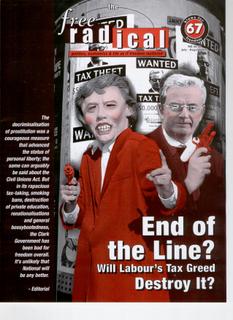
What an ignorant, destructive prick. As the Free Radical cover asked way back in issue 67, will Labour's tax greed destroy it? Probably. Eventually. But whatever the answer to that question, it's clear it's destroying us.

_ _ _ _ _
* Figures from Australian Fund Management, Annual Review, 2007, Credit Suisse (Australia)