Showing posts with label Cuba. Show all posts

Thursday, 26 February 2026

Congratulations to Cuba, the world's first Net Zero country

New Zealand, as you will all know by now, has been set by our government with at "target" to be Net Zero of greenhouse gas emissions (i.e., fossil fuels) by 20250.

But you don't need a time machine to see that future for a small island nation like ours..  You can just travel to the small island nation of Cuba,  where "the Trump administration is helping Cuba to achieve Net Zero by preventing oil tankers from landing there."

Only, in the New York Times article about this, it describes it as a bad thing. It has, says the Times, brought Cuba “to its knees.”

In Cuba, people are struggling with frequent blackouts, shortages of gasoline and cooking gas and dwindling supplies of diesel that power the nation’s water pumps. Trash is piling up, food prices are soaring, schools are cancelling classes and hospitals are suspending surgeries...
Wasn't the end of fossil fuels supposed to be a boon to this small island nation? 

Can't they use the "renewable," i.e., unreliable energy, with which Cuba is blessed to replace the fossil fuels so kindly withheld from them by theUS? After all, Cuba already has a bunch of wind farms. So as the Manhattan Contrarian asks, "Why doesn’t it just crank them up to provide the power formerly supplied by the fossil fuels?"

Could it be that a small island nation's power plants, water pumps, transport, food, families, schools and hospitals -- not to mention basic rubbish collection -- all actually depend on the reliable energy of fossil fuels?

Take a closer look at Cuba if you don't want that to be our future.

Friday, 28 February 2025

"Consequently, there is no incentive for the politicians to change their behaviour. It is for this reason we see tariffs consistently fail as a negotiation tool."


"To listen to protectionists, one would think tariffs are something of a miracle drug. Anything and everything can be solved by tariffs. Prices too low? Tariffs will raise ‘em. Prices too high? Tariffs will lower ‘em. Sprained knee? Just take two tariffs and call me in the morning. ...

"Take, for example, the argument that tariffs can be used as negotiation tools. The argument goes that you can threaten another nation with tariffs, impose the costs of the tariffs on them, and force them to bend to your will (whatever that will may be). ...

"[Yet] politicians face a different set of incentives. The major issue with many tariff supporters’ models is that they improperly model these incentives. This is a side effect of collectivist thinking; we must always remember that a 'nation' is a useful abstraction, but ultimately is made up of individuals who choose. A 'nation' never, ever chooses. And a government is not synonymous with the nation or the people located therein. ...

"Consequently, there is no incentive for the politicians to change their behaviour. It is for this reason we see tariffs consistently fail as a negotiation tool.

"Indeed, so-called trade sanctions and tariffs end up having the opposite effect. The American embargo of Cuba entrenched the Castro regime. Tariffs and embargoes on Iran failed to halt their nuclear program or weaken the regime. Putin still wages war in Ukraine despite (or because of?) trade sanctions. Perhaps most damningly, the Chinese government developed DeepSeek as a direct response to Trump’s original 'economic statecraft' against the Communist Party (continued by Biden).

"Adam Smith recognised this problem. In the 'Wealth of Nations' ... he notes that tariffs could be a potential tool to negotiate lower barriers in other nations. ...   Such negotiations could work, he states, but could also lead to war ...."
~ Jon Murphy from his post 'The Political Problem of Tariffs'

Tuesday, 27 August 2024

"Rather than searching in Marx's texts for a condemnation in advance of the Gulag, it is a matter of asking what in those texts could have made the Gulag possible."


Cartoon by Etta Hulme

"The [destructive aftermaths of the] Soviet Union, Maoist China, Kim's North Korea, Pol Pot's Cambodia, Castro's Cuba, Mugabe's Zimbabwe, Chavez and Maduro's Venezuela, and countless other deadly authoritarian regimes and revolutions— all carried out in Marx's name, and celebrated by Marxists at their inception — are casually dismissed and dissociated from Marx's theories ... They are not 'true socialism' or 'true Marxism,' we are told, and it falls to the next socialist regime to implement Marx 'the right way.'
    "A succinct and representative example of this tendency among modern intellectuals may be seen in political theorist Matthew McManus's account of Marx's reputation over time
'But of course the most substantial objection came from Karl Marx, whose epochal critique of political economy remains in some respects the climax of the modernist project...Marxism became the chief theoretical outlook for most of the major socialist movements and parties by the end of the 19th century, with many achieving important reforms. But its reputation was seriously tarnished by the totalitarian movements in the Soviet Union, China, Cambodia, and elsewhere, which appealed to Marx's legacy to advance tyranny while taking serious liberties with his thought. With the collapse of the Soviet Empire in 1989, many thought socialisms' days were numbered, though it has since enjoyed a resurgence in popularity as the inequalities and vulgarities of neoliberalism [sic] became increasingly scrutinised.'
"Note that McManus errs in assigning high status to Marx's intellectual following in the late nineteenth century, which, as we have seen, he did not possess at any point in his life or for many decades thereafter. Neither does McManus substantiate his efforts to differentiate the humanitarian abuses of Marx's twentieth century followers from Marx's own revolutionary theorising. 
    "One is reminded of the quip of French philosopher Michel Foucault, who stated in a rare moment of clarity: 'Rather than searching in [Marx's] texts for a condemnation in advance of the Gulag, it is a matter of asking what in those texts could have made the Gulag possible, what might even now continue to justify it, and what makes it intolerable truth still accepted today.' 'The Gulag question,' Foucault continued, 'must be posed not in terms of error (reduction of the problem to one of theory) but in terms of reality'."
~ Phil Magness, from recent writing

Thursday, 22 July 2021

Cuba Demoted to “Not Real Socialism”


Everywhere real socialism has arrived it has failed. Eastern Europe, Soviet Union, Cambodia, North Korea, Venezuela ... the roll-call is long. And every time it fails it becomes "not real socialism." Art Carden explains in this guest post how Cuba has become the latest example ...

Cuba Demoted to “Not Real Socialism”

by Art Carden

If the Socialist Party of Great Britain is an authority on such things (and they certainly claim to be), then it is now official: in light of recent anti-communist protests and civil unrest, Cuba has been demoted to “Not RealSocialism” and reclassified, along with the USSR and other failed socialist experiments, as “actually state capitalism.”

La Revolucion, it appears, is moving into the last stage of what we might call the 'Niemietz Cycle' -- named in honour of Kristian Niemietz, who expounded the descriptive theory in his excellent-and-downloadable-for-$0 book Socialism: The Failed Idea That Never Dies (I review it here and here). 

The first stage of the Niemietz Cycle is the “honeymoon” stage where things look like they’re going well. And they often do: contrary to what neoliberal naysayers might think, short-run successes seem to prove that socialism is viable. As long as there's something to loot, the looters will always be able to win over the moochers and be celebrated for it. Vive La Revolucion!

The second stage, however, comes hard on the heels. Niemietz calls this phase the “Excuses-and-Whatabouttery” stage, as mounting socialist failures invite savage reprisals against "anti-revolutionaries," and the continual disasters are explained away as the products of a series of unfortunate (and entirely coincidental) events, like weather in the Soviet Union and Zimbabwe. In the case of Cuba, we’re told–as we have been hearing for six decades–that the country’s problems aren’t because of socialism; they’re actually because of the US embargo. If it weren’t for the embargo, we’re told, the regime would be stable and socialist Cuba would thrive.

I think the embargo is a terrible idea that should be lifted immediately, as it has given Cuban communists a convenient scapegoat for their country’s problems.  The embargo, however, is not what causes Cuba’s woes, and people blaming the embargo overlook the fact that Cuba trades pretty extensively with the rest of the world – how else do you think Australian and Mexican merchants get the Cuban cigars they hawk to American tourists? It’s not because a Cuban Rhett Butler is smuggling them past a blockade. It’s because Cuba trades freely with the entire world. I suspect the US embargo hasn’t really hurt Cuba that much more than the “transgender bathroom” boycott hurt Target. [But it has averted the possibility that the increased trade may have induced Cubans to quietly and inexorably become capitalists, as happened in Vietnam - Ed.]

The “embargo” story also doesn’t make a whole lot of sense in light of Marxist claims about imperialism and free trade. On one hand, we learn that “periphery” countries are poor because they do trade freely with rich countries like the United States and welcome foreign direct investment. On the other hand, we learn that Cuba is poor because it cannot trade freely with the United States. I’m not sure how this works without a lot of auxiliary assumptions. It also ignores the conspicuous and inconvenient truth that the Cuban government restricts imports and has only lifted these restrictions for food, medicine, and toiletries “temporarily” in response to the protests.

Which brings us to the last and final stage of the Niemietz Cycle. At this point, the failures and the force have become too obvious to ignore or to explain away, even by western numb-nuts, and the country is thereby demoted to “Not Real Socialism.” Western intellectuals fawned over Stalin’s experiment with socialism, and only after it became a conspicuous failure did we learn that “It wasn’t actually socialism; it was Stalinism, and if only Trotsky had been in charge instead of Stalin….”

The litany of excuses is familiar. The disaster for those under these regimes is however very real. Cuba’s defenders have made much of its literacy programs and health care; however, 2018 research by Gilbert Berdine, Vincent Geloso, and Benjamin Powell shows that while Cuban health data aren’t exactly fake news, they aren’t exactly accurate, either

Even if the data are above reproach, there’s another important and uncomfortable question: if Cuba is a workers’ paradise, why are so many people trying so hard to leave? Migration patterns tell the clearest story. Cuba might provide asylum for high-profile American intellectuals and dissidents, but people “vote” overwhelmingly against socialism and for capitalism when they risk life and limb to get from Cuba to the United States. They may not be able to build a case from first principles explaining exactly why they prefer capitalism to socialism in a way that would satisfy a lot of intellectuals, but they demonstrate by their actions which system makes it possible for them to live as they see fit. Moreover, a few seconds with Google suggest to me that actually moving to and getting a job in Cuba would be really, really difficult, and if this website is correct that “A university professor can expect to earn in the region of CUP 1,500 (around US$68 per month),” I understand why so many intellectuals are perfectly happy to extol the virtues of Cuban socialism from comfortable offices and armchairs in the United States instead of lining up to live the collectivist dream.

We can sit around all day and debate the merits and demerits of socialism, whether or not Cuba is “real socialism,” whether or not its apparent reclassification is a demotion or a promotion (as the Babylon Bee calls it), and what intellectuals think people should do and want. Alternatively, we can look at socialism’s miserable track record and try to learn from what people actually do and actually want. Retroactively saying “Actually, that isn’t real socialism” about the Cuban revolution won’t change the fact that people vote for freedom and against socialism in overwhelming numbers.

* * * * * 

Art Carden is a Senior Fellow at the American Institute for Economic Research. He is also an Associate Professor of Economics at Samford University in Birmingham, Alabama and a Research Fellow at the Independent Institute.
His post first appeared at the American Institute of Economic Research.

Thursday, 7 February 2019

Thursday, 29 December 2016

The Cuba fantasy


Come on, you’ve all heard it said since old Busywhiskers died: “Sure, Fidel Castro was a dictator, but he also gave Cuba literacy, low infant mortality and world class health care” So didn’t socialism worked in that regard at least? Nope. Johan Norberg explains why those numbers don’t add up. Not just wrong, but dead wrong.


.

Wednesday, 30 November 2016

Castro’s Dead: Here’s What His Tombstone Should Say…


Fidel Castro, as you certainly know by now, is dead. And, says Chris Campbell in this guest post, there are some things that really must be inscribed on his tombstone.


Although we’re not ones to engage in schadenfreude or death celebration, we certainly won’t act like Fidel Castro was some kind of hero.

But that’s just us.

The US Green Party’s Jill Stein, who just won the lottery (what is it? $7 million now?) by tricking people into funding her “recount” (and, surprise, missing the Pennsylvania filing date), tweeted this about Castro: “Fidel Castro was a symbol of the struggle for justice in the shadow of empire. Presente!”

Actor Jack Nicholson said Castro was a “humanist like President Clinton.” And Chevy Chase said Cuba is “proof socialism sometimes works.”

Erik Loomis, a history professor at the University of Rhode Island, called Castro, Che Guevara and Ho Chi Minh, “an inspiration for billions of people around the world seeking freedom from colonial overlords.”

[And read: ‘Fidel Castro died as he lived: to the sound of useful idiots making allowances for his crimes.’]

And there’s the rub. In a perfect world, or in a void, Castro certainly wouldn’t have been great in any non-sociopath's eyes. Certainly not if any of these people lived under his regime. Why, being the intellectuals and personalities that they are, most of these limelight-hunters praising Castro probably would’ve been killed, or at least persecuted, by him.

But relative to the mightiest colonial overlords, they say, Castro wasn’t so bad. Principles be damned. Carlos Eire, a Professor of History and Religious Studies at Yale explains this unrequited love for Castro in, of all places, a Washington Post Op-Ed:

Because deceit was one of Fidel Castro’s greatest talents, and gullibility is one of the world’s greatest frailties. A genius at myth-making, Castro relied on the human thirst for myths and heroes. His lies were beautiful, and so appealing.
   
According to Castro and to his propagandists, the so-called revolution was not about creating a repressive totalitarian state and securing his rule as an absolute monarch, but rather about eliminating illiteracy, poverty, racism, class differences and every other ill known to humankind. This bold lie became believable, thanks largely to Castro’s incessant boasting about free schools and medical care, which made his myth of the benevolent utopian revolution irresistible to many of the world’s poor.

Fortunately, there’s been plenty of opposition to this “Castro is a hero” narrative. Take, for example, the backlash on which Canada’s Prime Minister Justin Trudeau has found himself on the receiving end.

Castro was “a controversial figure,” Trudeau said during his eulogy. But he was also “A legendary revolutionary and orator” who “made significant improvements to the education and health care of his island nation.”

The Twitter trolls instantly jumped into action. The backlash was no less than epic. Under the hashtag #TrudeauEulogies, (albeit dark) hilarity ensued:

“Today we mourn painter and animal rights activist, Adolf Hitler. His death also highlights the need for suicide awareness.”

“Mr. Stalin’s greatest achievement was his eradication of obesity in the Ukraine through innovative agricultural reforms.”

“Jim Jones provided shelter and hydration to hundreds of Americans and, for that, we will remember him fondly.”

“While a controversial figure, Mr. Gacy entertained many children at birthday parties.”

Today we mourn the death of Jeffrey Dahmer, who opened his home to the LGBTQ community and pushed culinary boundaries.”

Justin Trudeau Meme

In a just world, rather than those in power praising a tyrant, the truth about Castro would be left to no ambiguity.

In a just world, says Eire, “these 13 facts below would be etched on Castro’s tombstone and highlighted in every obituary, as bullet points -- a fitting metaphor for someone who used firing squads to murder thousands of his own people.

  • He turned Cuba into a colony of the Soviet Union and nearly caused a nuclear holocaust.
  • He sponsored terrorism wherever he could and allied himself with many of the worst dictators on earth.
  • He was responsible for so many thousands of executions and disappearances in Cuba that a precise number is hard to reckon.
  • He brooked no dissent and built concentration camps and prisons at an unprecedented rate, filling them to capacity, incarcerating a higher percentage of his own people than most other modern dictators, including Stalin.
  • He condoned and encouraged torture and extrajudicial killings.
  • He forced nearly 20 percent of his people into exile, and prompted thousands to meet their deaths at sea, unseen and uncounted, while fleeing from him in crude vessels.
  • He claimed all property for himself and his henchmen, strangled food production and impoverished the vast majority of his people.
  • He outlawed private enterprise and labour unions, wiped out Cuba’s large middle class and turned Cubans into slaves of the state.
  • He persecuted gay people and tried to eradicate religion.
  • He censored all means of expression and communication.
  • He established a fraudulent school system that provided indoctrination rather than education, and created a two-tier health-care system, with inferior medical care for the majority of Cubans and superior care for himself and his oligarchy, and then claimed that all his repressive measures were absolutely necessary to ensure the survival of these two ostensibly “free” social welfare projects.
  • He turned Cuba into a labyrinth of ruins and established an apartheid society in which millions of foreign visitors enjoyed rights and privileges forbidden to his people.
  • He never apologised for any of his crimes and never stood trial for them.

Yes, Castro did great evil. [And read: ‘Why The Left Loves Totalitarians Like Fidel Castro.’]

And, as Bryan Caplan writes on FEE.org, he continues to do evil by “charismatically inspiring sympathy for this psychopathic path to a glorious future.

“We need to get rid of all sympathy for Castro,” says Caplan.

But, he says, that’s just the first step: “Our ultimate goal should be to get rid of the errors that Castro has come to represent. Castro was a villain straight out of 1984. And in a just world, Orwell's words would adorn his tombstone:

“One does not establish a dictatorship in order to safeguard a revolution; one makes the revolution in order to establish the dictatorship.”


Chris Campbell is editor of the Laissez Faire Today newsletter, where this post first appeared.

FURTHER READING:

.

Monday, 28 November 2016

Time to spit on Castro’s grave [update 2]


A minor dictator and tyrant for six decades has died. Opined Garray Kasparov, who lived under several, there is no need to mourn:

Fidel Castro was one of the 20th century's many monsters. We should lament only that he had so long to inflict misery on Cuba and beyond.
    Don't rationalise or apologise for Castro's decades of brutal repression, torture, and murder. He didn't fight for freedom; he destroyed it.

So “why are some dictators remembered so fondly?” wonders Douglas Murray at The Times.

Long before his death it was obvious that Fidel Castro would benefit from the “revolutionary hero” type of obituary more than the “murderous bastard” variety. The BBC and the leader of Her Majesty’s opposition, among others, have not disappointed.
    Even now, Castro’s eulogists claim a man who urged the Russian leader Nikita Khrushchev to issue a pre-emptive nuclear strike against America to have been a man of peace. They claim the torturer of dissidents and sexual minorities to have been the representative of the oppressed. And they claim an unimaginative and logorrheic egomaniac to have been the voice of the voiceless. For decades before his death, Castro enjoyed a disgusting leniency, not to mention sycophancy, outside the nation he immiserated…
     His revolution with the people, for the people turned out to have very little interest in the people. If the justification for overthrowing Batista had been that Batista overthrew democracy, there was no evidence in the decades that followed that Castro had any devotion to the ballot box. And if Batista was brutal and oppressive — and he was — it was a habit Castro showed no desire to kick. Throughout his rule, Castro tortured, murdered and imprisoned his opponents to keep himself in power. Those who still deny these facts — and they are many — should consult the online
Cuba Archive as a corrective to their frivolous and sinister revisionism. Like dictators throughout history, Castro was on the side of the people for only as long as all the people were slavishly on his side. And as in North Korea, one of Castro’s staunchest allies, communism was not only the blueprint for the revolution but also an excuse of sorts. It applied an internationalist, intellectual coating to conceal a squalid and deeply parochial crime scene.

Excuses for the crimes continued throughout his reign.

Even now, with his death, we hear the implication that Castro at least “meant well”. This obscene claim can be heard in the assertion by Labour leader Jeremy Corbyn that Castro was “a champion of social justice”. It can be heard in the BBC describing Castro as “iconic”. And it can be heard in the corporation’s invitations to former KGB agents of influence, such as Richard Gott, to laud their hero on the airwaves..

There were no eulogies from world leaders more flowing than that from Canada’s child-PM Justin Trudeau

— whose Liberal party should have something to say about liberty — [but who] had this to say about Castro’s death: he feels “deep sorrow” upon hearing the news, notes his dad was “very proud to call him a friend,” and offers his “deepest condolences” to the dead dictator’s supporters.

As a former Sunday Times editor points out, Castro' "flaws" include 5,600 Cubans murdered by firing squad; 1,200 in “extrajudicial assassinations”; and tens of thousands jailed, tortured and who died escaping.

The online backlash against the child’s eulogy suggests at least that the embracing of butchers is far from universal, the hashtag #trudeaueulogy quickly trending to post Trudeau-like eulogies to the likes of Jeffrey Dahmer, Stalin and Vlad the Impaler:

Dahmer

Stalin1

Vlad

UPDATE 1: Lawrence Reed reckons the reaction to old busy-whiskers’s death is an important litmus test …:

The moral bankruptcy of the state-worshipping Left has never been more vivid than it is now in what they're saying about Fidel Castro. Good people of sound character and judgment don't praise thugs, thieves, tyrants and murderers but stupid people of lousy character and poor judgment apparently do, especially when they choose to embrace or cover up for an evil ideology.

UPDATE 2: Former Green MP Keith Locke fails the test. Dismissing Fidel Castro as a “brutal dictator” simply shows how out of touch  you are, he says at Martyn Bradbury’s blog. Linking to a good Guardian piece (!), a commenter reckons Keith would do better to remember Castro’s victims.

.

Wednesday, 15 September 2010

DOWN TO THE DOCTOR’S: Christchurch and Cuba – Moving In Different Directions

_richardmcgrath Libertarianz leader Dr Richard McGrath ransacks the newspapers for stories and headlines on issues affecting our freedom.

This week:   Christchurch and Cuba – Moving In Different Directions

1. The report, in the CHRISTCHURCH PRESS - “Recovery law cuts red tape “Emergency legislation rushed through Parliament has given the Government extraordinary powers to rebuild Christchurch. Faced with a massive damage bill and an uncertain future for many home and business owners, the Government says it needs the powers to get the city back on its feet as soon as possible.”

The reality: The government awards itself massive unbridled powers; places itself above laws such as the RMA and District Plans enforced by ferret-faced council bureaucrats, under which our freedom to act is crushed on a daily basis; exempts itself from scrutiny, accountability and liability for its actions; and blocks even our courts from challenging any of its decisions, under the guise of rebuilding Christchurch.

The problem: This is a draconian power grab, which will strengthen the power of the state at the expense of our liberty. This is an over-the-top reaction to a natural disaster, an opportunity for the government to seize for itself the power to impose its will on the people of NZ. The country is not at war; we are not under threat from foreign invaders or an armed insurrection from the populace. Yet our freedoms have been eroded; and this law may never be repealed. The government has decided it can ignore crap laws such as the RMA, Public Works Act, Local Government Act, and Building Act. But hang on - weren’t these laws necessary for our protection? Suddenly the government decides they weren’t that necessary after all. Why not get ditch these laws then, instead of having one rule for politicians and another for the rest of us peasants?  

Bouquet: To the Greens, for questioning the effect these emergency laws will have on our civil liberties, and whether such a concentration of power in the hands of a few is a good thing. But then why the hell did they end up voting for it?

Brickbat: To ACT – where was the “liberal” party while the government were rushing this legislation through in the middle of the night? Marching lockstep with their National masters, that’s where, like the faithful lapdogs they have become.

2. The report, in the NZ HERALD – “Cuba Cuts 500,000 State Jobs – “Cuba has announced it will cast off at least half a million state workers by early next year and reduce restrictions on private enterprise to help them find new jobs - the most dramatic step yet in President Raul Castro's push to radically remake employment on the communist-run island. Because unemployment is anathema in a communist society, state businesses have been forced to carry many people who do almost nothing. The labour overhaul comes less than a week after Fidel Castro caused a stir around the globe when he was quoted by visiting American magazine writer Jeffrey Goldberg as saying Cuba's communist economy no longer works.”

My reaction: – After fifty years of oppression, this could be the beginning of the end for the Communist dictatorship in Cuba, the Carribean equivalent of the dismantling of the Berlin Wall. It will be interesting to see whether the Castro government will allow the sort of privatisation and freeing up of trade that has seen China become the world’s fastest growing economy. Watch this space.

Bouquet (partial): To Raul Castro, for facing reality. He should be encouraged to push further and hold free elections in Cuba.

Brickbat: To President Obama, for extending the U.S. trade embargo on Cuba two weeks ago. His reaction to the bold moves toward a free society in Cuba should be to lift the embargo completely.

When the people fear the government, there is tyranny - when the government
fear the people, there is liberty.
- attributed to Thomas Jefferson

Wednesday, 15 April 2009

Cuba. It's still a mess.

Doug Bandow is right.  The embargo on Cuba has been disastrous, and its review is long overdue. US sanctions on trade with Cuba have done exactly nothing to harm Old Busywhiskers himself -- if anything, they've granted him and his cronies an excuse for the penury into which they've driven the populace.  Like all sanctions programmes it's harmed only the citizens themselves, about whom Castro's thugs could care less.  Far from supporting Cuban freedom, it's likely diminished it.

With sanctions, the Castro Regime has been reinforced.  Without sanctions, the Regime would likely have withered into irrelevance and nascent capitalism emerged again, much as it has in Vietnam.

"Trade and investment normally draw peoples together," says Bandow, and he's right.  It's time, as he says, for America's policy-makers "to ask the simple question: If 50 years of embargo have not worked, why do they expect another decade or two or three of sanctions to work?"

    A new political climate invites a new policy response. No more half measures. Congress and the president should drop the embargo. Americans should be free to visit and trade with Cuba. There should be no government subsidies, whether in the form of trade subsidies or foreign aid. But individuals and companies should be free to cut their own deals. Would this strategy transform the island nation? There are no guarantees, though foreign contact has helped spur liberalization elsewhere. But lifting the embargo would have a greater likelihood of success than continuing a policy which has consistently failed. Some day the Cuban people will be free. Relaxing U.S. policy would likely make that day come sooner.

A bonus point for any reader who can see the parallels with Fiji.

Thursday, 5 March 2009

DOWN TO THE DOCTOR’S: Cuba, Cats & Cullen

richardmcgrath

 DOWN TO THE DOCTOR’S – A weekly commentary on some of this week’s news items by Libertarianz leader Dr Richard McGrath . . .

  • Wairarapa Powers World-First Web Shop – Unfortunately, online electricity broker Powershop - who use Masterton as the base for its call centre - have used imagery of international terrorist and mass murderer Ernesto ‘Che’ Guevara to promote its product. Guevara once said if the [Cuban] missiles had remained, his government would have used them against the very heart of America, including New York. He was also a bloodthirsty sociopathic killer, who delighted in executing his political opponents in front of their families; he once dispatched a 14 year old boy, who refused to kneel before Guevara, by shooting him in the back of the neck. Powershop join the other useful idiots with their Che T-shirts and tattoos in denial about the true character of their hero.
  • Lugar Report Gives Momentum To Anti-Embargo Push – Senior Republican Party senator Richard Lugar has called for a fresh look at the American trade embargo imposed on Cuba by the Kennedy administration. I personally support the notion of free trade, and believe the U.S. should allow its producers to trade with Cuba. Free trade tends to promote peace, as nations don’t tend to pick fights with their major trading partners.
  • Farmers’ Prescription For The Jobs Summit – While they got some things right, too many of the suggestions from Federated Farmers involved asking the government to shove its nose into areas where it has no right to be. Good points were the calls for avoidance of job subsidies and protectionism; and support for the 90-day probation period for new employees in small businesses. Bad points included advocating minor tinkering with the Emissions Trading Scheme instead of its outright abolition; and forcing taxpayers to fund rural ‘infrastructure’, broadband, research and development, and agricultural training centres. Overall, too much entrenchment of Nanny in the farming sector for my liking.
  • Cullen Plans To Become Treaty Settlement Negotiator – The arrogant little weasel has given Bill English his worthless train set to play with, while he (Cullen) jumps from one gravy train onto the next one. Anyone who opposes ‘inside trading’ will surely be upset about Cullen, as a former Treaty Negotiations Minister, wanting to work for one of the various tribes trying to milk yet more money from taxpayers who weren’t around when the real and alleged infringements of the Treaty took place, and whose ancestors may not have been here at the time either.
  • Terror Tenants Told To Get Out – Vermin such as the Salt family in West Auckland, and gang associates and their families from Pomare in Lower Hutt are being told to sling their hooks and find accommodation in the private sector. Poor darlings - hopefully no private landlord will take them on as tenants, and they will end up on the doorstep of the parents who raised the little sociopaths in the first place - justice indeed, as the chickens literally come home to roost. Meantime, a bouquet to Housing NZ for showing some spine and kicking these bums right out of their comfort zone, and hopefully away from the innocent neighbours they have repeatedly terrorized and assaulted.
  • Gig Review: The Stray Cats At The Power Station – The world’s premiere rockabilly combo played the final concert on their Australasian jaunt last night in Auckland. Having bought their vinyl records in the 1980s, it was a thrill to see them live on their farewell tour. Brian, Lee and Jim – you were superb. Thanks for the memories. 

See y’all next week!  Dr Richard McGrath

Tuesday, 8 April 2008

Even free-ish trade is a good thing [update 1]

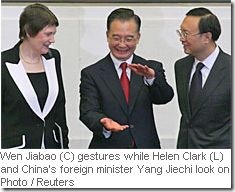
Clark_ChineseTrade Free trade?  Free trade doesn't come with tariffs, employment restrictions and other protectionist restraints on trade.  It doesn't come with pages and pages of agreements on duties, tariffs and quotas, and the continued entanglement of the state with economics.  Free trade is what it says it is: trade that's free of all government restrictions on sellers and buyers.

Genuinely free trade doesn't need pages and pages of lofty documents to protect them -- all that capitalist acts between consenting adults need to flourish is the disentanglement of the state from the loading docks and business houses of importers and exporters.  It's said that the US Declaration of Independence was written on one piece of parchment, and the ten commandments on two pieces of stone, but the European Union regulations on trade in bananas fill four hefty volumes that are less readable than a your average book of Chinese algebra. That's not how genuine free trade looks.

On that basis, the agreement the New Zealand government has just signed is not a free trade deal, but merely a freeish trade deal.

But that's still a good thing.   And it's damned exciting  to see two countries letting the breath of freeish air blow through their trade relations .. and damned refreshing to see politicians from all persuasions celebrating the opening up of trade and to announcing the slow abandonment of protectionism.  What we have today is better than we had yesterday -- even if it's not as good as we'll have in 2019 when the last of the tariffs is supposed to run out -- and more than you'd expect from two governments both on the reddish end of the political spectrum.

For those opposed, let's just remind ourselves of the chief benefits of trade:

  • There's the "double thank you moment." When you and I engage in trade -- let's say I pay you ten-thousand dollars for a container-load of iPods -- what we've both decided is that I value the iPods more than the ten-thousand dollars, whereas you value the money more than the noise-making equipment. We both win -- and the economy is the richer because both my money and your goods have moved to people who value them the most, and who can put them to the most productive ends -- and we all get to fill our homes and our counting houses with the stuff that we most want.

    This is a good thing, and it's proof again there's nothing "invisible" about Adam Smith's invisible hand. Trade benefits everyone.  "It is not from the benevolence of the butcher, the brewer or the baker that we expect our dinner, but from their regard to their own self-interest." The butcher, the brewer and the iPod-maker "direct [their] industry in such a manner as [their] produce may be of the greatest value," and we are the beneficiaries of their labours and their trade -- each intends only his own gain, but by the blessing of trade he is, said old Adam, "led by an invisible hand to promote an end which was no part of his intention."
  • International trade is a prime example of the virtue of comparative advantage, from which we all benefit.  Land-locked Switzerland for example produces watches and banking services in order to buy food and sailors, whereas we produce wool, beef, dairy products and sailors in order to buy the world's manufactured goods (and since most of these are now being manufactured in China, it's easy to see why trade with China is a good thing).  We all produce in order to trade, and the end result of all this industry is that the whole world is made better by the fact that we all specialise in doing what we do best: there are more watches, more food, more dairy products, more manufactured goods (and better and richer sailors) than there would be in the world if we all closed our borders and tried to do everything ourselves.

And let's remind ourselves that this is the reason we go to work every day: to be able to buy stuff that keeps us and our families alive and flourishing.  All that those remaining tariffs are going to do is make it more expensive for Ma and Pa Home-Owner to buy the stuff they need to make their homes better. Free trade makes everyone more prosperous (just look at that graph to the right for example to see what lowering tariffs, decreasing protectionism and increasing trade did for the US.)

Not everyone can see these benefits however, or if they do recognise them they raise other issues.

  • There are people who will argue that free trade kills local jobs. Just think for a moment about that. It certainly closes down jobs in industries and companies that don't perform well, and are doing things we don't do best -- but what it does by opening up trade is making goods cheaper for everybody who is working, leaving money in their pockets to buy from industries making use of that newly available labour to enter production in areas in which we're more productive.  In other words, trade allows us to move labour from less productive to more productive areas of industry, which will probably involve greater specialisation and increased comparative advantage.

    Everybody kicks a goal, and we're all made wealthier by it.  (And that's the case whatever China or anyone else does with regard to tariffs on our own exports.)
  • There are people who argue that trade with China encourages a government that persists in human rights abuses.  It's true: it does.  Recent events in Burma and Tibet and the ongoing human rights abuses and continuing existence of slave labour gulags suggest that with the Olympics just months away, Chinese politics now looks little different to Chinese politics at the time of the Tiananmen Square massacre

    But as we read news of Buddhist monks being shot on the streets of Lhasa, the chief question to consider is, "What can we do?"  The main thing to ask yourself whether free trade will 'open up' China more effectively than the Olympics, and the answer is "Of course.

    No one should ignore the liberating force that is free trade. Blockades and embargoes haven't made either Cuba or North Korea more free.  Imagine for example if trade with Cuba had been left as free as trade with Vietnam -- instead of fifty years of blockade and oppression and Old Busy Whiskers, Cubans would instead have been rewarded with the benefits of trade and the fruits of industry, and Old Busy Whiskers would be a long forgotten footnote in history.  Think about the example of trade and liberalisation provided by Hong Kong -- a beacon to all of us, let alone China -- and a prime example of how trade makes even the residents of a resource-free rock richer than Croesus could even dream about, and gives them all greater freedom.  Think about that when you oppose free trade on this basis.
  • There are people too who argue that trade with China will empower its military.  This is an argument that on the face of it has more legs, but on closer inspection is seen as just as illusory.  As Frederic Bastiat used to point out (and there's still no one better to read on the subject of free trade), "where goods don't cross borders, then armies will."  "Countries that trade," points out Bastiat commentator Lew Rockwell, "have a mutual stake in the preservation of open, friendly relations. This is one reason that free commercial activities promote peace, and why protectionism and trade sanctions generate war tensions...  Our lives – by which I mean the lives of regular people in [NZ] and in China – are made immeasurably better because of the freedom to trade. Our networks of exchange build private-sector prosperity in both countries."  This is a lesson learned by Japan and Japan's enemies in the death and destruction of the Second World War -- and if they'd read Bastiat instead of Clausewitz they would have learned it long before -- that when it comes to gaining a world full of resources, production and trade beats blockades and conquest every time.

    So we have to conclude again that as long as trade with China excludes trade in weapons (and Raykon aside, we hardly have any sort of comparative advantage in this area), then this is another argument that fails.

The fact is that this freeish trade deal is something to celebrate, just as it's something to celebrate that so many commentators are prepared to celebrate it.  That' real cause for a double celebration.  Cheers!

UPDATE: Not all commentators are prepared to celebrate. John Minto, as you may have guessed, isn't prepared to celebrate. He had an anti-trade piece in the Christchurch Press yesterday. Paul Walker makes a few comments on his article here, and good ones they are too. He concludes, not unreasonably, "Mr Minto should enrol in a first year economics course, he would learn much. But he would then have to buy the textbook ... and that is most likely to be imported."

Tuesday, 25 March 2008

Still no April Sun in Cuba

Some food for thought here for fans of communist dictators -- and for opponents and supporters of free trade:

   In 1958, Cuba was almost as rich as Japan, one and half times as wealthy as Singapore, richer than Hong Kong, and three times as prosperous as South Korea.
   Fifty years later, Cuba is one of the poorest countries in Latin America.
   Meanwhile, jurisdictions such as Hong Kong, Singapore, South Korea and Taiwan (the latter two also had dictators and problems similar to Cuba in the 1950s) have long eclipsed Cuba. They've done so not only in per capita wealth, but in measurements Castro's defenders point to when they assert the Marxist revolution "worked," such as in health care and education...

As Paul Walker comments, "GDP per person isn't a perfect measure of well being, but it is a rough guide to average living standards. And by that standard Castro has much to answer for."

Yes, he does.  But here's something else to think about, too:  given all we know about the liberating effects of free trade (see even the nominally communist Vietnam, for instance) -- and as we consider the merits of free trade with China -- and I invite readers to speculate on the state of Cuba and Castro and the country's communism today if the US had gone for free trade instead of blockade.  How liberating would fifty decades of free trade with Cuba have been, and what would have happened to Busy Whiskers and his communism if such a policy had been applied by the US?

Wednesday, 20 February 2008

Good riddance, Busy Whiskers

End communism Fidel Castro has stood down, but Cuban jails are still full of his opponents, the seventy-three thousand people he killed without either the benefit of trial or due process are still dead, and (as Humberto Fontova describes it)

a nation with a formerly massive influx of European immigrants needs machine guns, water cannons and tiger sharks to keep its people from fleeing, while half-starved Haitians a short 60 miles away turn up their noses at any thought of emigrating to Cuba.

The sooner Castro and his brother Raul join the ranks of the dead, the better.

Saturday, 3 March 2007

Consequences - Bernard Levin

Here's a postcard I picked up in Highgate in the early nineties, and with it goes a story.
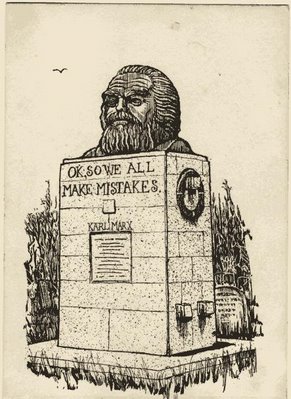
As you might have heard, one of my great pleasures when living in London was reading Bernard Levin's twice-weekly columns in The Times on the way to work. Wit, erudition and warm-hearted insight such as his in one's regular daily rag was partial recompense for many of the daily indignities of London life. Indeed, it was one of his columns therein that helped persuade me to forswear the indignities and return to New Zealand (or more precisely two successive columns, 'Down Under:1,' and Down Under:2' in which, after a short trip here, he praised New Zealand to the skies).

Re-reading an old book of Levin's columns the other day, I alighted on this one, from 198s, almost a decade before communist Eastern Europe collapsed and with that collapse providing the punchline for the postcard above. If the collapse provided the punchline, Levin's column perhaps provides the eulogy, one delivered a prescient eight years before the final burial.
* * * * *

Consequences
MARX SURELY PROVIDES one of the greatest paradoxes of history. Nearly half the people in the world live under governments that call themselves Marxist, and although the ultimate goal of humanity, in Marx’s philosophy, was the freeing of the individual from the bonds of class and exploitation which had held him since the rise of capitalism, a process of liberation which was to end with the withering away of the state, every one of the regimes which profess to live by his system is a brutal tyranny, in which the individual is less free than any capitalist wage—slave and in which the state, so far from withering away, is more obtrusive, more powerful and more ruthless than any government based on the class system.

How are we to explain this extraordinary looking- glass world? One way is to say — what is certainly true — that none of these ‘Marxist’ governments have anything Marxist about them, and that if Marx could return and examine them he would be quite unable to understand how and why his name had been dragged into the matter.

But of course that explanation, so far from clearing up the mystery, makes it all the more obscure. For if the Marxists have lost their Marxism, wherewith shall they be Marxed? Why should a Russian govern ment in 1983 feel obliged to pretend that it rules by the principles laid down in a big, boring book on Victorian economics written by an old man with a beard in Tufnell Park? None of the rulers concerned has ever read the book; they couldn’t have done, for no one could possibly finish it, not even Marx, who gave up, bored insensible by his own rubbish, after the first volume, though he lived on for more than a decade, sponging off Engels intellectually as well as financially, and leaving him to make what he could of the rest of the book.

This particular part of the Marxist legacy has many sides. The very same fate, it can be seen, has overtaken Trotsky, our own world being awash with idiots who call themselves Trotskyites without having read, let alone understood, a line of their hero or of Marx: for that matter the murderous lunacy called Maoism gave rise to a similar following elsewhere, calling themselves Maoist to the genuine bewilderment of the Chinese leadership, who could discern nothing of their ruler’s views in those held by many who styled themselves his loyal subjects in partibus infidelium.

A theory which, whatever its deviser’s intentions, has given rise to nothing but a barbaric despotism must surely have had something wrong with it in the first place. What is the causal connexion between Marx’s Marxism and the pseudo-Marxism of the Soviet empire, between a theory of liberation and an actuality of slavery, between a Utopian idealist who wanted all men to be brothers and a gallery of thugs who want nothing but the perpetuation of their own power?

I put it like that because of all the excuses for communist tyranny to be heard in the West one of the most repulsive, as well as the feeblest, is the claim that it cannot be laid to the door of Marx, or indeed of Lenin (who, it should be remembered, set up the Gulag). But in law, a man is held to be responsible for the likely consequences of his actions, and certainly it is not difficult to find in those of Marx and Marxism the seeds of the still proliferating evil practised in their name.

To start with, a man as personally intolerant as Marx, who was constantly denouncing and excommunicating all those in his own camp who ventured to question some detail of his argument, can hardly keep intolerance out of the bones of his philosophy. He did not have the power to send those he anathematised to their death, but he offered to those who came later a ready-made set of templates from which the justification of millions of deaths could be constructed, and it is no use saying he did not intend it; maybe not, but he was it.

He was also, in the same sense, the dictatorship of the proletariat, one of the greatest individual paradoxes within the main paradox itself: there is no system of government in the world, no, not the most corrupt personal fief of the worst of Black Africa’s dictators, in which the proletariat have less say in their own destiny than in the lands of communism, Marxism. But it is all too easy for those who dictate to the proletariat, by combining Rousseau (the father of modern totalitarianism) with Marx, to persuade themselves that all they are doing is to carry out the proletariat’s dictatorship by a form of representative government; Rousseau allows such rulers to claim that the proletariat, if they knew their best interests, would approve, and Marx provides a set of principles for the dictatorships to rule by. And the gun and the barbed wire will take care of anyone who points out that on both counts the emperor has no clothes.

The next charge that can be laid to Marx’s account is his historicism; again, the charge is not so much that he was guilty of it, though obviously he was, as that those who came after used it to justify their own crimes, so that Marx faces judgment as an accessory before the fact. If history is seen as a consistent progress through definable stages of development towards an ultimate apotheosis in which ‘pre-history ends and history begins’, then anyone who tries to push history out of its orbit must be an enemy of the people, for whom no fate can be too harsh; from this point it is no great step to arguing that anyone who denies that history is still in its original orbit is an enemy of the people too. Meanwhile the ultimate apotheosis is indefinitely postponed, no
doubt through the machinations of more enemies of the people, who must be sought out all the more ruthlessly, and all the more ruthlessly punished, even if the effort required for such salutary action means that the apotheosis must wait even longer.

But finally, and most important, there is the principle most closely associated with Marx -- though Engels, faced with the realisation that it was manifest nonsense, tried to weasel out of it after Marx’s death: historical materialism. And it is that nonsense, which five miflutes’ conversation with a single real human being would push over, that constitutes the greatest crime
committed by this harbinger of slavery and murder. Once the rulers are possessed of a theory which purports to explain everything in terms outside both the explainers and the explained-to, human beings become objects in a theory, and if there is one thing we know about objects in a theory, it is that they do not feel pain, not even from rubber truncheons or bullets. QED.

Lenin, Stalin, Brezhnev, Ulbricht, Jaruzelski, Rakosi, Mao, Castro — such men as these are not aberrations from Marxism, but its most perfect flowers, its juiciest fruits. Marxism gave them the weapons, and they finished the job; the fact that they finished Marxism at the same time is the last great irony of the story, but it is no consolation to those who died or to those who rot in
jail, or for that matter to those who still live still free and wish to stay that way. The revolution envisaged in the Communist Manifesto is, in the communist lands, further off than ever. No doubt that distresses Marx as much as it surprises him. But he has no one to blame except
himself.

The Times
March 11th, 1983.

Monday, 22 January 2007

Dictators kicking the bucket

The current quarter is a good one for dictator deaths. The lads at Pacific Empire celebrate the high "dictatorial death toll," and like me they look forward to Castro kicking the bucket and adding himself to the list.

They make a good argument for the death penalty for dictators -- "The standard libertarian argument against capital punishment is that government cannot be trusted to implement it without mistakenly executing innocents. This argument does not apply to the death of dictators, whose crimes are in public view, and whose survival is only ensured by controlling an omnipresent state." -- and conclude with a defence of tyrannicide, the assassination of murderous tyrants, and the hope that "that one day tyrannicide will be considered a just defense against a murder charge."

Is there any reason why it shouldn't be?

LINK: Tyrannicide! - Pacific Empire

RELATED: Obituary, Politics-World, History-Modern

Monday, 11 December 2006

Dead dictator

Pinochet has died. Don't mourn him, because he was just another murderous dictator, but (as I suggested the other day) just ask yourself why when Castro dies the reaction to his death will be vastly different.

RELATED: Obituary, Politics-World

Saturday, 9 December 2006

Should we have a heart for Pinochet?

Former dictator General Augusto Pinochet just refuses to go away. His heart attack has him back in the news, but still there is no-one who can find a good word for the murderer of 10,000, maybe even 30,000 of his countrymen.

Why should there be a good word for such a man? Well, ponder at least why there are so many bad words for him when there are so many good words for worse folk like Fidel Castro, Hugo Chavez and Mikhail Gorbachev, and so many not-so-bad words (given their even worse crimes) for other folk like Robert Mugabe, Pol Pot, Mengistu and Idi Amin. "One must ask," asked democide researcher RJ Rummel a couple of years ago, "why in a world of mass murderers that have killed far more people than Pinochet, do the media and human rights organizations devote so much attention to him?"
Elsewhere, many former mass murdering dictators and their henchmen walk the streets free from publicity or have died in their sleep never having faced justice. Uganda’s former President Idi Amin [for example], who murdered 255,000 people, some with his own hands, fled Uganda into exile and lived in Saudi Arabia with his four wives and with a government stipend until he died peacefully in 2003... [Or] Pol Pot, the worst of the lot over this period, responsible for the murder of 2,000,000 Cambodians in four years, was arrested in 1997, charged with treason, and sentenced . . . get this now . . . to house arrest.
Why indeed? Writing when both Pinochet and Gorbachev were still in power, Tibor Machan pondered why the latter received praise, plaudits and the love of liberals everywhere, while Pinochet received only approbation.
The question is, why? While he has been a ruthless opponent of political freedom in Chile for almost as long as he has been in power, in 1980 he helped forge a new constitution for that country that paves the way to full-scale political democracy... Pinochet has also established an economy in Chile that has led to greater prosperity there than in any other Central and Latin American country. While Chile has pockets of poverty, the country nevertheless has had lower inflation and higher employment than its neighbors.
And now in fact Chile has perhaps the freest economy and the freest press of all Latin America -- yet while Mikhail Gorbachev gets credit for reluctantly (and only tentatively) transforming the Soviet Union (he never forswore his desire to save what he called Lenin's "genuine socialism"), and only inadvertently freeing it and Eastern Europe from the yoke of dictatorship, Pinochet gets none at all for partially embracing capitalism and setting Chile on the road to something better than he and his confrères. Crikey, he's got to be one of the few political mass-murderers who at least admits some blame. RJ Rummel has a theory for "the huge difference in attention [and popularity]":
I suspect it is because Pinochet was a victorious enemy of the left. He seized power from Chile’s Marxist president who was maneuvering his own revolutionary overthrow of the democratic system, and eventually succeeded in setting the stage for a return to a moderate democratic government and full capitalism (this is a description, and not praise of his mass murders to achieve this). Most of the other killers on [Rummel's] list, including Pol Pot, however, were Marxist or socialist of some favor (Amin was praised by the left as an anti-imperialist, particularly his nationalization of foreign businesses; in 1975 he was elected president of the Organization of African Unity). To coin a phrase, for the Marxist and left, which dominate the major Western media, academic studies, and human rights organizations, which is the worst of the worst seems to depend on whether their ox is gored.
As Tibor Machan asked, "Is it that for most [western] intellectuals there are no enemies to the left?" Anyone like to answer that? Can we get a resounding condemnation for all the mass-murders on Rummel's list?

LINKS: Pol Pot? Idi Amin? No, it's Pinochet again - RJ Rummell
Glasnost in Chile? - Tibor Machan (1989) [page 23 of the PDF]
Pinochet to undergo heart surgery - Ireland Online
Pinochet admits dictatorship blame - CNN.Com

RELATED: Politics-World, History-Modern, History-Twentieth Century

Thursday, 7 December 2006

Fijian sanctions "harmful"

Based on current reports, the coup in Fiji is a a disaster for Fijians. So too are the sanctions imposed on Fijians by the Clark Government.

I say "imposed on Fijians" instead of "imposed on Fiji" since it is not the perpetrators of the coup but Fijians themselves that will suffer most from the severing of sporting ties, the removal of aid and scholarships, and the ban on Fijian immigration to NZ and on seasonal work in NZ for Fijians. Just as U.S. sanctions on Cuba, for example, have caused no pain at all to Castro but immense pain to individual Cubans, so too Clark's sanctions will hurt Fijians, but not its new military leaders.

Sanctions on military associations aside, the sanctions will have no effect on Bainimarama -- they are more about us feeling better about being ineffectual than they are about effecting any improvement for Fijians.

LINKS: NZ imposes Fiji sanctions - TVNZ

RELATED: Politics-World, Politics-NZ