Showing posts with label Compromise. Show all posts

Tuesday, 24 October 2023

'Co-governance is not our term ... not the final destination."


"This young cohort of new [firebrand Green and Te Pati Maori] MPs will undoubtedly have an influence in the House and on political discourse in the country. The self-described kōhanga reo generation promises to be vocal and controversial. To borrow Rawiri Waititi’s phrase, they represent the 'unapologetically Māori' perspective that he and his co-leader, Debbie Ngawera-Packer championed over the course of the last government.
    "It’s a strategy that has paid dividends for both Te Pāti Māori and the Greens in this election cycle, and has seen both Hipkins and his Minister, Willie Jackson, express their disappointment that Labour was not rewarded in a more fulsome manner for their government’s work progressing Māori issues over the last six years. ...
    "Much of that disconnect[ion] must be put down to co-governance. Whilst the term proved massively unpopular with the public, for politically active young Māori, co-governance is not an aspiration and certainly not a final destination given that it falls short of self-determination which they consider to be enshrined in tino rangatiratanga. It is, therefore, a concept that only retains popularity amongst Wellington’s political establishment. ...
    "Iwi leaders, such as Tūhoe’s Tamati Kruger, have been very clear about this point in the past.
    "'Co-governance is not our term. Mana Motuhake is our term. ... raising maximum authority for Tūhoe people.'
    "'I don’t see it as the final destination. ... I think it’s the next bus stop in a journey that has to be made. It’s everyone’s journey. It’s like gravity, you can’t defy it. It’s on its way,' Kruger said last year."

~ Philip Crump, from his post 'Gen Z in Da House'

"Contrary to the fanatical belief of its advocates, compromise [on basic principles] does not satisfy, but dissatisfies everybody; it does not lead to general fulfillment, but to general frustration; those who try to be all things to all men, end up by not being anything to anyone. And more: the partial victory of an unjust claim, encourages the claimant to try further ...
    "[And], so often, compromise sacrifices the higher value to the lesser. It comes down to the parties’ fundamental principles: The three rules listed below are by no means exhaustive; they are merely the first leads to the understanding of a vast subject.
  1. In any conflict between two men (or two groups) who hold the same basic principles, it is the more consistent one who wins.
  2. In any collaboration between two men (or two groups) who hold different basic principles, it is the more evil or irrational one who wins.
  3. When opposite basic principles are clearly and openly defined, it works to the advantage of the rational side; when they are not clearly defined, but are hidden or evaded, it works to the advantage of the irrational side."

~ Ayn Rand, composite quote, from her articles 'Doesn’t Life Require Compromise?' and 'The Anatomy of Compromise'

Friday, 2 September 2022

Are you now, or have you ever been, an Extremist?


"Observe, in politics, that the term extremism has become a synonym of 'evil,' regardless of the content of the issue (the evil is not what you are extreme about, but that you are 'extreme'—i. e., consistent)....
    "Of all the 'anti-concepts' polluting our cultural atmosphere, 'extremism' is the most ambitious in scale and implications; it goes much beyond politics. Let us now examine it in detail.
    "To begin with, 'extremism' is a term which, standing by itself, has no meaning. The concept of 'extreme' denotes a relation, a measurement, a degree. The dictionary gives the following definitions: 'Extreme, adj. — 1. of a character or kind farthest removed from the ordinary or average. 2. utmost or exceedingly great in degree.'
    "It is obvious that the first question one has to ask, before using that term, is: a degree — of what?
    "To answer: 'Of anything!' and to proclaim that any extreme is evil because it is an extreme — to hold the degree of a characteristic, regardless of its nature, as evil — is an absurdity ... Measurements, as such, have no value-significance — and acquire it only from the nature of that which is being measured.
    "Are an extreme of health and an extreme of disease equally undesirable? Are extreme intelligence and extreme stupidity ... equally unworthy? Are extreme honesty and extreme dishonesty equally immoral? Are a man of extreme virtue and a man of extreme depravity equally evil?
    "The examples of such absurdities can be multiplied indefinitely — particularly in the field of morality where only an extreme (i.e., unbreached, uncompromised) degree of virtue can be properly called a virtue. (What is the moral status of a man of “moderate” integrity?)
    "But 'don’t bother to examine a folly — ask yourself only what it accomplishes'....
    "This brings us to the deeper implications of the term 'extremism.' It is obvious that an uncompromising stand (on anything) is the actual characteristic which that 'anti-concept is designed to damn. It is also obvious that compromise is incompatible with morality. In the field of morality, compromise is surrender to evil.
    "There can be no compromise on basic principles. There can be no compromise on moral issues. There can be no compromise on matters of knowledge, of truth, of rational conviction.
    "If an uncompromising stand is to be smeared as 'extremism,' then that smear is directed at any devotion to values, any loyalty to principles, any profound conviction, any consistency, any steadfastness, any passion, any dedication to an unbreached, inviolate truth — any man of integrity.
    "And it is against all these that that 'anti-concept' has been and is being used."
~ Ayn Rand, combined quote from her essays 'The Cult of Moral Grayness' and 'Extremism: The Art of Smearing'

Wednesday, 23 March 2022

"We intend to remain alive."


"We intend to remain alive. Our neighbours want to see us dead. This is not a question that leaves much room for compromise."
~ former Israeli Prime Minister (and Ukrainian-born) Golda Meir, quoted by Ukrainian President Vladimir Zelensky, saying it is well-known to Israelis, Ukrainians "and Russians, too."

Tuesday, 20 April 2021

Advice to politicians ...


“Commentators often exhort some politician to place the interests of the country above his own (or his party’s) and to compromise with his opponents–and such exhortations are not addressed to petty grafters, but to reputable men. What does this mean? If the politician is convinced that his ideas are right, it is the country that he would betray by compromising. If he is convinced that his opponents’ ideas are wrong, it is the country that he would be harming. If he is not certain of either, then he should check his views for his own sake, not merely the country’s–because the truth or falsehood of his ideas should be of the utmost personal interest to him.”
          ~ Ayn Rand, from her article 'Selfishness Without a Self'


Tuesday, 26 March 2019

"You never compromise with violence. You never compromise with intimidation. You never compromise with those who want to use it to extinguish freedom and democracy, because if you do then the very things for which you stand are extinguished." #QotD


"You never compromise with violence. You never compromise with intimidation. You never compromise with those who want to use it to extinguish freedom and democracy, because if you do then the very things for which you stand are extinguished."
          ~ Margaret Thatcher, from a 1985 TV interview
. 

Monday, 4 December 2017

Quote of the Day: "The compromise between the party of spend more, and the party of tax less..."


"The [US] Senate just passed a 500-page tax reform bill. Assuming it lives up to its promise, it will cut taxes on corporations and individuals... The root of our problem [however] is spending... The government spends more than it takes in tax revenues. A lot more. The federal debt today is over $700 billion more than it was a year ago. The reason is simple. The people may love spending, but they hate taxes. So the government makes it up by borrowing... It is the compromise between the party of spend more, and the party of tax less: the policy of borrow more.
    "A reduction in tax revenues necessarily means an increase in net borrowing. Borrowing, of course, does not generate revenues. It is merely an addition to the debt... Borrowing is not a magic perpetual motion machine. It is not a way to spend above your revenues. It is not a way to consume without first producing. It is a just a way to deceive—to consume without the taxpayer realising it."

~ economist Keith Weiner, from his post 'The Party of Spend More vs. the Party of Tax Less'
.

Thursday, 30 October 2014

The Anatomy of Compromise

It’s supposed to be a virtue to compromise.

Most of the time people say this, they don’t mean compromise: they often just mean recognising what’s most important, and not losing it to what’s least important. 

Compromise isn’t always wrong though. “A compromise is an adjustment of conflicting claims by mutual concessions. This means that both parties to a compromise have some valid claim and some value to offer each other. And this means that both parties agree upon some fundamental principle which serves as a base for their deal.”1

Simple enough.

But so often compromise sacrifices the higher value to the lesser. It comes down to the parties’ fundamental principles:

The three rules listed below are by no means exhaustive; they are merely the first leads to the understanding of a vast subject.

  1. In any conflict between two men (or two groups) who hold the same basic principles, it is the more consistent one who wins.

  2. In any collaboration between two men (or two groups) who hold different basic principles, it is the more evil or irrational one who wins.

  3. When opposite basic principles are clearly and openly defined, it works to the advantage of the rational side; when they are not clearly defined, but are hidden or evaded, it works to the advantage of the irrational side.2

Allow me to demonstrate with a cat, an elephant, and Gareth Morgan:


1. Ayn Rand, “Doesn’t Life Require Compromise?” published in The Virtue of Selfishness
2. Ayn Rand, “The Anatomy of Compromise,” in Capitalism: The Unknown Ideal

Tuesday, 22 July 2014

Capitalism vs. crony capitalism

Guest post by Richard Ebeling

In the minds of many people, the term “capitalism” carries the idea of unfairness, exploitation, undeserved privilege and power, and immoral profit making. What is often difficult to get people to understand is that this misplaced conception of “capitalism” has nothing to do with real free markets and economic liberty, and laissez-faire capitalism, rightly understood.

During the dark days of Nazi collectivism in Europe, the German economist, Wilhelm Röpke(1899-1966), used the haven of neutral Switzerland to write and lecture on the moral and economic principles of the free society.

“Collectivism,” he warned, “was the fundamental and moral danger of the West.” The triumph of collectivism meant, “nothing less than political and economic tyranny, regimentation, centralization of every department of life, the destruction of personality, totalitarianism and the rigid mechanization of human society.”

If the Western world were to be saved, Röpke said (and after the war, he did more than most to save it), it would require a “renaissance of [classical] liberalism” springing “from an elementary longing for freedom and for the resuscitation of human individuality.”

What is the Meaning of Capitalism?

At the same time, such a renaissance was inseparable from the establishing of a capitalist economy. But what is capitalism? “Now here at once we are faced with a difficulty,” Röpke lamented, because, “capitalism contains so many ambiguities that it becoming every less adapted for an honest spiritual currency.”

As a solution, Röpke suggested that we “make a sharp distinction between the principle of a market economy as such . . . and the actual development which during the nineteenth and twentieth centuries has led to the historical foundation of market economy.”

Röpke went on, “If the word ‘Capitalism’ is to be used at all this should be with due reserve and then at most only to designate the historical form of market economy . . . Only in this way are we safe from the danger . . . of making the principle of the market economy responsible for things which are to be attributed to the whole historical combination  . . . of economic, social, legal, moral and cultural elements  . . . in which it [capitalism] appeared in the nineteenth century.”

In more recent times it has become common to use the term “crony capitalism,” implying a “capitalism” that is used, abused, and manipulated by those in political power to benefit and serve well connected special interest groups desiring to obtain wealth, revenues and “market share” that they could successfully acquire on an open, free and competitive market by offering better and less expense goods and services to consumers than their rivals.

Corrupted Capitalism vs. Free Market Capitalism

This facet of a corrupted capitalism is, unfortunately, not new. Even as the classical liberal philosophy of political freedom and economic liberty was growing in influence in Europe and America in the nineteenth century, many of the reforms moving society in that freer direction happened within a set of ideas, institutions, and policies that undermined the establishment of a truly free society.

Thus, the historical development of modern capitalism was “deformed” in certain essential aspects virtually from the start. Before all the implications and requirements of a free-market economy could be fully appreciated and implemented in the nineteenth century, it was being opposed and subverted by the residues of feudal privilege and mercantilist ideology.

Even as many of the proponents of free market capitalism and individualist liberalism were proclaiming their victory over oppressive and intrusive government in the middle decades of the nineteenth century, new forces of collectivist reaction were arising in the form of nationalism and socialism.

Three ideas in particular undermined the establishment of the true principles of the free market economy, and as a result, historical capitalism contained elements totally inconsistent with ideal of laissez-faire capitalism – a free competitive capitalism completely severed from the collectivist and power-lusting state.

The Ideas of “National Interest” and “Public Policy.”

In the seventeenth and eighteenth centuries, the emergence of the modern nation-state in Western Europe produced the idea of a “national interest” superior to the interests of the individual and to which he should be subservient. The purpose of “public policy” was to define what served the interests of the state, and to confine and direct the actions of individuals into those channels and forms that would serve and advance this presumed “national interest.”

In spite of the demise of the notion of the divine right of kings and the rise of the idea of the rights of (individual) man, and in spite of the refutation of mercantilism by the free-market economists of the eighteenth and nineteenth centuries, democratic governments continued to retain the conception of a “national interest.”

Instead of being defined as serving the interests of the king, it was now postulated as serving the interests of “the people” of the nation as a whole. In the twentieth century, public policy came to be assigned the tasks of government guaranteed “full employment,” targeted levels of economic growth, “fair” wages and “reasonable” profits for “labor” and “management,” and the politically influenced direction of investment and resource uses into those activities considered to foster the economic development viewed as advantageous to “the nation” in the eyes of those designing and implementing “public policy.”

Capitalism, therefore, was considered to be compatible with and indeed even requiring activist government. In nineteenth century America it often took the form of what were then called “internal improvements” – the government funded and subsidized “public works” projects to build, roads, canals, and railways, all which transferred taxpayers’ money into the hands of business interests interested in getting the government’s business rather than that of consumers in the marketplace.

It also manifested itself through trade protectionism meant to artificially foster “infant industries” behind high tariff walls. Selected businesses ran to the government insisting that they could never grow and prosper unless they were protected from foreign competition, at the expense, of course, of the consumers who would then have fewer choices at higher prices.

Today, it still includes public works projects, but also manipulation of investment patterns through fiscal policies designed to target “start-up” companies considered environmentally desirable or essential to “national security.” It also takes the form of pervasive economic regulation that controls and dictates methods of manufacturing, types and degrees of competition, and the associations and relationships that are permitted in the arena of commerce and exchange both domestically and in international trade.

In the misplaced use of the phrase “American free market capitalism” there is little that occurs in any corner of society that does not include the long arm of the highly interventionist state, and all with the intended purpose and resulting unintended consequences of political power being applied to benefit some at the expense of many others.

Perversely, the interventionist state in the evolution of historical capitalism has come to mean in too many people’s eyes the inescapable prerequisite for the maintenance of the market economy in the service of an ever-changing meaning of the “national interest.”

Central Banking as Monetary Central Planning

Whether in Europe or the United States, the application and practice of the principles of a free market economy were compromised from the start with the existence of monetary central planning in the form of central banking.

First seen as a device for assuring a steady flow of cheap money to finance the operations of government in excess of what those governments could extract from their subjects and citizens directly through taxation, monopolistic central banks were soon rationalized as the essential monetary institution for economic stability.

But the German economist, Gustav Stopler, clearly explained many decades ago in his book,This Age of Fable (1942), the government’s control of money undermines the very notion of a real free market economy:

“Hardly ever do the advocates of free capitalism realize how utterly their ideal was frustrated at the moment the state assumed control of the monetary system . . . A ‘free’ capitalism with governmental responsibility for money and credit has lost its innocence. From that point on it is no longer a matter of principle but one of expediency how far one wishes or permits governmental interference to go. Money control is the supreme and most comprehensive of all governmental controls short of expropriation.”

Once government controls the supply of money, it has the capacity to redistribute wealth, create inflations and cause economic depressions and recessions; distort the structure of relative prices and wages so they no longer reflect the values and choices of the buyers and sellers in the market; and generate misallocations of labor and capital throughout the economy that brings about imbalances of resource uses inconsistent with a market-based pattern of consumer demands for alternative goods and services.

Then, in the face of the market instabilities and distortions caused by the government’s mismanagement of the money supply and the banking system, the political authorities rationalize even more government intervention to “fix” the consequences of the boom-bust cycles their own earlier monetary central panning policies created.

The “Cruelty” of Capitalism and the Welfare State

The privileged classes of the pre-capitalist society hated the market. The individual was freed from subservience and obedience to the nobility, the aristocracy, and the landed interests.

For these privileged groups, a free market meant the loss of cheap labor, the disappearance of “proper respect” from their “inferiors,” and the economic uncertainty of changing market-generated circumstances.

For the socialists of the nineteenth and twentieth centuries, capitalism was viewed as the source of exploitation and economic insecurity for “the working class” who were considered dependent for their livelihood upon the apparent whims of the “capitalist class.”

The welfare state became the “solution” to capitalism’s supposed cruelty, a solution that created a vast and bloated welfare bureaucracy, made tens of millions of people perpetual wards of a paternalistic state, and drained society of the idea that freedom meant self-responsibility and mutual help through voluntary association and human benevolence.

A “capitalist” system with a welfare state is no longer a free society. It penalizes the industrious and the productive for their very success by punishing them through taxes and other redistributive burdens under the rationale of the “victimhood” of others in society who are claimed to have not received their “fair” due.

It weakens and then threatens to destroy the spirit and the reality of individual accomplishment, and spreads a mentality of “entitlement” to what others have honestly produced. And it restores the fearful idea that the state should not be the protector of each citizens individual rights but the compulsory arbiter who determines through force what each one is considered to “rightfully” deserve.

Peaceful and harmonious free market competition in the pursuit of excellence and creative improvement is replaced by the coerced game of mutual political plunder as individuals and groups in society attempt to grab what others have through a redistributive system of government force.

Free Market Capitalism was Hampered and Distorted

The ideal and the principle of the free market economy, of capitalism rightly understood were never fulfilled. What is called “capitalism” today is a distorted, twisted and deformed system of increasingly limited market relationships, as well as market processes hampered and repressed by state controls and regulations.

And overlaying the entire system of interventionist “crony” capitalism are the ideologies of eighteenth century mercantilism, nineteenth century socialism and nationalism, and twentieth century paternalistic welfare statism.

In this warped development and evolution of “historical capitalism,” as Wilhelm Röpke called it, the institutions for a truly free-market economy have either been undermined or prevented from emerging.

As the same time, the principles and actual meaning of a free-market economy have become increasingly misunderstood and lost. But it is the principles and the meaning of a free-market economy that must be rediscovered if liberty is to be saved and the burden of “historical capitalism” is to be overcome.

The socialists and “progressives” twisted and stole the good and worthy concept of liberalism as a political philosophy of individual rights and freedom, respect and protection of honestly acquired private property, and peaceful and voluntary industry, production and trade. It was usurped and made into the “modern” notion of liberalism as paternalistic Big Bother government controlling every aspect of life in the name of the “social good.”

Restoring the Ideal of Free Market Capitalism

The word “capitalism” was used as a term of abuse by the socialists almost from the beginning. But it also meant a system of creative and productive enterprise and industry by free and self-guiding individuals, each pursuing their peaceful self-interests through honest work, saving, and investment. The “self-made” man of capitalism was an ideal and model for the youth of America. The man who was motivated by his own independent self-responsible vision, who built something, new, better, and greater as a reflection of the potential of the reasoning and acting human being who sets his mind to work.

His wealth, if successfully accumulated, was honorably earned in the marketplace of ideas and industry, not plundered and stolen by force and political power. No individual is robbed or exploited on the truly free market, since all trade is voluntary and no man could be forced into an exchange or association not to his liking and consent.

Free competition sees to it that everyone tends to receive and earn a wage that reflects the estimation of his productive worth to others in society. Each individual is free to improve his talents and abilities to make his services more valuable to others over time, and earn the commensurate higher wages from possessing more marketable skills.

Wealth accumulated enables investment and capital formation for the production of new, better and more goods and services wanted by the consuming public, the majority of whom are the very wage-earning workers employed in the production and manufacture of those goods under the market-determined guiding hands of successful businessmen and entrepreneurs.

Free Market capitalism makes the consumer “king” of the marketplace who determines whether businessmen earn profits or suffer losses, base on what they decide to buy and how much they are willing to pay.

It is free market capitalism that helps make each man and woman a “captain” of their own fate, with the freedom about what work and employment to pursue, and the liberty to spend the income they earn in their own personal, desiring way to live the life they value and want, and that gives meaning and purpose to their own life.

No person need put up with humiliation, abuse or disrespect from a bureaucrat or political official who has control over their fate through the power of government planning, regulation and redistribution.

Free market capitalism offers people opportunities and choices as consumers, workers and producers, with the liberty to change course whenever the benefits from doing so seem to outweigh the costs in the eyes of the individual.

Free market, or laissez-faire, capitalism makes this all possible because it rests on a deeper political philosophical foundation based on the idea and ideal of the right of the individual to his own life, to be lived as he desires and chooses, as long as he respects the equal right of others to do the same.

Free market capitalism insists that there is no higher “national interest” above the individual interests of the separate citizens of a free society. In a system of free market capitalism government should no more control money and the banking system than a limited government should control the production and sale of shoes, soap, or salami.

And free market capitalism calls for each individual’s peacefully earned property and income to be respected and protected from plunder and theft, and that includes any created rationale and attempted justification to rob Peter to redistribute to Paul through the coercive power of government.

The good name of “capitalism” has to be recaptured and restored, just as the good name and concept of “liberalism,” rightly understood, should be returned to the advocates of individual liberty and free enterprise.

But this task requires friends of freedom to explain and make clear to others that what we live under today is not “capitalism” as it could be, should be and properly really means.

The reality of that “historical capitalism,” about which Wilhelm Röpke spoke, is the “crony capitalism” that must be rejected and opposed so that free men may some day live under and benefit from the truly free market capitalism that is the only economic system consist with a society of human liberty.


Richard M. Ebeling is a professor of economics at Northwood University. He was formerly president of The Foundation for Economic Education (2003–2008), was the Ludwig von Mises Professor of Economics at Hillsdale College (1988–2003) in Hillsdale, Michigan, and served as vice president of academic affairs for The Future of Freedom Foundation (1989–2003).

Wednesday, 1 August 2007

"Compromise is my middle name..."

Never one to take a stand when a compromise is on the table, Neville Key is now chasing compromises that haven't even been offered. From this morning's Herald we learn that he now wants a compromise on the dumped complementary medicines bill:
National Party leader John Key says he will sign up to the two-tiered compromise proposal on a transtasman therapeutics agency, a breakthrough that could see legislation taken off ice and passed by Christmas...
Is there anything on which this prick will take a stand? Any position at all that he won't sell out?

Is there anything in there at all?

UPDATE 1: Instant outcry here and DPF's, and then instant spin at John Boy's. "Today's NZ Herald story misrepresents our position," says John Boy. Oh yes? So what exactly is your position, John?
"The story correctly quotes me as saying 'If they came to us now with that proposal, we will sign it.' I was, of course, referring to the Trans-Tasman Therapeutic Goods regime - not the proposal put up by NZ First. I repeatedly made that clear to the NZ Herald yesterday."
Uh huh, so what exactly is your position, John?
Our position is simple: If complementary medicines are removed from the regime, National will support it.
Clear now? So what do those statements appearing in the Herald actually mean, those referring "to the two-tiered compromise proposal on a transtasman therapeutics agency" to which John Boy said:
  • "If they came to us now with that proposal, we will sign it."
  • "...bring us the proposal and we'll bring our pen. We're on."
  • "If they came to us now with that proposal, we will sign it. We sat there waiting for it to turn up. No one has ever seen it."
Seems to me he's engaging in confusion by pronoun. Perhaps he has a second middle name: Obfuscation.

UPDATE 2: Or perhaps his middle name is just Flat-Out-Liar. Herald journalist Audrey Young has come out swinging at her Herald blog, exposing Key's deceptive wriggle (and in the process shows the value of journalists' blogs in exposing politicians' cant) and calling him all but the 'L' word:
John Key has just issued a press statement saying my story in today's Herald on the transtasman therapeutics regulatory agency misrepresents him.

I'm bloody angry because his press statement totally misrepresents what took place yesterday.

He clearly suggested that if Labour presented him with a proposal like the one Peters put up - one that carves out complementary medicines except for those who export to Australia and have a voluntary opt-in - he would sign it.

I can only suspect that Tony Ryall - his chief negotiator on the bill - has gone ballistic and Key has had to back away from the clear and repetitive suggestion he made yesterday in the company of three senior Herald journalists that if he was presented with a proposal like the one Peters put up that he would sign it... But don't take my word for it. Read it for yourself. Naturally I had my tape running in the interview - there were four tapes on it.
Read on for part 1 of the interview transcript, which includes this gem:
Key: It's pretty straightforward isn't it? It's all very well people having a whack at us, but if they want to bring us a proposal in line with what Peters said on television, we'll sign it. I keep asking for it. No one has shown it to me."
Compare that now to what Key said this afternoon:
"The story correctly quotes me as saying 'If they came to us now with that proposal, we will sign it.' I was, of course, referring to the Trans-Tasman Therapeutic Goods regime - not the proposal put up by NZ First. I repeatedly made that clear to the NZ Herald yesterday."
How's your hero looking now, National apologists? He can't even lie straight.

Sunday, 6 May 2007

The Key Compromise

I rarely read Michael Laws, but this caught my eye, and perfectly suits the picture above. This is Laws on the Key Compromise:
But now the question needs to be asked. What exactly does Key stand for?

Pragmatism isn't a principle - it's a modus operandi. Although a genuinely pragmatic pollie would never have let Clark plot her escape - they would have taken the defeat in the house and ridden the issue all the way until 2008...

We know Key does not want to follow Brash's philosophical lead - that he is softer on race relations, privatisation and downsizing the state. But then he's no metro liberal either - his instincts remain utterly conservative. Which is why his appeasement seems so difficult to fathom...the fact remains that Bradford's bill will still make smacking your kids a criminal offence. Whether a light tap on the bum or a ruler across the fingers.

That it has been left to the police to work out the prosecutorial guidelines is a parliamentary cop- out. It is a surrender of policy to the courts - unelected pooh-bahs at the best of times.

Which is why Bradford was grinning like a Cheshire cat on Wednesday morning. She had conceded nothing - and won, proving that the inflexible can have their way with Key and the new National party. That's a lesson lobby groups will always remember.
And so too should the electorate.

Wednesday, 2 May 2007

Smacking compromise

Some questions:

When exactly would prosecuting light smacking be in "the public interest"?

And WTF would an "inconsequential"smack look like?

So just WTF does this new Bradford/Clark/Key/Dunne/Palmer anti-smacking Bill mean:
the [new amended Bill] ... will state that police will have discretion not to prosecute parents or guardians for use of force on a child if that force is "so inconsequential there is no public interest in pursuing a prosecution."
Any ideas? Any at all? Does that tell you clearly in advance, in law, what you can and can't do?

Will it stop the criminalisation of good parents? And will it protect good parents from CYFS?

Answers on a postcard, please.

UPDATE 1: Craig Smith of the Family Integrity organisation has an important point to make on the Bradford/Clark/Key/Dunne/Palmer compromise:
It is not changing the re-write of Section 59 which is another clause in the Bill. So, the clause will not pass into the Crimes Act. It is simply a bit of commentary in the Bill. And as Bradford just said [on air] this is precisely what Police do now anyway.

And of course, parents who use reasonable force to correct their children do not use inconsequential force...they use force that is going to have consequences...the consequence of present and future corrected behaviour. Police will have to consider this a criminal act.

And of course, CYFS is most likely still to be advised by police, even when the force is inconsequential, for the force is technically illegal. Here is where our greatest fear lies.

This is total and complete capitulation by National. They've surrendered
completely...

Here then, unless there is some miraculous event in Parliament today, is what Section 59 will look like [subsection 2 is the kicker]:

Parental Control
(1) Every parent of a child and every person in the place of a parent of the child is justified in using force if the force used is reasonable in the circumstances and is for the purpose of --
(a) preventing or minimising harm to the child or another person; or
(b) preventing the child from engaging or continuing to engage in conduct that amounts to a criminal offence; or
(c) preventing the child from engaging or continuing to engage in offensive or disuptive behaviour; or
(d) performing the normal daily tasks that are incidental to good care and parenting.
(2) Nothing in subsection (1) or in any rule of common law justifies the use of force for the purpose of correction.
(3) Subsection (2) prevails over subsection (1).
Correcting your children, you see in (2), is a criminal offense. And (3) says that if there is a doubt as to whether the force was for correction or for prevention, the correction interpretation must prevail.

Until now, juries convict the accused of a crime when no doubt about it exists, when it is beyond reasonable doubt. Now, if charged with the crime of using force to correct your child, the existence of doubt will legally require the jury to convict you of the crime...

UPDATE 2: The Herald's Audrey Young follows in the present tradition of her paper's journalists getting it exactly backwards in saying,

Everyone's a winner in this compromise... The alternative would have seen Helen Clark force unpopular, unwanted and unclear law on the country.
What abject, unadulterated nonsense. What we have forced upon us instead is an unpopular, unwanted and equally unclear compromise, without even the opportunity for debate. If she really thinks New Zealand parents are winners in that, then there's no hope for her.

UPDATE 3: Susan has it exactly right:
John Key: "Politics has been put to one side and sanity has prevailed".

Wrong on both counts, you moron.

My God, I honestly thought I couldn't think less of the Nats than I did. I was wrong. How could anybody vote for them again?

And as for Bradford, what a liar. I heard her say earlier last month that if there was ANY amendment to her bill, she'd 'pull it' altogether. And for all her talk, a persistent 80+% disapproval rating was NOT 'robust debate.'

They really have shown their true colours, the lot of them. Illuminating as to how they forget who works for whom.
UPDATE 4: Just a reminder of my point made some weeks ago: this is about more than just smacking; as Cindy Kiro has indicated clearly enough, it's about nationalising children.

On that score too, a commenter at David Farrars' Kiwiblog reminds us of this section from Karl Marx and Friedrich Engels's 1848 Communist Manifesto, from which I quote:
Abolition of the family!

Even the most radical flare up at this infamous proposal of the Communists...

The bourgeois family will vanish as a matter of course when its complement vanishes, and both will vanish with the vanishing of capital.

Do you charge us with wanting to stop the exploitation of children by their parents? To this crime we plead guilty.

But, you will say, we destroy the most hallowed of relations, when we replace home education by social.

And your education! Is not that also social, and determined by the social conditions under which you educate, by the intervention of society, dire or indirect, by means of schools, etc.? The Communists have not invented the intervention of society in education; they do but seek to alter the character of that intervention...
You might like to recall that Karl Marx hurled six children into the world with his much put-upon wife Jenny, but like Rousseau he never gave a thought for them or for their care. He 'socialised' his own children almost from their birth.

UPDATE 5: The Kiwi Herald has news that Clark and John Boy are to bury their few differences and will form a new Government of National Unity.
In a move that has stunned political analysts Helen Clarke announced that National and Labour will continue to work together to "advance the interests of good parents and good children everywhere -and all the other good people too."
A beaming Mr Key told reporters: "It seems so right that we should continue our new found common-cause this way."
Describing the moment when the leaders agreed to form the new Government Mr Key said that "after we had agreed on the smacking bill we went to shake hands and for a wonderful moment our eyes met. It was as though we both knew, at that instant, that our differences didn't matter anymore. In a sudden outpouring of emotion I began to say to Helen that we should unite as one, but she interrupted me and said 'John, I know. For the peoples sake let us now walk side-by-side.'

In the new spirit of co-operation Miss Clark and John Key will chair Cabinet "week and week about" while Michael Cullen and Bill English have already found a "lovely little bachelor pad to share."
Read the full 'news' here at The Kiwi Herald: Clark, Key Form Govt of National Unity.

Friday, 20 October 2006

How the new 'left' and 'right' meet in the authoritarian middle

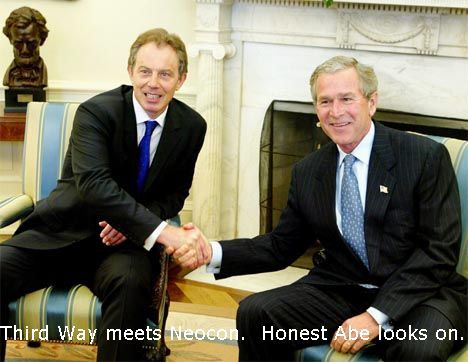
Many people have expressed surprise at the alliance of George W. Bush and Tony Blair, men respectively of the right and the left but who share an obviously genuine friendship. The answer to the apparent paradox is to be found in their respective philosophies. The so-called 'philosophies' of the left's 'Third Way' and the right's Neo-Conservatism' to which these two subscribe share more than their promoters might like to concede.

In fact, I would suggest that in all essentials the 'Third Way' is just the mirror image of 'Neo-Conservatism.' It is no accident that George Bush and Tony Blair have become allies; the understanding they so clearly share is born of a common way of seeing the political landscape, and it has lessons for us here in New Zealand.

Let me explain. These two political schools of the right and the left have until recently both of dominated their respective political 'markets,' and they've done so largely by making themselves 'pragmatic on principle': that is, they accept what they view as the 'political realities' of the present ideological and political geography of a country; they concede that capitalism produces rather more than any other alternative yet devised; and they've chosen to shackle the levers of power and the engine of capitalism simply to deliver votes.

That in a nutshell is the 'big idea' behind the ruling ideologies of both the Neocons and the Third Way zealots.

Far from being big ideas, both are little more than strategies for gaining and holding power for their 'side,' but in placing strategy over principles both leave largely bare the question of what they are gaining power for -- the result is that for both schools the pursuit of politics becomes power for power's sake - and we know (and have seen in the NZ Parliament recently) what the pursuit of power tends to do to those who pursue it absolutely. It's not at all pretty, and not all a natural environment in which freedom and liberty can flourish.

Fortuitously, recent posts on the local blogosphere make the comparison between the two relatively transparent. Prof. Brad Thompson's superb analysis of American conservatism gives the necessary keys to understanding the so-called philosophy of Neo-Conservatism; and now and in an apologia to the local left posted yesterday, Labour strategist Jordan Carter summarises for the "further left" the Third Way strategy followed by Labour here since 1993.

Third Way
If we look first at that "Third Way strategy" as summarised by Jordan: "The key components of that locally have been," he says,
  • Emphasis on the connection between social justice and economic development
  • Moderate political positioning, in touch with voters not activists
  • Pragmatic policy lines in terms of public spending and the market/community boundary
  • An avoidance of 'reform' as opposed to consolidation in most areas of policy
  • Incremental change and routing around, rather than challenging, opposition to particular policies
As I suggested above, this is hardly a 'big idea' in terms of political philosophy - this is strategy not philosophy, and if I may translate from the language of wonkery above into how it has worked in practice here, the strategy has been this:
  • Shackle capitalist means for socialist ends -- that is, use the engine of capitalism to produce, and the maw of politics to redistribute
  • Accept the political landscape (as Blair did in keeping the Thatcher reforms, and Clark has in keeping the Richardson/Douglas reforms) and seek instead to capture and massage and persuade the unthinking and the easily persuaded
  • Take ownership of the 'commanding heights' of state welfare (health, education, welfare), and use welfare distribution as a tool of politics: that is, make sure welfare is politically targeted (remember for example how South Auckland came in for Labour last September?) and that new welfare programmes are identified with Labour (Welfare for Working Families anyone?)
  • Keep former New Labour activists close and compliant (Hello Jim), and the harder left rabble quiet by whatever means necessary, including both 'buy-in' and buying off.
  • Blur public-private boundaries, and make both public and private companies either politically or financially dependent on the party in power
The aim of course is not reform per se, except to the extent that reform might attract votes. The measure of success for such a strategy is not the success of the programmes and policies introduced (as demonstrated in the almost complete lack of interest shown by Labour in plummeting literacy and numeracy, increasing (if now-hidden) hospital waiting lists, and the almost complete disinterest in recent poverty surveys showing increasing poverty), instead the real measure of success to such a strategist can be best measured by the number of votes such a strategy attracts. As Jordan boasts:
[The 'Third Way' strategy] has been a very successful strategy for Labour. The party has rebuilt from a very low share of the vote of 28% in 1996, to three consecutive election wins around 40%. The message of moderation, and of investment in public services instead of cutting taxes, has been an electoral winner.
Never mind the poverty and dependence, feel the power! "We won, you lost, eat that!" The aim of the 'Third Way' strategy is clear enough: it is power. Power for power's sake. The pursuit of power, and the holding of power once gained -- and all policy is geared to that aim, policy as the hand-maiden of power-lust.

Neocons
How does this differ from Neo-Conservatism? Hardly at all. Professor Brad Thompson summarises the advice given by Irving Kristol, the father of the Neo-Conservatism:
Kristol’s advice to Republicans is: Stop taking your principles so seriously (as if that were ever a problem). The successful statesman, he argues, is chameleon-like in his ability to redefine his principles in the light of changing circumstances. Don’t concern yourselves with principles; concern yourselves with acquiring and keeping power.
In other words, make policy the hand-maiden of power-lust. Third Way leftists and Neocon rightists might start at what they see as different ends of the political spectrum, but they both meet up in the authoritarian middle. Continuing the summary of the Neocons [with Thompson's words double-indented and my own single-indented):
Neocons agree with the underlying moral principles of the socialists; they disagree merely over the best means to achieve their shared ends. As do all good socialists, neocons hold that welfare should be regarded as a right because it is grounded in people’s “needs”—and, as Kristol explains, for the neocons, “needs” are synonymous with rights...
So how does a conservative welfare state work? And how does it differ from a liberal welfare state? Behind all the rhetoric, the shabby secret is that there is very little difference except how and by whom the readies are doled out. Both liberals and Neocons opposed Clinton's refoms of the welfare state. Both liberals and neoncons promise cradle to grave nannying. The Neocons, who (like Roger Douglas) talk about socalist ends through capitalist means simply insist that the all-powerful state should provide, but people should be allowed some "choice." The state will continue to put its hand in your pocket, increasingly so say neocons, but "the people choose their own “private” social security accounts; they choose their own “private” health and child-care providers; and parents receive vouchers and choose which schools their children will attend."
The choices, of course, are not the wide-open choices of a free market; rather, the people are permitted to choose from among a handful of pre-authorized providers. The neocons call this scheme a free-market reform of the welfare state.
Socialist ends through capitalist means, you see (or at least "conservative" means, capitalism not being the process so described). And as far as the neocons' "big idea" goes, that's it. George Bernard Shaw observed years ago that a government that robs Peter to pay Paul can always rely on the support of Paul. The neocons rob Peter, rob Paul, and channel that money to the providers pre-approved by the ruling party (who can expect to show their gratitude in the appropriate way), clipping the ticket on the way on behalf of the paternalistic state.
So the Neocon strategy of gaining and keeping power differs in practice only marginally from the strategy of the Third Way; both seek to politicise the delivery of welfare, and in doing so both seek to enlarge and expand the nannying state and put it at the service of buying votes.

In practice, then, Neocons and Third Way strategists are soul-mates. George, meet Tony. Tony, meet George. (Jordan, how do you feel?)

The Vision Thing
But as I've suggested above there is a problem with the strategies of both Neocons and Third Way zealots like Jordan's beloved Labour party, and it is best summarised by Brad Thompson in talking about the neocons:
The most remarkable issue about the neocons’ notion of a “governing philosophy” is that it is a strategy for governing without philosophy. The neocons unabashedly describe themselves as pragmatists; they eschew principles in favor of a mode of thinking—and they scorn thinking about what is moral in favor of thinking about what “works.” For over twenty-five years, they have fought an ideological war against ideology.
And at the end of that 'war' -- and just like Labour -- all they are left with is power, and little real idea of what to do with it. And here's the key thing, and it is this: the 'vision thing' is left for someone else to determine,
Never mind "the vision thing" -- about which George Bush Sr. agonised -- give yourself over instead to absolute rule, and let the other side seek out new visions . That's the neocon ticket. The three most important rules for absolute rule: Compromise, compromise and compromise. The fourth rule: if visions arise that are going to happen anyway, then just roll over and make sure you take the credit... This is what it means to “think politically.”
And therein here's the hope for local politics. As long as Third Way and Neocon strategists eschew ideas and the 'vision thing,' then ideas and vision become (or should become) the province of their ideologic opposition.

The question is, are they up to it?

LINKS: Third Way Tactics in Labour Politics - Just Left (Jordan Carter)
The Decline and Fall of American Conservatism - C.Bradley Thompson, The Objective Standard
'CONSERVATISM: A NEW OBITUARY.' Part 5: The "neocons" in practice -- adding cynicism to love - Not PC (Peter Cresswell)
Labour has failed the poor - No Right Turn (Idiot/Savant)
The Tom Roper Prize this year goes to Christchurch, New Zealand - Diogene's Lamp
The illiterate teaching illiteracy - Not PC (Aug, 2006)
Neither free nor education - Not PC (Nov, 2005)

RELATED: Politics-US, Politics, Objectivism, History-Modern, History-Twentieth Century, Politics-NZ, Welfare, Education, Health

Friday, 6 October 2006

'Blue Green': the new symbol of wetness

Occasionally reality conspires to prove a point more tellingly than you might deem realistic if you wrote about in fiction. You sometimes make your point, then read your newspaper and you think, "I could not have made this up."

I'm speaking about conservatism, and those who call themselves conservatives. This morning and over the last few days I've discussed at length Brad Thompon's analysis of the practical consequences of conservative ideology, the hallmarks of which can be characterised as being compromise, "me-tooism" and an embrace of one's opponents aims with the only change being the claim that conservatives will deliver them better. This, to conservatives, is called "heading off the opposition." To a conservative, you see, it's not so important what is done so much as who is doing it. That's why since the war there have been more socialist advances under conservative governments than there have under those of a liberal persuasion -- conservatives call this "heading off the opposition" -- those with principles call it "selling out."

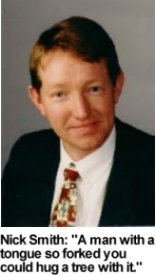
Even as I wrote that, National Party's Nick Smith was sleazing into print in order to prove that very point, suggesting that with National's weekend Blue-Green conference the Nats should look to head off the opposition by "softening its environmental message." As Vernon Small summarises the Smith slop:

Softening the environmental message, [Smith] hopes, will peel away some of that soft Labour vote while happily making a deal with the Green party that much more credible. More to the point, if National cannot hug the trees and the Greens, or edge them into a neutral position, then it may be trying in the long term to hug them to death.

This, to a conservative, is called strategy. No wonder Smith, to Lindsay Perigo, is a man with a tongue so forked you could hug a tree with.

What, in real concrete terms, does "softening the environmental message" mean besides giving the authoritarian environmentalists everything they're after? None at all. The "softening" Smith proposes are a sell-out on Kyoto, "a significant funding package to promote tree planting, cleaner air and water, and help for community conservation." Oh please. Not just selling out, but selling out so wetly. As I quoted Thompson this morning:
Never mind "the vision thing" -- about which George Bush Sr. agonised -- give yourself over instead to absolute rule, and let the other side seek out new visions. That's the neocon ticket. The three most important rules for absolute rule: Compromise, compromise and compromise. The fourth rule: if visions arise that are going to happen anyway, then just roll over and make sure you take the credit.

If liberals launch a national campaign for socialized medicine, Republicans should steal the issue from the Democrats and advocate a system of universal health care but one that allows people to choose their own doctor or HMO. If liberals commence a public campaign against the profits of “big business” or the salaries of their executives, Republicans should neutralize liberal pretensions by encouraging “greedy” and “profiteering” corporate executives to voluntarily donate their profits to charities. If radical environmentalists launch a public relations campaign against global warming, Republicans should encourage American companies to hire environmentalists as advisors...
As Thompson points out, and as Ayn Rand pointed out before him, moral appeasement of this sort serves only to embolden the conservative's opponents, "a lesson that conservatives seem constitutionally unable to learn. They fail to grasp that compromising one principle inevitably leads to hundreds of compromises in practice. In this relationship, liberalism will always have the upper hand and will always dictate the future..."

Should Smith and the Nats seek to spike the authoritarian guns not with compromise but with a ringing declaration this weekend of freedom and liberty and property rights -- and with it a clear and forceful demonstration of how the exercise and protection of property rights leads to both superior environmental values and maximum freedom -- then I would be right behind him.

But that's about as likely as Smith ever growing a spine.

LINKS: True blues go green - Vernon Small, Stuff

RELATED: Politics-NZ, Environment, Property Rights, Politics-National

'CONSERVATISM: A NEW OBITUARY.' Part 5: The "neocons" in practice -- adding cynicism to love

Continuing the series of excerpts from Prof. Brad Thompson's article 'The Decline and Fall of American Conservatism,' first published in The Objective Standard. Today, Part Five: Neoconservatism. (You can find Part Four here.)

Today we look at the neoconservative welfare-warfare state. How does it work? How does it differ from a liberal welfare state? And how exactly do the neocons reconcile Adam Smith and Karl Marx, Hayek and Trotsky.

"Neconservatives reject the fundamental principles of a free society," says Thompson. They would view an attempted return even to to the pre-New Deal world of Franklin Roosevelt "as not only impractical and fanciful, but, more importantly, as immoral." So for them the founding principles of the United States are just anathema.

The problem with the Founders’ liberalism, according to [neoconservative theorist Irving] Kristol, is that it begins with the individual, and a philosophy that begins with the “self” must accommodate and allow for selfishness, choice, and the pursuit of personal happiness. A secular capitalist society—a society that enables its citizens to pursue their self-interest—inevitably degenerates, he argues, into a culture of isolated individuals driven solely by the joyless quest for creature comforts. A free society grounded on the protection of individual rights leads inexorably to an amiable philistinism, an easygoing nihilism and, ultimately, to “infinite emptiness.”38

In other words, according to Kristol and friends, the principles espoused by John Adams, Thomas Jefferson, and James Madison lead inevitably to the Marquis de Sade, Abby Hoffman, and Jerry Springer.
It should be no surprise that neocons and cons alike should be opposed --ideologically opposed -- to any idea of rational selfishness. As a colleague of mine points out:

It is important to understand that Conservatives don't understand the American Revolution as a revolution of ideas. They regard it more as an evolution.

The original credo of conservatives is accordingly, not as laid out by the Founding Fathers, but by their Pilgrim forefathers. The character traits that the New Conservatives want to establish harks back to the ones that the Puritans regarded as virtuous. Accordingly, the ideas that generate their policies are the ones in Jefferson's Bible, and not the ones contained in his philosophy of Government. For those interested in pursuing this thought futher, here is a speech by Robert Cushman, one of the original pilgrims The Sin and Danger of Self Love

Note that his premise is the exact opposite of Rational Egoism

Just as it is for the neocons.
Neocons agree with the underlying moral principles of the socialists; they disagree merely over the best means to achieve their shared ends. As do all good socialists, neocons hold that welfare should be regarded as a right because it is grounded in people’s “needs”—and, as Kristol explains, for the neocons, “needs” are synonymous with rights...
So how does a conservative welfare state work? And how does it differ from a liberal welfare state? Behind all the rhetoric, the shabby secret is that there is very little difference except how and by whom the readies are doled out. Both liberals and neocons opposed Clinton's refoms of the welfare state. Both liberals and neoncons promise cradle to grave nannying. The neocons, who (like Roger Douglas) talk about socalist ends through capitalist means simply insist that the all-powerful state should provide, but people should be allowed some "choice." The state will continue to put its hand in your pocket, increasingly so say neocons, but "the people choose their own “private” social security accounts; they choose their own “private” health and child-care providers; and parents receive vouchers and choose which schools their children will attend."
The choices, of course, are not the wide-open choices of a free market; rather, the people are permitted to choose from among a handful of pre-authorized providers. The neocons call this scheme a free-market reform of the welfare state.
Socialist ends through capitalist means, you see (or at least "conservative" means, capitalism not being the process so described). And as far as the neocons' "big idea" goes, that's it. George Bernard Shaw observed years ago that a government that robs Peter to pay Paul can always rely on the support of Paul. The neocons rob Peter, rob Paul, and channel that money to the providers pre-approved by the ruling party (who can expect to show their gratitude in the appropriate way), clipping the ticket on the way on behalf of the paternalitic state.

As Thompson observes of this roundabout of venality,
If compassionate conservatism injected love into the hardened arteries of Republican politics, then neoconservatism infused blood-thinning cynicism into the Republican blood stream. Neoconservatism is a political philosophy concerned with, above all else, power. Like socialists, neocons want political power to create a certain kind of society—a virtuous society guided by the right purposes—purposes that they are very reluctant to share with the general public. They also believe that if government is in the hands of the wise and good, it ought not to be limited too much by constitutional rules and boundaries. The neocons are much more concerned about “who rules” than they are about the limits of political rule.
In the end neocons eschew principles for pragmatism. This is what neocons laughingly call a "governing philosophy."
The most remarkable issue about the neocons’ notion of a “governing philosophy” is that it is a strategy for governing without philosophy. The neocons unabashedly describe themselves as pragmatists; they eschew principles in favor of a mode of thinking—and they scorn thinking about what is moral in favor of thinking about what “works.” For over twenty-five years, they have fought an ideological war against ideology.
I did tell you this wouldn't be pretty.

The neocons urge Republicans to drop their limited-government principles and to consider only the immediate problems of the present, unconnected to all other problems, and without reference to principles. According to Irving Kristol, “there are moments when it is wrong to do the right thing.” This is Kristol‘s “First Law” of politics:

There are occasions where circumstances trump principles. Statesmanship consists not in being loyal to one’s avowed principles (that’s easy), but in recognizing the occasions when one’s principles are being trumped by circumstances. . . . The . . . creative statesman, one who possesses some political imagination, will see such occasions as possible opportunities for renewed political self-definition.50

In other words, Kristol’s advice to Republicans is: Stop taking your principles so seriously (as if that were ever a problem). The successful statesman, he argues, is chameleon-like in his ability to redefine his principles in the light of changing circumstances. Don’t concern yourselves with principles; concern yourselves with acquiring and keeping power.

Never mind "the vision thing" -- about which George Bush Sr. agonised -- give yourself over instead to absolute rule, and let the other side seek out new visions . That's the neocon ticket. The three most important rules for aboslute rule: Compromise, compromise and compromise. The fourth rule: if visions arise that are going to happen anyway, then just roll over and make sure you take the credit.
If liberals launch a national campaign for socialized medicine, Republicans should steal the issue from the Democrats and advocate a system of universal health care but one that allows people to choose their own doctor or HMO. If liberals commence a public campaign against the profits of “big business” or the salaries of their executives, Republicans should neutralize liberal pretensions by encouraging “greedy” and “profiteering” corporate executives to voluntarily donate their profits to charities. If radical environmentalists launch a public relations campaign against global warming, Republicans should encourage American companies to hire environmentalists as advisors. If feminists propose to nationalize pre-school child care, Republicans should go along but insist that parents be given vouchers to send their children to the day-care facility of their choice.

This is what it means to “think politically.”

Why would anyone support neocon government if this is all they have to offer? Well, you tell me. They offer leadership, but in a direction to be set by their opponents. They offer the free market, but only one shackled to provide "vouchers" for the welfare state. They offer vision, but only of ever bigger and ever more paternalistic government. As Ayn Rand said of the American conservatives back in in 1960, "If the "conservatives" do not stand for capitalism, they stand for and are nothing; they have no goal, no direction, no political principles, no social ideals, no intellectual values, no leadership to offer anyone." Today's conservatives stand for and are nothing.
Their advice to the Republican Party is to compromise and accept the moral ends of liberal-socialism, but with the caveat that conservatives can do a better job of doling out the goods and services.

Observe who is being asked to compromise what here. Conservatives are being asked to compromise their principles. Liberals are being asked to compromise only the way in which welfare is delivered. Moral appeasement of this sort serves only to embolden the Left, a lesson that conservatives seem constitutionally unable to learn. They fail to grasp that compromising one principle inevitably leads to hundreds of compromises in practice. In this relationship, liberalism will always have the upper hand and will always dictate the future...

According to Kristol, the “idea of a welfare state is in itself perfectly consistent with a conservative political philosophy—as Bismarck knew, a hundred years ago.”56 In addition to TR and FDR, the neocons add Bismarck to their list of statesman-like heroes. The neocons’ new Republican Party seeks to restore not a Jeffersonian model of government, but rather the Prussian welfare state.

This, according to the neocons, is what it means to be “in the ‘American grain.’” This is their contribution to “the stupid party” and to American life.

So "the stupid party" rolls on, while its ruling ideology rolls over any principles it once might have had.

But hasn't there been any successes to speak of? Any runs on the board? Have the big government neocons sold out so abjectly to their liberal-socialism of their opponents that there is nothing whatsoever to celebrate? Tune in tomorrow and find out.

'CONSERVATISM: A NEW OBITUARY,' THE SERIES SO FAR: LINKS: The Objective Standard, a journal of culture and politics.
Cartoon by Cox and Forkum
The sin and danger of self love - Robert Cushman (Plymouth, 1642)

RELATED: Politics-US, Politics, Objectivism, History-Modern, History-Twentieth Century

Friday, 8 September 2006

Dumbing down the Libertarian Party

Always a mongrel composition of odd-bods, the US Libertarian Party has now succumbed to strategists, spin doctors and the unprincipled wielders of spread sheets and white boards who have moved to dumb down the party's only remaining virtue: its slate of principled policies. Lew Rockwell, who is himself rather prone to odd moment of oddball-ism, has some very good things to say about this very bad development:
For those who haven't heard, the large, pedagogically useful, principled, and detailed Libertarian Platform — the best thing about the party — has been relegated to the wayback machine and is now replaced with a new one that is tiny, vague, rhetorically slippery, accommodating, friendlier to the state, and non-threatening to mainstream opinion.

Why? The small band that orchestrated this coup confesses: they want the LP to gain power.

They've admired the way the Republicans and Democrats have done it, and now they want to do it too. Gone is the posture of opposition, the radicalism, the edge, the braininess.


The debate has been framed as one between dogmatists and pragmatists. What's remarkable here is how the pragmatists are willing to concede just about every criticism made by the principled LPers of old. They admit that they have watered down the entire program. They admit to being pure pragmatists. They admit that they like certain aspects of the state, and were unhappy with the consistency and comprehensive radicalism of the old platform.


Carl Milsted — who seems to have played the major role in this — puts it this way. The LP has waffled between two separate functions. It tries to be "a radical protest organization (a PETA for liberty)" and also a "political party to get freedom lovers elected to office," so he thinks the former role ought to be abandoned in order to achieve the latter.


But you know what? The LP was not founded to get people elected to office. It was founded to oppose the regime and educate the public, and use elections as the vehicle to do so. [...]

Milsted is right that the idea of a principled political party is incongruous. So what conclusion does he come to? Let's get rid of principle and stick to politics. It's like saying there is a fly in my soup, so let's get rid of the soup and eat the fly!
As an example of the dumbing down, consider these two statements on property rights; the first is from the old platform:
We oppose all violations of the right to private property, liberty of contract, and freedom of trade, especially those done in the name of national security.
Sound, clear and principled. And now from the new platform:
The right to property and its physical resources, which is the fundamental cornerstone of a free and prosperous society, has been severely compromised by government at all levels.
Uugh! The former clear statement of principle has been dumbed-down to bland feel-ggod mush. The mush-merchants who've taken over say that much-peddling will lead to vote-getting which will lead to ... well, they're not sure what since the point now is only to get their feet under the political table. To what end? Blank out. No idea. The goal now is just and only to get their feet under the table. More likely however, by peddling such mush they will fail to achieve either goal: they'll neither educate nor achieve any tangible 'power,' and even if they did, what would gaining 'power' achieve if they've lost any ability to educate?

The equation of principle is quite beyond the 'pragmatic' peddlers of mush. (I'm pretty sure I've said this before somewhere. More than once.) In politics, pragmatism is not practical. Principle is.

Perhaps the US Libertarian Party activists should have looked to what happened to the Costa Rican libertarians in their last election (about which both I and Jacqueline Mackey Paisley Passey blogged, as did hardore Costa Rican libertarian Jorge). Here's Jorge and and Jackie summarising the results of the new softcore Movimento Libertario (ML):

"Does abandoning principle “work”?

"To answer this question lets look at how the “radical” hard core ML performed four years ago. In 2002 the ML received 1.7% of the vote for President and 9.34% of the vote for the Asamblea, electing six Diputados (congressmen). To do this they spend a bit more than US$ 200,000 in privately raised funds, explicitly rejecting government funds as immoral.

"This time around, they spent roughly US$ 1,900,000 and accepted state funds. For President, Guevara received 8.4% of the vote (86.9% counted). For Diputado, the ML has received 9.08%. It seems that they have elected six, but one has a razor thin margin, which may just disappear when all the votes are counted. So far 83.4% have been processed."

So let's see... after spending 10 times as much, with 4 more years of experience and organizing time, in the end the new "pragmatic" Movimiento Libertario achieved... exactly what the old "radical" Movimiento Libertario had achieved in the previous election. Except instead of electing 5 real libertarians to the legislature they've elected 5 or 6 "mostly" libertarians.

So much for pragmatism achieveing anything. From a principled party with 5 hardcore elected deputies giving them a well-used platform to educate and enlighten people about the ideas and roots of liberty, they've now lost all their principled members, and lost also any opportunity to educate anyone, even themselves -- they've become just another dumbed-down bunch of sharks in shiny suits with no reason for being in power other than just being in power.

I trust local Libertarianz will absorb Rockwell's lesson, one they've heard so often from me: "The LP was not founded to get people elected to office. It was founded to oppose the regime and educate the public, and use elections as the vehicle to do so." Exactly right.

LINKS: The Party of vacuous rhetoric - Lew Rockwell, Mises Institute
A spoonful of principle helps revolution fire - Peter Cresswell, 'Free Radical,' 1998

National Platform of the [US] Libertarian Party - May 2004, courtesy of the 'Wayback Machine' National Platform of the [US] Libertarian Party - June 2006, US Libertarian Party website Liberty lost her principles down in Costa Rica - 'Not PC' (Peter Cresswell)
Movimiento Libertaria loses principles, gets spanked - Jacqueline Mackey Paisley Passey
...and they didn't even get the votes - 'Sunni & the Conspirators'
Putting the 'P' word into politics - Peter Cresswell, speech to Tauranga Regional Libertarianz conference, 2002


RELATED: Politics-US, Politics-World, Libertarianism, Libz, Property Rights, Politics-ACT

Monday, 4 July 2005

Compromisers and meddlers destroy Costa Rica's libertarians

Sad news from Costa Rica about the parliamentary libertarians there, who have apparently gone native. Former activist Jorge Codina reports that the Moviemento Libertario (ML) is no longer a movement, nor any longer libertarian -- corrupted it seems by association with power and pragmatism. "The pragmatists are in control," says a tired, drained and clearly burnt out Jorge.

He puts the blame for the corruption of a fomerly principled parliamentary libertarian party firmly at the door of the 'classical liberal' Friedrich Naumann Foundation, an organisation whose lietmotif is compromise -- "you have to dump the ideology to get elected" said the unelected FNF to the already elected MLers, a message picked up by the pragmatists seduced by their proximity to power who have become politicians instead of libertarians, praising "good government" instead of freedom, and "efficiencies" over rights. Sound familiar?

As compromise replaces principle, the very reason for the existence of the Moviemento Libertario disapears, as the party is also now predicted to do. If politics has replaced principles, then how does ML fundamentally differ from any other bunch of power-lusters? Sad news indeed, and not without parallels here in NZ.

As Lord Acton once presciently pointed out, power corrupts ...

Saturday, 4 June 2005

Question for Act's libertarians

If you're going down anyway, then why not use the public platform you've got, eschew compromise and scandal-mongering, and start saying what you really believe?

Or say what you say you really believe?

 What have you got to lose that the polls are saying you haven't already? If not now, when?

 Here's five things you could try saying that at the moment you're too scared too:

  1. Abolish the RMA. No, don't say "review," "reform" or refine." Use the 'A' word! Tell people you want to liberate property owners and put a stake through planner's hearts. 
  2. End the War on Drugs. You tell people you're the party of freedom -- and show that you mean it. This would really put the acid on the Green Party authoritarians, and you might even pick up a few of those Green voters sick of their party's ban-everything wowserism. Even just joining with Milton Friedman in saying 'Legalise marijuana' might help you feel better about your libertarian credentials and help you sleep at night.
  3. Privatise, privatise, privatise. Don't fiddle, tinker or bugger about with Government departments and state assets and "PPPs": sell, give away or otherwise dispose of them all. Give back the schools and hospitals to those using and running them, recognise the property rights that already inhere in beaches and foreshore, and let the government lease the Beehive to hold cabinet meetings. 
  4. Abolish the Treaty of Waitangi and rescind the 'Treaty Principles.' Replace the Treaty with a constitution protecting individual rights, regardless of colour. 
  5. End the DPB. Put a nine-month time limit for the final date, announce that there will be no new beneficiaries accepted to the unaffordable scheme after that date, and start taking those currently on it off it when their kids get to three years of age. You've got a candidate advocating it, so why not start shouting it from the rooftops!  
 Get all that off your chest (and get rid of all those bloody suits) and then people will at least be able to tell you apart from the Nats, and if you are going down you can at least do so with the dignity of having spoken your mind.

It's better to die on your feet than live on your knees, isn't it? And if you are still alive after all the dust has settled, well then, you really would be a party of freedom, wouldn't you.

 [ADDENDUM: My poor arithmetic corrected (Thanks Berend.)]