"Two years after leaving the EU Britain has made almost none of the promised progress towards economic liberalisation. While Brussels hasn’t been helpful, libertarian ministers in the Tory government have been both conquered by the bureaucracy of the civil service and even turned into high-spending statists. There has been no attempt to reduce the state’s suffocating dominance over the economy.
"On current policies, the private sector is set to continue its long-term decline, with higher taxes and ever-increasing regulation. But it needn’t be so...."
~ Max Rangeley, from his post 'The UK and its Lost Opportunities'
Showing posts with label Boris Johnson. Show all posts
Showing posts with label Boris Johnson. Show all posts
Wednesday, 9 February 2022
"Two years after leaving the EU Britain has made almost none of the promised progress towards economic liberalisation...."


Friday, 22 November 2019
"Political lying is a form of theft. It means that voters make democratic judgments on the basis of falsehoods. Their rights are stripped away." #QotD
.
“Political lying is a form of theft. It means that voters make democratic judgments on the basis of falsehoods. Their rights are stripped away.”
~ philosopher Sissela Bok, summarised by Peter Oborne in his op-ed 'It’s not just Boris Johnson’s lying. It’s that the media let him get away with it'
Thursday, 25 July 2019
"Boris Johnson is taking over the Conservative party like a gangster taking over a crime syndicate... Yet step back and you see a weak man posing as a tough guy." #QotD
"Boris Johnson is taking over the Conservative party like a gangster taking over a crime syndicate...
"Don’t let ideological labels mystify you. 'Remainer,' 'Leaver,' 'no dealer' – these are just words to confuse the credulous and stop them seeing their country clearly. Power is the only word that need concern you. Power, rather than ideology, is what runs together resignations and sackings...
"I have never believed the media wisdom that 'the thing about Boris is that he just wants to be loved.' As an old journalist once told me, the one thing everyone says about a public figure is invariably wrong. So it has proved with Johnson.
"He does not want to be loved. He wants to dominate and to command: he wants to be obeyed...
"Yet step back and you see a weak man posing as a tough guy. He has a nominal parliamentary majority of three and falling. He has become Tory party leader by making promises which are impossible to meet ..."
~ Nick Cohen, in his op-ed 'Boris is a weak man posing as a tough guy'
.
Monday, 16 May 2016
The European Union is Anti-European
Former London Mayor Boris Johnson received headlines around the world for saying “the European Union (EU) wants a superstate, just as Hitler did.” That at least was what one of the headline wirters reports.
The former mayor of London, who is a keen classical scholar, argues that the past 2,000 years of European history have been characterised by repeated attempts to unify Europe under a single government in order to recover the continent’s lost “golden age” under the Romans.
“Napoleon, Hitler, various people tried this out, and it ends tragically,” he says.
“The EU is an attempt to do this by different methods.
“But fundamentally what is lacking is the eternal problem, which is that there is no underlying loyalty to the idea of Europe. There is no single authority that anybody respects or understands. That is causing this massive democratic void.”
Mr Johnson’s potentially inflammatory comparison to Hitler comes at a critical time in the referendum campaign, with senior Tories on either side publicly attacking each other in blunt terms.
So seen in context then, Johnson is not in fact saying what the headline writers report, nor is it at all “inflammatory” to point out that unifying Europe politically has been tried and failed before.
His main point, overlooked in the screaming headlines, is “that there is no underlying loyalty to the idea of Europe” whose strength has always been not in its centralisation, but its opposite. The point is echoed by Louis Rouanet below in today’s guest post.
The European Union is Anti-European
Guest post by Louis Rouanet

After the fall of the Roman Empire a period of political anarchy followed where cities, aristocrats, kings, and the church all competed with each other. Therefore, as Dr. Ralph Raico noted in his article “The European Miracle,”
Although geographical factors played a role, the key to western development is to be found in the fact that, while Europe constituted a single civilisation — Latin Christendom [born out of Greco-Roman paganism] — it was at the same time radically decentralised. In contrast to other cultures — especially China, India, and the Islamic world — Europe comprised a system of divided and, hence, competing powers and jurisdictions.
In other words, over the centuries, a long evolution of the institutions gave birth to personal liberty. Although the European aristocracies and states were restricting freedom, they were forced to grant more autonomy to their subjects, for, if they did not, people were opting out by migrating or using black markets. As Leonard Liggio puts it, after 1000 A.D.:
While bound by the chains of the Peace and Truce of God from looting the people, the uncountable manors and baronies meant uncounted competing jurisdictions in close proximity. ... This polycentric system created a check on politicians; the artisan or merchant could move down the road to another jurisdiction if taxes or regulation were imposed.
Europe was where the road to freedom began. It was in Europe that the values of individualism, liberalism, and autonomy rose from history and gave humanity a sense of progress that no civilisation had ever experienced to such an extent before. Unfortunately, the values and institutions that made Europe great vanished under the pressures of political centralisation, nationalism, statism, socialism, and fascism in the nineteenth and twentieth centuries. Today, however, a new danger looms over Europe — the European Union.
The European Institutions Against the Free Market
Contrary to what is often said, the European Union has nothing to do with peace, freedom, free trade, free capital and migration movement, cooperation, or stability. All this can very well be provided in a decentralised system. The European Union is nothing more than a cartel of governments that tries to gain power by harmonising the fiscal and regulatory legislation in every member State. Article 99 of the Treaty of Rome (1957) clearly states that indirect taxation “can be harmonised in the interest of the Common Market” by the European Commission. As for Article 101 of the same Treaty, it explicitly restrains regulatory competition “where the Commission finds that a disparity existing between the legislative or administrative provisions of the Member States distorts the conditions of competition in the Common Market.”
Since the very beginning, with the creation of the European Coal and Steel Community (ECSC) in 1951, the European institutions were more planning agencies than anything else. Indeed, the coal and steel industries at the time were mostly nationalised, and the goal of the ECSC was not to liberalise activity but to coordinate governments’ activities in these two sectors.
This fact, that the ECSC was not about free trade but about government planning, was known by everybody at the time. It was Robert Schuman, the French minister of foreign affairs, who proposed in his declaration of 9 May 1950, that the Franco-German coal and steel production be placed under a common High Authority within the framework of an organisation in which other European countries could participate. Also, the ECSC created for the first time European anti-trust legislation, which as Austrian economists [and Objectivists] understand, is nothing less than government planning in the name of an erroneous vision of what competition is. Even the Treaty of Rome (1957), the basis of the EU as we know it, despite enacting the free movement of goods, capital, and persons, remains a highly statist treaty. Indeed, it is often forgotten that among other things, the Treaty of Rome created a “European Investment Bank,” a “European Social Fund,” the highly protectionist creator of butter mountains and subsidised empty farmlands: the “Common Agricultural Policy,” the “common transport policy,” and reinforced European anti-trust legislation. Therefore, if in the short and medium run, the Treaty of Rome, by breaking the neck of protectionism, was a boon for the European economy, it created institutions that could and did expand their regulatory power in the future.
Many free marketers support the European Union on the ground that even if their regulations are bad, they are still far better than those produced by our very prolific national governments. Such a line of argument, often used in more socialist countries such as France, is sheer nonsense. It is the equivalent of saying: “I don’t mind being robbed twice because the second thief will be much nicer to me.” The question is not how to make “better” regulations but how to expand free trade.
Europeanism: True and False
In 1946, F.A. Hayek wrote a pathbreaking article named “Individualism: True and False” in whichhe distinguished two different individualist intellectual traditions. One, as Hayek calls it, is “true individualism,” based on evolutionism, the idea that institutions and individuals’ behaviors are not planned consciously but are rather the result of a spontaneous process. True individualism follows the tradition of the Scottish Enlightenment. It is “bottom up.” False individualism, on the contrary, is based on extreme rationalism and solipsism. False individualism is based on the idea that society, freedom, and markets, can be planned and should be planned. This false individualism is the heir of the 1789 and — even more clearly — of the 1793 French Revolutionaries. It is imposed, or attempted to, from the top down.
These two sorts of individualism are today at the root of two different sorts of Europeanism.
True Europeanism admits that most of what made Europe was not planned but rather spontaneous. The implications are that we ought to have as much decentralisation as possible for Europe to continue to strive and to safeguard human liberties. False Europeanism on the other hand thinks that Europe can only truly become Europe if planning exists by virtue of common political institutions.
False Europeanists believe that the only alternative is between Nation States and the European Union. Their defense of a centralised European political entity is based on the erroneous idea that society, law, markets, prosperity, and the “European spirit” ought to be designed by rulers – that political centralisation is positively linked to the process of civilisation itself. Europe during the Middle Ages, those thinkers say, lacked trade integration because it lacked political unification. It follows that we must be grateful today for the existence of the European Union. In their narrative, economic progress took place only when “Europe” slowly began to develop new trading alliances that combined some aspects of military protection with something akin to a free-trade area. But this version of history is very far from the truth. In the Middle Ages for instance, the lex mercatoria, the law of merchants, was purely private. Furthermore, the protective tariffs were mostly ignored anyway by Europeans. Smuggling was so widespread that England in the late Middle Ages for example should be in fact considered not as a nation of merchants but a nation of smugglers. As Murray Rothbard noted in Conceived in Liberty:
Too many historians have fallen under the spell of the interpretation of the late nineteenth-century German economic historians (for example, Schmoller, Bucher, Ehrenberg): that the development of a strong centralised nation-state was requisite to the development of capitalism in the early modern period. Not only is this thesis refuted by the flourishing of commercial capitalism in the Middle Ages in the local and non-centralised cities of northern Italy, the Hanseatic League, and the fairs of Champagne. … It is also refuted by the outstanding growth of the capitalist economy in free, localized Antwerp and Holland in the sixteenth and seventeenth centuries. Thus the Dutch came to outstrip the rest of Europe while retaining medieval local autonomy and eschewing state-building, mercantilism, government participation in enterprise — and aggressive war.
Thus, the idea that a centralised authority, in our case the European Union, is necessary for free trade is pure fantasy, It is false Europeanism. Its constructivist approach has prevailed in European institutions since the beginning. For example, one of the goals advanced by the Treaty of Rome was to “create markets” through a unified European Anti-trust legislation. Similarly, the official justification of the Common Agricultural Policy introduced in 1962 was to create a unified agricultural market. But markets do not need States or treaties to exist and they certainly do not need the European Union.
The parallel between false Europeanism and false individualism is also relevant when it comes to their respective imperialistic tendencies. Whereas the French revolutionaries wanted to invade Europe to impose their “universal values” through force, the European Union does not tolerate, in the name of Europe, independent States that do not want to submit to Brussels. Switzerland, for instance, is forced by the European Union to adopt countless regulations concerning food safety and gun ownership. If the Swiss confederation does not comply with many provisions of European law, the European Union threatens to cut off Switzerland’s access to the single market.
The most incredible political success of the European Union zealots is their constant shaming of those who refuse to submit to a European hegemonic super-State. But we must understand that only so-called “Euro sceptics” can truly be pro-Europe. Only “Euro sceptics” can be loyal toward the history and liberal values of their continent. In other words, the European Union itself is a highly anti-European institution.
We Need Decentralisation
On June 28, 2016, the British will vote on whether they want to stay in the EU or not.
If the NO vote wins, it might be the end of the European Union as we know it. Historically, Britain played a major role in the maintenance of a fairly decentralised European order. Whether it was with Napoleonic France, or the German 2nd Reich, or Nazi Germany, it has always been Britain that ultimately helped to break up the hegemonic endeavours of empires on continental Europe. The question is, then, will Britain play its historical role this summer against the imperialistic European Union?
We should consider any attempt to establish a more decentralised system with more competition between States as a boon for Europe and the Europeans. To be sure, the Nation-States must be dismantled, but not if it means the creation of an even bigger European Leviathan. It is, on the contrary, the regionalists and independence movements that must be supported, whether it is Scotland, Catalonia, or Corsica. The European miracle can be revived only through extreme political decentralisation. What history teaches us is that Europe is greater than the individuals that compose it only insofar as it respects liberty. Insofar as it is controlled or directed by a monolithic and central political authority or by bellicose Nation-States, Europe is limited by the inability of Europeans to escape the arbitrary restrictions of their governments.

His post first appeared at the Mises Daily.
[Image source: Peter Kurdulija https://www.flickr.com/photos/peter_from_wellington/]
Here’s Jean-Jacques Burnel:
Tuesday, 17 November 2015
Post-Paris: More writing & talking [updated]

So much more to think about overnight . . .
“They deal in chaos, but they work from a script. The failure to understand that is costing us dear.
”There is a playbook, a manifesto: The Management of Savagery/Chaos, a tract written more than a decade ago under the name Abu Bakr Naji, for the Mesopotamian wing of al-Qaida that would become Isis. Think of the horror of Paris and then consider these, its principal [and self-contradictory] axioms…”
Mindless terrorists? The truth about Isis is much worse – Scott Atran, GUARDIAN“It is highly likely that the Paris attackers were operating in a land that was not entirely foreign to them. They knew that they could rely on the help of other like-minded people. They also knew their actions would enjoy the passive support of a significant section of society, which is estranged from, and hostile to, the way of life of European societies. By now they must also know they are holding their own in a battle of ideas with European governments…
”But there’s something different about this type of terrorism, too. Such acts are not simply about unsettling the public and creating a climate of fear – they also aim to encourage others to take up the fight …
”The one response to terrorism that must be avoided, and fought, is appeasement …”
After Paris: We Must Refuse to Be Terrorised – Frank Furedi, SPIKED“There are good reasons to wait for the full facts instead of jumping to the conclusion that Isis infiltrators are exploiting Europe’s refugee crisis.”
Why Syrian refugee passport found at Paris attack scene must be treated with caution – Patrick Kingsley, GUARDIAN“Why are so few Westerners standing with, or fighting with, the Kurds?
”… Our leaders talk war on IS, while green-lighting war on the most implacable enemies of IS.
“The dearth of any true solidarity with the Kurds is striking. Of all the wicked things happening in the world today, the terrorising of the Kurds is up there with the worst, yet there’s little anger, barely any protest.
“The dearth of solidarity with the Kurds among Western progressives ultimately speaks to the baleful influence of the politics of victimhood.”
After Paris: Victory to the Kurds – Brendan O’Neill, SPIKED“Here we go again. The same mantras are dusted down: we must be more assertive of our values, less tolerant of extremism, we must challenge Muslim separatism more effectively, demand better integration.
“And in my opinion the same root question is somewhat evaded: what exactly are our values? It is easier to assume that this is obvious – and it gives an impression of toughness. For example Boris Johnson today: ‘This is a fight we will one day inevitably win – because in the end our view of the human spirit is vastly more attractive and realistic than theirs.’
“But what is our view of the human spirit? What is our ideology, our creed? There are various words we can reach for – freedom, democracy, liberalism, maybe enlightenment. Fine words, of course, but there’s also an air of vagueness. I find it odd that there have not been more attempts to define our values in the years since 9/11. Very few intellectuals seem to ask the most basic questions…”
Islamic State are clear about their values. Are we clear about ours? – Theo Hobson, SPECTATOR“For all of the commentaries to come detailing the various intelligence, military, and diplomatic responses that France, the United States, and the EU should pursue, nothing will substitute for our recognition of the enemy and a moral resolve to see its ideology defeated totally and permanently. When historians of the future look back on the beginning of the second millennium, they will find the curious spectacle of two civilizations in bitter conflict: one weak but tireless, underwritten by an ideology that demands submission at any cost and beholden to an image of regression back to a primitive way of life; the other strong, built on a heroic legacy of human achievement, but unequal to its inheritance.”
The Vengeance They Deserve – Slade Mendenhall, THE MENDENHALL“I can understand why many people react to something like what has happened and ask the question, why are they doing this, what have we done wrong to them. Many people cannot wrap their head around genuinely bad people existing. They believe surely people can be reasoned with, if we be reasonable with them. They just don’t get that it’s possible for people to have heinous and ridiculous beliefs that will cause them to want to kill you for not holding those beliefs. As a result they grasp for answers to explain it in a way that is logical, that fits the mould of ‘they’ve only done this to us because we did this to them.’ …
“[They apply our] sense of ethics, an ethics applicable to the living, an ethics that sets boundaries for the living and their pursuit of happiness in a social context, to a metaphysics of the dead, The Walking Dead. So, think of ISIS and other violent sectarian actors as The Walking Dead for a spell. See how it fits, if it has a certain ring to it, given the juxtaposition of their apocalyptic metaphysics with our ethics for the living, the lovers of life.”
The Walking Dead And The Metaphysics of ISIS – Richard Nikoley, FREE THE ANIMAL“The West’s movement towards the truth is ‘remarkably slow. We drag ourselves towards it painfully, inch by inch, after each bloody Islamist assault.
”In France, Britain, Germany, America and nearly every other country in the world it remains government policy to say that any and all attacks carried out in the name of Mohammed have ‘nothing to do with Islam’….
“‘Noble’ or not, this lie is a mistake. … To claim that people who punish people by killing them for blaspheming Islam while shouting ‘Allah is greatest’ has ‘nothing to do with Islam’ is madness. Because the violence of the Islamists is, truthfully, only to do with Islam: the worst version of Islam, certainly, but Islam nonetheless. …
“Here we land at the centre of the problem — a centre we have spent the last decade and a half trying to avoid: Islam is not a peaceful religion. No religion is, but Islam is especially not. Nor is it, as some ill-informed people say, solely a religion of war. There are many peaceful verses in the Quran which — luckily for us — the majority of Muslims live by. But it is, by no means, only a religion of peace.”
Will politicians finally admit that the Paris attacks had something to do with Islam? – Douglas Murray, SPECTATOR“It is not a new war, nor has it always been fought with weapons. It is, principally, an ideological war between the secular, liberal Enlightenment of the West and the theocratic, Dark Age philosophy that still dominates much of the Middle East and North Africa. …
“How does one defeat ideologues that do not fear death? While killing one’s enemy is certainly the chief means of victory in war, that alone is not sufficient—unless one manages to somehow kill every last member of the enemy’s force, which one should be prepared to do if necessary…
“…we should not delude ourselves into thinking that defeating the Islamic State will alone defeat Islamic totalitarianism. So long as the ideology is given room to breathe, it will re-emerge. Suffocating it will also mean eliminating its state sponsors—all of them. I do not mean state sponsors of the Islamic State, which are none, but of Islamic totalitarianism generally, in all its forms across all sects.”
Defeating the Islamic State: Toward a Foreign Policy of Reason – Brian Underwood, THE MENDENHALL”Can a civilisation cowed by campus millennials summon the resolve to defeat Islamic terrorists? …
“In the darker corners of the Internet and the leftward precincts of academia, the Enlightenment values of liberty, reason, and universal human rights—not to mention the world-changing political revolutions they inspired in Europe and the Americas—amount to little more than a cheap intellectual justification for the historical forces of imperialism, slaughter, and subjugation. Usually, it’s easy to ignore those who respond to events such as the attacks in Paris with soliloquies to the effect of: ‘Well, you know who the real terrorists are, don’t you?’ Or, ‘You can’t expect an entire civilization to take centuries of insults lying down.’ Or, ‘Do you know what’s happening in Palestine right now, yesterday, and every day?’
“It’s not easy to ignore those sentiments today.”
Enemies Foreign and Domestic – Matthew Hennessey, CITY JOURNAL“How did we get to this historical anomaly in France where, as the estimable scholar Daniel Pipes observes, “a majority population accepts the customs and even the criminality of a poorer and weaker community”? It is the result of a conquest ideology taking the measure of a civilisation that no longer values its heritage, no longer regards itself as worthy of defence.”
How France Became an Inviting Target of the Jihad – Andrew McCarthy, PJ MEDIA“Mistrust of religion is not confined to Islam, but Europeans regard it as more threatening to their national cultures than other faiths (or indeed atheism) …. The threat of Islamic terrorism is rising, to judge not just by today's slaughter but also by other attacks and a recent upward trend in arrests for religiously-inspired terrorism reported by Europol, the European Union's law-enforcement arm. Perceptions can easily run ahead of reality, however…. And European publics wildly overestimate the proportion of their populations that is Muslim.”
Daily Chart: Islam in Europe – ECONOMIST“’The Duke of Wellington famously said that the Battle of Waterloo was won on the playing-fields of Eton: and if that is the case, then the advance of the Islamic State was begun in the nice, tolerant, liberal academies of Britain and other parts of western Europe.’ …
”Many folk otherwise supportive of allowing peaceful people to cross borders freely argue this policy can’t survive Muslim immigration; they argue the policy is untenable since Muslims constitute an objective threat, to whom western borders must be irrevocably closed. But as many [Europeans] are slowly realising … the threat comes not from Muslim immigration: the threat is homegrown. …
”The cause of these homegrown killers? As Ben Caspit explained in an open letter to the UK Foreign Secretary, you would have to be deaf, blind and dumb not to know. …
”Some of these [homegrown killers] will simply be psychologically susceptible to the nastiness of a violent religion. But what else are they hearing? Where are the voices proclaiming the virtues of reason, individualism and liberty? Where today will they hear these values proclaimed proudly and unashamedly? Where will they learn of the superiority of reason over religion, of freedom over tyranny?
“When Britain was exporting liberty to much of the known world, these values were unapologetically front and centre. These were the values that built western civilisation. These were values absorbed by immigrants and locally-born alike. People moved to Britain and the west because of these values.
“What happened?
“In a word: multiculturalism.
“Multiculturalism taught that the values of civilisation and those of barbarism were equal.
“It taught that liberty and slavery were simply different choices.
“It taught that if any culture should be shamed it should be western culture. That the west is responsible for all the world’s horrors, and the rest of the world simply a victim. This is the perversion now taught and promulgated in schools, in universities and in learned commentaries peddled by perfumed academics for the consumption of the self-anointed.
“So for all the decades that we’ve been told that Islamic terror is the result of ignorance and poverty, leading westerners have been silent about the superiority of western health, wealth and freedom over a stone-age theocracy in which beheadings, clitorectomies, slavery and crucifixions still play a part.
“If leading westerners are apologetic about the values of their own culture, especially when the contrast is so stark, then why in hell would others take them seriously? Why wouldn’t they wonder if there isn’t something to be learned from the stone age?
“What, then, can we do? ‘Well, for a start, we can stop taking these losers at their own estimation…’”
Home-grown horror – Peter Cresswell, NOT PC, 2014
NB: I’ve added other related writing here at NOT PC under the tag: #Paris. Head there for more good and related writing.
UPDATE:
“All of the other suspects in the Paris attacks appear to have been European citizens. In fact, large numbers of citizens from France, Britain and other Western nations have travelled to Syria and Iraq to fight, suggesting that the problem is not so much those coming from over there but those who are already here. Nor are these people necessarily the ones with familial links to the Islamic world: There have been a number of European converts to Islam who have travelled to join the Islamic State, and vast numbers of European Muslims have repeatedly condemned the actions of the Islamic State."
The Islamic State wants you to hate refugees: And the plan may be working – Adam Taylor, WASHINGTON POST
“But Muslims who call the Islamic State un-Islamic are typically, as the Princeton scholar Bernard Haykel, the leading expert on the group’s theology, told me, ‘embarrassed and politically correct, with a cotton-candy view of their own religion’ that neglects ‘what their religion has historically and legally required.’ Many denials of the Islamic State’s religious nature, he said, are rooted in an ‘interfaith-Christian-nonsense tradition.’
“Haykel told ThinkProgress he still supported these claims, although he explained he was specifically referring to two groups of people who declare ISIS un-Islamic: Muslims he says [who] are ‘just ignorant’ of Islam’s legal and political history, and Christians who engage in what he called ‘the Christian tradition of interfaith dialogue’ and declare Islam a ‘religion of peace.’
“Haykel readily acknowledged there are numerous Islamic scriptures ‘that advocate a more kind of pacifist, less violent, and, in fact, an even tolerant and open-minded [religion that is] accepting of, let’s say, non-Muslims.’ But he concluded that the texts ISIS pulls from still exist within the Islamic tradition, thus making them Islamic.”
What The Atlantic Left Out About ISIS According To Their Own Expert – THINK PROGRESS
“Let’s fight for the enlightenment.
”The Enlightenment is a long-term strategy. In fact, many westerners would have to discover the enlightenment. The Enlightenment encourages us to be reflective. But to reflect on whether we are doing the right thing, isn’t an invitation to stop doing the right thing. As a civilisation we have become paralysed by self-doubt when we should have become energised by self-reflection. As we have discovered (or as many knew all along) is that a moral and ideological vacuum will be filled by others – as it turns out savages and barbarians.”
Let’s fight for the Enlightenment – Sinclair Davison, CATALLAXY FILES
Friday, 8 May 2015
A couple of links…
Just a special note for a UK election Friday: if you’ve been hanging out for a run-down on the British election featuring beer – and let’s face it, who hasn’t – then Neil Miller’s latest Malthouse blog 'Beer, British politics and Boris Johnson' is probably the second-best place to start (and try his favourite bus-stop beer, and you’ll soon be finished).
But if you were wondering why the Euro Zone is beginning to look more like meltdown-zone in “the markets” this morning, you might prefer David Stockman’s reminder that centrally-driven market highs have nothing to do with economics – whereas the busts they generate certainly do.
And finally (yes, that’s more than a couple, but they say it’s always better to under-promise and over-deliver) if you’d like a simple explanation of why art became ugly – why we need to see in our galleries Millie Brown’s vomit, Tracy Emin’s sheets and a boy buggering a goat -- then you need Stephen Hicks’s piece on emptiness and nausea in modern art. Because unlike Stephen, those alleged artists have nothing to say.
Tuesday, 11 December 2012
Meanwhile, in Doha, nothing happened

The Doha Round of climate chinwags ended with Christopher Monckton expelled for telling the truth, the gravy train riders telling themselves they’d live to trough another day, and green activists “close to despair” over the non-results of the non-agreements of yet another non-event. Benny Peiser rounds up some of the coverage:
A couple of weeks ago the great global warming bandwagon coughed and spluttered to a halt in Doha, the latest stop on its never-ending world tour. The annual UN climate conference COP18 is no small affair. This is a bandwagon whose riders number in the thousands: motorcades of politicians, buses full of technocrats and policy wonks and jumbo-jets full of hippies travelling half way round the world, (ostensibly) to save the planet from the (allegedly) pressing problem of climate change
— Andrew Montford, The Spectator 9 December 2012
At the end of another lavishly-funded U.N. conference that yielded no progress on curbing greenhouse emissions, many of those most concerned about climate change are close to despair.
–Barbara Lewis and Alister Doyle, Reuters, 9 December 2012
The United Nations climate talks in Doha went a full extra 24 hours and ended without increased cuts in fossil fuel emissions and without financial commitments between 2013 and 2015. However, this is a “historic” agreement, insisted Qatar’s Abdullah bin Hamad Al-Attiyah, the COP18 president.
–Inter Press Service, 10 December 2012
The conference held in Qatar agreed to extend the emissions-limiting Kyoto Protocol, which would have run out within weeks. But Canada, Russia and Japan – where the protocol was signed 15 years ago – all abandoned the agreement. The United States never ratified it in the first place, and it excludes developing countries where emissions are growing most quickly. Delegates flew home from Doha without securing a single new pledge to cut pollution from a major emitter.
–Barbara Lewis and Alister Doyle, Reuters, 9 December 2012
Climate negotiators at the most recent conference on global warming were unable to reduce expectations fast enough to match the collapse of their agenda. The only real winners here were the bureaucrats in the diplomacy industry for whom endless rounds of carbon spewing conferences with no agreement year after year mean jobs, jobs, jobs. The inexorable decline of the climate movement from its Pickett’s Charge at the Copenhagen summit continues.
–Walter Russell Mead, The American Interest, 9 December 2012
The UN climate conferences have descended into ritual farce, as naked money-grabbing on behalf of poor countries contrasts with finagling impossible solutions to what is likely a much-exaggerated problem. One leading question is how dubious science, shoddy economics and tried-and-failed socialist policies have come to dominate the democratic process in so many countries for so long. The answer appears to be the skill with which a radical minority — centred in and promoted by the UN, and funded by national governments and, even more bizarrely, corporations — has skilfully manipulated the political process at every level.
–Peter Foster, Financial Post, 7 December 2012
It’s green, it’s cheap and it’s plentiful! So why are opponents of shale gas making such a fuss? If it were not so serious there would be something ludicrous about the reaction of the green lobby to the discovery of big shale gas reserves in [Britain]. Here we are in the fifth year of a downturn. We have pensioners battling fuel poverty. We have energy firms jacking up their prices. We have real worries about security of energy supply … In their mad denunciations of fracking, the Greens and the eco-warriors betray the mindset of people who cannot bear a piece of unadulterated good news.
–Boris Johnson, The Daily Telegraph, 10 December 2012
[Hat tip Watts Up With That]
Thursday, 19 November 2009
Lame
Attempting to compete with the Labour MPs’ Red Alert blog, which is genuinely engaging, National’s “communications team” have come up with a lame site of their own, called imaginatively National Party MPs. Yawn.
Unlike at Red Alert, where if you wish you can engage in intellectual combat with Labour’s MPs, at the ‘National Party MPs’ blog you can instead learn exciting revelations about Simon Bridges liking Hot Milk; that Craig Foss plays dress up; that Chris Finlayson like Art; and that Todd McLay looks like Boris Johnson.
All this is hat tip Whale Oil by the way, since he’s the only one in the country likely to ever read the bloody thing, or want to. I certainly wouldn’t bother.
Oh, if you do visit even for a moment you can’t help but notice that little parliamentary crest appearing several times. And you know what that means? It means you and I are paying for it.
Monday, 9 November 2009
Remember, Remember the Ninth of November! [update 2]

Twenty years ago this week the Berlin Wall collapsed and hundreds of millions of enslaved Eastern Europeans were freed from decades of enslavement.
Freedom! A word only whispered in Eastern Europe since the Iron Curtain fell across Europe was now, at its collapse, trumpeted across the world!
As Richard Ebeling says, “For 28 years, from 1961 to 1989, it stood as a symbol of the tyranny of the totalitarian state under which the individual was viewed as the property of the state.” This slideshow comparing the death strip of the wall then with the prosperity that has replaced it now tells a graphic tale that is the most important story of the last half-century – and the most predictable result of both the birth and the failure of socialism.
In 1922 Ludwig Von MIses explained that socialism would eat itself and the people whom it enslaved – that it couldn’t plan, it couldn’t produce, that it couldn’t calculate -- that it was and always would be both morally depraved and economically unsustainable. Sixty-seven years later he was proven emphatically correct when the illusion that was socialist Eastern Europe collapsed, and the symbol of its totalitarian state was torn down.
The collapse when it came was peaceful, but when the Iron Curtain was finally pulled back after the decades of poverty and bloodshed, what was revealed was economic penury, human misery and an environmental basket-case.
One fact alone tells you the story: Hundreds of millions were enslaved behind the Wall; hundreds of thousands attempted to escape from the East; 171 were shot and killed at the Wall’s Death Strip . . . but nobody was ever killed trying to move from the West to the East*.
Today’s socialists like to forget about or dismiss the results of the twentieth-century’s greatest and most disastrous political experiment -- set up like a laboratory experiment by contrasting ideologies on either side of the Berlin Wall -- but in the collapse of the Wall and the reasons behind its inevitable collapse lie every lesson every student of socialism should have engraved on their soul. If they have one.
The simple lesson is this: "Man's mind is his basic tool of survival,” but "man's mind will not function at the point of a gun.”
“Socialism [identified Ayn Rand] is the doctrine that man has no right to exist for his own sake, that his life and his work do not belong to him, but belong to society, that the only justification of his existence is his service to society, and that society may dispose of him in any way it pleases for the sake of whatever it deems to be its own tribal, collective good…
“The alleged goals of socialism were: the abolition of poverty, the achievement of general prosperity, progress, peace and human brotherhood. The results have been a terrifying failure—terrifying, that is, if one’s motive is men’s welfare.”
Perhaps the single most astonishing result of the collapse is the reaction of the intellectuals. Anyone over twenty then who doesn’t yet get the lesson is confessing quite frankly that no fact can ever persuade them. They are self-admittedly intellectually dead.


In the twenty years since the collapse today’s intellectuals have evaded every fact that decades of socialism revealed, and ignored every “prophet” whose predictions about socialism was proven correct**. They’ve wriggled, they’ve evaded, they’ve turned to environmentalism to damn the production that proved impossible for socialism; to ‘multiculturalism’ to damn the west; and they’ve even embraced post-modernism to damn the facts – anything to avoid the reality that the Wall’s Fall should have made obvious.
And by the way, the post-collapse intellectual embracing of postmodernism is no accident. The old socialists have disappeared, they’ve mostly morphed into something else. The political crisis of socialism made several other revolutions necessary, including a political one – or as philosopher Stephen Hicks sagely observes, the failure of socialism made postmodernism necessary; the collapse of philosophy made it possible.
In his book Explaining Postmodernism, Hicks charts the failure and consequent “evolution” of socialism, which helps explain the apparent disappearance of the old “smokestack socialist”:

As my colleague Richard McGrath said this morning, the two decades that have passed since the Berlin Wall was torn down should not let die the lessons of socialism, nor the memory of those who died trying to escape the East European slave pens. They should be remembered, not forgotten.
“’Communism relied on watchtowers, snarling dogs, machine guns, and brick edifices topped with barbed wire,’ he said. ‘The Berlin Wall was the embodiment of this determination to rule by force. Today, twenty years since the wall was torn down, we should remember those East Germans who perished attempting to reach freedom in the West.’
‘The first person shot dead at the Berlin Wall was 24 year old Gunter Litfin, as he tried to swim across the Spree River on August 24, 1961. A year later, East German guards shot 17 year old Peter Fechter as he tried to scale the wall, and left him to bleed to death in that barren and desolate area of open land east of the Wall.”
“The last person known to be killed at the Wall was 20 year old bartender Chris Gueffroy, shot ten times for good measure on February 5, 1989.”
“Perhaps those who frequent the Lenin Bar in Auckland or Fidel’s Café in Wellington, or wear a red star cap or a Che Guevara T-shirt, should consider how long the authorities behind the Iron Curtain would have tolerated displays of dissent during the era of the Cold War.”
Oddly enough, it’s the buffoon Boris Johnson who offers the timeliest lesson,
“that it is precisely now, when the public mood is so bitter towards bankers, so hostile to profit, so seemingly brassed off with the very idea of wealth creation that we should remember how ghastly, grim and unworkable was the alternative – state-controlled socialism.”
Remember, remember, the ninth of November!
Remember these lessons and that warning as you regird your loins for the battle that Richard Ebeling outlined last week:
“Unfortunately, the Collectivist mentality did not end with either the fall of the Berlin Wall or the collapse of communism in the former Soviet Union. It remains alive and well in America and around the world, with its insistence that the individual lives for and is to be sacrificed to ‘interests’ of the state.
“We still have our work cut out for us, to demolish the numerous political "walls" with which the government continues to enslave us through its police power in the growing interventionist-welfare state and the threatening economic fascist order. “
And too the shaky philosophical foundations on which those walls are built.
* * * * *
** For example: Economist Paul Samuelson for example was still writing in 1989 in his best-selling textbook Economics that “the Soviet economy is proof that, contrary to what many skeptics had earlier believed, a socialist command economy can function and even thrive” (Samuelson and Nordhaus 1989, 837). Samuelson’s textbook (in revised editions) is still a best-seller, and a prescribed texts at many universities. By contrast Ludwig von MIses, who predicted the economic collapse in 1922 in his classic Economic Calculation in the Socialist Commonwealth (and who predicted the Great Depression in his 1912 Theory of Money and Credit and elsewhere) is still largely unknown by today’s intellectuals, and his books are untaught at nearly every major university. Unbelievable.
UPDATE 1: An unusually good piece here from Ed Hudgins: The Berlin Wall Then and Now. Here’s an excerpt:
“The wall was a breathtaking moral obscenity, a concrete manifestation in concrete of the philosophy on which it was built. The communists held that the good of society took priority over the interests of selfish individuals. They maintained that individuals must be required to work for society. Of course, the will of “society” was to be divined and carried out by a small ruling elite who would have the exclusive right to force all to serve whether they wanted to or not.
“And no one could be allowed to opt out and leave, to escape their duty to serve. The reality of this philosophy was most starkly on display in East Berlin. Communist countries were giant prison camps holding the slaves in bondage and shooting them if they tried to escape.
“Today there are only a few regimes, like North Korea, that are literal prison camps along the lines of the Soviet bloc. But the philosophy, and its manifestation in culture, that gave rise to the Berlin Wall is still very much alive.
UPDATE 2: Watch this inspiring, thrilling and informative short video around the events of November 9, 1989:

It was posted at the Austrian Economists blog, where they say, “we can still rejoice in this shinning example of the victory of the individual over the collective. Freedom was celebrated that day by people who were oppressed by their government for far too long.”
“Let's remember the sheer joy of that day, and the celebration of life evident in the faces of the young (and old) as the tore down the wall figuratively and literally and reclaimed their basic human freedoms. And let us also remember the intellectual arguments . . . that so thoroughly demonstrated that tyranny fails to deliver the goods, while freedom actually works. Even us cool-headed academics can get passionate about the fact that there is only one economic system that simultaneously delivers individual autonomy, generalized prosperity, and peaceful cooperation among diverse groups. Capitalism is not just ruthlessly efficient, it is civilizing . . . “
Tuesday, 1 July 2008
Did Crosby text him?
What a kerfuffle over nothing. So the National Party has hired (or not) a crowd of Australian spin doctors called Crosby Textor to write their lines for them (or not). And the importance of this is .... no, it completely escapes me. Every party lies -- does it matter who writes their lines?
"The SIS were bugging me!" Tariana Turia came up with that gem all on her own -- with a bit of help from congenital liars Gordon Campbell and Hicky Hager -- and the "holocaust" in Taranaki she invented was also all her own work. No need for expensive spin doctors for the Maori Party; the in-house skills seem fine.
"Cash for policies!" "American bagmen!" "The pledge card is not electioneering!" "Fact is, the Labour Party doesn't have enough money to hire it's liars -- -- unless of course you count Heather Simpson, who is paid by the taxpayer -- and their own in-house liars are clearly good enough at producing their own lies and misdirection to keep the media busy. Just look what a frenzy in a fruit bowl they've created over two Aussie spin doctors.
"We're all going to die!" "Save the snails!" "We support free speech!" Frankly, if it's pathetic self-serving lies you object to, then the dangerous lies and anti-industrial nonsense peddled by the Greens must surely take the biscuit. Do their lies, or Hager's own lies, outstrip the lies supposedly paid for by the Tories?
Every party lies. Every party spins. Some of them just have to hire others to write those lines for them. The story is not who writes the lies -- it should be the lies themselves.
UPDATE: And frankly, as arch-Machieavellians, the Australian spin twins Crosby Textor look about as useful as, well, Murray '0 from 3' McCully. As Colin Espiner observes,
for all its fearsome reputation, Crosby Textor’s results are mixed at best. It has advised National in its last four campaigns. National has lost three in a row. It advised John Howard last year. Howard lost. It advised Michael Howard in Britain. Howard lost. Its sole recent success was Boris Johnson in the London mayorlty, and Red Ken was history after introducing the congestion charge.
Monday, 19 May 2008
Bossy Boris
Many readers of this ramshackle blog have indicated to me enormous support for Boris Johnson's success in the London mayoralty elections, looking forward to a new era without Red Ken. Said Liberty Scott of the loopy Tory toff for example, "I have no idea what Boris would bring, other than a healthy dose of skepticism about Nanny State..."
Well, no. Looks like a predictably unhealthy dose of Tory backsliding and New Puritanism. Brendan O'Neill reports at Sp!ked that "the very first act of London’s new Conservative mayor, Boris Johnson, has been to declare a ban on drinking alcohol anywhere on the public transport system."
As I said before, Johnson's election signals a London without Red Ken, but not a London in which any of Red Ken's policies are repealed (that's the way conservatives roll, you know -- just watch NZ come November).
O'Neill makes the point clear:
You can tell a lot about a political leader by his attitude to alcohol. Historically, your position on the Booze Issue – including the freedom of people to buy it, to consume it, and even to vomit it up again in a hedge if necessary – defined where you stood on individual liberty itself, and on the trustworthiness of the mass of the population to make choices and to live with their consequences.
Where illiberal, elitist, suspicious and quite often Christian outfits sought to restrict people’s access to alcohol, great defenders of freedom and civil liberties groups emerged from the struggle against prohibition. John Stuart Mill’s impassioned defence of freedom, On Liberty, was written ‘in the midst of the growing power of Christian temperance groups’ (1); the American Civil Liberties Union was founded in 1920, also the year in which the American government prohibited the manufacture, transportation and sale of all alcoholic beverages (2).
[This ban] reveals more about [Boris'] new regime than he thinks. Boris ... wants his booze ban to demonstrate that he will be tough on anti-social behaviour and singular in his determination to restore respect, good manners and possibly cap-doffing to the streets of London. In fact, the ban reveals that, post-Ken, petty authoritarianism and distrust of the London masses is still rife in City Hall.
Over to you, Boris backers.
Monday, 5 May 2008
Boris beats Ken
 Let me propose a useful test for all you Tories, and all you died-in-the-wool Boris lovers. This is for every one of you who has hated everything Ken Livingston has ever done, including breathing, and who's cheered to a standstill Boris Johnson's weekend victory over the mad Marxist.
I suggest you take a deep breath, and start being realistic.
I suggest, as one way of measuring Boris's performance in office, that you might want to award Boris a point every time he overturns something Red Ken introduced -- which was always something egregious. How many points do you think he'll have earned before London's voters throw him out?
And what do you think this will say about the nature of Tory government?
Wednesday, 18 July 2007
Two mayors for two cities
Blair promotes two mayoral candidates for two of the world's great cities, both of whom piss all over their incumbents:
- For the Auckland mayoralty he's a fan of Steve Crow, and at fourteen percent Crow's in with a chance, (which with a "transmogrified" John Banks at fifty-five percent is more than you can say for Mother Hubbard). If I deigned to vote in such things then the pornographer (who told the Herald a while back that he's a libertarian,)would be my pick ahead of the two puritans.
- And in London, plummy-voiced nincompoop Boris Johnson is running for the job of mayor of Greater London against Ken Livingston. Says Liberty Scott of the loopy Tory toff, "I have no idea what Boris would bring, other than a healthy dose of skepticism about Nanny State... I want a few things from a Johnson mayoralty, but what it boils down to is less government, less spending and more accountability." A Johnson mayoralty would be good for both London and the House of Commons: he can't be a worse mayor than Red Ken (Hugo Chavez wouldn't be any worse), and removing Johson from the vicinity of any nukes would make the world a safer place.
Friday, 13 October 2006
"Give the bomb to Iran" says senior UK Tory
 "Give the bomb to Iran." That's the call of the UK Tory's Shadow Minister for Higher Education Boris Johnson, who's been described as a porky funster in a urine-coloured wig; the male equivalent of a blonde with big tits; a plummy-voiced nincompoop; the only dumb blonde in Westminster village; a man who has only just learned to dress himself; and a shrewd and calculating prick.
Having such a man as Shadow Minister for Higher Education is clear and present proof that Conservatives do have a sense of humour. And Johnson's call to "give the bomb to Iran" shows once again that the natural state of a conservative is on his knees. Neville Chamberlain is not dead, he's just wearing a urine-coloured wig and representing Henley in the House.
Shrewd and calculating he may be (let's give him the benefit of the doubt) but his latest calculated clarion call for crawling appeasement is the dumbest idea since leaving the US Pacific Fleet out there at Pearl Harbor with everything but a big 'Kick Me' sign pasted to their bows.
"Give Iran the nuclear bomb," he says, and as we see he does quite literally mean "give."
Perhaps the Americans could actually assist with the technology, as they assist the United Kingdom, in return for certain conditions: that the Iranian leadership stops raving about attacking Israel, for instance, and that progress is made towards democracy and so on. The Iranian public might feel grateful, and engaged, and not demonised.If you feel like issuing a warning about a tridal wave of wetness. now is the time. Because it's all-engulfing.
The tragedy of growing up is that human beings acquire the means of killing themselves and others. The human race now collectively has that power. The Iranians will join in soon enough. It might be sensible if they did so in an atmosphere of co-operation and understanding, and not amid intensifying threats and hysteria...Woosh. There it goes. I shall now leave you some space to ponder those words of wisdom (but not perhaps as much space as Iran's near neighbours might like to leave between them and Tehran's missile launch sites).
.
.
.
.
.
.
So what do you think. Does it seem any more sensible after some thought? No? Bear in mind, now that this is not Keith Locke or Chris Trotter or Oliver Stone saying this, it's offered by a senior British Conservative as a serious piece of RealPolitik.
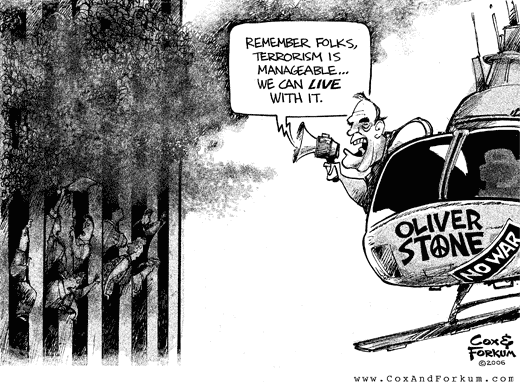 And speaking of Oliver Stone, his own advice that "we" should just learn to live with terrorism is not just well-skewered by the cartoon above, as a colleague of mine said it is also "proof that common sense is something else you can't get out of a Stone."
It's bloody hard getting it out of a Tory as well.
UPDATE: It's an anti-Democrat ad timed for US mid-term elections, but this Madeleine Albright video spoof mocks the same 'let's just be nice' appeasement that Johnson is calling for, and that Madeleine was in her time as Secretary of State all but ready to acquiesce to. See Madeleine sing Kumaya with Jim Jong Il. See her change a flat for Al Qaeda. See it now. "Nice' is not enough.
LINKS: Give Iran the nuclear bomb - Boris Johnson, Gulf News
The only dumb blonde in Westminster village - Daily Torygraph
Boris gaffe as he says 'Give nuclear bomb to Iran' - This London
Stone cold - cartoon by Cox and Forkum
The David Zucker Albright ad - You Tube
RELATED: War, Politics-World, Cartoons
Thursday, 16 March 2006
Who do you look like?
Once again, DPF has come up with a time-waster: a face recognition site that allows you to upload a photo and find out which celebrities you and your friends look like. Oddly, with two photos of myself there was no overlap of names, indicating perhaps that the face recognititon software still needs some work. Anyway, here's what it came up with for me:
The good/interesting:
Vicente Fox (67%)
Patrick Stewart (62%)
Ariel Sharon (62%)
Pedro Almodovar (61%)
Mel Gibson (60%)
The very good:
Andre Breton (71%)
Kevin Spacey (62%)
Ricky Ponting (61%)
The 'You've Got to Be Kidding!':
Boris Trajkovski (68%)
Lyndon B. Johnson (66%)
John Travolta (64%)
Ben Frigging Affleck (62%)
Martin Fucking Sheen (61%)
I'm burning with jealousy that Rodney Hide got Michael Collins, and DPF got Hemingway.
LINK: Face recognition site (requires free registration) [Hat tip DPF]
TAGS: Geek stuff, Quizzes
The good/interesting:
Vicente Fox (67%)
Patrick Stewart (62%)
Ariel Sharon (62%)
Pedro Almodovar (61%)
Mel Gibson (60%)
The very good:
Andre Breton (71%)
Kevin Spacey (62%)
Ricky Ponting (61%)
The 'You've Got to Be Kidding!':
Boris Trajkovski (68%)
Lyndon B. Johnson (66%)
John Travolta (64%)
Ben Frigging Affleck (62%)
Martin Fucking Sheen (61%)
I'm burning with jealousy that Rodney Hide got Michael Collins, and DPF got Hemingway.
LINK: Face recognition site (requires free registration) [Hat tip DPF]
TAGS: Geek stuff, Quizzes
Subscribe to:
Comments (Atom)