Showing posts with label Ban Bans. Show all posts

Thursday, 11 December 2025

So let’s review what Australia’s media ban has actually accomplished here...


"Australia’s social media ban for kids is now in effect. ... And, of course, it’s not working. Kids are always going to figure out ways to get around the ban:
It took 13-year-old Isobel less than five minutes to outsmart Australia’s “world-leading” social media ban for children.

A notification from Snapchat, one of the ten platforms affected, had lit up her screen, warning she’d be booted off when the law kicked in this week – if she couldn’t prove she was over 16.

“I got a photo of my mum, and I stuck it in front of the camera and it just let me through. It said thanks for verifying your age,” Isobel claims. “I’ve heard someone used Beyoncé’s face,” she adds.

“I texted her,” she gestures to her mum Mel, “and I was like, ‘Hey Mummy, I got past the social media ban’ and she was just like, ‘Oh, you monkey’.”
"Or how about this “hack”:
Either way, Adams and her friends don’t plan to go quietly. When one app asked them to submit a selfie for an age verification system, they used a photo of a golden retriever they found on Google.
It worked, she said.
"So let’s review what Australia’s politicians have actually accomplished here: They’ve alienated parents who don’t appreciate the government deciding how to raise their kids. They’ve taught an entire generation of young people that adults don’t trust them and that circumventing authority is both necessary and easy. They’ve cut off legitimate support networks for vulnerable kids while doing nothing about the actual harms that those same kids face. Indeed, they’ve actually pushed kids towards more dangerous places online while making it more difficult for them to learn to use the internet appropriately. And they’ve created a system so trivially easy to bypass that a golden retriever can pass age verification."

Wednesday, 30 November 2022

'Ban this sick filth' ?


"One thing that comes with the territory of being a libertarian is a lifetime of explaining that one can very much not wish to say 'Ban this sick filth,' while still thinking the thing concerned is sick filth."


Friday, 22 July 2022

Sri Lanka Crisis Reveals the Dangers of Green Utopianism


President Rajapaksa’s fertiliser ban wasn't the only factor behind Sri Lanka’s economic crash. But as Chelsea Follett and Malcolm Cochran explain in this guest post it's definitely part of this story -- and a a grim preview of what can result from distorting markets in the name of utopian priorities. 

Sri Lanka Crisis Reveals the Dangers of Green Utopianism

by Chelsea Follett and Malcolm Cochran

Last week, a group of Sri Lankan protestors took a refreshing dip in President Gotabaya Rajapaksa’s pool. It was probably a welcome respite from the steamy eighty-degree day in Colombo, as well from the unprecedented economic crisis currently devastating the country. Over the last year, Sri Lanka has experienced an annual inflation rate of more than 50 percent, with food prices rising 80 percent and transport costs a staggering 128 percent. Faced with fierce protests, the Sri Lankan government declared a state of emergency and deployed troops around the country to maintain order.

On Thursday morning, the New York Times published an episode of The Daily podcast discussing some of the forces behind the collapse. They outlined how years of irresponsible borrowing by the Rajapaksa political dynasty, combined with the damage caused by Covid lockdowns to Sri Lanka’s tourism industry, drained the country’s foreign exchange reserves. Soon, the country was unable to make payments on its debt or import essential goods like food and gasoline. Strangely, the hosts of the podcast, which reaches over 20 million monthly listeners, didn’t mention President Rajapaksa’s infamous fertiliser ban once during the entire thirty-minute episode.

Yet the fertiliser ban was, in fact, a major factor in the unrest. Agriculture is an essential economic sector in Sri Lanka. Around 10 percent of the population works on farms, and fully 70 percent of Sri Lankans are directly or indirectly dependent on agriculture. Tea production is especially important, consistently responsible for over ten percent of Sri Lanka’s export revenue. To support that vital industry, the country -- until recently -- was spending hundreds of millions of dollars every year to import synthetic fertilisers. But that was "until recently."

Because during his election campaign in 2019, Rajapaksa promised to wean the country off these fertilisers with what he said would be a ten-year transition to organic farming. He expedited his plan in April 2021 with a sudden ban on synthetic fertilisers and pesticides. He was so confident in his policies that he declared in a (since stealthily deleted and memory-holed) article for the World Economic Forum in 2018, “This is how I will make my country rich again by 2025.” It didn't. As the eco-modernist author Michael Shellenberger writes, the results of the experiment with primitive agricultural techniques were “shocking:”
Over 90 percent of Sri Lanka’s farmers had used chemical fertilisers before they were banned. After they were banned, an astonishing 85 percent experienced crop losses. Rice production fell 20 percent and prices skyrocketed 50 percent in just six months. Sri Lanka had to import $450 million worth of rice despite having been self-sufficient just months earlier. The price of carrots and tomatoes rose fivefold. … [Tea exports crashed] 18 percent between November 2021 and February 2022 — reaching their lowest level in more than two decades.
Of course, Rajapaksa’s foolish policy wasn’t revealed to him in a dream. As Shellenberger points out, the ban was inspired by an increasingly Malthusian environmentalism led by figures like the Indian activist Vandana Shiva, who cheered the ban last summer. Foreign investors beholden to the same ideology also praised and rewarded Sri Lanka for “taking up sustainability and ESG (environmental, social and corporate governance) issues on its top priority.” ESG represents a trend (or lasting shift, depending on who you ask) in some investors’ priorities. Put simply, it is an attempt to move capital toward organisations that further a set of amorphous environmental and social justice goals instead of toward the enterprises most likely to succeed and turn a profit.

Proponents of ESG have been pushing for government mandates requiring enterprises to disclose detailed information related to environmentalism and other social goals. That distorts and harms the smooth functioning of the capital markets that keep modern economies running and, in some cases, incentivises nice-sounding but economically inefficient projects, like a return to primitive agriculture. “The nation of Sri Lanka has an almost perfect ESG rating of 98.1 on a scale of 100,” notes David Blackmon in Forbes, and “the government which had forced the nation to achieve that virtue-signaling target in recent years [has as a result] collapsed.” 

Sri Lanka, in other words, offers a grim preview of what can result from distorting markets in the name of utopian priorities.

Consider a long-run perspective. Throughout most of human history, farmers produced only organic food—and food was so scarce that, despite the much lower population in the past, malnutrition was widespread. The long-term, global decline in undernourishment is one of humanity’s proudest achievements. Lacking any sense of history and taking abundant food for granted however, some environmentalists want to transform the global food system into an organic model. They see modern agriculture as environmentally harmful and would like to see a transition to natural fertilisers that would be familiar to our distant ancestors, such as compost and manure.

However, conventional farming is not only necessary to produce a sufficient amount of food to feed humanity (a point that cannot be emphasized enough—as the writer Alfred Henry Lewis once observed, “There are only nine meals between mankind and anarchy”) but in many ways it is also better for the environment. According to a massive meta-analysis by the ecologists Michael Clark and David Tilman, the natural fertilisers used in organic agriculture actually lead to more pollution than conventional synthetic products.This is partly because fertilisers and pesticides also allow farmers to farm their land more intensively, leading to ever-higher crop yields, which allows them to grow more food on less land. According to HumanProgress board member Matt Ridley, if we tried to feed the world with the organic yields of 1960, we would have to farm twice as much land as we do today. 


Despite successfully feeding more people than every before, the amount of land used globally for agricultural has peaked and is now in decline. So long as crop yields continue to increase, more and more land can be returned to natural ecosystems, which are far more biodiverse than any farm. Smart agriculture allows nature to rebound.

In wealthy countries, conventional farming is becoming ever-more efficient, using fewer inputs to grow more food. In the United States, despite a 44 percent increase in food production since 1981, fertiliser use barely increased at all, and pesticide use fell by 18 percent. As the esteemed Rockefeller University environmental scientist Jesse Ausubel noted, if farmers everywhere adopted the modern and efficient techniques of U.S. farmers, “an area the size of India or the USA east of the Mississippi could be released globally from agriculture.”

Most importantly, it must be re-stated, conventional agriculture feeds the world. Since the Green Revolution of the 1950s and 60s, world agricultural production has exploded, causing the per-capita global food supply to rise from barely over over 2,000 kcal per day in 1961, to reach nearly 3,000 in 2017. And this even as the world population itself exploded. While hunger is now making a comeback, that is not any lack of the ability to produce enough food -- it is wholly due to war, export restrictions, and the misguided policies of leaders like Rajapaksa his environmental (and "ethical investment") mentors.


To be sure, the fertiliser ban itself was not the only factor behind Sri Lanka’s economic crash. Much of the damage was also caused by the hastiness of the ban, and the difficulty of obtaining enough organic alternatives. However, the idea that organic farming can produce enough food for the world is an unreachable fantasy based on the naturalistic fallacy — the baseless notion that anything modern, such as agriculture incorporating non-natural components produced by the ingenuity of man, must be inferior to the all-natural precursor.

As Ted Nordhaus and Saloni Shah from the Breakthrough Institute point out, “there is literally no example of a major agriculture-producing nation successfully transitioning to fully organic or agroecological production.” We must never take the relative rarity of starvation in modern times as a given, nor romanticise and seek to return to farming’s all-organic past. Unfortunately, the delusion seems to be spreading, helped along by the global shift toward ESG. Last Sunday, Narendra Modi, the prime minister of India, praised “natural farming” during a speech in Gujarat, calling it a way to “serve mother earth” and promising that India will “move forward on the path of natural farming.” 

Let’s hope not.

* * * * * 

Chelsea Follett
Chelsea Follet works at the Cato Institute as a Researcher and Managing Editor of HumanProgress.org.


Malcolm Cochran
Malcolm Cochran is a research associate at HumanProgress.org.

Their Human Progress article also appeared at the Foundation of Economic Education.

Thursday, 13 December 2018

Quote of the Day: On Neo-Puritanism and "Meddlesome Preferences"


"[There may be] an implicit recognition by all parties ... that, although each may have preferences over the others' behaviour, any attempt to impose one person's preferences on the behaviour of another must be predicted to set off reciprocal attempt to have one's own behaviour constrained in a like fashion. An attitude of 'live and let live, ' or mutual tolerance and mutual respect, may be better for all of us, despite the occasional deviance from ordinary standards of common decency. 
    “Such an attitude would seem to be that of anyone who claimed to hold to democratic and individualistic values, in which each person's preferences are held to account equally with those of others. By contrast, the genuine elitist, who somehow thinks that his or her own preferences are ‘superior to,’ ‘better than, ‘ or ‘more correct’ than those of others, will, of course, try to control the behaviour of everyone else, while holding fast to his or her own liberty to do as he or she pleases.” 
        ~ James Buchanan, from his essay on 'Politics & Meddlesome Preferences'

[Hat tip Jim Rose]
.

Wednesday, 2 November 2016

100 celebrities are wrong. Save the elephants ... by owning them


100 “leading” conservationists, politicians, and celebrities just addressed an open letter to the UK government begging for a ban on ivory trade. If they wanted a better way to produce an Al Capone of the ivory trade, argues Bill Wirtz in this guest post, they couldn’t do better. [Your editor apologises in advance for the frequent use of the word ‘incentivise.’ – Ed.]

100 leading conservationists, politicians, and celebrities addressed an open letter to Theresa May’s Government asking for a ban on ivory trade. They want the UK to become a “global leader” on the prohibition of wildlife trade and help combat African poaching groups. Since we know how beneficial prohibition is for criminal gangs, the only group rejoicing over this leap forward will be the poachers themselves.

ivory1The alternative lies in the private sector.

Were I presented with the opportunity to become the Al Capone of the ivory trade, however, never would the temptation be as strong as now. Governments are immensely successful at making products under prohibition enormously valuable. As Milton Friedman said regarding drug prohibition:

If you look at the drug war from a purely economic point of view, the role of the government is to protect the drug cartel. That's literally true.

Every time there is a major call for an outright ban on ivory products, prices skyrocket, which ends up incentivising poachers to shoot more elephants. This has created a sort of cat-and-mouse game in which the volatility of ivory pricing is interdependent with outcries by NGOs. When the Chinese ivory prices tripled in 2015 due solely to increased calls for bans, wildlife NGOs said that the market was out of control and that "there is need for immediate action." There was no change in legislation, and yet when the public call for bans subsided and Chinese prices fell back to their original level five months later, the same NGOs claimed their work to be going in the right direction!

Conservation from Private Property

If we want to talk about the preservation of endangered species such as elephants, then let's not engage polemic assertions destined to sell a newspaper or get donations shipped in. Some African countries have taken action regarding poaching: the privatisation of elephants is provably effective.

Let's take the example of trophy hunting.

Unpopular it may be among the twitterati, but this hunting sport has gotten increasingly popular over the years. As National Geographic reported, these hunters imported more than 1.26 million trophies to the United States between the years 2005 and 2014, which is an average of 126,000 trophy imports a year, or 345 every single day.

Trophy hunting, however, is not the reason these species are endangered in the first place. They suffer considerably more from loss of habitat and poaching. In the case of loss of habitat, the endangered animals are driven out due to agricultural expansion for the harvesting of timber, wood, or fuel.

Ivory2The local population can be incentivised economically to protect these animals. In Namibia, the revenue from trophy hunting is the main revenue source for the funding of wildlife conservancies, and in South Africa, trophy hunting reportedly incentivised locals to give rhinoceros land to live on that protected them from poachers (Conservation Magazine, 2015). This evolution has led the number of existing rhinoceros to jump from 100 in 1916 to over 18,000 today (World Wildlife Fund, 2016). According to South Africa’s Department of Environmental Affairs, the total revenue from trophy hunting was close to R807 million (59.3 USD) in 2012 and just over R1 billion (73.5 USD) in 2013.

Elephants are victims of the tragedy of the commons: poachers maximising profits from the commons results in them shooting as many animals as possible before they’re all gone. The best protective measure in response is private property rights through the rule of law. If elephants possess a certain utility, notably harvesting ivory, then we should prefer they were owned privately, since their owners would be incentivised to protect them.

No ban on the international trade of a good could ever do the same.


Bill Wirtz studies French Law at the University of Lorraine in Nancy, France.
He blogs at Wirtz Bill, where this post first appeared (and subsequently at FEE.)

. 

.

Thursday, 20 August 2015

So let’s talk about passive smoking

Over the last decade, Nanny State and her anti-smoking hysterics have shut down bars, dissuaded drinkers from clubs, sent office workers out into the cold, and generally made lepers out of smokers in places of private property – and all on the basis of, it was said, the evidence that passive smoking causes cancer.

Well, guess what…

Passive smoking doesn’t give you lung cancer. So says a 2013 report publicised by the American Cancer Institute which will come as no surprise whatsoever to anyone with a shred of integrity who has looked into the origins of the great “environmental tobacco smoke” meme.

It was, after all, a decade ago that the British Medical Journal, published the results of a massive, long-term survey into the effects of second-hand tobacco smoke. Between 1959 and 1989 two American researchers named James Enstrom and Geoffrey Kabat surveyed no few than 118,094 Californians. Fierce anti-smoking campaigners themselves, they began the research because they wanted to prove once and for all what a pernicious, socially damaging habit smoking was. Their research was initiated by the American Cancer Society and supported by the anti-smoking Tobacco Related Disease Research Program.

At least it was at first. But then something rather embarrassing happened. Much to their surprise, Kabat and Enstrom discovered that exposure to environmental tobacco smoke (i.e., passive smoking), no matter how intense or prolonged, creates no significantly increased risk of heart disease or lung cancer.

Let’s say that again: exposure to environmental tobacco smoke (i.e., passive smoking), no matter how intense or prolonged, creates no significantly increased risk of heart disease or lung cancer.

Similar conclusions were reached by the World Health Organisation which concluded in 1998 after a seven-year study that the correlation between “passive smoking” and lung cancer was not “statistically significant.” A 2002 report by the Greater London Assembly agreed. So too did an investigation by the House of Lords Economic Affairs Committee.

Yet between 2006 and 2007 smoking was banned in all enclosed public places throughout the United Kingdom largely on the basis of the claim – widely promulgated by bansturbating politicians and kill-joy activists – that it was necessary to protect the health of non-smokers. On the basis, in other words, of a blatant and scientifically demonstrable lie.

It’s not just British health Nazis who like to promulgate this myth. Here’s what America’s Centers for Disease Control and Prevention has to say on the subject: “Secondhand smoke causes an estimated 3,400 lung cancer deaths among U.S. nonsmokers each year.”

The actual number, Jacob Sullum argues at Reason (on the back of a this article in the Journal of the National Cancer Institute,, is “probably closer to zero.”

The actual number is “probably closer to zero.” The article is titled "No Clear Link Between Passive Smoking and Lung Cancer."

So why does the medical establishment pretend otherwise? Sullum quotes a doctor who comments on the latest study’s findings. The doctor observes primly:

“The strongest reason to avoid passive cigarette smoke is to change societal behaviour: to not live in a society where smoking is a norm.”

Aha. Now we’re closer to the mark. What the doctor is showing here are the classic symptoms of “freedom of choice is far too dangerous for the little people” syndrome.

Was the smoking ban a good idea? Arguably, in some ways. It means that when you come home from a crowded gig or club, now, your hair and clothes no longer smell of stale smoke; it forces smokers to smoke less than they might otherwise have done because nipping outside for a fag is so inconvenient.

Against that, though, you have to set the enormous damage which has been done to the pub industry – and indeed to the atmosphere within pubs and clubs. More worrying still, though, is the ugly precedent it has set for the arbitrary confiscation by the State of property rights.

It should have been left up to individual institutions – private members clubs especially, but pubs and restaurants too – whether or not they wished to allow smoking on their premises. Punters would then have been free to choose whether or not they wished, on any given evening, to sacrifice their unalienable right not to be exposed to other people’s deadly tobacco smoke.

That is how free societies work. Free people make free choices.

In 2006 and 2007 in Britain – and at various other dates in other countries around the world – the forces of authoritarian government took away those rights. On the basis of a massive lie.

On the basis of a massive lie. But when does Nanny State ever admit she’s wrong?

Instead, she’s now doubling down: on e-cigarettes.

Because Nanny never sleeps.

[Hat tip Catallaxy Files. Cartoon from Sott.net]

Wednesday, 23 November 2011

The Greens are “moderate”?

The Greens are said to be looking “moderate.” Really? Here’s some uncomfortable unbreaking news about the Greens.

Friday, 1 July 2011

Some propositions on free speech

Since the country’s going insane over the so-called “death of free speech” because of folk boycotting an opportunistic book by a peddler of cherry-picking innuendo* (indeed, it was the cherry-picker himself who called the boycott the “death of free speech”) let’s examine again some basic propositions of free speech, just so we know what the animal looks like:

Some propositions on free speech

The right to free speech means the right to express one's ideas without danger of coercion, of physical suppression or of interference by the state. 
Censorship is interference by the state in the expression of ideas. (And laws against murder, rape, assault and child sex are sufficient to cover any violation of rights in the censor's current domain.)
A private network refusing to publish your views or a bookshop deciding not to sell your pamphleted screed is not censorship - it is their choice. (Remember choice?)
A private network choosing to offend is their business. Choosing not to watch or to withdraw advertising is yours.
Bad ideas are still ideas. You should be just as free to air them as I should be to ignore them, or to pillory them, ore to refuse to give them a home.
Just as the right to pursue happiness doesn't require that you be made happy, the principle of free speech doesn't demand that anyone provide you with a platform and a microphone.
Just as the right to do what I like with my health and my life does not mean that I have to smoke cannabis, neither does the right to free speech mean I must offend. Just as I must take responsibility for what I do with my health and my life, so too must I take responsibility for what I say.
I may choose to offend, and I have the right to, but free speech doesn't mean I have to. However, anyone able to épater le bourgeosie has always been able to count on free publicity from those being épater-ed. Drawing attention to something you dislike may give that which you dislike even more attention. Think about it.
By itself, "I'm offended," is not an argument. It's just a whine.
Saying you don't like 'South Park' is not a call for censorship. Saying you want it banned would be. Saying "I don't like that," is not censorship.
Organising a voluntary boycott is not censorship. Organising a government ban however would be.
I may be offended, but I may not commit violence against those who offend me. I may boycott, but I may not behead.
Blocking traffic, threats, and forced entry are no part of the right to protest. They are respectively a traffic hazard, an initiation of force and an act of trespass.
"Hate speech" is an illegitimate package deal. Laws against "hate speech" are illegitimate. Laws against conspiracy to commit murder are not.
The right to free speech gives the smallest minority the absolute protection of the state to air their views. The smallest minority is the individual.
My freedom ends where your nose begins. My free speech ends where your rights begin. The right to free speech does not mean that I may incorrectly besmirch your reputation by telling lies about you. This would be called fraud. Nor does it mean you may shout "fire" in a crowded theatre in which there is none, and in which the exit doors have been locked. This would be called fraud with menaces.
Speech is speech, not violent destruction.
Ridicule is better than bans.
Moral persuasion is better than force.
When tyranny occurs, it can be challenged from a thousand presses - but only if free speech and a free press has been valued in the interim; tyranny can never be easily challenged in the absence of the freedom to speak out.
Free speech has been more valued in the abstract than in reality.
"Freedom but..." is not freedom.
Forcing ideas underground does not eradicate them, it incubates them. Bad ideas are anaerobic -- the oxygen of free inquiry kills them. Bad ideas can only be fought with better ones.
If you don't like it, then just turn it off.  Don't get an arm of the state to do it for you.

_ _ _ _ _ _  _

* No, there’s no more need to read this book than any other of the blowhard’s books. Like his Inwhishtigate magazine, they all follow the same pattern of carefully chosen facts, selected out of context and smothered in oodles of innuendo. Why would you read this one? You’ve read one, you’ve read them all.

Thursday, 30 June 2011

QUOTE OF THE DAY: On RWC Bans [updated]

Just for the record, folks, it’s not a ban if the public boycotts another work of fiction by a blowhard. But it would be a ban if the govt decided to outlaw it. Alright? Great.  Just wanted to clear that up.

Because while the whole country gets itself all in a lather about a non-ban on a boorish book, the government continues to pass laws, without opposition, that will impose an actual ban on economic activity around or anywhere near a sporting event.

Latest result of them over-reaching themselves: no-fly zones, no-sign zones, a battalion of jackbooted clipboard wielders warming up to fan out around the country to say “No!” … and now a  New Plymouth school offside with the govt's Rugby World Cup laws because they want to do the same thing they’ve done for every major rugby event at Yarrow Stadium  since time began, which is park a few cars on its sports field to raise a bit of dosh for the school.

What insanity.

I loved this quote by friend Daniel Bell on a Facebook thread discussing this:

It's quite silly really. The tournament is running at a loss, pretty much everyone has admitted this now, but the original reason the Government decided to do this was apparently because of the economic benefits it would provide, yet now they're passing laws saying you can't benefit economically from the Rugby World Cup.

We really are a pathetic authoritarian backwater.

In fact (with that first paragraph in mind) make that a pathetic and confused authoritarian backwater.

Wish hard.

UPDATE: See, it’s not difficult to understand: A boycott is not a ban.

Monday, 2 November 2009

Busybodies, One, Two, Three

There were busybodies all over the place over the weekend.  Busybodies making sure that you didn’t smoke in bars, drink alcohol in public places and – most importantly! – that you didn’t talk into your phone while your car was moving or while "stationary in the normal flow of traffic, such as approaching intersections, traffic lights or roadworks."

This was important work – or so all the busybodies seemed to think.  Didn’t matter if you were eating while driving, or putting on your make up, or playing with the radio or you iPod – just as long as you weren’t talking to someone on that little electronic device we call a phone.

Bloody busybodies. They’re everywhere.

But I have a confession to make. I'm a busybody myself.

Yes, I’m a busybody. There, I've said it.  You'll notice that I frequently tell off busybodies for their bossiness, but the perceptive among you have noticed I'm one myself.

I have strong opinions and I don’t care who knows it.

I think taxation is theft.  That a government big enough to give you everything you want is big enough to take it all away again. That where liberty is concerned, “moderation” is suicide. That the point of liberty is to make the world safe for reason.

I hold these opinions strongly and, like all busybodies, I think my opinions should be yours too.  And if you don’t like those opinions, I have others.

I think it's wrong to listen to rap and techno.  I think smoking cigarettes in company is impolite and consuming recreational pharmaceuticals is dumb – but I think it’s your right to do that if you choose to.  

I endorse teaching youngsters phonetics, admiring figurative painting and sculpture, and building homes following the principles of organic architecture. I think you should listen to Wagner and Duke Ellington, refrain from eating meat, and avoid bad beer altogether. I think you should follow Australian Football and support Geelong, read Ayn Rand, Raymond Chandler and Umberto Eco, and drink martinis under a starry sky while filing your subscriptions to The Free Radical and the MG Car Club and your membership in the Libertarianz.

Like Sue Kedgley and Steven Joyce and the nannies in ASH and and ALAC I'm opinionated and bossy, and I don't care who knows it.  There is one small point of difference, however.  The main point is, the little question of persuasion.  Of persuasion as opposed to force.

There are two kinds of  busybodies, you see: those who want to persuade you that you're wrong and they're right (that's me, and I am), and those who want to force you.  Those who appeal to reason to demonstrate the superiority of their ideas, and those who resort to the big stick.

Doesn't matter who's right in that end, since even if you're right and they're wrong there's nothing you can do once Nanny's stick comes out.

You who never understand the difference between persuading someone to do your bidding, and coercing them never truly understand or respect the crucial difference between treating someone as a slave and respecting them as a a free man.

Using persuasion rather than coercion is the recognition that human beings are sovereign individuals, with the right to make their own choices, and to commit their own mistakes. Using force takes their choices away.

One appeals to the human mind, to human reason. The other treats people as a subject, as a serf, as a mindless chattel.

The truth is this: That just because you feel strongly about something that gives you no right to impose your feelings upon others who may in no wise agree with you.

A new law is not persuasion. No matter how many other MPs you can persuade, the effect of that law is the assembling of the vast might of legislative, judicial and police powers to enforce this thing about which you feel so strongly. That's force. That's coercion.

Talking about bringing in a ban is not persuasion, it is not a "national debate we should be having." It’s simply the first act in a three-act drama of bullying to come.

I say think twice before reaching for a ban, or calling for a legislative smack around people’s head.

If smacking is bad because it uses force against children, as some people have argued, then why isn't force bad when it's used against adults (who -- unlike children -- do have the full power of reason).

If date rape is bad because it takes away a woman's right to refuse consent (and so it does), then so too is every form of coercion in that it too takes away the power of consent.

In his seminal essay on Persuasion Versus Force Mark Skousen argues, "The triumph of persuasion over force is the sign of a civilised society." And so it is. What's wrong with persuading people, rather than using force? What’s wrong with reasoning with them instead of reaching for the big stick.  Isn't that -- or shouldn't that be -- the mark of a truly civilised society? If you look for symbolism, you might think of it as reason against brute force, or the mind versus the gun.

Isn’t it more civilised to appeal to what’s in someone’s mind by reason, than to reach for a gun to refuse that mind permission to think?  As Ayn Rand sais, “Force and mind are opposites; morality ends where a gun begins.”

How about we ban bans, and think about being civilised instead.

Freedom means the freedom to make mistakes.  It means leaving people free to make their own mistakes – to listen to rap and country music; to read Danielle Steel and Dan Brown; to smoke like a trooper and talk and text on their cellphones.

As Sir James Russell Lowell said, "the ultimate result of protecting fools from their folly is to fill the planet full of fools."

As the man says, if it makes sense, then they wouldn't have to force you.
Tuesday, 22 September 2009

GUEST POST: “No Blacks - No Dogs - No Mokos!”

Susan’s busy this week, so coming off the bench today as a replacement we have Suzuki Samurai with a little something to offend everyone.
NoBlacks Imagine the consternation, wailing, and gnashing of teeth a sign like this on the right would cause these days.
Geez, just look at the hullabaloo over the moko’d guy that was refused entry to a Christchurch bar. Have New Zealanders become more pathetic over the years? - so sensitive that adults, at the first sign of hurt feelings, run off to tell on each other to the media, or Fair Go . . . or their mums?
What’s happened  over the years is that, bit by bit, there’s been a corruption of what we understand by “individual rights.” At every turn we’ve seen a cultural shift towards becoming a nation of grizzlers demanding a “right” to everything from everyone else – towards an “entitlement” culture – towards the idea that everyone is owed a living at the expense of everyone else.  There is no such right. There is no such entitlement. This moko nothingness is all about the so-called right to not be offended, the so-called right to enter private property uninvited – regardless of the reasons you’ve been locked out. To make it easy for you (i.e. without having to go into a thesis on why no such rights exist), just think about the consequences of taking these rights to their natural conclusion – a place in which everyone is legally obliged to what every anyone else insists they do.
Is that the New Zealand you want to live in?
Now, no doubt you’ll be saying, “...but banning people from places, or not giving someone a job because of an aversion to someone’s race, age, religious persuasion, culture, gayness, choice of T-shirt is wrong, and should be illegal”. While I agree that most of these phobias are irrational, that doesn’t mean that holding these phobias should be illegal. Why not? – because phobias are ideas, not force; and therefore constitute nothing but a state of mind.
How do you make a state of mind illegal while holding to the values of the right to free expression & free speech? You can’t! While you may disapprove of someone else’s ideas – regardless of how awful those ideas are – that someone has a right to be wrong; your only right is to persuade them of their error or stay the hell away from them – that’s it, nothing else!
The point of law protecting free speech is simply to make the world safe for reason and rationality. It doesn’t guarantee that you’ll find it under rock you overturn.
Which leaves us with some pretty clear conclusions. That the property owner in Christchurch who’s been made the fall guy here is, as I said, quite rightly at liberty to decide who he serves in his bar.  That the moko’d one in question is quite at liberty to go somewhere else. That, in that way, everyone keeps their real rights intact. And that, if the Human Rights Commission were to penalise this bar owner, then that in itself would be a breach of free speech and free expression – and as such the only thing here that must be banned.
Freedom to be irrational. If you want to be free to be reasonable, then you have to expect some nonsense to be legal as well.  So get over it.


Monday, 3 August 2009

Debagging Green bullying

05_538_01_gross Since it’s been a few days since the control freaks at the Greens have called for a ban, a restriction, or just another way to boss us all around – last week it was bans on fishing, imports and foreign investment – this morning’s call for a mandatory charge on supermarkets’ plastic bags (effectively a new tax on supermarket shoppers) is already a few hours overdue.  As Sus says, Wussel Norman’s insistence that the government must force all supermarkets to emulate “New World's silly decision to impose a 5c charge on every plastic bag is just more force from New Zealand's most violent party. More fascism from self-professed peaceniks. More blanket contempt for everybody from these we-know-best control freaks.”  More force from “peaceniks” who’ve never understood the difference between persuasion and force.

Have you understood the real message of the Greens yet? it’s not peace, love and non-violent macrame pot-holders – and it’s certainly not “the environment.”  It’s bans, bullying and the “soft fascism” of government force.

Give ‘em up.

Monday, 13 October 2008

Nick Smith at your Xmas table

NZ's Environmental Risk Management Authority -- the crowd National's Nick Smith's wants to make into an even bigger bureaucracy called the Environmental Protection Agency -- has just sent out a memo "reminding importers that under the Hazardous Substances and New Organisms Act, Christmas crackers are covered by the definition of, and controls on, the importation of fireworks."

    As such Christmas crackers require a completed Certificate to Import Explosives from Erma (the Environmental Risk Management Authority) New Zealand before they may be imported into New Zealand,” the circular states.
   
It is estimated that only approximately 60 percent of Christmas crackers being imported into the country obtain the required certificates.

So that means no Christmas crackers this Christmas, just like there's no decent fireworks on fireworks night.  And it also means that this summer you'll have Helen Clark in your shower, Jeanette Fitzsimons changing your lightbulbs, and now Nick Smith sitting at your Xmas table holding a wet blanket.

That's a pretty foul trifecta.

Friday, 5 September 2008

More, please.

Speaking of things that should be banned on publicly "owned" footpaths, as some people have been, there are politicians about who'd like to ban this:

                                                    girlskissing
The fools.

What say we make a concerted effort instead to make bans unfashionable?  Who's with me here?  Let's Ban Bans!

If you don't like something someone's doing, what's wrong with persuasion for goodness' sake.

Tuesday, 26 August 2008

Why we have no power

You'll surely be aware by now that New Zealand is short of electrical power -- and if a winter in which businesses had to shut down for lack of power doesn't convince you, then nothing will. And you'll surely have noticed that for years now, environmentalists have opposed all new power stations, and insisted that "we" should instead be using "renewable" energy, and you'll have observed that now the government has effectively banned the construction of new thermal power stations, the environmentalists have succeeded in forcing us to rely upon their favourite means of power production. Yet something's clearly going on here that needs explaining, since every time new "renewable" projects to produce real power are proposed, those same environmentalists have opposed them.

The latest example is on a tributary of the Buller River on the West Coast, the Mokihinui, where environmentalists are now gearing up to fight a hydro scheme proposed by Meridian - gearing up to oppose it with the same ferocity they opposed Meridian's 'Project Aqua' hydro scheme for the Waitaki. Hydro, say local environmentalists, "is an outmoded concept."

So hydro is now out too, it seems, which means no hydro and no thermal -- which between them presently account for over ninety percent of New Zealand's increasingly enfeebled energy generation.

So what's left? By what means then does one produce the power that is an indispensable component of everything we do in our lives? Geothermal is too feeble (and even with new projects proposed would represent barely five percent of our current power demand), and meanwhile wind farms like Project Hayes have also been deemed unacceptable to environmentalists (too damaging to the landscape, they say); tidal power stations, like Crest Energy's proposed tidal power station in the Kaipara, are about to be deemed unacceptable (too damaging to the dolphins and to the mauri of the harbour); hydro dams like the Mokihinui are now "outmoded" (too damaging to the eels); and, it should be noted, even in places where solar energy is viable, like California's Mojave Desert, environmentalists are opposing that too.

The point to take here is that environmentalists will be gearing up for a fight whatever the means by which a power station is to be powered, whether it's thermal or 'renewable' or whatever -- their opposition is all too obviously to human power as such. As Project Hayes protestor Brian Turner put it,"Our economy should be required to serve the natural environment, not the other way round. Everything we do should be in accord with that rule... We've long been too big for our boots [continues Turner]. Which is what Eugenio Montale, the Nobel prize-winning poet, meant when he wrote:

Twilight began when man thought
himself of greater dignity than moles or crickets."

Take a moment to note the sentiment -- this is an environmentalism that puts "moles or crickets" ahead of human beings -- and another moment to reflect that this environmentalism is now mainstream.

We're now seeing some of the results of that "we're too big for our boots" environmentalism.

The protest in the Mojave Desert over solar power finally got even the Governator exasperated."If we cannot put solar power plants in the Mojave desert," said California governor Arnold Schwarzenegger, "I don't know where the hell we can put it."

But, says Keith Lockitch at the Ayn Rand Institute, that's the whole point. "This just shows the true objective of green activism. Environmentalists don't actually want us to find alternative ways of producing energy; they want us to stop using energy altogether.

The basic premise of environmentalism is to leave nature alone. Capturing and utilizing any source of energy--even ones that are supposedly green and renewable--will necessarily have some impact on nature, and will therefore inevitably be subject to environmentalist attacks and condemnation.
Since the use of energy is an indispensable component of everything we do in our lives, the greens' opposition to even such ridiculous, impractical sources of energy as solar and wind reveals their basic animus against human life.
On green philosophy, there is literally no place on earth for mankind.

Readers should draw the necessary lesson here. You must realise that human modification of the environment is the means by which human beings survive and flourish. The only means. And you must understand that when environmentalists say they're opposed to human modification of the environment they mean it.

What's needed, as I've said several times before, is a stake through the heart of the Resource Management Act [pdf] (which gives anti-human environmentalism so much house-room and so much legal power by which to obstruct development), and above all a new environmentalism that puts humans first, above moles and crickets and snails -- one that recognises we should be exactly as big for our boots as we need to be.

Sunday, 24 August 2008

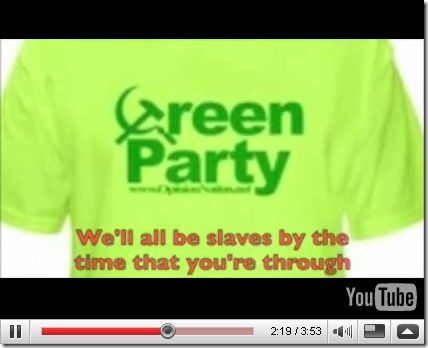
Do NOT watch this!

Please, I beg you, do not watch this video linked to below. Please do not click the link, and do not whatever you do head to LIBZ TV to watch it -- and even if you did head there and play the YOU TUBE video, then definitely do not open it full screen to make sure you can read all of the subtitles.

Ban_It

In fact, if you're an MP or member of the Green Party, then I implore you to ban it -- just like you try to ban everything that brings joy or walks tall in favour of everything that slithers.

"Ban." It's your favourite word, you know. Over recent years you've wanted to ban (and in many cases have succeeded in having banned) grape imports, alcohol ads, political speech for one year in three, ferrets, TV ads for kids, ads on TVNZ, growth hormones, native wood chip exports, native logging, pig swill, xenotransplantion trials, smacking, GE, field trials for GE, chemical trespass, property rights from the Bill of Rights, quick-fire logging, logging, fishing for toothfish, commercial fishing over much of New Zealand, whaling, 'toxic timber,' set-netting, bottom trawling, feeding animal remains to farm animals, battery cages, CCA-treated timber in playgrounds, direct-to-consumer advertising of drugs, crisps and meat pies from tuck shops, "the screening of programmes which sensationalise violence or use violence," "the routine feeding of antibiotics to healthy animals," GE maize, commercial releases of genetically engineered crops, "nuclear shipments from New Zealand's exclusive economic zone," sow crates, the dry sow stall, "weapons of mass destruction," the tooth fairy, nuclear powered vessels in our waters, beef imports from Britain to other European countries, "Japanese fishing boats from New Zealand waters," "the importation of all timber and timber products not certified as sustainable," "unsustainable" biofuels, open-cast mining, driven-shaft, gold mining, coal mining, mining, human cloning, sheep cloning, food irradiation, spray drift, all ships carrying nuclear weapons, wastes and fuel from the European Economic Zone, "backyard burning of rubbish such as plastics and treated timber," fireworks, "smoking in all workplaces including bars, restaurants and offices," "new uses of coal for energy," existing uses of coal of energy, new thermal power stations, "factory farming," dairy farming around Lake Taupo, dairy farming around Rotorua lakes, dairy farming in the Waikato river basin, "project-based approvals for the development of GE organisms," "all further building of prisons," free trade with China, junk food advertising to children, "the sale and long-term lease of New Zealand property to foreign investors," "the sale of toy tobacco products to under 18s," GM wheat, "environmentally destructive fishing methods," "uranium shipments," "the use of the antibiotic avoparcin in animal feed," "imports of cars older than 7 years," amalgam use in dentistry, the incineration of unsorted waste, unsorted waste, waste, "risky anti-depressants," "import of tissue for sheep cloning," 'trade in hazardous wastes," "'super baby' selection," plastic shopping bags, shopping bags, shopping, live sheep exports, and dihydrogen monoxide.

I'm sure you'll agree that it's a fair old list. If compiling it takes some effort, and I can assure you it did, then you might expect us to understand just how much single-minded dedication it must take to promote all that prohibition.

For all that you folks from the Green Party accuse every Tom, Dick & Harry of 'Greenwash' -- that is, "advertising, PR or spin that presents a government, company or its products as more environmentally friendly than is true" -- it's clearly you yourselves, every Russel, Sue and Keith of you, who are most guilty of Greenwash.

You see, as the leading interests of all your leading political candidates clearly indicate, you're barely environmentalists at all. You're not the light, fluffy green that your candle-worshipping and Morris dancing would indicate, you're the very deepest red, and you have been ever since you quietly and slowly took over from the hippies and stoners and reinserted the mantras of Mao and Trotsky into activists' heads.

So please, don't watch the video. Just ban it.

UPDATE 1: "Does this mean the Greens should review their policy of improving our environment by implementing a totalitarian dictatorship?" asks Psycho Milt at No Minister. "No worries there," he says, "since they don't have one."

Meanwhile, as if to prove Milt wrong, a desperate Greens leader Russel 'rustle' Norman trying to keep his his party's head above the five percent line is trying to calve off some floating NZ First voters with the unveiling of his party's latest ban: a ban on foreigners from buying property. Callum McPetrie tells you all you need to know about that.

Wednesday, 20 August 2008

Greens' Fitzsimons favours toxic poison drop

WHILE THAMES RESIDENTS PROTEST against the Department of Conservation's 1080 aerial drop in the Coromandel Ranges, dropping the toxic poison over 13,000 hectares from Jeanette Fitzsimons bit of “green heaven" in the Kauaeranga Valley all the way up to Te Puru, the clean, Green Party Leader pleads in today's Hauraki Herald for “tolerance.” “She did not know anyone who was comfortable with poison being dropped from the air," the local paper reports, "However, 1080 was necessary to ‘hold the line’ until a more effective pest control method was developed."

If recent polls can be trusted, Fitzsimon's party will experience a rather effective pest control method come November.  But it does seem strange to see the Green leader plead for tolerance for toxins, when opposition to toxins and the like was once the Greens' raison d'être.

Perhaps when the toxins are delivered by Nanny it's okay?

But why should hunters and land-owners have to be tolerant of a poor decision made by government without any reference to those directly affected?

Fact is, DoC's use of 1080 has been intensely destructive to everything but possums, on which it has only just held the line.  After many years and over a billion of tax payers dollars spent on possum control we still have the same 70 million possums we had at the start. Not successful and of very little, if any, benefit. 

No wonder DoC staff joke that the best way to protect the kiwi is to give it them to exterminate.

The so called possum problem is largely a manufactured one by the Government agencies who stand to gain from perpetrating it. DoC claims that the 70 million possums in New Zealand eat about 300 grams each of foliage each day, resulting in a whopping 21,000 tonnes of vegetation being consumed daily.

What they do not tell us though is the forests of this country produce about 300,000 tonnes of new vegetation daily

The economics do not make any sense either. The New Zealand Conservancy Authority states that the economic costs attributable to possums is estimated to be between $40 million and $60 million per year. Yet over $130 million is spent each year by State, private individuals and businesses on control. Not much benefit in something that uneconomic, or in the costs to game hunters and food gatherers who face a stand-down time of 6 months or more, and the considerable risk of contaminated meat, and the considerable costs to farmers directly and indirectly of aerial spreading of such a toxic poison on and near their properties --including in some cases whole farms -- with no compensation for their loss.

There are three main limits to possum populations in any given area; in decreasing order these are dry nest sites, food supply and (to a much lesser extent) play areas. Possum populations cannot go beyond these natural barriers, so despite DoC claims to the contrary, they simply cannot explode without control. In fact, many areas of New Zealand do not have any possum control, without any of the adverse effects that DoC claims they should experience.

Further, concern about damage done to endangered species by possums is more than offset by the damage done by 1080 itself.

THE ARGUMENT OVER THE use of 1080 shows once again the problem of a lack of private ownership.  To control a pest on government land, the government tramples on the rights of everyone - no matter how ineffective the control, or how toxic the chosen pesticide.  But governments always favour blunt instruments, in complete disregard of the damage they cause.

The use of 1080 itself should not be banned. What should be stopped is the widespread use of 1080 whether a landowner consents to it or not. 

1080 use should be controlled because of the downstream effects on almost everything, including invertebrates, birds and fish -- and all those good things that hunters like to shoot. There's no need for a ban, however, because widespread private ownership and rigorous common law would effectively do this anyway, as a responsible property owner would have trouble guaranteeing no harmful effects to other property owners. 

What needs to be emphasised is that in free countries free people own the land, not the Government.  It's the government's ownership of land that causes the conflict, not the possums.

Friday, 1 August 2008

Blocking business

Warehouse_180 For eighteen months now Foodstuffs and Woolworths have been wanting to act on a very basic business decision: to buy Warehouse shares from Warehouse shareholders, who for eighteen months have mostly been indicating they're wanting to sell. uk.reuters.com-2year
Willing buyers, willing sellers -- the very basis of the market economy we're supposed to have -- but for eighteen months the agencies of The State have been refusing to let this voluntary deal happen -- and the more The State has got in the way, the more the shares in the Warehouse have been losing value, from a high over over seven dollars at the start of 2007 to just over four dollars yesterday morning (right).
uk.reuters.com Yesterday the company last about twenty percent of its value (right) as the Court of Appeal upheld the decision of the Communist Commission to block the voluntary sale of shares by Warehouse shareholders.  This is a ban on business. [News here.]
The ban was obscene enough, but more obscene still was the statement made by the egregious bully Paula bloody Rebstock, whose belligerent presence as the head of the Communist Commission has done more to kill this deal than anything else.  Rebstock showed she's not just a thug, but an ignorant thug when she said after the decision: "We do see this as a victory for consumers and for competition, in what is a very important market to all New Zealanders."
The ignorance is breath-taking.  A decision to block a voluntary sale is to this entity "a victory for consumers."  A decision in favour of a monopolistic state agency -- her's -- is a "a victory for competition." The woman is a deluded self-important bully, which no doubt makes her the ideal choice to head a state agency whose mucky hands are thrust into  every significant business deal done in this pathetic authoritarian backwater.
"In coming to its decision to decline the acquisition," said Rebstock, "the [Communist] Commission considered that The Warehouse had already brought important new dimensions to supermarket competition, and potential competition, through its innovative supercentre stores."
In other words, I'm punishing investors because of the innovative business they chose to invest in.
The ignorance, and the argument for the existence of her agency, rests on a fundamental Marxist myth: that left to itself, a free-market will result in the formation of coercive monopolies.  This is an utterly flawed platonic  idea of competition -- a notion of “pure and perfect competition” totally unlike anything one normally means by the term “competition -- that results in the banning of freely made business deals, and the destruction of real property. 
Nothing could be further from the truth than the idea that entrepreneurs in a free market need to be overseen by ignorant bullies like Rebstock.  As a former Libertarianz leader said when her Commission was bullying Telecom (a softening up on which Labour's Minister for Nationalisation David Cunliffe later capitalised):
The only thing that needs to be regulated is the government, the only price that needs fixing and reducing is government spending, the best savings for the consumer will come when the government abolishes outfits like the interfering Communist Commission—and many more government departments besides.
[For a bonus point, can anyone tell me which scum-sucking statist politician set up the agency Rebstock heads up? Here's a clue: he's not the free-market hero you think he was.]

Wednesday, 30 July 2008

Heads up for this afternoon

_indexprodosbridgeroad Tune into 'The Panel' at 4:45 on Jim Mora's afternoon radio show on National Radio. 

Chris Trotter, Joanne Black, and Australian Objectivist and internet radio host and blogger Prodos (right) lock horns over Austalia's new ban on smoking in your own car.  It should be entertaining.

National Radio's frequencies and online archives can be found here.

UPDATE:  As predicted, it was great radio.  Combative as always, Prodos began by insisting Radio NZ be privatised, told the panel the ban puts the "Sieg Heil" into "inhale," and still had time left over to give Chris Trotter a brief lesson in dialectical materialism.  You can listen to it all here [audio]. Prodos comes on about ten minutes in.

The Joy of Not Lobbying

n1036967428_9502 As one of the Wellington Central candidates for Election '08, Libertarianz leader Bernard Darnton (right) was invited to join the other candidates at a lunchtime meet-the-lobbyists meeting at the Wellington Chamber of Commerce today.  He decided to talk about the joy of not lobbying.  I'll let you draw the obvious connection between his speech, and the issue de jour about which the whole beltway is presently all a-twitter.  Can you spot it?

Good afternoon, everyone.

A while back I picked up a booklet, The Joy of Lobbying at the Government Bookshop. It has glowing quotes on the back from the Prime Minister, the Communications Officer of the CTU, and the sitting member for Wellington Central, Marian Hobbs, who sadly can't be here today because she's cleaning out her desk for one of us.

The book has a guide to how laws are made and covers topics such as campaigning, media, and sucking up to MPs. It even has little anecdotes: “Sir Randal [Elliott] said they made absolutely no headway in the seatbelt issue for years. Then a close relative of a Minister was killed in a car crash and there was action from then on.” This episode is charmingly described as a bit of luck.

The trouble with lobbyists, author of this booklet Deirdre Kent included, is that they tend to be interfering do-gooders. They usually want someone else's money for some grand scheme, something made compulsory or something banned.

The list is endless: Imported wood, big TVs, fast food advertising, foreign fruit, lightbulbs, party pills, smoking in public, smoking in private, substances I've never even heard of. Ban them all! Politicians have the power to deliver all of this and so lobbyists are born.

Lobbyists are drawn to political power like flies to garbage. And the only way to get rid of the flies is to clean up the garbage.

There are people here today who lobby – I hope you do it reluctantly. To the trader, the person of commerce, who deals with people by voluntarily exchanging value for value, lobbying should not come easily. It should be a reluctant act of self-defence. Lobbying is a sad fact in a world where politicians wield too much power.

As author Ayn Rand observed, when the productive have to ask permission from the unproductive in order to produce, then you may know your culture is doomed.

When I said that the only way to get rid of the flies is to clean up the garbage, what I meant is that we need to limit the power of the government so that it's incapable of handing out these favours.

The proper role of government is to protect its citizens from aggression. Libertarianz would shrink the government back to its core duties: law and order and defence. Every other area of life would be depoliticised. We'd no longer fight over one-size-fits-all answers to every problem. People would be free to make their own arrangements as they see fit.

What this means for you is that you can spend more time running your businesses and less time running to the government. Rather than fight the people who are getting in your way, you can concentrate on helping your businesses realise their potential.

Wellington's – and New Zealand's – most important asset is people, their talent, and their creativity. If those talents and that creativity could be redirected to useful productive activity rather than being wasted on politics there's no limit to what we could achieve.

Vote Libertarianz and discover the joy of not lobbying.