"Capitalism is the only system where the state’s role is servant, not master, limited to protecting rights and banning force and fraud. When it oversteps, that isn’t capitalism failing, it’s the state abandoning capitalism."In every other system, there’s no confusion: the state is master by design."And anarchism doesn’t escape this dynamic, without a rights-protecting state, power doesn’t vanish, it shifts to gangs and warlords. The real choice isn’t no master, but whether the state is master over men or servant to their rights."~ Rock Chartrand
Showing posts with label Anarchy. Show all posts
Showing posts with label Anarchy. Show all posts
Tuesday, 16 September 2025
"Capitalism is the only system where the state’s role is servant, not master."


Tuesday, 29 October 2024
Ludwig Von Mises on Anarchism
“There are people who call government an evil, although a necessary evil. However, what is needed in order to attain a definite end must not be called an evil ... . Government may even be called the most beneficial of all earthly institutions as without it no peaceful human cooperation, no civilization and no moral life would be possible.”~ from Economic Freedom and Interventionism, p. 57.
"Anarchism misunderstands the real nature of man."~ from Liberalism, pp. 36-7.
“Liberalism differs radically from anarchism. It has nothing in common with the absurd illusions of the anarchists ... . Liberalism is not so foolish as to aim at the abolition of the state.”~ from Omnipotent Government, p. 48.
"[Anarchists are' shallow-minded, dull, [and suffer from] illusions and self-deception.”~ from The Ultimate Foundation of Economic Science, pp. 98-9
"I am not an 'enemy of the state' any more than I can be called an enemy of sulphuric acid because I am of the opinion that, useful though it may be for many purposes, it is not suitable either for drinking or for washing one's hands."~ from Liberalism, p. 38
Monday, 1 November 2021
Rule of Law v Rule of Men (Plague Edition)
On Saturday afternoon I watched a mob of what seemed 10,000 closely-assembled shouters, mouth-breathers and sovereign-citizen conspiracists crawl past my office window. They were chanting "freedom" -- a subject about which I do profess to know a little -- yet the only freedom about which there appeared any articulated concern seemed to be the freedom to ignore reality.
It's ironic. For years I've struggled to interest folk in freedom. I would have given my left ball to have a parade of 10,000 people marching to demand freedom. But I would really have wanted a reasonable percentage of that number to know what they were talking about.


I was asked the other day why so many apparent libertarians themselves don't seem to know what they're talking about when it comes to dealing with a pandemic. Or freedom. I suggested it's the difference between being genuinely pro-freedom (recognising that a context-sensitive application of rights will require govt involvement, and may require quarantines/vaccines/masks etc.) and simply being anti-govt (throwing your toys out of the cot and looking for guidance from the likes of Brian Tamaki, Mother Teresa, and Princess Diana*). It's a divide that since its inception has continue to plague (ahem) libertarianism -- the division between anarchy (no govt, on its way to mob rule) and the rule of law.
Mind you, if laws are imposed, such as laws about things like quarantines/vaccines/masks etc, the proper rule of law requires they be imposed objectively. Shops, offices, factories, schools, hospitals, employers, employees should be able to see understandable, predictable, objectively-derived criteria by which they may open, and how. Governments everywhere are trying, and flailing (and failing), but this is the standard we should stick them with: that all law, when applied -- even in times of plague -- must be objective. Which means that it must be objectively defined, interpreted, applied, and enforced. This is something all freedom-lovers should be focussed on, at all times. Not just now.
What does that mean, you ask -- too focus on new law being objective? Well, you're in luck: here's a short summary from University of Texas philosopher Tara Smith (courtesy of Stephen Hicks , who's running a course on this) of what it means, and how it's different to other views.

Any questions?
* I swear, I am not making this up.
Monday, 30 November 2020
"I am a rational animal."

"They offer me their truth vs my truth; instead I choose objective truth.
"They offer me their whim vs my whim; instead I choose reason.
"They offer me black vs white, male vs female, young vs old, straight vs gay, instead I choose individualism.
"They offer a sacrifice of myself to others vs a sacrifice of others to myself; instead I choose non-sacrificial trade.
"They offer me anarchy vs totalitarianism; instead I choose freedom.
"They offer me socialism vs fascism, instead I choose free-market capitalism.
"They offer me conservative vs liberal; instead I choose individual rights with government limited to protecting them.
"They offer false alternative after false alternative; but I think in objectively defined fundamental principles.
"I am a rational animal."
.
Thursday, 4 February 2016
So there’s a Laffer Curve for anarchists
So you’re familiar with the idea of the Laffer Curve, right?

Put in its simplest possible form, the Curve posits the non-intuitive idea that the maximum possible tax revenue does not necessarily come in at the highest tax rates.
The curve suggests that, as taxes increase from low levels, tax revenue collected by the government also increases. It also shows however that increasing tax rates after a certain point (T*) would cause people not to work as hard or not at all, thereby reducing tax revenue. Eventually, if tax rates reached 100% (the far right of the curve), then all people would choose not to work because everything they earned would go to the government.
Governments would like to be at point T*, because it is the point at which the government collects maximum amount of tax revenue while people continue to work hard.
So there are two places on the curve that would attract zero revenue: those with tax rates of 0% and 100%; and there is one place that attracts the most revenue: and that is some place in between.
Interesting idea.
Let’s call this the Curve for the Taxman – with all that that implies.
Did you know however that you can draw a similar relationship of sorts between the size of government, and our degree of freedom? One that should be a lesson for every anarchist everywhere.
Put in its simplest possible form, the Curve for Anarchists would posit the idea that the maximum possible freedom does not necessarily come about at the lowest possible size of government.
In particular, the curve would recognise that freedom is not the absence of government but the absence of physical coercion -- protecting against physical coercion or fraud being the primary job of any good government, but the initiation of it being many a bad government’s primary activity.
So as we’d expect the curve suggests that, as the size of government decreases from higher levels, our degree of individual freedom from government coercion also increases. It also suggests however that decreasing the size of government after a certain point would cause individual freedom to diminish not by the coercion of government, but from those of whom government is no longer protecting against.
Gangsters.
Criminals.
Mobs.
Self-described “protection agencies,” i.e., gangsters, criminals and mobs.
Eventually, if rights-protecting government were snuffed out altogether (the far left of the curve), then all freedom would be snuffed out altogether too. As it was in places like Somalia recently, Beirut in the Eighties, or warlord-era China.
The curve recognises that the idea of competing governments or “protection agencies” is simply a market in force that guarantees freedom from coercion for no-one.
And it recognises that anarchy itself, the total absence of government and law, is in fact only metastable, a system that is rapidly on the way to some other system – probably gangsterism or worse – and not at all one benevolent to the concept or preservation of freedom.
Now, we can certainly argue where our ideal place, F*, might be. Like the original Laffer Curve, it’s just a conceptual notion so it’s only drawn in the middle to make a nice-looking picture.

It would be more accurate, as we know, to move the curve to something more realistic:

So we can argue if we like about where that point might be. But we should also recognise that size might be a good way to judge things after dark, but should not on its own be the primary consideration when judging governments. What is of primary importance is not that government is small, but that it protects individual rights.
That, after all, is what government is for - to protect you from me, and me from you. And there’s no government like no government to ensure the absence of adequate protection.
[Laffer Curve pic by Investopedia]
RELATED POSTS HERE & ELSEWHERE:
- “All that is spoken about by anarcho-capitalist ‘hippies of the right’ about the systems of anarchy amount to no more than wishful thinking about the state of things and the nature of men. Of some men. As James Madison said, ‘If all men were angels no government would be necessary. If angels were to govern men, neither external nor internal controls on government would be necessary.’ But all men ain't angels, hence the need both for goverment and for controls on that government. We call those controls a constitution, just as Madison did.”
Cue Card Libertarianism – Anarchy – NOT PC - “You see, anarchists sincerely believe that they are merely advocating "competition" in the protection of rights. In fact, what their position would necessitate is "competition" in defining what "rights" are.” …
“Without a philosophical consensus, "competing agencies" (driven to maximize profits by satisfying their paying customers) will offer opposing, rival social factions any interpretations each wants. Definitions of "rights" and "liberty" and "justice" will become as much a matter of "competition" as will the methods, personnel and procedures each agency will offer to provide. And which agency will attract the most customers? Of course, the one that "gets results" by best satisfying consumer demand: i.e., the one which can impose its own definitions of "aggression" and "self-defense" on competitors.”
The Contradiction in Anarchism – Robert Bidinotto, RED BARN - “Anarchy, as a political concept, is a naive floating abstraction: . . . a society without an organized government would be at the mercy of the first criminal who came along and who would precipitate it into the chaos of gang warfare. But the possibility of human immorality is not the only objection to anarchy: even a society whose every member were fully rational and faultlessly moral, could not function in a state of anarchy; it is the need of objective laws and of an arbiter for honest disagreements among men that necessitates the establishment of a government.”
The Nature of Government – Ayn Rand, AYN RAND LEXICON - “’I know of no anarchist,’ [writes an anarchist], ‘who ever proposed that society be constituted without agreed standards, even if these were crystallised into one simple maxim such as 'you are free to do what you like except interfere with someone else's freedom,’ nor have any of them ever suggested that we stand idly by if our rights are abused by others.’
“This raises a number of questions. What if this ‘simple maxim’ is not the ‘agreed standard’? Why should it be? ‘Why shouldn't the Mongrel Mob's maxims be the ‘agreed standards’? How are "freedom’ and ‘rights’ to be defined? If someone, acting on a different definition from mine, proposes to abuse my rights, who stops him and on what grounds? Of what does ‘not standing idly by’ consist — blowing him away? It is in answering such questions that one encounters the inescapable need for government [and law].”
Freedom vs. Anarchy – Lindsay Perigo, FREE RADICAL - “The anarchists do not object to retaliatory force, only to it being wielded by a government. Why? Because, they say, it excludes ‘competitors.’ It sure does: it excludes vigilantes, lynch mobs, terrorists, and anyone else wanting to use force subjectively.
“’A government is the means of placing the retaliatory use of physical force under objective control–i.e., under objectively defined laws.’ (Ayn Rand, Capitalism: The Unknown Ideal)
“There can be only one supreme law of the land and only one government to enforce it. (State and local governments are necessarily subordinate to [a] federal government.)
“Could conflict among ‘competing governments’ be taken care of by treaties? Treaties?–enforced by whom? I once asked Ayn Rand about the feasibility of such treaties between sovereign ‘competing governments.’ She looked at me grimly and said, ‘You mean like at the U.N.?’”
Sorry Libertarian Anarchists, Capitalism Requires Government – Harry Binswanger, FORBES - “That anarchism is incompatible with the protection of individual rights is obvious from reading the news. Look at what the Mafia Defense Agency does. Look at what the PLO Defense Agency does. Look at what the Al Qaeda Defense Agency does. Such annoyingly obtrusive facts as the chronic conduct of these defense agencies are meaningless, though, we’re told. Anarchists tend to reply, “There you go again. That kind of bloody conflict among power-lusting gangs is not what we mean by defense agencies or an anarcho-capitalist society. What we mean is the smoothly functioning rights-respecting ‘defense agencies’ of our disconnected-from-facts-on-the-ground theoretical books and journal papers …
“In other words, anarchists merely assume that none of the proposed defense agencies would in fact actually be competing at the most fundamental level—i.e., [with force] …
“Or would there, after all, be some kind of mutually accepted and enforced ban on the wrongful use of force? If the latter, would there or would there not be enforceable mechanisms in place for adjudicating disputes among the defense agencies, and for declining to renew the license of a defense agency that tries to blow up World Trade Centers in the name of the Allah Defense Code?
“Problem, though: as soon as any such reasonable, enforceable constraints are imposed on the defense agencies independently of their preferences in a particular dispute, we are talking about an apparatus of limited government, not about anarchism or anarcho-capitalism….”
Did Roy A. Childs Jr. suffer from ‘Archist Illusions’? – DAVID M. BROWN’S BLOG
Sunday, 13 January 2008
If God is dead ... rejoice (updated)
Elizabeth Anderson’s “If God is Dead” essay is one of the best indictments of the Bible that I have ever read, says novelist Ed Cline.
Posing the conundrum of why God (or Allah, or whomever) is considered to be the be-all and end-all of morality – originating morality and rewarding it and punishing its delinquency – she writes:
“Consider first God’s moral character, as revealed in the Bible. He routinely punishes people for the sins of others. He punishes all mothers by condemning them to painful childbirth, for Eve’s sin. He punishes all human beings by condemning them to labor, for Adam’s sin (Gen. 3:16-18). He regrets his creation, and in a fit of pique, commits genocide and ecocide by flooding the earth (Gen. 6:7). He hardens Pharaoh’s heart against freeing the Israelites (Ex. 7:3), so as to provide the occasion for visiting plagues upon the Egyptians, who, as helpless subjects of a tyrant, had no part in Pharaoh’s decision. (So much for respecting free will, the standard justification for the existence of evil in the world.)”
So even if you believed the existence of this fiction, why would you grant him authority over morality?
UPDATE: Fact is, even Christians don't take their morality from the Bible, a point made perfectly clearly by Mr Dawkins:
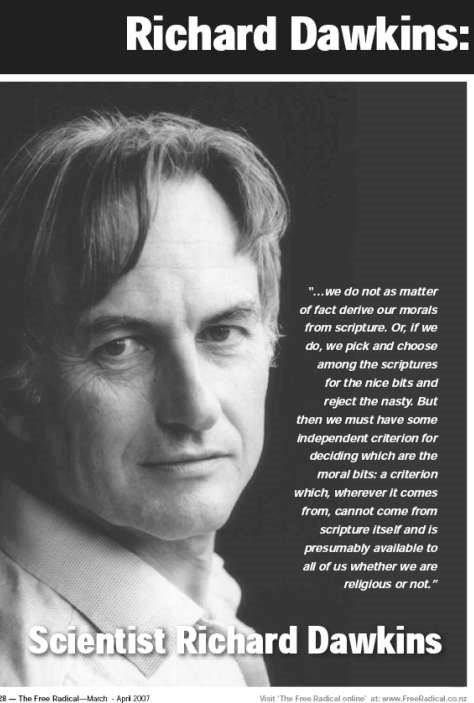
But that doesn't mean that the source of morality is somehow "innate," which is where Team Dawkins gets it wrong. The source of morality is not God or Helen Clark, it's neither our neighbours nor our feelings. No, the source of morality is reality.
It should be obvious enough why this matters, but to those who eschew thinking about ethics and who prefer instead to bloviate solely about politics, there's a political connection here too, as Peter Schwarz points out:
Does morality depend upon religion? Most people believe it does, which is a major reason behind the appeal of the religious right. People believe that without faith in a supernatural authority, we can have no moral values--no moral absolutes, no black-and-white distinctions, no firm demarcation between good and evil--in life or in politics. This is the assumption underlying Justice Antonin Scalia's recent assertion that "government derives its authority from God," since only religious faith can supposedly provide moral constraints on human action.
And what draws people to this bizarre premise--the premise that there is no rational basis for refraining from murder, rape or anarchism? The left's persistent assault on moral values.
That is, liberals characteristically renounce moral absolutes in favor of moral grayness.
BUT MORALITY ISN'T GREY. It is absolute. It's absolute because the source of morality is reality, which is impossible for anyone to evade, even the most hard-bitten religionist. Fact is, there are serious problems with the approaches taken by both the religionists (who insist on intrinsic rules, yet insist again on cherrypicking which ones are really and truly the ones to live by), and by their subjectivist opponents (who insist there are no absolutes, except the rule that there are no absolutes).
But to dismiss these objections is not to answer our question here, which is: “Can you then have morality without God? Whence comes moral structure if the Law-Giver in Chief is dead?”. The answer, to say it once again, is reality, and the constraints it places up on us. The source and locus of all our values is reality. Where else could they come from? All facts, to us, are potentially value-laden. The world is fashioned in a particular way, and to derive happiness and flourishing in such a world we need to act in such and such a way.
In response to this all too obvious point, those trained in university philosophy departments will often wheel out something called the 'Is-Ought' argument as 'proof' that facts are inherently value-free, or (to put it another way), that neither reality nor reason provide any basis from which to formulate a reliable ethics.
THE 'IS-OUGHT' ARGUMENT was a remarkable piece of sophistry devised by a drinker called David Hume ("David Hume could out-consume Schopenhauer and Schlegel" -- as many of you will remember), who suggested the fact that the world is this way or that way provides no means of suggesting whether one ought or ought not do something, and thus there is no way -- no way at all -- to put together any sort of rational morality. This is the sort of thing that in university philosophy departments passes for a sophisticated argument.
What's remarkable is that such a fatuous proposition should still have sufficient legs to persuade graduates of philosophy departments over two-hundred years after it was formulated. The 'is-ought problem' is a problem only if your mind has been crippled by such a department.
Aristotle stands first in line as a healthy contrast to both religionists and subjectivists and university philosophy professors in being a consistent (and too-frequently overlooked) advocate of a rational, earthly morality -- his was a "teleological" approach to ethics. That is, he said, we each act to achieve certain ends, and those ends must be the furtherance of our lives. All actions are (or should be) done "for the sake of" achieving some goal.
ARISTTOTLE PROVIDES A STARTING point from which to proceed rationally. Let’s think about what the basis for any rational standard of morality for human life would be. Morality should be ends-based – it should be goal-directed – but what end should it pursue? Surely the starting point would be the nature of human life itself? Shouldn’t the fact that human beings do have a specific nature tell us what we ought to do?
IT WAS AYN RAND who identified that the crucial fact about human life that provides such a starting point is the conditional nature of life, the fact that living beings daily confront the ever-present alternative of life or death. Act in this way and our life is sustained. Act in that way, and it isn't. Life is not automatic; it requires effort to sustain it, and reason to ascertain what leads towards death (which is bad), and what leads towards life (which is good). What standard then provides the basis by which a rational morality judges what one ought to do, or ought not to do? Life itself. Life is the standard. As Ayn Rand observed in her essay ‘The Objectivist Ethics,’
It is only the concept of "Life" that makes the concept of "Value" possible. It is only to a living entity that things can be good or evil.
Following Rand, Greg Salmieri and Alan Gotthelf point out that,
Rand’s virtue-focused rational egoism differs from traditional [ie., Aristotelian] eudaimonism in that Rand regards ethics as an exact science. Rather than deriving her virtues from a vaguely defined human function, she takes “Man’s Life” – i.e. that which is required for the survival of a rational animal across its lifespan – as her standard of value. This accounts for the nobility she ascribes to production – “the application of reason to the problem of survival” (1966, p. 9). For Rand, reason is man’s means of survival, and even the most theoretical and spiritual functions – science, philosophy, art, love, and reverence for the human potential, among others – are for the sake of life-sustaining action. This, for her, does not demean the spiritual by “bringing it down” to the level of the material; rather, it elevates the material and grounds the spiritual.
THE FACT THAT LIFE is conditional tells us what we ought to do: in the most basic sense, if we wish to sustain our life, then we ought to act in a certain way. This is the starting point for a rational, reality-based ethics: reality itself.
If, for example, that glass of brown liquid in front before us is dangerously toxic, then one ought not drink it. That would be bad. If, however, it is a glass of Epic Pale Ale, Limburg Czechmate or Stonecutter Renaissance Scotch Ale, then all things being equal one ought to consume it -- and with gusto. That would be good.
So much for the 'is-ought problem.' The fact that reality is constituted in a certain way, and that every living being confronts the fundamental existential alternative of life or death is what provides the basic level of guidance as to what one ought or ought not do. This fundamental alternative highlights an immutable fact of nature, which is that everything that is alive must act in its self-interest or die. A lion must hunt or starve. A deer must run from the hunter or be eaten. Man must obtain food and shelter, or perish. We must seek out good beer or else sentence ourselves to a lifetime of drinking Tui.
The pursuit of morality is that important.
The fact that we exist possessing a specific nature and that reality is constituted the way it is tells us what we ought to do.
(The intelligent reader will already have noticed that in seeing morality in this way, the primary issue in morality is not our responsibility to others, but fundamentally our responsibility to ourselves. Without first understanding our responsibility for sustaining our own life, no other responsibilities or obligations are even possible. Tibor Machan observes that this fact is recognised even in airline travel, where the instruction is always given that if oxygen masks drop from the ceiling you should put your own on first before trying to help others. Basically, this is a recognition that if you don't look after yourself first then you're dead, and of no use either to anyone else or to yourself. This might help explain to interested readers why Ayn Rand named her work on ethics: The Virtue of Selfishness.)
To any living being, facts are not inherently value-free, they are value-laden – some facts are harmful and we should act to avoid them; others are likely to be so pleasant that we should act to embrace them -- but all facts we should seek to understand, and in this context we should understand that all facts are potentially of either value or disvalue to us. Facts are inherently value-laden.
Contemplating the delightful reality of a glass of Limburg Czechmate, for example, demonstrates that some facts can be very desirable indeed, and are very much worth embracing. The point here is that it is not the facts themselves that make them valuable, it is our own relationship to those facts: how those facts impinge upon and affect our lives for either good or ill. It is up to us to discover and to make the most of these values. Leonard Peikoff makes the point in his book Objectivism:
Sunlight, tidal waves, the law of gravity, et al. are not good or bad; they simply are; such facts constitute reality and are thus the basis of all value-judgments. This does not, however, alter the principle that every "is" implies an "ought." The reason is that every fact of reality which we discover has, directly or indirectly, an implication for man's self-preservation and thus for his proper course of action. In relation to the goal of staying alive, the fact demands specific kinds of actions and prohibits others; i.e., it entails a definite set of evaluations.
For instance, sunlight is a fact of metaphysical reality; but once its effects are discovered by man and integrated to his goals, a long series of evaluations follows: the sun is a good thing (an essential of life as we know it); i.e., within the appropriate limits, its light and heat are good, good for us; other things being equal, therefore, we ought to plant our crops in certain locations, build our homes in a certain way (with windows), and so forth; beyond the appropriate limits, however, sunlight is not good (it causes burns or skin cancer); etc. All these evaluations are demanded by the cognitions involved -- if one pursues knowledge in order to guide one's actions. Similarly, tidal waves are bad, even though natural; they are bad for us if we get caught in one, and we ought to do whatever we can to avoid such a fate. Even the knowledge of the law of gravity, which represents a somewhat different kind of example, entails a host of evaluations --among the most obvious of which are: using a parachute in midair is good, and jumping out of a plane without one is bad, bad for a man's life.
But this is (or should be) basic stuff.
NOW, UNLESS YOU'RE a university philosophy professor (or David Hume) you don't simply sit there looking wide-eyed at the world, acting only on the basis of what appears in front of you on the bar. As Aristotle pointed out, if we want the good then our actions should be goal-directed. A rational man acts with purpose: that is, he acts in pursuit of his values. If our purpose is the enjoyment of more glasses of Limburg Czechmate, for example, (something even David Hume would agree is a value) then we must act in a way that allows us to acquire more drinking vouchers with which to buy them, a fridge in which to keep them, and to sustain our health, wealth and happiness so that we might enjoy them for many more years in the future.
We should act in this way or in that way, in other words, in order to bring into reality certain facts that our (rationally-derived) values tell us are good. Acting in this way is itself good. We might even call it “virtuous” – virtues being the means by which we acquire our values.
And further: we should act not just in order to stay alive. As Aristotle and Rand both point out, the proper human state of life is not just bare survival, it is a state of flourishing – not just life, but “the Good Life.” Rand again:
In psychological terms, the issue of man's survival does not confront his consciousness as an issue of "life or death," but as an issue of "happiness or suffering." Happiness is the successful state of life, suffering is the signal of failure, of death...
Happiness is the successful state of life, pain is an agent of death. Happiness is that state of consciousness which proceeds from the achievement of one's values...
But neither life nor happiness can be achieved by the pursuit of irrational whims. Just as man is free to attempt to survive in any random manner, but will perish unless he lives as his nature requires, so he is free to seek his happiness in any mindless fraud, but the torture of frustration is all he will find, unless he seeks the happiness proper to man. The purpose of morality is to teach you not to suffer and die, but to enjoy yourself and live.
Such is the nature of a rational morality. The fact that the world is constituted as it is, means that if life is our standard -- my life, here on this earth -- then we ought to recognise the value of a rational morality, and if we wish to achieve happiness we ought to act upon values derived from a rational morality focused upon life on this earth.
What the hell else could be as important?
Let me say it again on conclusion: the standard for morality -- the rational standard -- is not obedience to what your God says or Moses says; it's not doing what your priest or your pastor or your Imam says; it's not subscribing to the same standards as your teachers or your peers the folks who live next door; it's not listening to what your own "inner voice" seems to say, or what your mother or your father or your Great Grandfather Stonebender used to say. Not if it defies reason.
The rational standard is Life, our life, and the lives of those we love. The immediate beneficiary of our actions is not others; it's ourself, and the purpose of such a standard is not to suffer and die, but to enjoy ourselves and live. (Once we've identified and internalised ethical guidelines to further our own flourishing, we can then only then safely listen to our own "stomach feeling," but it would be fatal to do so any earlier.)
To turn Descartes on his head (which is no less than the silly French philosopher deserves), the basic ethical principle is this: "I am, therefore I'll think." Because if we don't think clearly there'll soon be no "I" around to think about.
I hope you think about that.
* * * * *
** For your homework, if you want to know more about Objectivist morality then you might want to act on that ...
- 'The Objectivist Ethics,' by Ayn Rand, in her book The Virtue of Selfishness: A New Concept of Egoism.
- Audiobook excerpt from the introduction to The Virtue of Selfishness.
- Religion and Morality - a free talk by Onkar Ghate at the Ayn Rand Institute web page.[Free registration is required. Once registered go to the Registered User Page and scroll down to 'Religion and Morality]
- Is-Ought? Not a Problem - Not PC
- Why Morality at All? - Not PC
- Does Evil Exist? - Not PC
- Cue Card Libertarianism: Morality - Not PC
Thursday, 6 December 2007
Cue Card Libertarianism: Political Spectrum
A repost of an always necessary 'Cue Card':
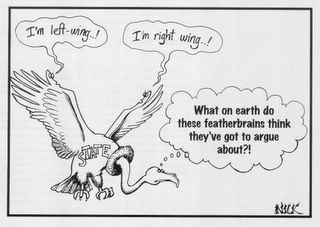 Political Spectrum, n. ie., that on which libertarians are not!
Because of the abysmally low capacity for intellectual abstraction among philosophically illiterate politicians, journalists and political science graduates, however, it is seemingly impossible to shake off the label “right wing” even when irrefutable evidence is offered that the label is wrong. Therefore, it becomes necessary to point out periodically that “libertarians are neither left nor right wing.”
Leaving aside its historical origins, the spectrum as commonly understood nowadays is a one-dimensional line that places communism on the extreme left (out to the west), fascism on the extreme right (out to the east), with gradations of democratic versions of each in between -- something whose usefulness is close to zero, except for those with minds as one-dimensional as the left-right spectrum itself.
 Libertarians maintain that all philosophies on this one-dimensional spectrum sanction coercion; that the differences are merely of degree not of principle; that it matters not whether coercion is initiated by a majority or by a dictator – it is still coercion, to which we are opposed in whatever guise it is practised. In short, the traditional one-dimensional spectrum fails because it excludes from discussion the full spectrum of political freedom. (And this is perhaps one reason for the spectrum's continued popularity.)
To lump libertarians in with the extreme right – with fascists, xenophobes, religious bigots etc. – is just as ignorant as it would be to call libertarians communists.
Another division of ideologies sometimes suggested is to place the total state on the left – communism and fascism – and the total absence of the state – anarchy, on the right, with gradations of statism in between. Thus: Communism/fascism democratic socialism/welfare state/mixed economy capitalism/limited constitutional government/individual freedom anarchy. But even this division is artificial, since anarchy also permits coercion without legal restraint, and must inevitably lead to some institutionalised form of it.
 If you really must simplify everything in this fashion, then a more meaningful arrangement is to make the traditional spectrum two-dimensional rather then one-dimensional by placing another line across the existing left-right one that goes north-south, heading down to authoritarianism at the bottom pole and up to freedom, sunshine and libertarianism at the top pole. At the four points of the compass then you would have Lenin, Mussolini and Winston Peters to the south; left-liberals like Gandhi, Ralph Nader and Nandor Tanczos to the west; and conservatives such as Margaret Thatcher, Rush Limbaugh and Ian Wishart to the east. Libertarians of course join Thomas Jefferson, James Madison and P.J. O'Rourke at the top of the world.
In the New Zealand context, the resulting diamond-shaped spectrum would look like this.
However and all in all, to paraphrase W.C. Fields, libertarians would rather be in Philadelphia. In 1776. And since the view of the state-citizen relationship expressed in the US Declaration of Independence doesn’t seem to have a comfortable place anywhere on the conventional Left-Right spectrum, it behoves us to leave those on it to quibble over who is to coerce whom, to what extent and why, while we get on with the business of promoting freedom – accepting with reluctance that in the meantime we shall undoubtedly have to put up with ignoramuses calling us “right wing.”
By their ignorance may ye know them.
LINKS: Left? Right? A plague on you both - Peter Cresswell
NZ's political spectrum - Peter Cresswell
Just how solid is that center? - Washington Post
Nolan Chart - Wikipedia
Cue Card Libertarianism - Introduction - Not PC
TAGS: Cue_Card_Libertarianism, Politics, Libertarianism, History
 Political Spectrum, n. ie., that on which libertarians are not!
 Because of the abysmally low capacity for intellectual abstraction among philosophically illiterate politicians, journalists and political science graduates, however, it is seemingly impossible to shake off the label “right wing” even when irrefutable evidence is offered that the label is wrong. Therefore, it becomes necessary to point out periodically that “libertarians are neither left nor right wing.”
Leaving aside its historical origins, the spectrum as commonly understood nowadays is a one-dimensional line that places communism on the extreme left (out to the west), fascism on the extreme right (out to the east), with gradations of democratic versions of each in between -- something whose usefulness is close to zero, except for those with minds as one-dimensional as the left-right spectrum itself.
 Libertarians maintain that all philosophies on this one-dimensional spectrum sanction coercion; that the differences are merely of degree not of principle; that it matters not whether coercion is initiated by a majority or by a dictator – it is still coercion, to which we are opposed in whatever guise it is practised. In short, the traditional one-dimensional spectrum fails because it excludes from discussion the full spectrum of political freedom. (And this is perhaps one reason for the spectrum's continued popularity.)
To lump libertarians in with the extreme right – with fascists, xenophobes, religious bigots etc. – is just as ignorant as it would be to call libertarians communists.
Another division of ideologies sometimes suggested is to place the total state on the left – communism and fascism – and the total absence of the state – anarchy, on the right, with gradations of statism in between. Thus: Communism/fascism democratic socialism/welfare state/mixed economy capitalism/limited constitutional government/individual freedom anarchy. But even this division is artificial, since anarchy also permits coercion without legal restraint, and must inevitably lead to some institutionalised form of it.
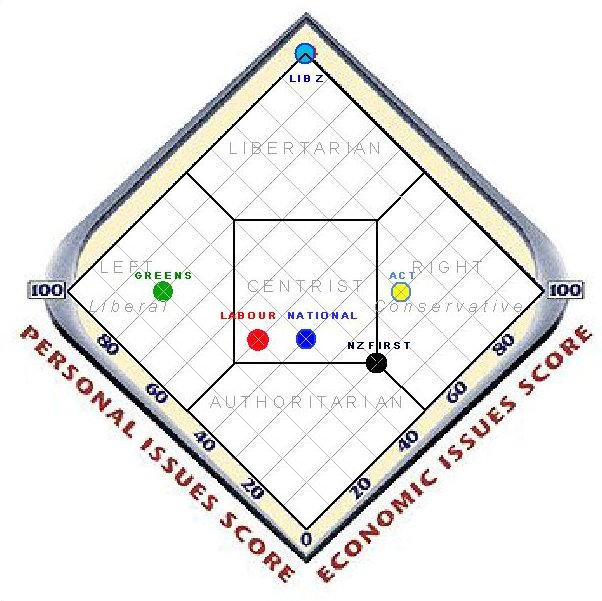 If you really must simplify everything in this fashion, then a more meaningful arrangement is to make the traditional spectrum two-dimensional rather then one-dimensional by placing another line across the existing left-right one that goes north-south, heading down to authoritarianism at the bottom pole and up to freedom, sunshine and libertarianism at the top pole. At the four points of the compass then you would have Lenin, Mussolini and Winston Peters to the south; left-liberals like Gandhi, Ralph Nader and Nandor Tanczos to the west; and conservatives such as Margaret Thatcher, Rush Limbaugh and Ian Wishart to the east. Libertarians of course join Thomas Jefferson, James Madison and P.J. O'Rourke at the top of the world.
In the New Zealand context, the resulting diamond-shaped spectrum would look like this.
However and all in all, to paraphrase W.C. Fields, libertarians would rather be in Philadelphia. In 1776. And since the view of the state-citizen relationship expressed in the US Declaration of Independence doesn’t seem to have a comfortable place anywhere on the conventional Left-Right spectrum, it behoves us to leave those on it to quibble over who is to coerce whom, to what extent and why, while we get on with the business of promoting freedom – accepting with reluctance that in the meantime we shall undoubtedly have to put up with ignoramuses calling us “right wing.”
By their ignorance may ye know them.
LINKS: Left? Right? A plague on you both - Peter Cresswell
NZ's political spectrum - Peter Cresswell
Just how solid is that center? - Washington Post
Nolan Chart - Wikipedia
Cue Card Libertarianism - Introduction - Not PC
TAGS: Cue_Card_Libertarianism, Politics, Libertarianism, History
Tuesday, 12 June 2007
Anarchism is self-defeating
You'll rarely see a better critique of the nonsense of anarchism than this one, from Harry Binswanger. "Competition," says Harry, "is an economic, not a political, concept; it refers to the voluntary exchange of values, not to the exchange of gunfire."
Read more of this common sense here: Harry Binswanger: Anarchism vs Objectivism. [Hat tip Thomas Lee]
See also: Cue Card Libertarianism: Anarchy
UPDATE 1: A commenter at SOLO has conveniently summarised the main points covered in just 1500 words:
UPDATE 2: A good debate on this still continuing at SOLO. Jump in.
Read more of this common sense here: Harry Binswanger: Anarchism vs Objectivism. [Hat tip Thomas Lee]
See also: Cue Card Libertarianism: Anarchy
UPDATE 1: A commenter at SOLO has conveniently summarised the main points covered in just 1500 words:
- why government must have a monopoly of force;
- the need for a philosophy of law to spell out details of objective justice;
- private force iss a violation of objective justice;
- the self-defence/emergency exception;
- private guards;
- what 'competing' would mean in practice;
- How anarchism is 'the rule of whim';
- how varying notions proposed for 'just retaliation' under anarchism would result in rights violations;
- the inescapability of disputes over rights in whatever anarchist system is initially set up;
- the stolen concept of a 'market' in force;
- the 'binding arbitration' fallacy;
- defense agency force is still force suppressing 'competition';
- the denial of the need for objectivity and proof in regard to force.
UPDATE 2: A good debate on this still continuing at SOLO. Jump in.
Monday, 7 May 2007
Why gangs? Why shooters? The answer, my friend, is blowing through the schools.
 After the events of the weekend -- youth violence, party mayhem, gang shootings -- people are asking questions: "Why do people join gangs?" "How do we put a stop to them?" "What makes someone drive through a crowd of young people with the intent to kill?" and "What the hell is happening to this country?"
The answer to the second question is simple enough: If you want to stop the rise and rise of gangs, then stop giving them an income stream. Stop giving them money. As any student of history can tell you, prohibition plays into the hands of gangsters. We've done the same thing here, and too few seem to want to recognise that.
 Why do people join gangs? What makes someone drive through a crowd of young people with the intent to kill? I think the answer to both is the same, and to demonstrate the answer, let me tell you about young Katelynn Johnson (right), a student at Virginia Tech -- a 'Hokie' as they call themselves -- who had a rather enlightening reaction to a monument for the 32 dead 'Hokies' in the Virginia Tech shooting. This martyr to worthiness added a 33rd stone (to the monument, not to her weight). The 33rd stone, she explained, "was meant for the shooter."
 When there was an outcry and someone removed the 33rd stone, this was Johnson's reaction:Well, I can say with certainty: "Yes, I am!" But Johnson, who is the very model of Progressive education, cannot. For her, as blogger Rob Tarr noted, her identification with the collective as a primary trumps everything; as does her complete inability and unwillingness to make any moral judgements whatsoever."'To see this community turn on one of its own no matter what he did is heartbreaking to me,' Johnson said. 'If we're a community, we're a community. If we're a family, we're a family. You can't pick and choose your family.'
"'We lost 33 Hokies that day, not 32,' she wrote. 'Who am I to judge who has value and who doesn't? I am not in that position. Are you?'"
Johnson is a perfect product of modern Progressive education, in which moral relativism and socialisation -- ie., identification with the collective -- are taught almost from birth as values that trump everything. As Glenn Woiceshyn explained after the Jonesboro shooting, Progressive education is "Socializing Students for Anarchy":
As you can see, moral relativism is only one part of modern failure, and Johnson isn't the only perfect product of modern Progressive education in the news. So too are school shooters, drive-through party killers, and gang members -- they're all part of the same coin. The overwhelming need to belong, the identification with a collective -- any collective -- is part of what explains the rise and rise of gangs; it is part of what makes them so attractive to members, and it is what Progressive education has succeeded in teaching these poor saps. That most gangs are tribal, and their members often Maori, is just a further aspect of that collectivism, a message of tribal socialization that would no doubt have resonated for young Maori.According to the founder [of Progressive education], John Dewey, "The school is primarily a social institution," whose central purpose is not "science, nor literature, nor history, nor geography . . . but the child's own social activities." Our schools certainly embrace both parts of this doctrine: teachers now attend to the child's "social" needs as devoutly as they dismiss his intellectual ones. Why, then, is social conflict--rather than social harmony--escalating?
The answer is: precisely because of this doctrine.
The Progressive philosophy maintains that the cause of social strife is the unwillingness of an individual to sacrifice his convictions to the group. Dewey maintained that it is the insistence on distinctions such as "true versus false" and "right versus wrong" that generates social conflict. If only children did not hold strong ideas, disagreement and conflict would evaporate in the sunshine of social harmony. Truth, therefore, is socially fractious--while ignorance is bliss.
Hence, what the Progressives mean by "socialization" is the surrender of one's mind--of one's independent knowledge and judgment--to a "group consensus."
For young hoods who shoot their fellow students or who mow down fellow party-goers with their cars, I think there's a similar thing going on: the collective and the need to belong trumps everything -- for these destructive bastards rejection by that collective is worse even than murder. At least murder gets them recognised.
As blogger Gus van Horn notes, to understand such an outlook, to get an inkling of how such an attitude is possible -- an attitude incubated in the Progressive education system delivered in the state's factory schools -- one need go no farther than this essay in The Chronicle of Higher Education that discusses US school shootings [emphasis has been added]:
[R]ampage school shootings are never spontaneous. Before they loaded a single weapon, [shooters] let fly with dozens of hints, ranging from vague comments like, "You'll see who lives or dies on Monday," to more-specific warnings to friends to "stay away from the school lobby." Those warnings started months before the shootings themselves. ...So the answer to that last question posed above should now be simple enough. What the hell is happening to this country? Answer: Progressive education.
Why do school shooters broadcast their intentions? They are trying to attract the attention of kids whom they hope will embrace them as friends but who have typically denied them the social status they crave. Michael [Carneal, for example] desperately wanted the acceptance of the "goth" group in his high school, which barely tolerated his presence. He posed as a delinquent when he was actually quite intellectual, passing off CDs he owned as stolen property. He stole pistols from his home and brought them to school as gifts for the most charismatic of the goths. "Not good enough," was the response. "We want rifles." No matter how hard Michael tried to change the way his peers saw him, nothing worked until the day he started fantasizing out loud about taking over the school and shooting people. That did work. He began to get attention. And once he had announced his intention, he risked social failure if he declined to go through with it.
School shooters are problem solvers. They are trying to turn the reputations they live with as losers into something more glamorous, more notorious. Seung-Hui Cho, a student of creative writing, probably didn't get a lot of "street cred" for his artistic side. Young men reap more social benefits from being successful on the football field. When their daily social experience -- created by their own ineptness, and often by the rejection of their peers -- is one of disappointment and friction, they want to reverse their social identities. How do they go about it? Sadly, becoming violent, going out in a blaze of glory, and ending it all by taking other people with them is one script that plays out in popular culture and provides a road map for notoriety.
Progressive education has been socializing students for anarchy now for at least half-a-century, so why should we be surprised that it is succeeding? It is exactly as Rob Tarr says, that for such misbegotten products of Progressive education, identification with the collective as a primary trumps everything else.
The antidote to this collective nihilism is course is the promotion of rational individualism, and an urgent change in the values taught that are taught every day in those factory schools -- or else, perhaps, the destruction of those schools.
And that's surely worth a thought?
Wednesday, 4 April 2007
"The hunting of the shark," by Bernard Levin
[What with various rooftop activities going on around Christchurch's Lichfield Lanes district, I felt duty bound to post this celebration from Bernard Levin of a similarly fun-loving lark in the dour Britain of a decade-and-a-half ago -- and a victorious fun-loving lark to boot. Read on to find out why there is a shark here pictured plunging through an Oxfordshire roof. . .]
I start unkindly, I fear, by saying that Mr John Power, who is chairman of the planning committee of Oxford city council, might do well to go and boil his head in a light stock with a bouquet garni and perhaps a teaspoonful of sherry.
This discourtesy is provoked by Mr Power sounding off in no uncertain manner: ". . . a victory for anarchy. . . a slap in the face for the decent and respectable people. . . seeking legal advice. . ." And what has brought him, in his municipal character, to such a state? Has someone opened a brothel next door to Balliol? Has the Sheldonian been taken over by meths-drinking dossers? Or has a band of undergraduate scofflaws had the impudence to debag Mr Power himself and paint his bottom purple?
 No such luck. What has brought Mr Power to the very edge of bursting is the decision of the public enquiry into the Hunting of the Shark. Over the six years of battle, you must have seen photographs of the famous fish which adorns the roof of the Oxford house of a Mr Bill Heine (to whom goes the Diamond Star and Sash of the Order of They Shall Be Mocked and With Good Reason); made of fibreglass, it is sited to look as though the shark dived headfirst at the roof-tiles and crashed through up to its gills. It makes a delightful, innocent, fresh and amusing sculpture, and people come from far and wide to see it, to admire it, to photograph it, and to smile at it. [That's her there, on the right.]
But there is nothing about smiling in the analects of the planning committee of the Oxford city council, and that august body ruled that it must come down, giving as the reason that it had been put up without planning permission, or more likely just because it was delightful, innocent, fresh and amusing — all qualities abhorred by such committees. Mr Heine (if he is descended from Heinrich Heine, it is another reason for me to shake his hand) fought heroically through the years as the battle swayed this way and that, with the authorities getting more and more indignant at the impudence of a mere person defying the might of a planning committee.
It had to go to a public enquiry, and eventually did, whence the sound of corks popping at 2 New High Street, Headington. For not only did the planning inspector of the Department of the Environment, Mr Peter Macdonald, rule that the shark can stay where it is, but the decision was couched in language so human, so intelligent and so wise that it ought to be painted in enormous letters on the pavements (both sides) of Whitehall. Here are some of his conclusions: “I cannot believe that the purpose of planning control is to enforce a boring and mediocre uniformity... Any system of control must make some space for the dynamic, the unexpected and the downright quirky, or we shall all be the poorer for it. I believe that this is one case where a little vision and imagination is appropriate.” Whereupon, Mr Power made it clear that he would “try to challenge the decision”, a threat that brought from Lord Palumbo, chairman of the Arts Council, this mild but appallingly true comment: “Most politicians do not know how to lose graciously.”
When I am Ruler of the Universe, one of my earliest decrees will lay down that anyone who uses the words “What if everybody did it?” will be fed to Sirius, the dog star. It is the last resort of the fun-killers, the oriflamme of the pursed lips brigade, the buttress of those whose motto is “Go and see what Johnny is doing and tell him to stop it.” Anyone but a prize nana would have seen that Mr Heine’s splendid lark (I pause here to commend the sculptor, Mr John Buckley) was an exact definition of delight, particularly Shakespeare’s kind “that give delight and hurt not.”
But it hurt the planning committee no end, whence the six years of battle and the preposterous comments (". . . a slap in the face of the decent and respectable people . . .") of its chairman when the battle was finally lost and won.
It is not difficult to see how people get things so devastatingly out of scale; indeed it is one of the most thoroughly studied of human frailties. I poked fun at the Oxford council planning committee and in particular its chairman, but that was largely because I had a measure of that body — useful but nothing more. Now suppose you have worked hard and honestly at your job (useful but nothing more), and you dream, or once did dream, of making a mighty stir, of climbing to the heights, of being Someone. What is the inevitable knowledge that goes with what has happened to those dreams, and what can be done about it? The knowledge, of course, is that the dreams have not come true; what can be done about it is to exercise that tiny corner of the world in which you do hold sway.
Man, proud man, dressed in a little brief authority... Shakespeare knew humankind, and knew that the briefer the authority the greater the vigour with which it is employed. The chairman of the Oxford council planning committee does not have the power to have anybody’s head cut off, nor to have anybody exiled to Outer Mongolia, nor even to compel anybody to do penance in a white sheet for seven days and seven nights. But he and his council do have the power (exercised, I am sure, only in strict compliance with the law) to order a man with a 25 ft fibreglass shark on his roof to take it off. And when he finds that higher authority has overruled him, he is fit to burst — whence the slap in the face for the decent and respectable people — because even that little authority has been, at least for some time, taken from him.
Shun power, shun it fiercely, if you want to sleep soundly in your bed. If it is real power, the power to compel others to do your bidding, your dreams will be haunted ones. If it is the mock power of the chairmanship of a municipal committee in Oxford, you will wake to disappointment. I am not going to quote Acton, but here is Hazlitt, who in this context is even more apposite:
No such luck. What has brought Mr Power to the very edge of bursting is the decision of the public enquiry into the Hunting of the Shark. Over the six years of battle, you must have seen photographs of the famous fish which adorns the roof of the Oxford house of a Mr Bill Heine (to whom goes the Diamond Star and Sash of the Order of They Shall Be Mocked and With Good Reason); made of fibreglass, it is sited to look as though the shark dived headfirst at the roof-tiles and crashed through up to its gills. It makes a delightful, innocent, fresh and amusing sculpture, and people come from far and wide to see it, to admire it, to photograph it, and to smile at it. [That's her there, on the right.]
But there is nothing about smiling in the analects of the planning committee of the Oxford city council, and that august body ruled that it must come down, giving as the reason that it had been put up without planning permission, or more likely just because it was delightful, innocent, fresh and amusing — all qualities abhorred by such committees. Mr Heine (if he is descended from Heinrich Heine, it is another reason for me to shake his hand) fought heroically through the years as the battle swayed this way and that, with the authorities getting more and more indignant at the impudence of a mere person defying the might of a planning committee.
It had to go to a public enquiry, and eventually did, whence the sound of corks popping at 2 New High Street, Headington. For not only did the planning inspector of the Department of the Environment, Mr Peter Macdonald, rule that the shark can stay where it is, but the decision was couched in language so human, so intelligent and so wise that it ought to be painted in enormous letters on the pavements (both sides) of Whitehall. Here are some of his conclusions: “I cannot believe that the purpose of planning control is to enforce a boring and mediocre uniformity... Any system of control must make some space for the dynamic, the unexpected and the downright quirky, or we shall all be the poorer for it. I believe that this is one case where a little vision and imagination is appropriate.” Whereupon, Mr Power made it clear that he would “try to challenge the decision”, a threat that brought from Lord Palumbo, chairman of the Arts Council, this mild but appallingly true comment: “Most politicians do not know how to lose graciously.”
When I am Ruler of the Universe, one of my earliest decrees will lay down that anyone who uses the words “What if everybody did it?” will be fed to Sirius, the dog star. It is the last resort of the fun-killers, the oriflamme of the pursed lips brigade, the buttress of those whose motto is “Go and see what Johnny is doing and tell him to stop it.” Anyone but a prize nana would have seen that Mr Heine’s splendid lark (I pause here to commend the sculptor, Mr John Buckley) was an exact definition of delight, particularly Shakespeare’s kind “that give delight and hurt not.”
But it hurt the planning committee no end, whence the six years of battle and the preposterous comments (". . . a slap in the face of the decent and respectable people . . .") of its chairman when the battle was finally lost and won.
It is not difficult to see how people get things so devastatingly out of scale; indeed it is one of the most thoroughly studied of human frailties. I poked fun at the Oxford council planning committee and in particular its chairman, but that was largely because I had a measure of that body — useful but nothing more. Now suppose you have worked hard and honestly at your job (useful but nothing more), and you dream, or once did dream, of making a mighty stir, of climbing to the heights, of being Someone. What is the inevitable knowledge that goes with what has happened to those dreams, and what can be done about it? The knowledge, of course, is that the dreams have not come true; what can be done about it is to exercise that tiny corner of the world in which you do hold sway.
Man, proud man, dressed in a little brief authority... Shakespeare knew humankind, and knew that the briefer the authority the greater the vigour with which it is employed. The chairman of the Oxford council planning committee does not have the power to have anybody’s head cut off, nor to have anybody exiled to Outer Mongolia, nor even to compel anybody to do penance in a white sheet for seven days and seven nights. But he and his council do have the power (exercised, I am sure, only in strict compliance with the law) to order a man with a 25 ft fibreglass shark on his roof to take it off. And when he finds that higher authority has overruled him, he is fit to burst — whence the slap in the face for the decent and respectable people — because even that little authority has been, at least for some time, taken from him.
Shun power, shun it fiercely, if you want to sleep soundly in your bed. If it is real power, the power to compel others to do your bidding, your dreams will be haunted ones. If it is the mock power of the chairmanship of a municipal committee in Oxford, you will wake to disappointment. I am not going to quote Acton, but here is Hazlitt, who in this context is even more apposite:
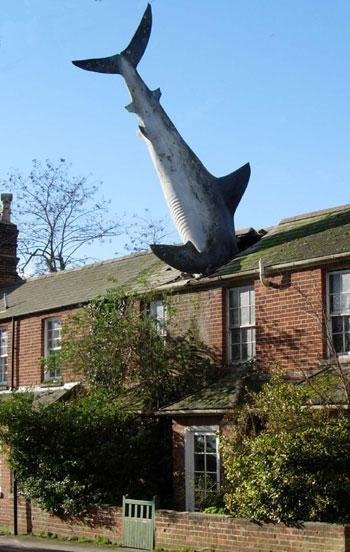 No such luck. What has brought Mr Power to the very edge of bursting is the decision of the public enquiry into the Hunting of the Shark. Over the six years of battle, you must have seen photographs of the famous fish which adorns the roof of the Oxford house of a Mr Bill Heine (to whom goes the Diamond Star and Sash of the Order of They Shall Be Mocked and With Good Reason); made of fibreglass, it is sited to look as though the shark dived headfirst at the roof-tiles and crashed through up to its gills. It makes a delightful, innocent, fresh and amusing sculpture, and people come from far and wide to see it, to admire it, to photograph it, and to smile at it. [That's her there, on the right.]
But there is nothing about smiling in the analects of the planning committee of the Oxford city council, and that august body ruled that it must come down, giving as the reason that it had been put up without planning permission, or more likely just because it was delightful, innocent, fresh and amusing — all qualities abhorred by such committees. Mr Heine (if he is descended from Heinrich Heine, it is another reason for me to shake his hand) fought heroically through the years as the battle swayed this way and that, with the authorities getting more and more indignant at the impudence of a mere person defying the might of a planning committee.
It had to go to a public enquiry, and eventually did, whence the sound of corks popping at 2 New High Street, Headington. For not only did the planning inspector of the Department of the Environment, Mr Peter Macdonald, rule that the shark can stay where it is, but the decision was couched in language so human, so intelligent and so wise that it ought to be painted in enormous letters on the pavements (both sides) of Whitehall. Here are some of his conclusions: “I cannot believe that the purpose of planning control is to enforce a boring and mediocre uniformity... Any system of control must make some space for the dynamic, the unexpected and the downright quirky, or we shall all be the poorer for it. I believe that this is one case where a little vision and imagination is appropriate.” Whereupon, Mr Power made it clear that he would “try to challenge the decision”, a threat that brought from Lord Palumbo, chairman of the Arts Council, this mild but appallingly true comment: “Most politicians do not know how to lose graciously.”
When I am Ruler of the Universe, one of my earliest decrees will lay down that anyone who uses the words “What if everybody did it?” will be fed to Sirius, the dog star. It is the last resort of the fun-killers, the oriflamme of the pursed lips brigade, the buttress of those whose motto is “Go and see what Johnny is doing and tell him to stop it.” Anyone but a prize nana would have seen that Mr Heine’s splendid lark (I pause here to commend the sculptor, Mr John Buckley) was an exact definition of delight, particularly Shakespeare’s kind “that give delight and hurt not.”
But it hurt the planning committee no end, whence the six years of battle and the preposterous comments (". . . a slap in the face of the decent and respectable people . . .") of its chairman when the battle was finally lost and won.
It is not difficult to see how people get things so devastatingly out of scale; indeed it is one of the most thoroughly studied of human frailties. I poked fun at the Oxford council planning committee and in particular its chairman, but that was largely because I had a measure of that body — useful but nothing more. Now suppose you have worked hard and honestly at your job (useful but nothing more), and you dream, or once did dream, of making a mighty stir, of climbing to the heights, of being Someone. What is the inevitable knowledge that goes with what has happened to those dreams, and what can be done about it? The knowledge, of course, is that the dreams have not come true; what can be done about it is to exercise that tiny corner of the world in which you do hold sway.
Man, proud man, dressed in a little brief authority... Shakespeare knew humankind, and knew that the briefer the authority the greater the vigour with which it is employed. The chairman of the Oxford council planning committee does not have the power to have anybody’s head cut off, nor to have anybody exiled to Outer Mongolia, nor even to compel anybody to do penance in a white sheet for seven days and seven nights. But he and his council do have the power (exercised, I am sure, only in strict compliance with the law) to order a man with a 25 ft fibreglass shark on his roof to take it off. And when he finds that higher authority has overruled him, he is fit to burst — whence the slap in the face for the decent and respectable people — because even that little authority has been, at least for some time, taken from him.
Shun power, shun it fiercely, if you want to sleep soundly in your bed. If it is real power, the power to compel others to do your bidding, your dreams will be haunted ones. If it is the mock power of the chairmanship of a municipal committee in Oxford, you will wake to disappointment. I am not going to quote Acton, but here is Hazlitt, who in this context is even more apposite:
No such luck. What has brought Mr Power to the very edge of bursting is the decision of the public enquiry into the Hunting of the Shark. Over the six years of battle, you must have seen photographs of the famous fish which adorns the roof of the Oxford house of a Mr Bill Heine (to whom goes the Diamond Star and Sash of the Order of They Shall Be Mocked and With Good Reason); made of fibreglass, it is sited to look as though the shark dived headfirst at the roof-tiles and crashed through up to its gills. It makes a delightful, innocent, fresh and amusing sculpture, and people come from far and wide to see it, to admire it, to photograph it, and to smile at it. [That's her there, on the right.]
But there is nothing about smiling in the analects of the planning committee of the Oxford city council, and that august body ruled that it must come down, giving as the reason that it had been put up without planning permission, or more likely just because it was delightful, innocent, fresh and amusing — all qualities abhorred by such committees. Mr Heine (if he is descended from Heinrich Heine, it is another reason for me to shake his hand) fought heroically through the years as the battle swayed this way and that, with the authorities getting more and more indignant at the impudence of a mere person defying the might of a planning committee.
It had to go to a public enquiry, and eventually did, whence the sound of corks popping at 2 New High Street, Headington. For not only did the planning inspector of the Department of the Environment, Mr Peter Macdonald, rule that the shark can stay where it is, but the decision was couched in language so human, so intelligent and so wise that it ought to be painted in enormous letters on the pavements (both sides) of Whitehall. Here are some of his conclusions: “I cannot believe that the purpose of planning control is to enforce a boring and mediocre uniformity... Any system of control must make some space for the dynamic, the unexpected and the downright quirky, or we shall all be the poorer for it. I believe that this is one case where a little vision and imagination is appropriate.” Whereupon, Mr Power made it clear that he would “try to challenge the decision”, a threat that brought from Lord Palumbo, chairman of the Arts Council, this mild but appallingly true comment: “Most politicians do not know how to lose graciously.”
When I am Ruler of the Universe, one of my earliest decrees will lay down that anyone who uses the words “What if everybody did it?” will be fed to Sirius, the dog star. It is the last resort of the fun-killers, the oriflamme of the pursed lips brigade, the buttress of those whose motto is “Go and see what Johnny is doing and tell him to stop it.” Anyone but a prize nana would have seen that Mr Heine’s splendid lark (I pause here to commend the sculptor, Mr John Buckley) was an exact definition of delight, particularly Shakespeare’s kind “that give delight and hurt not.”
But it hurt the planning committee no end, whence the six years of battle and the preposterous comments (". . . a slap in the face of the decent and respectable people . . .") of its chairman when the battle was finally lost and won.
It is not difficult to see how people get things so devastatingly out of scale; indeed it is one of the most thoroughly studied of human frailties. I poked fun at the Oxford council planning committee and in particular its chairman, but that was largely because I had a measure of that body — useful but nothing more. Now suppose you have worked hard and honestly at your job (useful but nothing more), and you dream, or once did dream, of making a mighty stir, of climbing to the heights, of being Someone. What is the inevitable knowledge that goes with what has happened to those dreams, and what can be done about it? The knowledge, of course, is that the dreams have not come true; what can be done about it is to exercise that tiny corner of the world in which you do hold sway.
Man, proud man, dressed in a little brief authority... Shakespeare knew humankind, and knew that the briefer the authority the greater the vigour with which it is employed. The chairman of the Oxford council planning committee does not have the power to have anybody’s head cut off, nor to have anybody exiled to Outer Mongolia, nor even to compel anybody to do penance in a white sheet for seven days and seven nights. But he and his council do have the power (exercised, I am sure, only in strict compliance with the law) to order a man with a 25 ft fibreglass shark on his roof to take it off. And when he finds that higher authority has overruled him, he is fit to burst — whence the slap in the face for the decent and respectable people — because even that little authority has been, at least for some time, taken from him.
Shun power, shun it fiercely, if you want to sleep soundly in your bed. If it is real power, the power to compel others to do your bidding, your dreams will be haunted ones. If it is the mock power of the chairmanship of a municipal committee in Oxford, you will wake to disappointment. I am not going to quote Acton, but here is Hazlitt, who in this context is even more apposite: The love of liberty is the love of others; the love of power is the love of ourselves.You do not have to be a bad man to want power. Our chairman is plainly an honest and scrupulous man, certainly to be numbered among the decent and respectable people who have figured so largely in this story. But he has forgotten the old and tried proverb: “A man with a stuffed shark on his roof is eccentric, and quite possibly in breach of the planning rules; a man who tries to take the shark off will run no danger of being bitten, but will almost certainly make a fool of himself.” [Christchurch bureaucrats, take note.] Bernard Levin, The Times, 11 June 1992
Wednesday, 17 January 2007
A question to ponder over the coming year
How much of your stolen $800,000 spent on buying the last election has Helen Clark paid back yet?
How much of the $158,000 Winston 'misappropriated' has he paid back?
Back in October when Don Brash reminded punters that Heather Simpson's validating legislation meant there was now "no legal obligation on anybody to pay back anything," The Popular and Competent Leaderene responded: "You have to take parties at their word and [when] they say they will refund that becomes a matter of honour."
Honour? Honour? From politicians? As I said back then, the irony really is palpable. Time for that old, old joke:
So, any bets as to when any of it will be paid back? Or if? Or if either the media or Key's National Socialists will bother pursuing this?
RELATED: Politics-NZ, Darnton V Clark, Politics-Labour
How much of the $158,000 Winston 'misappropriated' has he paid back?
Back in October when Don Brash reminded punters that Heather Simpson's validating legislation meant there was now "no legal obligation on anybody to pay back anything," The Popular and Competent Leaderene responded: "You have to take parties at their word and [when] they say they will refund that becomes a matter of honour."
Honour? Honour? From politicians? As I said back then, the irony really is palpable. Time for that old, old joke:
Q: How do you know when a politician's lying?More seriously, and as Supreme Court justice Louis Brandeis once reflected, "Our government ... teaches the whole people by its example. If the government becomes the lawbreaker, it breeds contempt for law; it invites every man to become a law unto himself; it invites anarchy."
A: Their lips are moving.
So, any bets as to when any of it will be paid back? Or if? Or if either the media or Key's National Socialists will bother pursuing this?
RELATED: Politics-NZ, Darnton V Clark, Politics-Labour
Wednesday, 15 November 2006
Cabaret of Desire - Silo Theatre
 Allow me to recommend a season of Berlin cabaret at Auckland's Silo Theatre: a 'Cabaret of Desire'! A brilliantly conceived and executed performance in a season that runs until mid-December. Don't miss it. From the playbill:
Sex. Hypocrisy. Defiance. Escape. Silo Theatre explores the biting musical experience of Kurt Weill, Mischa Spoliansky and Frederick Hollander. From MACK THE KNIFE to SURABAYA JOHNNY, these rousing anthems expose the hypocrisy of politics and the art of the possible.This is music from a time when cabaret had an edge: music that recognised, in the words of lyricist Freidrich Hollander*, whose songs were sung tonight: "Truth is hard and tough as nails/ That's why we need fairy tales" -- and it gave you both harshness and the fairy tale. Kurt Weill, for those who don't think they know him, is the predecessor to people like Tom Waits, Nick Cave, Serge Gainsbourg. Whipsmart music with attitude and bite. If you don't think you know him, or this era of unforgettably pungent music (Alabama Song, Mack the Knife might be familiar?) or if you want to know more, then my own favourite Weill album might be of interest -- Lost in the Stars: A Tribute to Kurt Weill
Provoke your spirit with the voice of the underground.
“…the lust and anarchy of the Weimar Republic shall live forever…”
UTE LEMPER
 -- or almost anything by Dagmar Krause -- if you can find anything --
 or by the luminous Ute Lemper
 .
.And do try and get along to the Silo before the season finishes. You won't regret it.
LINK: Berlin: Cabaret of Desire - Silo Theatre
RELATED: Music, Theatre, History
* PS: Here's a verse and chorus from that song quoted in part above, Hollander's 'Munchausen':
I saw a court of law where all the justices were just again
Where all the lawyers worked for free and all of them were honest men
You could be rich, you could be poor, you could be Christian or a Jew
Your politics did not have sway on how a judge would rule on you
Their hearts were young, their minds were free, they judged all man equally
Chorus:
Liar liar liar liar liar liar
I'm sick and tired of lies from you
But how I wish your lies were true
Liar liar liar liar liar liar
Truth is hard and tough as nails
That's why we need fairy tales
I'm all through with logical conclusions
Why should I deny myself illusions?
Tuesday, 14 November 2006
The fatalism of entropy. The dynamism of spontaneous order.
THE SECOND COMING
Turning and turning in the widening gyre
The falcon cannot hear the falconer;
Things fall apart; the centre cannot hold;
Mere anarchy is loosed upon the world...
Turning and turning in the widening gyre
The falcon cannot hear the falconer;
Things fall apart; the centre cannot hold;
Mere anarchy is loosed upon the world...
- W.B. Yeats
 People often talk as if the Law of Entropy somehow restricts human activity, or is a restraint on human free will. The idea, for example, that "even if human ingenuity is infinite, entropy may eventually put an absolute limit on the amount of wealth that can be created." Things fall apart, you see, the centre cannot hold, and there's not a blind thing we can do about it.
This is both an error of scale -- with entropy happening on a universal rather than a human scale -- and a mis-application. It ignores the very nature of human activity and human free will, and ignores too the very simple observation that confirms there is order all around us. As the author of the book Sync : The Emerging Science of Spontaneous Order
 says:
says:Scientists have often been baffled by the existence of spontaneous order in the universe. The laws of thermodynamics seem to dictate the opposite, that nature should inexorably degenerate toward a state of greater disorder, greater entropy. Yet all around us we see magnificent structures—galaxies, cells, ecosystems, human beings—that have all somehow managed to assemble themselves.The phenomenon of spontaneous order is often cited as one of the two or three most non-intuitive notion of economics -- see if you can guess the others -- but the free application of human ingenuity in a division of labour system is one such example of spontaneous order in action. Tim Harford describes it succinctly in The Undercover Economist
 as an order that "emerges out of the behavior of individuals even though it is not anyone's intention to promote the overall order."
Why am I telling you this? Because the chaps over at Cafe Hayek have spotted a beautiful example of spontaneous order in full and graphic action: a visual representation of air traffic in the United States over the course of the day. Watch as mainland USA and Hawaii are slowly 'painted in' by the 'spontaneous' travels of individual flights. Click here to go see the Quick Time movie. As they say at Cafe Hayek, what looks random slowly emerges as a most developed kind of 'un-planned' order -- unplanned that is by any central planning. "The flights around the country aren't random. They spring out of population density and the routes people want to travel. These are the source of the order and its visual representation."
Spontaneous order. It's a wonderful thing, and perhaps the best answer to both mis-applying 'entropists' and would-be central planners.
LINKS: The recent revival of spontaneous order - Economics Library
Flight Patterns - Aaron Koblin at UCLA
The nature of the order - Cafe Hayek
Sync : The Emerging Science of Spontaneous Order
- Stephen Strogatz, Amazon. ComThe Undercover Economist
- Tim Harford, Amazon.ComRELATED: Economics, Ethics, Philosophy, Science
Wednesday, 26 July 2006
Cue Card Libertarianism - Pro-Liberty, not Anti-State
Libertarians are not anti-state, they are primarily pro-liberty -- we define ourselves by what we are for, not what we are against. In the current state of the world, that difference makes all the difference in the world.
Pro-liberty libertarians understand that freedom in the political context means freedom from physical coercion, and in order to protect themseves from physical coercion individuals have the right to self-defence, to the use of retaliatory force. In order to bring this use of force under objective control, and to bar the initiation of physical force, governments are a necessity -- agencies, that is, that hold a monopoly on physical force in a given area. The job then is to tie up governments to do just this job, which is the reason constitutions were invented.
In the words of Ayn Rand: "A government is the means of placing the retaliatory use of physical force under objective control." To pro-liberty libertarians, this is the underlying purpose of governments, and the means by which liberty is assured. It is only by this means that the libertarian non-agression principle can be enforced, ie., that no person should initiate force aginst any other.
There are 'anti-government' and 'no-government libertarians' about however: they are more accurately called anarchists, or even anarcho-capitalists -- or as Ayn Rand used to accurately call them, "hippies of the right." Right on. You can find such types at sites such as AntiWar.Com, and LewRockwell.Com -- sites inhabited respectively by pacifists, who renounce the right to national self-defence altogether (it is national self-defence that causes all wars they will tell you), and by antediluvians (who frequently maintain that Abraham Lincoln was a Nazi and that the southern slave states should have won the Civil War).
Anarchism in either form is not pro-liberty; it does not bring force under objective control -- it cannot ensure the universality of the non-agression principle, or of any principle. Instead, at best, it simply sets up a market for competing forms of force.
Such a market can presently be seen in the suburbs and villages of Somalia and Lebanon.
There is one main area in which the difference between pro-liberty libertarians and anti-state anarchists is tragically apparent: Defence. Pro-liberty libertarians realise that to protect their citizens, governments must run credible defence forces that can protect against foreign invasion or interdiction. This is a legitimate role for governments: to uphold as Lindsay Perigo says, "the right to life, to liberty and the pursuit of one's enemies" when those enemies have designs on your life.
Anarchists however just wave their hands around and pretend this isn't necessary. Murray Rothbard for example, the godfather of modern anarcho-capitalism recognised that an anarchist society could not provide such a credible or unified force, and rather than dismissing as absurd his devotion to anarchy, he instead embraced the absurd by arguing it wasn't even necessary.
 Rothbard's rationalistic devotion to his anti-state views led him to claim -- at the height of the Cold War -- first, that there were "no external threats to the US"; second, that what looked like a clear threat, the Soviet Union, was in fact "devoted to peace"; and third the real villain of the Cold War was in fact the United States, who was "more warlike than even Nazi Germany."
Not just bizarre, then, but disgraceful. This is the man who "rejoiced" at watching what he called “a particularly exhilarating experience: the death of a State, or rather two States: Cambodia and South Vietnam….” You might care to know, as Murray didn't, that between them the deaths of those two states led directly to the deaths of about five million human beings. As Tom Palmer says on this episode"it matters which state replaces which."
It sure does.
As I said at the outset, given the current state of the world and the many very real external threats to human beings from terrorists and Islamists, the difference between being pro-liberty and being anti-state has never held more implications for the future of liberty around the world, and for our civilisation that is based on that liberty.
The anti-state anarchist must of necessity deny the existence of any real threat, and instead simply blames The Warfare State (the repository of all evil) or America ("more warlike than even Nazi Germany") for all the evils that exist. The pro-liberty libertarian however understands that this is nonsensical; that for liberty and civilisation to exist and be maintained, it is right to hunt down the bloodsoaked enemies of liberty and freedom who say they love death and who wish to inflict it on us.
Given the current state of the world then, the difference between being pro-liberty and anti-state may just be the difference between liberty and death.
LINKS: Cue Card Libertarianism - Force - Not PC
Cue Card Libertarianism - Government - Not PC
Cue Card Libertarianism - Constitution - Not PC
Cue Card Libertarianism - Freedom - Not PC
Cue Card Libertarianism - Anarchy - Not PC
Apologetics for 'Death of a State' - Tom Palmer
RELATED: War, Cue Card Libertarianism, Libertarianism, Politics-World, Israel
Pro-liberty libertarians understand that freedom in the political context means freedom from physical coercion, and in order to protect themseves from physical coercion individuals have the right to self-defence, to the use of retaliatory force. In order to bring this use of force under objective control, and to bar the initiation of physical force, governments are a necessity -- agencies, that is, that hold a monopoly on physical force in a given area. The job then is to tie up governments to do just this job, which is the reason constitutions were invented.
In the words of Ayn Rand: "A government is the means of placing the retaliatory use of physical force under objective control." To pro-liberty libertarians, this is the underlying purpose of governments, and the means by which liberty is assured. It is only by this means that the libertarian non-agression principle can be enforced, ie., that no person should initiate force aginst any other.
There are 'anti-government' and 'no-government libertarians' about however: they are more accurately called anarchists, or even anarcho-capitalists -- or as Ayn Rand used to accurately call them, "hippies of the right." Right on. You can find such types at sites such as AntiWar.Com, and LewRockwell.Com -- sites inhabited respectively by pacifists, who renounce the right to national self-defence altogether (it is national self-defence that causes all wars they will tell you), and by antediluvians (who frequently maintain that Abraham Lincoln was a Nazi and that the southern slave states should have won the Civil War).
Anarchism in either form is not pro-liberty; it does not bring force under objective control -- it cannot ensure the universality of the non-agression principle, or of any principle. Instead, at best, it simply sets up a market for competing forms of force.
Such a market can presently be seen in the suburbs and villages of Somalia and Lebanon.
There is one main area in which the difference between pro-liberty libertarians and anti-state anarchists is tragically apparent: Defence. Pro-liberty libertarians realise that to protect their citizens, governments must run credible defence forces that can protect against foreign invasion or interdiction. This is a legitimate role for governments: to uphold as Lindsay Perigo says, "the right to life, to liberty and the pursuit of one's enemies" when those enemies have designs on your life.
Anarchists however just wave their hands around and pretend this isn't necessary. Murray Rothbard for example, the godfather of modern anarcho-capitalism recognised that an anarchist society could not provide such a credible or unified force, and rather than dismissing as absurd his devotion to anarchy, he instead embraced the absurd by arguing it wasn't even necessary.
 Rothbard's rationalistic devotion to his anti-state views led him to claim -- at the height of the Cold War -- first, that there were "no external threats to the US"; second, that what looked like a clear threat, the Soviet Union, was in fact "devoted to peace"; and third the real villain of the Cold War was in fact the United States, who was "more warlike than even Nazi Germany."
Not just bizarre, then, but disgraceful. This is the man who "rejoiced" at watching what he called “a particularly exhilarating experience: the death of a State, or rather two States: Cambodia and South Vietnam….” You might care to know, as Murray didn't, that between them the deaths of those two states led directly to the deaths of about five million human beings. As Tom Palmer says on this episode"it matters which state replaces which."
It sure does.
As I said at the outset, given the current state of the world and the many very real external threats to human beings from terrorists and Islamists, the difference between being pro-liberty and being anti-state has never held more implications for the future of liberty around the world, and for our civilisation that is based on that liberty.
The anti-state anarchist must of necessity deny the existence of any real threat, and instead simply blames The Warfare State (the repository of all evil) or America ("more warlike than even Nazi Germany") for all the evils that exist. The pro-liberty libertarian however understands that this is nonsensical; that for liberty and civilisation to exist and be maintained, it is right to hunt down the bloodsoaked enemies of liberty and freedom who say they love death and who wish to inflict it on us.
Given the current state of the world then, the difference between being pro-liberty and anti-state may just be the difference between liberty and death.
LINKS: Cue Card Libertarianism - Force - Not PC
Cue Card Libertarianism - Government - Not PC
Cue Card Libertarianism - Constitution - Not PC
Cue Card Libertarianism - Freedom - Not PC
Cue Card Libertarianism - Anarchy - Not PC
Apologetics for 'Death of a State' - Tom Palmer
RELATED: War, Cue Card Libertarianism, Libertarianism, Politics-World, Israel
Friday, 24 March 2006
Cue Card Libertarianism: Political Spectrum
Political Spectrum, n. ie., that on which libertarians are not! Because of the abysmally low capacity for intellectual abstraction among philosophically illiterate politicians, journalists and political science graduates, however, it is seemingly impossible to shake off the label “right wing” even when irrefutable evidence is offered that the label is wrong. Therefore, it becomes necessary to point out periodically that “libertarians are neither left nor right wing.”
Leaving aside its historical origins, the spectrum as commonly understood nowadays is a one-dimensional line that places communism on the extreme left (out to the west), fascism on the extreme right (out to the east), with gradations of democratic versions of each in between. Libertarians maintain that all philosophies on this spectrum sanction coercion; that the differences are merely of degree not of principle; that it matters not whether coercion is initiated by a majority or by a dictator – it is still coercion, to which we are opposed in whatever guise it is practised. In short, the traditional one-dimensional spectrum fails because it excludes the full spectrum of political freedom from discussion.
To lump libertarians in with the extreme right – fascists, religious bigots etc – is just as ignorant as it is to call us communists. Another division of ideologies sometimes suggested is to place the total state on the left – communism and fascism – and the total absence of the state – anarchy, on the right, with gradations of statism in between. Thus: Communism/fascism democratic socialism/welfare state/mixed economy capitalism/limited constitutional government/individual freedom anarchy. But even this division is artificial, since anarchy also permits coercion without legal restraint and must inevitably lead to some institutionalised form of it.
If you really must simplify everything in this fashion, then a more meaningful arrangement is to make the traditional spectrum two-dimensional rather then one-dimensional by placing another line across the existing one facing north-south, with freedom and libertarianism to the north and authoritarianism at the opposite pole to the south. At the four points of the compass then you would have Lenin, Mussolini and Winston Peters to the south; left-liberals like Gandhi, Ralph Nader and Nandor Tanczos to the west; conservatives such as Margaret Thatcher, Rush Limbaugh and Ian Wishart to the east. Libertarians of course join Thomas Jefferson, James Madison and P.J. O'Rourke at the top of the world.
However and all in all, to paraphrase W.C. Fields, libertarians would rather be in Philadelphia. In 1776. And since the view of the state-citizen relationship expressed in the US Declaration of Independence doesn’t seem to have a comfortable place anywhere on the conventional Left-Right spectrum, it behoves us to leave those on it to quibble over who is to coerce whom, to what extent and why, while we get on with the business of promoting freedom – accepting with reluctance that in the meantime we shall undoubtedly have to put up with ignoramuses calling us “right wing.”
By their ignorance may ye know them.
LINKS: Left? Right? A plague on you both - Peter Cresswell
NZ's political spectrum - Peter Cresswell
Just how solid is that center? - Washington Post
Nolan Chart - Wikipedia
Cue Card Libertarianism - Introduction - Not PC
TAGS: Cue_Card_Libertarianism, Politics, Libertarianism, History
Subscribe to:
Comments (Atom)