
Future-proof energy strategies for
energy-intensive industries
Secure your site’s competitiveness with an adaptive transformation plan —
balancing capex, opex, and emissions
through Decision Intelligence by


Who trusts us
Energy-intensive industrial companies that make their strategic decisions with Path to Zero and partners for cost-effective decarbonisation of industry:


Your benefit
Manage risks, reduce costs and achieve emissions targets with Path to Zero
Results from our projects compared to the reference strategy:
-35 %
Value at Risk
VaR 2025-2040
-23 %
Reduction in energy costs
TCO 2025-2040
-85 %
Emissions
CO2e bis 2035

With decide, we finally master the complexity of decarbonisation measures and their interdependencies. We can evaluate our strategy and individual actions with high confidence — and reevaluate them with minimal effort.

Konstantin Weber
Energy Manager
MM Gernsbach
Our service portfolio
Consulting expertise
Scientifically grounded, methodologically sound, and focused on real-world application.
With expertise in energy management, process engineering and thermodynamics, we identify hidden potential and unlock it with tailored models.
- Advised over 50 industrial companies – from 100 GWh to over 1 TWh annual demand
- Over 10 years of practical experience in the energy-intensive industries
- Domain knowledge and modeling excellence – proven by over 30 publications in leading journals

Decision intelligence
Find the best economic strategy and establish it as an adaptive transformation plan with decide
Find the optimal balance of capex, opex and emissions and reduce costs by up to 30% with our market-leading optimization engine.
- Prioritize no-regret investments through holistic optimization
- Avoid misinvestments through scenario-based analyses
- Update your strategy as required – automated and simple
Strategic foresight
Adapt your strategy to the latest developments and adjust your transformation plan automatically with inform
You proactively manage risks arising from changing market conditions with our fundamental market model.
- Receive up-to-date forecasts on market and regulatory developments
- Evaluate the impact of changing market conditions on your strategy
- Detect and quantify opportunities and risks

The team’s expertise and the digital solution for transformation planning are unique on the market and proved highly valuable in our decision-making process.

Marcus Grothaus
Technical managing director
Scheurich Group
What you get
The leading tool in your hand
By implementing a transformation plan, you gain access to decide – taking full control of your energy strategy
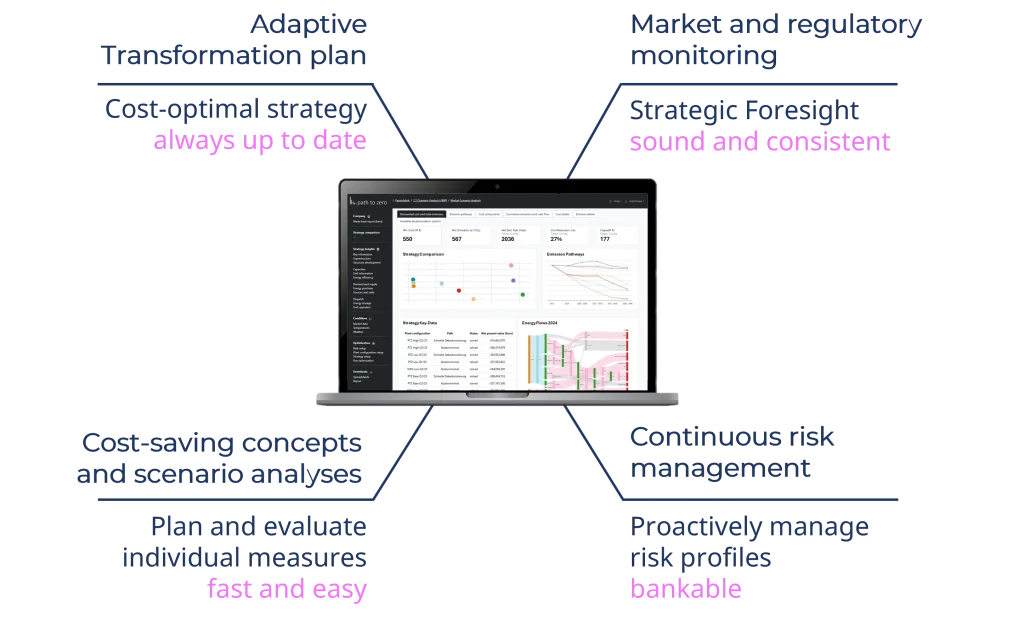
What makes us stand out
With Path to Zero you will find the best solution for your target mix – guaranteed by:

Leading methodology
- Up to 30% reduction in TCO through multi-period optimization
- Global exploration of the solution space
- Maximum flexibility for modeling your individual processes

Seamless integration of consulting and tooling
- No interfaces
- Direct contacts
- Fast processes
- Tangible results

Independence
- 100% owner-managed company
- No third-party solution brokering
- We are solely dedicated to delivering the best strategy for our customers

Current webinar
Reducing energy costs – excelling in transformation
Digital planning tools ensure competitiveness
November 20, 2025, 10:00 (CET)

FAQ – Frequently asked questions
What is a transformation plan?
A transformation plan is a roadmap for strategic planning and supports companies in decarbonizing their processes. It serves as a strategic tool with which companies can define individually tailored measures and decarbonization targets to achieve long-term climate neutrality. At a time when sustainable transformation is becoming increasingly important both ecologically and economically, a clear and precise transformation concept helps to achieve emission targets in a cost-optimized and efficient manner.
The primary aim of a transformation plan is to reduce the CO2 emissions of the company in order to meet the legally defined climate targets and thus contribute to the global climate protection strategy.
In addition, a transformation plan can be used to anchor the topic of environmental sustainability in the corporate strategy in the long term. The transformation plan can also help to secure the company’s competitiveness in the long term, as customers, investors and business partners will increasingly value green products in the future.
In order to create a transformation plan (formerly known as a transformation concept), the current status of emission-relevant processes is analyzed at first. The target state, which is latest to be achieved by 2045, is then defined and the path to achieve it is then worked out. As part of Module 5 of the Federal Funding for Energy and Resource Efficiency in the Economy in Germany (EEW), up to 70% of the costs of creating such a plan are eligible for funding.
Why is an energy strategy important?
– Reduce costs: A targeted procurement and consumption strategy can minimize electricity and energy costs in the long term.
– Increase security of supply: Companies avoid bottlenecks and ensure a stable, predictable energy supply.
– Optimize investments: A smart strategy ensures that capex and opex are optimized.
– Comply with regulations: Companies must increasingly meet legal requirements (e.g., CO₂ reduction targets).
How do you develop an economically optimal energy strategy?
→ Data-based forecasts with inform : How will electricity prices and grid fees develop? With inform companies receive model-based energy price forecasts that serve as a basis for informed decisions.
→ Optimized decisions with decide : Which strategy maximizes efficiency and profitability? Our software solution decide uses mathematical optimization to develop the most economically viable strategy for the company from various scenarios.
→ The transformation plan as a complete solution: How can the strategy be successfully implemented? The combination of inform and decide results in a clear transformation plan that secures a sustainable and economical energy future for companies.
→ An energy strategy is therefore crucial for coping with rising energy costs and ensuring a secure, profitable, and sustainable energy supply in the long term.
Where can I find the publications of Path to Zero?
Current studies and further resources can be found on this website at Ressources. You can find a comprehensive overview of the publications of the founders of Path to Zero in the Google Scholar profiles of Markus Bohlayer and Adrian Bürger.
Path to Zero
Founded to enable an economically viable decarbonisation of the industry.


