


Gastbeitrag von Vladislav Rjéoutski, Max Weber Netzwerk Osteuropa
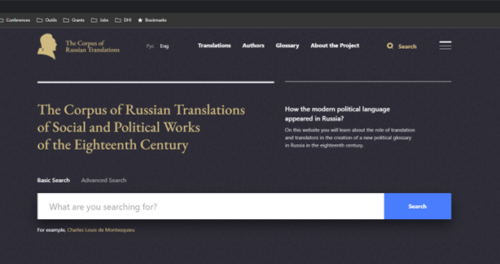
Homepage of the Corpus of Russian Translations – English Version
It was in the eighteenth century that Russian political language was born. The digital project The Corpus of Russian Translations of Social and Political Works of the Eighteenth Century of the Max Weber Network Eastern Europe1 explores the process of the transfer, adaptation and reception of key European political ideas and concepts in the Russian Empire during this period.
The starting point of the project was the assumption that Russian political terminology was invented in the process of translation, when political concepts acquired their precise meaning in specific social and political contexts. The main actors of this process were translators, commissioners of translations and readers who used and interpreted the new political vocabulary that transformed the semantic field of the Russian language.
Without understanding the historical meaning of the terms used in various political projects and treaties compiled or authored by statesmen of the Russian Empire at the time, it is hardly possible to grasp their intentions and the meaning they gave to their texts. In this respect, the study of Russian translations of political works opens a vast perspective by allowing us to compare European and Russian political terminology in order to see their common and specific features. Analyzing Russian political translations is a key to the understanding of the original Russian texts.
The database developed within the project presents samples of original texts alongside their Russian translations. Comparing different language versions makes it possible not only to examine the translators’ methods and principles, but also to gain insight into how readers of Russian understood and interpreted European political treatises throughout the “long” eighteenth century. We identified a wide range of sources that fall under the term ‘political’ in the eighteenth century: both published and manuscript, including not only political treaties, but also geographical and statistical descriptions of various states, essays on the history, political and social structure of countries, moral and political instructions for the noble, educational literature, political novels, and more. Periodicals were excluded, as their inclusion would have overloaded the project. We developed a structure for the project website and built a functional, user-friendly platform which enables users to navigate easily between the texts and their descriptions, the lexicon of political concepts, and the biographies of authors and translators, in order to view the concepts in various contexts. The database provides text samples in which political terminology is highly concentrated, making them easily accessible both to general users and to students of political thought.
The major step was the preparation of text samples and their descriptions, carried out with the help of more than twenty researchers from Russia and Ukraine. It was not possible to describe and publish samples of all the texts identified as ‘political literature’, as this would have far exceeded our capacities. However, we have described and published samples from nearly 200 translations of major political works by Bielfeld, Blackstone, D’Alembert, Diderot, Donato, Hobbes, Mably, Montesquieu, Pufendorf, Rousseau, Voltaire, and others. Importantly, we published excerpts from several dozen manuscripts which have never been published before.
One of the most time-consuming tasks was the descriptions of the manuscripts. In this regard, the colleagues involved carried out substantial research work. Manuscript translations were of great importance for the spread of political ideas in the Russian Empire, particularly in the first half of the eighteenth century, due to the high cost of printed books and to censorship.
Users can search for political concepts using the search bar, either through basic or advanced search. The advanced search allows users to refine their queries using a range of criteria, such as year of publication, language, and publication type (manuscript or printed). For example, a search for the German concept Staat yields 310 matches, including 26 translations, 18 original texts, and 192 excerpts, which can be accessed through the list of translations. The page devoted to each translation proposes its detailed description. The list of metadata is followed by excerpts from the original text and the corresponding translation. The key concepts are highlighted in bold; when a user hovers over a word or concept in the original text, the corresponding match in the translated text is highlighted, and vice versa.
We also developed methods to visualize the database results, adding a quantitative dimension to a project that is fundamentally grounded in a qualitative approach to the history of concepts and translation. This section was prepared with the help of Vadim Popov, digital humanities manager at the Max Weber Network Eastern Europe.
On the website, users can find a series of graphs and charts representing the place occupied by translated political literature in eighteenth-century Russian Empire among the other genres of translated book production, the importance of each original language in our corpus, and the evolution of translation, both political and general, in Russia over the century.
The section devoted to the visualization of quantitative results of the project is called ‘Statistics and charts’ and can be accessed via the menu located in the upper right corner of the main page of the project. The section is divided into four pages: an introduction, the graphs presenting the languages of the originals works, the graphs illustrating the chronological evolution of translation in the Russian Empire and a dashboard allowing users to generate personalized results based on various criteria.
The vast majority of texts considered “political” in the broad sense adopted here were translated into Russian from French, either from original works or from French translations of texts written in other European languages. Eighteenth-century France thus occupies a pivotal place in the genesis of Russian language political culture. German political texts rank second and likewise constituted a major source for political thought in the Russian Empire during this period.
We believe that this data is in many ways ground-breaking for understanding the history of book production and translation not only in eighteenth-century Russian Empire, but also in Europe as a whole. This project will be valuable for any research on the history of concepts in Europe. Our database helps historians of European political culture avoid anachronisms while working with the concepts of the past and exploring the circulation of ideas across the continent. Despite significant progress in this field over the past few decades, to the best of our knowledge there is still no comparable corpus of translated political texts for any other European language. We therefore hope that our project will serve as a model and inspire researchers from other countries.
The project is by no means limited to the history of concepts. Translation studies will of course benefit greatly from this database, given the large number of translated text samples it provides. There are, of course, different ways to explore translations in the early modern period. While our project shares an interest in the role of translators as cultural intermediaries with initiatives such as Übersetzungskulturen der Frühen Neuzeit, our approach differs significantly.
One project which could directly benefit from our database is the Russian National Corpus, a reference system based on an electronic collection of originally Russian texts designed to support research on the lexicon and grammar of the Russian language. Our database can enrich it with hundreds of translated texts, particularly for the early-modern period, which is rather poorly represented in the corpus.
1 Project coordinators: dr Sergey Polskoy (Higher School of Economics, Moscow) and dr Vladislav Rjéoutski (Gerda Henkel Foundation / German Historical Institute in Paris).

Nur der Text ist unter der Lizenz Creative Commons Namensnennung 4.0 International nutzbar
 . Alle anderen Elemente (Abbildungen, importierte Anhänge) sind „Alle Rechte vorbehalten“, sofern nicht anders angegeben.
OpenEdition schlägt Ihnen vor, diesen Beitrag wie folgt zu zitieren:
Vladislav Rjéoutski (7. Mai 2026). Understanding Political Thought in the Russian Empire Through Translation: A Research Project and Database of the Max Weber Network Eastern Europe. OstBib. Abgerufen am 7. Juni 2026 von https://doi.org/10.58079/166sz