
Greetings and welcome to the delayed fifth instalment in my #Dungeon26 project and first official post in my “World of Greyhawk” campaign design journal. In my previous post I discussed briefly the scope of the changes to the setting including two versions of my campaign map.
The reason this post was so delayed was I caught the flu and it had me under the weather for two weeks. I had no spoons to work on anything creative.
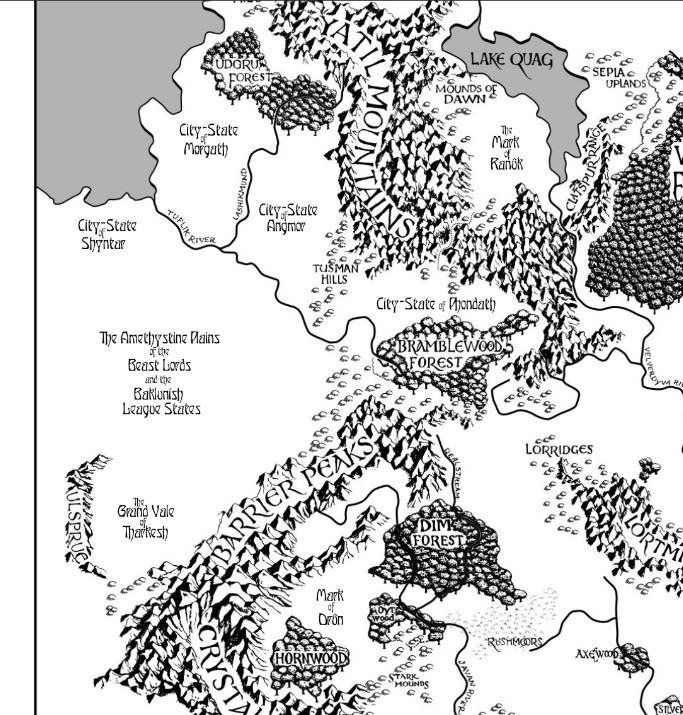
Here’s the updated #Dungeon26 map:

Soon, I will have to start on other sheets building out beyond the edges of this sheet.
Now, onto the first proper post of my “World of Greyhawk” campaign design journal. In this installment of the “WoG” campaign design journal I will be focusing on the various peoples that populate the “Flanaess” and their differences from official WotC canon.
As a reminder of what sources that I will be using, here’s a listing:
- The 1980 World of Greyhawk Folio
- The initial Deities and Demigods articles by Gary Gygax as published in Dragon Magazine.
Nothing beyond the above two sources will make up the foundation for my campaigns in “WoG”. So, forget all that you’ve ever read or experienced in the setting. As you know from my last post I changed the names of the Bakluni realms as well as those of Geoff, Sterich, Yeomanry and Perrenland.
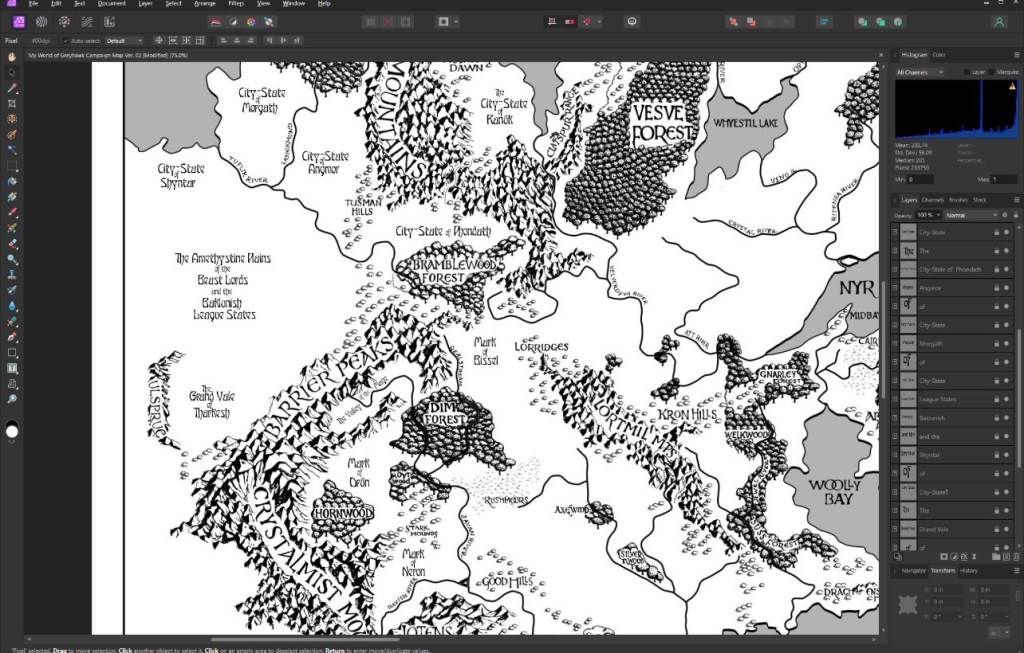
The reasoning behind the changes is to get rid of the Orientalist elements of the setting and those realm names that I always disliked – such as: Geoff, Sterich and Yeomanry. Most of the remaining realm names will remain unchanged, though many of the towns listed on the original Darlene map are being left off my campaign map unless they are mentioned in the “WoG” Folio.
Before I get into the Demi-Human and Humanoid kindreds, I want to discuss the four core “Human” kindreds and how I want them to be defined physically and culturally. They are not as described in the canon sources as I never cared for how they were portrayed.
The SUELOISE
In my version of the “World of Greyhawk” the oldest “human” civilisation was Sueloise, they were even more ancient than the Olve. Their language unlike in canon sources is not a dead language, though it’s only living dialects are spoken by the Northern “Barbarian” tribes, the tribes of the Amedio Jungle and Hepmonaland, and the peoples of both the Tilvanot Peninsula and Duxchan Islands.
The Sueloise and Olve peoples are linked through both Blood and Magic, and the Olve were once a integral part of the Sueloise Empire, until they became a perceived threat to the Imperial ruling class. Following the schism between these two kindreds, Imperial Doctrine became ethnocentric and a racially based caste system was established throughout the Empire.
The Olve were driven out of the empire via a program of genocide initially through slavery and eventually outright slaughter. Many of the surviving Olve fled east into the Flanaess creating bonds with the Flanae and various other Demi-Humans dwelling there for survival.
The Sueloise peoples are not a homogeneous species, most people descended from the survivors of the “Rain of Colourless Fire” were citizens of the eastern, northern and southern provinces and were of non Sueloise or mixed Sueloise stock.
Only the people who settled in the Tilvanot Peninsula were of “pure” Sueloise stock and descendants of the Sueloise ruling classes, who formed the Scarlet Brotherhood in hopes of restoring their lost power and influence. They see all other “Sueloise” peoples as mongrels and “false inheritors” Sueloise language and culture.
These “false Sueloise” people are believed to be only useful as pawns and used to have their racial “impurity” bred out of them. The “True Sueloise” as the people of the Tilvanot Peninsula ( and Duxchan Islands) see themselves as the saviours of their ancestral culture and ethnicity, even the non-ruling classes hold this to be true – or at least profess it publicly in order to avoid potential persecution by the Scarlet Brotherhood.
The people of the Barbarian North and the tribes of both the Amedio Jungle and Hepmonaland harbour no such ethno-chauvinist ideals. Their culture though rooted in what was Sueloise Imperial culture and language, the influence of the Flanae and Oeridians has long since helped shape the culture of the Northern Barbarian tribes.
While the indigenous populations of the Amedio Jungle and Hepmonaland helped shape the cultures of the Sueloise who settled and colonised those regions. Though loosely related by ancestry and the lingering influence of Ancient Sueloise Imperial culture the only thing that truly links these disparate populations is their languages and certain names that have survived into the present age.
Physical Description:
The Sueloise were a diverse kindred well before they migrated east into the Flanaess, Amedio Jungle and Hepmonaland. This physical description section will be broken into three subdivisions – “True Sueloise” of Tilvanot Peninsula and the Duxchan Islands, the Northern Barbarian tribes, the Sueloise tribes of the Amedio Jungle and Hepmonaland helped shape regions.
True Sueloise
True Sueloise are a tall bronze complexioned people with hair the colour of polished gold or silver as they age, eyes that span from amber to jade in colour. Amongst the members of the Scarlet Brotherhood can be found further mutations stemming from their age-old habits of magical genetic engineering. Their Clothing’s colours can be found in rich greens (sage, forest), cool tones (navy blue, teal), warm neutrals (beige, cream, taupe), and deep reds (burgundy, crimson).
Northern Sueloise Barbarians
Northern Sueloise Barbarians are often tall with complexions that are bronze to chestnut in coloration. Their hair can vary between black and brown, with occasional auburn colour. Their clothing is often in cool-toned blues (navy, cornflower), refreshing greens (sage, olive, mint), soft neutrals (cream, beige, grey), and muted warm tones (dusty rose, mustard, rust). Gold, brass, and deep teals also add a sophisticated contrast to this versatile colour. Their clothing often incorporates furs during the winter months.
Sueloise Tribes of the Amedio Jungles and Hepmonaland
The Sueloise tribes of the Amedio Jungles and Hepmonaland have a complexion that spans from muted bronze to Mahogany in coloration. Their hair varies from black to red in colour, with their eyes being blue to green. Their clothing is often of navy blue, sage green, or teal, which balance its warmth. For a classic, luxurious look, use neutrals such as cream, beige, or warm grey, or accent with gold and bronze to add depth.
Well, this post is getting extremely long and is just scratching the surface of the topic in question, as such I will end it for now and continue in a following bonus post coming soon. Till then please take care. Fin.






 Musing About Adventures in Classical Editions Play