#Dungeon26 instalment #5

Greetings and welcome to the delayed fifth instalment in my #Dungeon26 project and first official post in my “World of Greyhawk” campaign design journal. In my previous post I discussed briefly the scope of the changes to the setting including two versions of my campaign map.

The reason this post was so delayed was I caught the flu and it had me under the weather for two weeks. I had no spoons to work on anything creative.

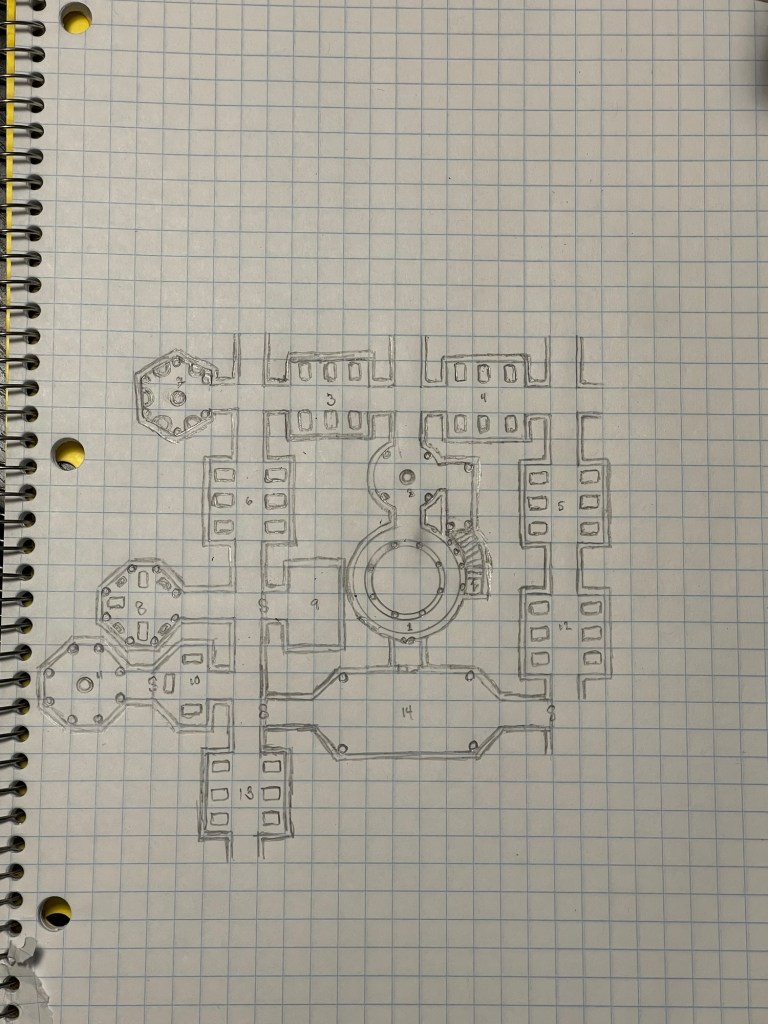
Here’s the updated #Dungeon26 map:

Soon, I will have to start on other sheets building out beyond the edges of this sheet.

Now, onto the first proper post of my “World of Greyhawk” campaign design journal. In this installment of the “WoG” campaign design journal I will be focusing on the various peoples that populate the “Flanaess” and their differences from official WotC canon.

As a reminder of what sources that I will be using, here’s a listing:

  • The 1980 World of Greyhawk Folio
  • The initial Deities and Demigods articles by Gary Gygax as published in Dragon Magazine.

Nothing beyond the above two sources will make up the foundation for my campaigns in “WoG”. So, forget all that you’ve ever read or experienced in the setting. As you know from my last post I changed the names of the Bakluni realms as well as those of Geoff, Sterich, Yeomanry and Perrenland.
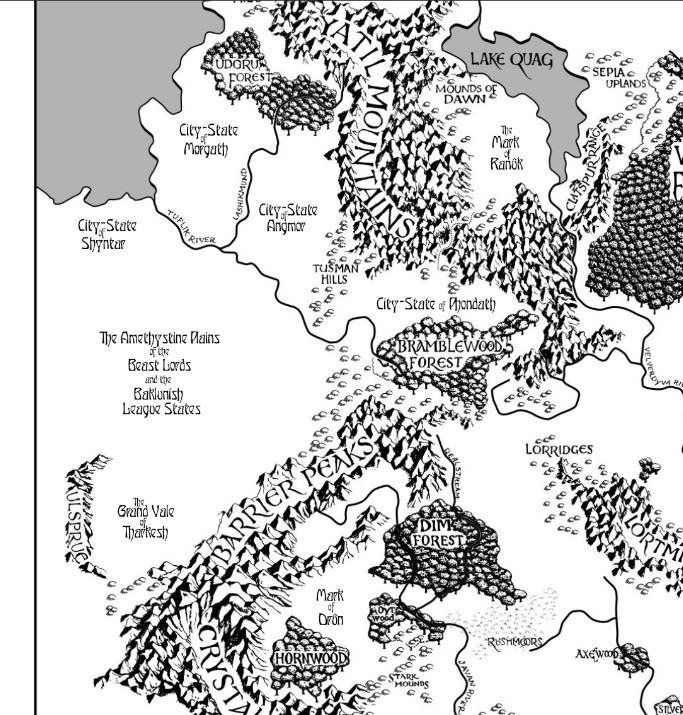
The latest version of my campaign map

The reasoning behind the changes is to get rid of the Orientalist elements of the setting and those realm names that I always disliked – such as: Geoff, Sterich and Yeomanry. Most of the remaining realm names will remain unchanged, though many of the towns listed on the original Darlene map are being left off my campaign map unless they are mentioned in the “WoG” Folio.

Before I get into the Demi-Human and Humanoid kindreds, I want to discuss the four core “Human” kindreds and how I want them to be defined physically and culturally. They are not as described in the canon sources as I never cared for how they were portrayed.

The SUELOISE

In my version of the “World of Greyhawk” the oldest “human” civilisation was Sueloise, they were even more ancient than the Olve. Their language unlike in canon sources is not a dead language, though it’s only living dialects are spoken by the Northern “Barbarian” tribes, the tribes of the Amedio Jungle and Hepmonaland, and the peoples of both the Tilvanot Peninsula and Duxchan Islands.

The Sueloise and Olve peoples are linked through both Blood and Magic, and the Olve were once a integral part of the Sueloise Empire, until they became a perceived threat to the Imperial ruling class. Following the schism between these two kindreds, Imperial Doctrine became ethnocentric and a racially based caste system was established throughout the Empire.

The Olve were driven out of the empire via a program of genocide initially through slavery and eventually outright slaughter. Many of the surviving Olve fled east into the Flanaess creating bonds with the Flanae and various other Demi-Humans dwelling there for survival.

The Sueloise peoples are not a homogeneous species, most people descended from the survivors of the “Rain of Colourless Fire” were citizens of the eastern, northern and southern provinces and were of non Sueloise or mixed Sueloise stock.

Only the people who settled in the Tilvanot Peninsula were of “pure” Sueloise stock and descendants of the Sueloise ruling classes, who formed the Scarlet Brotherhood in hopes of restoring their lost power and influence. They see all other “Sueloise” peoples as mongrels and “false inheritors” Sueloise language and culture.

These “false Sueloise” people are believed to be only useful as pawns and used to have their racial “impurity” bred out of them. The “True Sueloise” as the people of the Tilvanot Peninsula ( and Duxchan Islands) see themselves as the saviours of their ancestral culture and ethnicity, even the non-ruling classes hold this to be true – or at least profess it publicly in order to avoid potential persecution by the Scarlet Brotherhood.

The people of the Barbarian North and the tribes of both the Amedio Jungle and Hepmonaland harbour no such ethno-chauvinist ideals. Their culture though rooted in what was Sueloise Imperial culture and language, the influence of the Flanae and Oeridians has long since helped shape the culture of the Northern Barbarian tribes.

While the indigenous populations of the Amedio Jungle and Hepmonaland helped shape the cultures of the Sueloise who settled and colonised those regions. Though loosely related by ancestry and the lingering influence of Ancient Sueloise Imperial culture the only thing that truly links these disparate populations is their languages and certain names that have survived into the present age.

Physical Description:

The Sueloise were a diverse kindred well before they migrated east into the Flanaess, Amedio Jungle and Hepmonaland. This physical description section will be broken into three subdivisions – “True Sueloise” of Tilvanot Peninsula and the Duxchan Islands, the Northern Barbarian tribes, the Sueloise tribes of the Amedio Jungle and Hepmonaland helped shape regions.

True Sueloise

True Sueloise are a tall bronze complexioned people with hair the colour of polished gold or silver as they age, eyes that span from amber to jade in colour. Amongst the members of the Scarlet Brotherhood can be found further mutations stemming from their age-old habits of magical genetic engineering. Their Clothing’s colours can be found in rich greens (sage, forest), cool tones (navy blue, teal), warm neutrals (beige, cream, taupe), and deep reds (burgundy, crimson).

Northern Sueloise Barbarians

Northern Sueloise Barbarians are often tall with complexions that are bronze to chestnut in coloration. Their hair can vary between black and brown, with occasional auburn colour. Their clothing is often in cool-toned blues (navy, cornflower), refreshing greens (sage, olive, mint), soft neutrals (cream, beige, grey), and muted warm tones (dusty rose, mustard, rust). Gold, brass, and deep teals also add a sophisticated contrast to this versatile colour. Their clothing often incorporates furs during the winter months.

Sueloise Tribes of the Amedio Jungles and Hepmonaland

The Sueloise tribes of the Amedio Jungles and Hepmonaland have a complexion that spans from muted bronze to Mahogany in coloration. Their hair varies from black to red in colour, with their eyes being blue to green. Their clothing is often of navy blue, sage green, or teal, which balance its warmth. For a classic, luxurious look, use neutrals such as cream, beige, or warm grey, or accent with gold and bronze to add depth.

Well, this post is getting extremely long and is just scratching the surface of the topic in question, as such I will end it for now and continue in a following bonus post coming soon. Till then please take care. Fin.

Bonus post…Adventures in World of Greyhawk

Greetings and welcome to the latest bonus installment of the Adventures into Classical Editions Play blog. In this post I will be discussing my Scalemail (a personal hack of OD&D) primary campaign setting – the World of Greyhawk.

In this bonus article series I plan to share the various minor and major changes that I am making to the setting. The following is a list of sources that I will be using to develop my incarnation of the setting.

  • The 1980 World of Greyhawk Folio as the foundational document.
  • The cleaned up Darlene WoG map by Zach Henderson and assistance by Robert Conley. I am using the Greyscale historical version of the map to label as I desire.
  • The initial Deities & Demigods articles by Gary Gygax in Dragon Magazine.
  • For Scalemail I will be using the 3LBBs, articles in Strategic Review and a few Dragon Magazine articles to add bits to my hack.

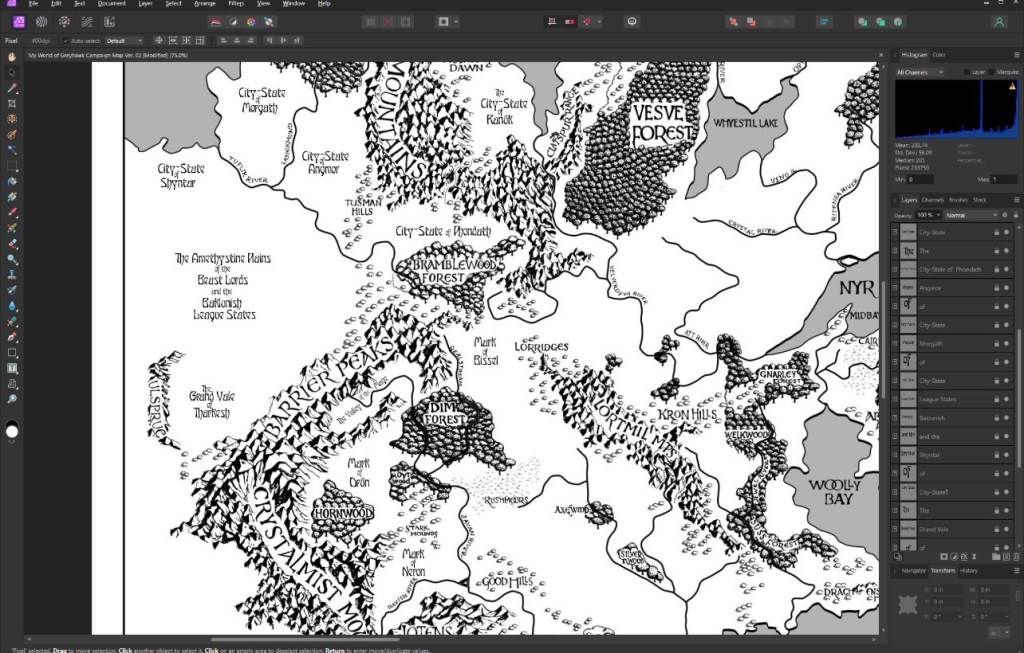
I have begun the development process by adding name changes to the various Bakluni states/regions, as well as the realm that was the Grand Duchy of Geoff. My initial attempt was to lean into the South Asian/Middle Eastern aspects of the original setting. The image below shows what that attempt was looking like. It just felt off to me.

I’m using Affinity Photo to add labels to the map.

Recently I decided to take names from my World of Skârn setting to erase the more Orientalist based elements of the setting and lean more into the Pulp Fantasy aspects of the setting.

The updated version of the map.

Understand that this will be the main change to the map except for a few city/town/village name changes that I never cared for. Most of the other changes to the setting will be centred around the kindreds that populate the world.

One thing about the Demi-Humans on my version of WoG is I am leaning heavily into the definition of the word “Demi” – which is “Partial or Half”, thus Demi-Humans are partially or half Human hybrids of the “True” races after which they are named or confused for.

In future installments of this series I will go into greater detail about these changes and how they will be implemented in Scalemail. I will be making some changes to the Humanoids as well, though I will be learning into the Pigfaced Orc thing, plus there will be no Half-Orcs, Gnolls, Kobolds or Hobgoblins as described in D&D – or at least not the post Chainmail iterations of D&D.

Concerning the World of Greyhawk pantheon I will initially be focusing exclusively on the powers as described in Gary Gygax’s initial Dragon Magazine articles. I have no current plans on including any of the expanded Deities and Demigods added in Dragon Magazine nor other TSR or WotC WoG products.

Well, this is enough of an overview of this project and I need to prepare for get off my bus and to run a quick errand before I get to work tonight. So I will end this post and get it published and shared.

Remember, next week I will be posting updates on my #Dungeon26 progress as normal. I will likely also be including the first proper segment in this WoG campaign development journal as well. See you soon, fin.

Changes…plus, #Dungeon26 instalment 4.

Greetings and welcome to the latest installment of this blog, as the title suggests there’s changes being made to it…and no I am not going on another hiatus. The changes to the blog is that I am going to be ending the Gygax 75 Challenge portion of the current series. I have tried the challenge on multiple times and yet haven’t finished one of them.

Though I love the concept of the Gygax 75 Challenge it is just not compatible with how I design settings. I prefer to create organically as I wander about my day or while sitting in front of my PC. Having to follow a set weekly schedule is counterintuitive to my creative process.

I have also come to the conclusion that creating my own homebrew settings is no longer a viable way for me to go forward. My work and sleep schedule doesn’t allow me the free time to do these kind of projects.

That means that any campaign settings that I will use, will need to be premade. As such, for my upcoming Scalemail campaigns I need to decide which of my Top Five Favourite Campaign Settings to use for them.

Of my top five favourite fantasy settings three are nixed straight out of contention – The Warhammer Fantasy “Known World”, which I have other plans for. Eberron is a no go, as I am likely using it for my Rolemaster play-by-post campaign. The “Known World (Mystara)” setting is too fleshed out for my needs for this campaign, if I run BECMI D&D I will then use it for that.

So, that leaves me the 1e Forgotten Realms and World of Greyhawk Folio settings. Of the two I have chosen the “World of Greyhawk” 1980 Folio edition. That means expect some major and minor changes to the setting.

I will be publishing a special bonus post about my initial plans for my personal incarnation of the “World of Greyhawk” and how my personal hack for “WoG” will manifest and how I plan on running my campaigns in the near future.

Once the bonus instalment is published, I will publish the next one covering #Dungeon26 as planned.

#Dungeon26 map update

Well, this post is getting long, I just wanted to finish by showing the latest update to my #Dungeon26 map – another 7 rooms done. So, that’s it for now as I have to begin eating dinner and preparing for work tomorrow and get some initial work done on the bonus post coming soon. Fin.

The Third installment of my Gygax 75 Challenge and #Dungeon26 projects Blog Series

Welcome to installment three of this series, but before I get into the meat of the post, I wanted to do a general update concerning my blogs – yes, you read that right…blogs. I totally spaced having other blogs on WordPress, I had thought that I had deleted them. Well, I guess I didn’t oopsies. As such I am moving what was going to be a blog series here “Adventures in the Known World to my “Oldhammer Gobbo’s Adventures into the Known World” blog instead. That way I don’t have to clutter posts here with Skirmish and other Wargaming content.

I also noticed that I had two other blogs as well. Hive Kratos was my Necromunda based blog but since I am shuttering that project, I will be deleting it. I also have a general Military Wargaming blog called “Kommando-Bunker 68”, this one will survive the purge and relaunched in the near future once I have content to publish there.

Now that the blog update is finished, I’ll will get back to the meat of this post.

But before I get to my Gygax 75 Challenge and #Dungeon26 projects I wanted to mention briefly a progress report for Scalemail – I have gotten through the Attributes and Alignment sections of the Character Creation chapter and have just begun the Archetypes section of the chapter. These archetypes will be thematic in nature and rooted to the setting of the Grymmlonds. I’ll post screencaps in my next blog post in this series next week.

Concerning Week Three of the Gygax 75 Challenge, I pretty much have been working on this as part of the #Dungeon26 project. That said, I plan on sketching out the Town Map this week as I have time so I can post Week Four content properly. Since, I have no real content to post for the Dungeon Week, I’ll move onto the #Dungeon26 portion of this post.

As the image above shows, I have added seven more “rooms” and four potential exits from this level or region of the catacombs. I also added a winding tunnel with an underground stream coursing through it. As I reach the edges of this sheet more “natural” formations will be added to the map to give it more variety.

Lastly, before I end this post and publish it, I wanted to mention another setting project that I’ll be working on as I move forward with this blog. In the following weeks I plan on developing my “code-name: Pangaea” setting set in an alternate mythic fantasy version of Earth. The map below is a teaser image that I created via Wonderdraft a while ago. Well, I hope y’all enjoy this brief post and see you next week. Fin.

The second installment of my Gygax 75 Challenge & #Dungeon26 projects

Greetings and sorry for the lateness of this follow up to my previous Gygax 75 Challenge and #Dungeon26 projects blog post, as I said in my last post things were anxiety inducing. That being said, I have done some work on all three of my projects, just not the amount I would have preferred to have done. Progress on my OD&D/Chainmail hack is still in its early stages…too early to post anything of note.

Moving on I have done the rough sketch of the surrounding area bit of the Gygax 75 Challenge, so I’ll post that below. I plan on redrawing it on a separate piece of Hex paper since the booklet I drew the rough sketch in isn’t the easiest to draw in as it wants to close on me. Yet, I wanted to get at least a rough preliminary sketch done since I need to source hex paper after I get paid this week.

The above preliminary rough sketch is to give an idea of the core dungeon and immediate surroundings of the dungeon and safe haven for the players will be. I may also do a digital version of the map via Inkarnate since I have a subscription at the Studio plan level…I might as well get some use from it, right?

I took the basic idea behind the #Dungeon26 project that I am working on to inform what the surrounding area was to be. As I said previously, these projects are interconnected after all. I’ll post both the initial hand drawn maps and any digital versions I make of them as I want to improve my skills both my traditional drawing and digital mapping ones. I unfortunately allowed my traditional drawing skills get rusty, so I’ll be endeavoring to improve them over the next several months.

The updated #Dungeon26 map

Well to end this installment I wanted to post the updated #Dungeon26 map with the next seven rooms of the Dwarven Catacombs. Again, since I don’t want to spoil things for my potential future players when I run them through this mega dungeon in early January 2027 once the #Dungeon26 project finishes the week of December 31st, 2026. So far, I am quite pleased with the progress in this map especially in comparison to my Gygax 75 Challenge rough sketch map.

Hopefully next week I’ll have another installment in this blog series, that said I’ll likely also publish an extra blog post though I am not sure what that post may be about yet. Until then please take care. Fin.

Adventures in the Known World

A Warhammer Fantasy Battle 2e, Warhammer Fantasy Roleplay 1e & Mordheim series

Editor’s Note: This series will be moved to my old “Oldhammer Gobbo’s Adventures into the Known World” blog.

Welcome to the “Adventures in the Known World – A Warhammer Fantasy Battle 2e, Warhammer Fantasy Roleplay 1e & Mordheim series” – in this blog series I plan to discuss my views on these three games and publish future battle reports and campaign session recaps. I’ll also be publishing articles on fan content I create expanding upon the settings and lore according to my “fan-canon’, this “fan-canon” will be initially rooted in the lore as described first in Warhammer Fantasy Battle 2e and then what was fleshed out in Warhammer Fantasy Roleplay 1e. That said, the Mordheim lore will be modified only so much that it deviates from the lore as presented in WHFB 2e and WHFRP 1e, mainly in concerns to warbands and how they may be portrayed – this will definitely affect the “Lustria” sub-campaign and the warbands native to that region.

I’ll also discuss fan content such as the “Der Gaukler” zines by Moshartz as it is highly inspirational zine that shows how one can make additions to Mordheim through one’s personal campaigns and thus expanding upon the rich lore of “Known World”. I’ll also discuss my favourite YouTuber’s Warhammer Fantasy Battle, Warhammer Fantasy Roleplay 1e and Mordheim content and how they’ve inspired me and my own personal campaigns.

My Warhammer Fantasy Battle 2e campaigns will be highly narrative skirmish focused, in nature eschewing the more competitive and larger army focused aspects of the hobby. The setting for all of my campaigns will be set in the Mordheim timeline. As such my campaigns will have more of a grim dark aesthetic compared to the brighter “Herohammer” era of the early 90s during 4th and 5th editions of Warhammer Fantasy Battle.

Since both of my WHFB 2e and WHFRP 1e campaigns will share the timeline as presented in Mordheim, as such they’ll be set during the turbulent period of Imperial civil unrest as the various claimants to the Imperial Throne  strive to gain the right to be Emperor Elect and rule a reunited Empire and usher in a new age of peace and prosperity for the Empire and its people. This period of turmoil will be the binding metaplot tying the various campaigns together.

Beyond the upcoming battle reports and campaign session recaps, and various articles focused on my new fan-canon I will also be publishing articles discussing creating terrain for both my WHFB 2e and Mordheim campaigns. I will also be spotlighting my warband creation projects and the creation of NPC monsters that will cause extra Chaos in both campaigns.

The reason that this blog series is being published on my “Adventures in Classical Editions Play” blog is that the games being covered are “classical” editions and unsupported spin-off games that are no longer supported by Games Workshop. Just as OD&D, Chainmail, BECMI and 1e AD&D are “classical” editions of D&D no longer supported by Wizards of the Coast/Hasbro. In future blog series published on this blog will focus on other “Classical” editions of games published during the 80’s into the early 90’s such as “Palladium Fantasy 1e”, “Teenage Mutant Ninja Turtles and other Strangeness”, “RIFTS 1e core book”, “Ninjas and Superspies”, “Beyond the Supernatural 1e” and “After the Bomb 1e” from Palladium Books; as well as “Cyberspace 1e RPG”, “Rolemaster 1/2e” and “Spacemaster 2e” by Iron Crown Enterprises, amongst other from that era.

By covering these other games, it will give me a ton of potential content to create for my campaigns and to share here with you my dear readers. Instead of creating several separate blogs and getting burnt out trying to make separate content for them and trying to create regular content for my OD&D/Chainmail hack which is simply a long-term passion project for me. These themed blog series will allow me to create content for other games that I love and share them here.  

Next Friday, I’ll be doing the second instalment of my Gygax 75 Challenge and #Dungeon26 project, last week with the local ICE targeted stops leading to shooting victims to drive into our neighbourhood and investigations occurring across the tram tracks from where I live…I wasn’t in the mood to work on either project. Future instalments in this series will be published when I have content to publish and share. I will say that the next instalment will focus on me discussing the timeline and various minor or major changes that I made to the official lore of the “Warhammer Fantasy” universe so you’ll have an idea of the setting and vibe my upcoming campaigns will have. Until next week please take care of yourselves in this perilous time that we are living in. Fin.

A Blog Reborn…Moving forward into 2026

`Greetings and welcome to “Musings about Adventures in Classical Editions Play” blog, I decided to resurrect my old Classic Tabletop Role Play Games blog for 2026. If you’ve followed this blog back when it was active you’ll notice a ton of old posts were purged, I did this as I wanted to clean up the blog and only keep the stuff that I was most proud of. That being said, I decided to resurrect this blog to help me actually get creative again and break through my creative block by having brief weekly blog posts to compose and publish on a regular basis.

The scope for this blog is to focus on three interrelated projects –

  • The development of my hack of OD&D/Chainmail for my personal D&D campaigns.
  • The development of my campaign setting for those campaigns via Gygax 75 Challenge.
  • The development of the initial dungeon via #Dungeon26.

I’ll be posting once a week with discussions on the development for these three projects, so I have a weekly goal for my creative output moving forward into 2026. In today’s post I’ll be discussing first steps in each project in turn.

My OD&D/Chainmail Hack – the Scalemail System

First off, this is not a project for future publication, it is simply for my personal use in my campaigns. In the past I allowed a desire to publish my hack to corrupt my creative process, and it caused multiple bouts of burnout for both my creative output and this blog in particular. I am striving not to continue making the same mistakes that plagued this blog and my past TTRPG creative efforts this time around.

Most of my previous readers who have chosen to check out this post out will know that I love the “Toolbox” aspect of OD&D, allowing fans to create their own hacks of the rules. Though I love this version of D&D, I do have my own preferences and as such the Scalemail System – or simply Scalemail, will conform to these preferences.

The core differences between Scalemail and other published hacks and the official OD&D rules are listed below:

  • Different Ability Scores – I find the official Abilities as lackluster and in later editions made things worse.
  • Different Classes – The classes (called archetypes) for Scalemail are more thematic and informed by the campaign setting.
  • A tweaked version of the Magic System, still Vancian in style just more thematic in nature and tied to a power point system.
  • A different combat system inspired by Chainmail and based upon my interpretation of the rules.
  • A different level progression system including abilities or maneuvers gained at new levels, which cap at 12 for each Archetype.
  • Races in Scalemail are tweaked versions of the OD&D races and are referred to as Kindreds.
  • Monsters and other non-Player Character encounters and potential threats are tweaked to fit my preferences.

In future posts I will cover aspects of Scalemail in a similar format as found within the OD&D “little brown books” (LBBs) except in a more expanded but concise manner. When possible, I’ll also include “designer notes” explaining the “why’s and wherefores” of my choices.

Gygax 75 challenge 2026 – The Grymmlonds

In developing my new homebrewed setting, I decided to use Ray Otus’ Gygax 75 pdf to help me create the setting in a timely and more restrained manner than I usually do thus hopefully limiting potential creative blocks.

Since this is the first week of both this blog and the Gygax 75 Challenge, I’ll start with the “Concept” stage of the challenge. As such the following “Bullet Points” list will focus on “The Pitch” and “Sources of Inspiration” for “The Grymmlonds”.

The Pitch –

  • A Points of Light Setting – the setting is a Post-Apocalyptic Science-Fantasy one informed by the implied setting from the OD&D “LBBs” but tweaked to fit my preferences since my influences are not those of Gygax and crew. I was born in 1972, and my inspirations are more contemporary in nature, though they do include Jack Vance’s “Dying Earth” tales, H.P. Lovecraft, R.E. Howard, Michael Moorcock and Fritz Leiber.
  • Chaos or the Unriht is ascendant – The Powers of “The Unriht” plague the world, it is a world in turmoil and ruin – kingdoms and empires no-longer exist – including those of the Elves and Dwarves, the sources of their magic and long lives no-longer exist and as such they are dying species little different than Men and Hobs – beyond culture and demeanor.
  • New “Gods” have arisen from the death of the Old Ones – The Old Gods are dead; they sacrificed themselves to preserve the world and seal away the most destructive and powerful Gods of the Unriht. New Gods of Riht and Balance have arisen from the bones of the Old Gods to inspire and empower new Heroes to help drive back the corruption and blight of the Unriht upon the world.
  • Old World objects and materials are gathered for Experience not Gold Pieces – instead of Gold Pieces equaling Experience Points, characters scavenge lost pre-cataclysm items and technology, as well as materials from slain monsters, magical herbs and other substances found during delves into the ruins, wilderness and the Unriht birthed living Underworld.
  • There are three sources of magic in the World of the Grymmlonds – These sources of magic are as follows: The Riht or Law in OD&D parlance, the Wiell of Heolor (the Well of Balance) – Neutrality in OD&D terms and The Unriht or Chaos in OD&D. Magic derived solely from “The Riht” is focused on creating, strengthening, purifying and healing, whereas magic derived solely from “The Unriht” is focused on destruction, corruption, disease and death. Magic derived from the Wiell of Heolor is the remaining essence of the Old Gods after they sacrificed themselves to seal away the Greater Gods of Unriht. This magic fuses elements of both “The Riht” and the “Unriht” thus creating magic that draws from both but without the need for an alliance to either the Riht or Unriht.

Sources of Inspiration –

  • Blade & BastardWarm Ash, Dusky Dungeons Light Novel by Kumo Kagyu. Is a fantasy Light Novel inspired by the Wizardry computer game series, and thus Dungeons and Dragons. The vibe is gritty D&D; it reads like a campaign-based narration.
  • Made in Abyss Manga by Akihito Tsukushi. It is a Manga (and Anime) based around a living and corruptive Dungeon/Mythic Underworld. I love how the “Dungeon” is a living entity that has its own biomes and creatures, and the fact that the deeper you go the greater the chance you’ll be lost to the Abyss.
  • The Faraway Paladin anime on Crunchroll. It is an Isekai where the main character is reincarnated in a fantasy world and raised by a trio of Undead. Though the character is technically “Overpowered” by OD&D/Classic D&D standards – not if you incorporate elements of Chainmail to that mix. Still in terms of the setting it does have a “Points of Light” vibe and as such I find it inspiring.
  • Goblin Slayer Light Novels by Kumo Kagyu. This series also by the author of Blade & Bastard is a at times very dark fantasy, though it is a bit more lighthearted and generic than Blade & Bastard is. It does give an example of how deadly early levels of D&D can be if properly DMed. Though some of the supporting characters can be seen as “overpowered” as found in 5e D&D, they are also high-level characters and the type of threats that they face are considerably strong.
  • Grimgar, Ashes and Illusions anime. This series is another Isekai that began as a Light Novel series before becoming a anime, I have only watched the anime. Like Goblin Slayer it accurately portrays how deadly D&D is especially in Classic D&D editions and how poor choices and mistakes can cause characters to die. Not only is the combat more in line with Classic D&D the focus on downtime activities and use of proper tactics can increase chances of survival, victory and growth (experience).
  • Lastly, Thieves’ World by various writers. Thieves’ World is a wonderful anthology series (and spinoff novels) written by some of the best writers in Fantasy and Science-Fiction. The setting is a gritty city that weaves political intrigue with tales of the various inhabitants of the city during a period of political upheaval brought on by a new regime and the eventual invasion of another power in the world. It’s a good example of factions and their rivalries impacting the city and its inhabitants both high and low born.

#Dungeon26Week One.

Unlike others who do this challenge as intended I plan on following other participants examples of doing this challenge weekly instead of daily. My work/sleep schedule does not allow me to do this on aa daily schedule. So, instead I’ll be drawing and describing seven “rooms” areas of my mega-dungeon on a weekly schedule instead.

The “Dungeon” lies beneath the ruins of a former trade city once ruled by Dwarves who built the city within a mountain pass. After the “Great Cataclysm” the city was destroyed – its people were killed, warped or fled their former home to safer environs. A new fortified town has arisen overlooking the ruined city, the pass where it lies and the fertile region to the west of the mountains.

The “Dungeon” itself looks like the gaping maw of some monster jutting from the earth at the center of the pass and ruins. A stairway has been magically formed within the interior wall of the “Maw or Pit” spiraling down into the depts of the dungeon. At the bottom is a large circular pond filled by rain and runoff and home to fish and other aquatic creatures. Where the stairway ends, is a vaulted chamber that opens in two directions:

  • South into a semi-open columned promenade surrounding the interior pond.
  • North into a vast warren of a catacombs of what was once the Dwarven Undercity.

The catacombs and promenade are the few parts of the ever-changing dungeon that are of Dwarven craftsmanship and are generally unchanging in their makeup.

The first seven rooms of the dungeon.

I’m not going to key this part of the dungeon until later, as I don’t want potential players to learn any secrets about this dungeon so I’m only sharing the rough draft here.

Well I have errands to run so I’ll be ending this post and publishing it before I leave. Please take care my dear readers and have a wonderful New Year in 2026. Fin

Magic-Users in my OD&D Campaign Part 4 – The Khondrū

225206AE-76E0-4ADF-BC18-A867EBAB901F

By Daarken

Greetings, in this installment of my Magic-Users in my OD&D Campaign series I will be tackling my version of Druids  – The Khondrū. I have not exactly cared about how the various editions of D&D treated Druids.

That said, I am not going to go too far afield in how they have been described; but I wanted to give my own tweak on them. I want them familiar enough to be recognizable as Druids but fit the vibe of my setting.

Khondrū in my setting serve the Titans and also serve their tribal communities. They have three main branches of their religious order – Dakūl (Oracles), Khondrū (Priests) and Sangōl (Bards).

They are also served by two lesser branches  The Halût Khondrū (AKA the Adventuring or Wandering Khondrū) and Zanthū (Rangers).

The core of this article will focus on the Halût Khondrū as they are who players will play as or encounter most often. That said I want to give a bit more background on my setting and how the Halût Khondrū fit within it as a religious order and power faction.

The Khondrū Order is a northern (in context of the initial campaign setting local) regional power amongst the tribal peoples. They give advice to Tribal and Clan leaders and coronate the the local Tribal leaders.

They hold immense sway amongst the

Northern Tribes located in what is known as the Tharkeshi Wilds.

The region is dominated by a large primal Cedar forest that blankets the hills and lower elevations of the Wantū (the Troll Mountains). The other parts of the Tharkeshi Wilds are lush plains and arid badlands.

The Khondrū Order are the remnants of an ancient religious order dedicated with preserving the eternal balance and acting as the mortal agents of the Primordial Titans after they sealed the world from the powers of Law and Chaos.

Khondrū is merely the regional name for these agents of the Titans. They have their own cultural variation upon their ancient order unique to their region.

The Titans taught their ancestors the secrets of Nature Magic and the various arts that they utilize in their long multi millennia existence. After the cataclysm much of their lore was lost.

The order decided to send out young adepts (Halût Khondrū) to wander in search of the lost lore and bring it and and relics of the order that they find. In this they are like Adventuring Priests of the “decadent” Southern City-States.

These Halût Khondrū (or Halût for short) are trained for years in wilderness survival, martial arts, music, religious and magical traditions of their Order. They then go for forth wandering in search of lost lore of the Khondrū Order.

This serves an additional purpose for the Order in that it helps weed out the weak amongst their number and strengthens the Order with those that survive and return.

Unlike Adventuring Priests, Warrior-Priests and Elementalists; the Halût Khondrū do not try to convert others to their ways or set up shrines. If they survive their wandering and prove themselves worthy they will be assigned a tribe or Clan of the Tharkeshi Tribes.

Those Halût Khondrū that excel in divination become Oracles, while those who excel music & storytelling become Sangōl; while those who master all the skills become true Khondrū – the Priests of the Order.

Once they return from their wanderings they are tested and evaluated to see what branch of the Order they will serve in. Only true Khondrū are granted a tribe or clan to serve often replacing their older Khondrū who had passed away or was to infirm to serve properly.

Both men and women can serve as as equals within the Khondrū Order.

Advancement is based on merit not nepotism or favoritism. Those who prove themselves worthy advance, those who don’t are given two choices – leave the Order and find a new life or join the Zanthū (Rangers) as defenders of of the Tharkeshi Wilds, especially the primal Wantū Forest where the Khondrū Order dwells.

There is a Chaotic counterpart to the Khondrū Order – The Azūzū Order of the dark Cedar Forest of the Chordeshi Wilds to the South.

4220E1CA-8AD4-4E1F-B9E3-7756157F747A

By Joseph Weston

Halût Khondrū

HD 6   Alignment Neutral or Chaos

Armor: Leather or fitted animal hide.

Weapons: Dagger, Darts, Spear, Staff, Sword and Bow.

Abilities:

  • Spellcasting – Nature/Elemental and Chaotic Spells.
  • Move Silently 1-4on a d6 in Wilderness only but 1-3 on a d6 roll elsewhere.
  • Hide in Shadows 1-4 on a d6 in Wilderness only but 1-3 on a d6 roll elsewhere.
  • Climb Shear Walls 1-4 on a d6
  • Backstab/Ambush on a successful Move Silently roll or Hide in Shadows roll.
  • At 3rd Level they can brew and use poison/venom on a 1-3 on a d6 roll. This increases to 1-4 on a d6 roll at 6th Level and a 1-5 on a d6 roll at 8th Level and above.
  • At 4th Level Pass without Trace in Wilderness only.
  • At 4th Level a Khondrū can summon a animal Familiar depending upon terrain type ritual is performed.
  • At 6th Level a Halût Khondrū takes their test. Those that succeed are granted Laying on Hands 3 times a day 1d6 at 6th Level, 2d6 at 8th Level & 3d6 at 12th Level.
  • At 8th Level Invisibility at will in Wilderness only.

Note: Halût Khondrū (Druids) and Zanthū (Rangers) are the only Humans that can use thieving skills listed above at that chance value, all others can try at 1-2 on a d6 roll.

Restrictions:

  • They cannot wear any armor beyond Leather or fitted Hide.
  • They can only use listed weaponry.
  • They cannot be Lawful
  • They must tithe 50% of their Wealth to their Order – Khondrū or Azūzū.
  • If they use Chaos spells more frequently than Nature spells they become corrupted and are initiated into the Azūzū Order and begin to acquire Chaos mutations.
  • They gain a -1 to Reaction Rolls amongst civilized Folk and a -2 Reaction Rills against Humanoids.
  • Halût Khondrū of the Khondrū and Azūzū Orders will attack each other on site and fight to the death – no exceptions.
  • Halût Khondrū who spend more than a week in a city gain a -1 on all rolls until they return to the Wilds for a week. This increases for each week within the city up to a max of -3.
  • Must take a taboo and abide it or if found in violation they lose access to their spells and must preform a 3 day fast and ritualistic cleansing rites.

There are no shape change abilities like the Druid. I wanted my Druid stand ins to have their own thematic feel. I went with the initial concept that Druids were basically a multi-classed Cleric/Magic-User with Thief abilities but without actual multiclassing.

Like all my class variations I wanted to have their own thematic vibe and speak of the setting they are developed for.

I hoped that you found this installment of my Magic-Users in my OD&D Campaign series of interest. Please take care, fin.

Magic-Users in my OD&D Campaign Part 3 – Elementalists

59898DB4-96CF-407A-B2FC-63D54F8324BD

By Paolo Puggioni

Greetings, in this post I will be continuing my series concerning Magic-Users in my OD&D campaign.

In this installment unlike my last post in the series where I showEd with some thematic tweaks how you can reskin the standard Magic-User to create a new class or variant. In this installment I will take the Magic-User class and make some more definite changes, thus creating an all new class. 

In my setting magic is still potent and flows through everything. It has three origins Law via divinities or agents of Order, Chaos via Infernal divinities or agents of Chaos and lastly Neutrality via the Titans – primordial divinities of Nature or other agents of balance or the eternal cycle.

Though magic is still potent in the world, the knowledge has largely been lost following the aftermath of a worldwide cataclysm.

Long ago the Titans sick of the constant struggles of both Law and Chaos in the world created powerful seals limiting access to the world by the powers of Law and Chaos.

Creating these seals drained the Titans of power and forced them into a multi millennium slumber. During this time where the divine and Infernal was limited from influence within the world, the Magi, rose in power and influence.

Unbeknownst to these mortal practitioners of magic that the more that they used magic the weaker the seals became. So after three millennia the seals broke and magic floods back into the world in uncontrollable torrents – that warped the very world in its wake.

Civilizations crumbled, new civilizations rose and fell again. But it wasn’t just magic being released into the world, but Infernal creatures from the Underworld, creatures and agents of Law from the Outer Realms of Law and from the Elemental planes.

Though much of the lore was lost in last century or two of the aftermath there were those who did preserve some of this magical lore – the Magi. Though few in number they sought to reclaim their lost secrets and regrow their numbers, power and influence.

As part of this process some came under the influence and eventual patronage of agents of Law, Chaos and Neutrality. One of those factions in the world are the Elementalists.

Elementalists are similar to Adventuring Priests and Warrior-Priests as they derive their knowledge and abilities by creating pacts with Elemental Lords.

But unlike the Adventuring Priest and Magi who need to study and research new spells to cast their magic – Elementalists can tap into the Elemental Realm of their patron and cast their spell without having to do research or study a spell book and memorize a spell.

That said they require concentration and time for marshaling the power and to properly manifest the spell within their mind in order to cast it. The more powerful the spell the longer and more draining the spell.

Whereas both Adventuring Priests and Magi can cast spells via incantations or prayers, Elementalists cannot.

3CE0C66B-DCAE-4632-97D6-3F1293270CE3

By Matt Forsyth

Elementalists also are limited to Spells tied to their Elemental Lord and their duty to them. But they gain other abilities to counter this restriction in spells.

There are four Elemental Lords – Grond Lord of Earth, Ishya Lady of Air, Zhuul Lord of Fire and Kilat Lady of Water.

Like Adventuring Priests and Warrior-Priests Elementalists must preform sacrifices and create shrines to exalt their patron and bring new gifted vassals to their patrons service.

Elementalists gain abilities in exchange for their service and loyalty to their Elemental Lord. These abilities are are tied to the element their patron controls.

An example: An Elementalist of Zhuul has abilities tied to Fire and has an animosity to Elementalists of Kilat.

C2226157-C1E3-4A9B-80A4-A831C537C1D4

By Felicia Cano

Elementalists

HD 6  Alignment Neutral

Weapons: Special see below

Armor: None

Abilities:

  • Spell Casting – restricted to those tied to element of their patron.
  • Elemental Resistance – resistance to normal non-magical attacks or aspects of nature tied to their element. They get a +2 to all saves vs. these attacks/aspects. Special see below.
  • Elemental Resistance  – at levels 3 and 6 they get Save vs. magical attacks as if they were twice their level (6 & 12 respectively).
  • Elemental Immunity – at level 12+ they have full immunity to all natural and magical attacks linked to their chosen element – including Dragon’s Breath.
  • Elemental Aspects – at levels 4, 8 & 12  the Elementalist develops a mutation tied to their element and this in turn will gradually transform into a semi-elemental being with an extended lifespan. Special see below.
  • Summon an elemental familiar tied to their element. Special see below.

Restrictions:

  • An Elementalist cannot join a party with another Elementalist of their rival Elemental Lord. Example: Zhuul – Kilat and Ishya – Grond.
  • Vulnerability to opposing Element -2 from 1st to 4th level, -4 from 5th to 8th level and -6 from 9th level on saves Vs. that element.
  • They must choose a taboo and if they break the taboo they are sent on a quest (as spell) to redeem themselves. They lose their abilities until the quest is completed or they fail in which they lose them permanently or they died on the quest.

Special Notes:

Weapons – An Elementalists are trained in weaponry symbolically tied to their Elemental Lord:

  • Grond – Bludgeoning Weapons
  • Ishya – Missile Weapons
  • Zhuul – Bladed Weapons
  • Kilat – Whips and Chain based Weapons

Combat – Elementalists are trained in Martial Arts styles symbolically tied to their element:

  • Earth – Defensive, Hard and immobile, strikes, locks and grappling.
  • Air – Defensive, Light and flowing, strikes and throws.
  • Fire – Aggressive fast and flamboyant. Strikes and bladed hand and feet weaponry.
  • Water – Aggressive but flexible. Locks, throws and grappling.

In these Martial Arts they can only be used against Humanoid opponents and they add a +1 to both their AC and Damage while fighting unarmed (minus exceptions above) every 3 levels.

At 1st-3rd level they get +1, at 4th -6th level +2, at 7th-9th level +3 and 10+ level they get a +4.

Elemental Familiar:

At 3rd level an Elementalist preforms a ritual involving a sacrifice and if their Elemental Lord is pleased will send their servant a elemental familiar to serve them.

These Elemental Familiars grow in power every four levels and suffer the same resistances and vulnerabilities that their master have. Also they can do greater damage at every four levels of their masters. 

The elemental familiar of Fire and Water because of their nature must be stored in a magical vessel until needed. Whereas Earth and Air elemental familiars can walk or fly besides their master.

At 4th-7th level they are 1 HD creatures, at 8th-11th level they are 2 HD creatures and at 12+ levels they are 3 HD creatures.

I will make a list of available elemental familiars for players to roll on or choose from (with DM approval).

Resistances:

  • Earth – to acids, gases and other toxic substances from the earth.
  • Air – Non-magical lightening, heavy winds cold from air based natural phenomena.
  • Fire – non-magical fire, embers, Heat, smoke and toxic fumes created by fire.
  • Water – drowning (ability to hold breath for long periods), salt water, tainted water and slippery surfaces (including ice).

Elemental Aspects:

Elementalists by channeling raw elemental magic, preforming sacrifices and communing with their Elemental Lord; they slowly transform into a semi-elemental being. Though technically human they have an extended lifespan and gain mutations influenced by their Elemental Lord.

I will be creating lists of these mutations broken into minor, intermediate and major categories. The players can either roll randomly or pick to fit their image of how their character should look (with DM approval).

Extra Note concerning Elemental Aspects:

Once an Elementalist has achieved full status as a semi-elemental being any children begotten via they will be a Vanyar. There is also a chance that a child produced after level 4 will be a Vanyar.

At 4th-7th level on a roll of a 6 on a d6 a Vanyar is born, at 8th-11th level it is a 4-6 a d6 an Vanyar is born.

Note: The Vanyar will be discussed in far more depth in a future post.

7032BA8B-E8DA-4706-BD82-0A0FFB64F81F

By JasonTN

So this is the Elementalist class and shows how you can take bits and pieces of existing classes and make something that thematically fits your world but doesn’t take away another classes special niche.

I wanted a variant of the Magi-User in my setting that was tied to the four primal alchemical elements, as I was inspired in part by the Fire Elementalists of the Adventurer comics I read as a teen and the Avatar the Last Air Bender and it’s spinoff The Legend of Korra.

Well I will end this installment of my blog so I can get it posted and shared about. Please take care, fin.

The Wanjok – The Troll Blooded

63512955-ECD1-4468-9D75-4A7DD1ABC050

By Paul Bonner Chronicles of Trudvang by Riot Minds
Edit: I changed the name my version of Druids from the Anglo-Saxon Rūnwita to Khondrū. 

Greetings, I am taking a brief break from my series of posts Magic-Users in my OD&D campaign. In this post I will be discussing a new Player Character Race – The Wanjok.

The Wanjok (pr. JuanYok) are not a true race but a human that has Troll ancestry. Trolls in my setting are not the rubbery skinned green monsters on traditional D&D, but a Fey race.

Unlike Elves in my setting the Wanjok were not kidnapped and magically transformed – they are the product of a mating between a Human and a Troll.

Trolls are not solely Chaotic like in OD&D but can also be of neutral Alignment.

Like their Troll sire they vary in size from 4’ to 7’, compared to Trolls who vary in size from 3’ to 9’. They are also stronger than humans and receive a +2 to their Str & Con rolls but a -1 to their Cha & Dex rolls. They also get a -2 to their Reaction Rolls, because of their Trollish heritage.

Though they appear as humans there are often various signs that mark a Wanjok as who they are. This could be tusks, pointed ears with tufts of fur, a fur tipped tail, a horn or multiple horns to claws; amongst other minor mutations.

The Wanjok are rare and are seen with suspicion by humans, who often fear their tainted ancestry. That said, unlike Elves and Smarag the Wanjok can hold position in Human nobility. As such they can be granted titles and land.

Wanjok cannot be Warrior-Priests, Magi, Adventuring Priests or Warrior-Magi. They can be Fighting-Men, Elementalists and Khondrū (Druids). They can advance to full level limits as humans in these three classes.

Wanjok are prone to adventure in part because of their suspicion amongst humans and a desire to seek glory in hopes of earning respect and position in their Clan and Tribe.

If they survive their adventures they return to their Clan Hold and give tribute to their Clan Chief who sponsors them.  They then travel to their tribal leader to give tribute and be granted a title and sent to clear land to build a domain.

The Wanjok are closely tied to nature, the Fey and primal magic thus their proclivity to become Elementalists or Khondrū.

Though drawn to magic Wanjok do not like to study Arcane magic and they have no desire to serve as Warrior-Priests or Adventuring Priests of the “decadent” southerners. Instead they prefer to worship either their Northern deities or Elemental Patrons.

The Wanjok male or female are capable warriors or practitioners of magic. They are also a proud yet gregarious people. Once they have earned the respect of their Clan and Tribe they are accepted as a full member.

The Wanjok also like to wear body paint and tattoos, especially amongst the Khondrū. Otherwise they dress similarly to other members of their Clan and Tribe. 

Lastly Wanjok are prone to berserker rage if damaged in battle. Every time they take damage they must make a save vs. poison.

Each time they successfully save vs. poison and thus resist the urge to go berserk, their save rises by 1 making it slightly harder to resist the next time they are injured.

Note: the above only applies to a single combat situation. Once that combat situation passes, the save returns to normal until the next combat situation.

With that I will end this installment of my blog so I can get it posted before bed. Please take care, fin.