opensource.google.com

Menu
Showing posts with label TensorFlow. Show all posts

The Power of Open Source

Thursday, April 11, 2024


At the day 1 keynote of Open Source Summit North America, Timothy Jordan, Director of Developer Relations and Open Source at Google, will talk about the landscape of open source and AI, the importance of a responsible approach, and the transformative impact of community collaboration. In anticipation of this talk, let’s break down the AI open source ecosystem, and how Google approaches it.

Google believes in the power of open technology to drive innovation and benefit everyone. It fosters creativity and collaboration, while ensuring technology access for developers and allowing customization to fit unique use cases. Open source licenses give developers full creative autonomy without restriction. It is this ecosystem of open source and open technology, shaped by ML frameworks like TensorFlow, Keras, and JAX, that has enabled so many incredible advances in AI in recent years.

The open source community has been in discussion on how to apply the Open Source Definition to carry forward the open principles of the OSD while addressing concepts like derived work and author attribution in AI. During Timothy’s keynote, he’ll speak to his own philosophy on Open Source and AI, and share how his assumptions about how we apply open source to AI have evolved. The immediate availability of AI models, powered by the open source ecosystem of ML frameworks, means it’s more important than ever that we establish a shared definition for open source and AI.

While that definition is in development, at Google we’re using precise language to describe our openly available models like Gemma. The definition and license is only one part of this open ML/AI future; advancements in safety tooling, policies, and developer knowledge are all part of creating a responsible and open future for AI. Those advancements are all fueled by a dedication to collaboration. Whether sharing innovations and improvements with the community, or having conversations with policymakers and open source leaders, collaboration is key to a responsible approach to AI in the open ecosystem. AI can only be safe and responsible if everyone’s experiences and perspectives are brought to the forefront as it’s built.

To demonstrate how open source has made AI readily available, Timothy will also take the audience through a “low code” demo of how to run large language models in-browser for web applications. Using MediaPipe, the LLM Inference API, and Gemma, users can quickly add genAI capabilities like document summarization and text generation.

Join us at Open Source Summit North America for this keynote, and visit opensource.google to learn more.

By the Google Open Source team

PJRT: Simplifying ML Hardware and Framework Integration

Monday, May 8, 2023

Infrastructure fragmentation in Machine Learning (ML) across frameworks, compilers, and runtimes makes developing new hardware and toolchains challenging. This inhibits the industry’s ability to quickly productionize ML-driven advancements. To simplify the growing complexity of ML workload execution across hardware and frameworks, we are excited to introduce PJRT and open source it as part of the recently available OpenXLA Project.

PJRT (used in conjunction with OpenXLA’s StableHLO) provides a hardware- and framework-independent interface for compilers and runtimes. It simplifies the integration of hardware with frameworks, accelerating framework coverage for the hardware, and thus hardware targetability for workload execution.

PJRT is the primary interface for TensorFlow and JAX and fully supported for PyTorch, and is well integrated with the OpenXLA ecosystem to execute workloads on TPU, GPU, and CPU. It is also the default runtime execution path for most of Google’s internal production workloads. The toolchain-independent architecture of PJRT allows it to be leveraged by any hardware, framework, or compiler, with extensibility for unique features. With this open-source release, we're excited to allow anyone to begin leveraging PJRT for their own devices.

If you’re developing an ML hardware accelerator or developing your own compiler and runtime, check out the PJRT source code on GitHub and sign up for the OpenXLA mailing list to quickly bootstrap your work.

Vision: Simplifying ML Hardware and Framework Integration

We are entering a world of ambient experiences where intelligent apps and devices surround us, from edge to the cloud, in a range of environments and scales. ML workload execution currently supports a combinatorial matrix of hardware, frameworks, and workflows, mostly through tight vertical integrations. Examples of such vertical integrations include specific kernels for TPU versus GPU, specific toolchains to train and serve in TensorFlow versus PyTorch. These bespoke 1:1 integrations are perfectly valid solutions but promote lock-in, inhibit innovation, and are expensive to maintain. This problem of a fragmented software stack is compounded over time as different computing hardware needs to be supported.

A variety of ML hardware exists today and hardware diversity is expected to increase in the future. ML users have options and they want to exercise them seamlessly: users want to train a large language model (LLM) on TPU in the Cloud, batch infer on GPU or even CPU, distill, quantize, and finally serve them on mobile processors. Our goal is to solve the challenge of making ML workloads portable across hardware by making it easy to integrate the hardware into the ML infrastructure (framework, compiler, runtime).

Portability: Seamless Execution

The workflow to enable this vision with PJRT is as follows (shown in Figure 1):

  1. The hardware-specific compiler and runtime provider implement the PJRT API, package it as a plugin containing the compiler and runtime hooks, and register it with the frameworks. The implementation can be opaque to the frameworks.
  2. The frameworks discover and load one or multiple PJRT plugins as dynamic libraries targeting the hardware on which to execute the workload.
  3. That’s it! Execute the workload from the framework onto the target hardware.

The PJRT API will be backward compatible. The plugin would not need to change often and would be able to do version-checking for features.

Diagram of PJRT architecture
Figure 1: To target specific hardware, provide an implementation of the PJRT API to package a compiler and runtime plugin that can be called by the framework.

Cohesive Ecosystem

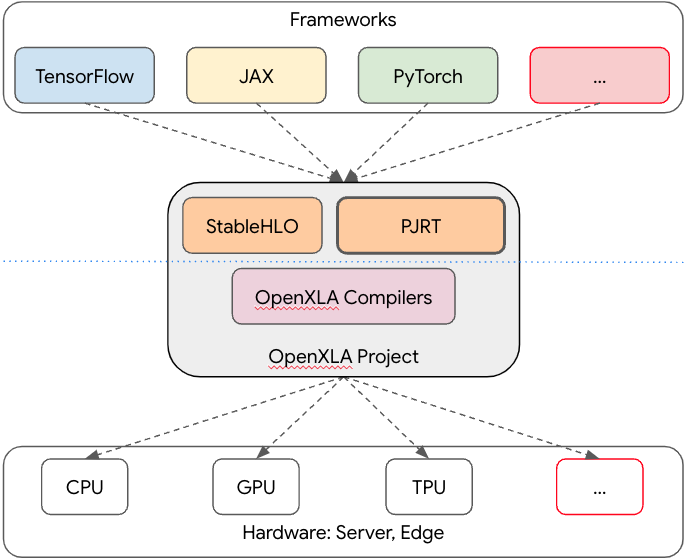
As a foundational pillar of the OpenXLA Project, PJRT is well-integrated with projects within the OpenXLA Project including StableHLO and the OpenXLA compilers (XLA, IREE). It is the primary interface for TensorFlow and JAX and fully supported for PyTorch through PyTorch/XLA. It provides the hardware interface layer in solving the combinatorial framework x hardware ML infrastructure fragmentation (see Figure 2).

Diagram of PJRT hardware interface layer
Figure 2: PJRT provides the hardware interface layer in solving the combinatorial framework x hardware ML infrastructure fragmentation, well-integrated with OpenXLA.

Toolchain Independent

PJRT is hardware and framework independent. With framework integration through the self-contained IR StableHLO, PJRT is not coupled with a specific compiler, and can be used outside of the OpenXLA ecosystem, including with other proprietary compilers. The public availability and toolchain-independent architecture allows it to be used by any hardware, framework or compiler, with extensibility for unique features. If you are developing an ML hardware accelerator, compiler, or runtime targeting any hardware, or converging siloed toolchains to solve infrastructure fragmentation, PJRT can minimize bespoke hardware and framework integration, providing greater coverage and improving time-to-market at lower development cost.

Driving Impact with Collaboration

Industry partners such as Intel and others have already adopted PJRT.

Intel

Intel is leveraging PJRT in Intel® Extension for TensorFlow to provide the Intel GPU backend for TensorFlow and JAX. This implementation is based on the PJRT plugin mechanism (see RFC). Check out how this greatly simplifies the framework and hardware integration with this example of executing a JAX program on Intel GPU.

"At Intel, we share Google's vision of modular interfaces to make integration easier and enable faster, framework-independent development. Similar in design to the PluggableDevice mechanism, PJRT is a pluggable interface that allows us to easily compile and execute XLA's High Level Operations on Intel devices. Its simple design allowed us to quickly integrate it into our systems and start running JAX workloads on Intel® GPUs within just a few months. PJRT enables us to more efficiently deliver hardware acceleration and oneAPI-powered AI software optimizations to developers using a wide range of AI Frameworks." - Wei Li, VP and GM, Artificial Intelligence and Analytics, Intel.

Technology Leader

We’re also working with a technology leader to leverage PJRT to provide the backend targeting their proprietary processor for JAX. More details on this to follow soon.

Get Involved

PJRT is available on GitHub: source code for the API and a reference openxla-pjrt-plugin, and integration guides. If you develop ML frameworks, compilers, or runtimes, or are interested in improving portability of workloads across hardware, we want your feedback. We encourage you to contribute code, design ideas, and feature suggestions. We also invite you to join the OpenXLA mailing list to stay updated with the latest product and community announcements and to help shape the future of an interoperable ML infrastructure.

Acknowledgements

Allen Hutchison, Andrew Leaver, Chuanhao Zhuge, Jack Cao, Jacques Pienaar, Jieying Luo, Penporn Koanantakool, Peter Hawkins, Robert Hundt, Russell Power, Sagarika Chalasani, Skye Wanderman-Milne, Stella Laurenzo, Will Cromar, Xiao Yu.

By Aman Verma, Product Manager, Machine Learning Infrastructure

Peer Bonus Experiences: Building tiny models for the ML community with TensorFlow

Friday, October 23, 2020

Almost all the current state-of-the-art machine learning (ML) models take quite a lot of disk space. This makes them particularly inefficient in production situations. A bulky machine learning model can be exposed as a REST API and hosted on cloud services, but that same bulk may lead to hefty infrastructure costs. And some applications may need to operate in low-bandwidth environments, making cloud-hosted models less practical.

In a perfect world, your models would live alongside your application, saving data transfer costs and complying with any regulatory requirements restricting what data can be sent to the cloud. But storing multi-gigabyte models on today’s devices just isn’t practical. The field of on-device ML is dedicated to the development of tools and techniques to produce tiny—yet high performing!—ML models. Progress has been slow, but steady!

There has never been a better time to learn about on-device ML and successfully apply it in your own projects. With frameworks like TensorFlow Lite, you have an exceptional toolset to optimize your bulky models while retaining as much performance as possible. TensorFlow Lite also makes it very easy for mobile application developers to integrate ML models with tools like metadata and ML Model Binding, Android codegen, and others.

What is TensorFlow Lite?

“TensorFlow Lite is a production ready, cross-platform framework for deploying ML on mobile devices and embedded systems.” - TensorFlow Youtube

TensorFlow Lite provides first-class support for Native Android and iOS-based integrations (with many additional features, such as delegates). TensorFlow Lite also supports other tiny computing platforms, such as microcontrollers. TensorFlow Lite’s optimization APIs produce world-class, fast, and well-performing machine learning models.

Venturing into TensorFlow Lite

Last year, I started playing around with TensorFlow Lite while developing projects for Raspberry Pi for Computer Vision, using the official documentation and this course to fuel my initial learning. Following this interest, I decided to join a voluntary working group focused on creating sample applications, writing out tutorials, and creating tiny models. This working group consists of individuals from different backgrounds passionate about teaching on-device machine learning to others. The group is coordinated by Khanh LeViet (TensorFlow Lite team) and Hoi Lam (Android ML team). This is by far one of the most active working groups I have ever seen. And, back in our starting days, Khanh proposed a few different state-of-art machine learning models that were great fits for on-device machine learning:

These ideas were enough for us to start spinning up Jupyter notebooks and VSCode. After months of work, we now have strong collaborations between machine learning GDEs and a bunch of different TensorFlow Lite models, sample applications, and tutorials for the community to learn from. Our collaborations have been fueled by the power of open source and all the tiny models that we have built together are available on TensorFlow Hub. There are numerous open source applications that we have built that demonstrate how to use these models.
The Cartoonizer model cartoonizes uploaded images

Margaret and I co-authored an end-to-end tutorial that was published from the official TensorFlow blog and published the TensorFlow Lite models on TensorFlow Hub. So far, the response we have received for this work has been truly mesmerizing. I’ve also shared my experiences with TensorFlow Lite in these blog posts and conference talks:

A Tale of Model Quantization in TF Lite
Plunging into Model Pruning in Deep Learning
A few good stuff in TF Lite
Doing more with TF Lite
Model Optimization 101

The power of collaboration

The working group is a tremendous opportunity for machine learning GDEs, Googlers, and passionate community individuals to collaborate and learn. We get to learn together, create together, and celebrate the joy of teaching others. I am immensely thankful, grateful, and humbled to be a part of this group. Lastly, I would like to wholeheartedly thank Khanh for being a pillar of support to us and for nominating me for the Google Open Source Peer Bonus Award.

By Sayak Paul, PyImageSearch—Guest Author

Introducing TensorFlow Recorder

Friday, August 7, 2020

When training computer vision machine learning models, data loading can often be a performance bottleneck, causing your GPU or TPU resources to be underutilized while waiting for data to be loaded into the model. Storing your dataset in the efficient TensorFlow Record (TFRecord) format is a great way to solve these problems, but creating TFRecords can unfortunately often require a great deal of complex code.

Last week we open sourced the TensorFlow Recorder project (also known as TFRecorder), which makes it possible for data scientists, data engineers, or AI/ML engineers to create image based TFRecords with just a few lines of code. Using TFRecords is incredibly important for creating efficient TensorFlow ML pipelines, but until now they haven’t been so easy to create. Before TFRecorder, in order to create TFRecords at scale you would have had to write a data pipeline that parsed your structured data, loaded images from storage, and serialized the results into the TFRecord format. TFRecorder allows you to write TFRecords directly from a Pandas dataframe or CSV without writing any complicated code.

You can see an example of TFRecoder below, but first let’s talk about some of the specific advantages of TFRecords.

How TFRecords Can Help

Using the TFRecord file format allows you to store your data in sets of files, each containing a sequence of protocol buffers serialized as a binary record that can be read very efficiently, which will help reduce the data loading bottleneck mentioned above.

Data loading performance can be further improved by implementing prefetching and parallel interleave along with using the TFRecord format. Prefetching reduces the time of each model training step(s) by fetching the data for the next training step while your model is executing training on the current step. Parallel interleave allows you to read from multiple TFRecords shards (pieces of a TFRecord file) and apply preprocessing of those interleaved data streams. This reduces the latency required to read a training batch and is especially helpful when reading data from the network.

Using TensorFlow Recorder

Creating a TFRecord using TFRecorder requires only a few lines of code. Here’s how it works.
import pandas as pd
import tfrecorder
df = pd.read_csv(...)
df.tensorflow.to_tfrecord(output_dir="gs://my/bucket")

TFRecorder currently expects data to be in the same format as Google AutoML Vision.

This format looks like a pandas dataframe or CSV formatted as:
splitimage_urilabel
TRAIN
gs://my/bucket/image1.jpgcat

Where:
  • split can take on the values TRAIN, VALIDATION, and TEST
  • image_uri specifies a local or google cloud storage location for the image file.
  • label can be either a text-based label that will be integerized or an integer
In the future, we hope to extend TensorFlow Recorder to work with data in any format.

While this example would work well to convert a few thousand images into TFRecords, it probably wouldn’t scale well if you have millions of images. To scale up to huge datasets, TensorFlow Recorder provides connectivity with Google Cloud Dataflow, which is a serverless Apache Beam pipeline runner. Scaling up to DataFlow requires only a little bit more configuration.
df.tensorflow.to_tfrecord(
output_dir="gs://my/bucket",
runner="DataFlowRunner",
project="my-project",
region="us-central1)

What’s next?

We’d love for you to try out TensorFlow Recorder. You can get it from GitHub or simply pip install tfrecorder. Tensorflow Recorder is very new and we’d greatly appreciate your feedback, suggestions, and pull requests.

By Mike Bernico and Carlos Ezequiel, Google Cloud AI Engineers

Introducing TensorNetwork, an Open Source Library for Efficient Tensor Calculations

Friday, June 7, 2019

Originally posted on the Google AI Blog.

Many of the world's toughest scientific challenges, like developing high-temperature superconductors and understanding the true nature of space and time, involve dealing with the complexity of quantum systems. What makes these challenges difficult is that the number of quantum states in these systems is exponentially large, making brute-force computation infeasible. To deal with this, data structures called tensor networks are used. Tensor networks let one focus on the quantum states that are most relevant for real-world problems—the states of low energy, say—while ignoring other states that aren't relevant. Tensor networks are also increasingly finding applications in machine learning (ML). However, there remain difficulties that prohibit them from widespread use in the ML community: 1) a production-level tensor network library for accelerated hardware has not been available to run tensor network algorithms at scale, and 2) most of the tensor network literature is geared toward physics applications and creates the false impression that expertise in quantum mechanics is required to understand the algorithms.

In order to address these issues, we are releasing TensorNetwork, a brand new open source library to improve the efficiency of tensor calculations, developed in collaboration with the Perimeter Institute for Theoretical Physics and X. TensorNetwork uses TensorFlow as a backend and is optimized for GPU processing, which can enable speedups of up to 100x when compared to work on a CPU. We introduce TensorNetwork in a series of papers, the first of which presents the new library and its API, and provides an overview of tensor networks for a non-physics audience. In our second paper we focus on a particular use case in physics, demonstrating the speedup that one gets using GPUs.

How are Tensor Networks Useful?

Tensors are multidimensional arrays, categorized in a hierarchy according to their order: e.g., an ordinary number is a tensor of order zero (also known as a scalar), a vector is an order-one tensor, a matrix is an order-two tensorDiagrammatic notation for tensors. and so on. While low-order tensors can easily be represented by an explicit array of numbers or with a mathematical symbol such as Tijnklm (where the number of indices represents the order of the tensor), that notation becomes very cumbersome once we start talking about high-order tensors. At that point it's useful to start using diagrammatic notation, where one simply draws a circle (or some other shape) with a number of lines, or legs, coming out of it—the number of legs being the same as the order of the tensor. In this notation, a scalar is just a circle, a vector has a single leg, a matrix has two legs, etc. Each leg of the tensor also has a dimension, which is the size of that leg. For example, a vector representing an object's velocity through space would be a three-dimensional, order-one tensor.
Diagrammatic notation for tensors.
The benefit of representing tensors in this way is to succinctly encode mathematical operations, e.g., multiplying a matrix by a vector to produce another vector, or multiplying two vectors to make a scalar. These are all examples of a more general concept called tensor contraction.
Diagrammatic notation for tensor contraction. Vector and matrix multiplication, as well as the matrix trace (i.e., the sum of the diagonal elements of a matrix), are all examples.
These are also simple examples of tensor networks, which are graphical ways of encoding the pattern of tensor contractions of several constituent tensors to form a new one. Each constituent tensor has an order determined by its own number of legs. Legs that are connected, forming an edge in the diagram, represent contraction, while the number of remaining dangling legs determines the order of the resultant tensor.
Left: The trace of the product of four matrices, tr(ABCD), which is a scalar. You can see that it has no dangling legs. Right: Three order-three tensors being contracted with three legs dangling, resulting in a new order-three tensor.
While these examples are very simple, the tensor networks of interest often represent hundreds of tensors contracted in a variety of ways. Describing such a thing would be very obscure using traditional notation, which is why the diagrammatic notation was invented by Roger Penrose in 1971.

Tensor Networks in Practice

Consider a collection of black-and-white images, each of which can be thought of as a list of N pixel values. A single pixel of a single image can be one-hot-encoded into a two-dimensional vector, and by combining these pixel encodings together we can make a 2^N-dimensional one-hot encoding of the entire image. We can reshape that high-dimensional vector into an order-N tensor, and then add up all of the tensors in our collection of images to get a total tensor Ti1,i2,...,iN encapsulating the collection.
This sounds like a very wasteful thing to do: encoding images with about 50 pixels in this way would already take petabytes of memory. That's where tensor networks come in. Rather than storing or manipulating the tensor T directly, we instead represent T as the contraction of many smaller constituent tensors in the shape of a tensor network. That turns out to be much more efficient. For instance, the popular matrix product state (MPS) network would write T in terms of N much smaller tensors, so that the total number of parameters is only linear in N, rather than exponential.
The high-order tensor T is represented in terms of many low-order tensors in a matrix product state tensor network.
It's not obvious that large tensor networks can be efficiently created or manipulated while consistently avoiding the need for a huge amount of memory. But it turns out that this is possible in many cases, which is why tensor networks have been used extensively in quantum physics and, now, in machine learning. Stoudenmire and Schwab used the encoding just described to make an image classification model, demonstrating a new use for tensor networks. The TensorNetwork library is designed to facilitate exactly that kind of work, and our first paper describes how the library functions for general tensor network manipulations.

Performance in Physics Use-Cases

TensorNetwork is a general-purpose library for tensor network algorithms, and so it should prove useful for physicists as well. Approximating quantum states is a typical use-case for tensor networks in physics, and is well-suited to illustrate the capabilities of the TensorNetwork library. In our second paper, we describe a tree tensor network (TTN) algorithm for approximating the ground state of either a periodic quantum spin chain (1D) or a lattice model on a thin torus (2D), and implement the algorithm using TensorNetwork. We compare the use of CPUs with GPUs and observe significant computational speed-ups, up to a factor of 100, when using a GPU and the TensorNetwork library.
Computational time as a function of the bond dimension, χ. The bond dimension determines the size of the constituent tensors of the tensor network. A larger bond dimension means the tensor network is more powerful, but requires more computational resources to manipulate.

Conclusion and Future Work

These are the first in a series of planned papers to illustrate the power of TensorNetwork in real-world applications. In our next paper we will use TensorNetwork to classify images in the MNIST and Fashion-MNIST datasets. Future plans include time series analysis on the ML side, and quantum circuit simulation on the physics side. With the open source community, we are also always adding new features to TensorNetwork itself. We hope that TensorNetwork will become a valuable tool for physicists and machine learning practitioners.

Acknowledgements

The TensorNetwork library was developed by Chase Roberts, Adam Zalcman, and Bruce Fontaine of Google AI; Ashley Milsted, Martin Ganahl, and Guifre Vidal of the Perimeter Institute; and Jack Hidary and Stefan Leichenauer of X. We'd also like to thank Stavros Efthymiou at X for valuable contributions.

by Chase Roberts, Research Engineer, Google AI and Stefan Leichenauer, Research Scientist, X 

TF-Ranking: a scalable TensorFlow library for learning-to-rank

Wednesday, December 5, 2018

Cross-posted from the Google AI Blog.

Ranking, the process of ordering a list of items in a way that maximizes the utility of the entire list, is applicable in a wide range of domains, from search engines and recommender systems to machine translation, dialogue systems and even computational biology. In applications like these (and many others), researchers often utilize a set of supervised machine learning techniques called learning-to-rank. In many cases, these learning-to-rank techniques are applied to datasets that are prohibitively large — scenarios where the scalability of TensorFlow could be an advantage. However, there is currently no out-of-the-box support for applying learning-to-rank techniques in TensorFlow. To the best of our knowledge, there are also no other open source libraries that specialize in applying learning-to-rank techniques at scale.

Today, we are excited to share TF-Ranking, a scalable TensorFlow-based library for learning-to-rank. As described in our recent paper, TF-Ranking provides a unified framework that includes a suite of state-of-the-art learning-to-rank algorithms, and supports pairwise or listwise loss functions, multi-item scoring, ranking metric optimization, and unbiased learning-to-rank.

TF-Ranking is fast and easy to use, and creates high-quality ranking models. The unified framework gives ML researchers, practitioners and enthusiasts the ability to evaluate and choose among an array of different ranking models within a single library. Moreover, we strongly believe that a key to a useful open source library is not only providing sensible defaults, but also empowering our users to develop their own custom models. Therefore, we provide flexible API's, within which the users can define and plug in their own customized loss functions, scoring functions and metrics.

Existing Algorithms and Metrics Support

The objective of learning-to-rank algorithms is minimizing a loss function defined over a list of items to optimize the utility of the list ordering for any given application. TF-Ranking supports a wide range of standard pointwise, pairwise and listwise loss functions as described in prior work. This ensures that researchers using the TF-Ranking library are able to reproduce and extend previously published baselines, and practitioners can make the most informed choices for their applications. Furthermore, TF-Ranking can handle sparse features (like raw text) through embeddings and scales to hundreds of millions of training instances. Thus, anyone who is interested in building real-world data intensive ranking systems such as web search or news recommendation, can use TF-Ranking as a robust, scalable solution.

Empirical evaluation is an important part of any machine learning or information retrieval research. To ensure compatibility with prior work,  we support many of the commonly used ranking metrics, including Mean Reciprocal Rank (MRR) and Normalized Discounted Cumulative Gain (NDCG). We also make it easy to visualize these metrics at training time on TensorBoard, an open source TensorFlow visualization dashboard.
An example of the NDCG metric (Y-axis) along the training steps (X-axis) displayed in the TensorBoard. It shows the overall progress of the metrics during training. Different methods can be compared directly on the dashboard. Best models can be selected based on the metric.

Multi-Item Scoring

TF-Ranking supports a novel scoring mechanism wherein multiple items (e.g., web pages) can be scored jointly, an extension of the traditional scoring paradigm in which single items are scored independently. One challenge in multi-item scoring is the difficulty for inference where items have to be grouped and scored in subgroups. Then, scores are accumulated per-item and used for sorting. To make these complexities transparent to the user, TF-Ranking provides a List-In-List-Out (LILO) API to wrap all this logic in the exported TF models.
The TF-Ranking library supports multi-item scoring architecture, an extension of traditional single-item scoring.
As we demonstrate in recent work, multi-item scoring is competitive in its performance to the state-of-the-art learning-to-rank models such as RankNet, MART, and LambdaMART on a public LETOR benchmark.

Ranking Metric Optimization

An important research challenge in learning-to-rank is direct optimization of ranking metrics (such as the previously mentioned NDCG and MRR).  These metrics, while being able to measure the performance of ranking systems better than the standard classification metrics like Area Under the Curve (AUC), have the unfortunate property of being either discontinuous or flat. Therefore standard stochastic gradient descent optimization of these metrics is problematic.

In recent work, we proposed a novel method, LambdaLoss, which provides a principled probabilistic framework for ranking metric optimization. In this framework, metric-driven loss functions can be designed and optimized by an expectation-maximization procedure. The TF-Ranking library integrates the recent advances in direct metric optimization and provides an implementation of LambdaLoss. We are hopeful that this will encourage and facilitate further research advances in the important area of ranking metric optimization.

Unbiased Learning-to-Rank

Prior research has shown that given a ranked list of items, users are much more likely to interact with the first few results, regardless of their relevance. This observation has inspired research interest in unbiased learning-to-rank, and led to the development of unbiased evaluation and several unbiased learning algorithms, based on training instances re-weighting. In the TF-Ranking library, metrics are implemented to support unbiased evaluation and losses are implemented for unbiased learning by natively supporting re-weighting to overcome the inherent biases in user interactions datasets.

Getting Started with TF-Ranking

TF-Ranking implements the TensorFlow Estimator interface, which greatly simplifies machine learning programming by encapsulating training, evaluation, prediction and export for serving. TF-Ranking is well integrated with the rich TensorFlow ecosystem. As described above, you can use TensorBoard to visualize ranking metrics like NDCG and MRR, as well as to pick the best model checkpoints using these metrics. Once your model is ready, it is easy to deploy it in production using TensorFlow Serving.

If you’re interested in trying TF-Ranking for yourself, please check out our GitHub repo, and walk through the tutorial examples. TF-Ranking is an active research project, and we welcome your feedback and contributions. We are excited to see how TF-Ranking can help the information retrieval and machine learning research communities.

By Xuanhui Wang and Michael Bendersky, Software Engineers, Google AI

Acknowledgements

This project was only possible thanks to the members of the core TF-Ranking team: Rama Pasumarthi, Cheng Li, Sebastian Bruch, Nadav Golbandi, Stephan Wolf, Jan Pfeifer, Rohan Anil, Marc Najork, Patrick McGregor and Clemens Mewald‎. We thank the members of the TensorFlow team for their advice and support: Alexandre Passos, Mustafa Ispir, Karmel Allison, Martin Wicke, and others. Finally, we extend our special thanks to our collaborators, interns and early adopters: Suming Chen, Zhen Qin, Chirag Sethi, Maryam Karimzadehgan, Makoto Uchida, Yan Zhu, Qingyao Ai, Brandon Tran, Donald Metzler, Mike Colagrosso, and many others at Google who helped in evaluating and testing the early versions of TF-Ranking.

Googlers on the road: CLS and OSCON 2018

Friday, July 13, 2018

Next week a veritable who’s who of free and open source software luminaries, maintainers and developers will gather to celebrate the 20th annual OSCON and the 20th anniversary of the Open Source Definition. Naturally, the Google Open Source and Google Cloud teams will be there too!

Program chairs at OSCON 2017, left to right:
Rachel Roumeliotis, Kelsey Hightower, Scott Hanselman.
Photo used with permission from O'Reilly Media.
This year OSCON returns to Portland, Oregon and runs from July 16-19. As usual, it is preceded by the free-to-attend Community Leadership Summit on July 14-15.

If you’re curious about our outreach programs, our approach to open source, or any of the open source projects we’ve released, please find us! We’re eager to chat. You’ll find us and many other Googlers throughout the week on stage, in the expo hall, and at several special events that we’re running, including:
Here’s a rundown of the sessions we’re hosting this year:

Sunday, July 15th (Community Leadership Summit)

11:45am   Asking for time and/or money by Cat Allman

Monday, July 16th (Tutorials)

9:00am    Getting started with TensorFlow by Josh Gordon
1:30pm    Introduction to natural language processing with Python by Barbara Fusinska

Tuesday, July 17th (Tutorials)

9:00am    Istio Day opening remarks by Kelsey Hightower
9:00am    TensorFlow Day opening remarks by Edd Wilder-James
9:05am    Sailing to 1.0: Istio community update by April Nassi
9:05am    The state of TensorFlow by Sandeep Gupta
9:30am    Introduction to fairness in machine learning by Hallie Benjamin
9:55am    Farm to table: A TensorFlow story by Gunhan Gulsoy
11:00am  Hassle-free, scalable machine learning with Kubeflow by Barbara Fusinska
11:05am  Istio: Zero-trust communication security for production services by Samrat Ray, Tao Li, and Mak Ahmad
12:00pm  Project Magenta: Machine learning for music and art by Sherol Chen
1:35pm    Istio à la carte by Daniel Ciruli

Wednesday, July 18th (Sessions)

9:00am    Wednesday opening welcome by Kelsey Hightower
11:50am  Machine learning for continuous integration by Joseph Gregorio
1:45pm    Live-coding a beautiful, performant mobile app from scratch by Emily Fortuna and Matt Sullivan
2:35pm    Powering TensorFlow with big data using Apache Beam, Flink, and Spark by Holden Karau
5:25pm    Teaching the Next Generation to FLOSS by Josh Simmons

Thursday, July 19th (Sessions)

9:00am    Thursday opening welcome by Kelsey Hightower
9:40am    20 years later, open source is as important as ever by Sarah Novotny
11:50am  Google’s approach to distributed systems observability by Jaana B. Dogan
2:35pm    gRPC versus REST: Let the battle begin with Alex Borysov
5:05pm    Shenzhen Go: A visual Go environment for everybody, even professionals by Josh Deprez

We look forward to seeing you and the rest of the community there!

By Josh Simmons, Google Open Source

Semantic Image Segmentation with DeepLab in TensorFlow

Thursday, March 15, 2018

Cross-posted on the Google Research Blog.

Semantic image segmentation, the task of assigning a semantic label, such as “road”, “sky”, “person”, “dog”, to every pixel in an image enables numerous new applications, such as the synthetic shallow depth-of-field effect shipped in the portrait mode of the Pixel 2 and Pixel 2 XL smartphones and mobile real-time video segmentation. Assigning these semantic labels requires pinpointing the outline of objects, and thus imposes much stricter localization accuracy requirements than other visual entity recognition tasks such as image-level classification or bounding box-level detection.


Today, we are excited to announce the open source release of our latest and best performing semantic image segmentation model, DeepLab-v3+ [1]*, implemented in TensorFlow. This release includes DeepLab-v3+ models built on top of a powerful convolutional neural network (CNN) backbone architecture [2, 3] for the most accurate results, intended for server-side deployment. As part of this release, we are additionally sharing our TensorFlow model training and evaluation code, as well as models already pre-trained on the Pascal VOC 2012 and Cityscapes benchmark semantic segmentation tasks.

Since the first incarnation of our DeepLab model [4] three years ago, improved CNN feature extractors, better object scale modeling, careful assimilation of contextual information, improved training procedures, and increasingly powerful hardware and software have led to improvements with DeepLab-v2 [5] and DeepLab-v3 [6]. With DeepLab-v3+, we extend DeepLab-v3 by adding a simple yet effective decoder module to refine the segmentation results especially along object boundaries. We further apply the depthwise separable convolution to both atrous spatial pyramid pooling [5, 6] and decoder modules, resulting in a faster and stronger encoder-decoder network for semantic segmentation.


Modern semantic image segmentation systems built on top of convolutional neural networks (CNNs) have reached accuracy levels that were hard to imagine even five years ago, thanks to advances in methods, hardware, and datasets. We hope that publicly sharing our system with the community will make it easier for other groups in academia and industry to reproduce and further improve upon state-of-art systems, train models on new datasets, and envision new applications for this technology.

By Liang-Chieh Chen and Yukun Zhu, Google Research

Acknowledgements
We would like to thank the support and valuable discussions with Iasonas Kokkinos, Kevin Murphy, Alan L. Yuille (co-authors of DeepLab-v1 and -v2), as well as Mark Sandler, Andrew Howard, Menglong Zhu, Chen Sun, Derek Chow, Andre Araujo, Haozhi Qi, Jifeng Dai, and the Google Mobile Vision team.

References
  1. Encoder-Decoder with Atrous Separable Convolution for Semantic Image Segmentation, Liang-Chieh Chen, Yukun Zhu, George Papandreou, Florian Schroff, and Hartwig Adam, arXiv: 1802.02611, 2018.
  2. Xception: Deep Learning with Depthwise Separable Convolutions, François Chollet, Proc. of CVPR, 2017.
  3. Deformable Convolutional Networks — COCO Detection and Segmentation Challenge 2017 Entry, Haozhi Qi, Zheng Zhang, Bin Xiao, Han Hu, Bowen Cheng, Yichen Wei, and Jifeng Dai, ICCV COCO Challenge Workshop, 2017.
  4. Semantic Image Segmentation with Deep Convolutional Nets and Fully Connected CRFs, Liang-Chieh Chen, George Papandreou, Iasonas Kokkinos, Kevin Murphy, and Alan L. Yuille, Proc. of ICLR, 2015.
  5. Deeplab: Semantic Image Segmentation with Deep Convolutional Nets, Atrous Convolution, and Fully Connected CRFs, Liang-Chieh Chen, George Papandreou, Iasonas Kokkinos, Kevin Murphy, and Alan L. Yuille, TPAMI, 2017.
  6. Rethinking Atrous Convolution for Semantic Image Segmentation, Liang-Chieh Chen, George Papandreou, Florian Schroff, and Hartwig Adam, arXiv:1706.05587, 2017.


* DeepLab-v3+ is not used to power Pixel 2's portrait mode or real time video segmentation. These are mentioned in the post as examples of features this type of technology can enable.

Open Sourcing the Hunt for Exoplanets

Friday, March 9, 2018


Recently, we discovered two exoplanets by training a neural network to analyze data from NASA’s Kepler space telescope and accurately identify the most promising planet signals. And while this was only an initial analysis of ~700 stars, we consider this a successful proof-of-concept for using machine learning to discover exoplanets, and more generally another example of using machine learning to make meaningful gains in a variety of scientific disciplines (e.g. healthcare, quantum chemistry, and fusion research).

Today, we’re excited to release our code for processing the Kepler data, training our neural network model, and making predictions about new candidate signals. We hope this release will prove a useful starting point for developing similar models for other NASA missions, like K2 (Kepler’s second mission) and the upcoming Transiting Exoplanet Survey Satellite mission. As well as announcing the release of our code, we’d also like take this opportunity to dig a bit deeper into how our model works.

A Planet Hunting Primer

First, let’s consider how data collected by the Kepler telescope is used to detect the presence of a planet. The plot below is called a light curve, and it shows the brightness of the star (as measured by Kepler’s photometer) over time. When a planet passes in front of the star, it temporarily blocks some of the light, which causes the measured brightness to decrease and then increase again shortly thereafter, causing a “U-shaped” dip in the light curve.
A light curve from the Kepler space telescope with a “U-shaped” dip that indicates a transiting exoplanet.
However, other astronomical and instrumental phenomena can also cause the measured brightness of a star to decrease, including binary star systems, starspots, cosmic ray hits on Kepler’s photometer, and instrumental noise.
The first light curve has a “V-shaped” pattern that tells us that a very large object (i.e. another star) passed in front of the star that Kepler was observing. The second light curve contains two places where the brightness decreases, which indicates a binary system with one bright and one dim star: the larger dip is caused by the dimmer star passing in front of the brighter star, and vice versa. The third light curve is one example of the many other non-planet signals where the measured brightness of a star appears to decrease.
To search for planets in Kepler data, scientists use automated software (e.g. the Kepler data processing pipeline) to detect signals that might be caused by planets, and then manually follow up to decide whether each signal is a planet or a false positive. To avoid being overwhelmed with more signals than they can manage, the scientists apply a cutoff to the automated detections: those with signal-to-noise ratios above a fixed threshold are deemed worthy of follow-up analysis, while all detections below the threshold are discarded. Even with this cutoff, the number of detections is still formidable: to date, over 30,000 detected Kepler signals have been manually examined, and about 2,500 of those have been validated as actual planets!

Perhaps you’re wondering: does the signal-to-noise cutoff cause some real planet signals to be missed? The answer is, yes! However, if astronomers need to manually follow up on every detection, it’s not really worthwhile to lower the threshold, because as the threshold decreases the rate of false positive detections increases rapidly and actual planet detections become increasingly rare. However, there’s a tantalizing incentive: it’s possible that some potentially habitable planets like Earth, which are relatively small and orbit around relatively dim stars, might be hiding just below the traditional detection threshold — there might be hidden gems still undiscovered in the Kepler data!

A Machine Learning Approach

The Google Brain team applies machine learning to a diverse variety of data, from human genomes to sketches to formal mathematical logic. Considering the massive amount of data collected by the Kepler telescope, we wondered what we might find if we used machine learning to analyze some of the previously unexplored Kepler data. To find out, we teamed up with Andrew Vanderburg at UT Austin and developed a neural network to help search the low signal-to-noise detections for planets.
We trained a convolutional neural network (CNN) to predict the probability that a given Kepler signal is caused by a planet. We chose a CNN because they have been very successful in other problems with spatial and/or temporal structure, like audio generation and image classification.
Luckily, we had 30,000 Kepler signals that had already been manually examined and classified by humans. We used a subset of around 15,000 of these signals, of which around 3,500 were verified planets or strong planet candidates, to train our neural network to distinguish planets from false positives. The inputs to our network are two separate views of the same light curve: a wide view that allows the model to examine signals elsewhere on the light curve (e.g., a secondary signal caused by a binary star), and a zoomed-in view that enables the model to closely examine the shape of the detected signal (e.g., to distinguish “U-shaped” signals from “V-shaped” signals).

Once we had trained our model, we investigated the features it learned about light curves to see if they matched with our expectations. One technique we used (originally suggested in this paper) was to systematically occlude small regions of the input light curves to see whether the model’s output changed. Regions that are particularly important to the model’s decision will change the output prediction if they are occluded, but occluding unimportant regions will not have a significant effect. Below is a light curve from a binary star that our model correctly predicts is not a planet. The points highlighted in green are the points that most change the model’s output prediction when occluded, and they correspond exactly to the secondary “dip” indicative of a binary system. When those points are occluded, the model’s output prediction changes from ~0% probability of being a planet to ~40% probability of being a planet. So, those points are part of the reason the model rejects this light curve, but the model uses other evidence as well - for example, zooming in on the centred primary dip shows that it's actually “V-shaped”, which is also indicative of a binary system.

Searching for New Planets

Once we were confident with our model’s predictions, we tested its effectiveness by searching for new planets in a small set 670 stars. We chose these stars because they were already known to have multiple orbiting planets, and we believed that some of these stars might host additional planets that had not yet been detected. Importantly, we allowed our search to include signals that were below the signal-to-noise threshold that astronomers had previously considered. As expected, our neural network rejected most of these signals as spurious detections, but a handful of promising candidates rose to the top, including our two newly discovered planets: Kepler-90 i and Kepler-80 g.

Find your own Planet(s)!

Let’s take a look at how the code released today can help (re-)discover the planet Kepler-90 i. The first step is to train a model by following the instructions on the code’s home page. It takes a while to download and process the data from the Kepler telescope, but once that’s done, it’s relatively fast to train a model and make predictions about new signals. One way to find new signals to show the model is to use an algorithm called Box Least Squares (BLS), which searches for periodic “box shaped” dips in brightness (see below). The BLS algorithm will detect “U-shaped” planet signals, “V-shaped” binary star signals and many other types of false positive signals to show the model. There are various freely available software implementations of the BLS algorithm, including VARTOOLS and LcTools. Alternatively, you can even look for candidate planet transits by eye, like the Planet Hunters.
A low signal-to-noise detection in the light curve of the Kepler 90 star detected by the BLS algorithm. The detection has period 14.44912 days, duration 2.70408 hours (0.11267 days) beginning 2.2 days after 12:00 on 1/1/2009 (the year the Kepler telescope launched).
To run this detected signal though our trained model, we simply execute the following command:
python predict.py  --kepler_id=11442793 --period=14.44912 --t0=2.2
--duration=0.11267 --kepler_data_dir=$HOME/astronet/kepler 
--output_image_file=$HOME/astronet/kepler-90i.png 
--model_dir=$HOME/astronet/model
The output of the command is prediction = 0.94, which means the model is 94% certain that this signal is a real planet. Of course, this is only a small step in the overall process of discovering and validating an exoplanet: the model’s prediction is not proof one way or the other. The process of validating this signal as a real exoplanet requires significant follow-up work by an expert astronomer — see Sections 6.3 and 6.4 of our paper for the full details. In this particular case, our follow-up analysis validated this signal as a bona fide exoplanet, and it’s now called Kepler-90 i!
Our work here is far from done. We’ve only searched 670 stars out of 200,000 observed by Kepler — who knows what we might find when we turn our technique to the entire dataset. Before we do that, though, we have a few improvements we want to make to our model. As we discussed in our paper, our model is not yet as good at rejecting binary stars and instrumental false positives as some more mature computer heuristics. We’re hard at work improving our model, and now that it’s open sourced, we hope others will do the same!


By Chris Shallue, Senior Software Engineer, Google Brain Team

If you’d like to learn more, Chris is featured on the latest episode of This Week In Machine Learning & AI discussing his work.

TFGAN: A Lightweight Library for Generative Adversarial Networks

Tuesday, December 12, 2017

Crossposted on the Google Research Blog

Training a neural network usually involves defining a loss function, which tells the network how close or far it is from its objective. For example, image classification networks are often given a loss function that penalizes them for giving wrong classifications; a network that mislabels a dog picture as a cat will get a high loss. However, not all problems have easily-defined loss functions, especially if they involve human perception, such as image compression or text-to-speech systems. Generative Adversarial Networks (GANs), a machine learning technique that has led to improvements in a wide range of applications including generating images from text, superresolution, and helping robots learn to grasp, offer a solution. However, GANs introduce new theoretical and software engineering challenges, and it can be difficult to keep up with the rapid pace of GAN research.

A video of a generator improving over time. It begins by producing random noise, and eventually learns to generate MNIST digits.
In order to make GANs easier to experiment with, we’ve open sourced TFGAN, a lightweight library designed to make it easy to train and evaluate GANs. It provides the infrastructure to easily train a GAN, provides well-tested loss and evaluation metrics, and gives easy-to-use examples that highlight the expressiveness and flexibility of TFGAN. We’ve also released a tutorial that includes a high-level API to quickly get a model trained on your data.
This demonstrates the effect of an adversarial loss on image compression. The top row shows image patches from the ImageNet dataset. The middle row shows the results of compressing and uncompressing an image through an image compression neural network trained on a traditional loss. The bottom row shows the results from a network trained with a traditional loss and an adversarial loss. The GAN-loss images are sharper and more detailed, even if they are less like the original.
TFGAN supports experiments in a few important ways. It provides simple function calls that cover the majority of GAN use-cases so you can get a model running on your data in just a few lines of code, but is built in a modular way to cover more exotic GAN designs as well. You can just use the modules you want -- loss, evaluation, features, training, etc. are all independent.. TFGAN’s lightweight design also means you can use it alongside other frameworks, or with native TensorFlow code. GAN models written using TFGAN will easily benefit from future infrastructure improvements, and you can select from a large number of already-implemented losses and features without having to rewrite your own. Lastly, the code is well-tested, so you don’t have to worry about numerical or statistical mistakes that are easily made with GAN libraries.
Most neural text-to-speech (TTS) systems produce over-smoothed spectrograms. When applied to the Tacotron TTS system, a GAN can recreate some of the realistic-texture, which reduces artifacts in the resulting audio.
When you use TFGAN, you’ll be using the same infrastructure that many Google researchers use, and you’ll have access to the cutting-edge improvements that we develop with the library. Anyone can contribute to the github repositories, which we hope will facilitate code-sharing among ML researchers and users.

By Joel Shor, Senior Software Engineer, Machine Perception

TensorFlow Lattice: Flexibility Empowered by Prior Knowledge

Wednesday, October 11, 2017

Crossposted on the Google Research Blog

Machine learning has made huge advances in many applications including natural language processing, computer vision and recommendation systems by capturing complex input/output relationships using highly flexible models. However, a remaining challenge is problems with semantically meaningful inputs that obey known global relationships, like “the estimated time to drive a road goes up if traffic is heavier, and all else is the same.” Flexible models like DNNs and random forests may not learn these relationships, and then may fail to generalize well to examples drawn from a different sampling distribution than the examples the model was trained on.

Today we present TensorFlow Lattice, a set of prebuilt TensorFlow Estimators that are easy to use, and TensorFlow operators to build your own lattice models. Lattices are multi-dimensional interpolated look-up tables (for more details, see [1--5]), similar to the look-up tables in the back of a geometry textbook that approximate a sine function.  We take advantage of the look-up table’s structure, which can be keyed by multiple inputs to approximate an arbitrarily flexible relationship, to satisfy monotonic relationships that you specify in order to generalize better. That is, the look-up table values are trained to minimize the loss on the training examples, but in addition, adjacent values in the look-up table are constrained to increase along given directions of the input space, which makes the model outputs increase in those directions. Importantly, because they interpolate between the look-up table values, the lattice models are smooth and the predictions are bounded, which helps to avoid spurious large or small predictions in the testing time.

How Lattice Models Help You

Suppose you are designing a system to recommend nearby coffee shops to a user. You would like the model to learn, “if two cafes are the same, prefer the closer one.”  Below we show a flexible model (pink) that accurately fits some training data for users in Tokyo (purple), where there are many coffee shops nearby.  The pink flexible model overfits the noisy training examples, and misses the overall trend that a closer cafe is better. If you used this pink model to rank test examples from Texas (blue), where businesses are spread farther out, you would find it acted strangely, sometimes preferring farther cafes!
Slice through a model’s feature space where all the other inputs stay the same and only distance changes. A flexible function (pink) that is accurate on training examples from Tokyo (purple) predicts that a cafe 10km-away is better than the same cafe if it was 5km-away. This problem becomes more evident at test-time if the data distribution has shifted, as shown here with blue examples from Texas where cafes are spread out more.
A monotonic flexible function (green) is both accurate on training examples and can generalize for Texas examples compared to non-monotonic flexible function (pink) from the previous figure.

In contrast, a lattice model, trained over the same example from Tokyo, can be constrained to satisfy such a monotonic relationship and result in a monotonic flexible function (green). The green line also accurately fits the Tokyo training examples, but also generalizes well to Texas, never preferring farther cafes.

In general, you might have many inputs about each cafe, e.g., coffee quality, price, etc. Flexible models have a hard time capturing global relationships of the form, “if all other inputs are equal, nearer is better, ” especially in parts of the feature space where your training data is sparse and noisy. Machine learning models that capture prior knowledge (e.g.  how inputs should impact the prediction) work better in practice, and are easier to debug and more interpretable.

Pre-built Estimators

We provide a range of lattice model architectures as TensorFlow Estimators. The simplest estimator we provide is the calibrated linear model, which learns the best 1-d transformation of each feature (using 1-d lattices), and then combines all the calibrated features linearly. This works well if the training dataset is very small, or there are no complex nonlinear input interactions. Another estimator is a calibrated lattice model. This model combines the calibrated features nonlinearly using a two-layer single lattice model, which can represent complex nonlinear interactions in your dataset. The calibrated lattice model is usually a good choice if you have 2-10 features, but for 10 or more features, we expect you will get the best results with an ensemble of calibrated lattices, which you can train using the pre-built ensemble architectures. Monotonic lattice ensembles can achieve 0.3% -- 0.5% accuracy gain compared to Random Forests [4], and these new TensorFlow lattice estimators can achieve 0.1 -- 0.4% accuracy gain compared to the prior state-of-the-art in learning models with monotonicity [5].

Build Your Own

You may want to experiment with deeper lattice networks or research using partial monotonic functions as part of a deep neural network or other TensorFlow architecture. We provide the building blocks: TensorFlow operators for calibrators, lattice interpolation, and monotonicity projections. For example, the figure below shows a 9-layer deep lattice network [5].


Example of a 9-layer deep lattice network architecture [5], alternating layers of linear embeddings and ensembles of lattices with calibrators layers (which act like a sum of ReLU’s in Neural Networks). The blue lines correspond to monotonic inputs, which is preserved layer-by-layer, and hence for the entire model. This and other arbitrary architectures can be constructed with TensorFlow Lattice because each layer is differentiable.

In addition to the choice of model flexibility and standard L1 and L2 regularization, we offer new regularizers with TensorFlow Lattice:
  • Monotonicity constraints [3] on your choice of inputs as described above.
  • Laplacian regularization [3] on the lattices to make the learned function flatter.
  • Torsion regularization [3] to suppress un-necessary nonlinear feature interactions.
We hope TensorFlow Lattice will be useful to the larger community working with meaningful semantic inputs. This is part of a larger research effort on interpretability and controlling machine learning models to satisfy policy goals, and enable practitioners to take advantage of their prior knowledge. We’re excited to share this with all of you. To get started, please check out our GitHub repository and our tutorials, and let us know what you think!

By Maya Gupta, Research Scientist, Jan Pfeifer, Software Engineer and Seungil You, Software Engineer

Acknowledgements

Developing and open sourcing TensorFlow Lattice was a huge team effort. We’d like to thank all the people involved: Andrew Cotter, Kevin Canini, David Ding, Mahdi Milani Fard, Yifei Feng, Josh Gordon, Kiril Gorovoy, Clemens Mewald, Taman Narayan, Alexandre Passos, Christine Robson, Serena Wang, Martin Wicke, Jarek Wilkiewicz, Sen Zhao, Tao Zhu

References

[1] Lattice Regression, Eric Garcia, Maya Gupta, Advances in Neural Information Processing Systems (NIPS), 2009
[2] Optimized Regression for Efficient Function Evaluation, Eric Garcia, Raman Arora, Maya R. Gupta, IEEE Transactions on Image Processing, 2012
[3] Monotonic Calibrated Interpolated Look-Up Tables, Maya Gupta, Andrew Cotter, Jan Pfeifer, Konstantin Voevodski, Kevin Canini, Alexander Mangylov, Wojciech Moczydlowski, Alexander van Esbroeck, Journal of Machine Learning Research (JMLR), 2016
[4] Fast and Flexible Monotonic Functions with Ensembles of Lattices, Mahdi Milani Fard, Kevin Canini, Andrew Cotter, Jan Pfeifer, Maya Gupta, Advances in Neural Information Processing Systems (NIPS), 2016
[5] Deep Lattice Networks and Partial Monotonic Functions, Seungil You, David Ding, Kevin Canini, Jan Pfeifer, Maya R. Gupta, Advances in Neural Information Processing Systems (NIPS), 2017
.