Online Dungeon Master

January 31, 2012

Quick Hits: January 2012

Filed under: 4e D&D, Adventures, Advice/Tools, dndnext, Editions, Podcasts — Tags: , , — OnlineDM @ 7:30 AM

After taking a brief, inadvertent break from blogging recently, I thought I’d jump back in with some quick-hit thoughts on D&D Next, my own D&D campaigns, some non-RPG games I’ve played, the Order of the Stick Kickstarter, and the upcoming Genghis Con.

D&D Next

I’m liking most of what I’m hearing out of DDXP. Simplicity if you want it, complexity if you want it, and a real effort to reach out to players of all editions. The Dice Monkey Radio bonus episode featured yours truly discussing the game with some other folks in the D&D community. I can’t wait to get my 1e books! Yay for potential unity!

My D&D Campaigns

I’ve had some real life stuff interfering with my gaming for the past couple of months, and my Friday night MapTool game is currently on hiatus. Fortunately, it looks like the real life stuff has cleared up, and I should be able to resume that game soon. Yay!

My Madness at Gardmore Abbey and ZEITGEIST campaigns have been similarly delayed, though less explicitly so. I’m hopinh to run a session of Gardmore this weekend. I was thrilled to discover that Tracy Hurley, Sarah Darkmagic herself, included a link to my write-ups of my Gardmore Abbey sessions in her article over on the Wizards of the Coast D&D page. Woo hoo!  Thanks again, Tracy!

I’m also working on a new adventure in response to a reader question. I received a request for some basic “DM 101” tips. I provided a few in an email (this came during the real-life-interfering time, so I didn’t write much), but I definitely want to make this into a blog post. And I think an important DM 101 thing to provide is a good intro adventure. I did a lot of brainstorming on planes last week and am hoping to build the adventure itself and run it in the next couple of weeks.

Non-RPG games

I got a copy of Innovation for Christmas and have played it several times. Cool little game, and it travels well! I was in Florida and Pennsylvania last week, and a friend in Florida and family members in Pennsylvania all enjoyed it. 

When I was in my FLGS recently, I saw a copy of Kittens in a Blender. In real life I’m a cat lover, even fostering kittens for the local animal shelter. Still, I couldn’t resist – in part because the game makers apparently donate part of the proceeds to a no-kill shelter.

I finally tried the game with my wife Monday night, and it’s about what I expected – rather goofy! I think it would play much better with more than two players, of course. I find that there’s an interesting tension in the game when your “best” move is to go ahead and hit the Blend button in order to save your kittens who have gotten away, but when you have a kitten or two who will face death in the machine. The illustrations are adorable, and they make it hard to consign the fluffies to die. And that’s a good thing!

Genghis Con

The local convention is a couple of weeks away, and I’m excited! I’ll be running my Staff of Suha trilogy, and I have players signed up for all three slots. I was disappointed to learn that the Hero System game based on Dr. Horrible that I was registered for was canceled, but I’m still looking forward to trying some Dresden Files and Ashes of Athas.

Order of the Stick books

I’m guessing most people who read my blog probably know about Order of the Stick, Rich Burlew’s awesome web comic about a stick figure band of D&D adventurers. I own all of the books except War and XPs, and was therefore very excited when Rich announced a Kickstarter project to get that book back in print.

He needed to raise almost $60,000 in order to get the book in print. He blew through that in about a day. As of this writing the Kickstarter has been up for a little over a week, and he’s raised nearly $300 grand and counting. This pretty much means that all of the OotS books will be in print. Yay!

My only frustration: The comic is so popular that all of the special rewards (such as those involving signed copies of the books) are snatched up before I have a chance to sign up for them! Oh well; good for Rich!

If you love OotS, I recommend supporting this Kickstarter.

Looking ahead

Now that real life seems to have gotten out of the way, I’m looking forward to more gaming goodness. My new web site should be going live soon, and I’m excited about the improved look and feel. Fun things are afoot!

-Michael the Online Dungeon Master

OnlineDM1 on Twitter

August 27, 2011

Free art: Numeric runes

Filed under: 4e D&D — Tags: , , — OnlineDM @ 7:35 AM

There’s a puzzle in my third adventure (to be released after I run it at TactiCon next Friday) that involves numbers. The puzzle itself is optional and could be handled with skill checks, but I decided to go ahead and make it a true puzzle for those players who enjoy that sort of thing.

And since this is D&D, just throwing a set of numbers out there didn’t seem like enough. Yes, I’ll give the Arabic numeral version of the puzzle to parties who don’t want to deal with extra complexity, but I decided to use runes to represent the numbers 1 through 8.

Now, I don’t know anything about runes and wasn’t quite sure how to find runes to represent numbers, so I decided to just create my own. I’m not an especially artistic person, but I figured I’d be up to the task of making simple linear runes.

To make them more decipherable, the number of pen strokes in each rune corresponds to its number. So, the rune for the number 6 has six strokes.

Feel free to use these at your own table, and let me know if you have any suggestions to improve them!

Rune 1

Rune 2

Rune 3

Rune 4

Rune 5

Rune 6

Rune 7

Rune 8

January 25, 2011

Out of the gaming closet

Filed under: Background, Reviews & Culture — Tags: , , — OnlineDM @ 9:58 PM

I put up a post a few months back that talked about the gaming closet – the fact that I didn’t really talk to my co-workers about my gaming hobby. I felt a little bad being closeted like that, but working in finance in a somewhat senior position, I was worried that being known as a D&D player might hurt my reputation.

I’ve since decided that I’m comfortable with who I am, and I’ve started letting people know that I’m a gamer when it’s appropriate. I first mentioned it to a co-worker who knew that I used to play Magic: The Gathering. He asked if I still played, and I told him that I had moved on to D&D. No bad reaction from him – that’s one good sign.

Next, a co-worker of mine who works in another state was visiting Colorado for work and I invited him over for dinner. He already knew that I liked board games, so I talked about D&D (and we ended up playing Castle Ravenloft). It turns out that he used to be a big D&D player several years ago, and he asked to be included the next time I start up an online game. Cool! The fact that I’m his boss probably means that the DM-player relationship would be too awkward, but still, it’s nice that he was enthusiastic about it.

Now we come to today. I’m excited about my plans to attend GenCon for the first time this summer. I work in Colorado, but my company also has offices in Indianapolis (home of GenCon). I travel for work from time to time, and I asked my boss about maybe making a business trip out of a personal vacation that I wanted to take to Indianapolis in early August (okay, so I haven’t told my boss about my gaming yet). He put me in touch with a co-worker in Indianapolis who could coordinate my business trip.

When I called that guy on the phone and explained that I was trying to schedule some work either before or after my personal trip, he asked about the dates and then what I was in town for. I said that my wife and I were going to a gaming convention, and he said, “You mean GenCon? I’ll be there, too!”

It turns out that he, too, is a gamer, as are some of the people he works with in Indianapolis. He invited me and my wife to join him for a game while we’re in town. How cool is that?

So, to sum up, I’m taking some confident strides out of the gaming closet now, and I’m glad for it. The air smells sweeter out here!

July 25, 2010

War of the Burning Sky – First session

Filed under: 4e D&D, Advice/Tools, Play — Tags: , , , — OnlineDM @ 4:19 PM

This past Friday evening I ran my online group through our first session of EN World’s War of the Burning Sky campaign.  It did not go as well as our session from the previous week, where I had run them through a Living Forgotten Realms adventure, and it’s my fault: I just wasn’t as prepared as I should have been, and it showed.

The session started off well, with the players talking about some back story for their characters and possible connections with one another and with the campaign setting.  I really enjoyed this part of the session, and it’s given me some good ideas for the future.

Then we got into the actual adventure itself (WARNING: SPOILERS AHEAD).  Some of this was okay and some… less so.  The party begins by meeting a woman named Torrent in a tavern that has been closed by the city guards because the owner is a magic user and there’s a coming crackdown on magic (“The Scourge”).  Torrent is there to bring the party into “The Resistance.”  Great, no problem.

V. Shane's awesome depiction of Torrent from the War of the Burning Sky

As they finish chatting, they’re ambushed by bounty hunters.  Now, this is laid out as a pretty exciting encounter in the published adventure, and I totally biffed it.  There’s a warning of something coming, with the sound of creaking floorboards overhead in what is supposed to be an empty building.  Then some bounty hunters come barging in the front door, with the goal of forcing the party out the side door. (I was totally unable to accomplish this.)

Then a bomb hits the building and flames burst out all over the place.  Then the ceiling starts collapsing in places.  This would have been a good way to force the players out of the building and into the alley, but I failed to play it that way.  They basically ignored the chaos and beat the crap out of the bounty hunters.  I decided to have the leader of the bounty hunters (who wisely stayed outside) tell his men to retreat, but the party kept beating them on the way out (and really, who can blame them?).

We then had an interaction with the lead bounty hunter, Kathor, which, as I played it, didn’t make any sense.  Kathor is supposed to be ambivalent about being a bounty hunter, and that came across okay, but it was tough for me to reasonably play it so that the players would accept his withdrawal without attacking him further.  We worked it out so that the players are trying to recruit him into the resistance (a cool idea on the party’s part), but I admit that I didn’t handle this encounter very well.

We next played a few vignettes as the party made their way through the now-burning city toward their rendezvous with a gnome who is supposed to have information that they’re to take out of the city.  These little scenes were a bit out of place, but the party role-played them well.

Then we had to abruptly cut off the game, as one of the players got called into work unexpectedly.  I was okay with this, frankly, as it will give me more time to prepare for the next session.

After much reflection, I’ve decided that I have no interest in running a pre-packaged campaign through to completion.  A pre-packaged adventure, sure, but not a whole campaign.  I need to be able to wing it on the fly and change NPC motivations, all sorts of crazy things, and that’s tough with a published campaign.  So, I’ll be using the published campaign for inspiration and nothing more.  For one thing, I’m interested in getting the party into an underground area of some sort for some cool battles, and I don’t see anything like that in the near future for this campaign.  Easy solution: Change it!

My lessons from this time around are:

  • BE PREPARED!  If you’re not prepared as the DM, things aren’t going to go well.
  • Maintain flexibility.  Unless you’re the kind of DM who can run a party closely to a script, don’t hew too closely to a published adventure path.  You need to be able to adapt on the fly.
  • When you’re given cool material (like the burning, collapsing building that the party is fighting inside) make the most of it!  Describe it vividly, and let it affect the characters in whatever way seems most appropriate to you.

Next session is going to be better, I can already tell.  I’ve already made some big changes to the next combat encounter, which will take the adventure mildly off the published path.  I’m anxious to start working with my player characters’ backgrounds, too, and I have some interesting ideas on how to do that.

July 24, 2010

Running my first in-person Living Forgotten Realms game

Filed under: 4e D&D, Advice/Tools, DM Lessons, Play — Tags: , , — OnlineDM @ 6:39 PM

Today I officially became not only an online dungeon master but also an in-person dungeon master.  I finally ran a Living Forgotten Realms game at my friendly local game store, Enchanted Grounds (spoiler alert: I ended up killing one of the PCs).  I started preparing for this game (and talking about it on the blog) almost a month ago, and I already ran this same adventure for my online group last week, so it’s fair to say that I was well-prepared!

The module was WATE1-1: Heirloom, a Living Forgotten Realms adventure for a party of four to six players of levels one to four.  There will be some spoilers for this particular adventure ahead, just so you know.

The game was scheduled to start at 9:00 AM.  I got to the store around 8:45 to get ready – and then realized at 8:50 that I had forgotten the handouts for the players (they explain the laws of Waterdeep, show a map of Waterdeep, and show a list of stolen items that was provided to the City Watch in the story).  Fortunately, I live within walking distance of home, so it took me only two minutes to drive back, two minutes two print the handouts and two minutes to get back to the store.

We were fortunate to be allowed to play on Enchanted Grounds’ fancy new gaming table, which has an inset in the middle for the battle map and a special pull-out tray with a built-in screen for the game master.  There were four players at game time, and two more were on their way but running late.  We waited about 25 minutes before starting – and naturally the two latecomers showed up just as we got going.  No harm done!

Since this blog is meant to be educational, I think it’s worth talking about what I did to prepare for running this adventure:

  • Read the adventure at least twice, paying special attention to the point of the story and, on later read-throughs, the details of combat tactics from the enemies
  • Create the maps in MapTool, convert them to posters with PosteRazor, print them out in color and tape them together
  • Get monster minis together – I used self-made tokens.  I wish I had also brought some generic non-combatant NPC tokens, but that was a minor oversight.Tokens
  • Get some way of keeping track of conditions such as bloodied, slowed, marked, etc.  I went with little rubber bands from Target that are intended to be hair bands for girls.  I believe my wife Barbara found a big container of them for $3.  I sorted them by color and stored them on twist-ties.
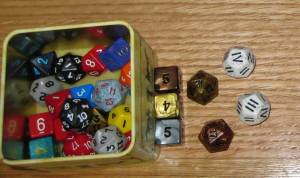
  • Get dice.  Lots of dice.  No, a few more than that.  Yeah, that’s the ticket! (Note the awesome d12s that have Roman numerals for 1 to 4 printed three times – actually rollable d4s!  I got them from Dicepool.) 
  • Write the name of each type of monster on a half index card and roll initiative for it.  Write that number on the half index card.
  • Get blank half index cards for each player character.  Write the character’s name (along with race and class, maybe the player’s name and a description of the mini so you know who it is – all optional, but nice) at the top of the card.  As the players roll initiative for a battle, write the character’s initiative on the card, crossing out any old initiative number that’s on it.  You can then order the cards (PCs and bad guys) by initiative and use this to keep track of who’s up and who’s next – plus it’s easy if someone delays or readies an action to put them in a new position.
  • Get a blank piece of paper for each battle.  Write the name of each monster on a line, treating multiple monsters of the same type separately (so Guard Drake 1 has a line, as does Guard Drake 2).  Write in parentheses next to the monster its bloodied value, followed by a colon and the starting hit points.  As the monster takes damage, cross off the rightmost number and replace it with the new HP total.  Check it against the bloodied value to see if the monster is bloodied yet.
  • When you’re at the table, write down each player’s name, their character’s name, their race and class, their passive Insight and Perception scores and their initiative modifier

With that, we were off and running.  The adventure begins with a long skill challenge to find the thief who stole the title heirloom.  As with my online game, I never said that we were in a skill challenge.  Instead I said, “Okay, what do you want to do now?”  Someone decided to ask around the pub for information on where they might be able to find stolen goods – “Give me a Streetwise roll.”  That pointed them to another tavern, where they looked around to see if they could find anyone matching the description of the information broker they had been given – “All right, Perception.”  And so on.

In the middle of the long skill challenge, we had a quick-hit combat encounter with some drunken sailors.  There was some fun role playing, as one of the PCs tried to hit on the damsel in distress (she wasn’t interested, and I played her as such).  There was some great bluffing of the City Watch, too – “Honest, officers, these men just fell down drunk.  We didn’t attack them…”

Once the thief was located in his lair, the battle became more interesting.  I had ramped up the difficulty level of the battle a little bit, based on past experience, and I’m glad I did.  Lots of players ended up severely bloodied, but nobody dropped.  Our assassin got a little cocky after teleporting in behind a bandit and basically destroying him in one shot, so he ended up trying to take on a couple of halfling thieves by himself.  Bad idea – those guys love to get combat advantage and deal extra damage!

The players did defeat the thief and successfully interrogated him about the stolen heirloom.  He told them where to find the person who hired him to steal it.  I then asked the players what they wanted to do with the thief and his gang.  After a short discussion, they decided to execute them.  I had a bloodthirsty table!  But so it goes.  Had this been a home game, I would have made sure that there would be consequences from this in the future, but for a one-shot I decided to just move on.

The final battle against the gnome factor and his allies in an inn room was pretty cool.  Our assassin and our monk were stealthy about getting into position, seeing some gnomes in their room at the end of a hall and successfully hiding from the gnomes.  Our fighter tried to be stealthy but failed, making too much noise while coming up the steps.  The gnomes looked up, and our bard, thinking quickly, walked up the stairs and past the hallway, whistling merrily – so I had him make a Bluff check, which he totally rocked.  Thus, with surprise preserved, the party was able to charge down the hall in a surprise round before the battle began.

Our strikers jumped right into the thick of things, dealing tons of damage but leaving themselves exposed – especially the monk.  The gnomes spread the hurt around a little bit, but the two dumb guard drakes attacked the closest thing that was threatening their master, which was our monk.  The monk did get an opportunity attack on one drake as the drake moved into position between the monk and the gnomes, but then both drakes took big bites out of the monk.  Guard drakes, as it turns out, do tons of damage when they’re near allies, and the two big chomps put the monk at exactly his negative bloodied value.  He was dead – that is, dead dead, not just “I’m lying on the ground but I’ll be fine later” dead.  I felt a little bad, but that’s what happens when a relatively squishy striker charges into battle without waiting for defender support (a lesson I learned myself the first time I played an avenger).

Pretty soon the gnomes were all bloodied, facing our wizard’s Flaming Sphere, and several of them were invisible due to their fade away power.  When the gnome leader’s turn came up, with his invisibility in place, I had him open the window of the room, fey step down to the street below and start running.  Of course, all the player characters could see was a window opening.  They were left with a tough choice – attack the empty space where they had last seen the gnome leader, or try to go after him in case he ran.

The bard attacked the empty square and rolled well enough that I told him that he didn’t feel like there was anything there to hit.  So the wizard decided to run back down the stairs and into the alley leading to the front of the inn – where he spotted the gnome!  Meanwhile, back in the room, the fighter and psion took care of the guard drakes, the other gnomes jumped out the window (one killing himself) and the bard decided to take a flying leap after everyone.  He made his Acrobatics check, landed on his feet, saw the gnome leader and pegged him with two arrows (smart use of an action point).  Mission accomplished!

This was a fun way to spend a Saturday morning, and I know the players had fun, too.  Interestingly, the person whose player I killed, Jason, had played this adventure once before (in the same party as me when I had played it), and during the course of the adventure he said, “Wow, this is way cooler than the last time!”  That’s what I love to hear.  Even though his character died, he still role-played the things that his spirit was doing, cheering on the rest of the party.  The two players at the table who were new to fourth edition had a good time and learned a lot about how the game works.  Fun was had by all.

I’m learning that I really like being a dungeon master, whether in person or online.  I’ve also learned that I need to feel prepared in order to do well. (In my next post I’ll talk about my experience running my online group through the beginning of the War of the Burning Sky while not being as prepared as I’d like.) I think I’d like to do some more DMing for Living Forgotten Realms in the future.

July 17, 2010

Online campaign – What a rush!

Filed under: 4e D&D, Advice/Tools — Tags: , , , , , , , , — OnlineDM @ 1:15 AM

It’s amazing that I have the energy to write tonight, given that I just spent four and a half hours running a D&D adventure online for EIGHT PLAYERS, but it was such a rush.  I can’t believe how well it all went!  Seven of the players were already logged in before the scheduled start time, and the eighth ran about 10-15 minutes late (no big deal).

Starting Screen

We started off with everyone being able to see their tokens on a small map (with an image of the map of Waterdeep on the page), and I explained how MapTool worked.  As a player, the only things they really needed to know were how to move their token (click and drag), how to move around the map (right click and drag; zoom with the mouse wheel) and how to deal with their macros (just click them).  That went pretty easily.

We also spent a little time talking about the future of the group.  We’re going to split in two – one with me as the DM playing at level 1 and one with another person from the group as the DM, playing at some higher level in order to get to paragon tier faster.  But since I had put everything together for this evening with the plan of having eight players, we would still play the adventure together.  (It was the Living Forgotten Realm module that I’ll be running in my local store next Saturday – WATE1-1 Heirloom.)

I should also point out that, in addition to having MapTool open with everyone impersonating their characters in order to talk in-character (way cool), we also had Skype open for voice chat.  Let me give a huge shout-out to Skype – this software is awesome.  We had excellent call quality with eight active lines (two of the players were together at one computer), no lag – it was just fantastic.

Anyway, I used audio to communicate with my players most of the time, and they used a mixture of audio and text.  The adventure started off with a lengthy skill challenge to track down a thief who had stolen a family heirloom (hence the title of the module, “Heirloom”).  Mixed in the middle was a quickie combat encounter with some drunken sailors, which ended in one action – the party’s invoker walking up and unleashing an encounter power that just about wiped them out (whereupon the sailors that were still up surrendered and staggered away).

At the end of the skill challenge, the party confronted the thief and his cronies in their underground lair.  This battle was much more interesting, with some good movement, creative use of marks, and SO many conditions to keep track of!  It’s easier in MapTool than in real life – I can’t imagine running this encounter with eight PCs around a real table.

We took a five-minute break before diving into the final encounter, where the party faced the person who had hired the thief to steal the heirloom.  The party did a good job of achieving surprise, and it became clear that I could either have the bad guys fight smart – keeping their guard drakes in front of the door to the room and making it hard for the party to do anything – or have them fight fun – letting the drakes shift back into the room so the melee fighters had something interesting to do.  I went with fun, and I’m glad I did.

The best part of the evening was the very end of this encounter.  I had some bad guys, who were hidden at the time, go out the window of the room they were in, trying to escape.  Hilarity ensued as the party tried to go after them.  Lots of falling out windows, landing on people who had already fallen (dealing improvised damage – why not?), and so on.

Looking back, it was clear that the encounters were not all that challenging for the party, since no one ever ended up making death saving throws.  But you know what?  For a party of eight, that’s okay.  The encounters were long enough already, and making them tougher would have made them take longer.

The most important thing was that everyone legitimately seemed to have a great time.  A couple of people who were planning to go play in the high-level game reached out to me to say that they were having so much fun that they were considering staying low-level.  That’s really gratifying to hear – “I’m having so much fun that I want to keep playing in your game.”  Is there a better feeling as a DM?  Not to mention the fact that one of the players is an Englishman playing in his first-ever tabletop RPG, and he played with us from 1:00 AM to 5:30 AM his time.  How’s that for dedication!

It will be a little sad to break up the group, but I honestly don’t have the energy for an eight-PC campaign.  I can handle four or five, but beyond that I think it’s just a little too much.  Still, just to run a game this big one time was worthwhile.  It was, quite frankly, an unqualified success, and I can’t imagine it having gone any better.  This is what I live for as an online dungeon master!

July 16, 2010

Online D&D game – Final prep for first session

Filed under: 4e D&D, Advice/Tools — Tags: , , , , — OnlineDM @ 8:41 AM

I wish I had time to put up as in-depth a post as I would like, but I spent far longer than I planned to last night getting everything ready for this evening’s session of my online D&D game.  I’ll at least summarize what was involved.

  • Creating the encounter maps in MapTool (I ended up re-doing them all on one map so that the players wouldn’t have to flip between multiple maps in the campaign)
  • Updating the properties for the campaign per the suggestion of one of my more MapTool-experienced players (pretty minor changes)
  • Creating tokens for all of the bad guys, including their stats and macros for their powers
  • Creating tokens for all of the players (well, except the two who will be bringing their own), including THEIR stats and power macros
  • And of course making sure that I’ll know what I’m doing when I actually run the adventure
PC Tokens

Top row: Alayne, Thorfin, Faebs. Bottom row: Landon, Fudrick, Jaks

All of this ended up taking somewhere close to 10 hours over the past few days – and that was for an adventure that was already pre-written and for which I had previously created encounter maps and enemy token images!  I shudder to think how much time I’ll have to put in once I start creating my own adventures.

On the bright side, I’ll no longer have to change properties or create PC tokens (or at least not very often), and the more I create monster tokens the more efficient I get at it (using templates for them, for instance).  I’m guessing that the prep work for a typical future session within MapTool (once I’ve already decided what the encounters will look like, what bad guys to use, etc.) will probably take about three hours instead of ten.  Just a guess, though.

Now all that’s left to do is get the group together and run the game!  It sounds so easy when I write it like that…

July 3, 2010

Advice I’ve received for my LFR session

For my last several posts, I’ve been talking about my decision to plunge into dungeon mastering a Living Forgotten Realms game at my friendly local game store, Enchanted Grounds.  That game will be three weeks from today.  I’ve already put the maps and minis together, so all that remains is for me to get comfortable with the adventure itself and then to run it well.

To that end, I’ve been seeking advice from other DMs, both here on my blog and over on EN World.  Here is the advice that I’ll be trying to keep in mind as I get ready to run my first adventure in public:

  • Be enthusiastic!  Enthusiasm from the DM means enthusiasm and fun for the players.
  • Make sure to really know the story of the adventure, not just the monster stats and skill challenge mechanics.
  • Get a feel for the personalities of the NPCs, especially in skill challenges.  Try to make them memorable and act as they would act.
  • At the table, set up a sheet that reminds me of who the PCs are:
    • Name
    • Class and race (optional, but it helps me for roleplaying)
    • Passive perception and insight
    • Defenses, including non-asset class defenses
    • Initiative modifiers
  • Have a flexible method of keeping track of initiative.  I’ve seen some DMs with little tags that they move around, or I’ve seen people using index cards.  I’ve also seen a dry-erase board, or ultimately D&D 4e Combat Manager (which I love, but not for this particular session).
  • When announcing whose turn it is, also announce who will be after that so that the next person can be thinking about what they plan to do.
  • Look for opportunities for bad guys to do cool or unexpected things – grabbing an item a PC drops, trying a stunt, etc.  This may encourage the players to think creatively, too!  Just make sure I’m ready to handle the rules for cool stuff.
  • Have the bad guys taunt the PCs or otherwise talk or yell or whatever during combat.  Make them characters, not just stat blocks with weapons.
  • When the battle is over except for a meaningless minion or two, just call it.  Don’t take the time to make the PCs hunt down that last little dude who can’t really hurt them.  Have him surrender, or just say that the PCs eventually finish him.

Naturally, these tips apply to dungeon mastering in general, not specifically for Living Forgotten Realms.  What other suggestions do you have in order for me to make this fun for myself and, more importantly, for my players?  Have I forgotten anything obvious?

July 1, 2010

Creating tokens for in-person gaming

Victory is mine!  In my last couple of posts, I’ve talked about the fact that I’m going to be serving as dungeon master for a real-life D&D game at my local game store, Enchanted Grounds, on July 24, 2010.  It will be a Living Forgotten Realms game.  I don’t own any minis (little statues to represent creatures), so I decided to make my own tokens (little flat representations of creatures) using the guidelines from Newbie DM’s blog.

After a little bit of trial and error, I succeeded terrifically.  The steps are as follows:

  • Find a good image for a token online, such as this one for a paladin: Paladin
  • Drag the token into PhotoShop
  • Resize the canvas in PhotoShop to be way bigger than the current image, and fill the additional background space to match the background that came with the image (I recommend using the eyedropper tool to get the right color and the paint bucket tool for the fill):Paladin2
  • Open up Token Tool and drag this new image from PhotoShop into Token Tool
  • Pick a nice border in Token Tool.  Also, go with 256 x 256 for the token size
  • Resize and re-center the image in Token Tool to look the way you want
  • Drag the image from the top right corner of Token Tool into PhotoShop:Paladin Token
  • From here, follow the instructions from NewbieDM to copy the token to a new letter-sized image (8.5″ x 11″), duplicating the token image, dragging a bloodied layer over it and making the bloodied layer semi-transparent (note that minions don’t get bloodied, so minion tokens don’t need a bloodied image – you can put one minion on one side of a token and another minion on the other side)
  • Rinse and repeat until you have a whole sheet of these tokens:Token Sheet

Play around with the size a little bit; I found that you actually want them to be a bit bigger than 1″ across, even though the ultimate size you’ll be punching out is 1″.  I like to have no border on my physical tokens – I like them to take up the whole 1″ circle if possible.  You’ll want to get a 1″ hole punch (I paid $10 for one at Michael’s – it’s pretty heavy duty) and a bunch of 1″ fender washers (I paid $8 for a box of 100 at the local hardware store) and a glue stick.  Below you can see my first pass at the paladin token (when I was aiming for 1″ exactly) and my second pass (when I went bigger) – the second looks way, way cooler.Paladin Tokens

The overall result was awesome, in my humble opinion.  I made tokens for the paladin I play in LFR games (Rhogar), the Avenger I’m playing in my in-person game (Kern), Barbara’s dragonborn Runepriest (Zaaria), and the enemies I’ll need for the LFR module.  These include a wererat, a gnome arcanist, some gnome skulks, some guard drakes, and a whole bunch of human bandits (generally minions).  On the back of the bandits I put goblins and kobolds (common minions, I think).

Tokens

I’m really happy with the way these turned out.  I now have all of the minis that I need for my LFR game, and the maps that I shared yesterday ended up working out great when I used PosteRazor to print them out (I’ve just printed them in black and white for now as a proof of concept, but I know they’ll be fine in color, too).  I’m feeling good about this!

I’ll make the individual token files that I created available on the Downloads page of my blog, too, so you can get them all one by one.

June 30, 2010

Living Forgotten Realms DM Preparation – Maps

As I mentioned in my last post, I’ll be a first-time DM for a Living Forgotten Realms (LFR) session at my local store on July 24, 2010.  I’ve gotten the adventure module (WATE1-1 Heirloom) and read through it once, which is a good start.  The things I haven’t been certain about are what to do about maps and what to do about tokens.  I’m pretty sure I’ll follow Ismael_DM’s suggestion in the comments of using the tutorial on Newbie DM’s blog to make flat tokens using metal washers.  More on that as I actually give it a shot.  (Thanks for the tip, Ismael_DM!)

As for maps, I’m pretty sure I’m going to stick with what I know: MapTool! While I’d love to set up a projector with my laptop to project a MapTool screen onto the tabletop (and there is a person at the local store who does exactly this), I’m not ready to lay out the cash required to build that sort of thing.

I’m pretty sure, though, that I can build my maps in MapTool and then print them out as “posters” to put on the table for my players to use.  DM Samuel has talked on his blog about doing this, building the maps in a program called GridMapper (which I probably would have loved a few weeks ago before I learned how to really use MapTool) and then printing them out to scale using a program called PosteRazor.  I haven’t tried the printing part yet, but I figured I’d start by building the maps in MapTool.  Printing can come later.

There are three combat encounters in the module I’ll be running (no real spoilers here).  There’s a battle outside of a random inn on a random street, a battle inside a shop and the room beneath it, and a battle that can take place either in a room in an inn, next to a stable, or on the city streets depending on what has happened earlier in the adventure.

The adventure describes how to build each encounter area using Dungeon Tiles.  Now, I don’t have any Dungeon Tiles myself, but Wizards of the Coast has a program called Dungeon Tiles Mapper that you can download for free and which contains images for a bunch of different tiles (not all of them, but a good variety).  Combining that with the big MapTool image download that I have, I was able to recreate the maps pretty well (in my humble opinion).  In some cases I tried to be as faithful as possible to the original, but there were some cases where I decided to make my own improvements.

First, I created a map that serves as both the inn exterior for the first battle as well as for the last battle (the downstairs part of the inn).  I used a texture to paint the cobblestone streets, a Dungeon Tile image for the inn itself, a stairs object from the big MapTool download and a roof object from that same download to represent the building next door.Inn Exterior

Next, I created the main room of the shop from the second encounter.  This was dead simple – one Dungeon Tile image.

Shop Interior

After that, I created the hideout beneath the shop.  This one was much more involved.  I used some Dungeon Tiles for the spiral staircase, the blue rune, the wooden stairs and the trap door.  I used some flooring from the Dungeon Tiles to paint the stone floor as well as the wooden platform floor.  I used images from the MapTool download for everything else (tables, bookshelves, chair, chest).  I think it turned out really nicely.

Hideout

Next up was the room in the inn.  Nothing here was from Dungeon Tiles.  The stairs, beds and windows were from the MapTool download and the floors and walls were painted using various wood textures from that download.

Inn Room

Finally, the exterior of the stable.  It’s a lot like the inn exterior with the streets and the roof.  The horse and cart came from the big MapTool download.

Stable Exterior

My next task will be to try to print these out using the correct scale in PosteRazor.  Wish me luck!  And as always, I’d love to hear your feedback, whether about the maps themselves or about the general idea of printing these out to use at the table (probably on card stock).

Older Posts »

Blog at WordPress.com.

Design a site like this with WordPress.com
Get started