Digital resources in the Social Sciences and Humanities OpenEdition Our platforms OpenEdition Books OpenEdition Journals Hypotheses Calenda Libraries OpenEdition Freemium Follow us

Strengthening Diamond OA for books: OAPEN’s role in the AEGIS-OA project

The AEGIS-OA (Activate European Guidance and Incentives for Sustainable Open Access publishing) project is working to strengthen institutional, non-profit open access (OA) publishing across Europe by leveraging and expanding the services of the European Diamond Capacity Hub (EDCH). Within this landscape, OA books play a vital role. The OAPEN Foundation (OAPEN), as a dedicated infrastructure supporting OA book publishing, is contributing its long-standing expertise in OA books to ensure that Diamond OA book publishing is fully embedded in the project’s frameworks, tools, and community-building activities. 

A colourful diamond outlined by a blue shield shape with the words 'AEGIS-OA' to the right in large blue letters and 'Advancing Diamond Open Access Publishing' in smaller blue letters underneath that

At the AEGIS-OA kick-off meeting in Brussels on 20 March 2026, OAPEN and OPERAS jointly led a workshop focused on Diamond OA books. The session explored how the project’s core activities can be meaningfully adapted to the specific realities of OA book publishing, and how book publishers can be better supported, recognised, and connected across the wider AEGIS-OA ecosystem. 

OA books within AEGIS-OA 

AEGIS-OA builds on earlier work, including the DIAMAS and PALOMERA projects, but operates within a more compressed timeframe and with a broader scope. For OA books, this raises important questions. What does Diamond OA book publishing mean in practice? How can books be integrated into the Diamond Open Access Standard (DOAS)? How can book publishers be supported without overburdening small, community-driven initiatives? 

The project is powered by a consortium of 24 partners from 16 European countries, comprising 14 beneficiary partners and 10 associated partners. OAPEN, as a beneficiary, is leading and contributing to several work packages that address these questions directly. Packages we are leading are outlined below, and a full list of work packages and tasks can be found in the approved funding call.  

What OAPEN is working on 

Developing DOAS adaptations for books 

A central area of work is the adaptation of the Diamond Open Access Standard (DOAS) for publishers of Diamond OA books – DOAS version 2.0. This task recognises that while many principles of Diamond OA publishing apply across formats, books have different criteria, such as editorial and technical workflows, metadata requirements, and governance models. 

OAPEN is leading the development of DOAS. This work involves proposing which elements of DOAS apply to both books and journals, which need modification, and where new book-specific criteria are required before validating this with the community. The result will be a practical, realistic framework that reflects how Diamond OA book publishing can work. 

Resources and training materials for OA books 

OAPEN is also leading work on new articles, guidelines, and training materials for OA book publishers. These resources are designed to help publishers understand and apply Diamond OA standards, strengthen their operations, and engage with certification and assessment processes. 

European Diamond OA books community 

Community-building is another core strand of OAPEN’s work in AEGIS-OA. OAPEN is contributing to the development of a European Diamond OA Books Community that brings together book publishers, National Capacity Centres (NCCs), infrastructures, and other stakeholders. 

This includes expanding representation of OA book publishers in the EDCH Registry and Forum and addressing practical questions such as how Diamond OA book publishers should be evaluated, and whether existing criteria can be adapted fairly for books. The community is also seen as a space to collectively review and refine DOAS version 2.0, ensuring that it reflects real publishing practice. 

Sustainable Diamond OA publishing 

AEGIS-OA will also focus on the challenges facing the stakeholders involved in the financial support of the Diamond OA model and on the challenges relating to the practical arrangements for funding for both book and journal publishers. This will be done in conjunction with the NCCs and the OA Books Policy Forum facilitated by OAPEN, Science Europe and cOAlition S. 

What comes next 

Over the course of the project, OAPEN’s contributions will result in concrete deliverables. These include DOAS version 2.0 integrating books and journals, new resources and training material, and a draft workflow for inclusion in key infrastructures such as the European Diamond Capacity Hub Registry and the Directory of Open Access Books (DOAB). 

Together, these outputs aim to improve visibility and recognition of Diamond OA books, and support sustainable, community-governed publishing models across Europe. 

AEGIS-OA offers a unique opportunity to ensure that OA books are fully part of Europe’s Diamond OA future. OAPEN is proud to play a central role in making that happen.  

Update on platform stability: Our continuous effort to protect community access 

Aggressive content-harvesting bots and automated systems are generating increased traffic to open infrastructure platforms and library repositories, creating a community-wide challenge. This activity places significant strain on open platforms, affecting normal operations and services that users depend on. 

Concerns about the long-term impact of bot scraping were highlighted at a 2025 Charleston Conference panel, ‘Bot war: Will evil AI-scraping bots succeed in destroying our open digital libraries?’, which raised questions about the future sustainability of open platforms. 

Despite these issues, we remain and persist in our effort to provide our normal services as we always have. Therefore, we want to provide an update on the intermittent access issues that some users may experience when visiting the OAPEN Library and the Directory of Open Access Books (DOAB). 

Understanding the challenge 

Our platforms are currently under a sustained, high-volume struggle from automated traffic. This traffic consists primarily of aggressive content harvesting bots and automated systems scanning for vulnerabilities. If left unmitigated, this activity would overwhelm our infrastructure, cause outages, and ultimately deny access to the global scholarly community we exist to serve. 

Our response: protecting legitimate access 

To safeguard stable and reliable access for researchers, students, librarians, publishers, and the general public, we have implemented proactive security controls. The primary measure is rate limiting coupled with temporary IP restrictions

When our systems detect an IP address making an exceptionally high number of requests in a short period, characteristic of automated scraping, access from that address is temporarily restricted. Affected users will see the following message: 

“Access Temporarily Restricted: We have detected an unusually high volume of requests from your network. To protect the stability of our service for all users, access has been temporarily limited for 24 hours. If you are a legitimate user and believe this is an error, please contact our support team.” 

Additionally, we will whitelist IP ranges for the libraries supporting us, so that users accessing OAPEN or DOAB from the library networks get better access to our services. 

This targeted approach allows us to limit disruptive traffic while providing a clear, straightforward path for genuine users to regain access. 

How you can help ensure uninterrupted access 

OAPEN and DOAB are free and open to everyone, and registration or login is not required for access. However, anyone can create an account (not only publishers and other professionals), and being logged in can help reduce the chance that your IP address is temporarily restricted by our automated protection measures. Authenticated sessions are trusted and are far less likely to be flagged by our systems. 

If your access is restricted: 

  1. Wait for the temporary block to expire. The standard restriction period is 24 hours. 
  1. Log in to your account (see instructions below). Login is not a prerequisite to access the OAPEN Library and DOAB, but a helpful measure to avoid blocks. 
  1. Contact our support team. If the issue persists and affects your work, please reach out to us at [email protected].  

Providing your IP address can help us investigate. 

To login to the OAPEN Library, click the ‘Join’ button in the top-right corner of the window and proceed to login if you already have an account or register as a new user.  

To login to DOAB, click the ‘Publisher login’ in the navigation bar at the top of the window and proceed to login if you already have an account or register as a new user

Why these measures are essential 

OAPEN and DOAB are non-profit, community-serving infrastructures. Our mission is to guarantee open, equitable, and resilient access to scholarly books. Permitting uncontrolled automated exploitation as performed by these AI bots directly contradicts this mission, threatening the service for everyone. The protections we have in place are not merely technical safeguards; they are a necessary commitment to our community’s ability to rely on us. 

Together with our server hosting partner, CERN, we are continuously monitoring the situation and refining our systems to improve their accuracy and minimise any impact on real users. This work remains a top operational priority.  

We thank you for your patience and continued support. 

The OAPEN & DOAB Team 

Building the future of OAPEN and DOAB: Our technical roadmap for 2026 

Since the OAPEN Library was launched at the Frankfurt Book Fair in 2010, our organisation has grown from a bold idea into a global infrastructure pillar for open access (OA) books. Today, more than 40,000 peer-reviewed titles are hosted on our platform, discovered by millions of readers worldwide, trusted by hundreds of publishers and over 300 supporting libraries. 

The Directory of Open Access Books (DOAB) was launched by OAPEN in 2013 and became an independent foundation in 2019, jointly managed by the OAPEN Foundation and OpenEdition. It’s a community-driven discovery service that indexes and provides access to scholarly, peer-reviewed OA books, helping users find trusted OA books and OA book publishers.  

But fifteen years of intense, mission-driven growth also means fifteen years of accumulated technical decisions. Some have aged well. Others now require deliberate, strategic modernisation. 

In 2025, we took two important steps to prepare for the next fifteen years.  

First, we commissioned an independent technical review by the Curtin Institute for Data Science at Curtin University in Perth, Australia. We had previously worked with them on the Book Analytics Dashboard project so they knew our infrastructures fairly well and we know they have strong capabilities with data infrastructures. The report, delivered in July 2025, provided a comprehensive, evidence-based diagnosis of our infrastructure, workflows, and codebase – and a clear set of recommendations.  

Second, we strengthened and grew our technology team after Ronald Snijder departed in the summer of 2025. Transitions of this kind are never easy, but they also create opportunities for renewal. In October, Dr Anna Wałek joined as our new Head of Technology, bringing extensive experience in digital library transformation and open science infrastructure. Her appointment marked a turning point: we now have strategic leadership dedicated entirely to our technical roadmap. 

We also recruited to fill critical gaps. Vaggelis Theodorakopoulos, our Platform Engineer, and Sinziana Paltineanu, then Project Manager and now one of our three Metadata & Systems Specialists, remained as anchors of continuity. Wiktor Florian joined in December 2025 as Metadata & Systems Specialist, bringing data engineering expertise. Hanna Varachkina joined in January 2026 as Metadata & Systems Specialist, to strengthen our metadata quality and publisher communication from a technical standpoint. 

The team is now fully staffed, with clear roles, a shared mandate, and a unified plan. 

Today, we are ready to share the result of these efforts: our technical roadmap for 2026. 

The foundation: Curtin review and a new team 

The Curtin review was never intended to be a document to shelve. It was commissioned as a working instrument, and it has served exactly that purpose. The report confirmed both our strengths – the trust of the community, the richness of our metadata, the dedication of our staff – and the areas where investment is long overdue. 

On the infrastructure side, the review highlighted risks associated with running DSpace 6.3 (unsupported since 2023), an outdated Solr version requiring manual management, and a metadata export service that has become increasingly difficult to maintain. Upgrading these core systems is essential not only for security and stability, but also to enable faster search, more accurate discovery results, and better integration with library catalogues and external services – improvements that publishers, librarians, and researchers will directly experience. 

On the workflow side, it documented what many publishers have told us directly: manual steps in the deposit process, particularly email notifications after FTP uploads, create unnecessary friction. Metadata updates and withdrawals still require human intervention. The statistics dashboard, while valued, no longer meets the expectations of users who need flexible, timely reporting. 

With the Curtin analysis in hand and a complete team in place, we spent the final months of 2025 translating recommendations into concrete projects. The result is our technical roadmap for 2026. 

Our 2026 Roadmap: Five strategic priorities 

Based on the Curtin recommendations and our own internal audit, we have organised our technical work for 2026 around five core priorities. Each has a clear owner, timeline, and measurable outcomes. 

1. Automation of the deposit workflow for OAPEN Library 

 Publishers depositing books with OAPEN should not have to send an email to confirm an FTP upload. Our new, fully automated pipeline will detect files, validate and transform metadata, check for duplicates, import content into DSpace, and register the book in OAPEN – all without manual intervention. [Pilot expected Q2 2026]. 

2. Transition from IRUS-UK to OpenAIRE 

Over the past years, the OAPEN Dashboard has become an essential tool for many publishers, libraries, and funders collaborating with OAPEN. It provides evidence of impact, supports reporting to funders, and helps demonstrate the global reach of OA books. We know how much our communities rely on it, and we take that responsibility seriously.  

IRUS-UK will be retired in April 2026 by Jisc. OAPEN continued sending complete usage data to the service, but this data has not been made available since October 2025 until February 2026. Rather than investing further resources into a decommissioned service, we are accelerating our migration to OpenAIRE. This will provide a COUNTER-compliant, sustainable analytics infrastructure that is more within our control.  [Target: Q2 2026]. 

3. Upgrade of DSpace and Solr 

Migrating from DSpace 6.3 to a modern, supported version 10 is a complex operation, but it’s also non-negotiable. Upgrading these core systems is essential not only for security and stability, but also to enable faster search, more accurate discovery results, and better integration with library catalogues and external services – improvements that publishers, librarians, and researchers will directly experience. [Target: Q3 2026].  

4. Metadata enrichment and improved discoverability for OAPEN Library and DOAB 

Our current metadata schema has been minimal by design. To meet publisher expectations and library requirements, we are expanding ONIX field support, enabling automated metadata updates and withdrawals, and implementing PRISM peer-review metadata. [Q3 2026]. 

5. Intelligent management of AI bot traffic 

The surge in traffic from AI crawlers has repeatedly threatened platform stability (see our blogs from April 2025May 2025, and November 2025). Together with CERN, we have deployed rate limiting and improved monitoring. We are now working with the broader open infrastructure community to develop shared principles for ethical, sustainable traffic management. [Continuous 2026]. 

What this means for our community 

We know that a roadmap like this – full of upgrades, migrations, and automation – doesn’t look spectacular from the outside. Much of this work happens beneath the surface. It doesn’t appear in search results or dashboard widgets. It won’t make headlines. 

But it’s precisely this kind of unglamorous, persistent investment that has kept OAPEN and DOAB running for fifteen years. 

Every migration we undertake, every manual process we automate, every line of legacy code we replace – these are not ends in themselves. They are our commitment to you that the infrastructure you rely on today will still be here tomorrow. That the books you publish, fund, and curate will remain discoverable, accessible, and safe. 

We are publishing this roadmap because we believe trust is not a given. It is built, daily, through transparency and follow-through. And we believe that the libraries and publishers who support us – financially and otherwise – deserve to see where their investment is going, namely into foundations that will serve them at least the next fifteen years. 

Acknowledgements 

None of this work would be possible without the trust and support of our community. We thank the Curtin Institute for Data Science for their rigorous and constructive review. We thank CERN for their continued partnership and technical excellence. We thank the funders and 300+ libraries worldwide whose financial contributions sustain our operations. And we thank the hundreds of publishers who entrust us with their content every day. 

Fifteen years ago, infrastructures like OAPEN and DOAB were viewed merely as passion projects. Today, they are indispensable parts of the OA book infrastructure ecosystem. The roadmap we have shared today is our commitment to ensuring resilient and trustworthy infrastructures supporting scholarly communication. 

OAPEN Library Dashboard update – IRUS-UK Data Feed Restored  

We are pleased to confirm that as of 9 February 2026, the IRUS-UK service has resumed processing OAPEN Library usage data. The Dashboard is now receiving updates again, and publishers will have access to current usage statistics going forward. 

However, we must also share disappointing news: data from the period between 17 October 2025 and 9 February 2026 cannot be recovered

What happened? 

On 17 October 2025, IRUS-UK stopped making OAPEN usage data available via their API. Throughout the entire period, our logs – verified with CERN – confirm that we continued to send complete usage data without interruption. The issue was on the IRUS-UK side, not ours. 

We were in regular contact with Jisc, providing logs and assistance to help resolve the problem. We also kept publishers informed – everyone who contacted us received the information we had at the time. 

Why the data cannot be recovered? 

IRUS-UK has confirmed that its system does not accept retrospective data. Once the interruption occurred, the data for those months was effectively lost. No amount of effort on our part – or theirs – can restore it. 

We understand how frustrating this is. Usage data is essential for demonstrating impact, reporting to funders, and understanding readership. A gap of nearly four months is a real loss, and we are deeply sorry. 

What now? 

The good news is that the feed is now working again. Current data is flowing, and the Dashboard will reflect new usage from this point forward. 

IRUS-UK will be retired in April 2026, and we are building a modern, sustainable analytics infrastructure that we will fully control – one that will not leave publishers in this position again. 

Thank you! 

To everyone who contacted us, asked questions, and stayed patient through this: thank you. We know this has been difficult, and we are grateful for your understanding. 

If you have questions about specific titles or need assistance interpreting the available data, please reach out. We are here to help. 

The OAPEN  Tech Team 

Temui Para Duta OAPEN & DOABWawancara dengan Maria Lamury, Duta DOAB untuk Indonesia

Apa motivasi anda untuk bergabung sebagai duta DOAB?

Pada saat saya bekerja sebagai pustakawan, dana untuk pembelian buku cetak atau melanggan platform e-book tidak terlalu besar untuk pengembangan koleksi perpustakaan. Meskipun banyak e-book gratis yang tersedia di internet, kredibilitas pengarang dan penerbit seringkali dipertanyakan. Saya bersyukur dengan adanya mekanisme pengujian kualitas pada DOAB, pengguna di seluruh dunia dapat mengetahui bahwa karya ilmiah yang dikumpulkan dan disebarluaskan dapat dipercaya.

Apa rencana anda untuk mendorong penerbitan buku akses terbuka di negara/wilayah anda dengan bergabung sebagai duta DOAB?

Dengan menjadi duta DOAB, saya dapat membantu pustakawan di negara saya untuk mengakses data yang terpercaya pada buku-buku akses terbuka yang sudah diuji kualitasnya serta mendorong penerbit buku akses terbuka dalam memperbaiki kualitas publikasi dan metadata mereka dengan mendukung DOAB dan pada saat yang bersamaan mendapat manfaat dengan bergabung pada Trusted Platform Network. Pada jangka panjang, bermitra dengan DOAB dapat membangun komunitas buku akses terbuka yang mendukung penerbit dalam mengelola publikasi sesuai dengan standar yang diakui.

Siapa yang menginspirasi anda dalam peranan ini?

Bagi saya, Dr. John Willinsky, tokoh kunci di balik Open Journal Systems (OJS), yang menginspirasi saya dalam peranan ini. Beliau memulai dengan visi yang tulus untuk membuat pengetahuan dapat diakses secara terbuka oleh publik dan kini OJS telah menjadi sistem penerbitan dan pengelolaan jurnal yang paling banyak digunakan di seluruh dunia. Saya sangat beruntung dapat bekerja bersama beliau pada beberapa proyek selama dua tahun terakhir dan telah membuka mata saya terhadap pentingnya berkomitmen terhadap akses terbuka dan konsisten untuk membagikan pengetahuan kepada orang lain.

Apa tantangan terbesar yang anda lihat dalam mengembangkan penerbitan akses terbuka di negara/wilayah anda.

Indonesia adalah pengguna terbesar Open Journal Systems dan banyak jurnal akses terbuka yang secara aktif bersaing untuk dapat diakui sebagai publikasi yang berkualitas, untuk akreditasi nasional dan dapat diindeks di database bibliografis internasional seperti DOAJ. Namun, saya tidak melihat usaha yang sepadan dalam membangun dan mempromosikan buku-buku akses terbuka. Saya percaya bahwa ini adalah kesempatan bagi saya untuk kembali ke ‘akar’ dan bekerja kembali dengan para pustakawan dan penerbit buku akses terbuka untuk meningkatkan kesadaran akan pentingnya pekerjaan DOAB dan untuk mempromosikan cara terbaik guna mendukung penerbitan buku akses terbuka.

Apa ada yang ingin anda tambahkan?

Kontribusi saya mungkin hanya sebuah langkah kecil, tetapi dengan komitmen yang kuat dan usaha bersama dengan komunitas, saya berharap suatu hari nanti Indonesia dapat menjadi penerbit terbesar dari buku-buku akses terbuka di seluruh dunia.

Meet the OAPEN&DOAB Ambassadors An Interview with Maria Lamury DOAB Ambassador for Indonesia 

What motivated you to join DOAB as an ambassador?

When I worked as  librarian, I found it was difficult for the library to get sufficient budget to purchase printed books or subscribe to e-book platforms to enhance our library collections. Although many free e-books are available on the internet, the credibility of their authors and publishers can often be questionable. Thanks to the quality assurance mechanisms DOAB has in place, users around the world know that the scholarly content it aggregates and disseminates can be trusted.

How do you plan to drive open access books publishing in your country/region through your work as a DOAB ambassador?

By becoming a DOAB ambassador, I can help librarians in my region access reliable data on quality-assured OA books and encourage OA book publishers to improve the quality of their publications and metadata by supporting DOAB and at the same time benefitting from joining the Trusted Platform Network. In the long term, in partnership with DOAB, we can establish an OA books community that supports publishers in managing their publications according to recognised standards.

What or who inspires you in your role?

I would say that Dr. John Willinsky, the man behind the Open Journal Systems (OJS),  has been the inspiration for me in this role. He began with a genuine vision to make knowledge freely accessible to the public and now OJS is the world’s most widely used journal management and publishing system. It was an honour to work with him on several projects over the past two years and has opened my eyes to the importance of committing to OA and consistently sharing knowledge with others.

What are the biggest challenges you see in advancing open access book publishing in your country/region?

Indonesia is the largest user of Open Journal Systems and many OA journals actively ‘compete’ to be recognised as qualified publications, aiming for national accreditation and visibility in international bibliographic databases such as DOAJ. However, I do not see the same level of effort on developing and promoting OA books. For this reason, I believe it is an opportunity for me to return to my roots and work closely with librarians and OA book publishers to raise awareness of the important works of DOAB and to promote best practices to support OA books publishing.

Is there anything else you would like to add?

My contribution may be only a small step, but with strong commitment and collective community effort, I hope Indonesia will one day become a leading publisher of open access books in the world.

Meet the OAPEN & DOAB Ambassadors An interview with Ramazan Turgut DOAB Ambassador for Turkey

Ramazan Turgut is a publishing specialist and academic working at the intersection of open science, scholarly communication, and digital research infrastructure. He currently serves as Managing Editor at the Directory of Open Access Journals (DOAJ), where he supports the transition of journals to open access and promotes best practices in metadata, publication ethics, and editorial workflows.

What motivated you to join DOAB as an ambassador?

I have spent most of my career helping journals and books from Turkey become visible in international indexes, often starting from national infrastructures such as DergiPark for journals and local university presses for books, and I’ve seen first-hand how transformative that visibility can be for researchers, institutions, and local communities. DOAB plays a unique role in giving open access books a global reach while respecting bibliodiversity and local publishing traditions. For the Turkish open access community, DOAB feels like a natural complement to existing journal infrastructures, because it offers books the same kind of global visibility that many journals already enjoy through platforms like DergiPark. Becoming an ambassador felt like a very natural step: it allows me to bring together my work in DOAJ, my experience with metadata and infrastructure, my long-standing professional commitment to open, equitable access to knowledge and personal passion for books.

How do you plan to drive open access books publishing in your country/region through your work as a DOAB ambassador?

My first priority is to listen to publishers, editors, and librarians in Turkey and understand how to establish a bidirectional and mutually beneficial relationship with DOAB, to drive forward open access books publishing together. Many are interested in open access monographs, but may feel unsure about technical workflows, metadata, or quality criteria. I want to demystify the process: offering webinars and hands-on support in Turkish, helping publishers prepare high-quality metadata, and connecting them with the wider DOAB and OAPEN community. In parallel, I hope to build stronger bridges between institutional presses, university libraries, and global infrastructures such as DOAB, DOAJ, Crossref, and OpenAIRE, so that open access books from Turkey are properly indexed, trusted, and easily discoverable worldwide.

What or who inspires you in your role?

I am constantly inspired by small university presses, librarians, and editors who are committed to open access even when they work with very limited resources. In Turkey, I’ve seen teams build impressive journal and book programmes with almost no dedicated infrastructure, just a strong belief that knowledge should be shared. I’m also inspired by scholars who publish in languages like Turkish, Kurdish or Arabic and still want their work to be part of global conversations. Their efforts to balance local relevance with international visibility motivate me to work on better metadata, multilingual discovery, and more inclusive infrastructures.

What are the biggest challenges you see in advancing open access book publishing in your country/region?

One major challenge in Turkey is the lack of sustainable funding and policy frameworks for open access monographs. Many institutions support open access in principle, but concrete policies, budgets, and workflows for books are only just emerging. In Turkey, most open access journals benefit from the shared national platform DergiPark, but there is not yet a comparable common infrastructure for open access books. I know that TÜBİTAK ULAKBİM is exploring the idea of such a platform. If this materialises, it could be a real game-changer, especially for open access books produced by university presses. A national book platform, if realised, could fill this gap and make it much easier for university presses to publish open access books sustainably, especially in Turkish.

There is also some uncertainty and misunderstanding around quality: authors sometimes worry that publishing an open access book might be seen as “less serious” or “less prestigious”, which is, of course not true. Finally, technical capacity can be a barrier; things like persistent identifiers, XML or high-quality multilingual metadata can feel overwhelming. Part of my role as ambassador is to show that these challenges are solvable, and that infrastructures like DOAB exist precisely to support publishers on this journey.

Anything else you would like to add?

Beyond my ambassador role, I’m involved in a collaborative initiative called “Language Agnostic Knowledge”, which explores how AI and semantic technologies can make non-English research more visible in global infrastructures. For me, this is closely connected to the mission of DOAB: open access only becomes truly meaningful when books are not just free to read, but also easy to find, regardless of the language they are written in. I’m excited to contribute to a future where open access books from Turkey and the wider region are fully part of the international research conversation, on their own terms and in their own languages.

OAPEN & DOAB Elçileriyle Tanışın: Türkiye DOAB Elçisi Ramazan Turgut ile Söyleşi

Ramazan Turgut, açık bilim, akademik iletişim ve dijital araştırma altyapılarının kesişim noktasında çalışan bir yayıncılık uzmanı ve akademisyendir. Hâlen Directory of Open Access Journals (DOAJ)’da Yönetici Editör olarak görev yapmakta; bu kapsamda dergilerin açık erişime geçiş süreçlerini desteklemekte ve metadata, yayın etiği ile editoryal iş akışlarında iyi uygulamaların benimsenmesini teşvik etmektedir.

S1. DOAB’a elçi olarak katılma motivasyonunuz neydi?

Kariyerimin önemli bir bölümünü, Türkiye’de yayımlanan dergi ve kitapların uluslararası dizinlerde görünürlüğünü artırmaya adadım. Bu süreçte çoğu zaman dergiler için DergiPark gibi ulusal altyapılardan, kitaplar için ise üniversite yayınevlerinden yola çıkıldığını gördüm. Bu görünürlüğün araştırmacılar, kurumlar ve yerel topluluklar açısından ne kadar dönüştürücü olabildiğine birebir tanıklık ettim. DOAB, açık erişimli kitaplara küresel ölçekte erişim sağlarken bibliyoçeşitliliğe ve yerel yayıncılık geleneklerine saygı göstermesiyle benzersiz bir rol üstleniyor. Türkiye’deki açık erişim topluluğu açısından DOAB, mevcut dergi altyapılarını doğal bir şekilde tamamlayan bir yapı olarak öne çıkıyor; DOAJ gibi platformlar aracılığıyla dergilerin hâlihazırda sahip olduğu küresel görünürlüğü DOAB kitaplara kazandırıyor. Elçi olmak benim için son derece doğal bir adımdı: DOAJ’daki çalışmalarımı, metadata ve altyapı konusundaki deneyimimi, bilgiye açık ve adil erişime yönelik uzun soluklu mesleki bağlılığımı ve kitaplara duyduğum kişisel tutkuyu bir araya getirme imkânı sunuyor.

S2. DOAB elçisi olarak yürüttüğünüz çalışmalar aracılığıyla ülkenizde/bölgenizde açık erişimli kitap yayıncılığını nasıl geliştirmeyi planlıyorsunuz?

Öncelikli hedefim, Türkiye’deki yayıncıları, editörleri ve kütüphanecileri dinlemek ve DOAB ile çift yönlü, karşılıklı faydaya dayalı bir ilişkiyi nasıl kurabileceğimizi birlikte anlamak. Pek çok paydaş açık erişimli monografilere ilgi duyuyor; ancak teknik iş akışları, metadata ya da kalite kriterleri konusunda tereddüt yaşayabiliyor. Amacım süreci sadeleştirmek ve anlaşılır kılmak: Türkçe webinarlar ve uygulamalı destek sunmak, yayıncıların yüksek kaliteli metadata hazırlamalarına yardımcı olmak ve onları DOAB ve OAPEN topluluğuyla buluşturmak. Buna paralel olarak, kurumsal yayınevleri, üniversite kütüphaneleri ve DOAB, DOAJ, Crossref ve OpenAIRE gibi küresel altyapılar arasında daha güçlü köprüler kurmayı hedefliyorum. Böylece Türkiye’de yayımlanan açık erişimli kitapların doğru şekilde dizinlenmesi, güvenilir bulunması ve dünya genelinde kolayca keşfedilebilir olması mümkün olacaktır.

S3. Bu roldeki çalışmalarınızda size ilham veren kişi veya unsurlar nelerdir?

Sınırlı kaynaklarla çalışmalarına rağmen açık erişime güçlü bir bağlılık gösteren küçük üniversite yayınevleri, kütüphaneciler ve editörler beni sürekli olarak motive ediyor. Türkiye’de, neredeyse hiç özel altyapısı olmayan, ancak bilginin paylaşılması gerektiğine dair güçlü bir inançla etkileyici dergi ve kitap programları oluşturan ekipler gördüm. Ayrıca Türkçe, Kürtçe veya Arapça gibi dillerde yayın yapan ve buna rağmen çalışmalarının küresel akademik tartışmaların bir parçası olmasını isteyen araştırmacılardan da ilham alıyorum. Yerel bağlamı korurken uluslararası görünürlüğü sağlama yönündeki bu çabalar, daha iyi metadata, çok dilli keşif ve daha kapsayıcı altyapılar üzerine çalışmam için beni teşvik ediyor.

S4. Ülkenizde/bölgenizde açık erişimli kitap yayıncılığının gelişmesindeki en büyük zorluklar nelerdir?

Türkiye’deki temel sorunlardan biri, açık erişimli monograflar için sürdürülebilir finansman ve politika çerçevelerinin eksikliğidir. Pek çok kurum açık erişimi ilkesel olarak desteklese de, kitaplara yönelik somut politikalar, bütçeler ve iş akışları henüz yeni yeni oluşmaktadır. Türkiye’de açık erişimli dergilerin büyük çoğunluğu, ulusal ölçekte paylaşılan DergiPark platformundan faydalanmaktadır; ancak açık erişimli kitaplar için henüz benzer bir ortak altyapı bulunmamaktadır. TÜBİTAK ULAKBİM’in bu yönde bir platform fikrini değerlendirdiğini biliyorum. Böyle bir girişimin hayata geçmesi, özellikle üniversite yayınevleri tarafından üretilen açık erişimli kitaplar için oyunun kurallarını değiştirebilir. Ulusal bir kitap platformu, bu boşluğu doldurarak üniversite yayınevlerinin, özellikle Türkçe yayınlar açısından, açık erişimli kitapları sürdürülebilir biçimde yayınlamasını önemli ölçüde kolaylaştırabilir.

Buna ek olarak, kalite konusuna dair bazı belirsizlikler ve yanlış algılar da mevcut. Yazarlar zaman zaman açık erişimli bir kitabın “daha az ciddi” ya da “daha az prestijli” algılanabileceğinden endişe edebiliyor; oysa bunun doğru olmadığı açıktır. Son olarak, teknik kapasite de bir engel oluşturabilmektedir; kalıcı tanımlayıcılar, XML ya da yüksek kaliteli çok dilli metadata gibi unsurlar göz korkutucu görünebilir. Elçi olarak rollerimden biri, bu zorlukların aşılabilir olduğunu ve DOAB gibi altyapıların yayıncıları tam da bu yolculukta desteklemek için var olduğunu göstermek.

S5. Eklemek istediğiniz başka bir husus var mı?

Elçilik rolümün yanı sıra, “Language Agnostic Knowledge” adlı işbirliğine dayalı bir girişimde yer alıyorum. Bu girişim, yapay zekâ ve anlamsal teknolojilerin İngilizce dışındaki araştırmaların küresel altyapılarda daha görünür hâle gelmesine nasıl katkı sağlayabileceğini inceliyor. Bu çalışma, benim için DOAB’ın misyonuyla doğrudan bağlantılıdır: Açık erişim, kitaplar yalnızca ücretsiz okunabilir olmakla kalmayıp, yazıldıkları dilden bağımsız olarak kolayca bulunabildiğinde gerçekten anlam kazanır. Türkiye’den ve daha geniş bölgeden gelen açık erişimli kitapların, kendi koşullarıyla ve kendi dillerinde uluslararası akademik diyaloğun tam anlamıyla bir parçası olduğu bir geleceğe katkı sunmaktan büyük heyecan duyuyorum.

Protecting Stability and Access: How We’re Safeguarding the OAPEN Library and DOAB Against Bot Traffic Surges 

We want to share an important update regarding the temporary access issues that some of our community may have recently experienced on our platforms. We are fully aware of the problem and are working tirelessly to resolve it. 

The Challenge: An Unprecedented Surge in Automated Traffic 

In recent weeks, we have observed a rapid, global increase in traffic generated by automated systems (so-called bots), particularly those associated with large AI language models (LLMs) that are “scraping” the web for content. While this traffic is a testament to the value of our resources, it has repeatedly overwhelmed our infrastructure, hosted by CERN, threatening the stability and availability of the platforms for all users. 

Our Response: Implementing Advanced Protective Measures 

To protect access for researchers, students, and all genuine users, our technical team, in collaboration with engineers at CERN, has deployed a sophisticated, multi-layered traffic management system. 

Part of this strategy involves controlled rate limiting. This means that some users may temporarily encounter a “429 Too Many Requests” error message. 

We want to reassure you: this error does not mean the platform is down or that you are doing anything wrong.  

It is an intentional, temporary defense mechanism to prevent the system from being completely overwhelmed. 

How You Can Help 

  • If you see a 429 error: Please be patient. Wait a short moment and try your request again. In most cases, this is all that is needed. 
  • If the problem is persistent: If you regularly experience this error in a way that hinders your work, please contact us. Your reports are invaluable – they help us fine-tune the security measures to minimize disruption for real users. 

Why This Matters 

The mission of OAPEN and DOAB is to support open science and provide unrestricted access to high-quality academic books. Addressing this technical challenge is crucial to fulfilling this mission. We cannot allow bots to deprive human users of access. 

Thank you for your understanding and support. We are deeply grateful for your patience as we continuously work to improve our infrastructure for the benefit of the entire open science community. 

Introducing Our New Head of Technology, Anna Wałek 

We are thrilled to announce that Dr. Anna Wałek has joined the OAPEN Foundation as our new Head of Technology. Anna brings a unique and powerful combination of strategic vision, deep expertise in open science infrastructure, and a proven ability to lead technological transformation in academia. Her appointment comes at a pivotal time as we move into the implementation phase of our 2025-2028 Strategic Plan, and she will be instrumental in ensuring our technology platform is secure, scalable, and aligned with our community’s needs. 

Anna is a recognised global leader, having recently served as the President of IATUL (International Association of University Libraries). Her extensive experience – from leading digital library transformations at the Gdańsk University of Technology and Sorbonne University Abu Dhabi to contributing to European initiatives such as the European Open Science Cloud (EOSC) – provides her with a unique understanding of the challenges and opportunities in open scholarly communication. 

“I was drawn to OAPEN and DOAB because they are not just platforms; they are global public goods and pillars of trust for the open access book ecosystem,” says Anna. “Our strategic plan gives us a clear mandate to ensure our infrastructures are resilient, innovative, and directly support our core mission of promoting bibliodiversity and reducing inequalities. I am excited to collaborate with our team, our hosting partner CERN, other strategic our core partners within the OPERAS research infrastructure and innovative communities like COPIM, and our global community of publishers, libraries, funders and researchers to build a technological foundation that is both robust and transformative.” 

To welcome Anna, we asked her to share her vision for the technological future of OAPEN and DOAB. 

Interview: A Conversation with Dr Anna Wałek, the new Head of Technology at OAPEN and DOAB 

Welcome to the OAPEN and DOAB team! Can you tell us what attracted you most to working here? 

Thank you for the warm welcome! For years, I have admired OAPEN and DOAB. They are not simply platforms – they are fundamental components of the open science infrastructure, enjoying immense trust from the community. My decision to join stemmed from a sense that I could make a real contribution to the development of something that has such a concrete, positive impact on the world of science. Our technological work directly increases the visibility and accessibility of academic books, a mission very close to my heart. 

What are your main technological priorities for the coming months? 

My focus is on three key areas. Firstly, the successful execution of the planned modernisation of our core platform is crucial. This is a strategic investment in our future flexibility, performance, and security. Secondly, I am committed to working with our partners at CERN to enhance further the reliability and integrity of our data and assets. The goal is for our publishers and users to be able to rely entirely on the stability of our services. Thirdly, we will examine our processes, particularly on the deposit side, to identify opportunities to streamline and reduce unnecessary manual work for our publishers. 

Looking a bit further ahead to 2026, what is your technological plan for OAPEN and DOAB

2026 will be an efficient year for us, focused on the user. For OAPEN Library, this means leveraging the new platform’s potential to improve content discovery experiences further. We want navigation and search to be even more intuitive, and the platform itself to be even more user-friendly for readers and researchers worldwide. 

For DOAB, it’s a time to solidify its position as a global, trusted source of OA book metadata. We will focus on ensuring the highest quality and completeness of our data so that libraries and aggregators can use it unconditionally. We will also develop services that transparently communicate book quality, such as PRISM. Finally, we are keen to ensure the synergy between the OAPEN Library and the DOAB catalogue is even smoother and more efficient. A key part of this is deepening our technical collaboration within the OPERAS research infrastructure and with key community partners like OASPA and LIBER. We are stronger when our systems work seamlessly together. 

How do you intend to align technological development with the goals set out in the OAPEN 2025-2028 Strategy? 

In my view, technology and strategy are inextricably linked. The strategy sets our directions, such as supporting bibliodiversity or reducing inequalities in scholarly communication, and technology provides the tools to achieve these goals. 

For instance, by investing in modern, stable infrastructure, we build the trust necessary for publishers from around the world to collaborate with us long-term. By automating processes, we not only increase our efficiency but also lower barriers to entry for smaller publishers that may not have extensive administrative resources. This is a very concrete manifestation of our commitment to diversity. And by refining our APIs and metadata services, we actively support the global open science ecosystem, facilitating integration and content reuse. Our active participation in OPERAS and collaboration with global initiatives like SCOSS and IOI ensures our technical roadmap is informed by and contributes to the broader open science landscape. Every technical decision is thus evaluated based on its impact on our strategic objectives. 

Finally, what is your most significant source of inspiration in this new role? 

Without hesitation – the people and the shared mission. I am surrounded by a team full of passion and dedication, and our community of publishers and librarians truly believes in the purpose of what we do. The technology we develop serves a very human purpose: making high-quality knowledge accessible to anyone who needs it. 

To have a real, positive impact on the world of science, while working on such fundamental platforms – that is what gives deep meaning to my work. I am tremendously motivated by the vision of what we can achieve together for the benefit of the entire academic community. Knowing that we are part of a larger, collaborative effort with partners across Europe and beyond makes this work even more inspiring. 

Marking the 15th anniversary of the OAPEN Library 

This year marks the 15th anniversary of the OAPEN Library, which was launched at the Frankfurt Book Fair in 2010.  At this year’s fair, we invite you to attend our half hour panel discussion on ‘The Evolution of Open Access Books’ to celebrate the occasion.  It’s happening on Thursday, 16 October from 12:00 to 12:30 CEST at the Innovation Stage (Hall 4.0, H106).   

An anniversary like this provides an excellent moment to reflect on the past, present, and future. Two years ago, I co-wrote the article ‘Open Access to Books – the Perspective of a Non-profit Infrastructure Provider’ (Journal of Electronic Publishing, 2023, https://doi.org/10.3998/jep.3303) that covered the history of OAPEN quite well. A couple of years prior to that, I shared a more personal account of the origins of OAPEN in ‘A brief saga about open access books’ (Nordic Perspectives on Open Science, 2021, https://doi.org/10.7557/11.5751). 

So, in this blog post I will shift focus from the past to where we are today and where we’re heading at OAPEN.  

A good place to begin is our Strategic Plan 2025-2028.  Released at the beginning of this year, the plan is the result of a thorough process involving our team, as well as our Supervisory and Advisory Boards. It sets a clear direction for the future and is defined by six strategic goals. It’s the implementation of the goals, however, that makes the difference. Our team has been working hard to materialise the strategy through concrete action. 

I know that walking through a strategic plan can be quite tedious, so I will keep it brief and share some highlights to give you a general idea of how we are steering OAPEN in times of rapid change. 

Our key stakeholders are libraries, publishers, and funders. Everything we do – and should do – is to address their needs. In this way, we can best serve the research community and thereby also the researchers. We are committed to ensuring that our existing services are available and reliable, that we are able to develop new services, and build capacity for our stakeholders. A central prerogative is to promote and ensure high quality standards, improve the user experience of OAPEN, explore and implement AI where relevant. We also want to build strong partnerships, support equity in the global distribution of open access (OA) books and professionalise our organisation. 

Here’s what we’ve been doing recently to achieve all the objectives:  

  • We have established a partnership with CERN and migrated our DSpace servers to the CERN Data Centre. This reinforces the reliability and robustness of our services.
  • We have commissioned a full technical review of our infrastructures, performed by the Curtin University Institute for Data Science. This review replicated and documented our code base and provided us with an extensive report including a set of recommendations for future developments. The review considered feedback from several partners provided via thorough interviews. Based on stakeholder and partner feedback, we have solidified our backend and defined a technical roadmap based on user needs. 
  • We have revisited and elaborated our evaluation criteria for the inclusion of book publishers and further professionalised our evaluation processes – described in this blog post.
  • We have updated our visual identity and redesigned our website – read more here.
  • We have started conversations with several partners about the ethical use of AI, with a focus on respecting the licensing terms of the works we host.
  • We have joined the newly established OPERAS AI Special Interest Group.
  • We have set up an Ambassador Programme to promote the values of OA in scholarly publishing globally.
  • We have been deeply engaged in international projects focused on strengthening openness, diversity, equity, and inclusion across scholarly disciplines and publishing practices in Europe, but also in other parts of the world, most recently in Latin America and Africa.
  • We have professionalised the organisation by introducing HR policies and support functions, a Jira ticketing system, CRM, and invoicing systems, and external annual financial audit controls.
  • We have expanded our team with exceptionally friendly, engaged, and skilled colleagues representing eight different nationalities.  

Many of these activities are ongoing and keep us all very busy. Constantly improving and fine-tuning our workflows and services requires a lot of effort. Additionally, new activities are in the pipeline, for example – based on the Curtin recommendations – the development of automated workflows for importing OA books into the OAPEN Library and upgrading the DSpace software to the next version. We also want to expand our engagement in the Middle East and Asia while maintaining strong connections to our existing community of libraries and publishers.  

All our services and work invested in them are only made possible through the generous financial support of more than 350 libraries around the world. We are extremely grateful to all those who support us and we invite other libraries to consider doing the same – more info here. Even if financial isn’t possible, there are other important ways to contribute. We encourage libraries to advocate for OA books whenever possible and integrate the OAPEN Library collection of over 40,000 peer-reviewed OA books into their library catalogues, making them immediately available to their patrons. It’s free of charge and there are multiple ways of doing it – see here.  

We also want to thank the hundreds of publishers who trust us to host their books. Without your content there would be no OAPEN Library. If you are a publisher considering joining OAPEN, here’s the info you need to know. 

We also want to extend our gratitude to the research funders we work with. We are immensely grateful for our collaboration and invite other research funding organisations to explore our collection services or consider becoming part of the Policy Forum on OA Books. 

We are fortunate to be part of a vibrant, amicable, and fast-developing community. Good colleagues are foundational to bringing progress and joy to work. This, alongside a strong drive to fulfil our mission and vision, is what personally helps me get up in the morning.  

Since beginning my career in scholarly book publishing in 2003, I have strived to ensure that high quality research published in book form can reach their audiences as far and wide as possible. Open access is the most effective means to ensure this, which is why the work we do at OAPEN is truly meaningful to me.  

Scholarly books that have undergone rigorous peer review and meticulous editorial work deserve to be available not only to scholars and students but also to readers across the globe. When I worked in publishing, I was always fascinated by the interest in research books by audiences far beyond academia. These books often open doors to new perspectives on well-known topics as well as insights into hidden or overlooked parts of humanity and the society we live in.  

Books carry weight and trust. In an increasingly polarised and fragmented society contaminated by misinformation and post-truth claims, scholarly books play a vital role. At a few recent conferences – including at the Open Science Fair 2025 and the UN Science Summit 2025 – I have addressed the work we do to promote and ensure trust in OA book publishing.  

Reflecting on the article “The Aspasia Project: Protecting and Repairing the Infrastructure of the Public Debate” by my good friend and colleague Pierre Mounier, I believe our work contributes to a larger effort of restoring the public knowledge infrastructure. Pierre underscores that this restoration is urgently needed to protect our liberal democracies from ruthless autocrats who want to dominate the world. In this sense, I feel that we – as part of a larger community – are part of an extremely important and existential mission to uphold our values and our way of life and build a better future for the next generations.  

I truly look forward to the next 15 years and to continuing this journey with our fantastic team to fulfil our mission in collaboration with libraries, publishers, funders, and our brilliant community partners across the world. 

OAPEN and DOAB at the Open Access Tage 2025

We were delighted to participate in the OA-Tage 2025 in Konstanz in September. The energy, commitment and level of engagement from everyone present was truly inspiring. Together with the German speaking open access community, we addressed the practical needs of publishers and how we can collectively improve the systems and practices of open scholarly communication.

We had the pleasure of connecting with colleagues from Verfassungsblog, SeDOA, the German Open Access Network, AG Universitätsverlage and many others. These conversations were rich in perspectives and ideas, offering fertile ground for collaboration and shared innovation to support open access book publishing.

The workshop we co-hosted with colleagues from Copim Open Book Futures and AG Universitätsverlage focused on scaling small through horizontal collaboration, rooted in open values and interoperable infrastructures. Together we examined workflows that support community-led OA book publishing – covering everything from collective funding schemes (Open Book Collective and Opening the Future) and open metadata (via Thoth) to discoverability and archiving (with DOAB and OAPEN). Thanks to all who supported the workshop – Marco Winkler, Maxi Kindling, Bernhard Schubert, Elisabeth Stadler, Oliver Krüger, Joe Deville, Kevin Sanders, Kira Hopkins and Toby Steiner – as well as the participants who brought such thoughtful reflections to it.

Exercise from the workshop

The keynote presentations distilled some of the central challenges and opportunities in the open access landscape. Pierre Mounier reminded us that we – the community – derive empowerment as agents in serving that very community. He argued against isolation from existing systems – and rather than adopting their logic, or merely mirror them, we should instead redirect them towards our shared goals. In this way, efficient, sustainable and equitable systems can be fostered and supported through community-led approaches.

In many talks and conversations across the days, including in the keynote by Marco Tullney,  it was stressed how there can be no open access without open infrastructure: It is important to build, support and sustainably fund community-governed open infrastructure to ensure that scholarly publishing becomes truly open, equitable and not least independent of commercial control. 

It was great to meet institutions who, despite increasing financial pressures, continue to support us and other open infrastructures, setting a clear example of the kind of shared responsibility and long-term vision that open access demands. Supporting open infrastructures is a commitment to a more equitable, transparent and credible scholarly communication system. We work daily to deepen our collaboration with open access communities around the world to ensure a more resilient and inclusive future for open access.

We are very grateful to all who helped make OA-Tage 2025 such a vibrant, meaningful event  – including the organisers and everyone who shared their ideas and time with us.

We look forward to continuing these conversations – and to seeing you all in Linz next year!

The Bodensee in Konstanz

OAPEN and DOAB at the Open Access Tage 2025

Wir haben uns sehr gefreut, letzte Woche an den OA-Tagen 2025 in Konstanz teilzunehmen. Die Energie, das Engagement und die Beteiligung aller Anwesenden waren wirklich inspirierend. Gemeinsam mit der deutschsprachigen Open-Access-Community haben wir uns mit den praktischen Bedürfnissen von Verlagen befasst und darüber diskutiert, wie wir gemeinsam die strukturellen Grundlagen der offenen, wissenschaftlichen Kommunikation in eine bessere Richtung bewegen können.

Es war uns eine Freude, uns mit Kolleg:innen von Verfassungsblog, SeDOA, dem Deutschen Open-Access-Netzwerk, der AG Universitätsverlage und vielen weiteren auszutauschen. Diese Gespräche waren reich an Perspektiven und Ideen und boten fruchtbaren Boden für Zusammenarbeit und gemeinsame Innovationen zur Unterstützung des Open-Access-Buchverlagswesens.

Der Workshop, den wir gemeinsam mit Kolleg:innen von Copim Open Book Futures und der AG Universitätsverlage veranstalteten, stand unter dem Motto „Scaling small through horizontal collaboration“, verankert in offenen Werten und interoperablen Infrastrukturen. Gemeinsam untersuchten wir Workflows, die gemeinschaftsgeleitetes Open-Access-Buchpublizieren unterstützen – von kollektiven Finanzierungsmodellen (Open Book Collective und Opening the Future) über offene Metadaten (via Thoth) bis hin zu Auffindbarkeit und Archivierung (mit DOAB und OAPEN). Unser Dank gilt allen, die den Workshop unterstützt haben – Marco Winkler, Maxi Kindling, Bernhard Schubert, Elisabeth Stadler, Oliver Krüger, Joe Deville, Kevin Sanders, Kira Hopkins und Toby Steiner – ebenso wie den Teilnehmenden, die so wertvolle Reflexionen eingebracht haben.

Exercise from the workshop

Die Keynotes fassten einige der zentralen Herausforderungen und Chancen in der Open-Access-Landschaft zusammen. Pierre Mounier erinnerte uns daran, dass wir – die Community – unsere Stärke daraus ziehen, dieser Community als handelnde Akteur:innen zu dienen. Er sprach sich gegen eine Abschottung von bestehenden Systemen aus – und plädierte dafür, diese nicht einfach zu übernehmen oder zu spiegeln, sondern sie in Richtung unserer gemeinsamen Ziele umzulenken. Auf diese Weise können effiziente, nachhaltige und gerechte Systeme durch gemeinschaftsgeleitete Ansätze gefördert und unterstützt werden.

In einer weiteren Keynote machte Marco Tullney eindrücklich deutlich, dass es kein Open Access ohne offene Infrastrukturen geben kann: Die kritischen Infrastrukturen, die Open Access ermöglichen, müssen kontinuierlich und gemeinschaftlich unterstützt werden.

Besonders ermutigend war es, Institutionen zu treffen, die trotz steigender finanzieller Belastungen weiterhin uns und andere offene Infrastrukturen unterstützen – und damit ein klares Beispiel für die Art geteilter Verantwortung und langfristiger Perspektive setzen, die Open Access erfordert. Die Unterstützung offener Infrastrukturen ist ein Bekenntnis zu einem gerechteren, transparenteren und glaubwürdigeren System wissenschaftlicher Kommunikation. Wir arbeiten täglich daran, unsere Zusammenarbeit mit Open-Access-Communities weltweit zu vertiefen, um eine resilientere und inklusivere Zukunft für Open Access zu gewährleisten.

Wir sind allen sehr dankbar, die dazu beigetragen haben, dass die OA-Tage 2025 ein so lebendiges und bedeutungsvolles Ereignis waren – einschließlich der Organisator:innen und aller, die ihre Ideen und ihre Zeit mit uns geteilt haben.

Wir freuen uns darauf, diese Gespräche fortzusetzen – und Sie alle im nächsten Jahr in Linz wiederzusehen!

The Bodensee in Konstanz

Change of technical leadership at OAPEN and DOAB

Shortly after the launch of the OAPEN project back in 2008, I remember that the project coordinator, Eelco Ferwerda at Amsterdam University Press (AUP) introduced a new colleague to the project: Ronald Snijder. Ronald was the Project Supervisor Digital Publications at AUP and introduced to support the technical coordination of the OAPEN project.

After the launch of the OAPEN Library in 2010 and the subsequent establishment of the OAPEN Foundation, Ronald became the technical coordinator of OAPEN, however from 2014 until the end of 2019 only one day per week while working the remaining days of the week at the Employee Insurance Agency (UWV) in the Netherlands as a Data Architect. In 2020, Ronald came back full time to the OAPEN Library and the Directory of Open Access Books as Operations Manager and then later as CTO/Head of Research.

His impact on the infrastructures is immense and no one knows their way around the OAPEN Library as well as Ronald. He has been overseeing and with colleagues developed the technologies that enable OAPEN and DOAB to connect hundreds of publishers with thousands of libraries around the world. Wizarding intricate metadata conversion schemes has indeed been a hallmark of Ronald and colleagues and partners know and respect him for his expertise in this domain. But he is also known for his interest in the impact of publishing academic books open access which has led to many scholarly articles and papers and most notably his PhD dissertation from Leiden University in 2019 published by AUP and of course available in the OAPEN Library (http://library.oapen.org/handle/20.500.12657/25287).

Ronald has now decided to make a change in his working life. From October 2025 he will pursue a new role as Enterprise Architect at the National Health Care Institute in the Netherlands. While we regret that Ronald is leaving us, we wish him all the very best in his new role. We will miss him greatly for all his work, support, friendliness, and dry Dutch humour and indeed we thank him deeply for the time and effort he has devoted to OAPEN and DOAB. Ronald’s last working day at OAPEN Foundation will be 29 August 2025.

Ronald leaves OAPEN and DOAB in good shape. We have recently migrated our DSpace environments (the servers) to the CERN Data Centre in Geneva. Our DSpace specialist and programmer, Vaggelis Theodorakopoulos, has been working with us for almost two years and has become fully acquainted with the services and together with the rest of the Tech team, they will ensure that OAPEN and DOAB are in good hands.

Our strategic plans for the coming years (https://www.oapen.org/oapen/oapen-strategic-plan-2025-2028 and https://doabooks.org/en/doab/doab-strategic-plan-2025-2028) together with the recommendations of a report commissioned from the Institute for Data Science at Curtin University in Australia (performing an independent technical review and documentation exercise of the infrastructures) have given us a clear technical roadmap for OAPEN and DOAB.

To steer these developments, we are now hiring a new Head of Technology (see vacancy note) to bring OAPEN and DOAB into the future in close collaboration with a fast-growing and very exciting community around open access publishing of academic books. This marks a next phase for OAPEN and DOAB as we celebrate the 15 years anniversary of the OAPEN Library this year at the Frankfurt Book Fair.

Much has happened in the OA books landscape since the launch of the OAPEN Library in 2010. And much has happened to the OAPEN Library. It began with six publishers adding their peer-reviewed OA books to a shared platform – now more than 400 publishers contribute over 40,000 books. New open services for academic books have emerged over the past few years that OAPEN and DOAB are interoperating with. Libraries, publishers, and research funders have new requests that we are responding to or in the process of finding solutions for. OAPEN is engaged in multiple international projects and new directions for OA book publishing, for example Diamond OA book publishing. Etc. etc. The landscape has certainly changed over the past 15 years!

We sometimes jokingly say that OAPEN is an old start-up that has now become a professional organisation. Building on Ronald’s comprehensive contributions over the years we are now taking even further steps to improve the resilience, efficiency, and scalability of OAPEN and DOAB. Exciting times are ahead of us and while we regret that Ronald has chosen not to be part of this journey, we wish him all the best on his new career path and truly thank him for his contributions over the years.

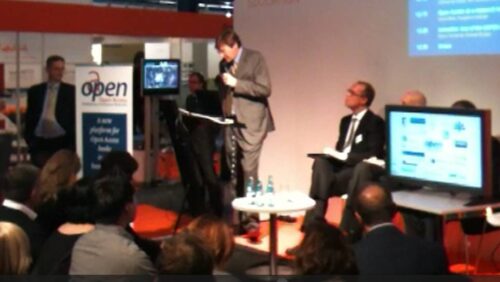
Ronald Snijder standing next to the OAPEN poster at the launch of the OAPEN Library in 2010 at the Frankfurt Book Fair (a rather blurry screen shot, unfortunately, of a recording with my iPhone 3).